INTRODUCTION TO
    POLITICS

CONCEPTIONS OF POLITICS


   GCC Spring 2

  By Joseph Ochieng Okumu: Global Citizens’ College
OUTLINE

DEFINING POLITICS


  1. Politics as the art of government
  2. Politics as public affairs
  3. Politics as compromise and consensus
  4. Politics as power and the distribution of
     resources.

            By Joseph Ochieng Okumu: Global Citizens’ College
DIFFERENT CONCEPTIONS OF POLITICS

Politics As The Art Of Government
• This is a state-centered view of politics.
  - Politics is what governments‖ or states‖ do.
• It means that most people, most institutions
  and most social activities can be regarded as
  being outside politics.
• Businesses, schools and other educational
  institutions, community groups, families and so
  on are in this sense nonpolitical.

            By Joseph Ochieng Okumu: Global Citizens’ College
The Cynic View of Politics

• The implication of this state-centric
  conception of politics is that politics is
  thought of as a negative word.

• It raises up images of trouble, disruption and
  even violence on the one hand, and deceit,
  manipulation and lies on the other.


             By Joseph Ochieng Okumu: Global Citizens’ College
The Cynic View of Politics

“One has to be a lowbrow, a bit of a murderer,
to be a politician, ready and willing to see
people sacrificed, slaughtered, for the sake of an
idea, whether a good one or a bad one”.
- Henry Miller
“The more you read and observe about this
Politics thing, you got to admit that each party is
worse than the other. The one that's out always
looks the best”. - Will Rogers

            By Joseph Ochieng Okumu: Global Citizens’ College
Politics as Public Affairs

• A second and broader conception of politics
  moves beyond the narrow realm of
  government.
• Politics is thought of as public life or public
  affairs.
• The distinction between the political and the
  nonpolitical corresponds with the division
  between an essentially public sphere of life
  and what can be thought of as a private
  sphere.
            By Joseph Ochieng Okumu: Global Citizens’ College
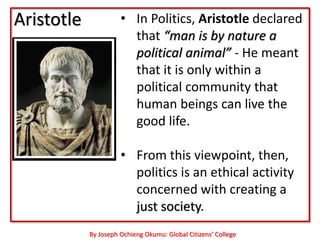
Aristotle             • In Politics, Aristotle declared
                        that “man is by nature a
                        political animal” - He meant
                        that it is only within a
                        political community that
                        human beings can live the
                        good life.

                      • From this viewpoint, then,
                        politics is an ethical activity
                        concerned with creating a
                        just society.‖
            By Joseph Ochieng Okumu: Global Citizens’ College
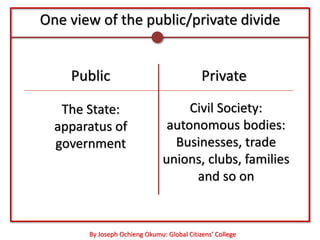
One view of the public/private divide


    Public                                  Private

   The State:                       Civil Society:
  apparatus of                  autonomous bodies:
  government                     Businesses, trade
                               unions, clubs, families
                                     and so on


       By Joseph Ochieng Okumu: Global Citizens’ College
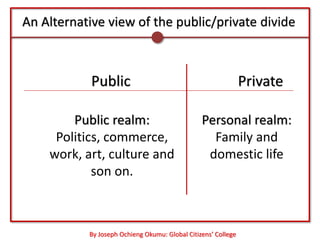
An Alternative view of the public/private divide


            Public                                             Private

        Public realm:                           Personal realm:
     Politics, commerce,                          Family and
    work, art, culture and                       domestic life
            son on.


           By Joseph Ochieng Okumu: Global Citizens’ College
Hannah Arendt
• This conception of politics as something
  positive and public activity was firmly
  endorsed by - Hannah Arendt

• She argued that politics is the most important
  form of human activity because it involves
  interaction amongst free and equal citizens.

• It thus gives meaning to life and affirms the
  uniqueness of each individual.
            By Joseph Ochieng Okumu: Global Citizens’ College
Politics as Compromise and Consensus
• The third conception of politics relates to the
  way in which decisions are made.

• Politics is seen as a particular means of
  resolving conflict: that is, by compromise,
  conciliation and negotiation. –

• Politics becomes the process of “conflict
  resolution.”
• In this view, the key to politics is a wide
  dispersal of power.
             By Joseph Ochieng Okumu: Global Citizens’ College
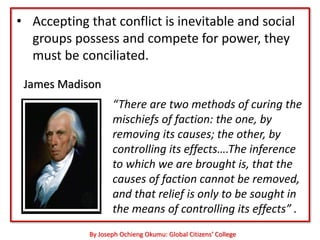
• Accepting that conflict is inevitable and social
  groups possess and compete for power, they
  must be conciliated.
 James Madison
                    “There are two methods of curing the
                    mischiefs of faction: the one, by
                    removing its causes; the other, by
                    controlling its effects….The inference
                    to which we are brought is, that the
                    causes of faction cannot be removed,
                    and that relief is only to be sought in
                    the means of controlling its effects” .
             By Joseph Ochieng Okumu: Global Citizens’ College
Politics as power and the distribution of resources.
Politics as Power
• The fourth definition of politics is both the
   broadest and the most radical.

• Rather than confining politics to a particular
  sphere; - this view sees politics at work in all
  social activities and in every corner of human
  existence.
• In this sense, politics takes place at every level
  of social interaction.
             By Joseph Ochieng Okumu: Global Citizens’ College
• It can be found within families and amongst
  small groups of friends just as much as
  amongst nations and on the global stage.
Distribution of Power and Resources

• At its broadest, politics concerns the
  production, distribution and use of resources
  in the course of social existence.
• At its broadest, politics concerns the
  production, distribution and use of resources
  in the course of social existence.

            By Joseph Ochieng Okumu: Global Citizens’ College
• Politics is, in essence, power: the ability to
  achieve a desired outcome, through whatever
  means.

• From this perspective, politics is about
  diversity and conflict.

• The essential ingredient is the existence of
   scarcity…
• Politics can therefore be seen as a struggle over
  scarce resources, and power can be seen as the
  means through which this struggle is conducted
             By Joseph Ochieng Okumu: Global Citizens’ College
CONCLUSION


 The inescapable presence of diversity and
scarcity ensures that politics is an inevitable
      feature of the human condition.


          By Joseph Ochieng Okumu: Global Citizens’ College
Overview
          of
Political Ideologies

    By Joseph Ochieng Okumu: Global Citizens’ College
OUTLINE
A. Ideologies
   • Liberalism
   • Conservatism
   • Socialism
   • Communism

B. Right-wing and left-wing politics
   • Historical origin of the terms
   • Practice
   • Spectrum

             By Joseph Ochieng Okumu: Global Citizens’ College
What is a political ideology?
• A coherent set of ideas of on how people
  should live together
• A plan of action for applying these ideas

How it is applicable in four key functions;

  •   Explanatory
  •   Evaluative
  •   Orientation
  •   Programmatic

            By Joseph Ochieng Okumu: Global Citizens’ College
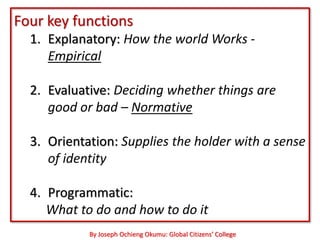
Four key functions
  1. Explanatory: How the world Works -
     Empirical

  2. Evaluative: Deciding whether things are
     good or bad – Normative

  3. Orientation: Supplies the holder with a sense
     of identity

  4. Programmatic:
     What to do and how to do it
            By Joseph Ochieng Okumu: Global Citizens’ College
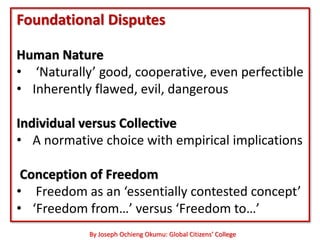
Foundational Disputes

Human Nature
• ‘Naturally’ good, cooperative, even perfectible
• Inherently flawed, evil, dangerous

Individual versus Collective
• A normative choice with empirical implications

 Conception of Freedom
• Freedom as an ‘essentially contested concept’
• ‘Freedom from…’ versus ‘Freedom to…’
            By Joseph Ochieng Okumu: Global Citizens’ College
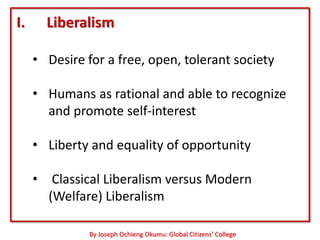
I.     Liberalism

     • Desire for a free, open, tolerant society

     • Humans as rational and able to recognize
       and promote self-interest

     • Liberty and equality of opportunity

     • Classical Liberalism versus Modern
       (Welfare) Liberalism

               By Joseph Ochieng Okumu: Global Citizens’ College
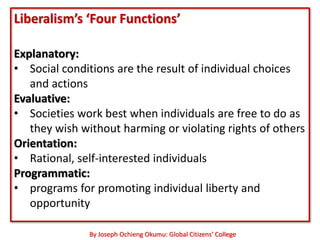
Liberalism’s ‘Four Functions’

Explanatory:
• Social conditions are the result of individual choices
   and actions
Evaluative:
• Societies work best when individuals are free to do as
   they wish without harming or violating rights of others
Orientation:
• Rational, self-interested individuals
Programmatic:
• programs for promoting individual liberty and
   opportunity

               By Joseph Ochieng Okumu: Global Citizens’ College
II. Conservatism
  • Human imperfection

  • Focused on conserving existing social order

  • Custom and tradition as ‘latent wisdom’

  • Organic view of society

  • Acceptance of inequality

  • Freedom and order
            By Joseph Ochieng Okumu: Global Citizens’ College
Conservatism’s ‘Four Functions’

Explanatory:
• Social conditions are the result of human
   imperfections (intellectual and moral)
Evaluative:
• Success is a question of social order and harmony
Orientation:
• Each of us is part of a greater whole, and we should
   act with interest of society (not just self) in mind
Programmatic:
• Slow and cautious change


               By Joseph Ochieng Okumu: Global Citizens’ College
III. Socialism
Flaws of Liberalism
• Individualism and Social Class
• Economics and Political Power

Economic Equality as ‘True Equality’

Economic Planning and the Welfare State


             By Joseph Ochieng Okumu: Global Citizens’ College
Socialism’s ‘Four Functions’
Explanatory:
• Social conditions can only be understood by reference
   to economic and class relations
Evaluative:
• Sharpness of economic divisions (exploitive?)
   determines health of society
Orientation:
• People should think of themselves in terms of their
   economic (class) position
Programmatic:
• Policies must be put into place to advance economic
   equality

              By Joseph Ochieng Okumu: Global Citizens’ College
IV. Communism

Historical Materialism
• Economic (material) foundation of social change
• Class conflict as engine of history
Historical progression
• Primitive Communism Slave-based Empires
• Feudalism Capitalism Communism
Inherent contradictions
• Capitalism, profit and exploitation
• Revolution

            By Joseph Ochieng Okumu: Global Citizens’ College
Communism’s ‘Four Functions’
Explanatory:
• Social conditions determined by economic and class
   relations
Evaluative:
• Sharpness of class divisions determines ‘stage of
   development’
Orientation:
• People should think of themselves in terms of their
   class position
Programmatic:
• Policies must be put into place to advance movement
   toward communist revolution and ‘classless society’

              By Joseph Ochieng Okumu: Global Citizens’ College
Right – Wing vs Left – Wing

                 Politics

              Spectrum


    By Joseph Ochieng Okumu: Global Citizens’ College
Historical origin of the terms
• The terms Right and Left refer to political affiliation
  which originated early in the French Revolutionary era
  of 1789 – 1896
• The seating arrangement in the French parliament –
  18th century
     Socio-political system which existed in most of Europe
     during the 18th century
     Countries were ruled by absolutism – the monarch had
     absolute control over the government
     Classes of people – privileged and unprivileged
     Unprivileged people – paid taxes and treated badly
     Privileged people – did not pay taxes and treated well

                By Joseph Ochieng Okumu: Global Citizens’ College
• The meaning of left-wing and right-wing varies
  considerably between different countries and
  at different times

• Generally, the right wing often values tradition
  while the left wing often values reform and
  classlessness,

• with the center seeking a balance between the
  two such as with social democracy or
  regulated capitalism.

            By Joseph Ochieng Okumu: Global Citizens’ College
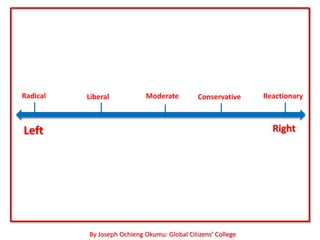
Radical   Liberal           Moderate          Conservative    Reactionary


Left                                                            Right


          By Joseph Ochieng Okumu: Global Citizens’ College
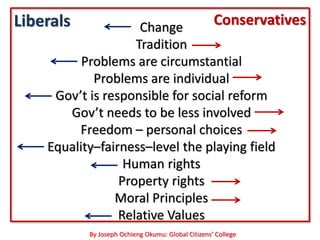
Left of Moderate
Liberal

• Believe that the government should actively
  promote social reform to increase individuals’
  well being.

• Favor change but work peacefully within the
  existing political system. (Democrats, Green
  Party - US)


            By Joseph Ochieng Okumu: Global Citizens’ College
Right Side of Moderate
Conservative

• Government should stay out of the lives of
  citizens and businesses, except on moral
  issues.

• Favor the status quo, (the way things are).
  Hesitant to change.

• Will work peacefully within the existing
  political system.
            By Joseph Ochieng Okumu: Global Citizens’ College
Liberals             Change                         Conservatives
                    Tradition
          Problems are circumstantial
            Problems are individual
     Gov’t is responsible for social reform
       Gov’t needs to be less involved
         Freedom – personal choices
    Equality–fairness–level the playing field
                  Human rights
                 Property rights
                Moral Principles
                 Relative Values
           By Joseph Ochieng Okumu: Global Citizens’ College

Introduction to politics

  • 1.
    INTRODUCTION TO POLITICS CONCEPTIONS OF POLITICS GCC Spring 2 By Joseph Ochieng Okumu: Global Citizens’ College
  • 2.
    OUTLINE DEFINING POLITICS 1. Politics as the art of government 2. Politics as public affairs 3. Politics as compromise and consensus 4. Politics as power and the distribution of resources. By Joseph Ochieng Okumu: Global Citizens’ College
  • 3.
    DIFFERENT CONCEPTIONS OFPOLITICS Politics As The Art Of Government • This is a state-centered view of politics. - Politics is what governments‖ or states‖ do. • It means that most people, most institutions and most social activities can be regarded as being outside politics. • Businesses, schools and other educational institutions, community groups, families and so on are in this sense nonpolitical. By Joseph Ochieng Okumu: Global Citizens’ College
  • 4.
    The Cynic Viewof Politics • The implication of this state-centric conception of politics is that politics is thought of as a negative word. • It raises up images of trouble, disruption and even violence on the one hand, and deceit, manipulation and lies on the other. By Joseph Ochieng Okumu: Global Citizens’ College
  • 5.
    The Cynic Viewof Politics “One has to be a lowbrow, a bit of a murderer, to be a politician, ready and willing to see people sacrificed, slaughtered, for the sake of an idea, whether a good one or a bad one”. - Henry Miller “The more you read and observe about this Politics thing, you got to admit that each party is worse than the other. The one that's out always looks the best”. - Will Rogers By Joseph Ochieng Okumu: Global Citizens’ College
  • 6.
    Politics as PublicAffairs • A second and broader conception of politics moves beyond the narrow realm of government. • Politics is thought of as public life or public affairs. • The distinction between the political and the nonpolitical corresponds with the division between an essentially public sphere of life and what can be thought of as a private sphere. By Joseph Ochieng Okumu: Global Citizens’ College
  • 7.
    Aristotle • In Politics, Aristotle declared that “man is by nature a political animal” - He meant that it is only within a political community that human beings can live the good life. • From this viewpoint, then, politics is an ethical activity concerned with creating a just society.‖ By Joseph Ochieng Okumu: Global Citizens’ College
  • 8.
    One view ofthe public/private divide Public Private The State: Civil Society: apparatus of autonomous bodies: government Businesses, trade unions, clubs, families and so on By Joseph Ochieng Okumu: Global Citizens’ College
  • 9.
    An Alternative viewof the public/private divide Public Private Public realm: Personal realm: Politics, commerce, Family and work, art, culture and domestic life son on. By Joseph Ochieng Okumu: Global Citizens’ College
  • 10.
    Hannah Arendt • Thisconception of politics as something positive and public activity was firmly endorsed by - Hannah Arendt • She argued that politics is the most important form of human activity because it involves interaction amongst free and equal citizens. • It thus gives meaning to life and affirms the uniqueness of each individual. By Joseph Ochieng Okumu: Global Citizens’ College
  • 11.
    Politics as Compromiseand Consensus • The third conception of politics relates to the way in which decisions are made. • Politics is seen as a particular means of resolving conflict: that is, by compromise, conciliation and negotiation. – • Politics becomes the process of “conflict resolution.” • In this view, the key to politics is a wide dispersal of power. By Joseph Ochieng Okumu: Global Citizens’ College
  • 12.
    • Accepting thatconflict is inevitable and social groups possess and compete for power, they must be conciliated. James Madison “There are two methods of curing the mischiefs of faction: the one, by removing its causes; the other, by controlling its effects….The inference to which we are brought is, that the causes of faction cannot be removed, and that relief is only to be sought in the means of controlling its effects” . By Joseph Ochieng Okumu: Global Citizens’ College
  • 13.
    Politics as powerand the distribution of resources. Politics as Power • The fourth definition of politics is both the broadest and the most radical. • Rather than confining politics to a particular sphere; - this view sees politics at work in all social activities and in every corner of human existence. • In this sense, politics takes place at every level of social interaction. By Joseph Ochieng Okumu: Global Citizens’ College
  • 14.
    • It canbe found within families and amongst small groups of friends just as much as amongst nations and on the global stage. Distribution of Power and Resources • At its broadest, politics concerns the production, distribution and use of resources in the course of social existence. • At its broadest, politics concerns the production, distribution and use of resources in the course of social existence. By Joseph Ochieng Okumu: Global Citizens’ College
  • 15.
    • Politics is,in essence, power: the ability to achieve a desired outcome, through whatever means. • From this perspective, politics is about diversity and conflict. • The essential ingredient is the existence of scarcity… • Politics can therefore be seen as a struggle over scarce resources, and power can be seen as the means through which this struggle is conducted By Joseph Ochieng Okumu: Global Citizens’ College
  • 16.
    CONCLUSION The inescapablepresence of diversity and scarcity ensures that politics is an inevitable feature of the human condition. By Joseph Ochieng Okumu: Global Citizens’ College
  • 17.
    Overview of Political Ideologies By Joseph Ochieng Okumu: Global Citizens’ College
  • 18.
    OUTLINE A. Ideologies • Liberalism • Conservatism • Socialism • Communism B. Right-wing and left-wing politics • Historical origin of the terms • Practice • Spectrum By Joseph Ochieng Okumu: Global Citizens’ College
  • 19.
    What is apolitical ideology? • A coherent set of ideas of on how people should live together • A plan of action for applying these ideas How it is applicable in four key functions; • Explanatory • Evaluative • Orientation • Programmatic By Joseph Ochieng Okumu: Global Citizens’ College
  • 20.
    Four key functions 1. Explanatory: How the world Works - Empirical 2. Evaluative: Deciding whether things are good or bad – Normative 3. Orientation: Supplies the holder with a sense of identity 4. Programmatic: What to do and how to do it By Joseph Ochieng Okumu: Global Citizens’ College
  • 21.
    Foundational Disputes Human Nature •‘Naturally’ good, cooperative, even perfectible • Inherently flawed, evil, dangerous Individual versus Collective • A normative choice with empirical implications Conception of Freedom • Freedom as an ‘essentially contested concept’ • ‘Freedom from…’ versus ‘Freedom to…’ By Joseph Ochieng Okumu: Global Citizens’ College
  • 22.
    I. Liberalism • Desire for a free, open, tolerant society • Humans as rational and able to recognize and promote self-interest • Liberty and equality of opportunity • Classical Liberalism versus Modern (Welfare) Liberalism By Joseph Ochieng Okumu: Global Citizens’ College
  • 23.
    Liberalism’s ‘Four Functions’ Explanatory: •Social conditions are the result of individual choices and actions Evaluative: • Societies work best when individuals are free to do as they wish without harming or violating rights of others Orientation: • Rational, self-interested individuals Programmatic: • programs for promoting individual liberty and opportunity By Joseph Ochieng Okumu: Global Citizens’ College
  • 24.
    II. Conservatism • Human imperfection • Focused on conserving existing social order • Custom and tradition as ‘latent wisdom’ • Organic view of society • Acceptance of inequality • Freedom and order By Joseph Ochieng Okumu: Global Citizens’ College
  • 25.
    Conservatism’s ‘Four Functions’ Explanatory: •Social conditions are the result of human imperfections (intellectual and moral) Evaluative: • Success is a question of social order and harmony Orientation: • Each of us is part of a greater whole, and we should act with interest of society (not just self) in mind Programmatic: • Slow and cautious change By Joseph Ochieng Okumu: Global Citizens’ College
  • 26.
    III. Socialism Flaws ofLiberalism • Individualism and Social Class • Economics and Political Power Economic Equality as ‘True Equality’ Economic Planning and the Welfare State By Joseph Ochieng Okumu: Global Citizens’ College
  • 27.
    Socialism’s ‘Four Functions’ Explanatory: •Social conditions can only be understood by reference to economic and class relations Evaluative: • Sharpness of economic divisions (exploitive?) determines health of society Orientation: • People should think of themselves in terms of their economic (class) position Programmatic: • Policies must be put into place to advance economic equality By Joseph Ochieng Okumu: Global Citizens’ College
  • 28.
    IV. Communism Historical Materialism •Economic (material) foundation of social change • Class conflict as engine of history Historical progression • Primitive Communism Slave-based Empires • Feudalism Capitalism Communism Inherent contradictions • Capitalism, profit and exploitation • Revolution By Joseph Ochieng Okumu: Global Citizens’ College
  • 29.
    Communism’s ‘Four Functions’ Explanatory: •Social conditions determined by economic and class relations Evaluative: • Sharpness of class divisions determines ‘stage of development’ Orientation: • People should think of themselves in terms of their class position Programmatic: • Policies must be put into place to advance movement toward communist revolution and ‘classless society’ By Joseph Ochieng Okumu: Global Citizens’ College
  • 30.
    Right – Wingvs Left – Wing Politics Spectrum By Joseph Ochieng Okumu: Global Citizens’ College
  • 31.
    Historical origin ofthe terms • The terms Right and Left refer to political affiliation which originated early in the French Revolutionary era of 1789 – 1896 • The seating arrangement in the French parliament – 18th century Socio-political system which existed in most of Europe during the 18th century Countries were ruled by absolutism – the monarch had absolute control over the government Classes of people – privileged and unprivileged Unprivileged people – paid taxes and treated badly Privileged people – did not pay taxes and treated well By Joseph Ochieng Okumu: Global Citizens’ College
  • 32.
    • The meaningof left-wing and right-wing varies considerably between different countries and at different times • Generally, the right wing often values tradition while the left wing often values reform and classlessness, • with the center seeking a balance between the two such as with social democracy or regulated capitalism. By Joseph Ochieng Okumu: Global Citizens’ College
  • 33.
    Radical Liberal Moderate Conservative Reactionary Left Right By Joseph Ochieng Okumu: Global Citizens’ College
  • 34.
    Left of Moderate Liberal •Believe that the government should actively promote social reform to increase individuals’ well being. • Favor change but work peacefully within the existing political system. (Democrats, Green Party - US) By Joseph Ochieng Okumu: Global Citizens’ College
  • 35.
    Right Side ofModerate Conservative • Government should stay out of the lives of citizens and businesses, except on moral issues. • Favor the status quo, (the way things are). Hesitant to change. • Will work peacefully within the existing political system. By Joseph Ochieng Okumu: Global Citizens’ College
  • 36.
    Liberals Change Conservatives Tradition Problems are circumstantial Problems are individual Gov’t is responsible for social reform Gov’t needs to be less involved Freedom – personal choices Equality–fairness–level the playing field Human rights Property rights Moral Principles Relative Values By Joseph Ochieng Okumu: Global Citizens’ College