


Silvia Andena Castañeda
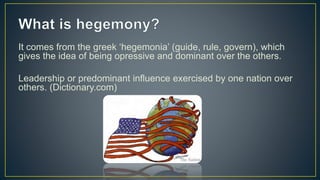
It comes from the greek ‘hegemonia’ (guide, rule, govern), which
gives the idea of being opressive and dominant over the others.
Leadership or predominant influence exercised by one nation over
others. (Dictionary.com)
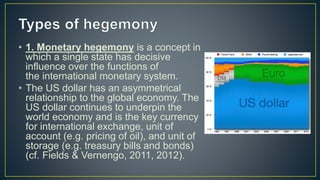
• 1. Monetary hegemony is a concept in
which a single state has decisive
influence over the functions of
the international monetary system.
• The US dollar has an asymmetrical
relationship to the global economy. The
US dollar continues to underpin the
world economy and is the key currency
for international exchange, unit of
account (e.g. pricing of oil), and unit of
storage (e.g. treasury bills and bonds)
(cf. Fields & Vernengo, 2011, 2012).
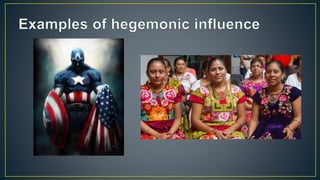
2. Cultural hegemony describes
the domination by the ruling class, who
manipulate the culture of society-
beliefs, perceptions, values, etc.- so that
their worldview becomes the worldview
that is imposed and accepted as the
cultural norm; the universally
valid dominant ideology.
It justifies the social, political, and
economic situation as natural, inevitable,
perpetual and beneficial for everyone,
rather than as artificial social
constructs that benefit only the ruling
• After cultural hegemony has been
established, a period called
posthegemony starts to develop. The
role of hegemony was to convince, while
posthegemony strives to control and
maintain the dominating ideology.
• People who live in a posthegemonic
period have absorbed the dominant
ideology and integrated it into their
behavioral, emotional and cognitive
identity.
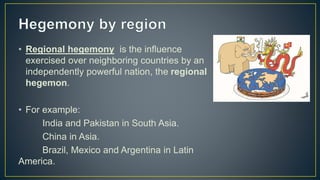
• Regional hegemony is the influence
exercised over neighboring countries by an
independently powerful nation, the regional
hegemon.
• For example:
India and Pakistan in South Asia.
China in Asia.
Brazil, Mexico and Argentina in Latin
America.
You are going to make a Power Point presentation about the
following in teams of 3-4. Look for an example of cultural
hegemony and answer the following:
• What was the hegemonic action?
• When did it occur? Is it still happening?
• What characters are/were involved?
• How did this affect the dominated party?
https://youtu.be/jbkSRLYSojo
Hegemony

Hegemony

  • 1.
  • 2.
    It comes fromthe greek ‘hegemonia’ (guide, rule, govern), which gives the idea of being opressive and dominant over the others. Leadership or predominant influence exercised by one nation over others. (Dictionary.com)
  • 3.
    • 1. Monetaryhegemony is a concept in which a single state has decisive influence over the functions of the international monetary system. • The US dollar has an asymmetrical relationship to the global economy. The US dollar continues to underpin the world economy and is the key currency for international exchange, unit of account (e.g. pricing of oil), and unit of storage (e.g. treasury bills and bonds) (cf. Fields & Vernengo, 2011, 2012).
  • 4.
    2. Cultural hegemonydescribes the domination by the ruling class, who manipulate the culture of society- beliefs, perceptions, values, etc.- so that their worldview becomes the worldview that is imposed and accepted as the cultural norm; the universally valid dominant ideology. It justifies the social, political, and economic situation as natural, inevitable, perpetual and beneficial for everyone, rather than as artificial social constructs that benefit only the ruling
  • 5.
    • After culturalhegemony has been established, a period called posthegemony starts to develop. The role of hegemony was to convince, while posthegemony strives to control and maintain the dominating ideology. • People who live in a posthegemonic period have absorbed the dominant ideology and integrated it into their behavioral, emotional and cognitive identity.
  • 6.
    • Regional hegemonyis the influence exercised over neighboring countries by an independently powerful nation, the regional hegemon. • For example: India and Pakistan in South Asia. China in Asia. Brazil, Mexico and Argentina in Latin America.
  • 8.
    You are goingto make a Power Point presentation about the following in teams of 3-4. Look for an example of cultural hegemony and answer the following: • What was the hegemonic action? • When did it occur? Is it still happening? • What characters are/were involved? • How did this affect the dominated party?
  • 9.