Structural-Functionalists see education
as contributing to the smooth
functioning of society. Educational
systems train the most qualified
individuals for the most socially
important positions. Education teaches
people not only the skills and thinking
skills to maximize their potential, but
also teaches them to be good citizens
and get along with others. They would
NOT see education as contributing to
inequality (along class, race, gender,
etc. lines) but rather as serving the
positive function of the overall society.
Parsons’ Structural
Functionalism:
• 1. A- adaptation
• 2. G- goal attainment
• 3. I- integration
• 4. L- latency
Adaptation:
– A system must cope with external
situational exigencies. It must adapt to its
environment and adapt environment to its
needs.
e.g. #1 New Corella as an Agricultural
Municipality sticks on planting Agricultural
Products.
e.g. #2 Rice fields converting to banana
plantation because of its demand.
Goal Attainment
- A system must define and achieve
its primary goals.
Integration
- A system must regulate the
interrelationship of its component parts.
Latency (pattern
maintenance)
– A system must furnish, maintain, and renew
both the motivation of individuals and the
cultural patterns that create and sustain
the motivation.
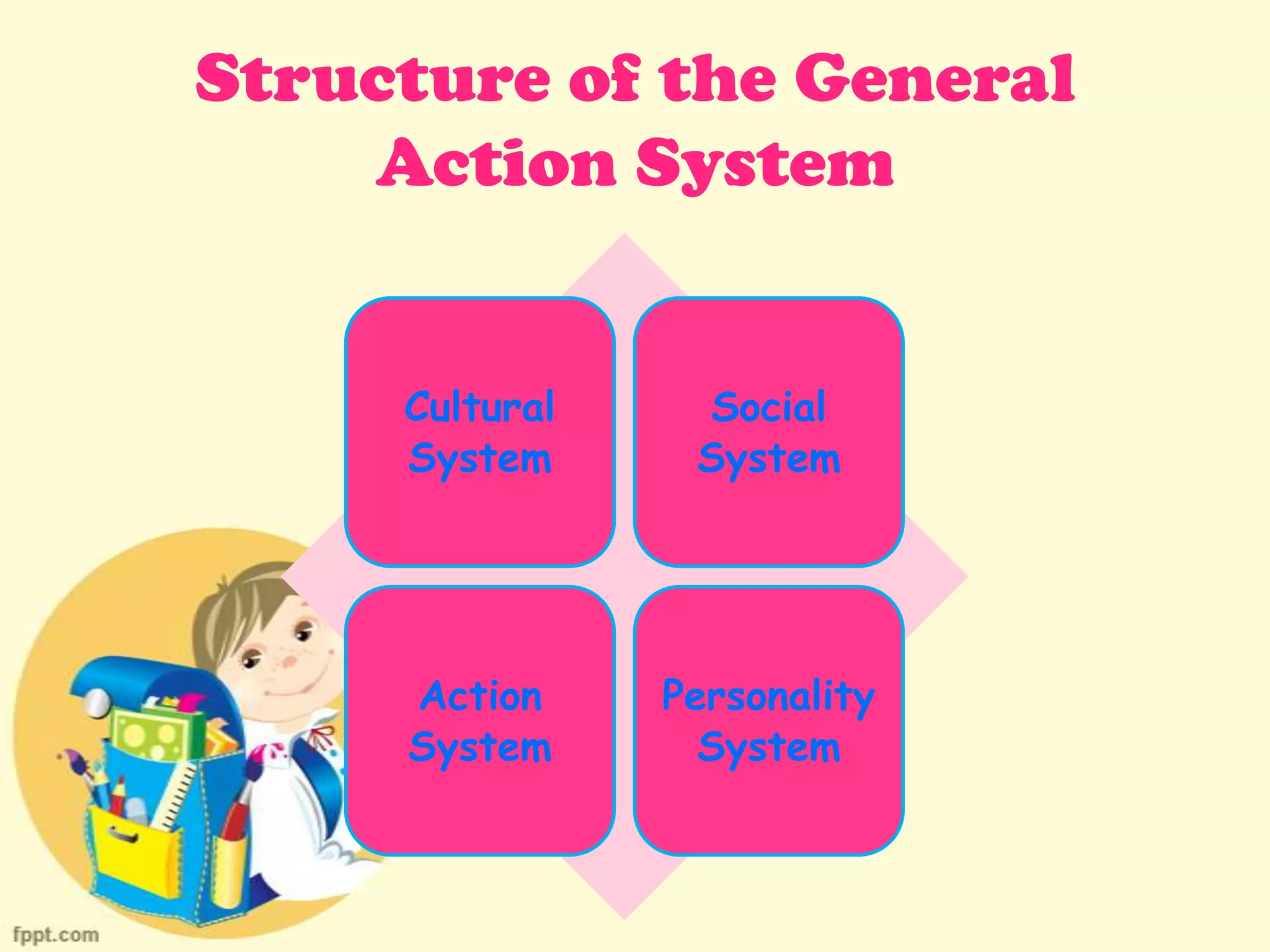
Structure of the General
Action System
Cultural
System
Social
System
Action
System
Personality
System
Action System
• Handles adaptation function by
adjusting to and transforming the
external world
Social System
• Copes with the integration by
controlling its component parts
Personality System
• Performs the goal attainment function
by defining system goals and mobilizing
resources to attain them.
Cultural System
• Performs the latency function by
providing actors with the norms and
values that motivate them for action.
Functional
Requisites of a
Social System
Talcott Parsons
1. Social system must be structured
so that they operate compatibility
with other systems.
2. To survive, the social system must
have the requisite from other
systems
3. The system must meet a
significant proportion of the
needs of its actor.
4. The system must elicit adequate
participation from its members.
5. It must have at least a minimum
of control over potentially
disruptive behavior.
6. If conflict becomes sufficiently
disruptive, it must be controlled.
7. Finally, a social system
requires a language in order
to survive.
KEY PRINCIPLES OF THE
FUNCTIONALIST
PERSPECTIVE
1. Interdependency
• Society is made up of interdependent
parts
• Every part of society is dependent to
some extent on other parts of society
2. Functions of social
structure and culture
• Each part of the social system exists
because it serves some function
Social structure – organization of
society, including institutions, social
positions & distribution of resources
Culture – set of
beliefs, language, rules, values &
knowledge held in common by members of
society
3. Consensus and
Cooperation
• Societies have a tendency towards
consensus, that is to have certain basic
values that nearly everyone in the
society agrees upon
Cooperation – inability to cooperate will
paralyze the society & people will devote
more and more effort to fighting one
another rather than getting anything
done.
4. Equilibrium
• The characteristic of the society when
it has achieved the form that is best
adapted to its situation.
• Once a society has achieved the form
that is best adapted to its situation, it
has reached a state of balance or
equilibrium, and it will remain in that
condition until it is forced to change by
some new condition.
Structural Functionalism

Structural Functionalism

  • 2.
    Structural-Functionalists see education ascontributing to the smooth functioning of society. Educational systems train the most qualified individuals for the most socially important positions. Education teaches people not only the skills and thinking skills to maximize their potential, but also teaches them to be good citizens and get along with others. They would NOT see education as contributing to inequality (along class, race, gender, etc. lines) but rather as serving the positive function of the overall society.
  • 3.
    Parsons’ Structural Functionalism: • 1.A- adaptation • 2. G- goal attainment • 3. I- integration • 4. L- latency
  • 4.
    Adaptation: – A systemmust cope with external situational exigencies. It must adapt to its environment and adapt environment to its needs. e.g. #1 New Corella as an Agricultural Municipality sticks on planting Agricultural Products. e.g. #2 Rice fields converting to banana plantation because of its demand.
  • 5.
    Goal Attainment - Asystem must define and achieve its primary goals.
  • 6.
    Integration - A systemmust regulate the interrelationship of its component parts.
  • 7.
    Latency (pattern maintenance) – Asystem must furnish, maintain, and renew both the motivation of individuals and the cultural patterns that create and sustain the motivation.
  • 8.
    Structure of theGeneral Action System Cultural System Social System Action System Personality System
  • 9.
    Action System • Handlesadaptation function by adjusting to and transforming the external world
  • 10.
    Social System • Copeswith the integration by controlling its component parts
  • 11.
    Personality System • Performsthe goal attainment function by defining system goals and mobilizing resources to attain them.
  • 12.
    Cultural System • Performsthe latency function by providing actors with the norms and values that motivate them for action.
  • 13.
    Functional Requisites of a SocialSystem Talcott Parsons
  • 14.
    1. Social systemmust be structured so that they operate compatibility with other systems. 2. To survive, the social system must have the requisite from other systems 3. The system must meet a significant proportion of the needs of its actor.
  • 15.
    4. The systemmust elicit adequate participation from its members. 5. It must have at least a minimum of control over potentially disruptive behavior. 6. If conflict becomes sufficiently disruptive, it must be controlled.
  • 16.
    7. Finally, asocial system requires a language in order to survive.
  • 17.
    KEY PRINCIPLES OFTHE FUNCTIONALIST PERSPECTIVE
  • 18.
    1. Interdependency • Societyis made up of interdependent parts • Every part of society is dependent to some extent on other parts of society
  • 19.
    2. Functions ofsocial structure and culture • Each part of the social system exists because it serves some function Social structure – organization of society, including institutions, social positions & distribution of resources Culture – set of beliefs, language, rules, values & knowledge held in common by members of society
  • 20.
    3. Consensus and Cooperation •Societies have a tendency towards consensus, that is to have certain basic values that nearly everyone in the society agrees upon Cooperation – inability to cooperate will paralyze the society & people will devote more and more effort to fighting one another rather than getting anything done.
  • 21.
    4. Equilibrium • Thecharacteristic of the society when it has achieved the form that is best adapted to its situation. • Once a society has achieved the form that is best adapted to its situation, it has reached a state of balance or equilibrium, and it will remain in that condition until it is forced to change by some new condition.