
Presented by,
Shukun karthika. G,
Periyar Maniammai University,
Tanjore.
LEARNING
LEARNING
๏‚— The process of learning has great value for
enriching the human life in all shape.
๏‚— Learning definitely affects the human behavior in
organization.
๏‚— Example:
A workerโ€™s skill, a managers attitude, a
supervisorโ€™s motivation and a secretary's mode of
dress are all learning.
DETERMINANTS OF
LEARNING
๏‚— Motive:
๏ƒผDrives promote people to action.
๏ƒผPrimary energisers of behaviour.
๏‚— Stimuli:
๏‚— Object existing in the environment in which a
person lives.
๏ƒผ Generalisation,
๏ƒผ Discrimination,
๏ƒผ Responses,
๏ƒผ Reinforcement,
๏ƒผ Retention.
Stimuli
๏‚žGeneralisation:
๏ƒ˜ Two stimuli which are exactly alike.
๏‚žDiscrimination:
๏ƒ˜ There should be no discrimination among the working
place.
๏ƒ˜ Mainly should not show attitude or manner towards workers.
๏‚žResponses:
๏ƒ˜ Preferable physical observation.
๏ƒ˜ That is physical form, perception, attitude or situation.
๏‚žRetention:
๏ƒ˜ Remembrance of learning behaviour one time.
๏ƒ˜ And which is forgotten over time is called extinction.
THEORY OF LEARNING
๏‚— Classical conditioning,
๏‚— Operant Learning,
๏‚— Cognitive Theory,
๏‚— Social Learning Theory.
Classical conditioning
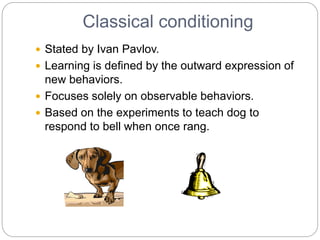
๏‚— Stated by Ivan Pavlov.
๏‚— Learning is defined by the outward expression of
new behaviors.
๏‚— Focuses solely on observable behaviors.
๏‚— Based on the experiments to teach dog to
respond to bell when once rang.
Cont.
๏‚— Therefore it is a logical oriented example.
๏‚— But these had limitations.
๏‚— Human beings are more complex than dogs but less
amenable to simple cause and effect conditionings.
๏‚— Behavioural environment is complex.
๏‚— Humanโ€™s decision making is always complex.
Operant Learning
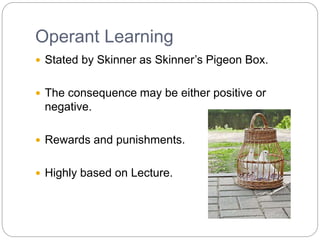
๏‚— Stated by Skinner as Skinnerโ€™s Pigeon Box.
๏‚— The consequence may be either positive or
negative.
๏‚— Rewards and punishments.
๏‚— Highly based on Lecture.
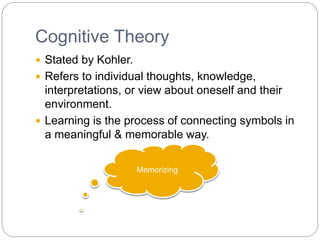
Cognitive Theory
๏‚— Stated by Kohler.
๏‚— Refers to individual thoughts, knowledge,
interpretations, or view about oneself and their
environment.
๏‚— Learning is the process of connecting symbols in
a meaningful & memorable way.
Memorizing
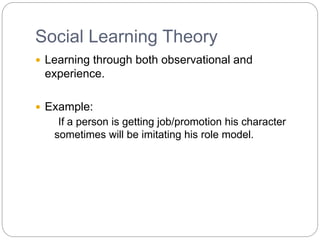
Social Learning Theory
๏‚— Learning through both observational and
experience.
๏‚— Example:
If a person is getting job/promotion his character
sometimes will be imitating his role model.
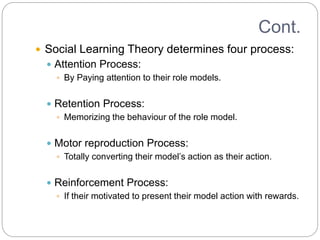
Cont.
๏‚— Social Learning Theory determines four process:
๏‚— Attention Process:
๏‚— By Paying attention to their role models.
๏‚— Retention Process:
๏‚— Memorizing the behaviour of the role model.
๏‚— Motor reproduction Process:
๏‚— Totally converting their modelโ€™s action as their action.
๏‚— Reinforcement Process:
๏‚— If their motivated to present their model action with rewards.
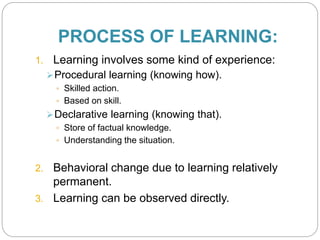
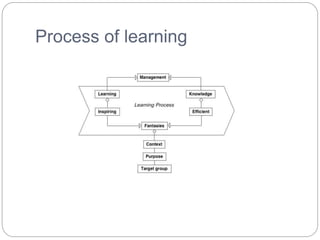
PROCESS OF LEARNING:
1. Learning involves some kind of experience:
๏ƒ˜Procedural learning (knowing how).
๏‚ง Skilled action.
๏‚ง Based on skill.
๏ƒ˜Declarative learning (knowing that).
๏‚ง Store of factual knowledge.
๏‚ง Understanding the situation.
2. Behavioral change due to learning relatively
permanent.
3. Learning can be observed directly.
Process of learning
THANK
YOU

Learning by Shukun Karthika

  • 1.
    Presented by, Shukun karthika.G, Periyar Maniammai University, Tanjore. LEARNING
  • 2.
    LEARNING ๏‚— The processof learning has great value for enriching the human life in all shape. ๏‚— Learning definitely affects the human behavior in organization. ๏‚— Example: A workerโ€™s skill, a managers attitude, a supervisorโ€™s motivation and a secretary's mode of dress are all learning.
  • 3.
    DETERMINANTS OF LEARNING ๏‚— Motive: ๏ƒผDrivespromote people to action. ๏ƒผPrimary energisers of behaviour. ๏‚— Stimuli: ๏‚— Object existing in the environment in which a person lives. ๏ƒผ Generalisation, ๏ƒผ Discrimination, ๏ƒผ Responses, ๏ƒผ Reinforcement, ๏ƒผ Retention.
  • 4.
    Stimuli ๏‚žGeneralisation: ๏ƒ˜ Two stimuliwhich are exactly alike. ๏‚žDiscrimination: ๏ƒ˜ There should be no discrimination among the working place. ๏ƒ˜ Mainly should not show attitude or manner towards workers. ๏‚žResponses: ๏ƒ˜ Preferable physical observation. ๏ƒ˜ That is physical form, perception, attitude or situation. ๏‚žRetention: ๏ƒ˜ Remembrance of learning behaviour one time. ๏ƒ˜ And which is forgotten over time is called extinction.
  • 5.
    THEORY OF LEARNING ๏‚—Classical conditioning, ๏‚— Operant Learning, ๏‚— Cognitive Theory, ๏‚— Social Learning Theory.
  • 6.
    Classical conditioning ๏‚— Statedby Ivan Pavlov. ๏‚— Learning is defined by the outward expression of new behaviors. ๏‚— Focuses solely on observable behaviors. ๏‚— Based on the experiments to teach dog to respond to bell when once rang.
  • 7.
    Cont. ๏‚— Therefore itis a logical oriented example. ๏‚— But these had limitations. ๏‚— Human beings are more complex than dogs but less amenable to simple cause and effect conditionings. ๏‚— Behavioural environment is complex. ๏‚— Humanโ€™s decision making is always complex.
  • 8.
    Operant Learning ๏‚— Statedby Skinner as Skinnerโ€™s Pigeon Box. ๏‚— The consequence may be either positive or negative. ๏‚— Rewards and punishments. ๏‚— Highly based on Lecture.
  • 9.
    Cognitive Theory ๏‚— Statedby Kohler. ๏‚— Refers to individual thoughts, knowledge, interpretations, or view about oneself and their environment. ๏‚— Learning is the process of connecting symbols in a meaningful & memorable way. Memorizing
  • 10.
    Social Learning Theory ๏‚—Learning through both observational and experience. ๏‚— Example: If a person is getting job/promotion his character sometimes will be imitating his role model.
  • 11.
    Cont. ๏‚— Social LearningTheory determines four process: ๏‚— Attention Process: ๏‚— By Paying attention to their role models. ๏‚— Retention Process: ๏‚— Memorizing the behaviour of the role model. ๏‚— Motor reproduction Process: ๏‚— Totally converting their modelโ€™s action as their action. ๏‚— Reinforcement Process: ๏‚— If their motivated to present their model action with rewards.
  • 12.
    PROCESS OF LEARNING: 1.Learning involves some kind of experience: ๏ƒ˜Procedural learning (knowing how). ๏‚ง Skilled action. ๏‚ง Based on skill. ๏ƒ˜Declarative learning (knowing that). ๏‚ง Store of factual knowledge. ๏‚ง Understanding the situation. 2. Behavioral change due to learning relatively permanent. 3. Learning can be observed directly.
  • 13.
  • 14.