Welcome to
My
Presentation
LEARNING
Organisation
Behavior
Content :-
Meaning of Learning
Nature of Learning
Factors affecting learning
Theories of Learning
Meaning
Learning can be defined as the
permanent changes in
behavior due to direct and
indirect experience.
Nature of Learning
ⱺIt involves changes
ⱺIt may or may not guarantee
improvement
ⱺIt should be permanent in nature
ⱺIt is lifelong
ⱺIt is reflected through behavior
Factors affecting Learning
Learning is based upon some key factors that decide
what changes will be caused by this experience. The key
elements or major factors that affect learning are :-
Motivation – The encouragement, the support one gets
to complete a task, to achieve a goal is known as
motivation. It is very important aspect of learning as its
acts gives us a positive energy to complete a task.
For e.g. :- The coach motivated the players to win the
match.
Continue…..
 Practice – We all know that “Practice makes us perfect”.
In order to be perfectionist or at least complete the task,
it is very important to practice what we have learnt.
For e.g. :- We can be programmer only when we execute
the codes we have written.
 Environment – We learn from our surrounding, we
learn from the people around us. They are two types of
environment – internal and external.
Continue……
For e.g. :- A child when at home learns from the family
which is an internal environment, but when sent to
school, it is an external environment.
Mental Group – It describes our thinking by the
group of people we chose to hang out with. In simple
words, we make a group of those people with whom we
connect. It can be for a social cause where people with
the same direction.
For e.g. :- A group of readers, travelers etc.
Continue….
• These are the main factors that influence
what a person learns, these are the root level
factors for our behavior and everything we
do is connected to what we learnt.
How Learning Occurs ?How Learning Occurs ?
• Learning can be understood clearly with the help of
some theories that will explain our behavior.
• Some of the theories are :-
a. Classical Conditioning Theory
b.Operant Conditioning Theory
c. Social Learning Theory
d.Cognitive Learning Theory
A. Classical Conditioning
Theory
• The classical conditioning theory occurs when a
conditioned stimulus with an unconditioned stimulus.
• Usually, the conditioned stimulus (CS) is an impartial
stimulus like the sound of a tuning fork, the
unconditioned stimulus (US) is biologically effective like
the taste of food.
• The unconditioned response (UR) to the unconditioned
stimulus (US) is an unlearned reflex response like
salivation.
Continue……
• After this coupling process is repeated (for e.g., some
learning may already occur after a single coupling), an
individual shows a conditioned response (CR) to the
conditioned stimulus, is presented alone.
• The conditioned response is mostly similar to the
unconditioned response, but unlike the unconditioned
response, it must be acquired through experience and
is nearly impermanent.
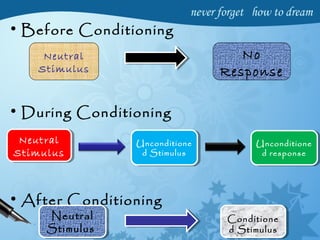
• Before Conditioning
• During Conditioning
• After Conditioning
Neutral
Stimulus
No
Response
Neutral
Stimulus
Neutral
Stimulus
Unconditione
d Stimulus
Unconditione
d Stimulus
Unconditione
d response
Unconditione
d response
Neutral
Stimulus
Neutral
Stimulus
Conditione
d Stimulus
Conditione
d Stimulus
B. Operant Conditioning
Theory
• This theory also known as instrumental conditioning.
• This theory is a learning process in which behavior is
sensitive to or controlled by its outcomes.
• Let’s take an example of child. A child may learn to
open a box to get the candy inside, or learn to avoid
touching a hot stove.
• In comparison, the classical conditioning develops a
relationship between a stimulus and a behavior.
Continue….
• The example can be elaborated as the child may
learn to salivate at the sight of candy, or to
tremble at the sight of an angry parents.
C. Social Learning Theory
• Social learning approach is a behavioral approach.
• The approach basically deals with learning process based
on direct observation and experience. It is achieved while
interacting with individuals.
• In social learning people observe, alter and even construct
a particular environment to fit in the social behavioral
pattern.
• Individuals learn a great deal and they copy their behavior
and display the same.
Continue…
For e.g. :- Children copy the behavior of their
parents, adults and copy cinema actor/actress in
various styles.
•Social learning in organisation by observing
various cultural and social practices.
D. Cognitive Learning
Theory
• Cognition defines a person’s ideas, thoughts, knowledge,
interpretation, understanding about himself and environment.
• This theory considers learning as the outcome of deliberate
thinking on a problem or situation based upon known facts and
responding in an objective and more oriented manner.
• It perceives that a person learns the meaning of various objects
and events and also learns the response depending upon the
meaning assigned to the stimuli.
• E.g. :- Employee skill, manager’s attitude are all learned.
Presented by :-
Yamini
Kahaliya
BBA
(Honors)

Learning (Organisation Behavior)

  • 1.
  • 2.
  • 3.
    Content :- Meaning ofLearning Nature of Learning Factors affecting learning Theories of Learning
  • 4.
    Meaning Learning can bedefined as the permanent changes in behavior due to direct and indirect experience.
  • 5.
    Nature of Learning ⱺItinvolves changes ⱺIt may or may not guarantee improvement ⱺIt should be permanent in nature ⱺIt is lifelong ⱺIt is reflected through behavior
  • 6.
    Factors affecting Learning Learningis based upon some key factors that decide what changes will be caused by this experience. The key elements or major factors that affect learning are :- Motivation – The encouragement, the support one gets to complete a task, to achieve a goal is known as motivation. It is very important aspect of learning as its acts gives us a positive energy to complete a task. For e.g. :- The coach motivated the players to win the match.
  • 7.
    Continue…..  Practice –We all know that “Practice makes us perfect”. In order to be perfectionist or at least complete the task, it is very important to practice what we have learnt. For e.g. :- We can be programmer only when we execute the codes we have written.  Environment – We learn from our surrounding, we learn from the people around us. They are two types of environment – internal and external.
  • 8.
    Continue…… For e.g. :-A child when at home learns from the family which is an internal environment, but when sent to school, it is an external environment. Mental Group – It describes our thinking by the group of people we chose to hang out with. In simple words, we make a group of those people with whom we connect. It can be for a social cause where people with the same direction. For e.g. :- A group of readers, travelers etc.
  • 9.
    Continue…. • These arethe main factors that influence what a person learns, these are the root level factors for our behavior and everything we do is connected to what we learnt.
  • 10.
    How Learning Occurs?How Learning Occurs ? • Learning can be understood clearly with the help of some theories that will explain our behavior. • Some of the theories are :- a. Classical Conditioning Theory b.Operant Conditioning Theory c. Social Learning Theory d.Cognitive Learning Theory
  • 11.
    A. Classical Conditioning Theory •The classical conditioning theory occurs when a conditioned stimulus with an unconditioned stimulus. • Usually, the conditioned stimulus (CS) is an impartial stimulus like the sound of a tuning fork, the unconditioned stimulus (US) is biologically effective like the taste of food. • The unconditioned response (UR) to the unconditioned stimulus (US) is an unlearned reflex response like salivation.
  • 12.
    Continue…… • After thiscoupling process is repeated (for e.g., some learning may already occur after a single coupling), an individual shows a conditioned response (CR) to the conditioned stimulus, is presented alone. • The conditioned response is mostly similar to the unconditioned response, but unlike the unconditioned response, it must be acquired through experience and is nearly impermanent.
  • 13.
    • Before Conditioning •During Conditioning • After Conditioning Neutral Stimulus No Response Neutral Stimulus Neutral Stimulus Unconditione d Stimulus Unconditione d Stimulus Unconditione d response Unconditione d response Neutral Stimulus Neutral Stimulus Conditione d Stimulus Conditione d Stimulus
  • 14.
    B. Operant Conditioning Theory •This theory also known as instrumental conditioning. • This theory is a learning process in which behavior is sensitive to or controlled by its outcomes. • Let’s take an example of child. A child may learn to open a box to get the candy inside, or learn to avoid touching a hot stove. • In comparison, the classical conditioning develops a relationship between a stimulus and a behavior.
  • 15.
    Continue…. • The examplecan be elaborated as the child may learn to salivate at the sight of candy, or to tremble at the sight of an angry parents.
  • 16.
    C. Social LearningTheory • Social learning approach is a behavioral approach. • The approach basically deals with learning process based on direct observation and experience. It is achieved while interacting with individuals. • In social learning people observe, alter and even construct a particular environment to fit in the social behavioral pattern. • Individuals learn a great deal and they copy their behavior and display the same.
  • 17.
    Continue… For e.g. :-Children copy the behavior of their parents, adults and copy cinema actor/actress in various styles. •Social learning in organisation by observing various cultural and social practices.
  • 18.
    D. Cognitive Learning Theory •Cognition defines a person’s ideas, thoughts, knowledge, interpretation, understanding about himself and environment. • This theory considers learning as the outcome of deliberate thinking on a problem or situation based upon known facts and responding in an objective and more oriented manner. • It perceives that a person learns the meaning of various objects and events and also learns the response depending upon the meaning assigned to the stimuli. • E.g. :- Employee skill, manager’s attitude are all learned.
  • 20.