Group 2
Hendro Ariyanto 110810251003
Irsyad Abdul Ghani 110810251004
Eka Ardha Nareswari 110810251013
THE DIFFERENCE BETWEEN THE
ECONOMIC SYSTEM
AND
THE ECONOMIC SYSTEM OF ISLAM
DEFINITION OF ISLAMIC
ECONOMICS
Islamic economic system is an economic
system based on the teachings and values ​​of
Islam , derived from the Quran , the Sunnah
, ijma and qiyas .
THE HISTORY OF ISLAMIC
ECONOMICS
The collapse of the capitalist economic
system is the reason the incidence of new
thinking about the economic system of
islam/Sharia especially among muslim countries
or countries that the majority of the inhabitants
are Muslim.
CHARACTERISTIC OF ISLAMIC
ECONOMICS
a. Treasure belongs to God and Man is the
Caliph of property .
b. Tied with economic theology , Sharia ( Law )
, and Moral
c. Balance between spirituality and materialism
d. Islamic economic interests Creatingbalance
Between Individuals with common interests.
CHARACTERISTIC OF ISLAMIC
ECONOMICS
e. Individual liberty is guaranteed in Islam
f. State is authorized to intervene in the economy
g. Consumption guidance
h. Investment instructions
i. Alms
j. Prohibition of riba
THE PURPOSE OF ISLAMIC
ECONOMICS
• Giving birth of Islam in the areas of economic
life .
• Making wealth with which we have are able to
practice as zakat .
• Provide the solemn to the community .
• To be self-sufficient so it does not depend on
the other party . Thus it can live in freedom by
not regulated by other parties .
ISLAMIC ECONOMIC
AND CONVENTIONAL ECONOMIC
a. Islamic economics
Islamic Economics is actually a system that
reflects the nature and once his trademark.
b. Conventional economic
The birth of the capitalist economic system, it
is actually a further development of
economic thought and the development of
the European continent in the past.
CHARACTERISTICS OF ISLAMIC
ECONOMICS
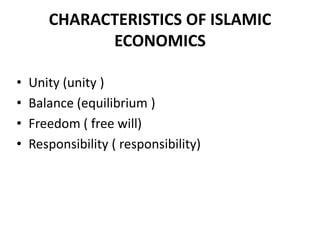
• Unity (unity )
• Balance (equilibrium )
• Freedom ( free will)
• Responsibility ( responsibility)
CHARACTERISTIC OF CONVENTIONAL
ECONOMICS
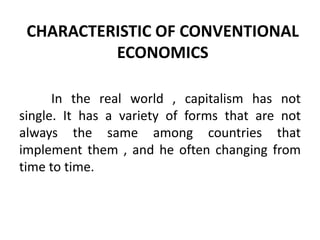
In the real world , capitalism has not
single. It has a variety of forms that are not
always the same among countries that
implement them , and he often changing from
time to time.
ISLAMIC ECONOMICS
VS
CONVENTIONAL ECONOMICS
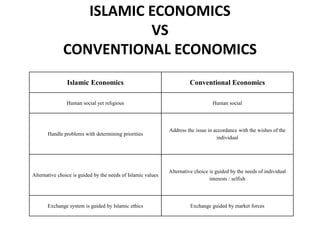
Islamic Economics Conventional Economics
Human social yet religious Human social
Handle problems with determining priorities
Address the issue in accordance with the wishes of the
individual
Alternative choice is guided by the needs of Islamic values
Alternative choice is guided by the needs of individual
interests / selfish
Exchange system is guided by Islamic ethics Exchange guided by market forces
ISLAMIC ECONOMICS
VS
CONVENTIONAL ECONOMICS
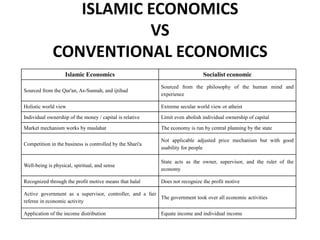
Islamic Economics Socialist economic
Sourced from the Qur'an, As-Sunnah, and ijtihad
Sourced from the philosophy of the human mind and
experience
Holistic world view Extreme secular world view or atheist
Individual ownership of the money / capital is relative Limit even abolish individual ownership of capital
Market mechanism works by maslahat The economy is run by central planning by the state
Competition in the business is controlled by the Shari'a
Not applicable adjusted price mechanism but with good
usability for people
Well-being is physical, spiritual, and sense
State acts as the owner, supervisor, and the ruler of the
economy
Recognized through the profit motive means that halal Does not recognize the profit motive
Active government as a supervisor, controller, and a fair
referee in economic activity
The government took over all economic activities
Application of the income distribution Equate income and individual income
ISLAMIC ECONOMICS
VS
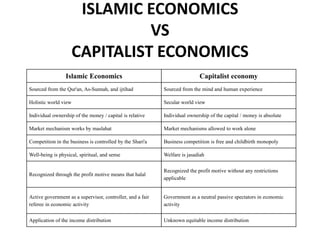
CAPITALIST ECONOMICS
Islamic Economics Capitalist economy
Sourced from the Qur'an, As-Sunnah, and ijtihad Sourced from the mind and human experience
Holistic world view Secular world view
Individual ownership of the money / capital is relative Individual ownership of the capital / money is absolute
Market mechanism works by maslahat Market mechanisms allowed to work alone
Competition in the business is controlled by the Shari'a Business competition is free and childbirth monopoly
Well-being is physical, spiritual, and sense Welfare is jasadiah
Recognized through the profit motive means that halal
Recognized the profit motive without any restrictions
applicable
Active government as a supervisor, controller, and a fair
referee in economic activity
Government as a neutral passive spectators in economic
activity
Application of the income distribution Unknown equitable income distribution

The difference between the economic system

  • 1.
    Group 2 Hendro Ariyanto110810251003 Irsyad Abdul Ghani 110810251004 Eka Ardha Nareswari 110810251013
  • 2.
    THE DIFFERENCE BETWEENTHE ECONOMIC SYSTEM AND THE ECONOMIC SYSTEM OF ISLAM
  • 3.
    DEFINITION OF ISLAMIC ECONOMICS Islamiceconomic system is an economic system based on the teachings and values ​​of Islam , derived from the Quran , the Sunnah , ijma and qiyas .
  • 4.
    THE HISTORY OFISLAMIC ECONOMICS The collapse of the capitalist economic system is the reason the incidence of new thinking about the economic system of islam/Sharia especially among muslim countries or countries that the majority of the inhabitants are Muslim.
  • 5.
    CHARACTERISTIC OF ISLAMIC ECONOMICS a.Treasure belongs to God and Man is the Caliph of property . b. Tied with economic theology , Sharia ( Law ) , and Moral c. Balance between spirituality and materialism d. Islamic economic interests Creatingbalance Between Individuals with common interests.
  • 6.
    CHARACTERISTIC OF ISLAMIC ECONOMICS e.Individual liberty is guaranteed in Islam f. State is authorized to intervene in the economy g. Consumption guidance h. Investment instructions i. Alms j. Prohibition of riba
  • 7.
    THE PURPOSE OFISLAMIC ECONOMICS • Giving birth of Islam in the areas of economic life . • Making wealth with which we have are able to practice as zakat . • Provide the solemn to the community . • To be self-sufficient so it does not depend on the other party . Thus it can live in freedom by not regulated by other parties .
  • 8.
    ISLAMIC ECONOMIC AND CONVENTIONALECONOMIC a. Islamic economics Islamic Economics is actually a system that reflects the nature and once his trademark. b. Conventional economic The birth of the capitalist economic system, it is actually a further development of economic thought and the development of the European continent in the past.
  • 9.
    CHARACTERISTICS OF ISLAMIC ECONOMICS •Unity (unity ) • Balance (equilibrium ) • Freedom ( free will) • Responsibility ( responsibility)
  • 10.
    CHARACTERISTIC OF CONVENTIONAL ECONOMICS Inthe real world , capitalism has not single. It has a variety of forms that are not always the same among countries that implement them , and he often changing from time to time.
  • 11.
    ISLAMIC ECONOMICS VS CONVENTIONAL ECONOMICS IslamicEconomics Conventional Economics Human social yet religious Human social Handle problems with determining priorities Address the issue in accordance with the wishes of the individual Alternative choice is guided by the needs of Islamic values Alternative choice is guided by the needs of individual interests / selfish Exchange system is guided by Islamic ethics Exchange guided by market forces
  • 12.
    ISLAMIC ECONOMICS VS CONVENTIONAL ECONOMICS IslamicEconomics Socialist economic Sourced from the Qur'an, As-Sunnah, and ijtihad Sourced from the philosophy of the human mind and experience Holistic world view Extreme secular world view or atheist Individual ownership of the money / capital is relative Limit even abolish individual ownership of capital Market mechanism works by maslahat The economy is run by central planning by the state Competition in the business is controlled by the Shari'a Not applicable adjusted price mechanism but with good usability for people Well-being is physical, spiritual, and sense State acts as the owner, supervisor, and the ruler of the economy Recognized through the profit motive means that halal Does not recognize the profit motive Active government as a supervisor, controller, and a fair referee in economic activity The government took over all economic activities Application of the income distribution Equate income and individual income
  • 13.
    ISLAMIC ECONOMICS VS CAPITALIST ECONOMICS IslamicEconomics Capitalist economy Sourced from the Qur'an, As-Sunnah, and ijtihad Sourced from the mind and human experience Holistic world view Secular world view Individual ownership of the money / capital is relative Individual ownership of the capital / money is absolute Market mechanism works by maslahat Market mechanisms allowed to work alone Competition in the business is controlled by the Shari'a Business competition is free and childbirth monopoly Well-being is physical, spiritual, and sense Welfare is jasadiah Recognized through the profit motive means that halal Recognized the profit motive without any restrictions applicable Active government as a supervisor, controller, and a fair referee in economic activity Government as a neutral passive spectators in economic activity Application of the income distribution Unknown equitable income distribution