Group Decision Making
PGDM (2013-15) Term-II

Dynamics of Group Behavior
Session-6
Dr. Vikramaditya Ekkirala
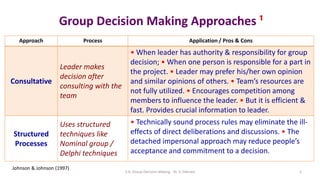
Group Decision Making Approaches ¹
Approach

Process

Application / Pros & Cons

Consultative

Leader makes
decision after
consulting with the
team

• When leader has authority & responsibility for group
decision; • When one person is responsible for a part in
the project. • Leader may prefer his/her own opinion
and similar opinions of others. • Team’s resources are
not fully utilized. • Encourages competition among
members to influence the leader. • But it is efficient &
fast. Provides crucial information to leader.

Structured
Processes

Uses structured
techniques like
Nominal group /
Delphi techniques

• Technically sound process rules may eliminate the illeffects of direct deliberations and discussions. • The
detached impersonal approach may reduce people’s
acceptance and commitment to a decision.

Johnson & Johnson (1997)

S-6: Group Decision Making - Dr. V. Ekkirala

2
Group Decision Making Approaches…..
Approach

Process

Application/ Pros & Cons

Group votes on the
Democratic decision and
majority rules

Includes all team members opinions and is faster.
But voting may create resentment between winners
& losers. Disagreeing members may not support
and implement the decision. Voting may prematurely close the discussion on issues that are not
fully resolved.

Require discussion
until all members
agree.

Requires time, energy & skill to reach consensus but
it is the best way to fully utilize team resources and
decisions have greater likelihood of effective
implementation.

Consensus

The use of consensus decision making was positively related to team effectiveness for all
types of teams (Devine & colleagues, 1999)
S-6: Group Decision Making - Dr. V. Ekkirala

3
Group Decision Making Techniques
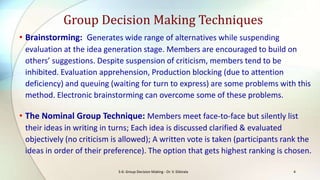
• Brainstorming: Generates wide range of alternatives while suspending
evaluation at the idea generation stage. Members are encouraged to build on
others’ suggestions. Despite suspension of criticism, members tend to be
inhibited. Evaluation apprehension, Production blocking (due to attention
deficiency) and queuing (waiting for turn to express) are some problems with this
method. Electronic brainstorming can overcome some of these problems.

• The Nominal Group Technique: Members meet face-to-face but silently list
their ideas in writing in turns; Each idea is discussed clarified & evaluated
objectively (no criticism is allowed); A written vote is taken (participants rank the
ideas in order of their preference). The option that gets highest ranking is chosen.
S-6: Group Decision Making - Dr. V. Ekkirala

4
Group Decision Making Techniques

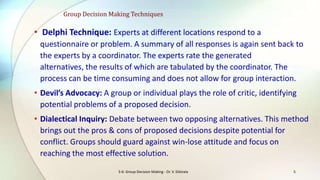
• Delphi Technique: Experts at different locations respond to a
questionnaire or problem. A summary of all responses is again sent back to
the experts by a coordinator. The experts rate the generated
alternatives, the results of which are tabulated by the coordinator. The
process can be time consuming and does not allow for group interaction.
• Devil’s Advocacy: A group or individual plays the role of critic, identifying
potential problems of a proposed decision.
• Dialectical Inquiry: Debate between two opposing alternatives. This method
brings out the pros & cons of proposed decisions despite potential for
conflict. Groups should guard against win-lose attitude and focus on
reaching the most effective solution.
S-6: Group Decision Making - Dr. V. Ekkirala

5
Group Decision Making Techniques….

• Stepladder Technique: Two persons work independently on the same
problem and come together to present their ideas and jointly discuss on
solutions. A third person working alone on the problem joins the group and
presents his/her views to the rest of the group who discuss. This process is
continued by adding further members working alone on the same problem to
present their views to the entire group which collectively works on the
problem. This enables members to express their independent views without
the knowledge of group’s prior discussion/decision.

• Electronic Meetings: Holding teleconferences through satellite transmission
in which people located at different places participate in discussions.
S-6: Group Decision Making - Dr. V. Ekkirala

6
Group Decision Making Techniques….

• Group Decision Support Systems: GDSS combines computer, decision
technologies & communication. Group members anonymously discuss ideas
through computer program in chat rooms. A record of these discussions is
available for all to examine. People using GDSS were found to be sharing more
information with the group than in face-to-face discussions, as revealed in a
research study (Lam & Shaubroek, 2000) ².

• Electronic Meetings ³: Holding teleconferences through satellite transmission
or by means of telephone lines in which people located at different places
participate in discussions. This method has proven to be effective and being
practiced by companies like GE Appliances, Marriot Corp., and Sun
Microsystems. (Greenberg & Baron, 2010) ⁴.
S-6: Group Decision Making - Dr. V. Ekkirala

7
Conclusion
• Group decisions are better when groups successfully pool up the
needed resources (composition/complementary skills).

• Group decisions are better if the quality of its communication and
process enable pooling of ideas, knowledge and alternatives.
• Groups are needed for problems that are too complex to be
addressed by individuals.
• Groups can enhance their decision quality by avoiding the traps of
groupthink and group shift.

• Groups take more time to make decisions than individuals.
S-6: Group Decision Making - Dr. V. Ekkirala

8
References
1.

Johnson, D., & Johnson, F. (1997). Joining together: Group theory and group skills (6th ed.).
Boston: Allyn & Bacon.

2.

Lam, S. S. K., & Shaubroeck, J. (2000). Improving group decisions by better pooling
information: A comparative advantage of group decision support systems. Journal of
Applied Psychology, 85, 564-573.

3.

Harmon, J., Schneer, J. A., & Hoffman, L. R. (1995). Electronic meetings and established
decision groups: Audioconferencing effects on performance and structural stability.
Organizational Behavior and Human Decision Process, 61, 138-147.

4.

Greenberg, J., & Baron, R. A. (2010). Behavior in Organizations (9th ed.). New Delhi: PHI
Learning Private Ltd.

S-6: Group Decision Making - Dr. V. Ekkirala

9

S 6. Group Decision Making

  • 1.
    Group Decision Making PGDM(2013-15) Term-II Dynamics of Group Behavior Session-6 Dr. Vikramaditya Ekkirala
  • 2.
    Group Decision MakingApproaches ¹ Approach Process Application / Pros & Cons Consultative Leader makes decision after consulting with the team • When leader has authority & responsibility for group decision; • When one person is responsible for a part in the project. • Leader may prefer his/her own opinion and similar opinions of others. • Team’s resources are not fully utilized. • Encourages competition among members to influence the leader. • But it is efficient & fast. Provides crucial information to leader. Structured Processes Uses structured techniques like Nominal group / Delphi techniques • Technically sound process rules may eliminate the illeffects of direct deliberations and discussions. • The detached impersonal approach may reduce people’s acceptance and commitment to a decision. Johnson & Johnson (1997) S-6: Group Decision Making - Dr. V. Ekkirala 2
  • 3.
    Group Decision MakingApproaches….. Approach Process Application/ Pros & Cons Group votes on the Democratic decision and majority rules Includes all team members opinions and is faster. But voting may create resentment between winners & losers. Disagreeing members may not support and implement the decision. Voting may prematurely close the discussion on issues that are not fully resolved. Require discussion until all members agree. Requires time, energy & skill to reach consensus but it is the best way to fully utilize team resources and decisions have greater likelihood of effective implementation. Consensus The use of consensus decision making was positively related to team effectiveness for all types of teams (Devine & colleagues, 1999) S-6: Group Decision Making - Dr. V. Ekkirala 3
  • 4.
    Group Decision MakingTechniques • Brainstorming: Generates wide range of alternatives while suspending evaluation at the idea generation stage. Members are encouraged to build on others’ suggestions. Despite suspension of criticism, members tend to be inhibited. Evaluation apprehension, Production blocking (due to attention deficiency) and queuing (waiting for turn to express) are some problems with this method. Electronic brainstorming can overcome some of these problems. • The Nominal Group Technique: Members meet face-to-face but silently list their ideas in writing in turns; Each idea is discussed clarified & evaluated objectively (no criticism is allowed); A written vote is taken (participants rank the ideas in order of their preference). The option that gets highest ranking is chosen. S-6: Group Decision Making - Dr. V. Ekkirala 4
  • 5.
    Group Decision MakingTechniques • Delphi Technique: Experts at different locations respond to a questionnaire or problem. A summary of all responses is again sent back to the experts by a coordinator. The experts rate the generated alternatives, the results of which are tabulated by the coordinator. The process can be time consuming and does not allow for group interaction. • Devil’s Advocacy: A group or individual plays the role of critic, identifying potential problems of a proposed decision. • Dialectical Inquiry: Debate between two opposing alternatives. This method brings out the pros & cons of proposed decisions despite potential for conflict. Groups should guard against win-lose attitude and focus on reaching the most effective solution. S-6: Group Decision Making - Dr. V. Ekkirala 5
  • 6.
    Group Decision MakingTechniques…. • Stepladder Technique: Two persons work independently on the same problem and come together to present their ideas and jointly discuss on solutions. A third person working alone on the problem joins the group and presents his/her views to the rest of the group who discuss. This process is continued by adding further members working alone on the same problem to present their views to the entire group which collectively works on the problem. This enables members to express their independent views without the knowledge of group’s prior discussion/decision. • Electronic Meetings: Holding teleconferences through satellite transmission in which people located at different places participate in discussions. S-6: Group Decision Making - Dr. V. Ekkirala 6
  • 7.
    Group Decision MakingTechniques…. • Group Decision Support Systems: GDSS combines computer, decision technologies & communication. Group members anonymously discuss ideas through computer program in chat rooms. A record of these discussions is available for all to examine. People using GDSS were found to be sharing more information with the group than in face-to-face discussions, as revealed in a research study (Lam & Shaubroek, 2000) ². • Electronic Meetings ³: Holding teleconferences through satellite transmission or by means of telephone lines in which people located at different places participate in discussions. This method has proven to be effective and being practiced by companies like GE Appliances, Marriot Corp., and Sun Microsystems. (Greenberg & Baron, 2010) ⁴. S-6: Group Decision Making - Dr. V. Ekkirala 7
  • 8.
    Conclusion • Group decisionsare better when groups successfully pool up the needed resources (composition/complementary skills). • Group decisions are better if the quality of its communication and process enable pooling of ideas, knowledge and alternatives. • Groups are needed for problems that are too complex to be addressed by individuals. • Groups can enhance their decision quality by avoiding the traps of groupthink and group shift. • Groups take more time to make decisions than individuals. S-6: Group Decision Making - Dr. V. Ekkirala 8
  • 9.
    References 1. Johnson, D., &Johnson, F. (1997). Joining together: Group theory and group skills (6th ed.). Boston: Allyn & Bacon. 2. Lam, S. S. K., & Shaubroeck, J. (2000). Improving group decisions by better pooling information: A comparative advantage of group decision support systems. Journal of Applied Psychology, 85, 564-573. 3. Harmon, J., Schneer, J. A., & Hoffman, L. R. (1995). Electronic meetings and established decision groups: Audioconferencing effects on performance and structural stability. Organizational Behavior and Human Decision Process, 61, 138-147. 4. Greenberg, J., & Baron, R. A. (2010). Behavior in Organizations (9th ed.). New Delhi: PHI Learning Private Ltd. S-6: Group Decision Making - Dr. V. Ekkirala 9