Assumptions
ď‚· Rational behavior of the consumer
ď‚· Utility is ordinal
ď‚· Diminishing marginal rate of substitution
ď‚· Consistency in choice
ď‚· Transitivity in choice making
ď‚· Goods consumed are substitutable
Definition :
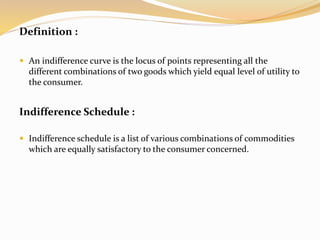
ď‚— An indifference curve is the locus of points representing all the
different combinations of two goods which yield equal level of utility to
the consumer.
Indifference Schedule :
ď‚— Indifference schedule is a list of various combinations of commodities
which are equally satisfactory to the consumer concerned.
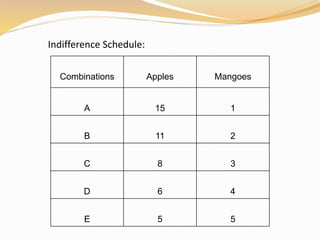
Indifference Schedule:
Combinations Apples Mangoes
A 15 1
B 11 2
C 8 3
D 6 4
E 5 5
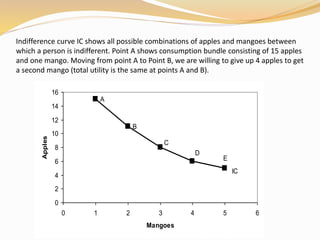
Indifference curve IC shows all possible combinations of apples and mangoes between
which a person is indifferent. Point A shows consumption bundle consisting of 15 apples
and one mango. Moving from point A to Point B, we are willing to give up 4 apples to get
a second mango (total utility is the same at points A and B).
E
D
C
B
A
0
2
4
6
8
10
12
14
16
0 1 2 3 4 5 6
Mangoes
Apples
IC
Indifference Map :
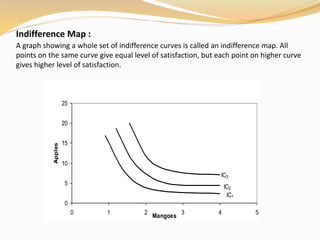
A graph showing a whole set of indifference curves is called an indifference map. All
points on the same curve give equal level of satisfaction, but each point on higher curve
gives higher level of satisfaction.
0
5
10
15
20
25
0 1 2 3 4 5
Mangoes
Apples
IC1
IC2
IC3
Properties of indifference curves :
• Indifference curves are negatively sloped
Given a combination of commodity X and commodity Y, with every
increase in X, the amount in Y should fall in order that the level of
satisfaction from every combination should remain the same.
• Indifference curves are convex to the origin
Convexity illustrates the law of diminishing marginal rate of substitution.
• Indifference curves can never intersect each other
Indifference curves can never intersect each other because each
indifference curve represents a specific level of satisfaction. If two
indifference curves intersect each other, then at the point of intersection,
the consumer is experiencing two different levels of utility.
Consumer Equilibrium
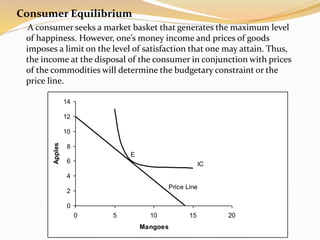
A consumer seeks a market basket that generates the maximum level
of happiness. However, one’s money income and prices of goods
imposes a limit on the level of satisfaction that one may attain. Thus,
the income at the disposal of the consumer in conjunction with prices
of the commodities will determine the budgetary constraint or the
price line.
IC
Price Line
0
2
4
6
8
10
12
14
0 5 10 15 20
Mangoes
Apples
E

Indifference curve

  • 2.
    Assumptions ď‚· Rational behaviorof the consumer ď‚· Utility is ordinal ď‚· Diminishing marginal rate of substitution ď‚· Consistency in choice ď‚· Transitivity in choice making ď‚· Goods consumed are substitutable
  • 3.
    Definition : ď‚— Anindifference curve is the locus of points representing all the different combinations of two goods which yield equal level of utility to the consumer. Indifference Schedule : ď‚— Indifference schedule is a list of various combinations of commodities which are equally satisfactory to the consumer concerned.
  • 4.
    Indifference Schedule: Combinations ApplesMangoes A 15 1 B 11 2 C 8 3 D 6 4 E 5 5
  • 5.
    Indifference curve ICshows all possible combinations of apples and mangoes between which a person is indifferent. Point A shows consumption bundle consisting of 15 apples and one mango. Moving from point A to Point B, we are willing to give up 4 apples to get a second mango (total utility is the same at points A and B). E D C B A 0 2 4 6 8 10 12 14 16 0 1 2 3 4 5 6 Mangoes Apples IC
  • 6.
    Indifference Map : Agraph showing a whole set of indifference curves is called an indifference map. All points on the same curve give equal level of satisfaction, but each point on higher curve gives higher level of satisfaction. 0 5 10 15 20 25 0 1 2 3 4 5 Mangoes Apples IC1 IC2 IC3
  • 7.
    Properties of indifferencecurves : • Indifference curves are negatively sloped Given a combination of commodity X and commodity Y, with every increase in X, the amount in Y should fall in order that the level of satisfaction from every combination should remain the same. • Indifference curves are convex to the origin Convexity illustrates the law of diminishing marginal rate of substitution. • Indifference curves can never intersect each other Indifference curves can never intersect each other because each indifference curve represents a specific level of satisfaction. If two indifference curves intersect each other, then at the point of intersection, the consumer is experiencing two different levels of utility.
  • 8.
    Consumer Equilibrium A consumerseeks a market basket that generates the maximum level of happiness. However, one’s money income and prices of goods imposes a limit on the level of satisfaction that one may attain. Thus, the income at the disposal of the consumer in conjunction with prices of the commodities will determine the budgetary constraint or the price line. IC Price Line 0 2 4 6 8 10 12 14 0 5 10 15 20 Mangoes Apples E