This document provides an overview of elasticity of demand, including:
- Definitions of price elasticity of demand and the types of elasticities, including perfectly elastic, perfectly inelastic, relatively elastic, relatively inelastic, and unit elastic demands.
- Factors that affect price and income elasticities of demand, such as commodity nature, availability of substitutes, and proportion of income spent.
- Explanations and diagrams demonstrating zero income elasticity, negative income elasticity, and positive income elasticity of demand.
- Measurements of income elasticity and how it is calculated using changes in quantity demanded and income.
- Other elasticities discussed include cross elasticity of demand and advertising
Overview of the presentation topic on Elasticity of Demand by Ranjane Rohan V., a Mechanical Engineering student.
Definition of Price Elasticity of Demand as the responsiveness of quantity demanded to price changes.
Introduction to five types of price elasticity, including perfectly elastic, perfectly inelastic, relatively elastic, relatively inelastic, and unit elastic demand.
Description of perfectly elastic demand, where demand changes with no price change, illustrated with a demand curve.
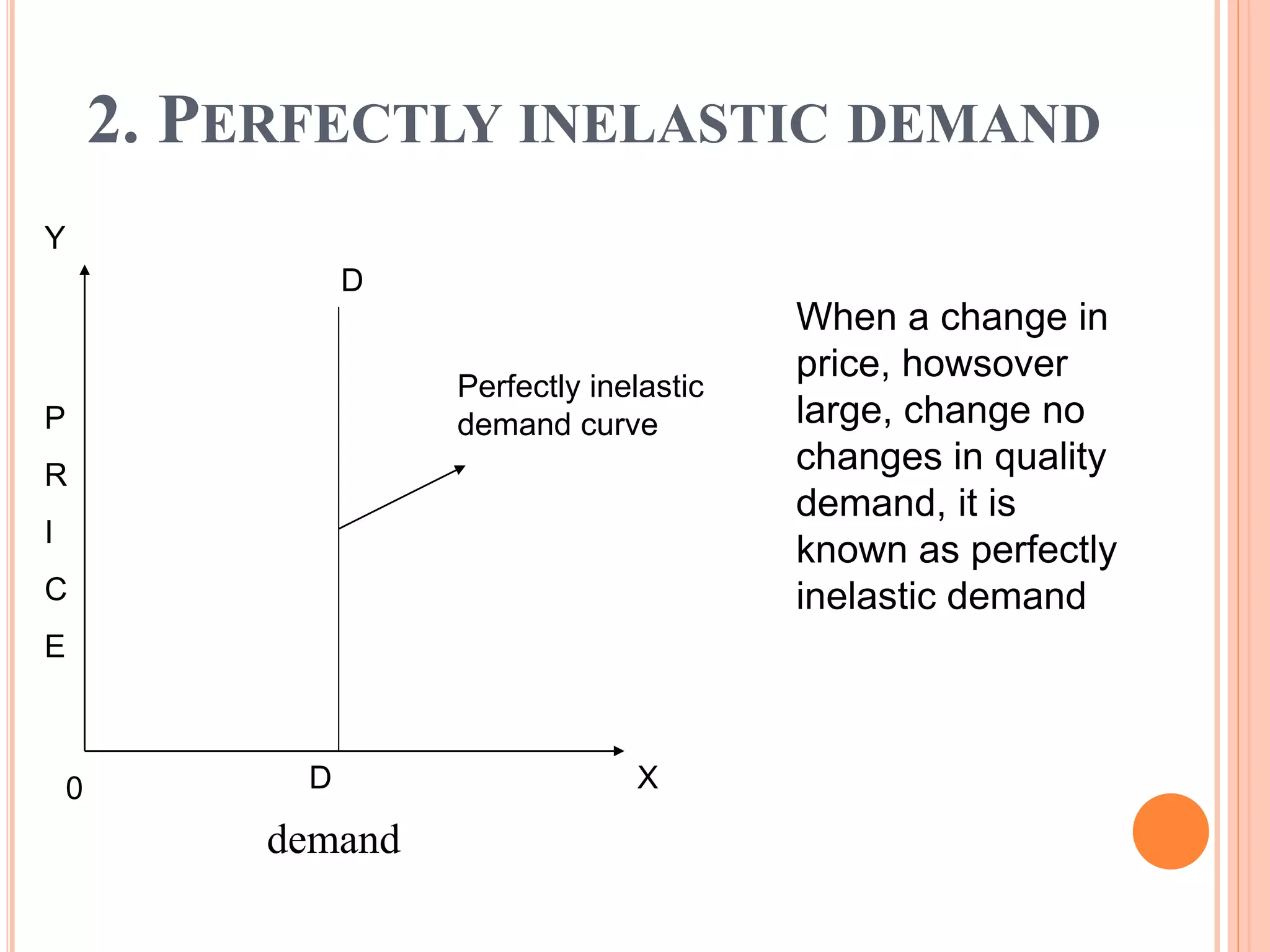
Explains perfectly inelastic demand, where demand remains unchanged despite any large price changes.
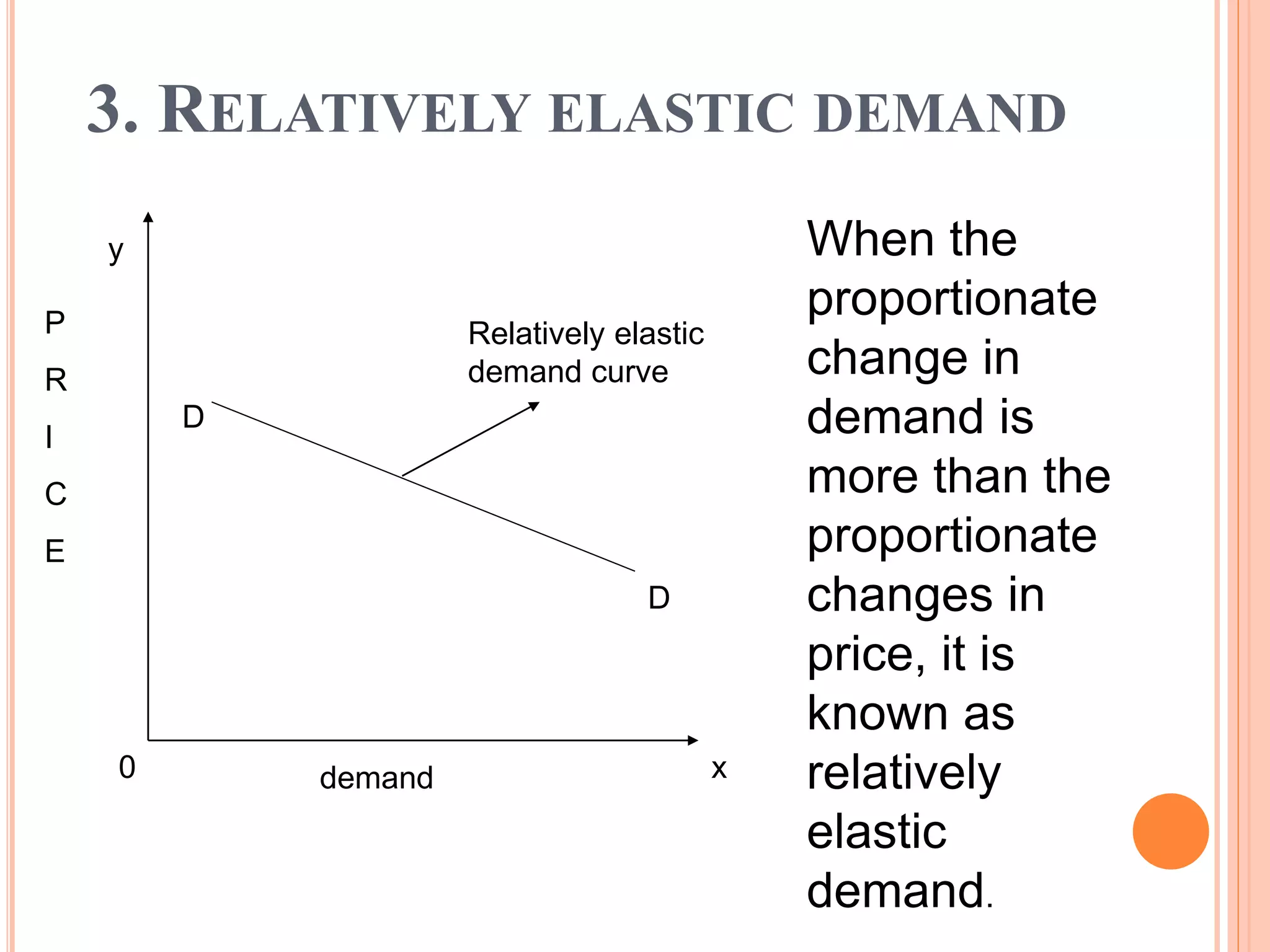
Defines relatively elastic demand as a situation where demand changes more than the price changes.
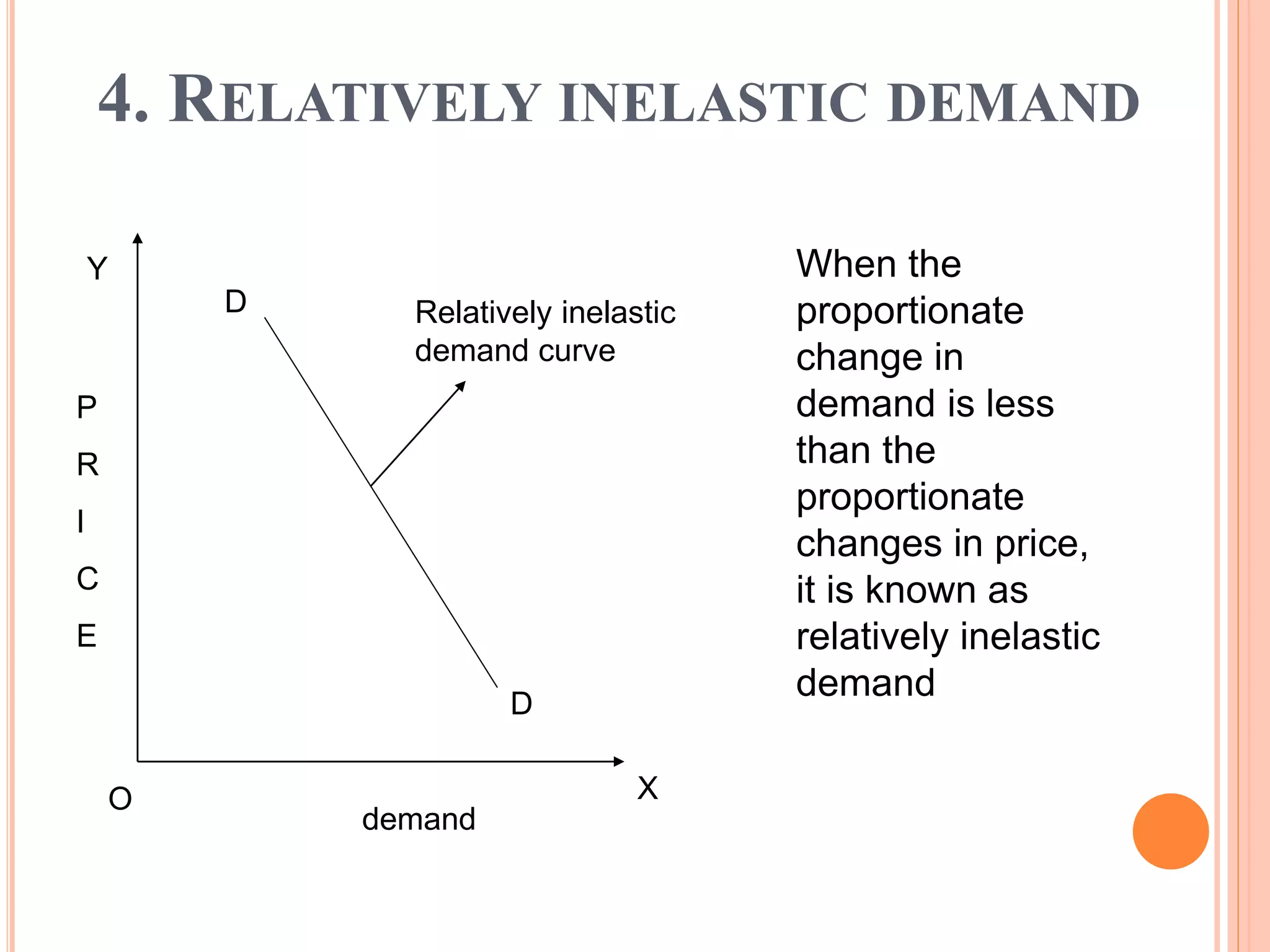
Defines relatively inelastic demand, where demand changes less than the price changes.
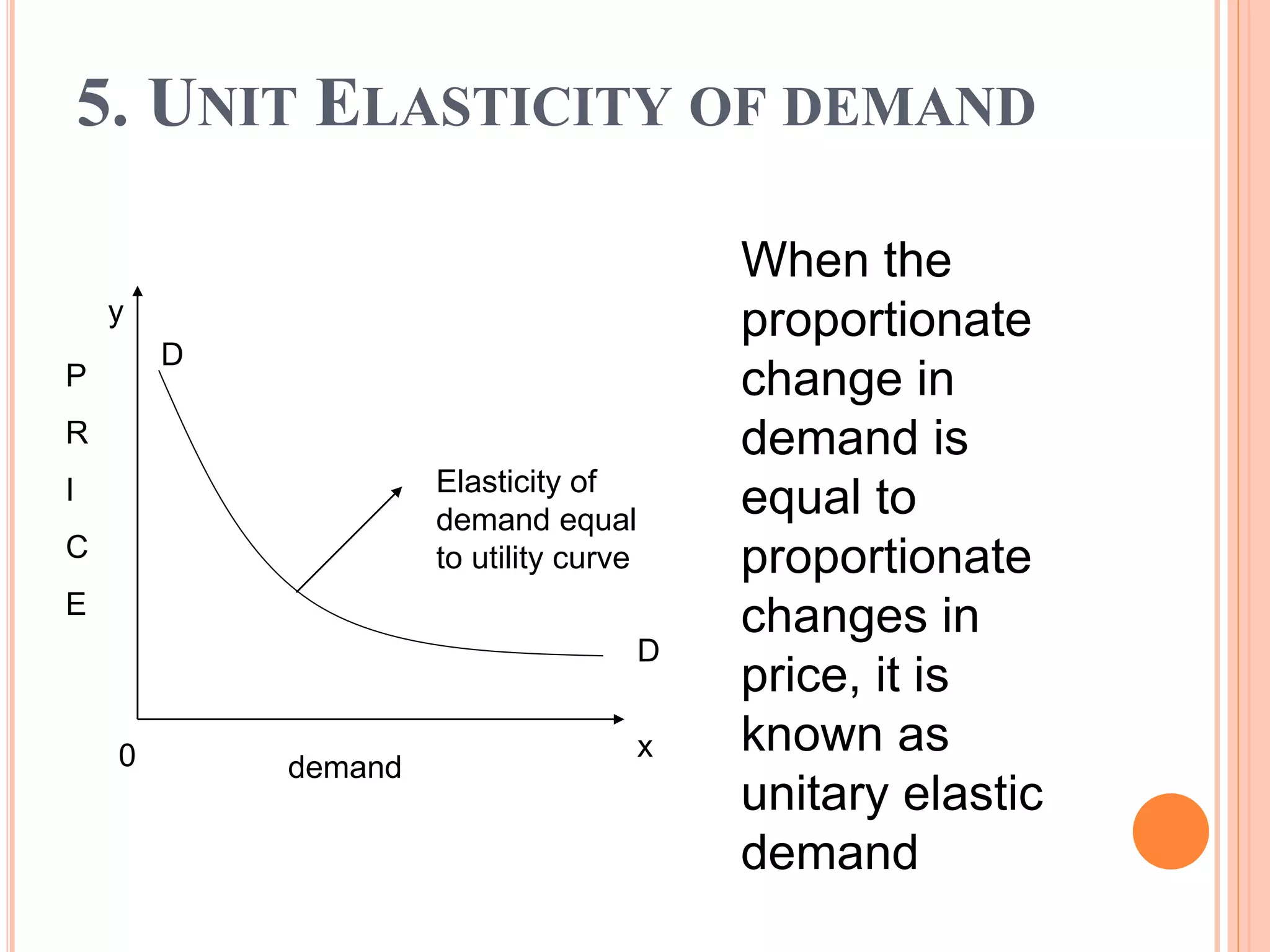
Describes unit elasticity of demand, where demand changes equal the proportional change in price.
A diagram showing different demand types, including perfectly elastic, inelastic, and unitary elastic demands.
Factors that influence price elasticity of demand, including nature of the commodity and availability of substitutes.
Introduces types of income elasticity, including zero, negative, and positive income elasticity of demand.
Graph representation of zero income elasticity of demand showing no change in quantity as income changes.
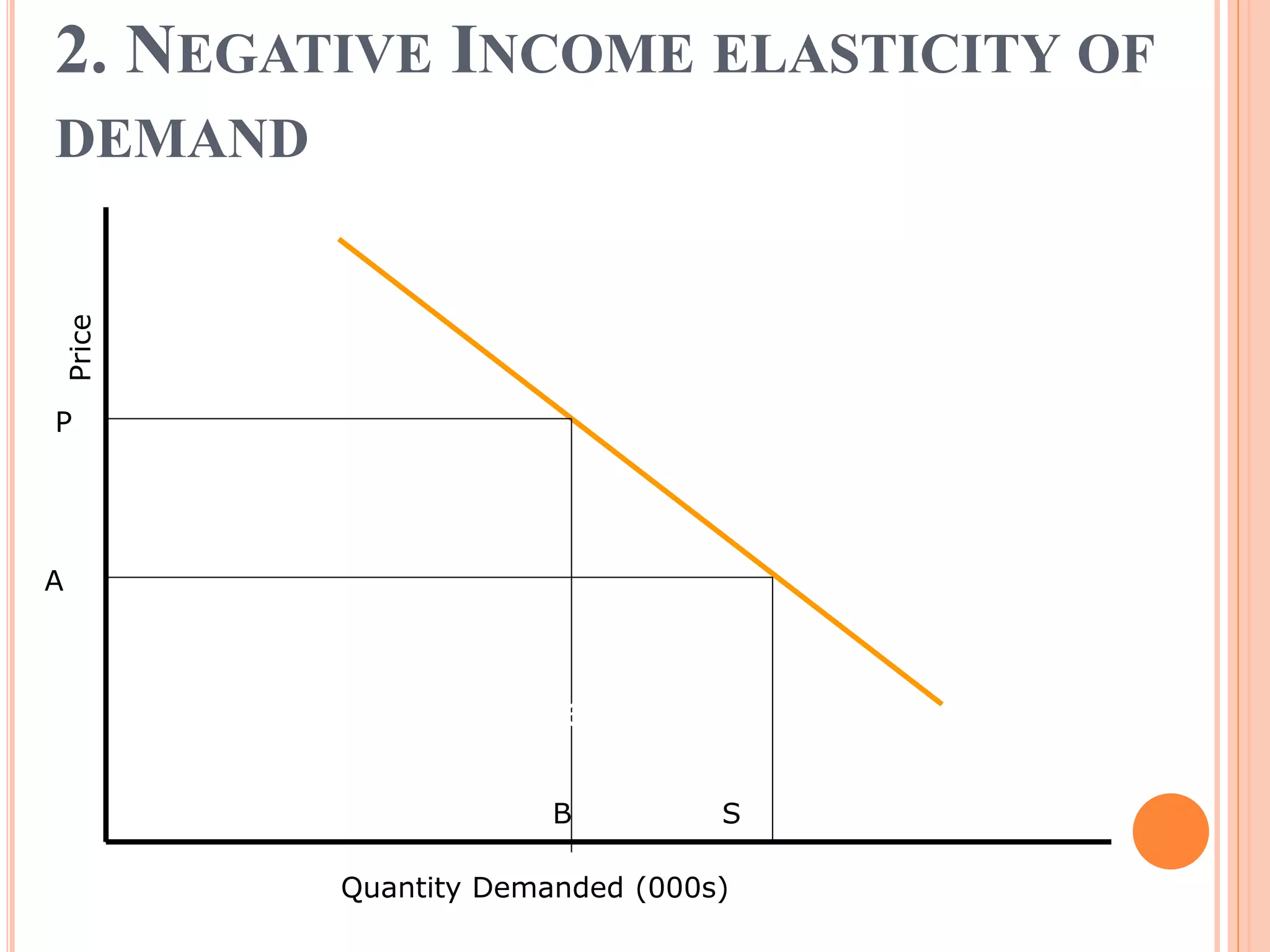
Illustrates negative income elasticity, where demand decreases as income increases.
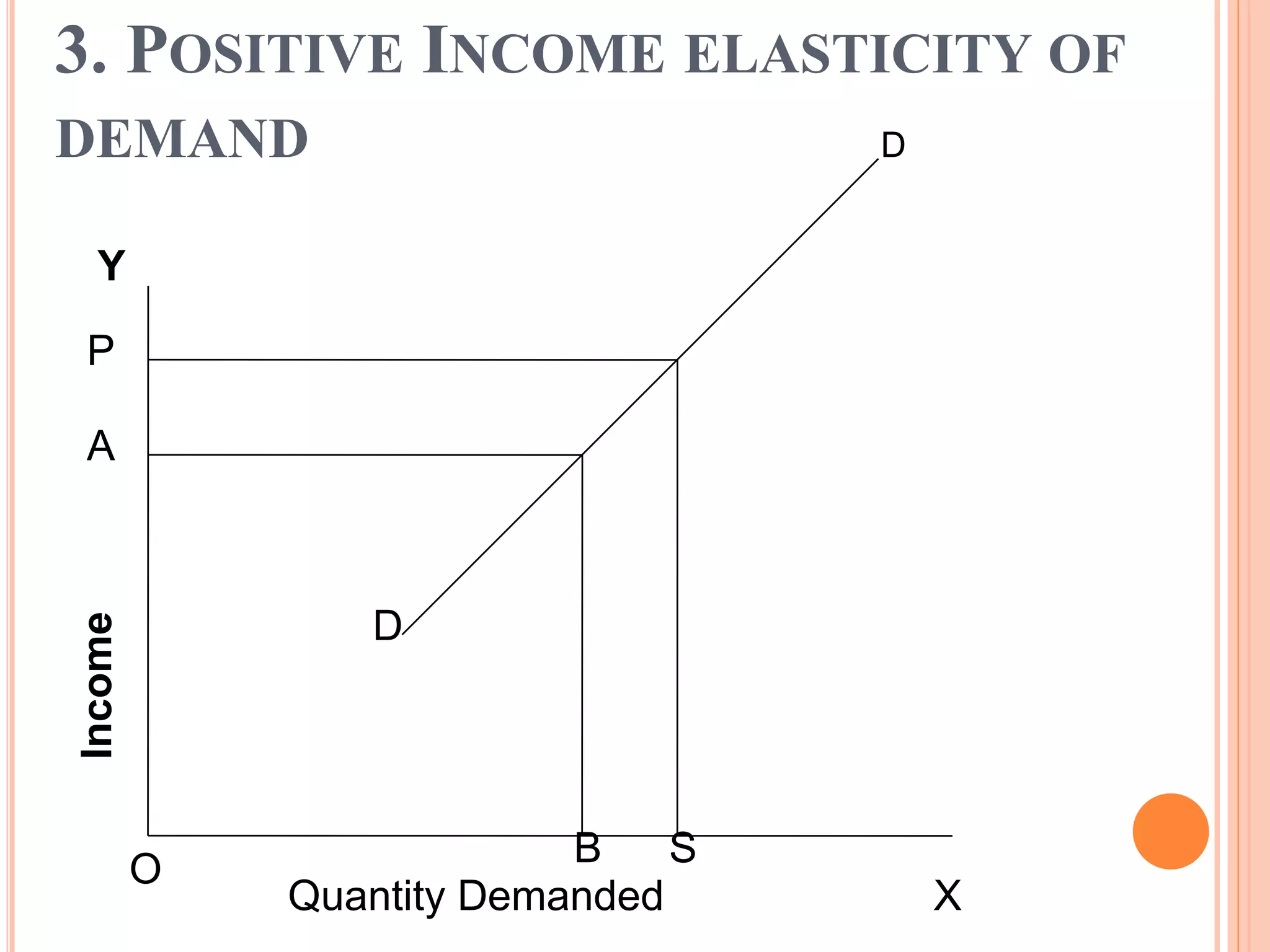
Explains positive income elasticity of demand through graphs, indicating demand increases with income.
Further details on positive income elasticity, distinguishing between different levels of elasticity.
Graphical representation of all income elasticities showing the relationship between quantity demanded and income.
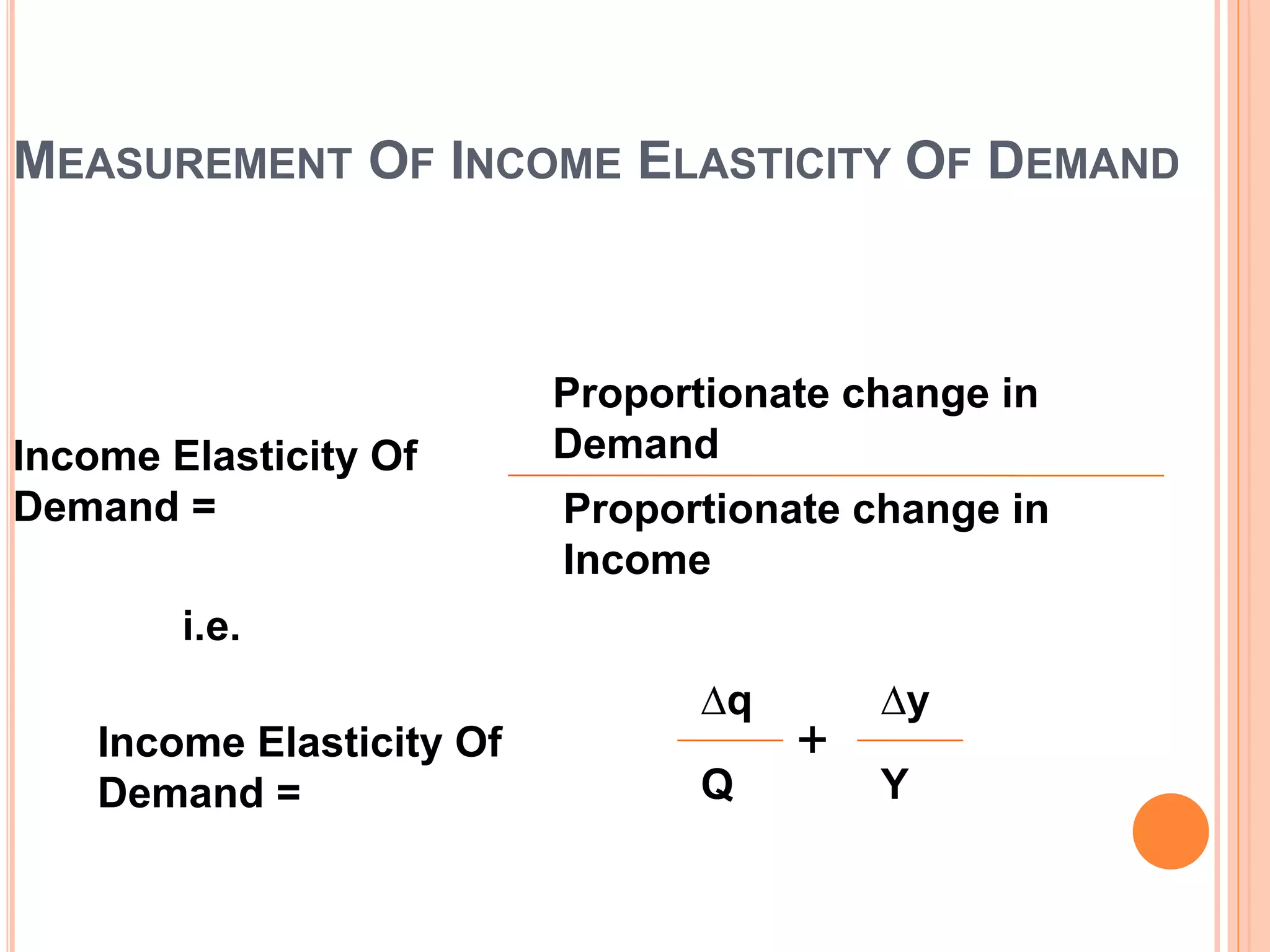
Formula for measuring income elasticity of demand based on proportionate changes in quantity and income.
An example to calculate income elasticity of demand with numerical values illustrating the calculation process.
Discusses factors impacting income elasticity, such as the income itself and the price of commodities.
Highlights the significance of understanding income elasticity for production planning and market analysis.
Defines cross elasticity of demand, showing the relationship between demand for one product and the price of another.
Formula for measuring cross elasticity of demand based on changes in demand for product X and price of product Y.
Explains advertising elasticity of demand as a measure of demand change due to advertising expenditure.
Formula for calculating advertising elasticity of demand based on proportionate changes in demand and advertising spending.
Final slide thanking the audience, concluding the presentation on elasticity of demand.
PREPARED BY :
RANJANEROHAN V.
ENROLMENT NO: 160503119059
BRANCH : MECHANICAL ENGG.
SEMESTER :4TH (1ST SHIFT)
3.
DEFINITION OF PRICEELASTICITY OF
DEMAND
The change in the quantity demanded of a
product due to a change in its price is known
as Price elasticity of demand. Thus, the
sensitiveness or responsiveness of demand
to change in price is as called elasticity of
demand
4.
TYPES OF PRICEELASTICITY OF
DEMAND
1) Perfectly elastic demand (Infinitely Elastic)
2) Perfectly inelastic demand
3) Relatively elastic demand
4) Relatively inelastic demand
5) Unit Elasticity of demand (Unitary Elastic)
5.
1. PERFECTLY ELASTICDEMAND
P
R
I
C
E
y
0 x
Perfectly elastic
demand curve
D D
When the
demand for a
product
changes –
increases or
decreases
even when
there is no
change in
price, it is
known as
perfect elastic
demand.
demand
6.
2. PERFECTLY INELASTICDEMAND
demand
D
D
Perfectly inelastic
demand curve
0
Y
X
P
R
I
C
E
When a change in
price, howsover
large, change no
changes in quality
demand, it is
known as perfectly
inelastic demand
7.
3. RELATIVELY ELASTICDEMAND
Relatively elastic
demand curve
P
R
I
C
E
demand0 x
y
D
D
When the
proportionate
change in
demand is
more than the
proportionate
changes in
price, it is
known as
relatively
elastic
demand.
8.
4. RELATIVELY INELASTICDEMAND
Relatively inelastic
demand curve
XO
Y
demand
D
D
P
R
I
C
E
When the
proportionate
change in
demand is less
than the
proportionate
changes in price,
it is known as
relatively inelastic
demand
9.
5. UNIT ELASTICITYOF DEMAND
Elasticity of
demand equal
to utility curve
y
x0 demand
P
R
I
C
E
D
D
When the
proportionate
change in
demand is
equal to
proportionate
changes in
price, it is
known as
unitary elastic
demand
10.
ALL KINDS OFDEMAND CAN BE SHOWN
IN ONE DIAGRAM AS FOLLOW
D
D1
D2
D3
D4
D5
Y
X0
DEMAND
P
R
I
C
E
WHERE
D1) Perfectly elastic
demand
D2)Relatively elastic
demand
D3)Elasticity of demand
equal to utility
D4)Relatively inelastic
demand
D5)Perfectly inelastic
demand
11.
FACTORS AFFECTING PRICE
ELASTICITYOF DEMAND
Nature of the Commodity
Availability of Substitutes
Variety of uses of commodity
Postponement
Influence of habits
Proportion of Income spent on a
commodity
Range of prices
TYPES OF INCOMEELASTICITY OF
DEMAND
Zero Income elasticity of demand
Negative Income elasticity of demand
Positive Income elasticity of demand
14.
1. ZERO INCOMEELASTICITY OF DEMAND
Y
XO
D
D
Quantity Demanded
Income
15.
2. NEGATIVE INCOMEELASTICITY OF
DEMAND
Price
P
B
A
S
Total Revenue
Quantity Demanded (000s)
16.
3. POSITIVE INCOMEELASTICITY OF
DEMAND
Y
P
A
D
D
B S
O
XQuantity Demanded
Income
17.
•POSITIVE INCOME ELASTICITYOF
DEMAND
Income Elasticity Equal to Unity or
One
Income Elasticity Greater Than
Unity Or One
Income Elasticity Less Than Unity
or One
MEASUREMENT OF INCOMEELASTICITY OF DEMAND
Income Elasticity Of
Demand =
Proportionate change in
Demand
Proportionate change in
Income
i.e.
Income Elasticity Of
Demand =
∆q
Q Y
∆y
+
20.
MEASUREMENT OF INCOMEELASTICITY
OF DEMAND
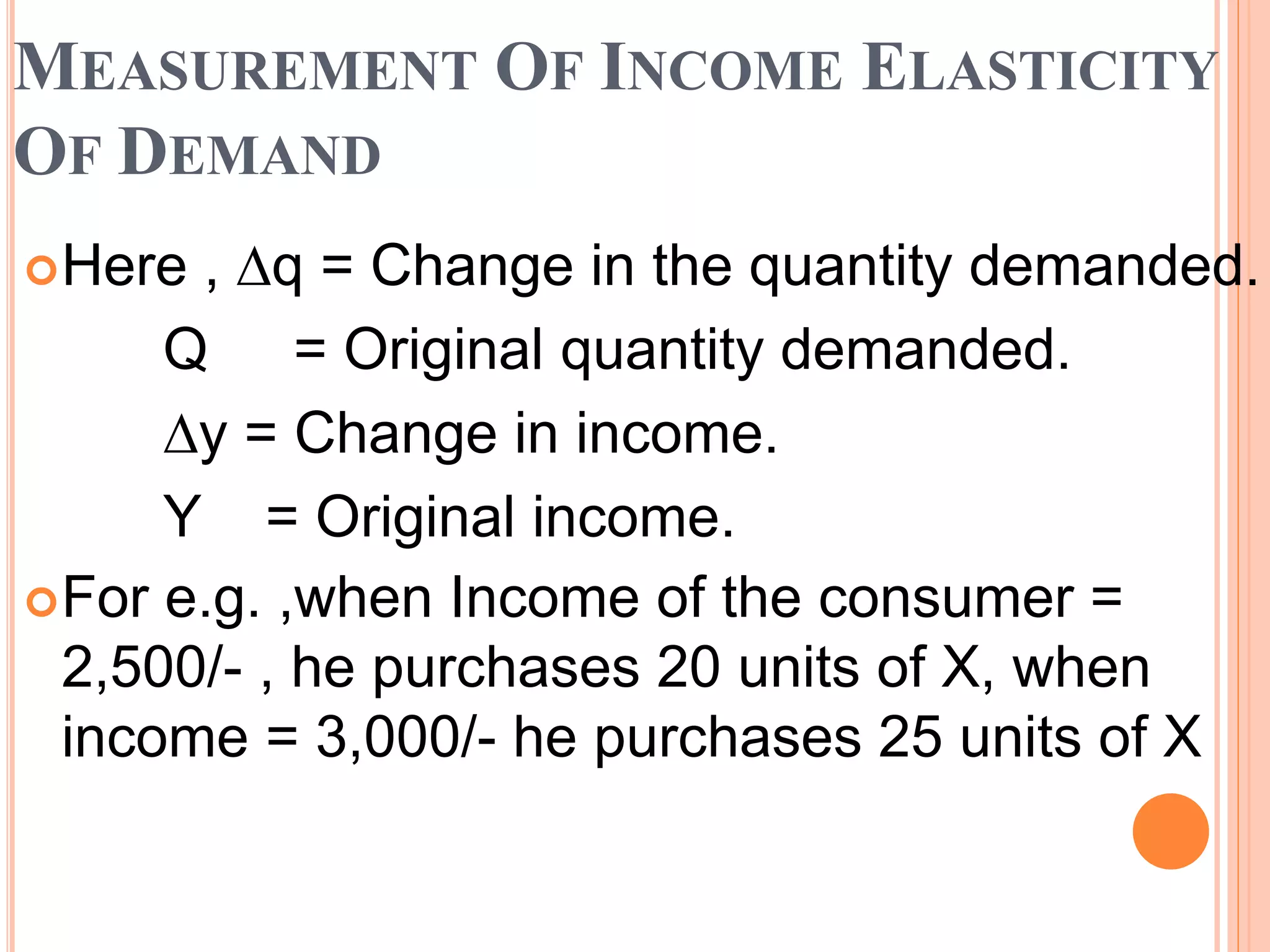
Here , ∆q = Change in the quantity demanded.
Q = Original quantity demanded.
∆y = Change in income.
Y = Original income.
For e.g. ,when Income of the consumer =
2,500/- , he purchases 20 units of X, when
income = 3,000/- he purchases 25 units of X
21.
Thus
Income Elasticity ofDemand
=
= (5/20) + (500/2500)
= 1.5
therefore here the IED is 1.5 which is more
than one.
∆q
Q Y
∆y
+
IMPORTANCE OF THECONCEPT OF
INCOME ELASTICITY OF DEMAND
In production planning and management
In forecasting demand when change in
consumers income is expected
In classifying goods as normal and inferior
In expansion and contraction of the firm by the
figure of income elasticity of demand
Markets situations could be studied with the
help of IED
24.
CROSS ELASTICITYOF DEMAND
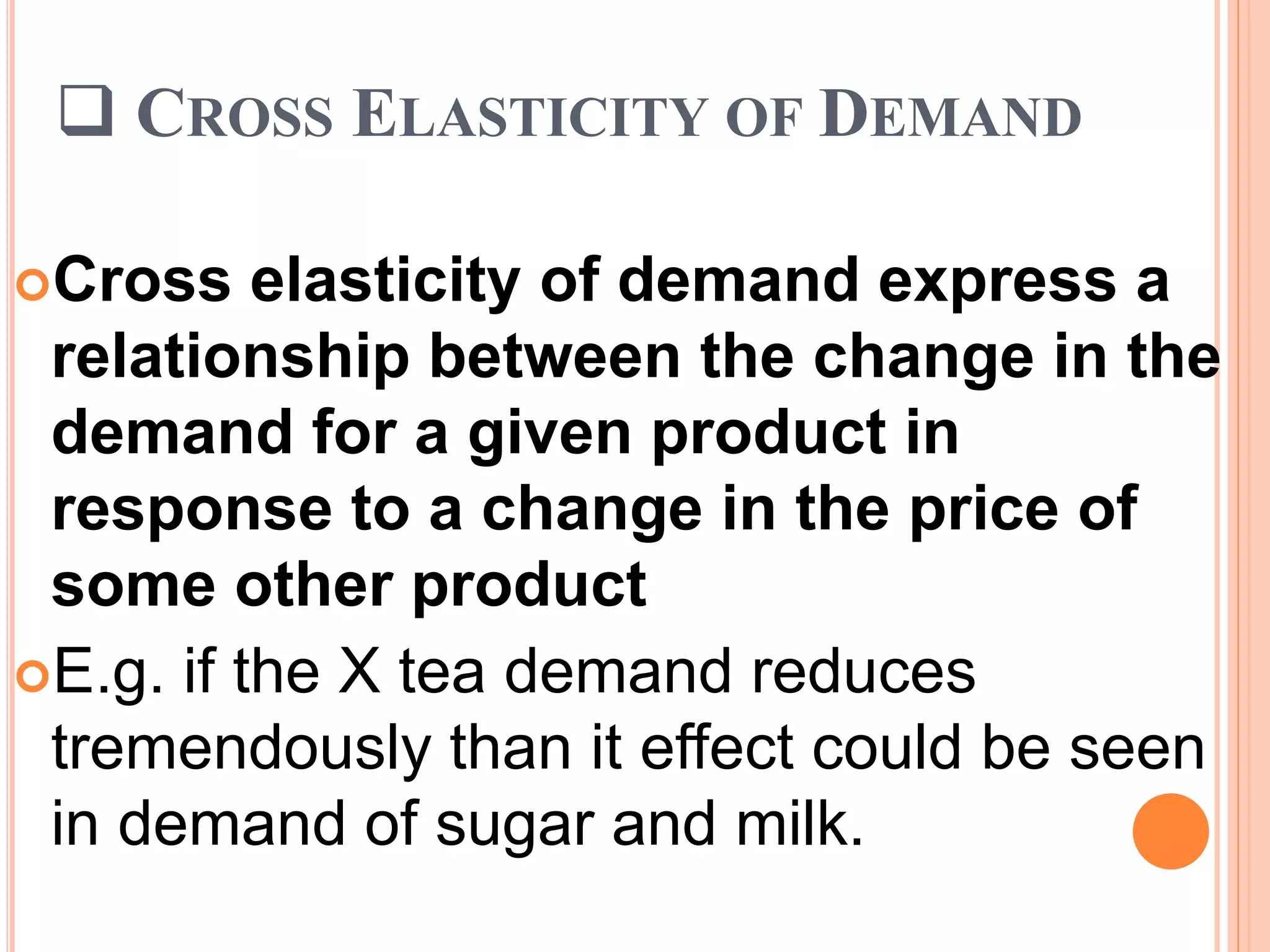
Cross elasticity of demand express a
relationship between the change in the
demand for a given product in
response to a change in the price of
some other product
E.g. if the X tea demand reduces
tremendously than it effect could be seen
in demand of sugar and milk.
25.
MEASUREMENT CROSS ELASTICITYOF
DEMAND
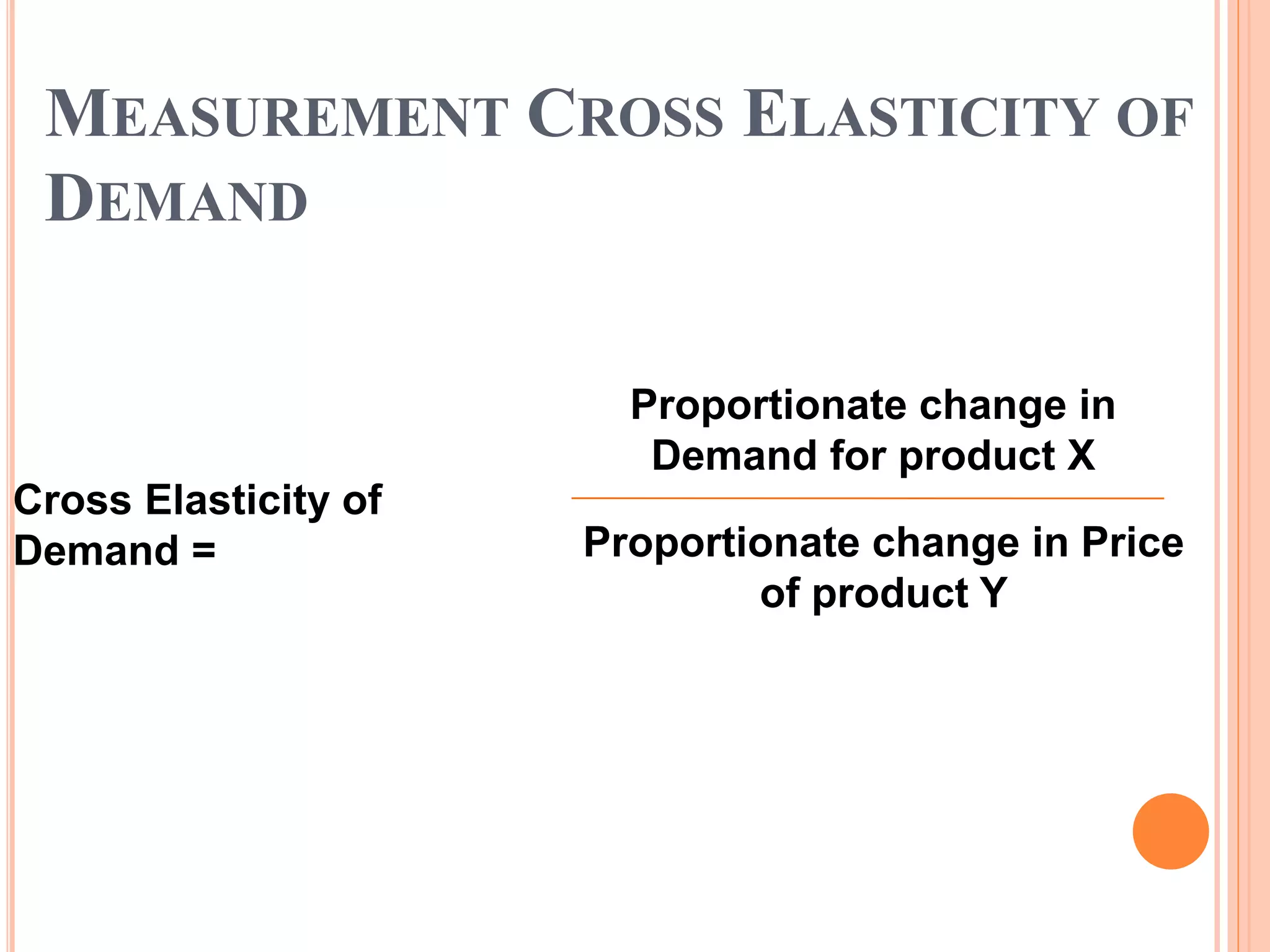
Proportionate change in
Demand for product X
Proportionate change in Price
of product Y
Cross Elasticity of
Demand =
26.
ADVERTISING ELASTICITY OFDEMAND
Advertising elasticity of demand is the
measure of the rate of change in
demand due to change in advertising
expenditure
The amount of change in demand of
goods due to advertisement is known as
Advertisement Elasticity of Demand .
27.
ADVERTISING ELASTICITY OFDEMAND
Proportionate change in
Demand for product
Proportionate change in
Advertising expenditure
i.e.
∆qx
Q A
∆a
÷
Advertising Elasticity of
Demand =
Advertising Elasticity of
Demand =