The document discusses the ordinal utility approach to consumer behavior. It summarizes that the ordinal utility approach assumes utility can only be ranked qualitatively rather than measured cardinally. The key tools of the ordinal approach are indifference curves, which show combinations of goods that provide equal utility, and the budget line, which shows affordable combinations given prices and income. Consumer equilibrium occurs where the indifference curve is tangent to the budget line, indicating the highest attainable utility given constraints.
INTRODUCTION
● Utility analysisis based on the assumption that cardinal measurement of
utility is possible. But it is not a practical proposition.
● The consumer can at best compare the satisfaction derived from different
goods or from different units of the same good. this is called an ordinal
measurement of utility.
● Ordinal means ranked or ordered like first, second, or third.
3.
ORDINAL UTILITY APPROACH
ORDINALUTILITY APPROACH
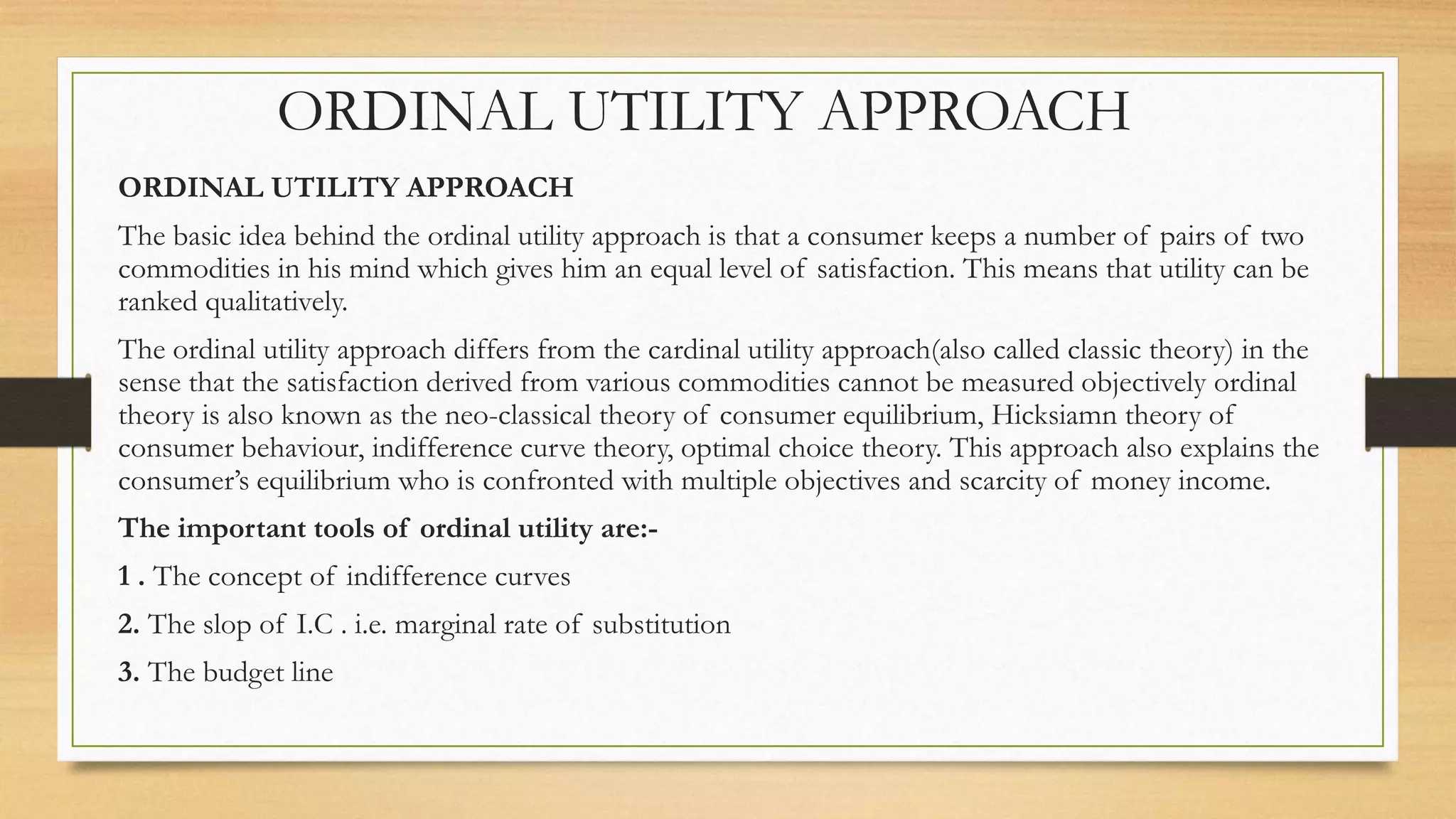
The basic idea behind the ordinal utility approach is that a consumer keeps a number of pairs of two
commodities in his mind which gives him an equal level of satisfaction. This means that utility can be
ranked qualitatively.
The ordinal utility approach differs from the cardinal utility approach(also called classic theory) in the
sense that the satisfaction derived from various commodities cannot be measured objectively ordinal
theory is also known as the neo-classical theory of consumer equilibrium, Hicksiamn theory of
consumer behaviour, indifference curve theory, optimal choice theory. This approach also explains the
consumer’s equilibrium who is confronted with multiple objectives and scarcity of money income.
The important tools of ordinal utility are:-
1 . The concept of indifference curves
2. The slop of I.C . i.e. marginal rate of substitution
3. The budget line
4.
Indifference curve
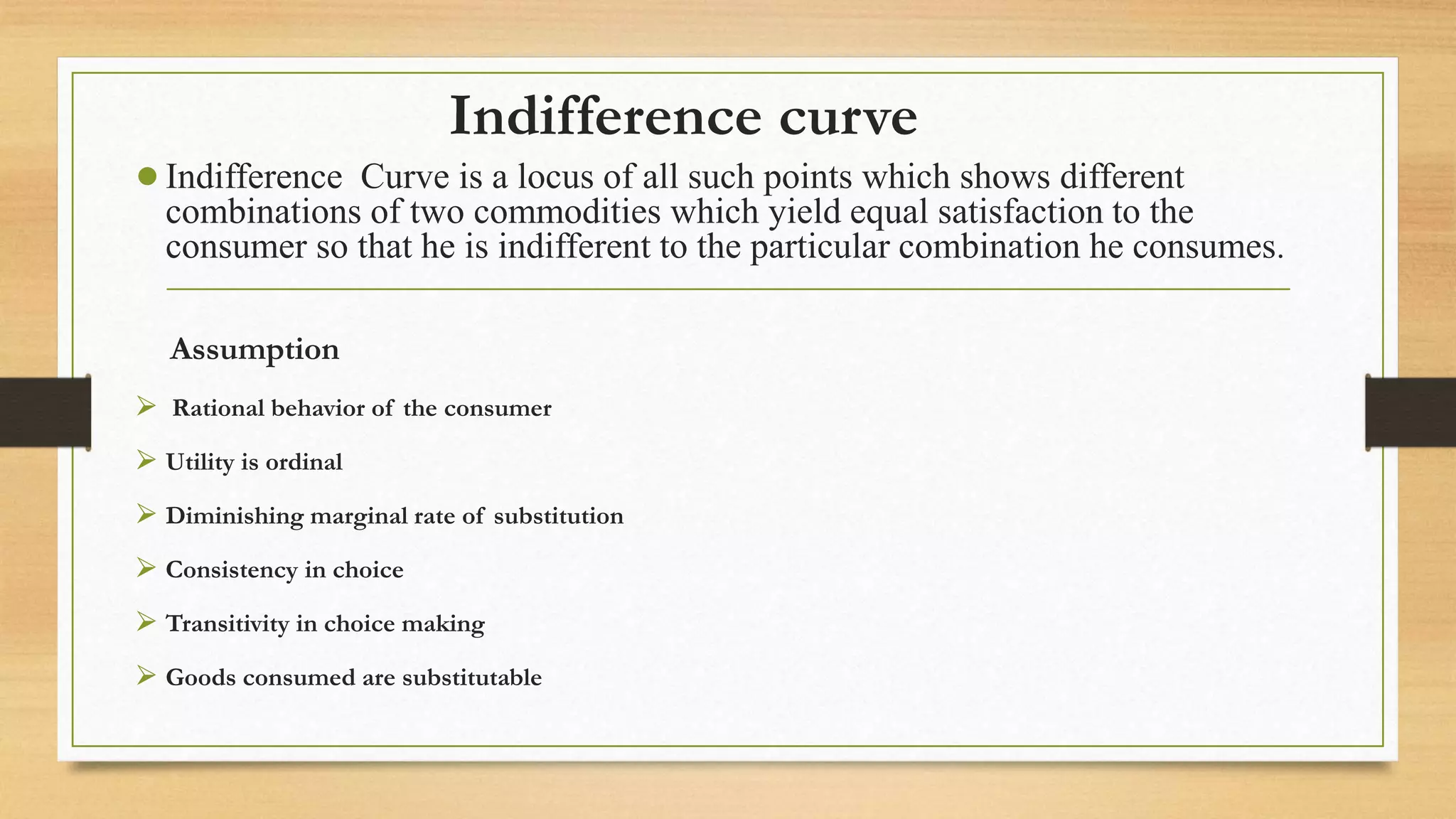
●Indifference Curveis a locus of all such points which shows different
combinations of two commodities which yield equal satisfaction to the
consumer so that he is indifferent to the particular combination he consumes.
Assumption
⮚ Rational behavior of the consumer
⮚ Utility is ordinal
⮚ Diminishing marginal rate of substitution
⮚ Consistency in choice
⮚ Transitivity in choice making
⮚ Goods consumed are substitutable
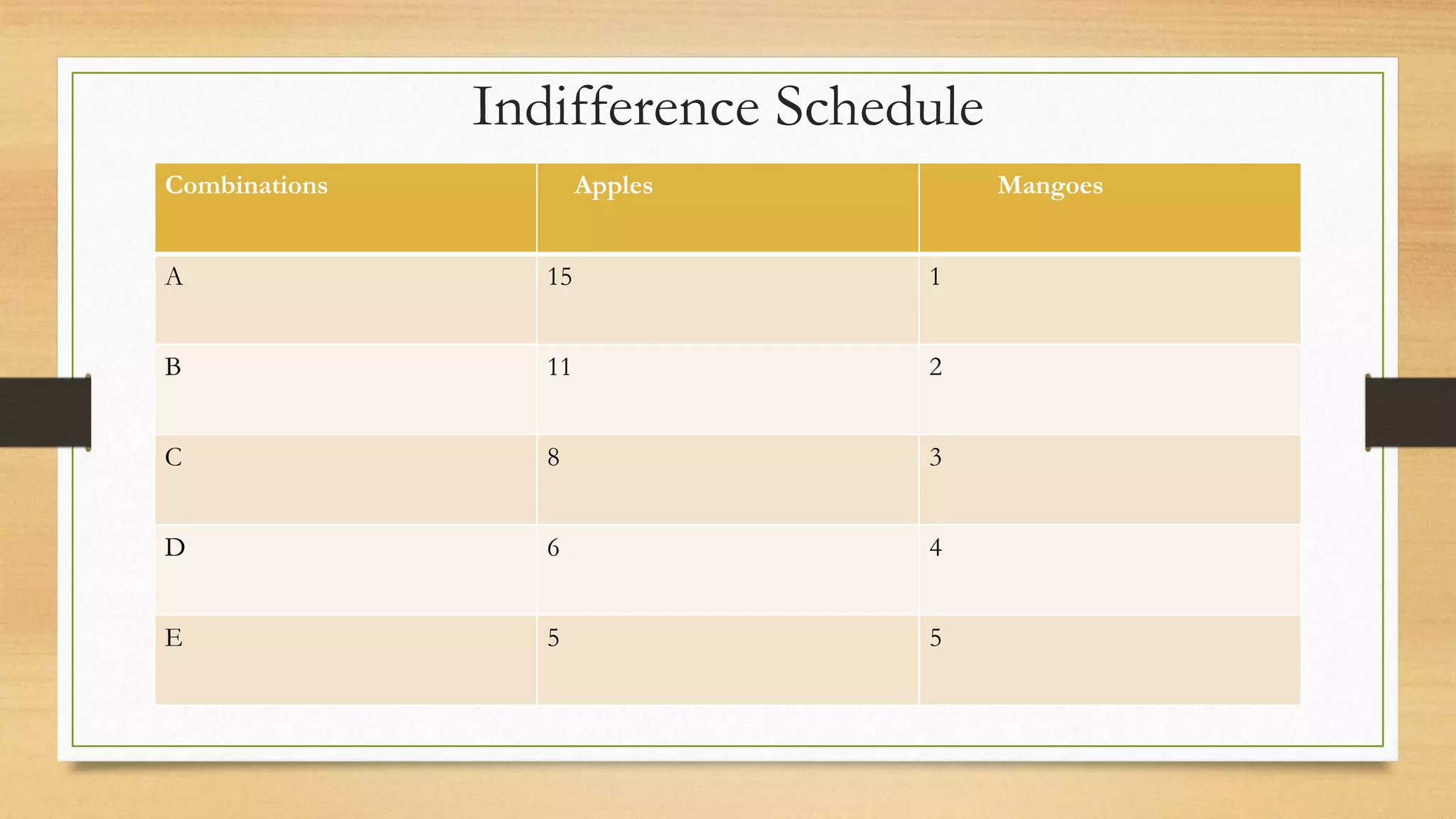
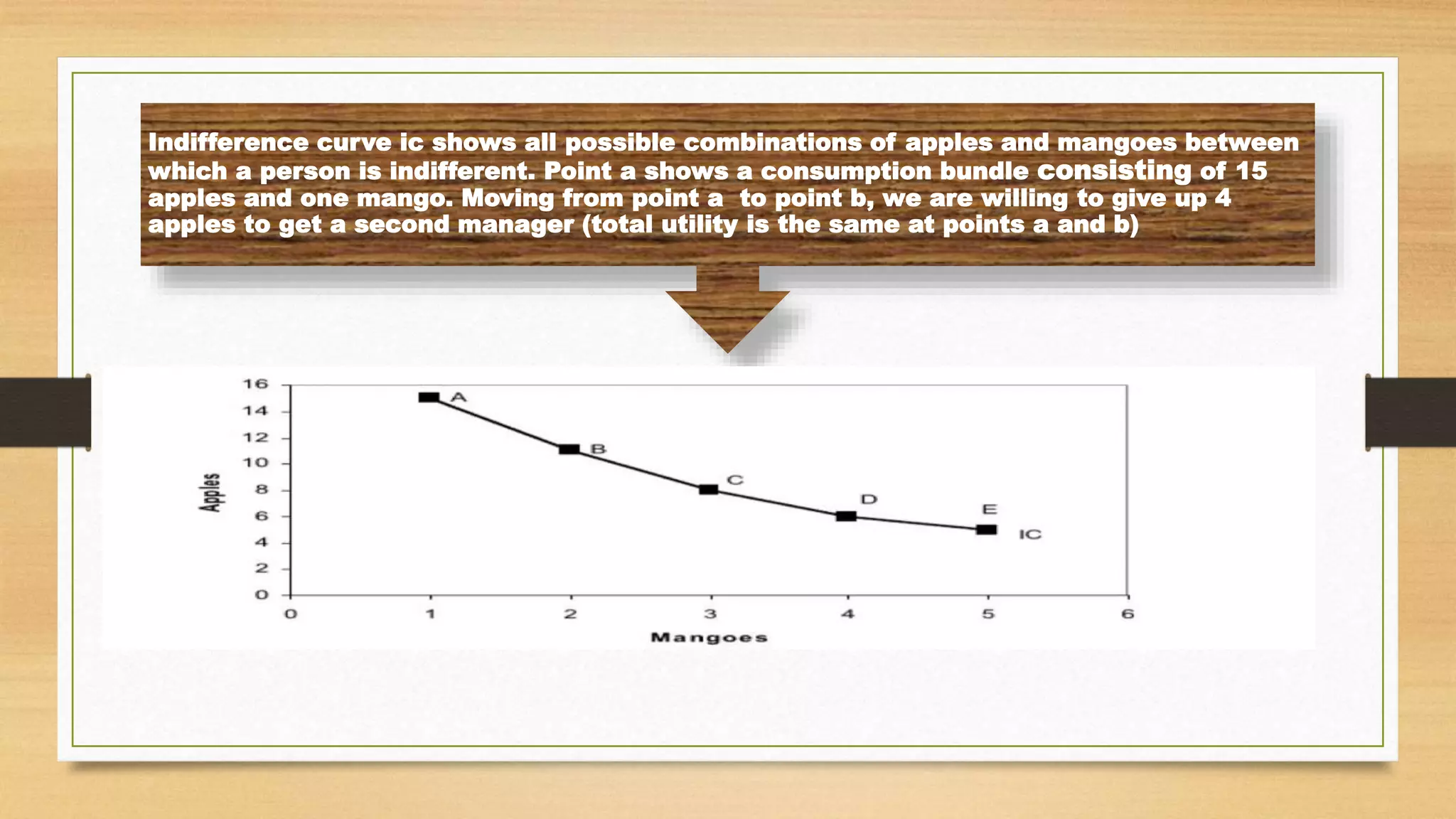
Indifference curve icshows all possible combinations of apples and mangoes between
which a person is indifferent. Point a shows a consumption bundle consisting of 15
apples and one mango. Moving from point a to point b, we are willing to give up 4
apples to get a second manager (total utility is the same at points a and b)
7.
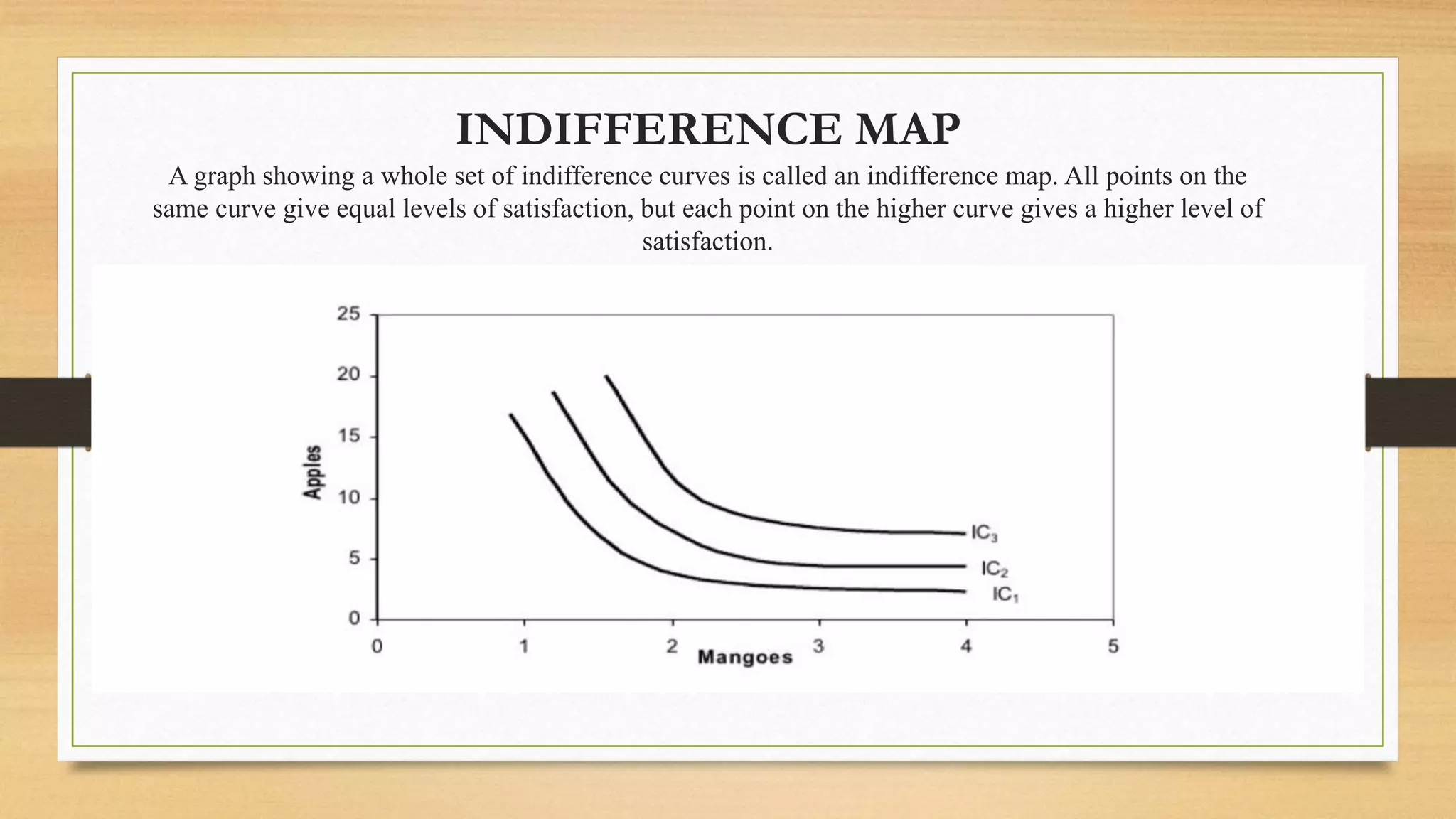
INDIFFERENCE MAP
A graphshowing a whole set of indifference curves is called an indifference map. All points on the
same curve give equal levels of satisfaction, but each point on the higher curve gives a higher level of
satisfaction.
8.
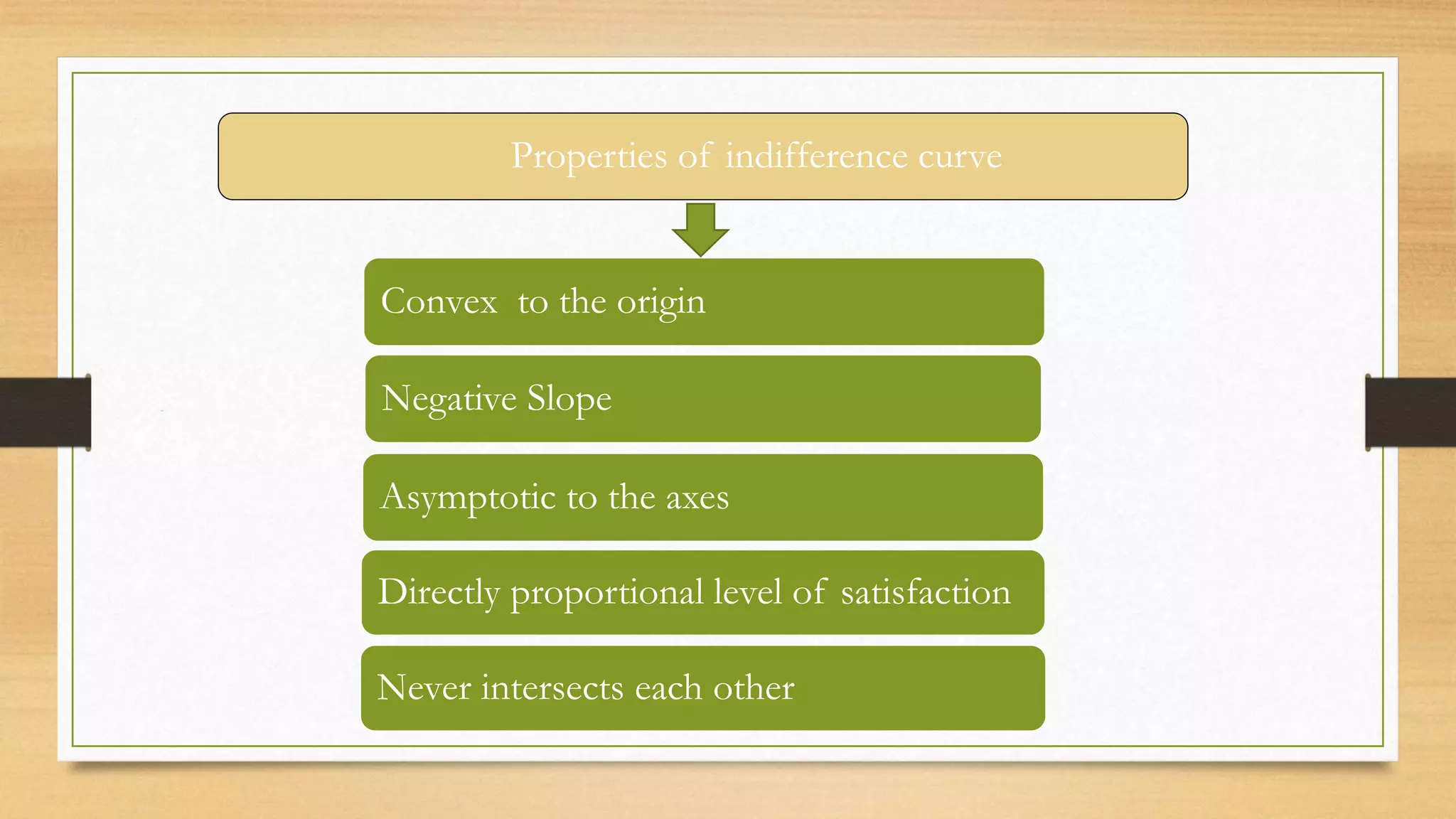
Properties of indifferencecurve
Convex to the origin
Negative Slope
Asymptotic to the axes
Directly proportional level of satisfaction
Never intersects each other
Marginal rate ofsubstitution
(MRS)
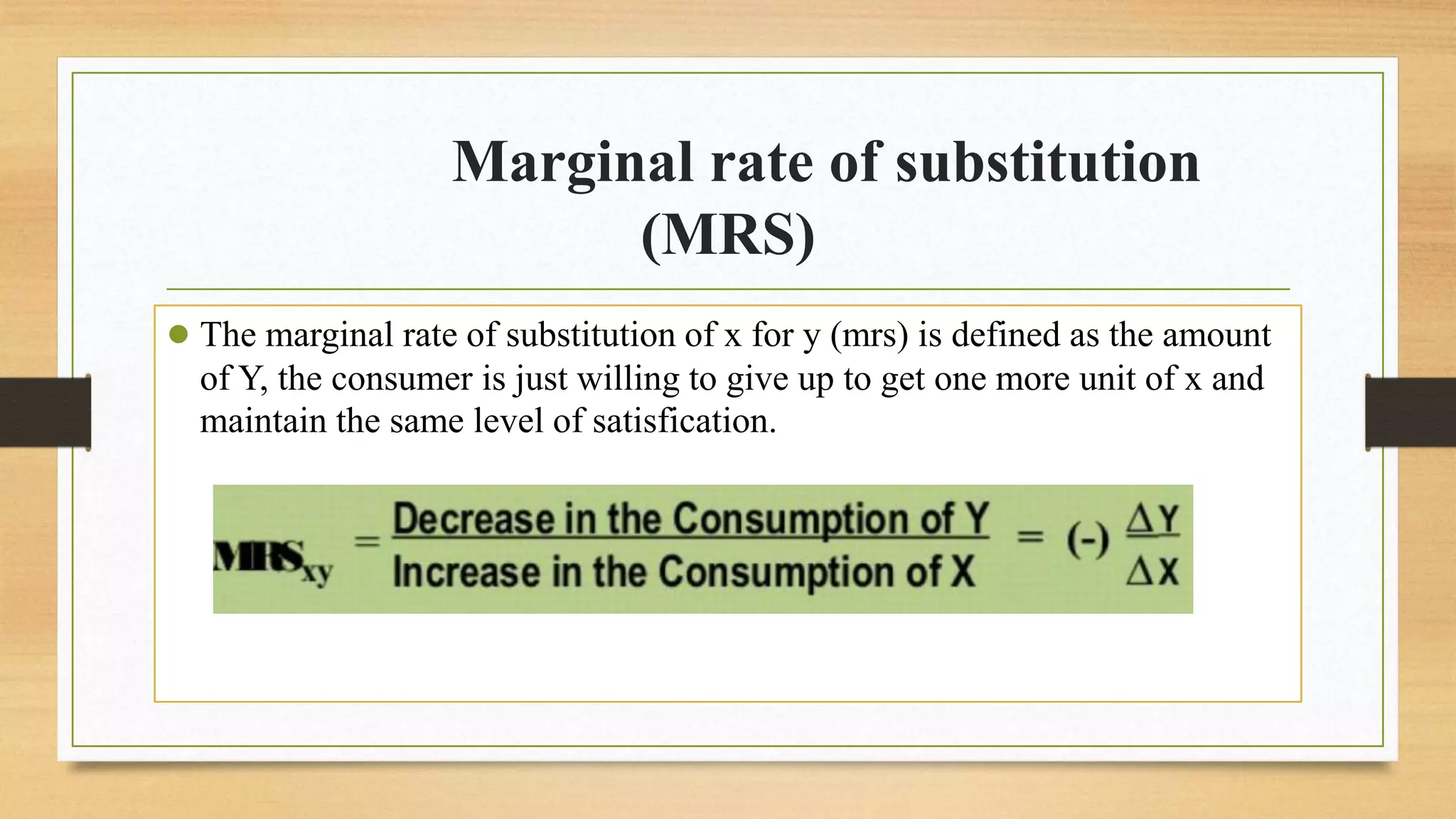
● The marginal rate of substitution of x for y (mrs) is defined as the amount
of Y, the consumer is just willing to give up to get one more unit of x and
maintain the same level of satisfication.
11.
DIMINISHING MARGINAL RATEOF
SUBSTITUTION
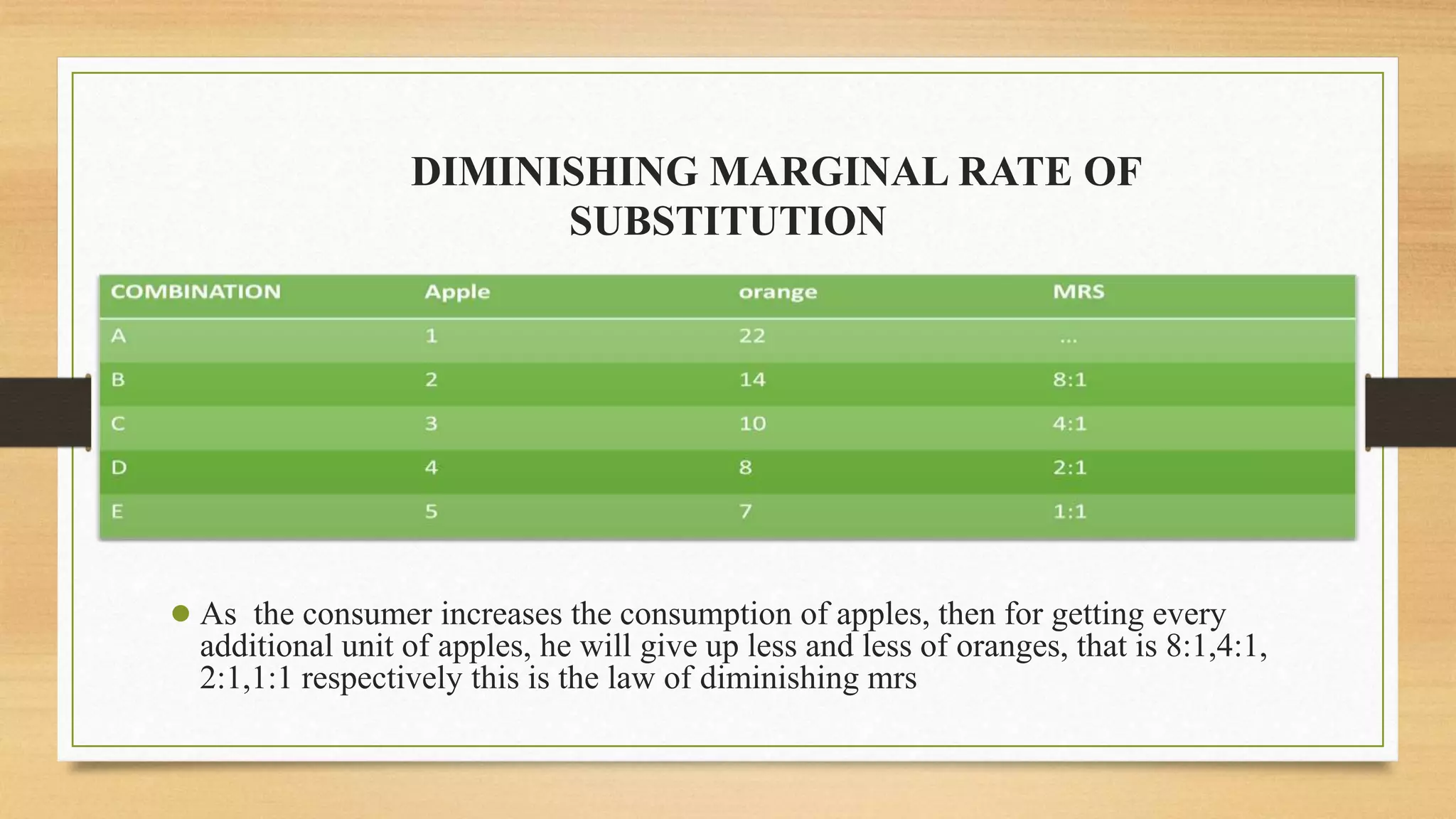
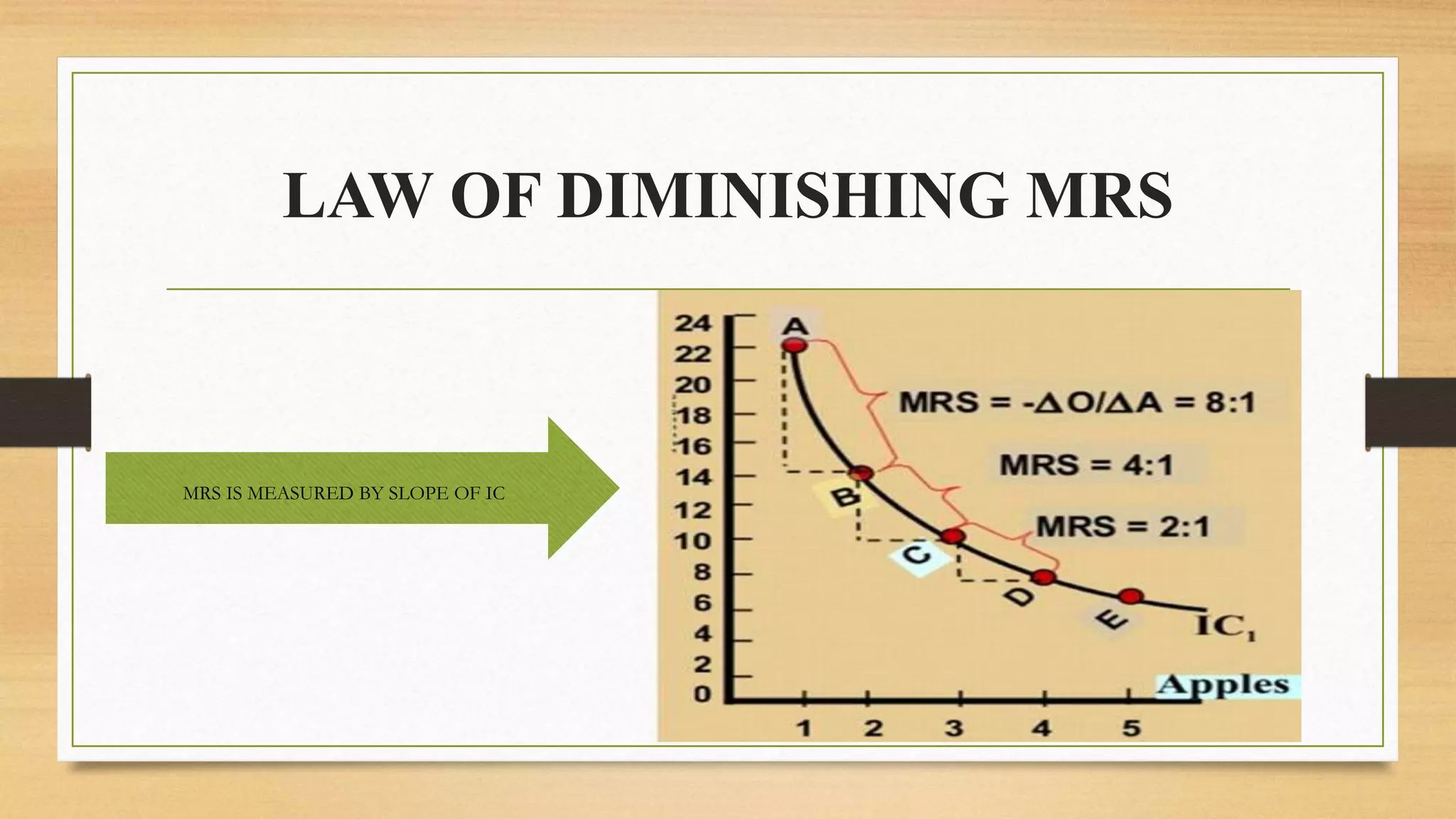
● As the consumer increases the consumption of apples, then for getting every
additional unit of apples, he will give up less and less of oranges, that is 8:1,4:1,
2:1,1:1 respectively this is the law of diminishing mrs
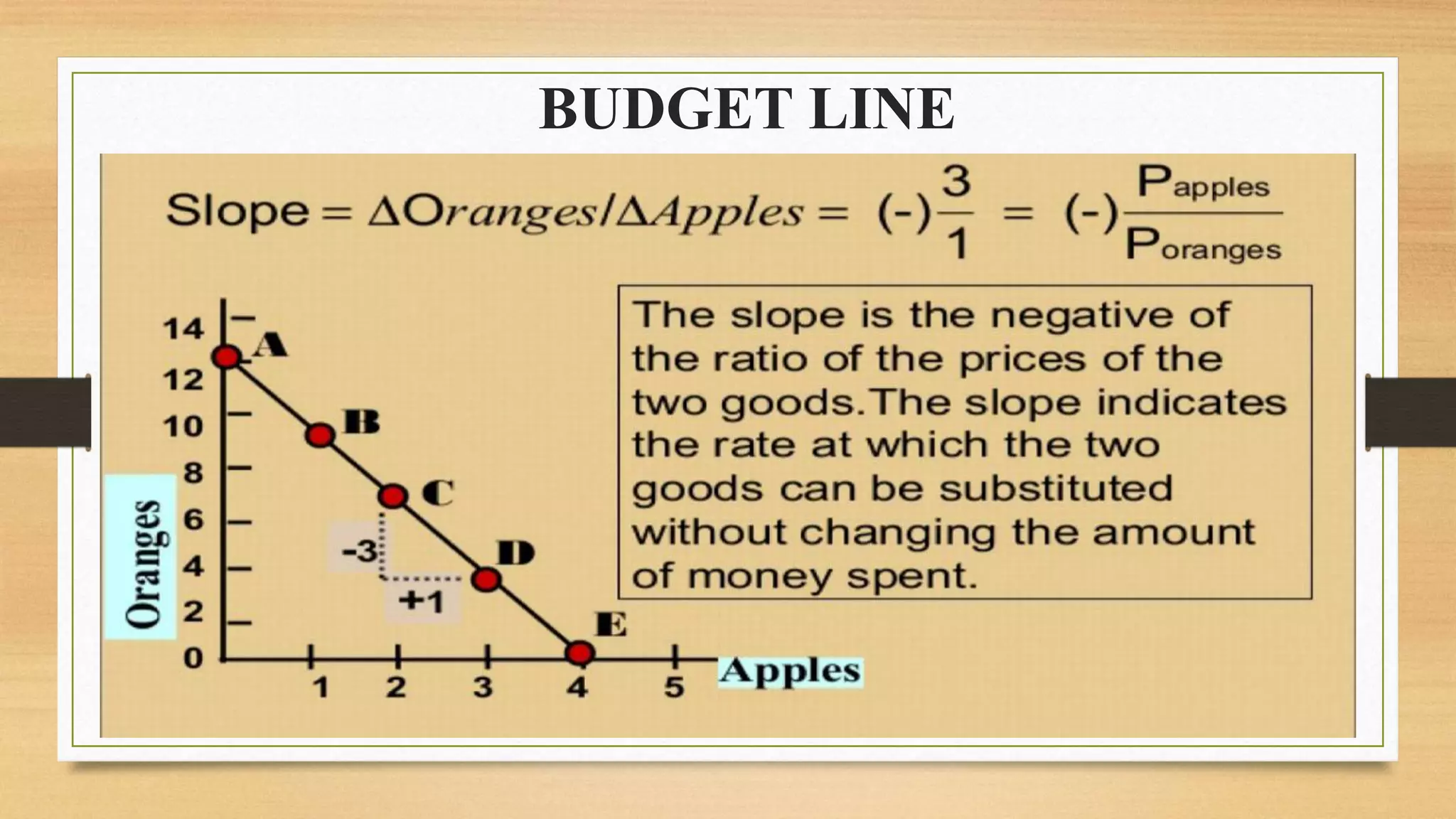
BUDGET LINE ORPRICE LINE
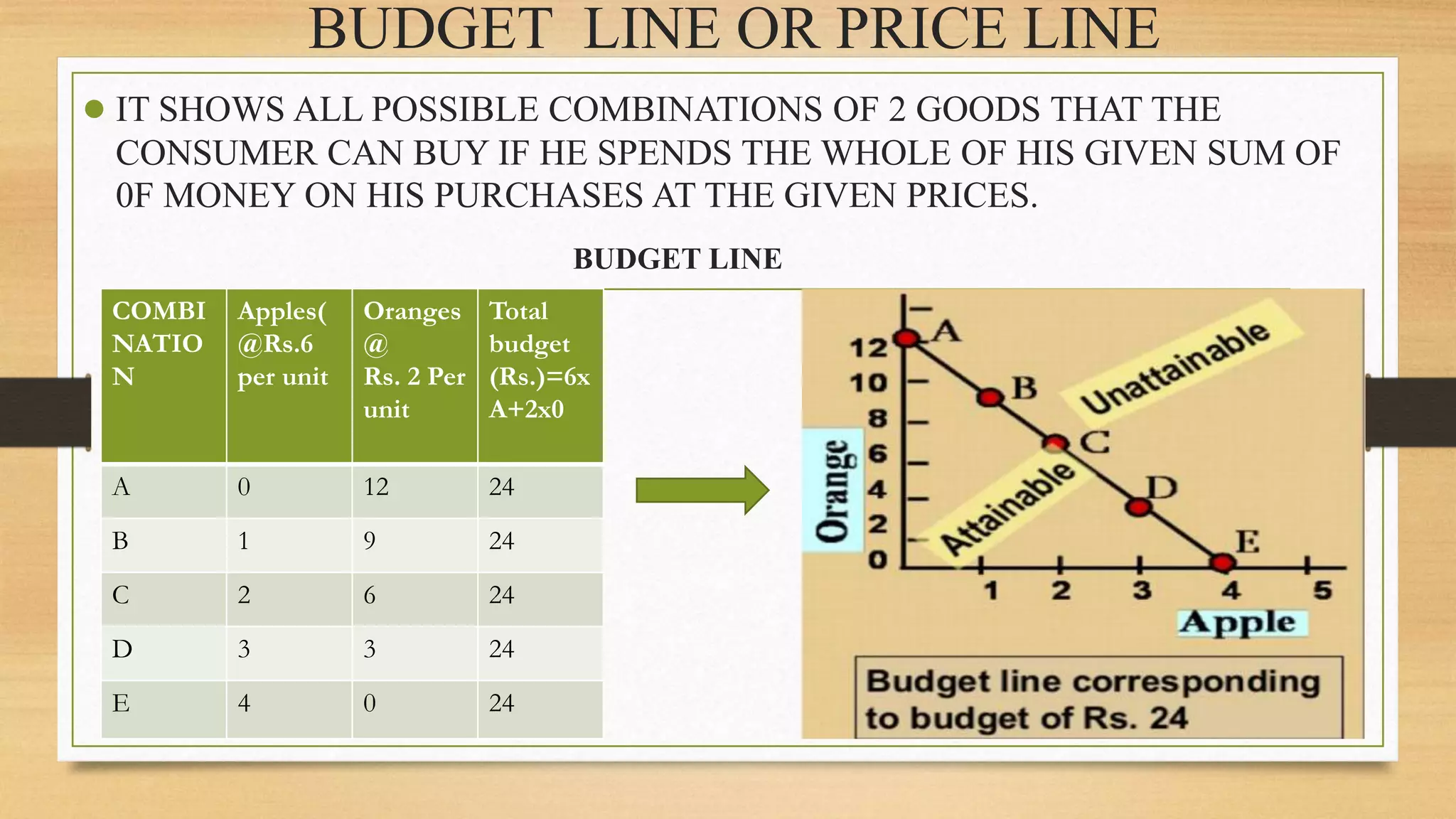
● IT SHOWS ALL POSSIBLE COMBINATIONS OF 2 GOODS THAT THE
CONSUMER CAN BUY IF HE SPENDS THE WHOLE OF HIS GIVEN SUM OF
0F MONEY ON HIS PURCHASES AT THE GIVEN PRICES.
BUDGET LINE
COMBI
NATIO
N
Apples(
@Rs.6
per unit
Oranges
@
Rs. 2 Per
unit
Total
budget
(Rs.)=6x
A+2x0
A 0 12 24
B 1 9 24
C 2 6 24
D 3 3 24
E 4 0 24
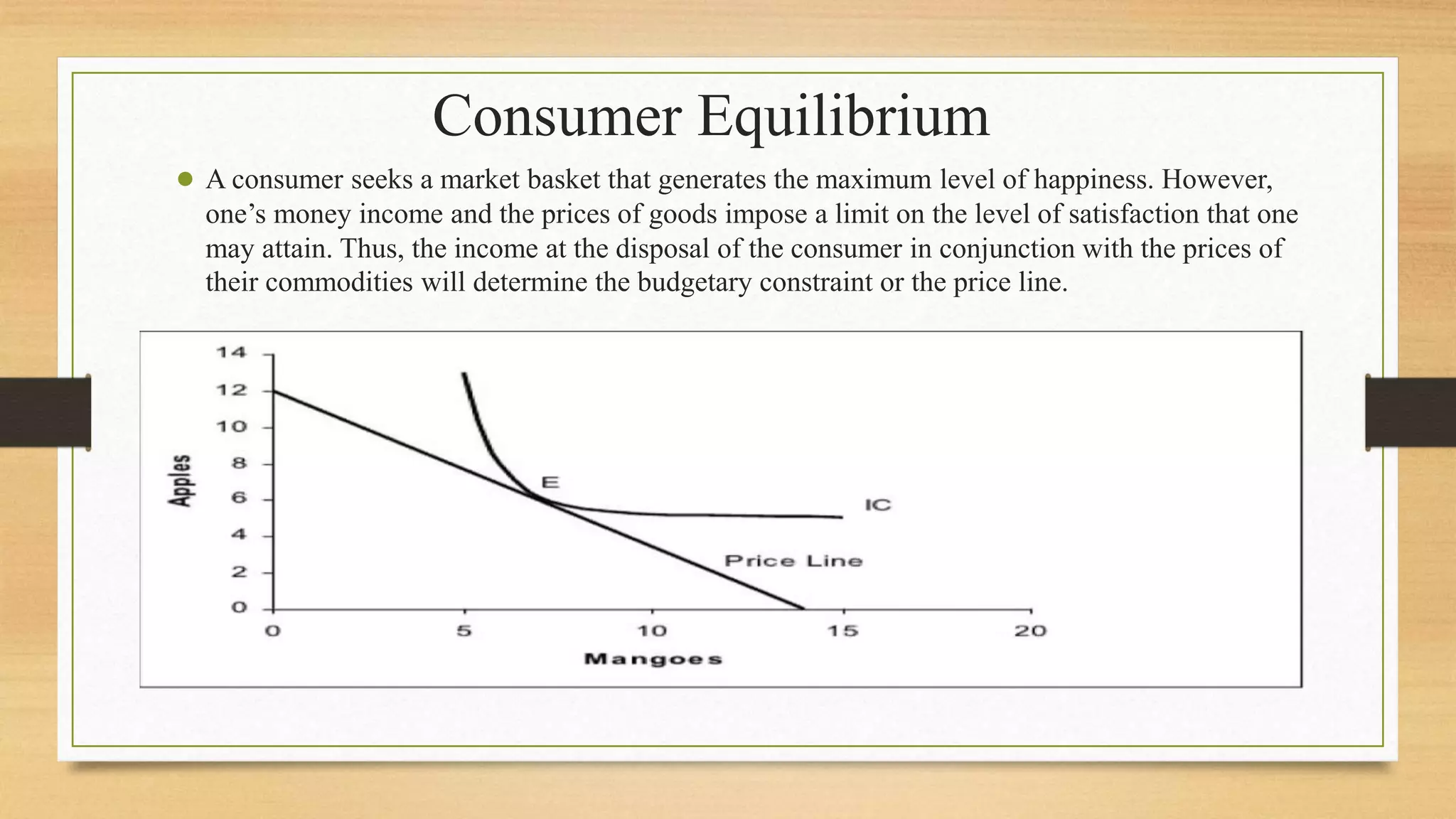
Consumer Equilibrium
● Aconsumer seeks a market basket that generates the maximum level of happiness. However,
one’s money income and the prices of goods impose a limit on the level of satisfaction that one
may attain. Thus, the income at the disposal of the consumer in conjunction with the prices of
their commodities will determine the budgetary constraint or the price line.
16.
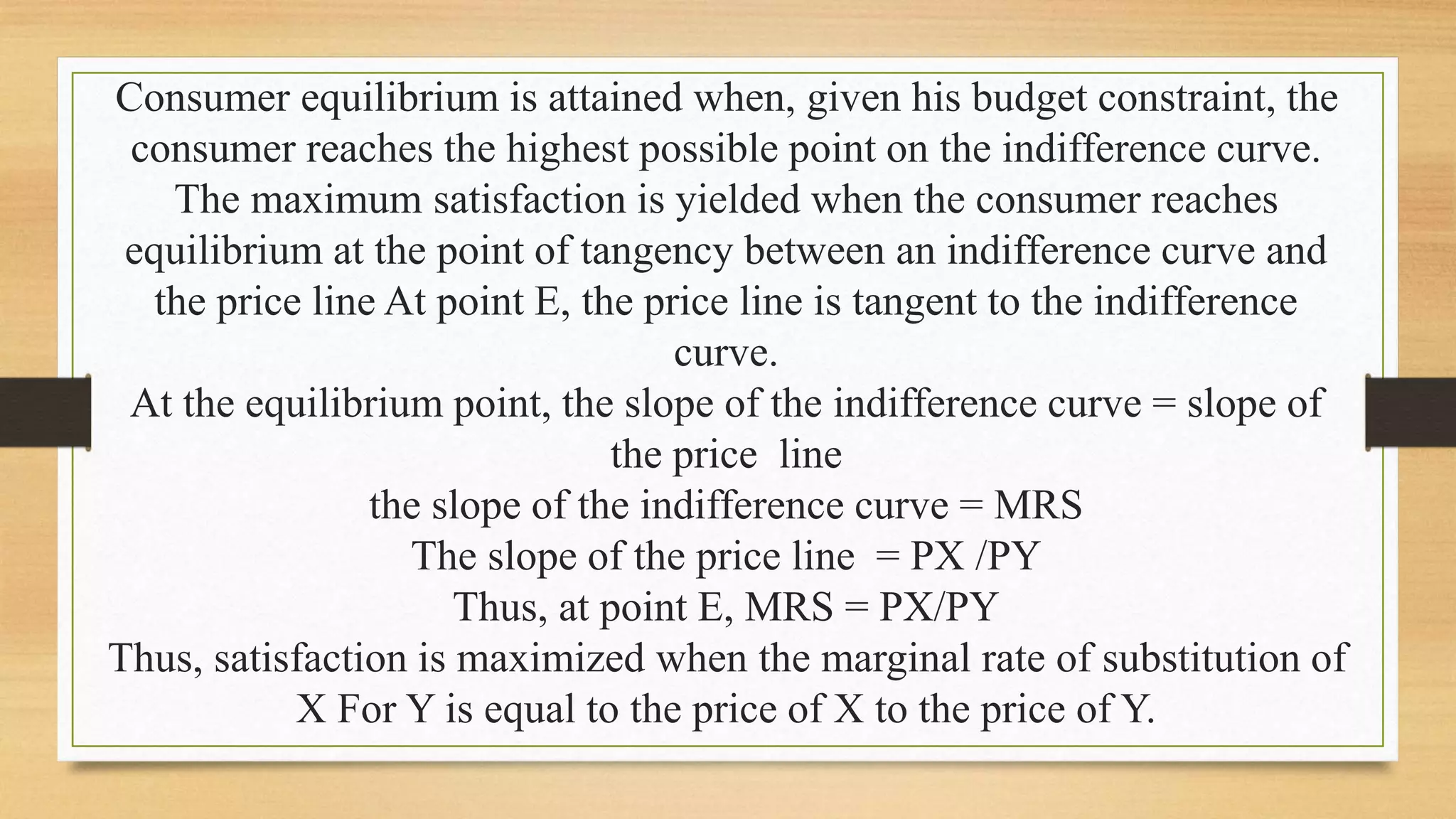
Consumer equilibrium isattained when, given his budget constraint, the
consumer reaches the highest possible point on the indifference curve.
The maximum satisfaction is yielded when the consumer reaches
equilibrium at the point of tangency between an indifference curve and
the price line At point E, the price line is tangent to the indifference
curve.
At the equilibrium point, the slope of the indifference curve = slope of
the price line
the slope of the indifference curve = MRS
The slope of the price line = PX /PY
Thus, at point E, MRS = PX/PY
Thus, satisfaction is maximized when the marginal rate of substitution of
X For Y is equal to the price of X to the price of Y.
17.
ASSUMPTION
● Consumer incomeis constant
● Consumers know the price of all things
● Consumer can spend his income in small quantities
● Consumer is rational
● Consumer is fully aware of the indifference map.
● Goods are divisible.
18.
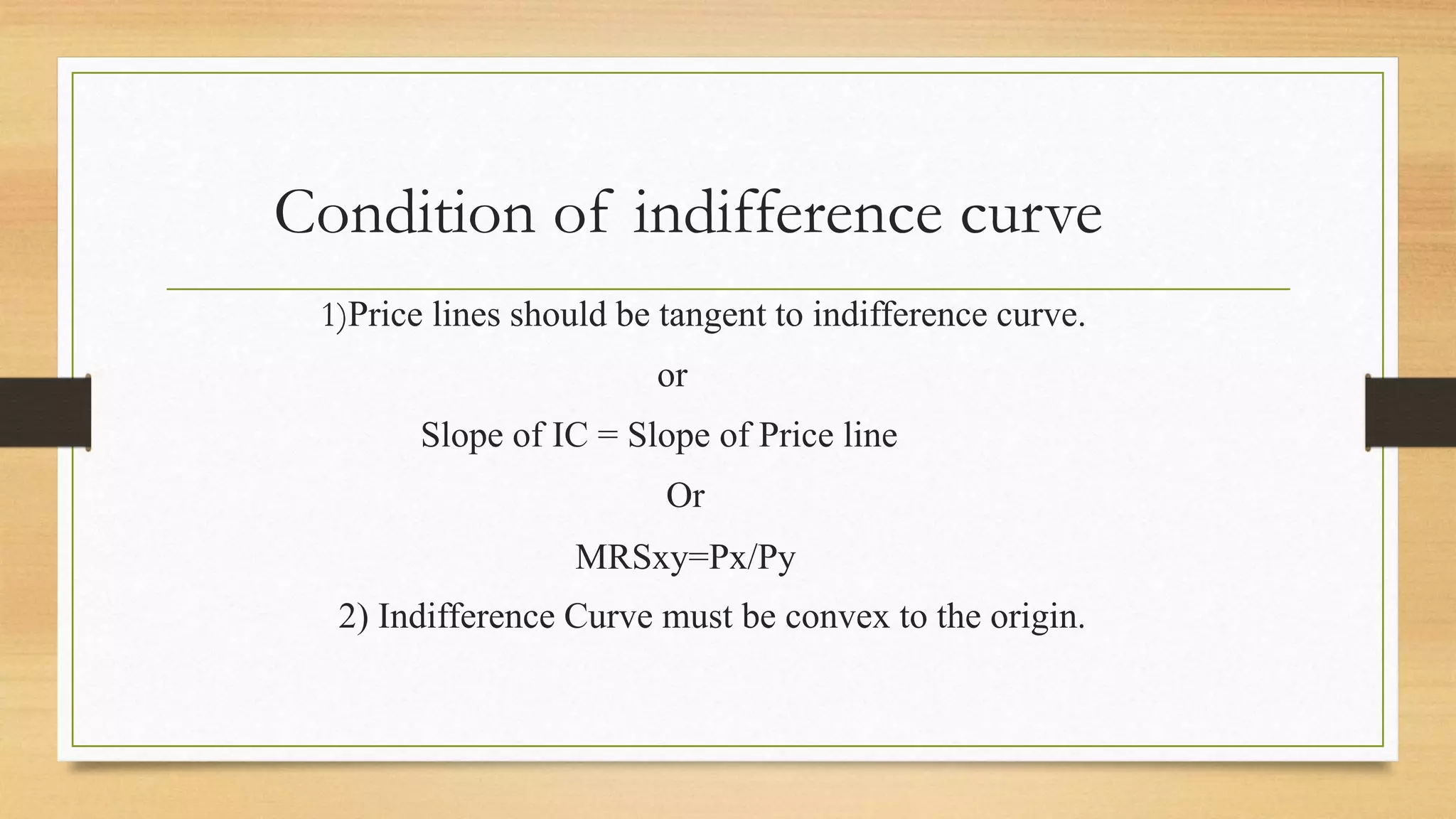
Condition of indifferencecurve
1)Price lines should be tangent to indifference curve.
or
Slope of IC = Slope of Price line
Or
MRSxy=Px/Py
2) Indifference Curve must be convex to the origin.
19.
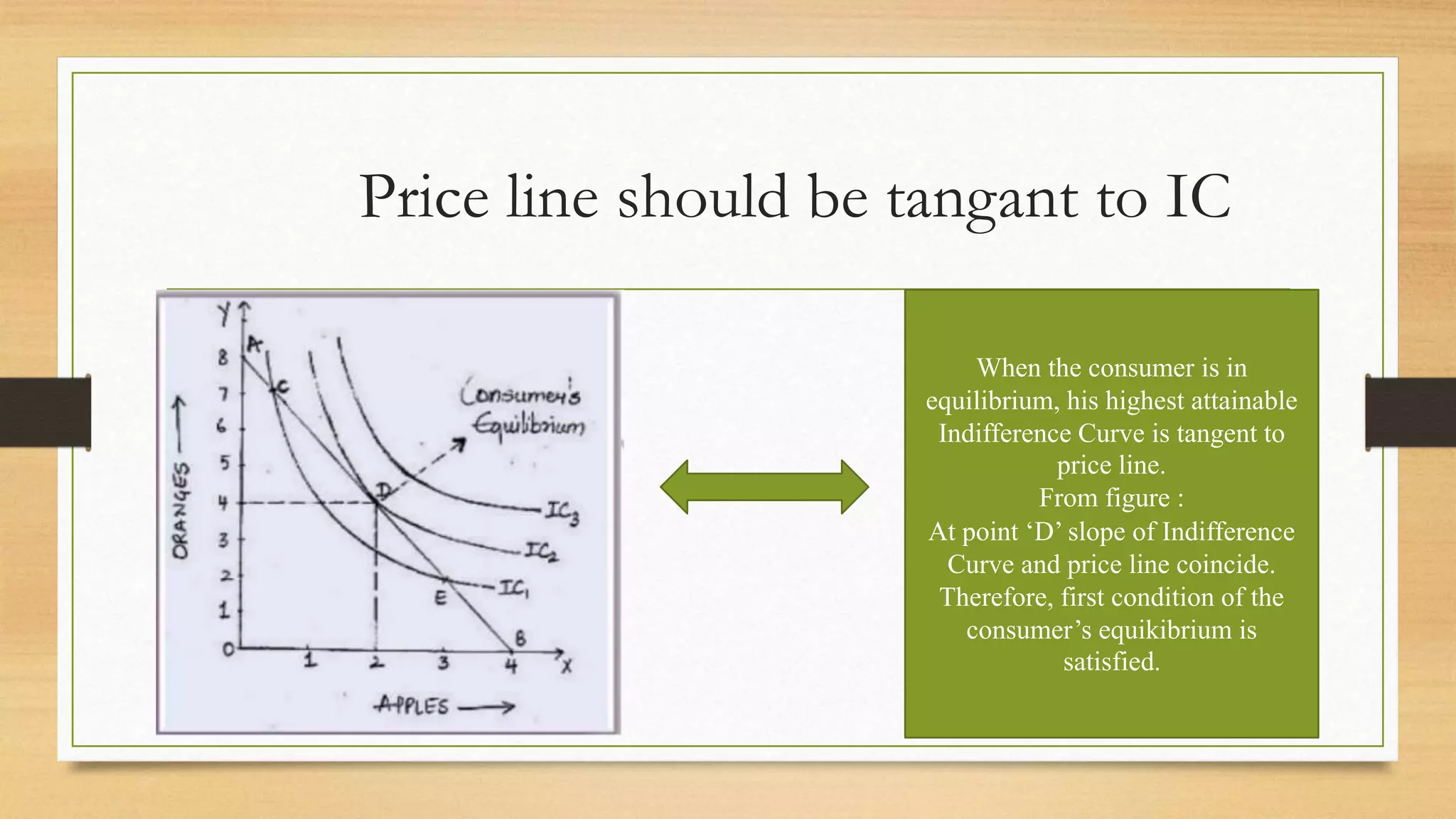
Price line shouldbe tangant to IC
When the consumer is in
equilibrium, his highest attainable
Indifference Curve is tangent to
price line.
From figure :
At point ‘D’ slope of Indifference
Curve and price line coincide.
Therefore, first condition of the
consumer’s equikibrium is
satisfied.
20.
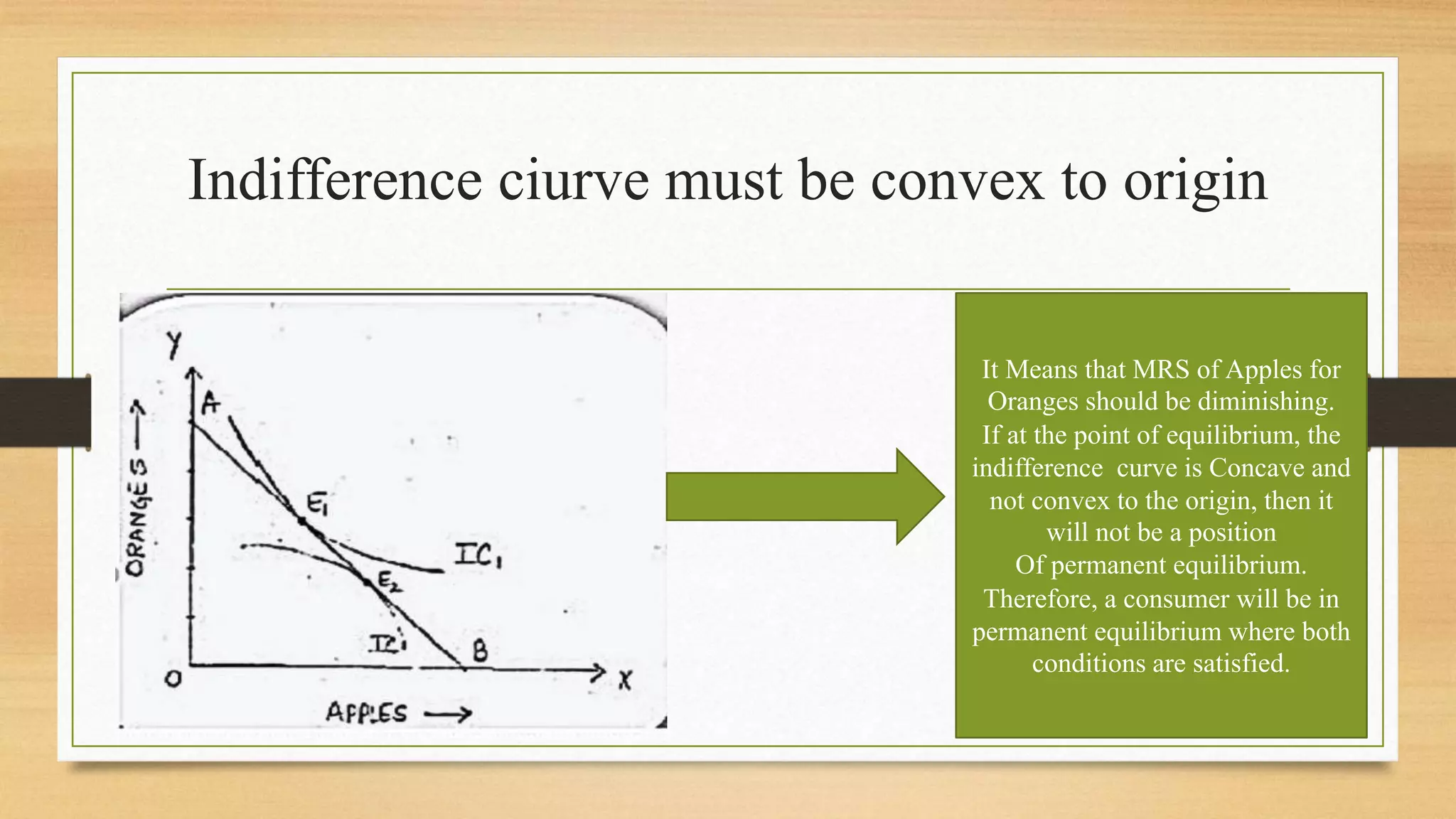
Indifference ciurve mustbe convex to origin
It Means that MRS of Apples for
Oranges should be diminishing.
If at the point of equilibrium, the
indifference curve is Concave and
not convex to the origin, then it
will not be a position
Of permanent equilibrium.
Therefore, a consumer will be in
permanent equilibrium where both
conditions are satisfied.
21.
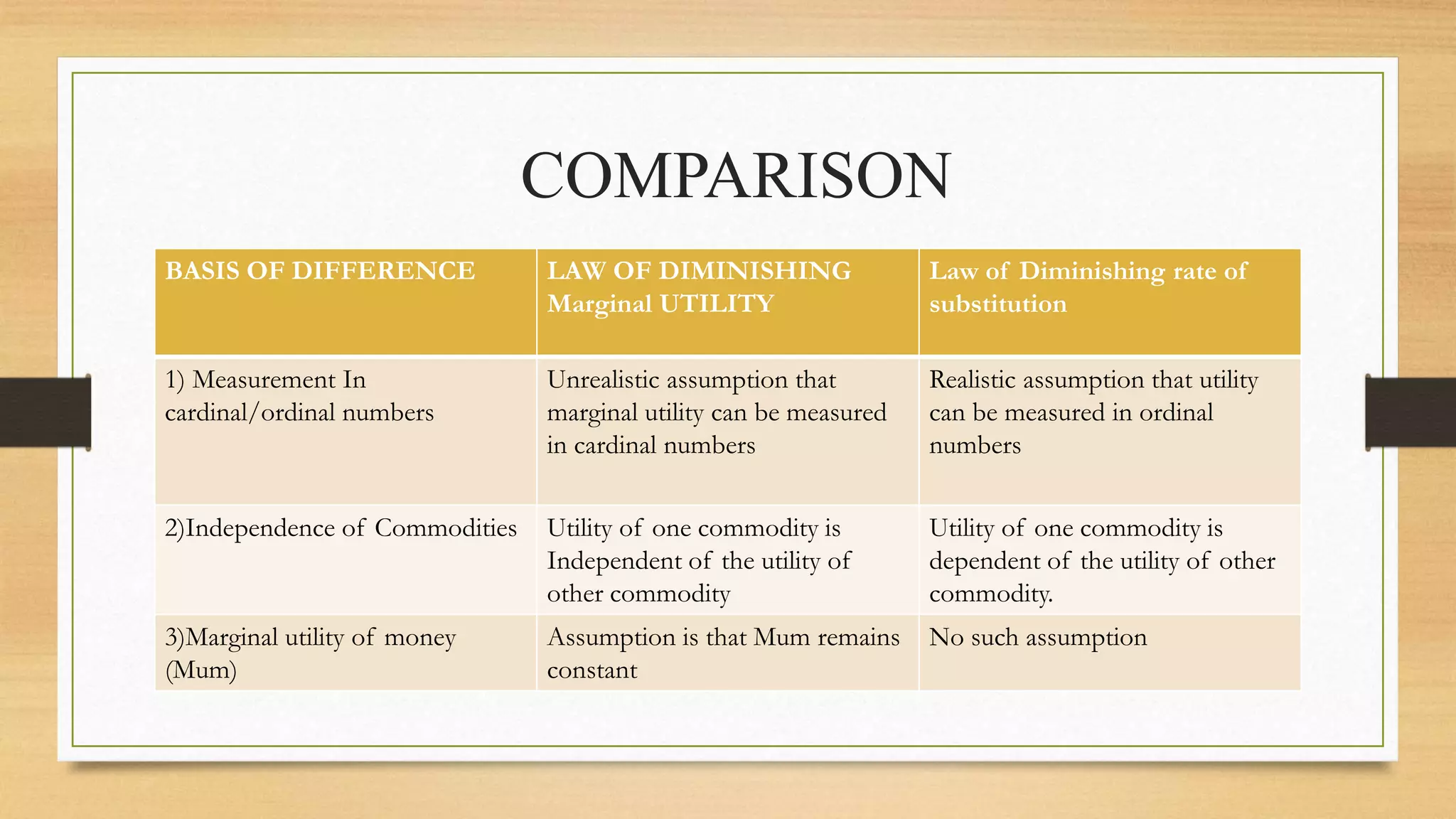
COMPARISON
BASIS OF DIFFERENCELAW OF DIMINISHING
Marginal UTILITY
Law of Diminishing rate of
substitution
1) Measurement In
cardinal/ordinal numbers
Unrealistic assumption that
marginal utility can be measured
in cardinal numbers
Realistic assumption that utility
can be measured in ordinal
numbers
2)Independence of Commodities Utility of one commodity is
Independent of the utility of
other commodity
Utility of one commodity is
dependent of the utility of other
commodity.
3)Marginal utility of money
(Mum)
Assumption is that Mum remains
constant
No such assumption
22.
Criticism of indifferencecurve
●Old wine in a new bottle
●Away from reality
●Consumer is not rational
●Two goods model unrealistic
●All commodities are not divisible