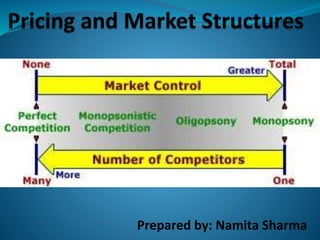
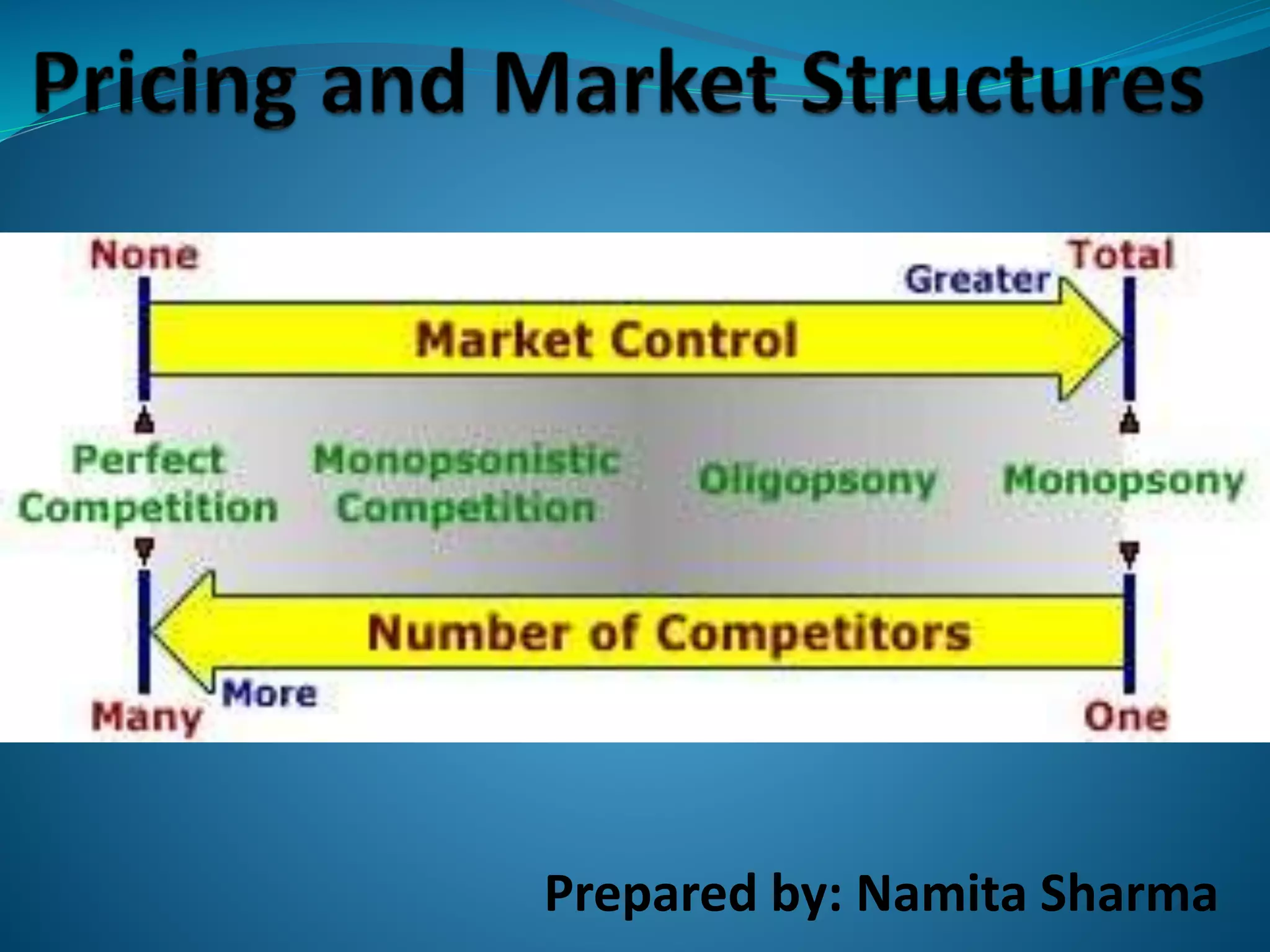



Prepared by: Namita Sharma
Market is a place where buyers and sellers appear to conduct exchange
transactions.
The only requirement of a market is that all potential buyers and sellers
should be in close contact with each other to conduct exchange
transaction.
According to Cournot : “Market is not any particular place in which things
are bought or sold, but the whole of any region in which buyers and sellers
are in such free interaction with each other that the prices of the same
goods tend to equality easily and quickly”.
Basic Features :
 Buyers
 Sellers
 Interaction
 Existence of a commodity
 Price
Market:
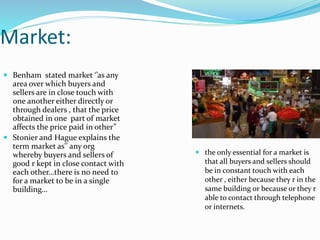
 Benham stated market ‘’as any
area over which buyers and
sellers are in close touch with
one another either directly or
through dealers , that the price
obtained in one part of market
affects the price paid in other”
 Stonier and Hague explains the
term market as'' any org
whereby buyers and sellers of
good r kept in close contact with
each other…there is no need to
for a market to be in a single
building…
 the only essential for a market is
that all buyers and sellers should
be in constant touch with each
other , either because they r in the
same building or because or they r
able to contact through telephone
or internets.
Market Classification
 On the basis of area
 On the basis of nature of transaction
 On basis of volume of business
 On the basis of time
 On the basis of status of seller
 On the basis of regulation
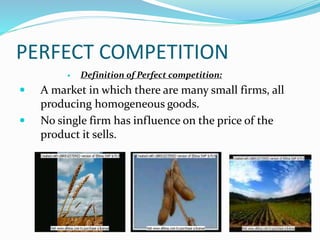
PERFECT COMPETITION
 Definition of Perfect competition:
 A market in which there are many small firms, all
producing homogeneous goods.
 No single firm has influence on the price of the
product it sells.
Perfect competition:
 A very large no of relatively small
buyers and sellers .
• All sellers sell homogenous
products
• The firms are free to enter or leave
the market
• The firms in industry don’t collude
with each other .
• The factors of production must be
free to enter or leave the industry.
• Each buyer and seller operates
under the condition od certainty.
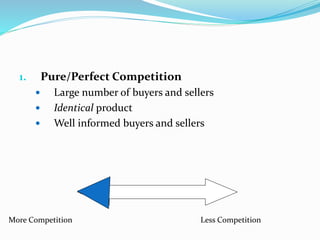
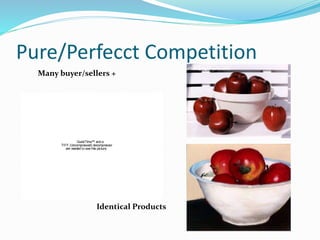
1. Pure/Perfect Competition
 Large number of buyers and sellers
 Identical product
 Well informed buyers and sellers
More Competition Less Competition
Pure/Perfecct Competition
QuickTime™ and a
TIFF (Uncompressed) decompressor
are needed to see this picture.
Many buyer/sellers +
Identical Products
 Feature of Perfect competition
 Many buyers / Many sellers
 Homogeneous Products
 Low-entry / exit barriers
 Perfect information – For both consumers and
producers
 Firms aim to maximize
PERFECT COMPETITION
 Advantages of perfect competition:
 High degree of competition helps allocate resources
to most efficient use
 Price = marginal costs
 Competition encourages efficiency
 Firms operate at maximum efficiency
 Consumers benefit: consumers charged a lower price
 Responsive to consumer wishes: Change in demand,
leads extra supply
PERFECT COMPETITION
 Disadvantage of perfect competition:
 The conditions for perfect competition are very strict,
there are few perfectly competitive markets
 Insufficient profits for investment
 Lack of product variety
 Lack of competition over product design and
specification
 Unequal distribution of goods & income
 Externalities e.g. Pollution
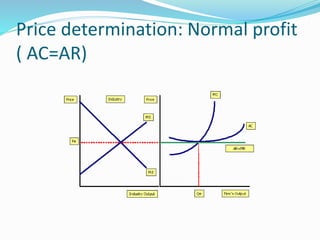
Price determination: Normal profit
( AC=AR)
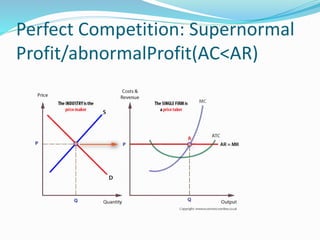
Perfect Competition: Supernormal
Profit/abnormalProfit(AC<AR)
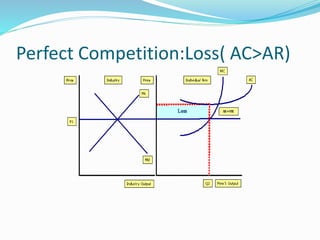
Perfect Competition:Loss( AC>AR)
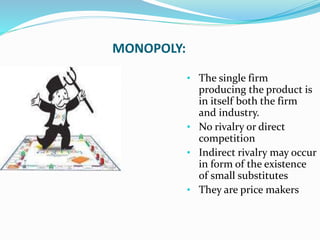
MONOPOLY:
• The single firm
producing the product is
in itself both the firm
and industry.
• No rivalry or direct
competition
• Indirect rivalry may occur
in form of the existence
of small substitutes
• They are price makers
Monopoly
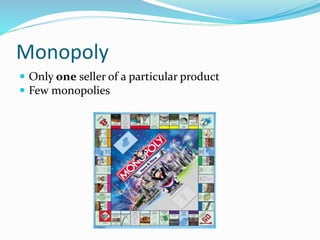
 Only one seller of a particular product
 Few monopolies
Monopoly
 One seller dominates the market with no close
substitutes
More Competition Less Competition
Monopoly
 Natural Monopoly -
efficient production
by a single supplier
 San Diego Gas &
Electric
Monopoly
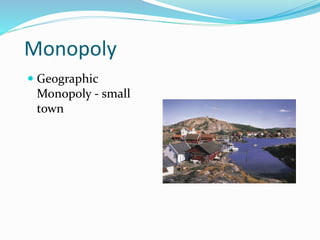
 Geographic
Monopoly - small
town
Monopoly
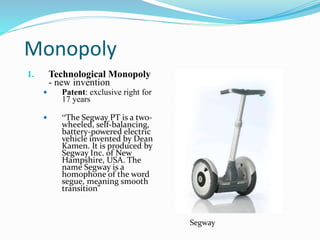
1. Technological Monopoly
- new invention
 Patent: exclusive right for
17 years
 “The Segway PT is a two-
wheeled, self-balancing,
battery-powered electric
vehicle invented by Dean
Kamen. It is produced by
Segway Inc. of New
Hampshire, USA. The
name Segway is a
homophone of the word
segue, meaning smooth
transition”
Segway
Monopoly
1. Technological
Monopoly - new
invention
 Copyright: lifetime + 50
years
 “The National Football
League is a professional
American football
league that constitutes
one of the four major
professional sports
leagues in North
America”
This telecast is copyrighted by the NFL for the private use of our audience. Any
other use of this telecast or of any pictures, descriptions, or accounts of the
game without the NFL’s consent, is prohibited.
Monopoly
1. Government
Monopoly -
government owned
businesses
MONOPOLY’S CHARACTERISTICS
 A single firm selling all output in a market : it is a
direct contrast to perfect competition.
 Unique product:
 Barriers to Entry and Exit.
 Government license or franchise
 Resource ownership
 Patent and copyrights
 High start- up cost
 Decreasing average total cost
 Specialized information
Indian railways: as Monopoly
ADVANTAGES OF MONOPOLY
 Import the products and compete with foreign
companies
 Complete freedom in selecting prices or quantity
 No guarantee of profitability........ there is only one firm
DISADVANTAGES OF MONOPOLY
 The prices charged even increase prices
 Reduce the quality of the products
 Reduce the satisfaction of the customers
 Cause many disadvantages for the employees of the
company
Origin of monopoly :
 Patent rights for products
 Gov. policies such as granting licenses or imposing
foreign trade restrictions.
 Ownership and control over some strategic raw
materials
 Exclusive knowledge of technology by the firms.
 Size of the market can accommodate a single firm
 Prevention of entries
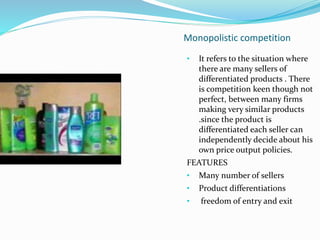
Monopolistic competition
• It refers to the situation where
there are many sellers of
differentiated products . There
is competition keen though not
perfect, between many firms
making very similar products
.since the product is
differentiated each seller can
independently decide about his
own price output policies.
FEATURES
• Many number of sellers
• Product differentiations
• freedom of entry and exit
MONOPOLISTIC COMPETITION
What is Monopolistic Competition?
Monopolistic Competition, also called competitive
market, where there are a large number of
independent firms which have a very small
proportion of the market share
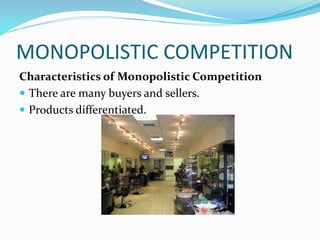
MONOPOLISTIC COMPETITION
Characteristics of Monopolistic Competition
 There are many buyers and sellers.
 Products differentiated.
MONOPOLISTIC COMPETITION
There are few barriers to entry and exit.
Each firms may have a tiny “monopoly”.
Firm has some control over price.
MONOPOLISTIC COMPETITION
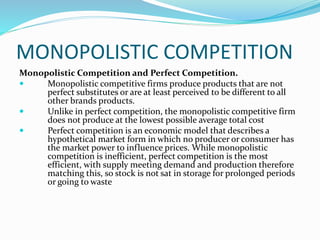
Monopolistic Competition and Perfect Competition.
 Monopolistic competitive firms produce products that are not
perfect substitutes or are at least perceived to be different to all
other brands products.
 Unlike in perfect competition, the monopolistic competitive firm
does not produce at the lowest possible average total cost
 Perfect competition is an economic model that describes a
hypothetical market form in which no producer or consumer has
the market power to influence prices. While monopolistic
competition is inefficient, perfect competition is the most
efficient, with supply meeting demand and production therefore
matching this, so stock is not sat in storage for prolonged periods
or going to waste
 Price difference with in price range
 Increase elasticity of demand
 Price war
 Gift articles
 Unfair methods
Price discrimination
 It is said to exist when the same product is sold for
different prices to different buyers. Conditions for
price dicr. Are:
 Difference in price elastisities.
 Market segmentation
 Efficient separation of sub markets
 Legal sanction for price discrimination
 Various brands
 Some buyers are ignorant or lack mobility
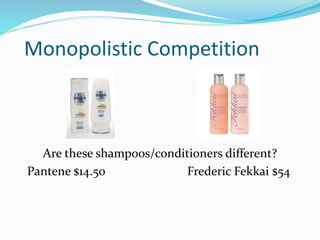
Monopolistic Competition
Are these shampoos/conditioners different?
Pantene $14.50 Frederic Fekkai $54
Monopolistic Competition
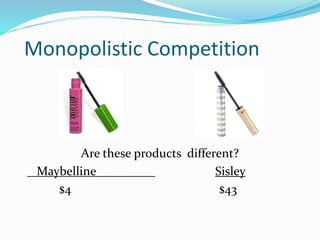
Are these products different?
Maybelline Sisley
$4 $43
Monopolistic Competition
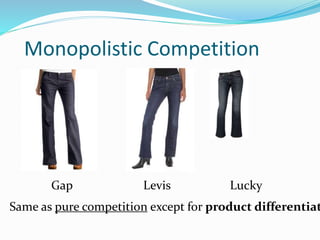
Same as pure competition except for product differentiat
Gap Levis Lucky
MONOPOLISTIC COMPETITION
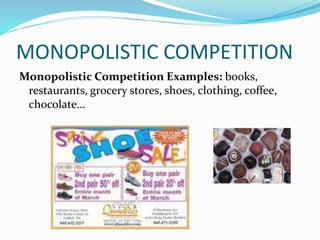
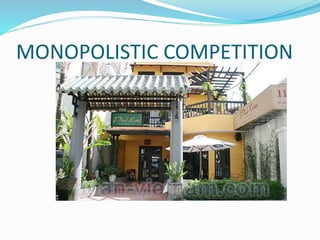
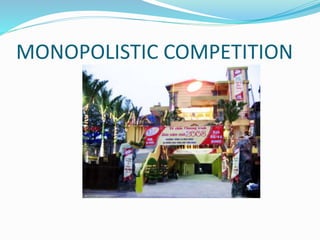
Monopolistic Competition Examples: books,
restaurants, grocery stores, shoes, clothing, coffee,
chocolate…
MONOPOLISTIC COMPETITION
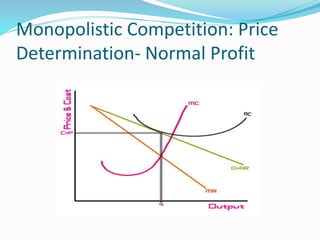
Monopolistic Competition: Price
Determination- Normal Profit
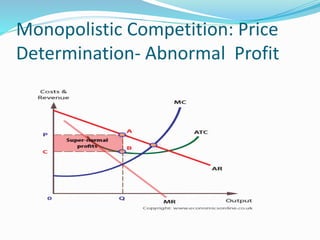
Monopolistic Competition: Price
Determination- Abnormal Profit
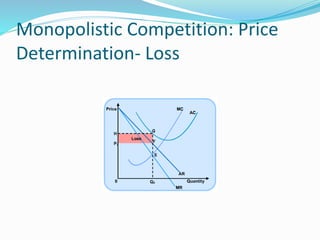
Monopolistic Competition: Price
Determination- Loss
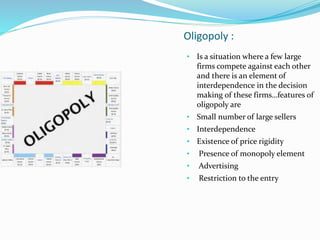
Oligopoly :
• Is a situation where a few large
firms compete against each other
and there is an element of
interdependence in the decision
making of these firms…features of
oligopoly are
• Small number of large sellers
• Interdependence
• Existence of price rigidity
• Presence of monopoly element
• Advertising
• Restriction to the entry
Oligopoly
 A few very large sellers dominate the industry
 Oligopolists act independently by lowering prices
soon after the first seller announces the cut
 Collusion: formally agree to set prices
 Engage in price wars
More Competition Less Competition
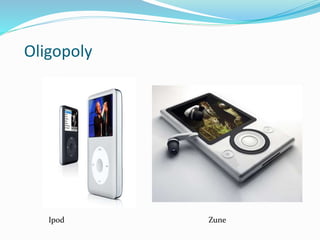
Oligopoly
Ipod Zune
Oligopoly
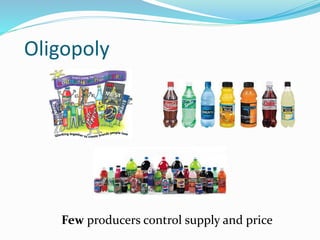
Few producers control supply and price
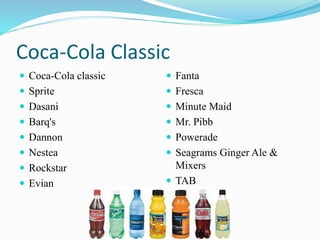
Coca-Cola Classic
 Coca-Cola classic
 Sprite
 Dasani
 Barq's
 Dannon
 Nestea
 Rockstar
 Evian
 Fanta
 Fresca
 Minute Maid
 Mr. Pibb
 Powerade
 Seagrams Ginger Ale &
Mixers
 TAB
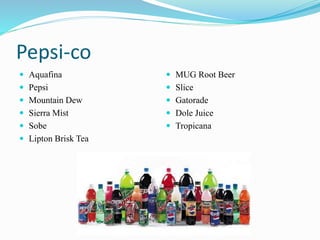
Pepsi-co
 Aquafina
 Pepsi
 Mountain Dew
 Sierra Mist
 Sobe
 Lipton Brisk Tea
 MUG Root Beer
 Slice
 Gatorade
 Dole Juice
 Tropicana
Cadbury
 Canada Dry
 Clamato
 Dr Pepper
 Hawaiian
Punch
 Mott's
 Orangina
 Snapple
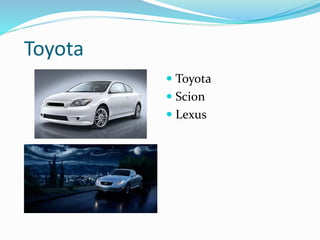
Toyota
 Toyota
 Scion
 Lexus
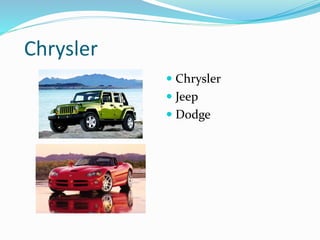
Chrysler
 Chrysler
 Jeep
 Dodge
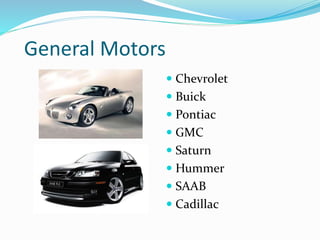
General Motors
 Chevrolet
 Buick
 Pontiac
 GMC
 Saturn
 Hummer
 SAAB
 Cadillac
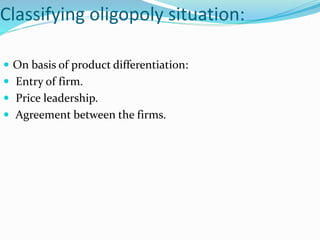
Classifying oligopoly situation:
 On basis of product differentiation:
 Entry of firm.
 Price leadership.
 Agreement between the firms.
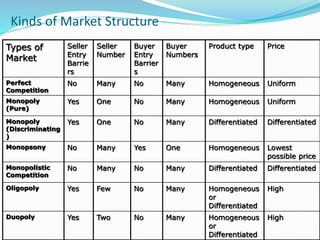
Kinds of Market Structure
Types of
Market
Seller
Entry
Barrie
rs
Seller
Number
Buyer
Entry
Barrier
s
Buyer
Numbers
Product type Price
Perfect
Competition
No Many No Many Homogeneous Uniform
Monopoly
(Pure)
Yes One No Many Homogeneous Uniform
Monopoly
(Discriminating
)
Yes One No Many Differentiated Differentiated
Monopsony No Many Yes One Homogeneous Lowest
possible price
Monopolistic
Competition
No Many No Many Differentiated Differentiated
Oligopoly Yes Few No Many Homogeneous
or
Differentiated
High
Duopoly Yes Two No Many Homogeneous
or
Differentiated
High
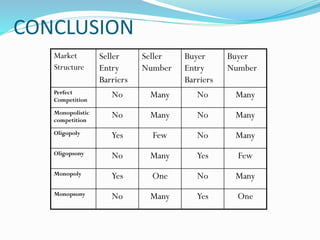
CONCLUSION
Market
Structure
Seller
Entry
Barriers
Seller
Number
Buyer
Entry
Barriers
Buyer
Number
Perfect
Competition
No Many No Many
Monopolistic
competition
No Many No Many
Oligopoly Yes Few No Many
Oligopsony No Many Yes Few
Monopoly Yes One No Many
Monopsony No Many Yes One
Pricing and markets

Pricing and markets

  • 1.
  • 2.
    Market is aplace where buyers and sellers appear to conduct exchange transactions. The only requirement of a market is that all potential buyers and sellers should be in close contact with each other to conduct exchange transaction. According to Cournot : “Market is not any particular place in which things are bought or sold, but the whole of any region in which buyers and sellers are in such free interaction with each other that the prices of the same goods tend to equality easily and quickly”. Basic Features :  Buyers  Sellers  Interaction  Existence of a commodity  Price
  • 3.
    Market:  Benham statedmarket ‘’as any area over which buyers and sellers are in close touch with one another either directly or through dealers , that the price obtained in one part of market affects the price paid in other”  Stonier and Hague explains the term market as'' any org whereby buyers and sellers of good r kept in close contact with each other…there is no need to for a market to be in a single building…  the only essential for a market is that all buyers and sellers should be in constant touch with each other , either because they r in the same building or because or they r able to contact through telephone or internets.
  • 4.
    Market Classification  Onthe basis of area  On the basis of nature of transaction  On basis of volume of business  On the basis of time  On the basis of status of seller  On the basis of regulation
  • 5.
    PERFECT COMPETITION  Definitionof Perfect competition:  A market in which there are many small firms, all producing homogeneous goods.  No single firm has influence on the price of the product it sells.
  • 6.
    Perfect competition:  Avery large no of relatively small buyers and sellers . • All sellers sell homogenous products • The firms are free to enter or leave the market • The firms in industry don’t collude with each other . • The factors of production must be free to enter or leave the industry. • Each buyer and seller operates under the condition od certainty.
  • 7.
    1. Pure/Perfect Competition Large number of buyers and sellers  Identical product  Well informed buyers and sellers More Competition Less Competition
  • 8.
    Pure/Perfecct Competition QuickTime™ anda TIFF (Uncompressed) decompressor are needed to see this picture. Many buyer/sellers + Identical Products
  • 9.
     Feature ofPerfect competition  Many buyers / Many sellers  Homogeneous Products  Low-entry / exit barriers  Perfect information – For both consumers and producers  Firms aim to maximize
  • 10.
    PERFECT COMPETITION  Advantagesof perfect competition:  High degree of competition helps allocate resources to most efficient use  Price = marginal costs  Competition encourages efficiency  Firms operate at maximum efficiency  Consumers benefit: consumers charged a lower price  Responsive to consumer wishes: Change in demand, leads extra supply
  • 11.
    PERFECT COMPETITION  Disadvantageof perfect competition:  The conditions for perfect competition are very strict, there are few perfectly competitive markets  Insufficient profits for investment  Lack of product variety  Lack of competition over product design and specification  Unequal distribution of goods & income  Externalities e.g. Pollution
  • 12.
  • 13.
  • 14.
  • 15.
    MONOPOLY: • The singlefirm producing the product is in itself both the firm and industry. • No rivalry or direct competition • Indirect rivalry may occur in form of the existence of small substitutes • They are price makers
  • 16.
    Monopoly  Only oneseller of a particular product  Few monopolies
  • 17.
    Monopoly  One sellerdominates the market with no close substitutes More Competition Less Competition
  • 18.
    Monopoly  Natural Monopoly- efficient production by a single supplier  San Diego Gas & Electric
  • 19.
  • 20.
    Monopoly 1. Technological Monopoly -new invention  Patent: exclusive right for 17 years  “The Segway PT is a two- wheeled, self-balancing, battery-powered electric vehicle invented by Dean Kamen. It is produced by Segway Inc. of New Hampshire, USA. The name Segway is a homophone of the word segue, meaning smooth transition” Segway
  • 21.
    Monopoly 1. Technological Monopoly -new invention  Copyright: lifetime + 50 years  “The National Football League is a professional American football league that constitutes one of the four major professional sports leagues in North America” This telecast is copyrighted by the NFL for the private use of our audience. Any other use of this telecast or of any pictures, descriptions, or accounts of the game without the NFL’s consent, is prohibited.
  • 22.
  • 23.
    MONOPOLY’S CHARACTERISTICS  Asingle firm selling all output in a market : it is a direct contrast to perfect competition.  Unique product:  Barriers to Entry and Exit.  Government license or franchise  Resource ownership  Patent and copyrights  High start- up cost  Decreasing average total cost  Specialized information
  • 24.
  • 25.
    ADVANTAGES OF MONOPOLY Import the products and compete with foreign companies  Complete freedom in selecting prices or quantity  No guarantee of profitability........ there is only one firm
  • 26.
    DISADVANTAGES OF MONOPOLY The prices charged even increase prices  Reduce the quality of the products  Reduce the satisfaction of the customers  Cause many disadvantages for the employees of the company
  • 27.
    Origin of monopoly:  Patent rights for products  Gov. policies such as granting licenses or imposing foreign trade restrictions.  Ownership and control over some strategic raw materials  Exclusive knowledge of technology by the firms.  Size of the market can accommodate a single firm  Prevention of entries
  • 28.
    Monopolistic competition • Itrefers to the situation where there are many sellers of differentiated products . There is competition keen though not perfect, between many firms making very similar products .since the product is differentiated each seller can independently decide about his own price output policies. FEATURES • Many number of sellers • Product differentiations • freedom of entry and exit
  • 29.
    MONOPOLISTIC COMPETITION What isMonopolistic Competition? Monopolistic Competition, also called competitive market, where there are a large number of independent firms which have a very small proportion of the market share
  • 30.
    MONOPOLISTIC COMPETITION Characteristics ofMonopolistic Competition  There are many buyers and sellers.  Products differentiated.
  • 31.
    MONOPOLISTIC COMPETITION There arefew barriers to entry and exit. Each firms may have a tiny “monopoly”. Firm has some control over price.
  • 32.
    MONOPOLISTIC COMPETITION Monopolistic Competitionand Perfect Competition.  Monopolistic competitive firms produce products that are not perfect substitutes or are at least perceived to be different to all other brands products.  Unlike in perfect competition, the monopolistic competitive firm does not produce at the lowest possible average total cost  Perfect competition is an economic model that describes a hypothetical market form in which no producer or consumer has the market power to influence prices. While monopolistic competition is inefficient, perfect competition is the most efficient, with supply meeting demand and production therefore matching this, so stock is not sat in storage for prolonged periods or going to waste
  • 33.
     Price differencewith in price range  Increase elasticity of demand  Price war  Gift articles  Unfair methods
  • 34.
    Price discrimination  Itis said to exist when the same product is sold for different prices to different buyers. Conditions for price dicr. Are:  Difference in price elastisities.  Market segmentation  Efficient separation of sub markets  Legal sanction for price discrimination  Various brands  Some buyers are ignorant or lack mobility
  • 35.
    Monopolistic Competition Are theseshampoos/conditioners different? Pantene $14.50 Frederic Fekkai $54
  • 36.
    Monopolistic Competition Are theseproducts different? Maybelline Sisley $4 $43
  • 37.
    Monopolistic Competition Same aspure competition except for product differentiat Gap Levis Lucky
  • 38.
    MONOPOLISTIC COMPETITION Monopolistic CompetitionExamples: books, restaurants, grocery stores, shoes, clothing, coffee, chocolate…
  • 39.
  • 40.
  • 41.
  • 42.
  • 43.
  • 44.
  • 45.
  • 46.
    Oligopoly : • Isa situation where a few large firms compete against each other and there is an element of interdependence in the decision making of these firms…features of oligopoly are • Small number of large sellers • Interdependence • Existence of price rigidity • Presence of monopoly element • Advertising • Restriction to the entry
  • 47.
    Oligopoly  A fewvery large sellers dominate the industry  Oligopolists act independently by lowering prices soon after the first seller announces the cut  Collusion: formally agree to set prices  Engage in price wars More Competition Less Competition
  • 48.
  • 49.
  • 50.
    Coca-Cola Classic  Coca-Colaclassic  Sprite  Dasani  Barq's  Dannon  Nestea  Rockstar  Evian  Fanta  Fresca  Minute Maid  Mr. Pibb  Powerade  Seagrams Ginger Ale & Mixers  TAB
  • 51.
    Pepsi-co  Aquafina  Pepsi Mountain Dew  Sierra Mist  Sobe  Lipton Brisk Tea  MUG Root Beer  Slice  Gatorade  Dole Juice  Tropicana
  • 52.
    Cadbury  Canada Dry Clamato  Dr Pepper  Hawaiian Punch  Mott's  Orangina  Snapple
  • 53.
  • 54.
  • 55.
    General Motors  Chevrolet Buick  Pontiac  GMC  Saturn  Hummer  SAAB  Cadillac
  • 56.
    Classifying oligopoly situation: On basis of product differentiation:  Entry of firm.  Price leadership.  Agreement between the firms.
  • 57.
    Kinds of MarketStructure Types of Market Seller Entry Barrie rs Seller Number Buyer Entry Barrier s Buyer Numbers Product type Price Perfect Competition No Many No Many Homogeneous Uniform Monopoly (Pure) Yes One No Many Homogeneous Uniform Monopoly (Discriminating ) Yes One No Many Differentiated Differentiated Monopsony No Many Yes One Homogeneous Lowest possible price Monopolistic Competition No Many No Many Differentiated Differentiated Oligopoly Yes Few No Many Homogeneous or Differentiated High Duopoly Yes Two No Many Homogeneous or Differentiated High
  • 58.
    CONCLUSION Market Structure Seller Entry Barriers Seller Number Buyer Entry Barriers Buyer Number Perfect Competition No Many NoMany Monopolistic competition No Many No Many Oligopoly Yes Few No Many Oligopsony No Many Yes Few Monopoly Yes One No Many Monopsony No Many Yes One