MARKET EQUILIBRIUM
Prof. Prabha Panth
17-04-201617/04/2016 Prabha Panth
What determines market price?
• Classical economists: cost of production
determines market price.
• Utilitarians thought that demand determined
market price.
• Marshall pointed out that both D and S are
needed to determine market price.
• D and S are like two blades of a pair of
scissors, both are needed to cut material.
217/04/2016 Prabha Panth
Market
• Market is where willing buyers meet willing
sellers, for exchange of goods and services.
• Could be local, national or international markets.
• Refers to Perfect Competition, or a Free Market,
without Government controls.
• Both buyers and sellers agree to the market price.
• At equilibrium, Qd = Qs.
• The market is cleared, i.e. at the given price there
is no surplus of supply,
• Or unsatisfied demand, or shortages.
317/04/2016 Prabha Panth
Market Equilibrium
• Supply and demand are opposing forces.
• When P increases D decreases, but S
increases.
• When P decreases D increases, but S
decreases.
• But there could be one price at which D = S.
• This is the point of Market Equilibrium.
• With Equilibrium P and Equilibrium Q.
417/04/2016 Prabha Panth
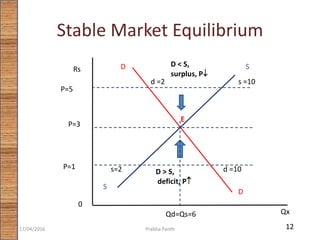
Market Equilibrium
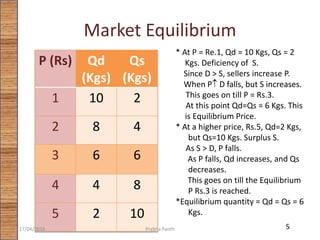
P (Rs) Qd
(Kgs)
Qs
(Kgs)
1 10 2
2 8 4
3 6 6
4 4 8
5 2 10
* At P = Re.1, Qd = 10 Kgs, Qs = 2
Kgs. Deficiency of S.
Since D > S, sellers increase P.
When P D falls, but S increases.
This goes on till P = Rs.3.
At this point Qd=Qs = 6 Kgs. This
is Equilibrium Price.
* At a higher price, Rs.5, Qd=2 Kgs,
but Qs=10 Kgs. Surplus S.
As S > D, P falls.
As P falls, Qd increases, and Qs
decreases.
This goes on till the Equilibrium
P Rs.3 is reached.
*Equilibrium quantity = Qd = Qs = 6
Kgs.
517/04/2016 Prabha Panth
D and S equations
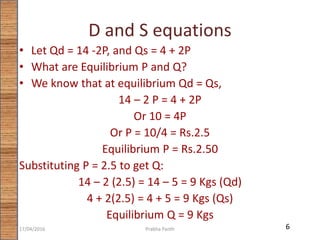
• Let Qd = 14 -2P, and Qs = 4 + 2P
• What are Equilibrium P and Q?
• We know that at equilibrium Qd = Qs,
14 – 2 P = 4 + 2P
Or 10 = 4P
Or P = 10/4 = Rs.2.5
Equilibrium P = Rs.2.50
Substituting P = 2.5 to get Q:
14 – 2 (2.5) = 14 – 5 = 9 Kgs (Qd)
4 + 2(2.5) = 4 + 5 = 9 Kgs (Qs)
Equilibrium Q = 9 Kgs
617/04/2016 Prabha Panth
Equilibrium with Shifts in Demand
Curve
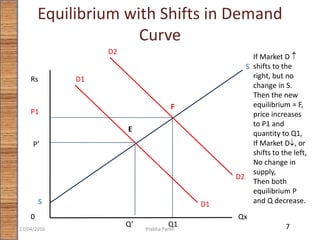
Rs
0 Qx
D1
D1S
S
P’
Q’
E
D2
D2
P1
F
Q1
If Market D 
shifts to the
right, but no
change in S.
Then the new
equilibrium = F,
price increases
to P1 and
quantity to Q1,
If Market D, or
shifts to the left,
No change in
supply,
Then both
equilibrium P
and Q decrease.
717/04/2016 Prabha Panth
Market Equilibrium
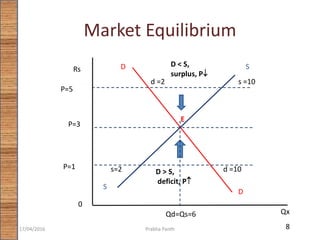
Rs
Qx
0
D
D
S
S
P=5
d =2 s =10
D < S,
surplus, P
P=1 d =10s=2 D > S,
deficit, P
P=3
E
Qd=Qs=6
817/04/2016 Prabha Panth
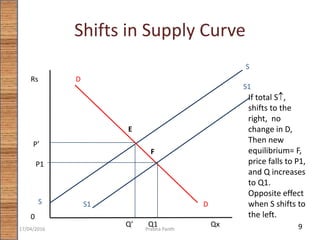
Shifts in Supply Curve
Rs
0
Qx
P’
E
Q’
D
DS
S
S1
S1
P1
F
Q1
If total S,
shifts to the
right, no
change in D,
Then new
equilibrium= F,
price falls to P1,
and Q increases
to Q1.
Opposite effect
when S shifts to
the left.
917/04/2016 Prabha Panth
Stability, Uniqueness and Existence of
Market Equilibrium
1017/04/2016 Prabha Panth
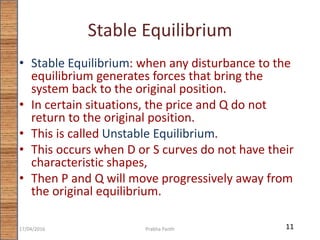
Stable Equilibrium
• Stable Equilibrium: when any disturbance to the
equilibrium generates forces that bring the
system back to the original position.
• In certain situations, the price and Q do not
return to the original position.
• This is called Unstable Equilibrium.
• This occurs when D or S curves do not have their
characteristic shapes,
• Then P and Q will move progressively away from
the original equilibrium.
1117/04/2016 Prabha Panth
Stable Market Equilibrium
Rs
Qx
0
D
D
S
S
P=5
d =2 s =10
D < S,
surplus, P
P=1 d =10s=2 D > S,
deficit, P
P=3
E
Qd=Qs=6
1217/04/2016 Prabha Panth
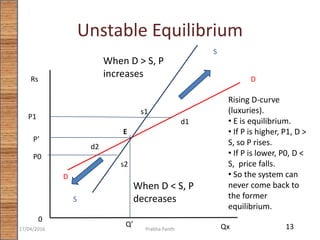
Unstable Equilibrium
Rs
0
Qx
D
D
S
S
P’
E
Q’
P1
d1
s1
When D > S, P
increases
Rising D-curve
(luxuries).
• E is equilibrium.
• If P is higher, P1, D >
S, so P rises.
• If P is lower, P0, D <
S, price falls.
• So the system can
never come back to
the former
equilibrium.
When D < S, P
decreases
s2
d2
P0
1317/04/2016 Prabha Panth
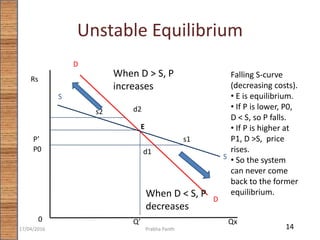
Unstable Equilibrium
Rs
0 Qx
D
D
S
S
P’
E
Q’
P0
s1
d1
When D < S, P
decreases
s2 d2
When D > S, P
increases
Falling S-curve
(decreasing costs).
• E is equilibrium.
• If P is lower, P0,
D < S, so P falls.
• If P is higher at
P1, D >S, price
rises.
• So the system
can never come
back to the former
equilibrium.
1417/04/2016 Prabha Panth
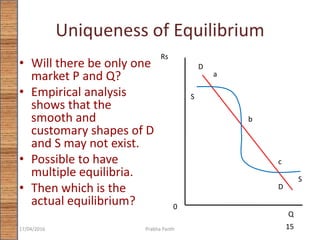
Uniqueness of Equilibrium
• Will there be only one
market P and Q?
• Empirical analysis
shows that the
smooth and
customary shapes of D
and S may not exist.
• Possible to have
multiple equilibria.
• Then which is the
actual equilibrium?
S
Rs
0
Q
D
D
S
a
b
c
1517/04/2016 Prabha Panth
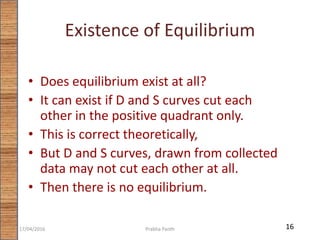
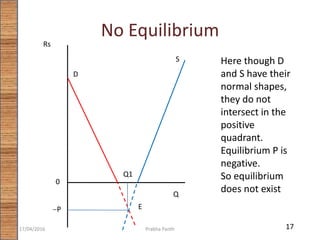
Existence of Equilibrium
• Does equilibrium exist at all?
• It can exist if D and S curves cut each
other in the positive quadrant only.
• This is correct theoretically,
• But D and S curves, drawn from collected
data may not cut each other at all.
• Then there is no equilibrium.
1617/04/2016 Prabha Panth
Rs
0
Q
P
D
S Here though D
and S have their
normal shapes,
they do not
intersect in the
positive
quadrant.
Equilibrium P is
negative.
So equilibrium
does not exist
E
Q1
17
No Equilibrium
17/04/2016 Prabha Panth
Q
0
Rs
D
S
P
 Q
E
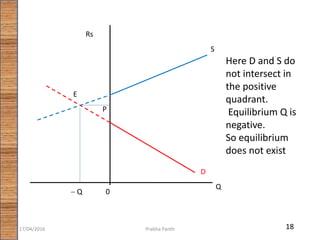
Here D and S do
not intersect in
the positive
quadrant.
Equilibrium Q is
negative.
So equilibrium
does not exist
1817/04/2016 Prabha Panth
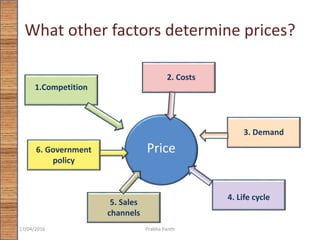
What other factors determine prices?
Price
1.Competition
2. Costs
3. Demand
4. Life cycle
5. Sales
channels
6. Government
policy
17/04/2016 Prabha Panth
Questions
I. Short answers:
1. Define Market Equilibrium, and depict it with the
help of a diagram.
2. Estimate the market P and Q from the following
equations: Qd = 45 – 10P, and Qs=5+10P
3.Is equilibrium always unique? Show with the help
of a diagram.
2017/04/2016 Prabha Panth
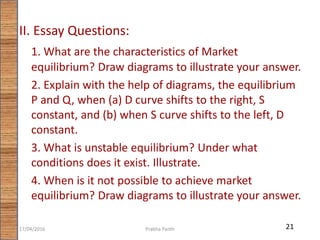
II. Essay Questions:
1. What are the characteristics of Market
equilibrium? Draw diagrams to illustrate your answer.
2. Explain with the help of diagrams, the equilibrium
P and Q, when (a) D curve shifts to the right, S
constant, and (b) when S curve shifts to the left, D
constant.
3. What is unstable equilibrium? Under what
conditions does it exist. Illustrate.
4. When is it not possible to achieve market
equilibrium? Draw diagrams to illustrate your answer.
2117/04/2016 Prabha Panth

Market Equilibrium

  • 1.
    MARKET EQUILIBRIUM Prof. PrabhaPanth 17-04-201617/04/2016 Prabha Panth
  • 2.
    What determines marketprice? • Classical economists: cost of production determines market price. • Utilitarians thought that demand determined market price. • Marshall pointed out that both D and S are needed to determine market price. • D and S are like two blades of a pair of scissors, both are needed to cut material. 217/04/2016 Prabha Panth
  • 3.
    Market • Market iswhere willing buyers meet willing sellers, for exchange of goods and services. • Could be local, national or international markets. • Refers to Perfect Competition, or a Free Market, without Government controls. • Both buyers and sellers agree to the market price. • At equilibrium, Qd = Qs. • The market is cleared, i.e. at the given price there is no surplus of supply, • Or unsatisfied demand, or shortages. 317/04/2016 Prabha Panth
  • 4.
    Market Equilibrium • Supplyand demand are opposing forces. • When P increases D decreases, but S increases. • When P decreases D increases, but S decreases. • But there could be one price at which D = S. • This is the point of Market Equilibrium. • With Equilibrium P and Equilibrium Q. 417/04/2016 Prabha Panth
  • 5.
    Market Equilibrium P (Rs)Qd (Kgs) Qs (Kgs) 1 10 2 2 8 4 3 6 6 4 4 8 5 2 10 * At P = Re.1, Qd = 10 Kgs, Qs = 2 Kgs. Deficiency of S. Since D > S, sellers increase P. When P D falls, but S increases. This goes on till P = Rs.3. At this point Qd=Qs = 6 Kgs. This is Equilibrium Price. * At a higher price, Rs.5, Qd=2 Kgs, but Qs=10 Kgs. Surplus S. As S > D, P falls. As P falls, Qd increases, and Qs decreases. This goes on till the Equilibrium P Rs.3 is reached. *Equilibrium quantity = Qd = Qs = 6 Kgs. 517/04/2016 Prabha Panth
  • 6.
    D and Sequations • Let Qd = 14 -2P, and Qs = 4 + 2P • What are Equilibrium P and Q? • We know that at equilibrium Qd = Qs, 14 – 2 P = 4 + 2P Or 10 = 4P Or P = 10/4 = Rs.2.5 Equilibrium P = Rs.2.50 Substituting P = 2.5 to get Q: 14 – 2 (2.5) = 14 – 5 = 9 Kgs (Qd) 4 + 2(2.5) = 4 + 5 = 9 Kgs (Qs) Equilibrium Q = 9 Kgs 617/04/2016 Prabha Panth
  • 7.
    Equilibrium with Shiftsin Demand Curve Rs 0 Qx D1 D1S S P’ Q’ E D2 D2 P1 F Q1 If Market D  shifts to the right, but no change in S. Then the new equilibrium = F, price increases to P1 and quantity to Q1, If Market D, or shifts to the left, No change in supply, Then both equilibrium P and Q decrease. 717/04/2016 Prabha Panth
  • 8.
    Market Equilibrium Rs Qx 0 D D S S P=5 d =2s =10 D < S, surplus, P P=1 d =10s=2 D > S, deficit, P P=3 E Qd=Qs=6 817/04/2016 Prabha Panth
  • 9.
    Shifts in SupplyCurve Rs 0 Qx P’ E Q’ D DS S S1 S1 P1 F Q1 If total S, shifts to the right, no change in D, Then new equilibrium= F, price falls to P1, and Q increases to Q1. Opposite effect when S shifts to the left. 917/04/2016 Prabha Panth
  • 10.
    Stability, Uniqueness andExistence of Market Equilibrium 1017/04/2016 Prabha Panth
  • 11.
    Stable Equilibrium • StableEquilibrium: when any disturbance to the equilibrium generates forces that bring the system back to the original position. • In certain situations, the price and Q do not return to the original position. • This is called Unstable Equilibrium. • This occurs when D or S curves do not have their characteristic shapes, • Then P and Q will move progressively away from the original equilibrium. 1117/04/2016 Prabha Panth
  • 12.
    Stable Market Equilibrium Rs Qx 0 D D S S P=5 d=2 s =10 D < S, surplus, P P=1 d =10s=2 D > S, deficit, P P=3 E Qd=Qs=6 1217/04/2016 Prabha Panth
  • 13.
    Unstable Equilibrium Rs 0 Qx D D S S P’ E Q’ P1 d1 s1 When D> S, P increases Rising D-curve (luxuries). • E is equilibrium. • If P is higher, P1, D > S, so P rises. • If P is lower, P0, D < S, price falls. • So the system can never come back to the former equilibrium. When D < S, P decreases s2 d2 P0 1317/04/2016 Prabha Panth
  • 14.
    Unstable Equilibrium Rs 0 Qx D D S S P’ E Q’ P0 s1 d1 WhenD < S, P decreases s2 d2 When D > S, P increases Falling S-curve (decreasing costs). • E is equilibrium. • If P is lower, P0, D < S, so P falls. • If P is higher at P1, D >S, price rises. • So the system can never come back to the former equilibrium. 1417/04/2016 Prabha Panth
  • 15.
    Uniqueness of Equilibrium •Will there be only one market P and Q? • Empirical analysis shows that the smooth and customary shapes of D and S may not exist. • Possible to have multiple equilibria. • Then which is the actual equilibrium? S Rs 0 Q D D S a b c 1517/04/2016 Prabha Panth
  • 16.
    Existence of Equilibrium •Does equilibrium exist at all? • It can exist if D and S curves cut each other in the positive quadrant only. • This is correct theoretically, • But D and S curves, drawn from collected data may not cut each other at all. • Then there is no equilibrium. 1617/04/2016 Prabha Panth
  • 17.
    Rs 0 Q P D S Here thoughD and S have their normal shapes, they do not intersect in the positive quadrant. Equilibrium P is negative. So equilibrium does not exist E Q1 17 No Equilibrium 17/04/2016 Prabha Panth
  • 18.
    Q 0 Rs D S P  Q E Here Dand S do not intersect in the positive quadrant. Equilibrium Q is negative. So equilibrium does not exist 1817/04/2016 Prabha Panth
  • 19.
    What other factorsdetermine prices? Price 1.Competition 2. Costs 3. Demand 4. Life cycle 5. Sales channels 6. Government policy 17/04/2016 Prabha Panth
  • 20.
    Questions I. Short answers: 1.Define Market Equilibrium, and depict it with the help of a diagram. 2. Estimate the market P and Q from the following equations: Qd = 45 – 10P, and Qs=5+10P 3.Is equilibrium always unique? Show with the help of a diagram. 2017/04/2016 Prabha Panth
  • 21.
    II. Essay Questions: 1.What are the characteristics of Market equilibrium? Draw diagrams to illustrate your answer. 2. Explain with the help of diagrams, the equilibrium P and Q, when (a) D curve shifts to the right, S constant, and (b) when S curve shifts to the left, D constant. 3. What is unstable equilibrium? Under what conditions does it exist. Illustrate. 4. When is it not possible to achieve market equilibrium? Draw diagrams to illustrate your answer. 2117/04/2016 Prabha Panth