Increasing the Strength and Reliability
of Press Fits
Before We Start
 This webinar will be available afterwards at
designworldonline.com & email
 Q&A at the end of the presentation

 Hashtag for this webinar: #DWwebinar
Moderator

Presenter

Q&A

Miles Budimir

Doug
Lescarbeau

Robert Dunkel

Design World

Henkel-Loctite

Henkel-Loctite
Increasing Strength &
Reliability of Press Fits
Doug Lescarbeau
Anaerobic Technology Director, Henkel Corporation
Robert Dunkel
Technical Service Director, Henkel Corporation

November 14, 2013
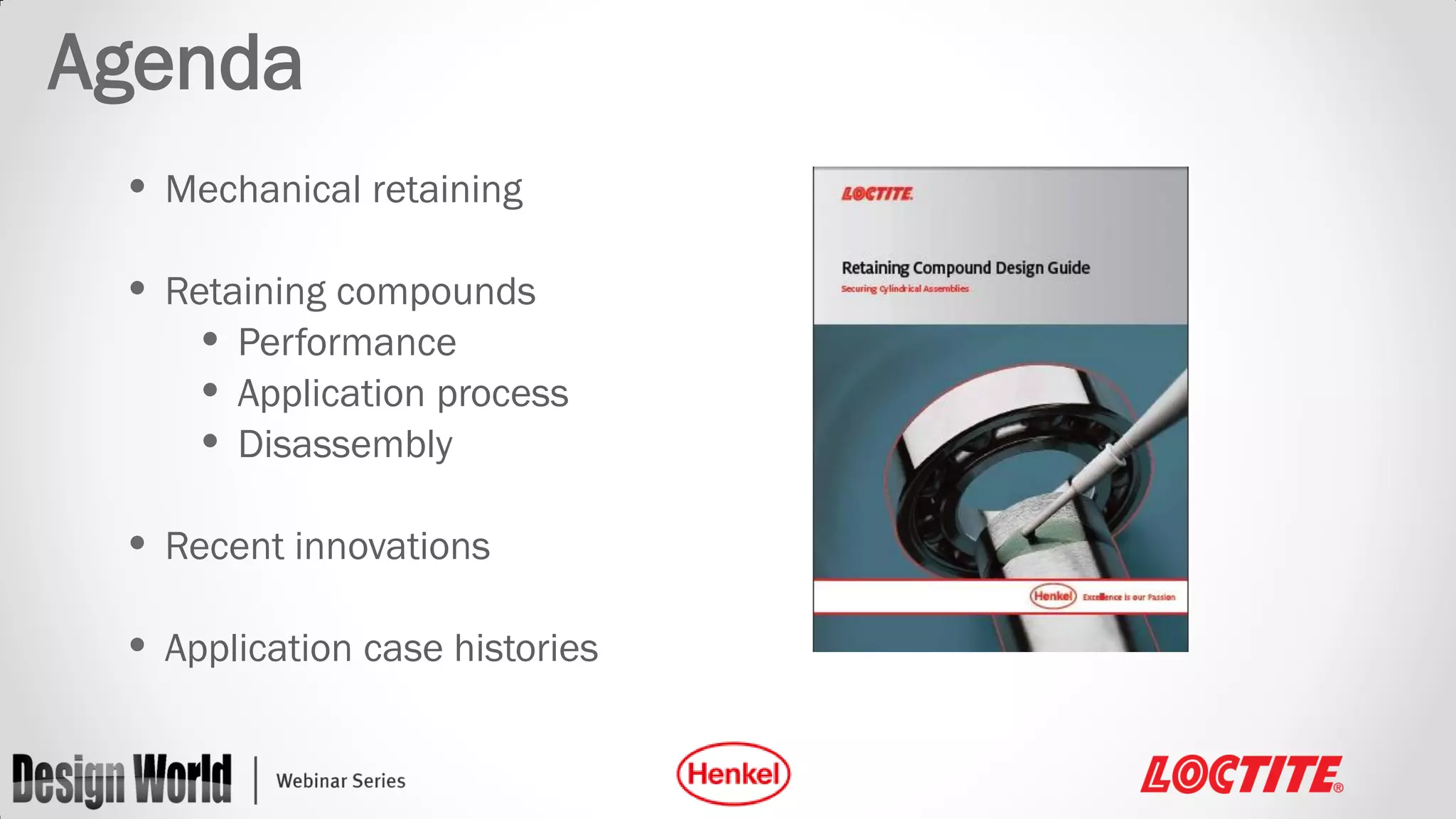
Agenda
• Mechanical retaining
• Retaining compounds
• Performance
• Application process
• Disassembly
• Recent innovations
• Application case histories
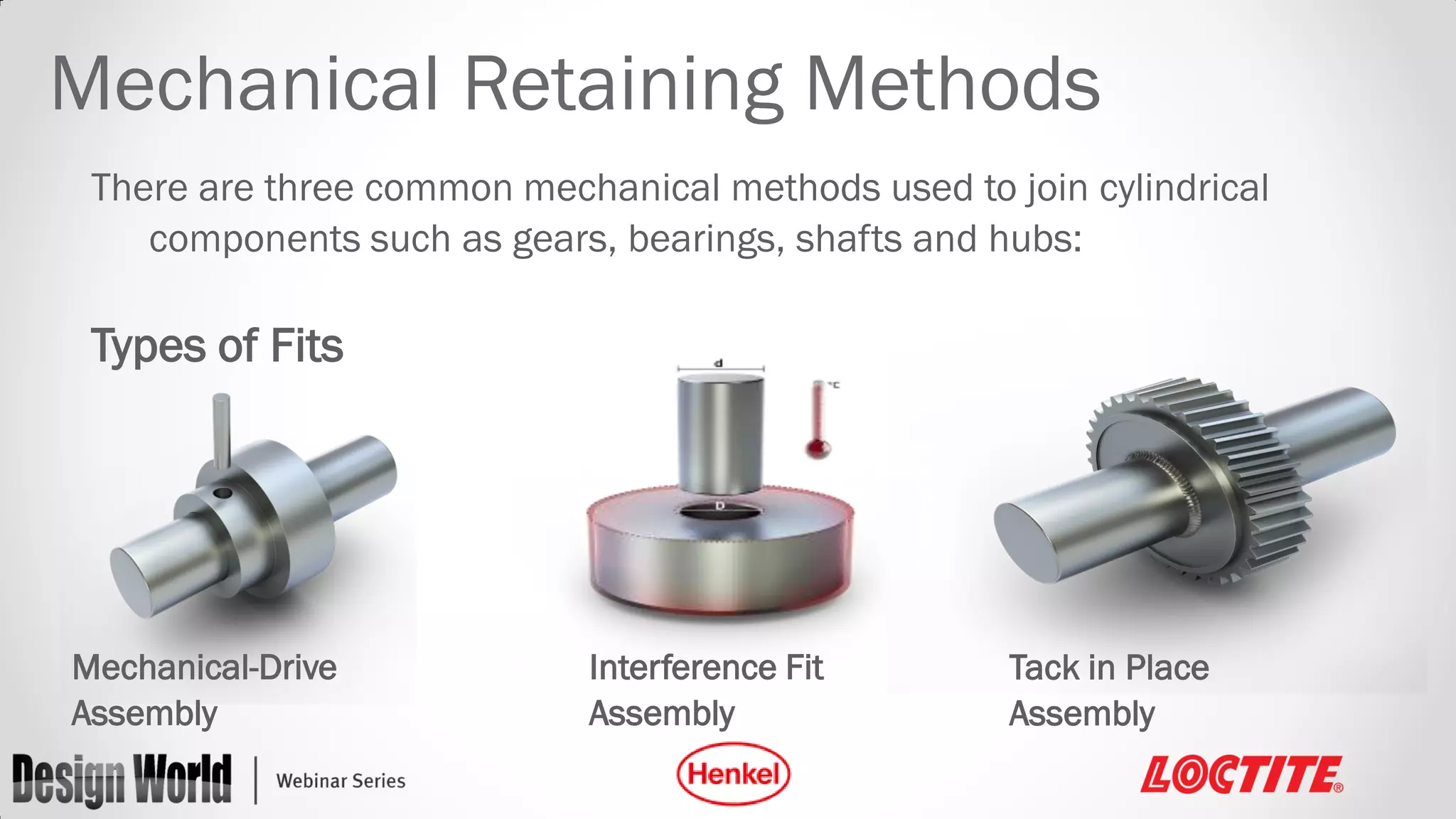
Mechanical Retaining Methods
There are three common mechanical methods used to join cylindrical
components such as gears, bearings, shafts and hubs:

Types of Fits

Mechanical-Drive
Assembly

Interference Fit
Assembly

Tack in Place
Assembly
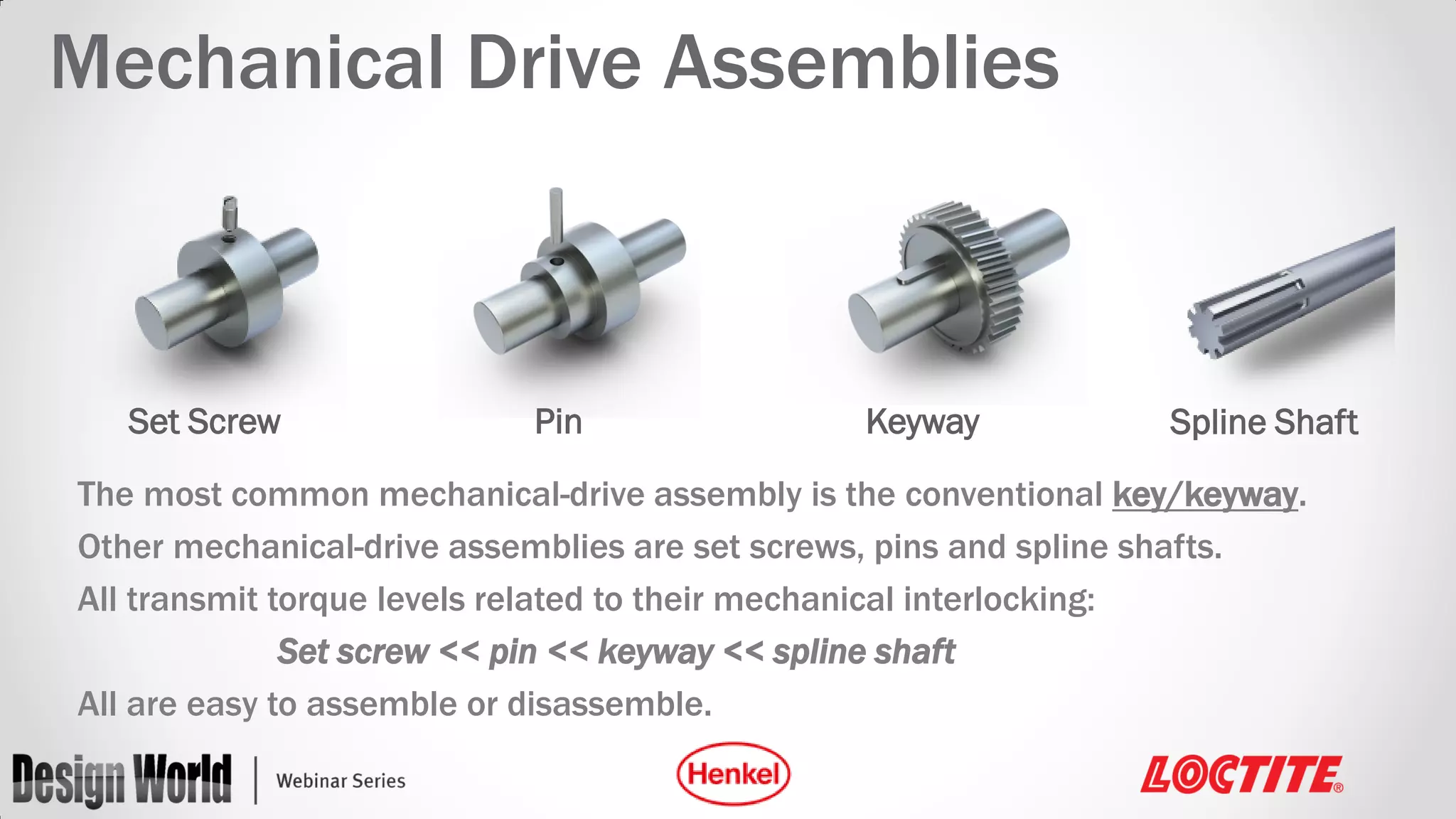
Mechanical Drive Assemblies

Set Screw

Pin

Keyway

Spline Shaft

The most common mechanical-drive assembly is the conventional key/keyway.
Other mechanical-drive assemblies are set screws, pins and spline shafts.
All transmit torque levels related to their mechanical interlocking:
Set screw << pin << keyway << spline shaft
All are easy to assemble or disassemble.
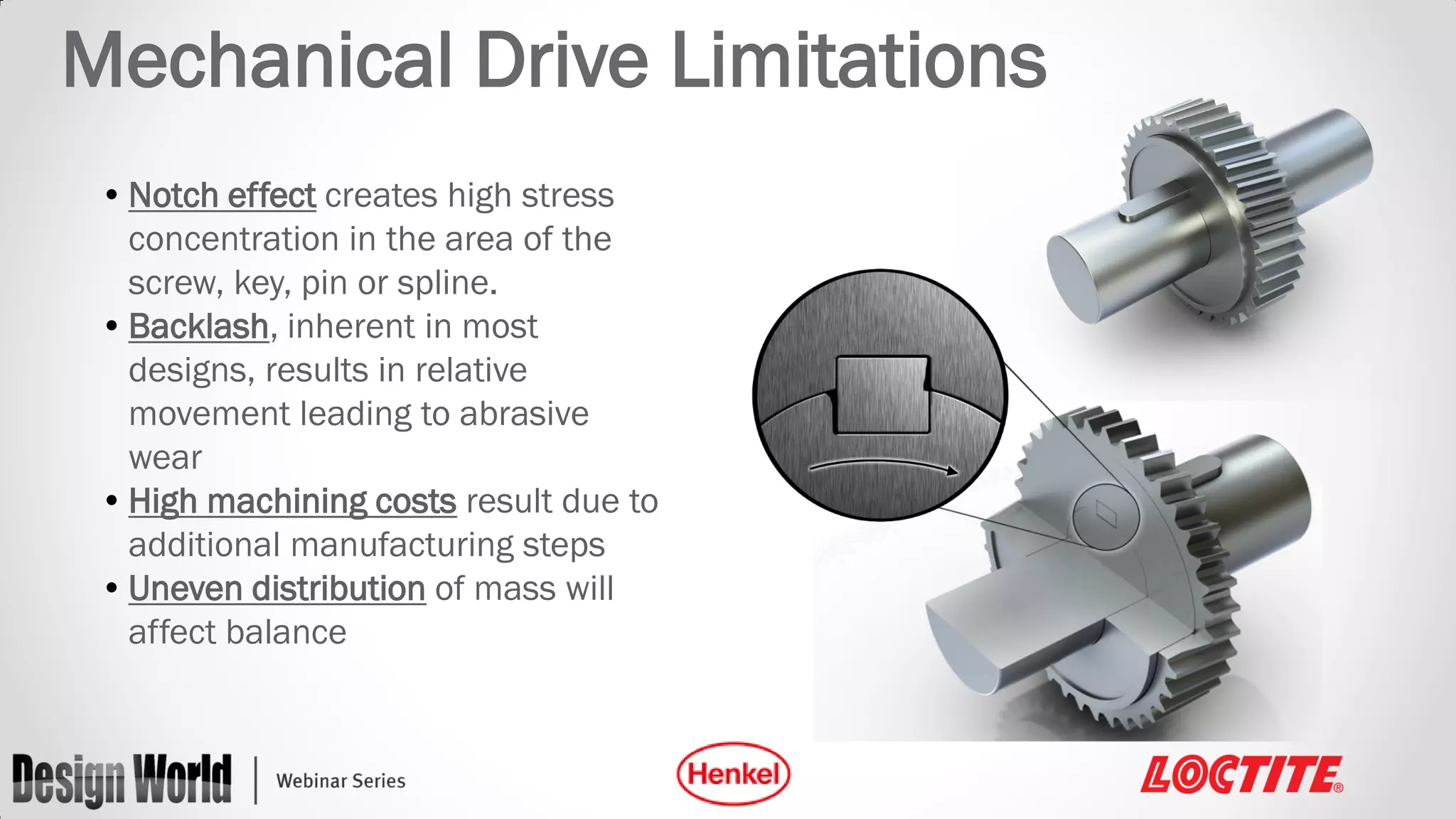
Mechanical Drive Limitations
• Notch effect creates high stress
concentration in the area of the
screw, key, pin or spline.
• Backlash, inherent in most
designs, results in relative
movement leading to abrasive
wear
• High machining costs result due to
additional manufacturing steps
• Uneven distribution of mass will
affect balance
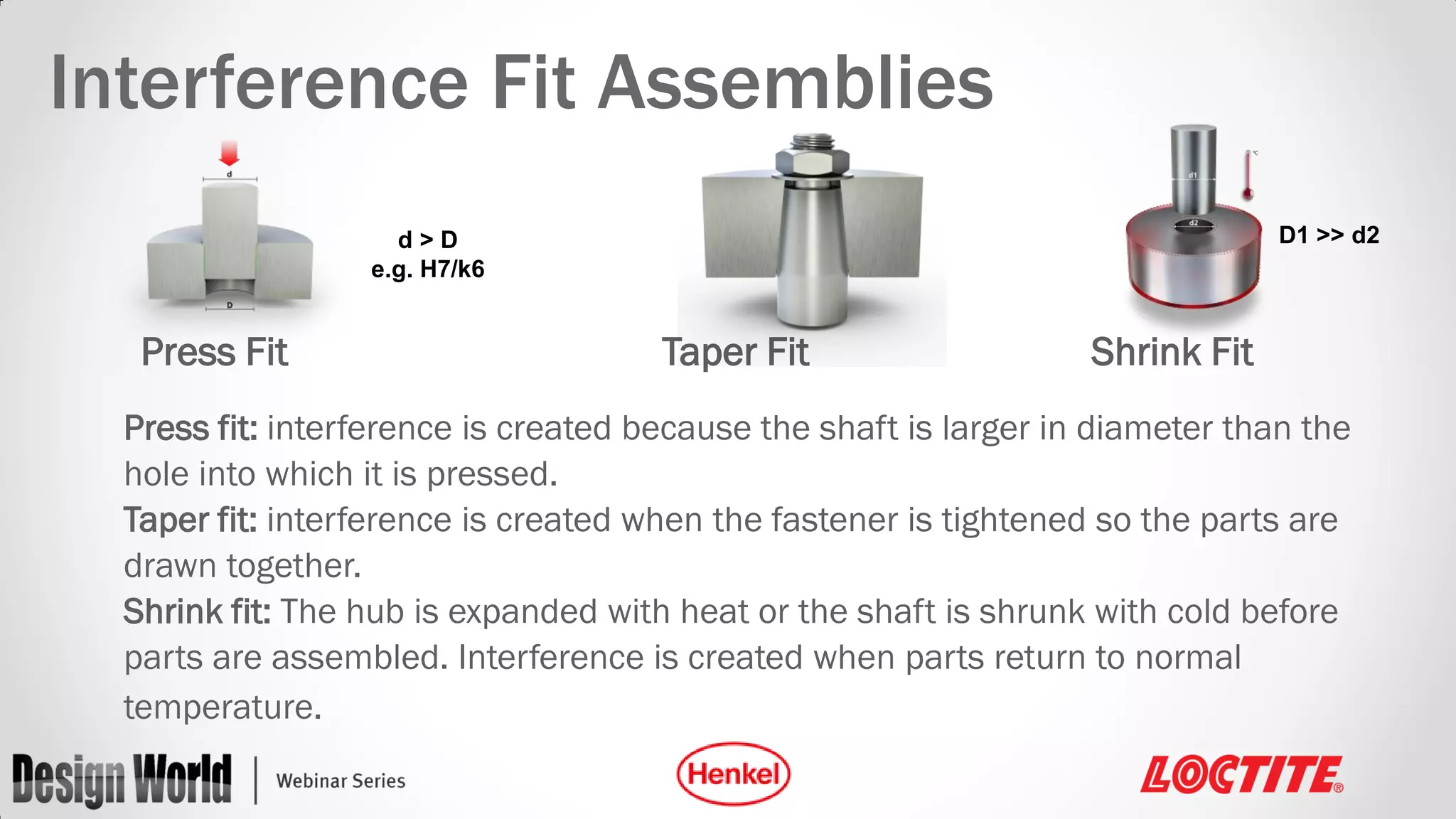
Interference Fit Assemblies
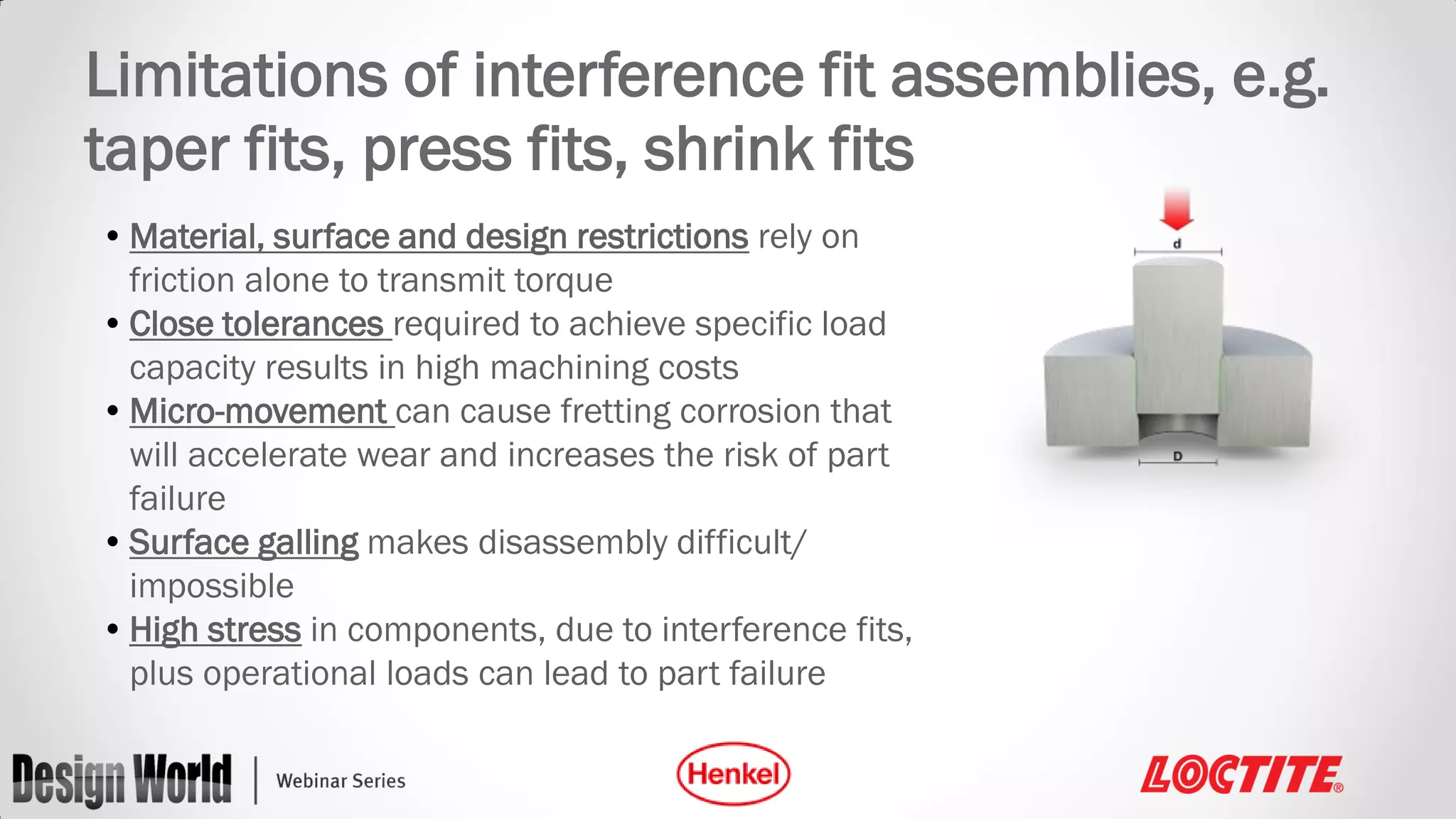
D1 >> d2

d>D
e.g. H7/k6

Press Fit

Taper Fit

Shrink Fit

Press fit: interference is created because the shaft is larger in diameter than the
hole into which it is pressed.
Taper fit: interference is created when the fastener is tightened so the parts are
drawn together.
Shrink fit: The hub is expanded with heat or the shaft is shrunk with cold before
parts are assembled. Interference is created when parts return to normal
temperature.
Limitations of interference fit assemblies, e.g.
taper fits, press fits, shrink fits
• Material, surface and design restrictions rely on
friction alone to transmit torque
• Close tolerances required to achieve specific load
capacity results in high machining costs
• Micro-movement can cause fretting corrosion that
will accelerate wear and increases the risk of part
failure
• Surface galling makes disassembly difficult/
impossible
• High stress in components, due to interference fits,
plus operational loads can lead to part failure
Tack in Place Assemblies
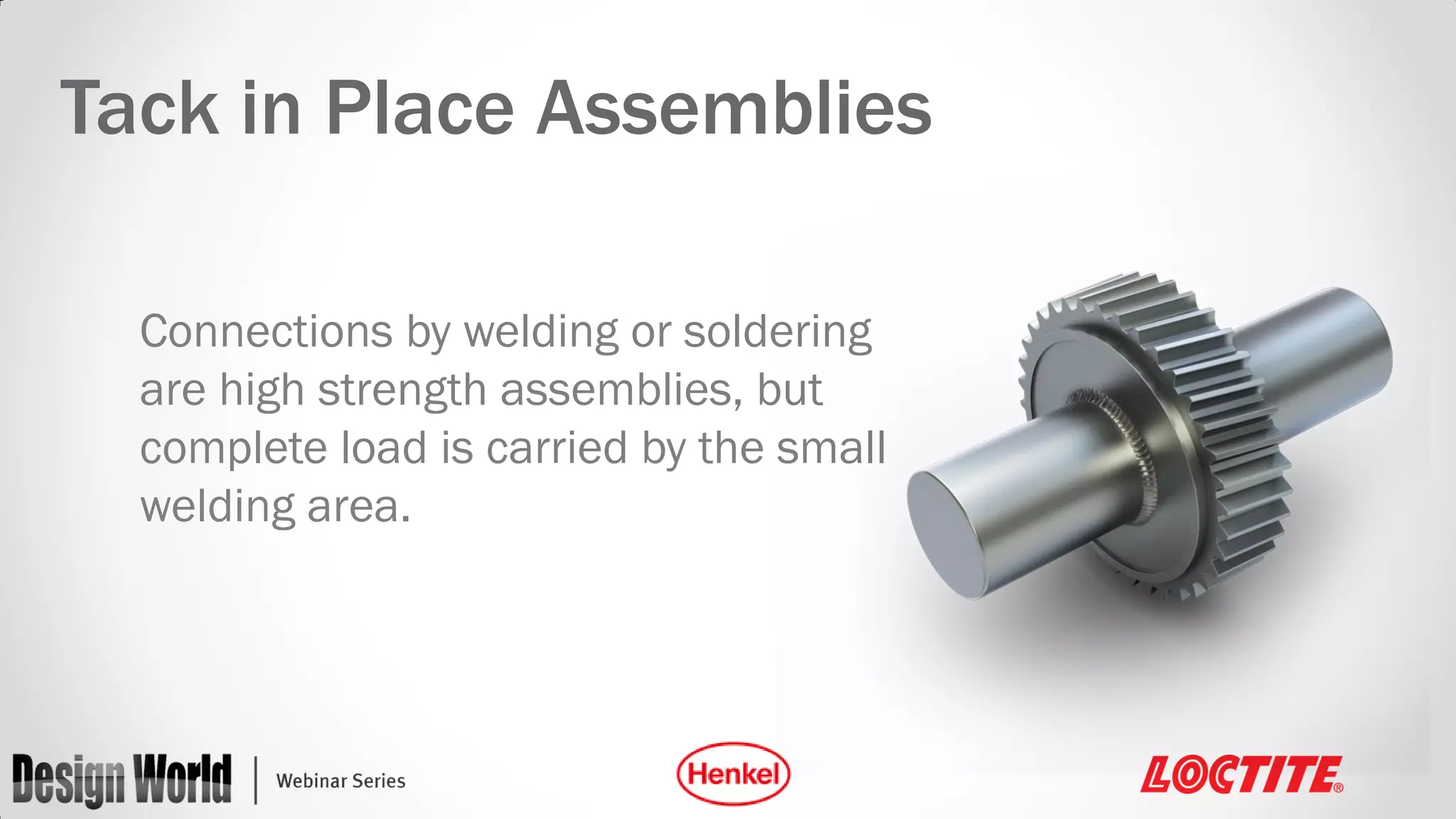
Connections by welding or soldering
are high strength assemblies, but
complete load is carried by the small
welding area.
Limitations of welded or soldered tack in place
assemblies

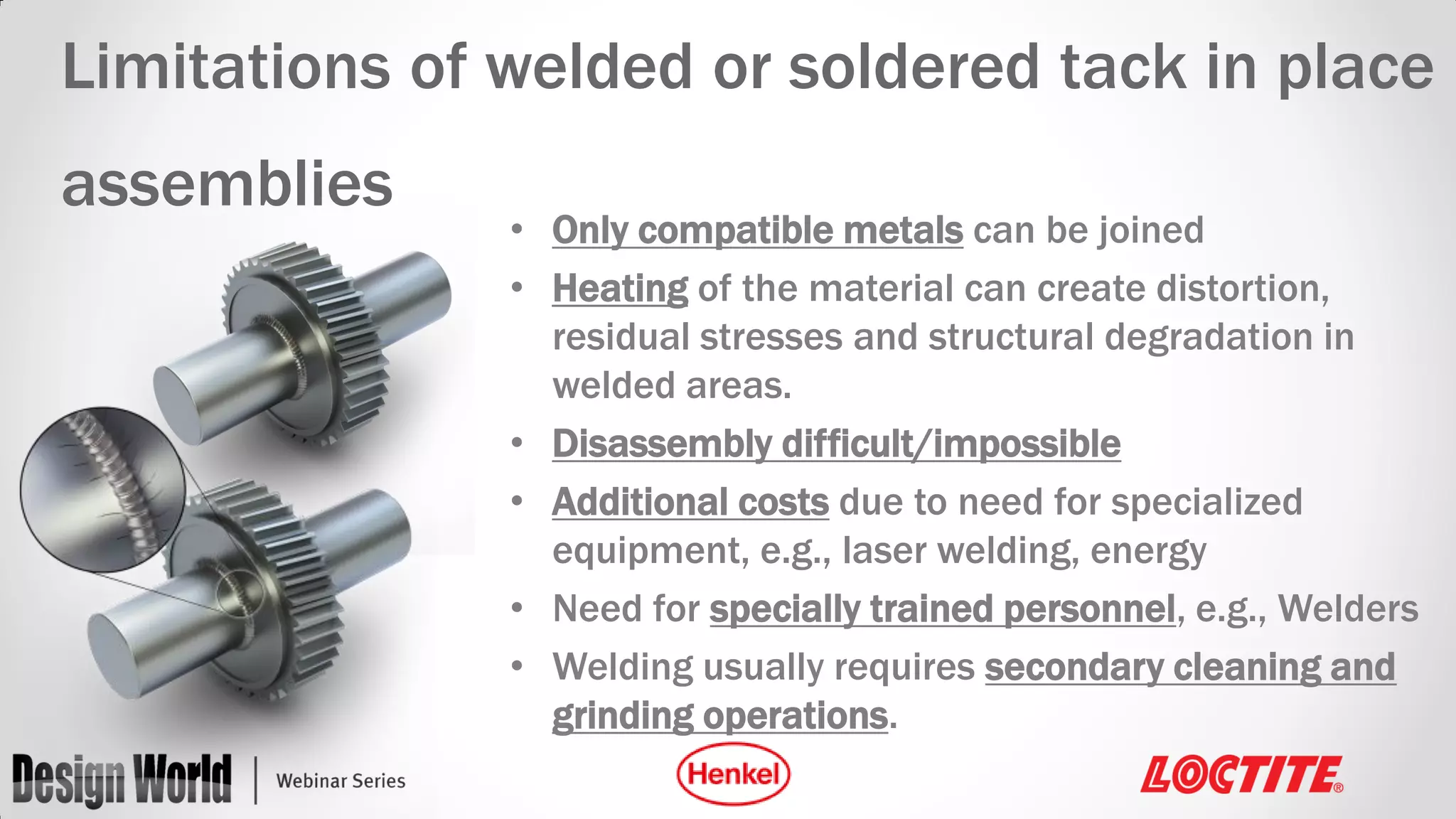
• Only compatible metals can be joined
• Heating of the material can create distortion,
residual stresses and structural degradation in
welded areas.
• Disassembly difficult/impossible
• Additional costs due to need for specialized
equipment, e.g., laser welding, energy
• Need for specially trained personnel, e.g., Welders
• Welding usually requires secondary cleaning and
grinding operations.
Retaining Compounds
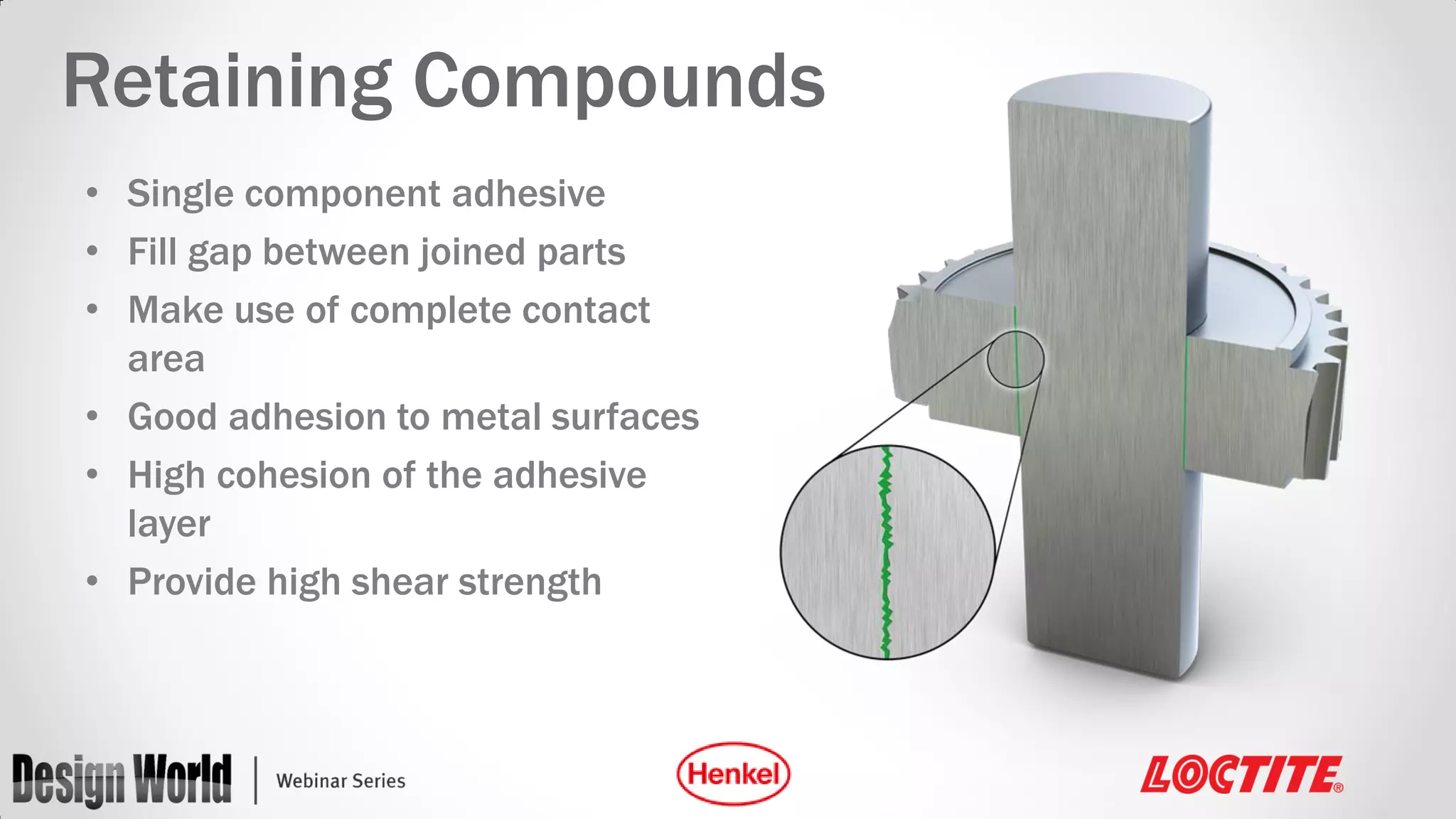
• Single component adhesive
• Fill gap between joined parts
• Make use of complete contact
area
• Good adhesion to metal surfaces
• High cohesion of the adhesive
layer
• Provide high shear strength
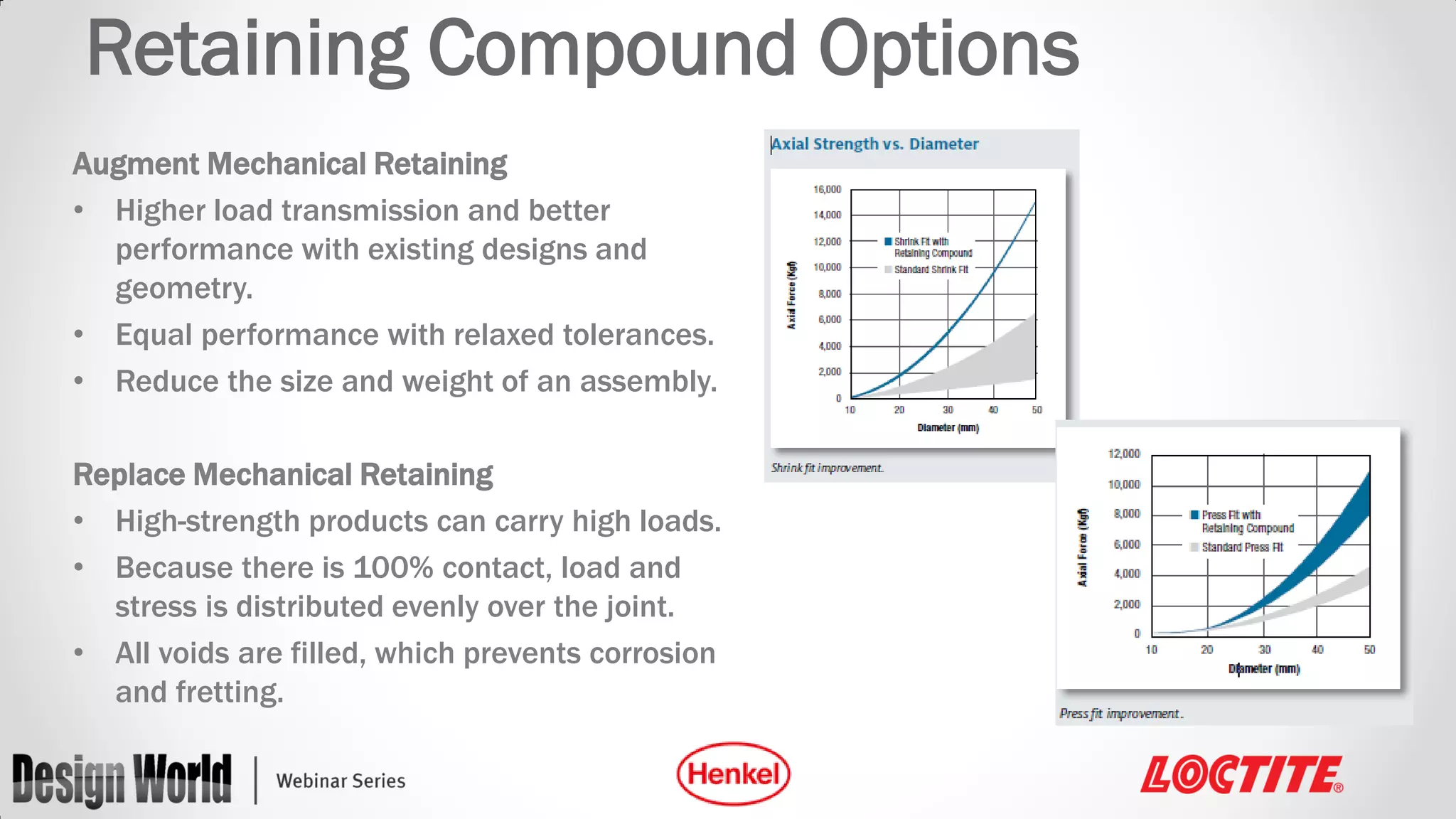
Retaining Compound Options
Augment Mechanical Retaining
• Higher load transmission and better
performance with existing designs and
geometry.
• Equal performance with relaxed tolerances.
• Reduce the size and weight of an assembly.
Replace Mechanical Retaining
• High-strength products can carry high loads.
• Because there is 100% contact, load and
stress is distributed evenly over the joint.
• All voids are filled, which prevents corrosion
and fretting.
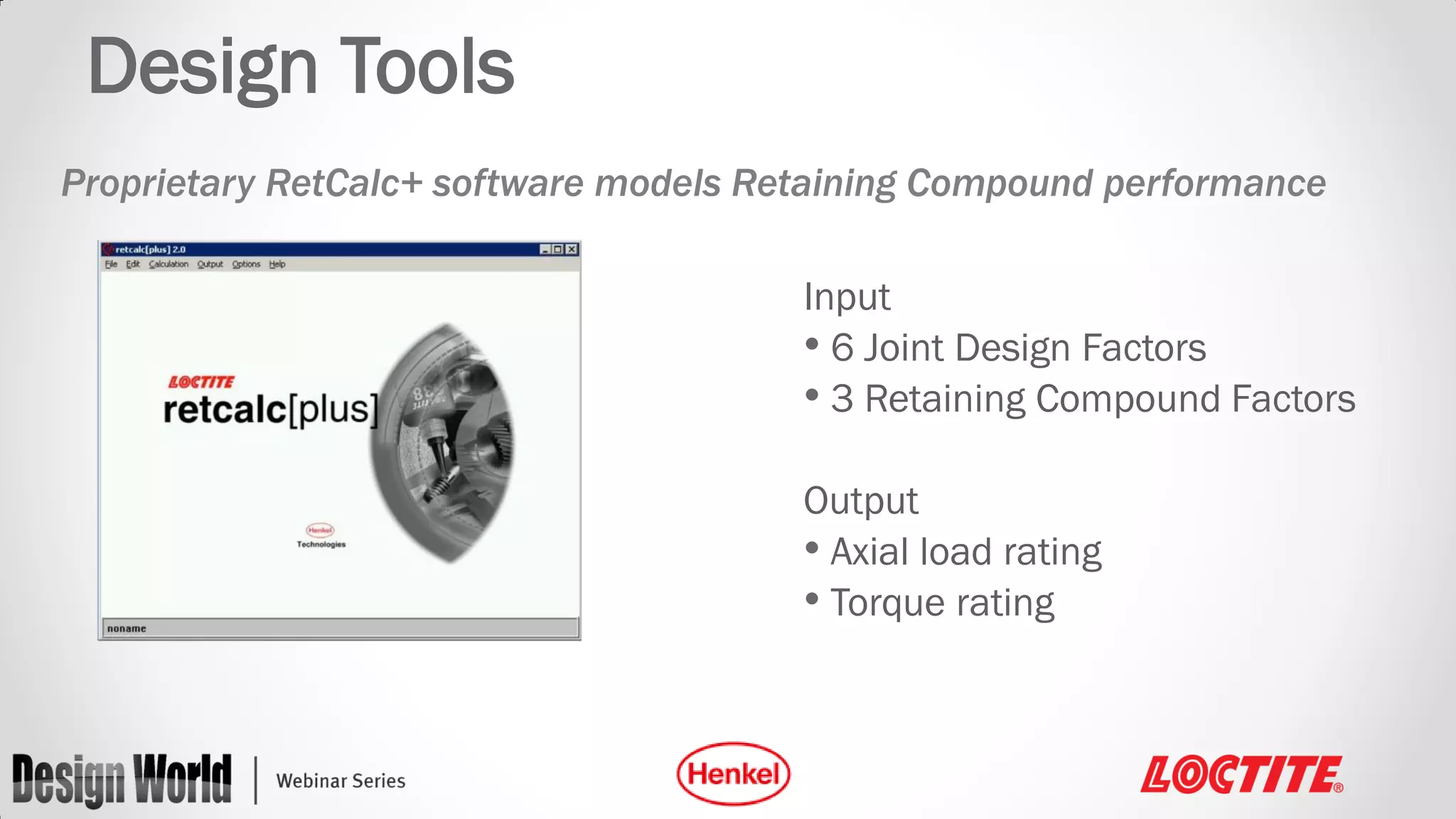
Design Tools
Proprietary RetCalc+ software models Retaining Compound performance
Input
• 6 Joint Design Factors
• 3 Retaining Compound Factors

Output
• Axial load rating
• Torque rating
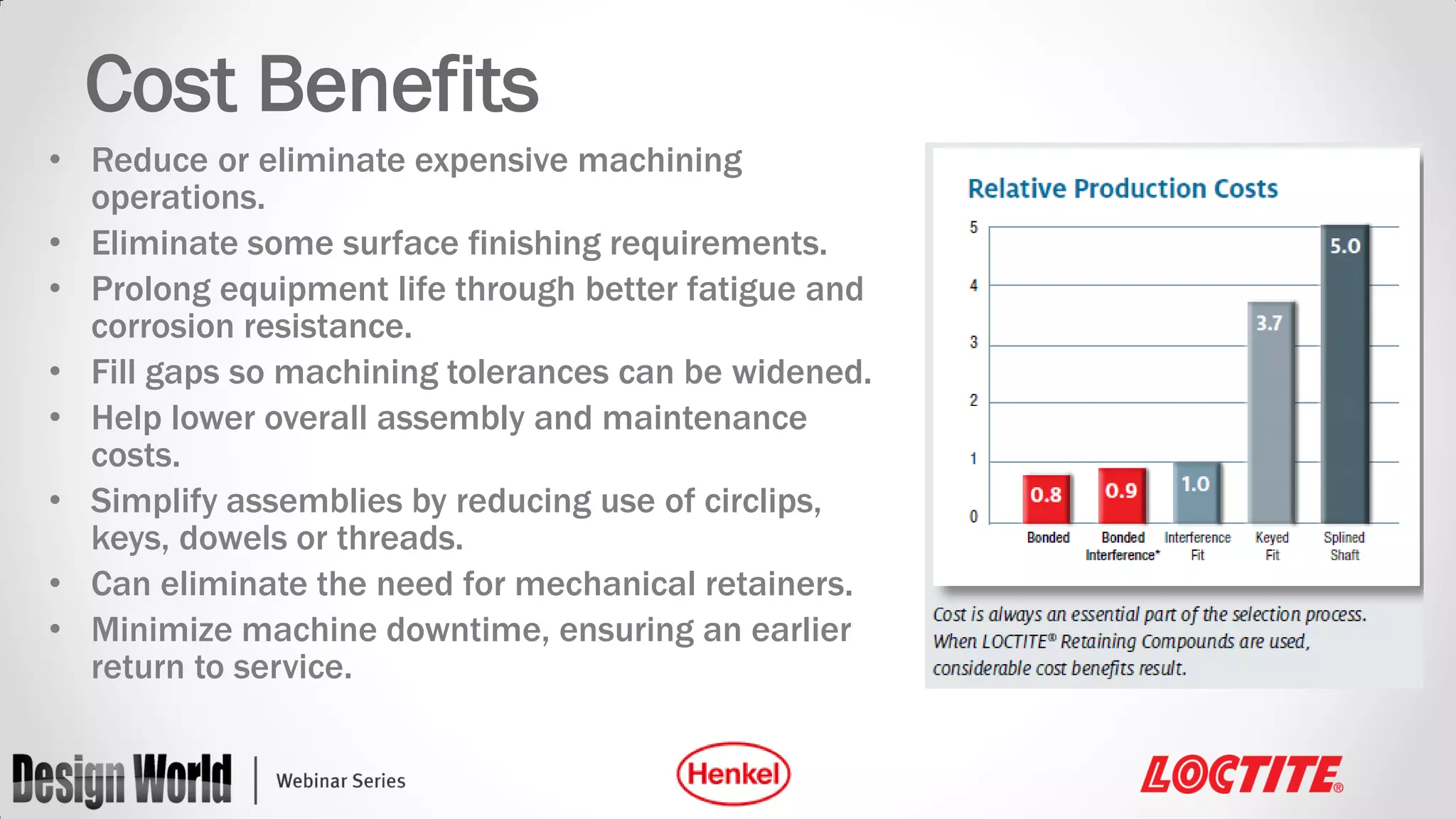
Cost Benefits
• Reduce or eliminate expensive machining
operations.
• Eliminate some surface finishing requirements.
• Prolong equipment life through better fatigue and
corrosion resistance.
• Fill gaps so machining tolerances can be widened.
• Help lower overall assembly and maintenance
costs.
• Simplify assemblies by reducing use of circlips,
keys, dowels or threads.
• Can eliminate the need for mechanical retainers.
• Minimize machine downtime, ensuring an earlier
return to service.
Retaining Compounds
Comparison to Mechanical Assembly Methods
Retaining Compounds:
• Increase assembly reliability.
• Produce more accurate, rigid assemblies.
• Eliminate backlash in keys and splines.
• Prevent small diameter shaft distortion.
• Increase strength of mechanical retaining
methods.
• Eliminate fretting corrosion.
• Seal against environmental corrosion.
• Eliminate high assembly stresses.
• Reduce variations in load transmission.
• Allow dissimilar materials to be assembled more
easily.

Interference (press fits or shrink) fits and taper fits
• Rely on friction alone to transmit torque; therefore, they are limited by
material, surfaces and design.
• Close tolerances are needed to obtain specific load capacities, leading
to higher production costs.
• Interference fitting creates stresses in the components that can lead to
failure, particularly when combined with operational stresses.
Keyway and spline assemblies
• Cause high stresses due to the “notch effect” that occurs.
• Result in high machining costs and backlash.
Welding and soldering
• Only compatible metals can be joined.
• Heating of the material can lead to residual stresses and structural
degradation and distortion.
• Requires skilled labor and secondary cleaning and grinding.
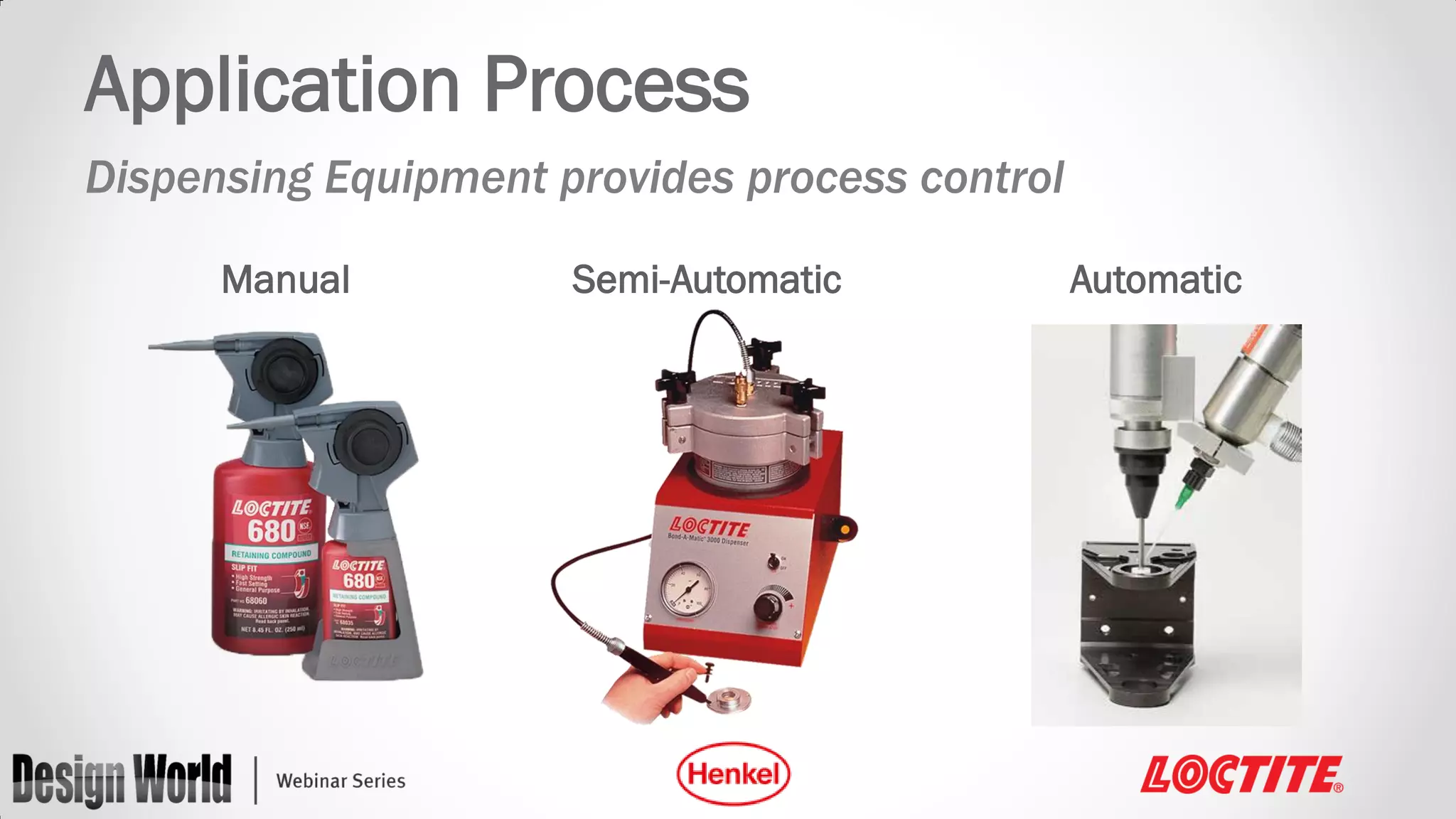
Application Process
Dispensing Equipment provides process control
Manual

Semi-Automatic

Automatic
Disassembly
Bearings assembled with Retaining
Compound can be disassembled with
industry standard bearing disassembly
tools and techniques, including bearing
pullers and hydraulic presses.
Another technique is to heat the parts well
above the service temperature [to 250°C
(482°F) for most products] and
disassemble while the parts are hot.
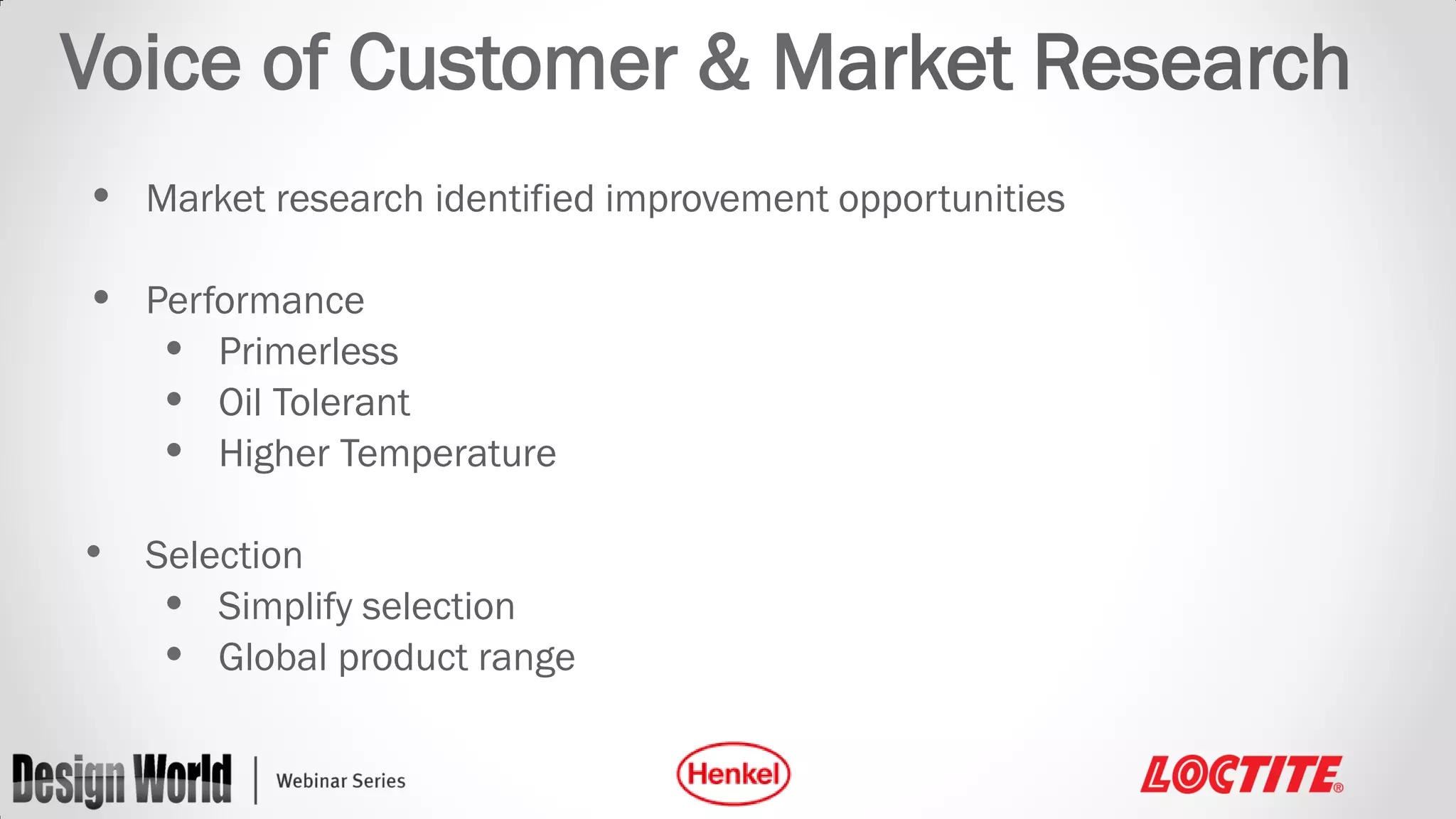
Voice of Customer & Market Research
• Market research identified improvement opportunities
• Performance
• Primerless
• Oil Tolerant
• Higher Temperature
• Selection
• Simplify selection
• Global product range
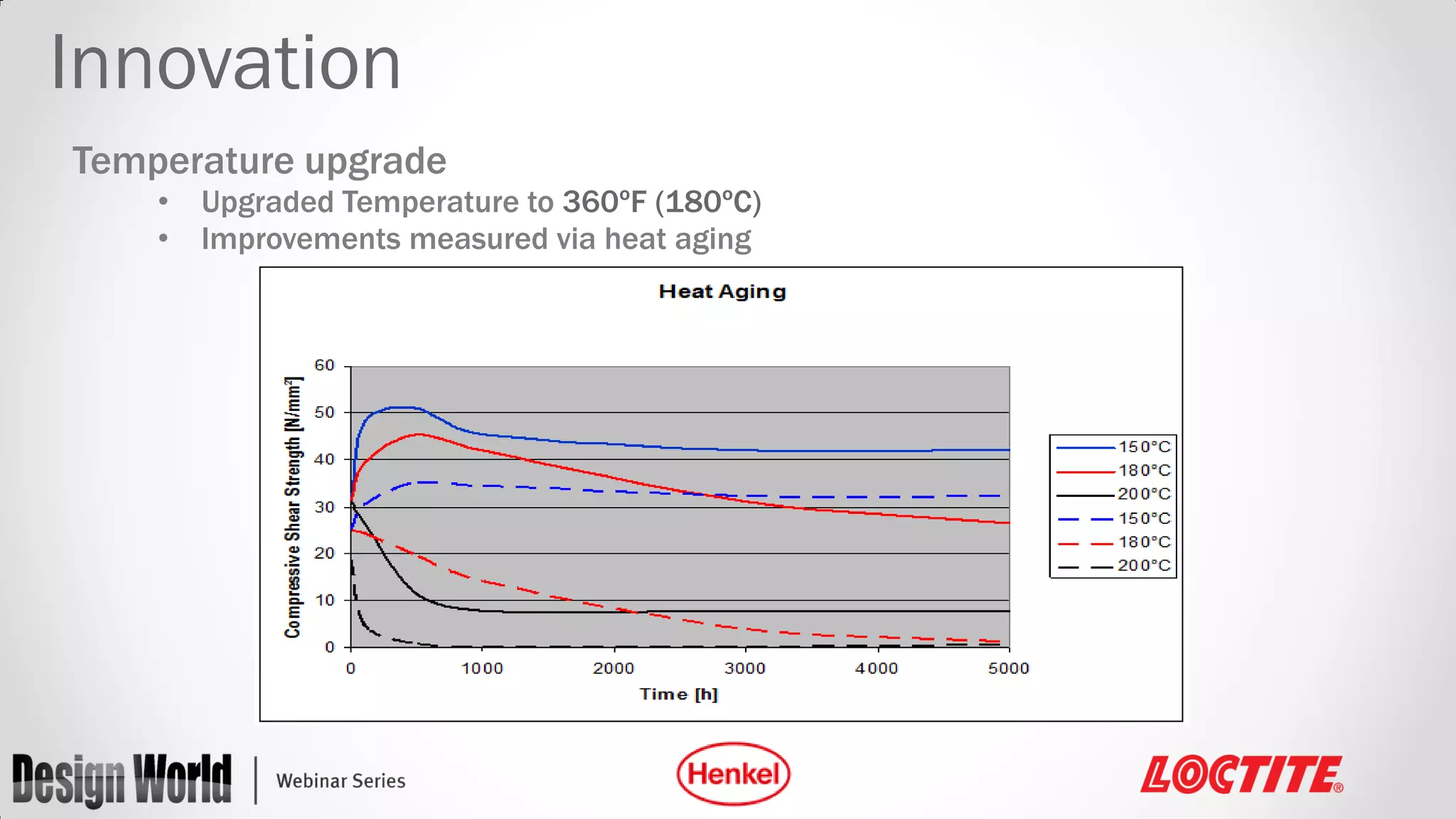
Innovation
Temperature upgrade
•
•

Upgraded Temperature to 360ºF (180ºC)
Improvements measured via heat aging
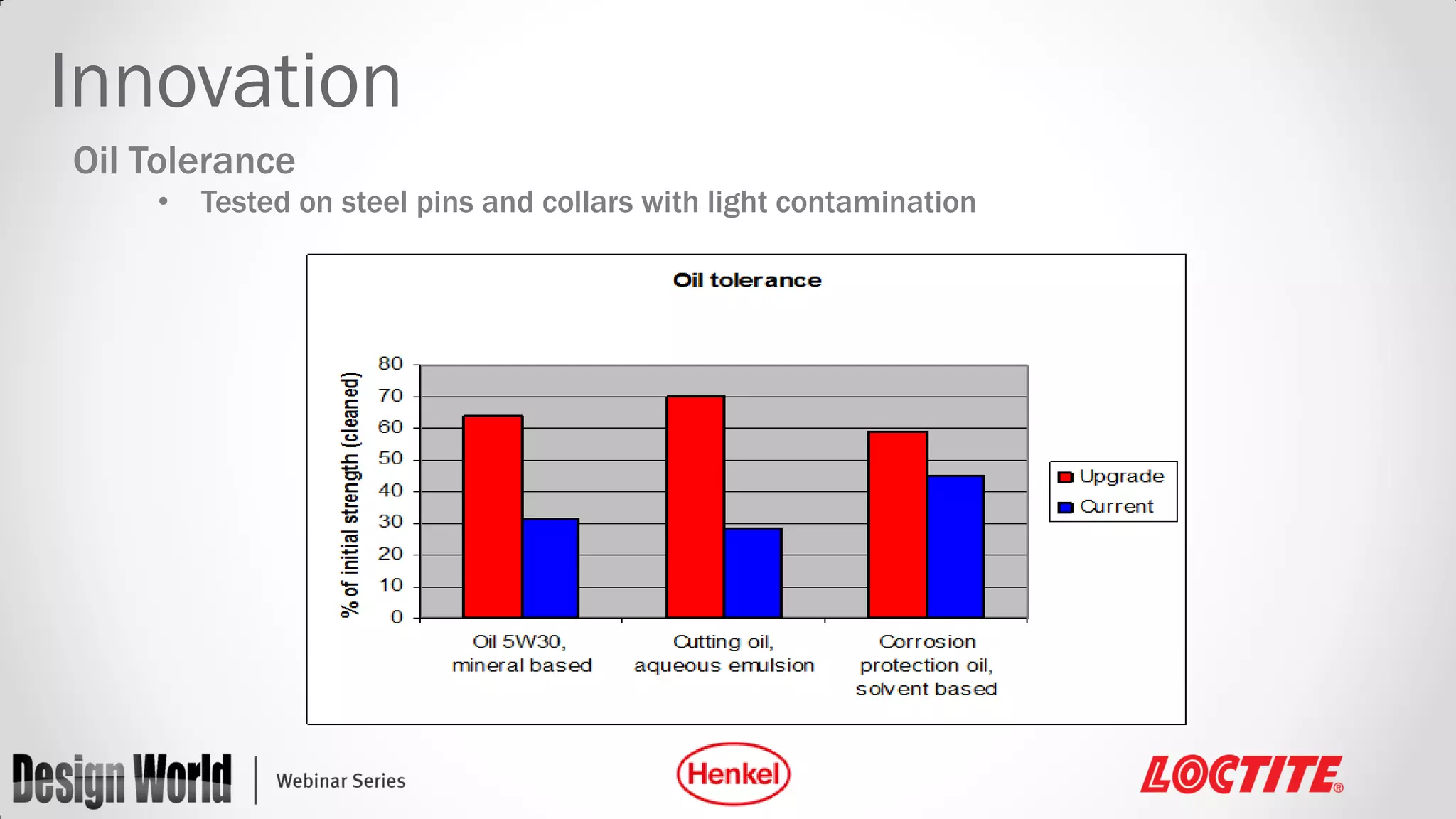
Innovation
Oil Tolerance
•

Tested on steel pins and collars with light contamination
Innovation
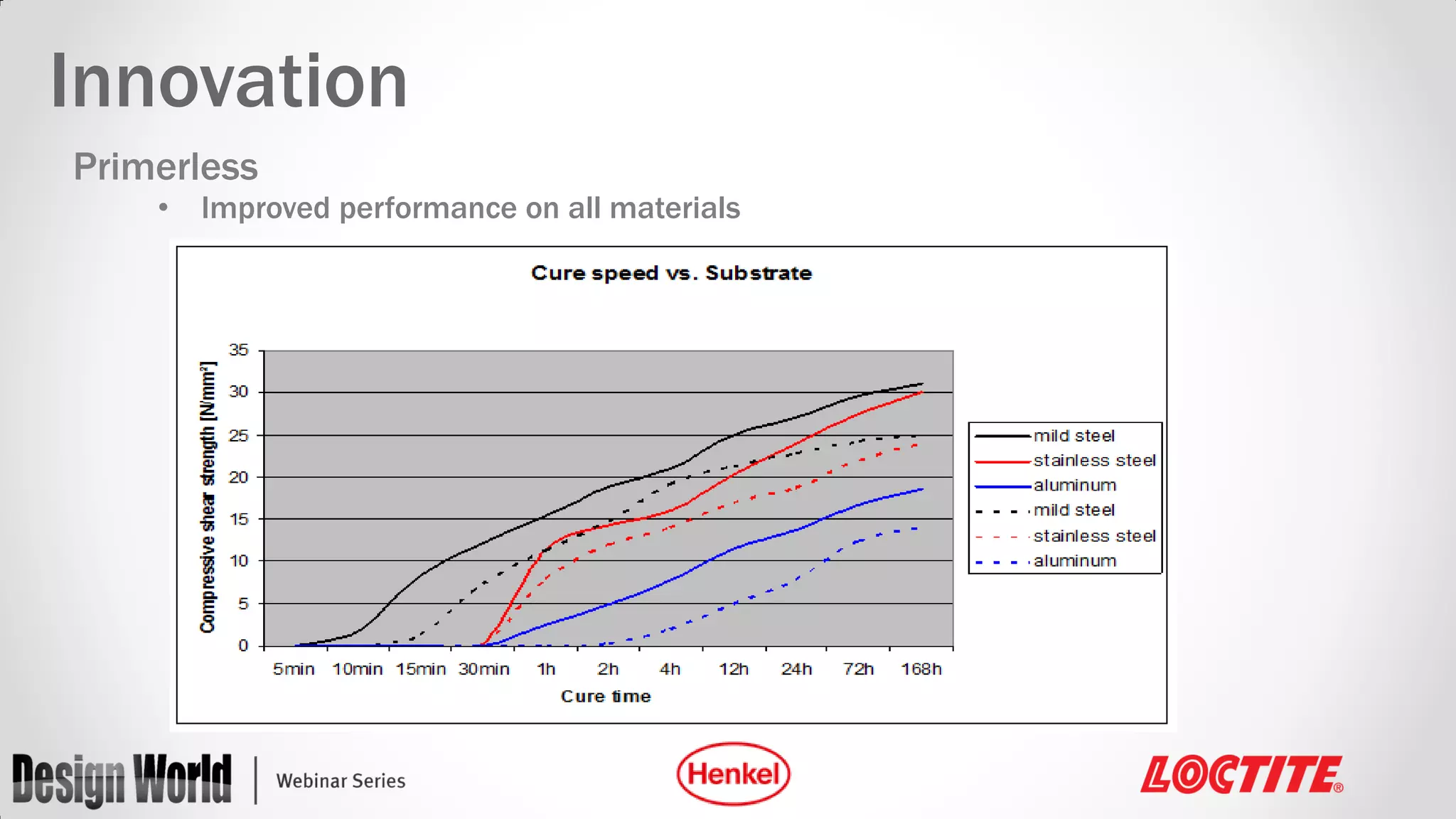
Primerless
•

Improved performance on all materials
Innovation
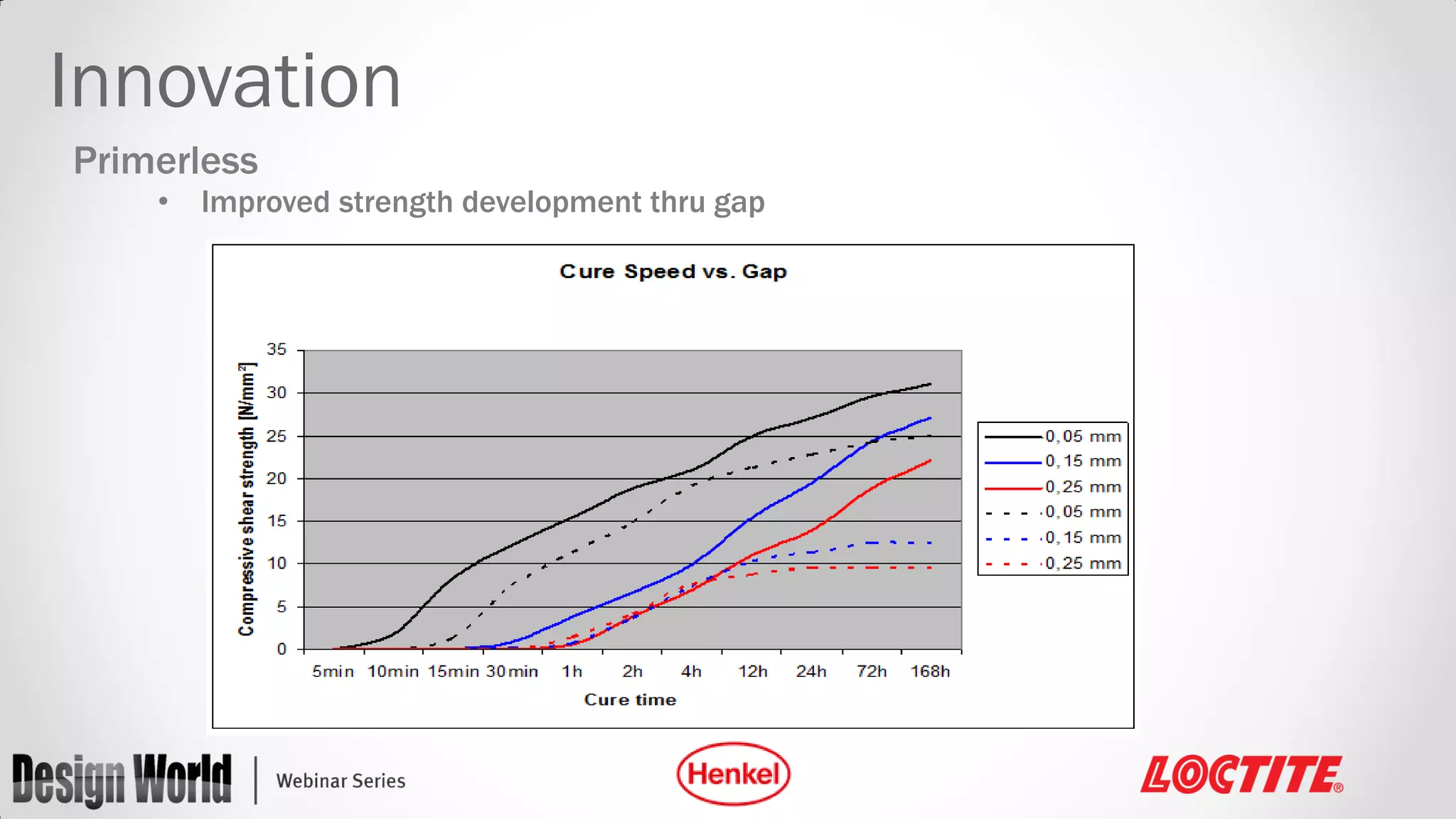
Primerless
•

Improved strength development thru gap
Innovation
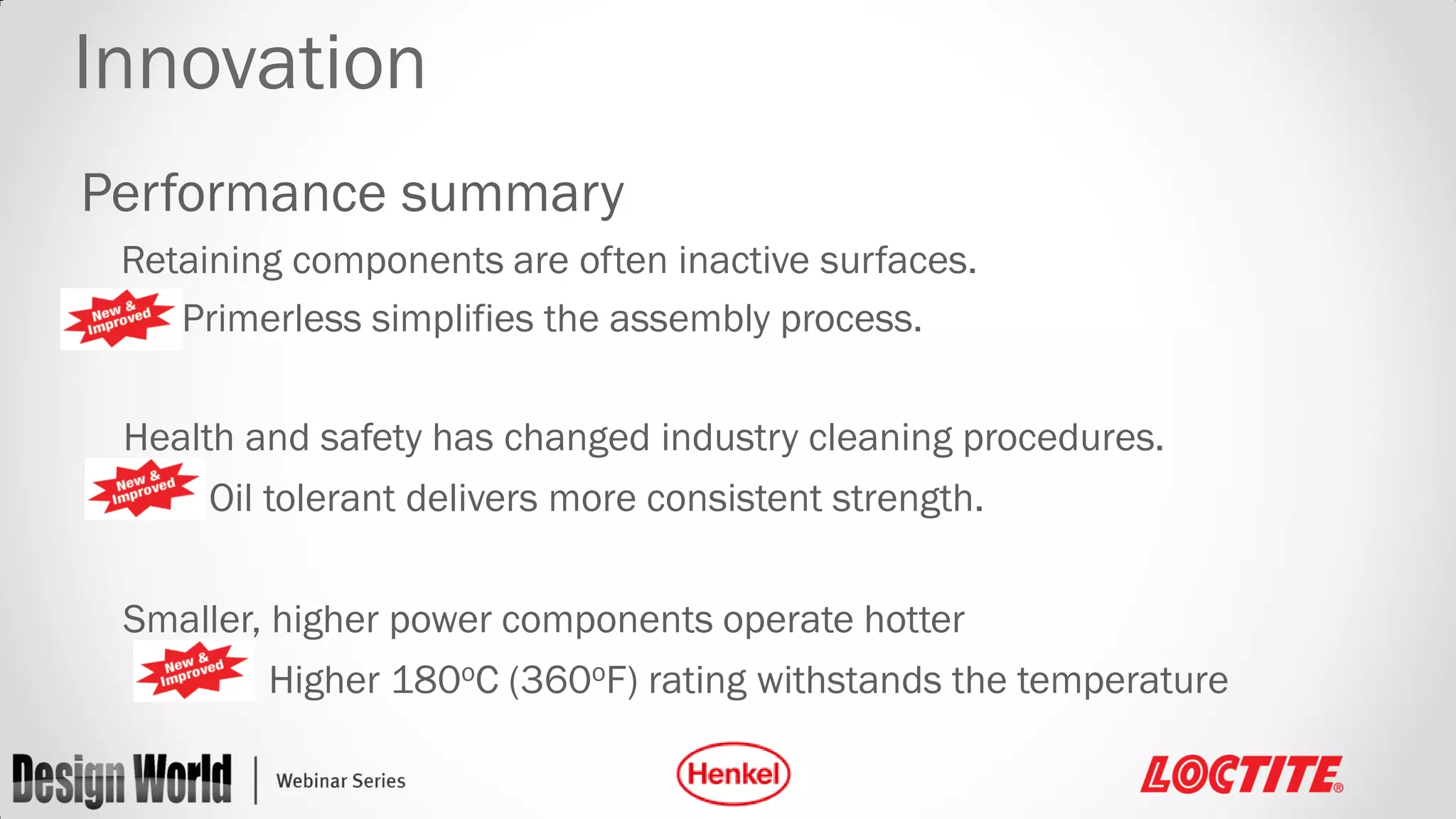
Performance summary
Retaining components are often inactive surfaces.
Primerless simplifies the assembly process.
Health and safety has changed industry cleaning procedures.
Oil tolerant delivers more consistent strength.
Smaller, higher power components operate hotter
Higher 180oC (360oF) rating withstands the temperature
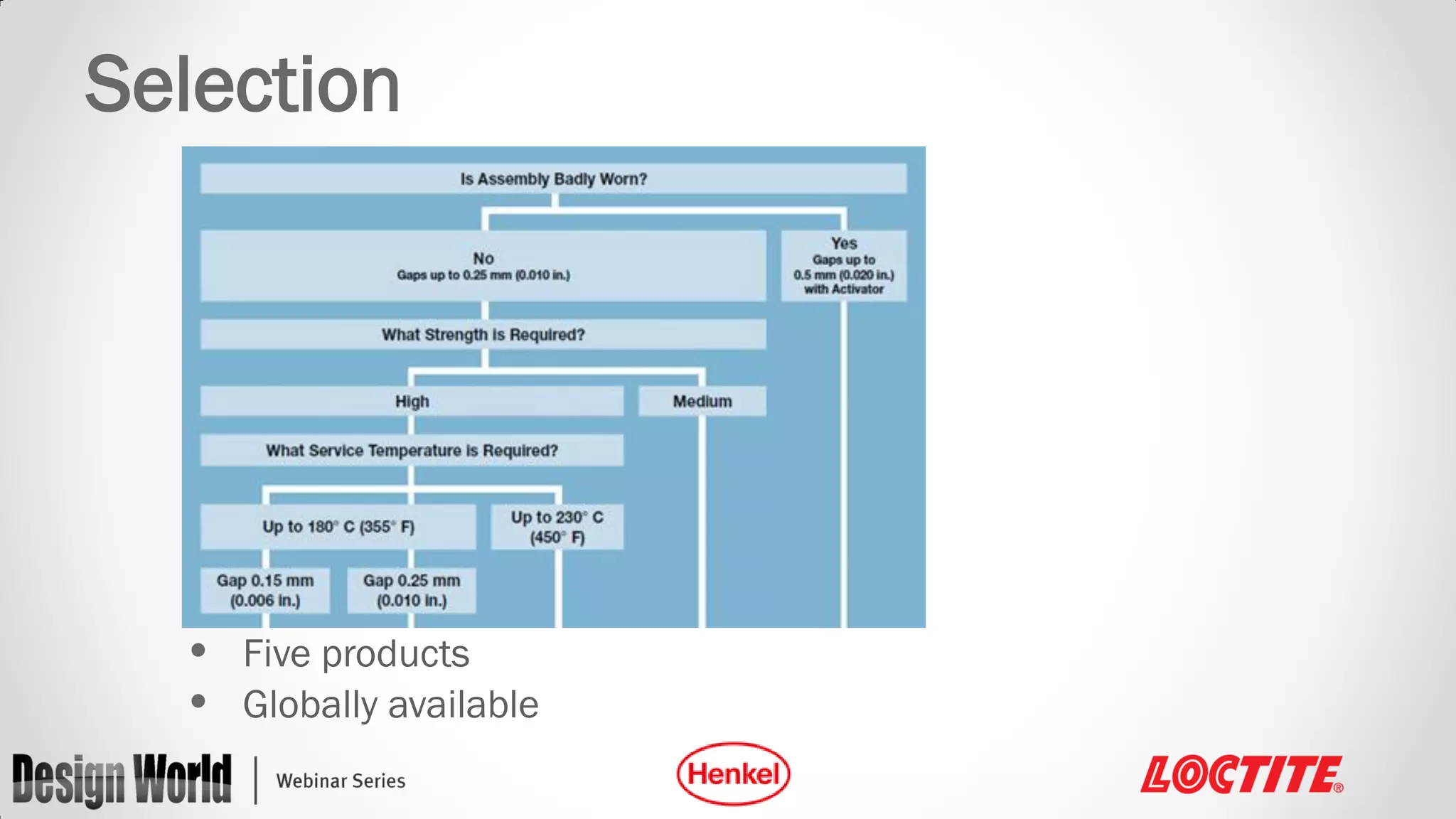
Selection

• Five products
• Globally available
Applications
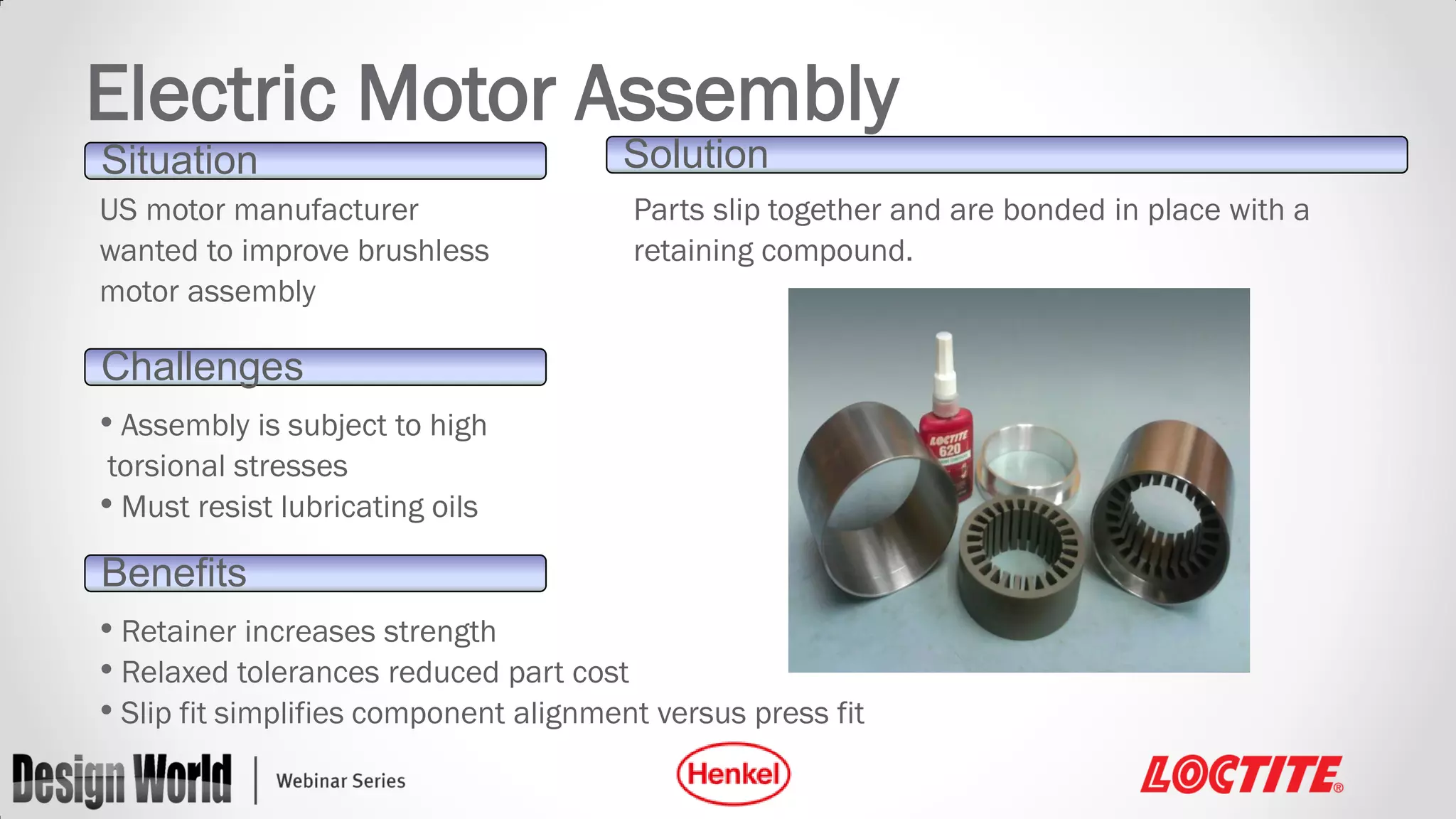
Electric Motor Assembly
Situation
US motor manufacturer
wanted to improve brushless
motor assembly

Solution
Parts slip together and are bonded in place with a
retaining compound.

Challenges
• Assembly is subject to high
torsional stresses
• Must resist lubricating oils

Benefits
• Retainer increases strength
• Relaxed tolerances reduced part cost
• Slip fit simplifies component alignment versus press fit
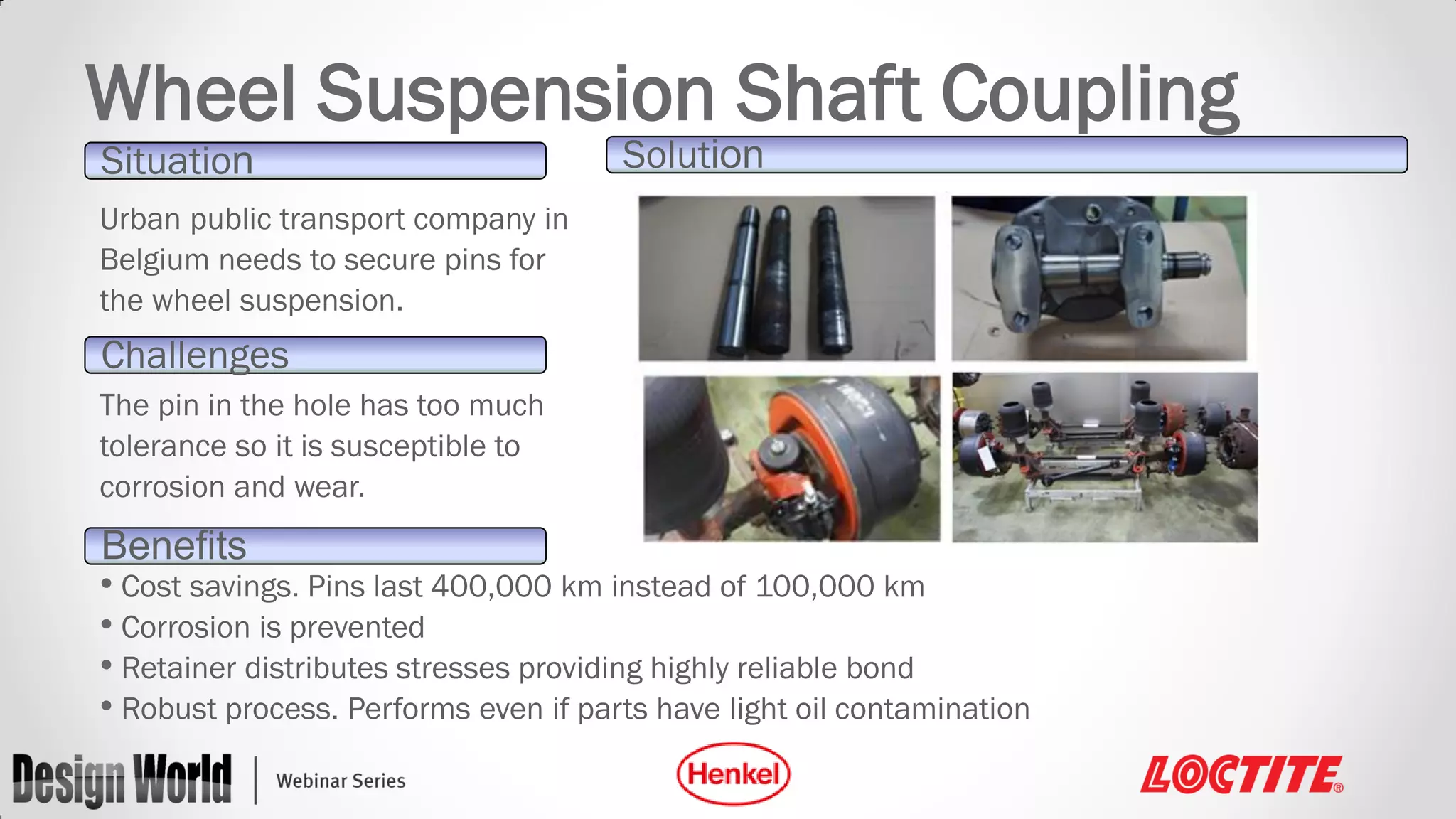
Wheel Suspension Shaft Coupling
Situation

Solution

Urban public transport company in
Belgium needs to secure pins for
the wheel suspension.

Challenges
The pin in the hole has too much
tolerance so it is susceptible to
corrosion and wear.

Benefits
• Cost savings. Pins last 400,000 km instead of 100,000 km
• Corrosion is prevented
• Retainer distributes stresses providing highly reliable bond
• Robust process. Performs even if parts have light oil contamination
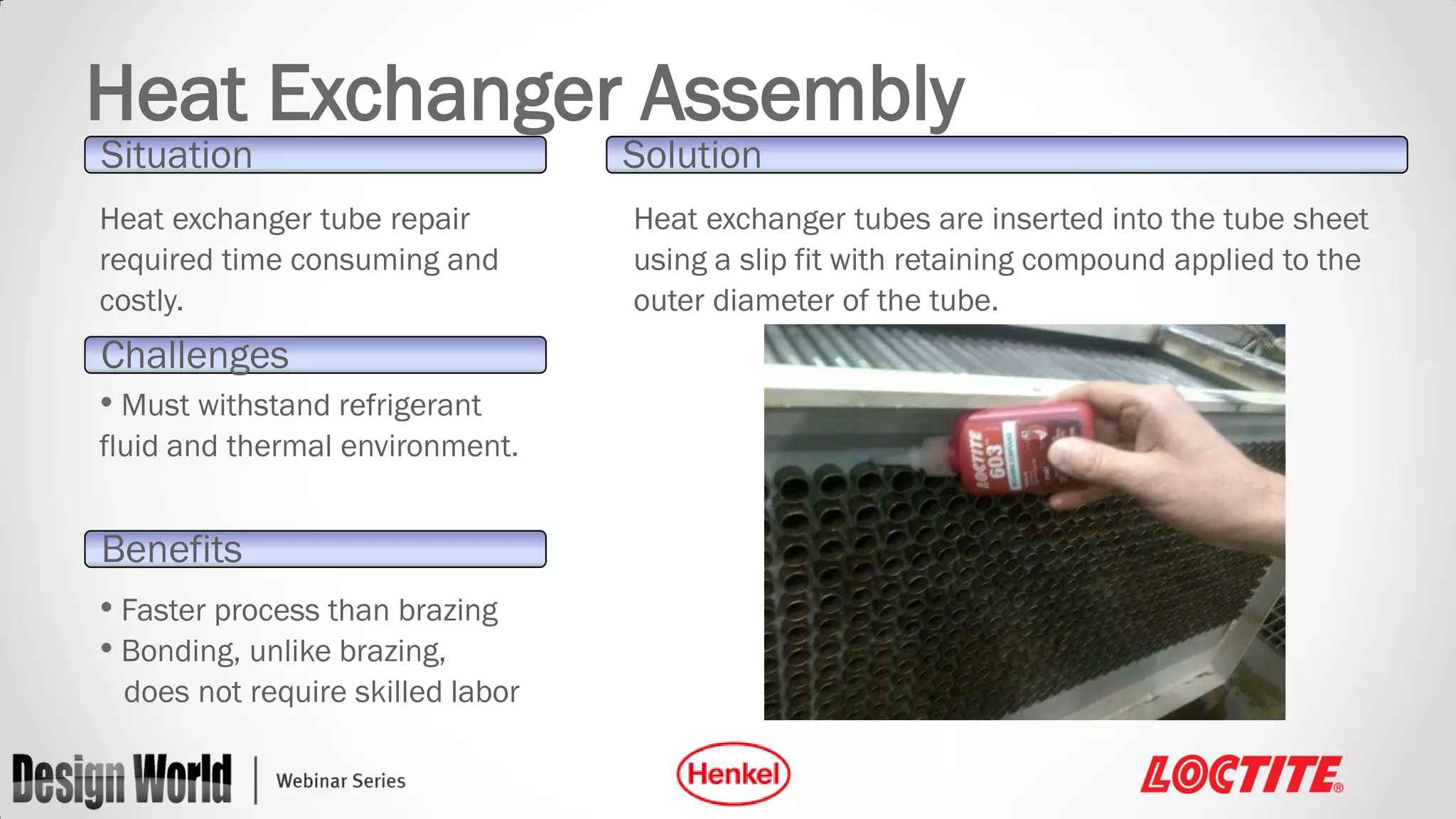
Heat Exchanger Assembly
Situation

Heat exchanger tube repair
required time consuming and
costly.

Challenges
• Must withstand refrigerant
fluid and thermal environment.

Benefits
• Faster process than brazing
• Bonding, unlike brazing,
does not require skilled labor

Solution

Heat exchanger tubes are inserted into the tube sheet
using a slip fit with retaining compound applied to the
outer diameter of the tube.
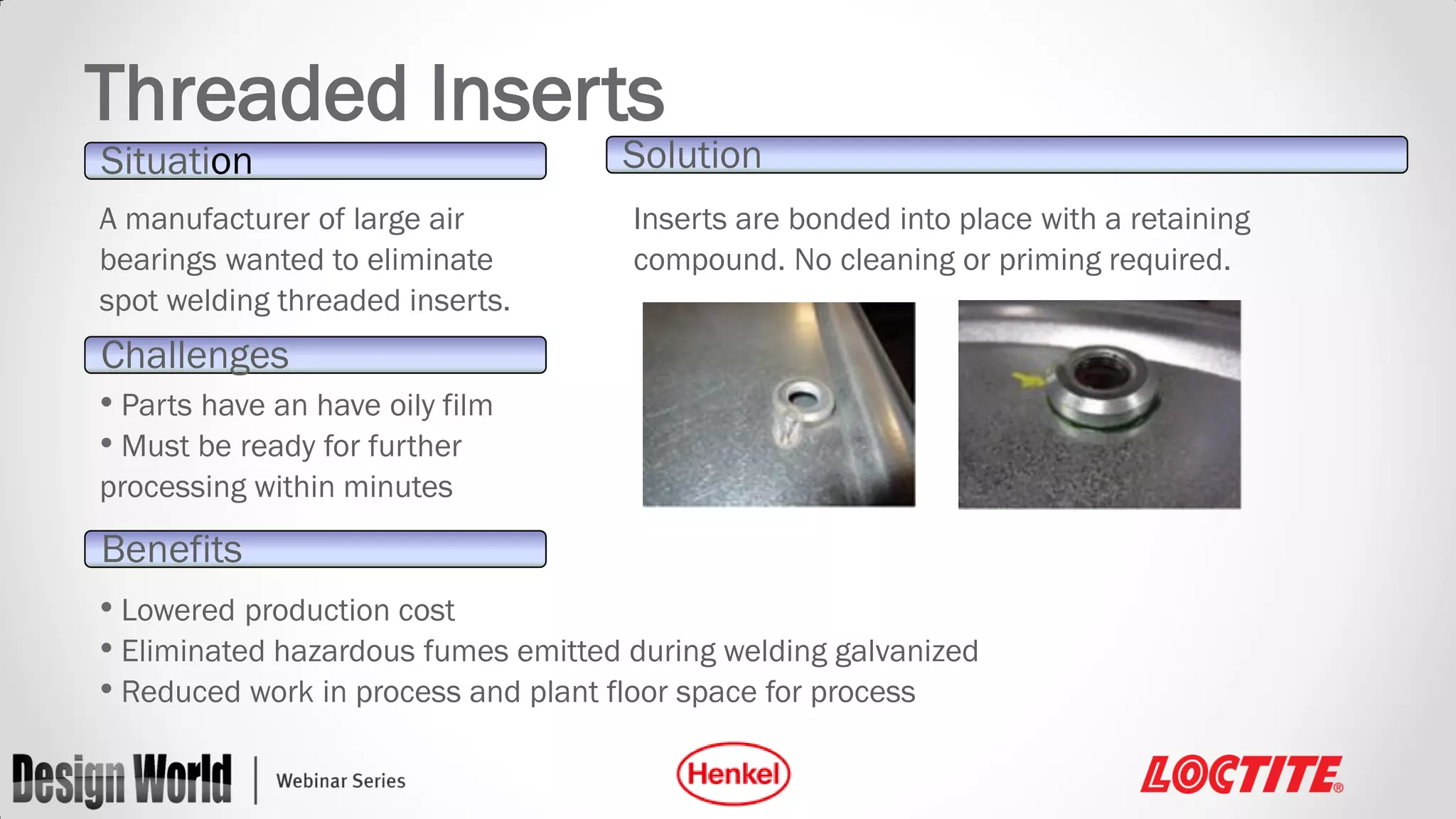
Threaded Inserts
Situation
A manufacturer of large air
bearings wanted to eliminate
spot welding threaded inserts.

Solution
Inserts are bonded into place with a retaining
compound. No cleaning or priming required.

Challenges
• Parts have an have oily film
• Must be ready for further
processing within minutes

Benefits
• Lowered production cost
• Eliminated hazardous fumes emitted during welding galvanized
• Reduced work in process and plant floor space for process
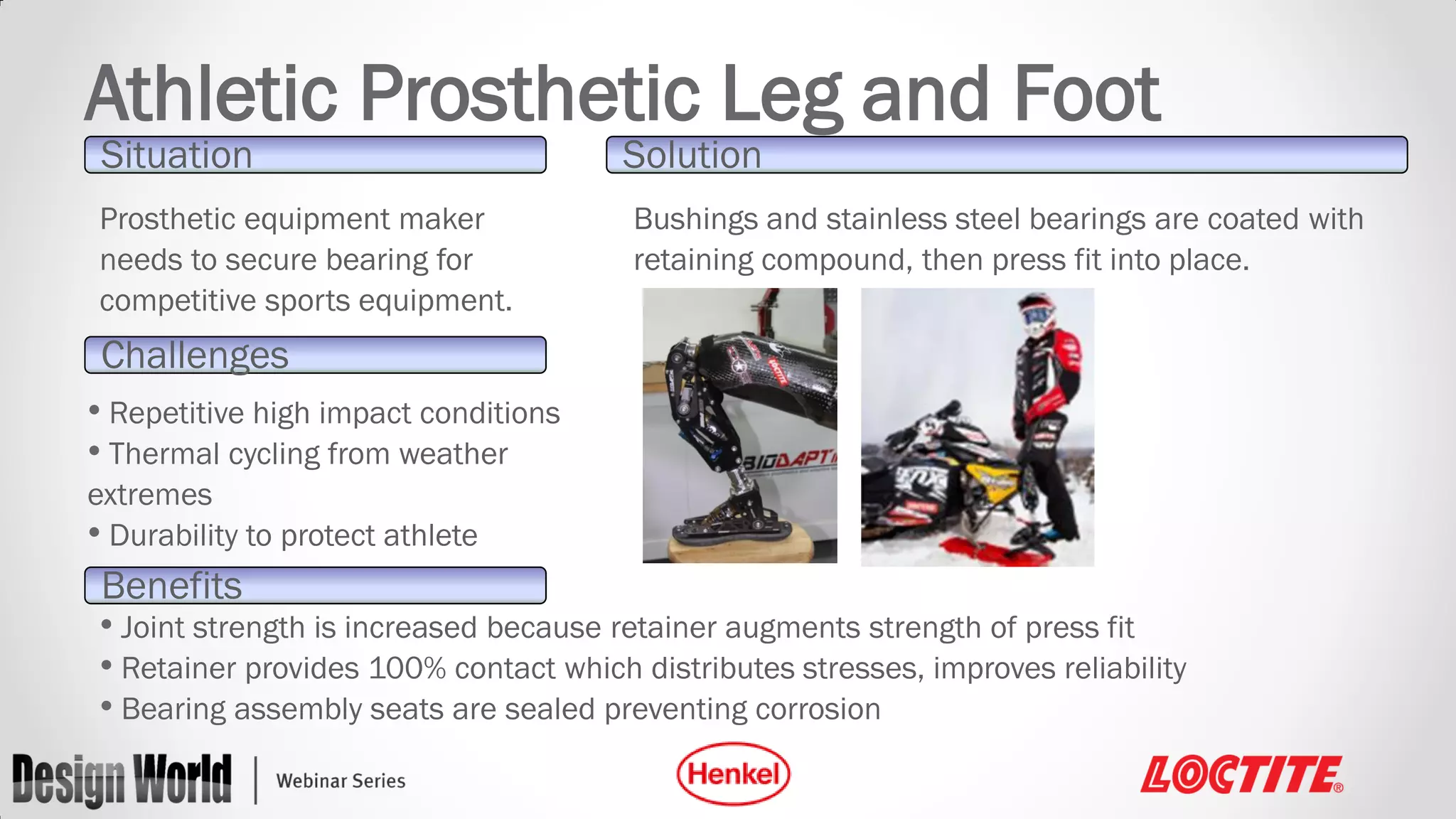
Athletic Prosthetic Leg and Foot
Situation

Prosthetic equipment maker
needs to secure bearing for
competitive sports equipment.

Solution

Bushings and stainless steel bearings are coated with
retaining compound, then press fit into place.

Challenges
• Repetitive high impact conditions
• Thermal cycling from weather
extremes
• Durability to protect athlete

Benefits
• Joint strength is increased because retainer augments strength of press fit
• Retainer provides 100% contact which distributes stresses, improves reliability
• Bearing assembly seats are sealed preventing corrosion
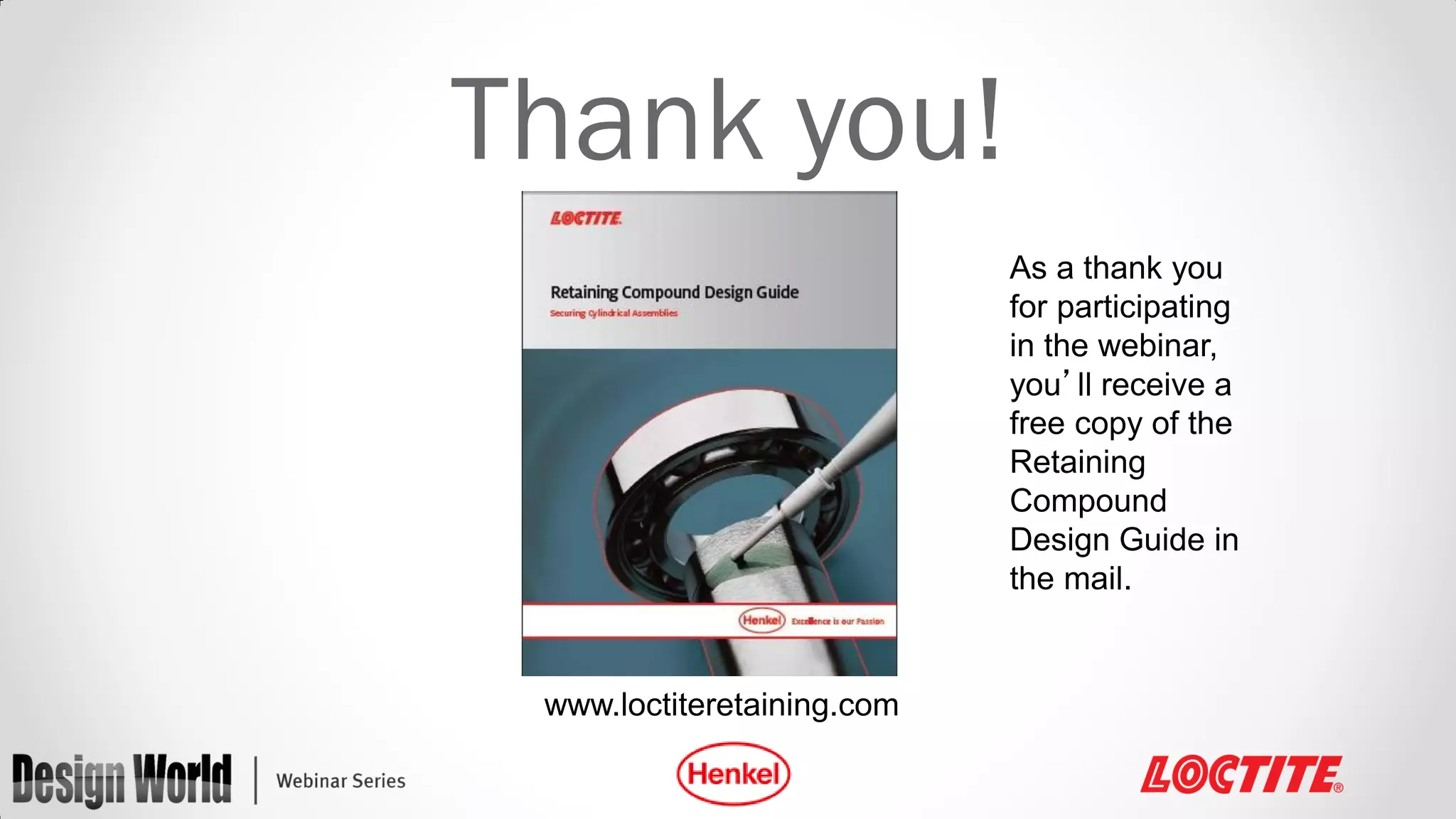
Thank you!
As a thank you
for participating
in the webinar,
you’ll receive a
free copy of the
Retaining
Compound
Design Guide in
the mail.

www.loctiteretaining.com
Questions?
Henkel-Loctite

Design World

Miles Budimir
mbudimir@wtwhmedia.com
Phone: 440.234.4531
Twitter: @DW_Motion

Doug Lescarbeau
doug.lescarbeau@henkel.com

Henkel-Loctite

Robert Dunkel
Robert.dunkel@henkel.com
Thank You
 This webinar will be available at designworldonline.com & email
 Tweet with hashtag #DWwebinar
 Connect with

 Discuss this on EngineeringExchange.com
Increasing the Strength and Reliability of Press Fits

Increasing the Strength and Reliability of Press Fits

  • 1.
    Increasing the Strengthand Reliability of Press Fits
  • 2.
    Before We Start This webinar will be available afterwards at designworldonline.com & email  Q&A at the end of the presentation  Hashtag for this webinar: #DWwebinar
  • 3.
  • 4.
    Increasing Strength & Reliabilityof Press Fits Doug Lescarbeau Anaerobic Technology Director, Henkel Corporation Robert Dunkel Technical Service Director, Henkel Corporation November 14, 2013
  • 5.
    Agenda • Mechanical retaining •Retaining compounds • Performance • Application process • Disassembly • Recent innovations • Application case histories
  • 6.
    Mechanical Retaining Methods Thereare three common mechanical methods used to join cylindrical components such as gears, bearings, shafts and hubs: Types of Fits Mechanical-Drive Assembly Interference Fit Assembly Tack in Place Assembly
  • 7.
    Mechanical Drive Assemblies SetScrew Pin Keyway Spline Shaft The most common mechanical-drive assembly is the conventional key/keyway. Other mechanical-drive assemblies are set screws, pins and spline shafts. All transmit torque levels related to their mechanical interlocking: Set screw << pin << keyway << spline shaft All are easy to assemble or disassemble.
  • 8.
    Mechanical Drive Limitations •Notch effect creates high stress concentration in the area of the screw, key, pin or spline. • Backlash, inherent in most designs, results in relative movement leading to abrasive wear • High machining costs result due to additional manufacturing steps • Uneven distribution of mass will affect balance
  • 9.
    Interference Fit Assemblies D1>> d2 d>D e.g. H7/k6 Press Fit Taper Fit Shrink Fit Press fit: interference is created because the shaft is larger in diameter than the hole into which it is pressed. Taper fit: interference is created when the fastener is tightened so the parts are drawn together. Shrink fit: The hub is expanded with heat or the shaft is shrunk with cold before parts are assembled. Interference is created when parts return to normal temperature.
  • 10.
    Limitations of interferencefit assemblies, e.g. taper fits, press fits, shrink fits • Material, surface and design restrictions rely on friction alone to transmit torque • Close tolerances required to achieve specific load capacity results in high machining costs • Micro-movement can cause fretting corrosion that will accelerate wear and increases the risk of part failure • Surface galling makes disassembly difficult/ impossible • High stress in components, due to interference fits, plus operational loads can lead to part failure
  • 11.
    Tack in PlaceAssemblies Connections by welding or soldering are high strength assemblies, but complete load is carried by the small welding area.
  • 12.
    Limitations of weldedor soldered tack in place assemblies • Only compatible metals can be joined • Heating of the material can create distortion, residual stresses and structural degradation in welded areas. • Disassembly difficult/impossible • Additional costs due to need for specialized equipment, e.g., laser welding, energy • Need for specially trained personnel, e.g., Welders • Welding usually requires secondary cleaning and grinding operations.
  • 13.
    Retaining Compounds • Singlecomponent adhesive • Fill gap between joined parts • Make use of complete contact area • Good adhesion to metal surfaces • High cohesion of the adhesive layer • Provide high shear strength
  • 14.
    Retaining Compound Options AugmentMechanical Retaining • Higher load transmission and better performance with existing designs and geometry. • Equal performance with relaxed tolerances. • Reduce the size and weight of an assembly. Replace Mechanical Retaining • High-strength products can carry high loads. • Because there is 100% contact, load and stress is distributed evenly over the joint. • All voids are filled, which prevents corrosion and fretting.
  • 15.
    Design Tools Proprietary RetCalc+software models Retaining Compound performance Input • 6 Joint Design Factors • 3 Retaining Compound Factors Output • Axial load rating • Torque rating
  • 16.
    Cost Benefits • Reduceor eliminate expensive machining operations. • Eliminate some surface finishing requirements. • Prolong equipment life through better fatigue and corrosion resistance. • Fill gaps so machining tolerances can be widened. • Help lower overall assembly and maintenance costs. • Simplify assemblies by reducing use of circlips, keys, dowels or threads. • Can eliminate the need for mechanical retainers. • Minimize machine downtime, ensuring an earlier return to service.
  • 17.
    Retaining Compounds Comparison toMechanical Assembly Methods Retaining Compounds: • Increase assembly reliability. • Produce more accurate, rigid assemblies. • Eliminate backlash in keys and splines. • Prevent small diameter shaft distortion. • Increase strength of mechanical retaining methods. • Eliminate fretting corrosion. • Seal against environmental corrosion. • Eliminate high assembly stresses. • Reduce variations in load transmission. • Allow dissimilar materials to be assembled more easily. Interference (press fits or shrink) fits and taper fits • Rely on friction alone to transmit torque; therefore, they are limited by material, surfaces and design. • Close tolerances are needed to obtain specific load capacities, leading to higher production costs. • Interference fitting creates stresses in the components that can lead to failure, particularly when combined with operational stresses. Keyway and spline assemblies • Cause high stresses due to the “notch effect” that occurs. • Result in high machining costs and backlash. Welding and soldering • Only compatible metals can be joined. • Heating of the material can lead to residual stresses and structural degradation and distortion. • Requires skilled labor and secondary cleaning and grinding.
  • 18.
    Application Process Dispensing Equipmentprovides process control Manual Semi-Automatic Automatic
  • 19.
    Disassembly Bearings assembled withRetaining Compound can be disassembled with industry standard bearing disassembly tools and techniques, including bearing pullers and hydraulic presses. Another technique is to heat the parts well above the service temperature [to 250°C (482°F) for most products] and disassemble while the parts are hot.
  • 20.
    Voice of Customer& Market Research • Market research identified improvement opportunities • Performance • Primerless • Oil Tolerant • Higher Temperature • Selection • Simplify selection • Global product range
  • 21.
    Innovation Temperature upgrade • • Upgraded Temperatureto 360ºF (180ºC) Improvements measured via heat aging
  • 22.
    Innovation Oil Tolerance • Tested onsteel pins and collars with light contamination
  • 23.
  • 24.
  • 25.
    Innovation Performance summary Retaining componentsare often inactive surfaces. Primerless simplifies the assembly process. Health and safety has changed industry cleaning procedures. Oil tolerant delivers more consistent strength. Smaller, higher power components operate hotter Higher 180oC (360oF) rating withstands the temperature
  • 26.
  • 27.
  • 28.
    Electric Motor Assembly Situation USmotor manufacturer wanted to improve brushless motor assembly Solution Parts slip together and are bonded in place with a retaining compound. Challenges • Assembly is subject to high torsional stresses • Must resist lubricating oils Benefits • Retainer increases strength • Relaxed tolerances reduced part cost • Slip fit simplifies component alignment versus press fit
  • 29.
    Wheel Suspension ShaftCoupling Situation Solution Urban public transport company in Belgium needs to secure pins for the wheel suspension. Challenges The pin in the hole has too much tolerance so it is susceptible to corrosion and wear. Benefits • Cost savings. Pins last 400,000 km instead of 100,000 km • Corrosion is prevented • Retainer distributes stresses providing highly reliable bond • Robust process. Performs even if parts have light oil contamination
  • 30.
    Heat Exchanger Assembly Situation Heatexchanger tube repair required time consuming and costly. Challenges • Must withstand refrigerant fluid and thermal environment. Benefits • Faster process than brazing • Bonding, unlike brazing, does not require skilled labor Solution Heat exchanger tubes are inserted into the tube sheet using a slip fit with retaining compound applied to the outer diameter of the tube.
  • 31.
    Threaded Inserts Situation A manufacturerof large air bearings wanted to eliminate spot welding threaded inserts. Solution Inserts are bonded into place with a retaining compound. No cleaning or priming required. Challenges • Parts have an have oily film • Must be ready for further processing within minutes Benefits • Lowered production cost • Eliminated hazardous fumes emitted during welding galvanized • Reduced work in process and plant floor space for process
  • 32.
    Athletic Prosthetic Legand Foot Situation Prosthetic equipment maker needs to secure bearing for competitive sports equipment. Solution Bushings and stainless steel bearings are coated with retaining compound, then press fit into place. Challenges • Repetitive high impact conditions • Thermal cycling from weather extremes • Durability to protect athlete Benefits • Joint strength is increased because retainer augments strength of press fit • Retainer provides 100% contact which distributes stresses, improves reliability • Bearing assembly seats are sealed preventing corrosion
  • 33.
    Thank you! As athank you for participating in the webinar, you’ll receive a free copy of the Retaining Compound Design Guide in the mail. www.loctiteretaining.com
  • 34.
    Questions? Henkel-Loctite Design World Miles Budimir mbudimir@wtwhmedia.com Phone:440.234.4531 Twitter: @DW_Motion Doug Lescarbeau doug.lescarbeau@henkel.com Henkel-Loctite Robert Dunkel Robert.dunkel@henkel.com
  • 35.
    Thank You  Thiswebinar will be available at designworldonline.com & email  Tweet with hashtag #DWwebinar  Connect with  Discuss this on EngineeringExchange.com