In situ Hybridization (ISH)
&
Fluorescence in situ Hybridization (FISH)
Creative Diagnostics®
www.creative-diagnostics.com
Introduction
In situ Hybridization (ISH) is a method that allows to localize and detect
nucleic acid sequences within structurally intact cells or morphologically
preserved tissues sections.
Fluorescence in situ hybridization (FISH) is a kind of ISH which uses
fluorescent probes binding parts of the chromosome to show a high degree
of sequence complementarity.
Creative Diagnostics ®Creative
Diagnostics ®
Principle
Creative Diagnostics ®Creative Diagnostics ®Creative
Diagnostics ®
ISH works by using a tagging cDNA or probe that will hybridize with the
target DNA sequence
Creative Diagnostics ®Creative Diagnostics ®Creative
Diagnostics ®
Probe preparation
 Probe is critical to in situ hybridization,
and a right probe can help you achieve your
goals.
 Not only the probe types but also the label of
probe should you take into account when you
choose a probe for in situ hybridization.
Probe types
Four basic probe types
Stable, available, easier to obtain
dsDNA probes
Stable, easier to work with, more
specific, resistant to RNases, better
tissue penetration, without self-
hybridize
ssDNA probes
Economical, stable, available, easier to work with, more specific, resistant to
RNases, better tissue penetration, better reproducibility.
Synthetic oligonucleotides probes
Higher thermal stability, better tissue
penetration, more specific, low
background noise by RNase
RNA probes
Creative Diagnostics ®Creative Diagnostics ®Creative
Diagnostics ®
Labeling Probe
Labeling techniques
Radioactive isotopes
• 32
P
• 35
S
• 3
H
Non-radioactive labels
• biotin
• digoxigenin
• fluorescent dye (FISH)
Creative Diagnostics ®Creative Diagnostics ®Creative
Diagnostics ®
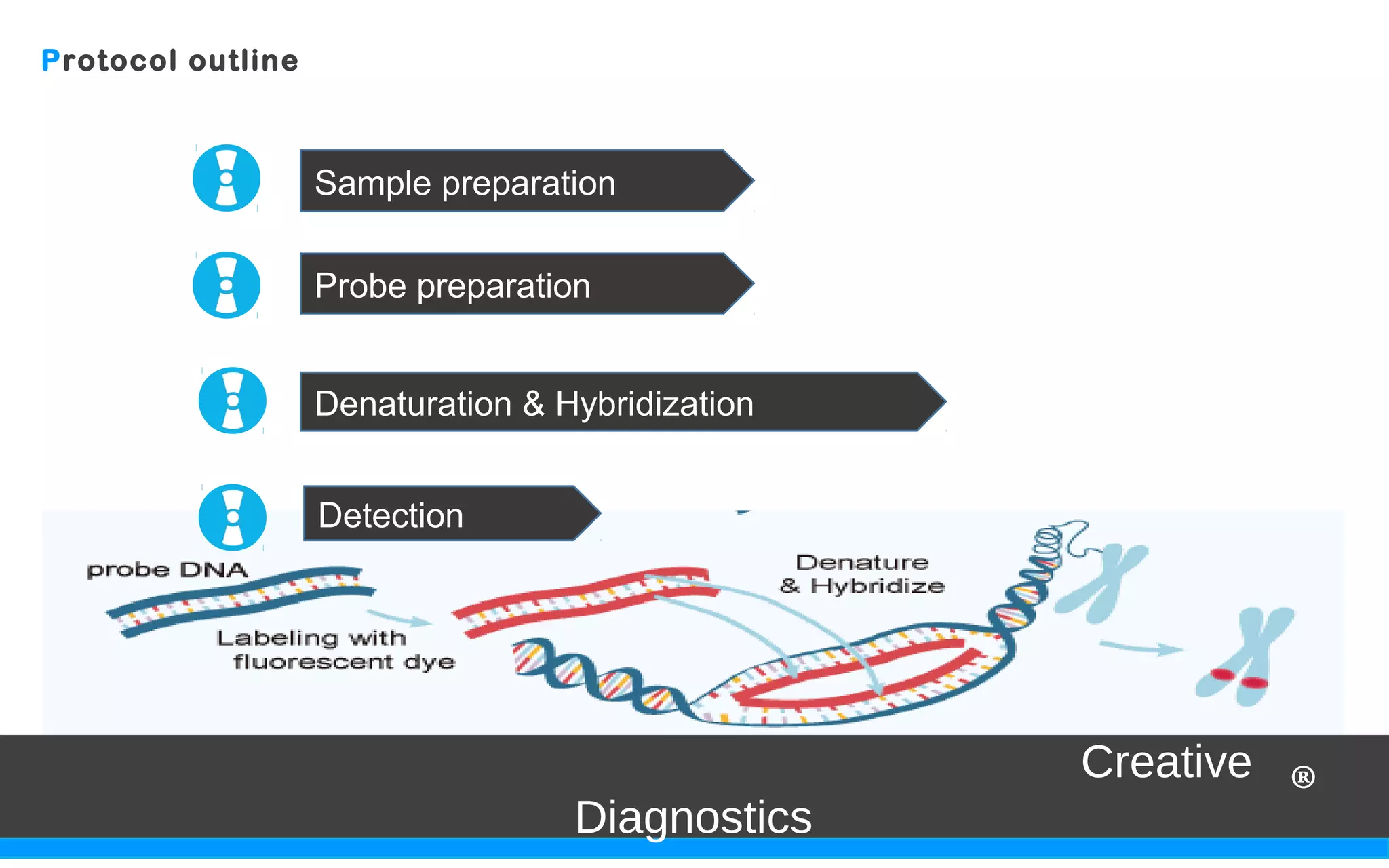
Protocol outline
Creative Diagnostics ®Creative Diagnostics ®Creative
Diagnostics ®
Sample preparation
Probe preparation
Denaturation & Hybridization
Detection
Creative Diagnostics ®Creative Diagnostics ®Creative
Diagnostics ®
Procedure
Sample Preparation
Embedded
Sectioned
Procedure
Creative Diagnostics ®Creative Diagnostics ®Creative
Diagnostics ®
Denaturation & hybridization
Permeablization
Probe added
Procedure
Creative Diagnostics ®Creative Diagnostics ®Creative
Diagnostics ®
Denaturation & hybridization
Washes and detection
Procedure
Creative Diagnostics ®Creative Diagnostics ®Creative
Diagnostics ®
Detection
NonradioactiveprobeRadioactiveprobe
Application
 Morphology: Morphology and population structure of microorganisms
 Pathology: Pathogen profiling, abnormal gene expression
 Developmental biology: Gene expression profiling in embryonic tissues
 Karyotyping and phylogenetic analysis: Unique FISH patterns on individual chromosomes,
chromosomal aberrations
 Physical mapping: Mapping clones on chromosomes and direct assignment of mapped
clones to chromosomal regions associated with heterochromatin or euchromatin
Creative Diagnostics ®Creative Diagnostics ®Creative
Diagnostics ®
In situ hybridization has been widely used for research applications
Creative Diagnostics®
Thank You !
www.creative-diagnostics.com
For more info please contact us:
Phone:
Email:
1-631-624-4882
info@creative-diagnostics.com
Go to our website!

In situ Hybridization (ISH) and Fluorescence in Situ Hybridization (FISH)

  • 1.
    In situ Hybridization(ISH) & Fluorescence in situ Hybridization (FISH) Creative Diagnostics® www.creative-diagnostics.com
  • 2.
    Introduction In situ Hybridization(ISH) is a method that allows to localize and detect nucleic acid sequences within structurally intact cells or morphologically preserved tissues sections. Fluorescence in situ hybridization (FISH) is a kind of ISH which uses fluorescent probes binding parts of the chromosome to show a high degree of sequence complementarity. Creative Diagnostics ®Creative Diagnostics ®
  • 3.
    Principle Creative Diagnostics ®CreativeDiagnostics ®Creative Diagnostics ® ISH works by using a tagging cDNA or probe that will hybridize with the target DNA sequence
  • 4.
    Creative Diagnostics ®CreativeDiagnostics ®Creative Diagnostics ® Probe preparation  Probe is critical to in situ hybridization, and a right probe can help you achieve your goals.  Not only the probe types but also the label of probe should you take into account when you choose a probe for in situ hybridization.
  • 5.
    Probe types Four basicprobe types Stable, available, easier to obtain dsDNA probes Stable, easier to work with, more specific, resistant to RNases, better tissue penetration, without self- hybridize ssDNA probes Economical, stable, available, easier to work with, more specific, resistant to RNases, better tissue penetration, better reproducibility. Synthetic oligonucleotides probes Higher thermal stability, better tissue penetration, more specific, low background noise by RNase RNA probes Creative Diagnostics ®Creative Diagnostics ®Creative Diagnostics ®
  • 6.
    Labeling Probe Labeling techniques Radioactiveisotopes • 32 P • 35 S • 3 H Non-radioactive labels • biotin • digoxigenin • fluorescent dye (FISH) Creative Diagnostics ®Creative Diagnostics ®Creative Diagnostics ®
  • 7.
    Protocol outline Creative Diagnostics®Creative Diagnostics ®Creative Diagnostics ® Sample preparation Probe preparation Denaturation & Hybridization Detection
  • 8.
    Creative Diagnostics ®CreativeDiagnostics ®Creative Diagnostics ® Procedure Sample Preparation Embedded Sectioned
  • 9.
    Procedure Creative Diagnostics ®CreativeDiagnostics ®Creative Diagnostics ® Denaturation & hybridization Permeablization Probe added
  • 10.
    Procedure Creative Diagnostics ®CreativeDiagnostics ®Creative Diagnostics ® Denaturation & hybridization Washes and detection
  • 11.
    Procedure Creative Diagnostics ®CreativeDiagnostics ®Creative Diagnostics ® Detection NonradioactiveprobeRadioactiveprobe
  • 12.
    Application  Morphology: Morphologyand population structure of microorganisms  Pathology: Pathogen profiling, abnormal gene expression  Developmental biology: Gene expression profiling in embryonic tissues  Karyotyping and phylogenetic analysis: Unique FISH patterns on individual chromosomes, chromosomal aberrations  Physical mapping: Mapping clones on chromosomes and direct assignment of mapped clones to chromosomal regions associated with heterochromatin or euchromatin Creative Diagnostics ®Creative Diagnostics ®Creative Diagnostics ® In situ hybridization has been widely used for research applications
  • 13.
    Creative Diagnostics® Thank You! www.creative-diagnostics.com For more info please contact us: Phone: Email: 1-631-624-4882 info@creative-diagnostics.com Go to our website!