The cell line
Integrity
Shaimaa Ahmadeen
Biological products Quality Assessor
Jens
Martensson
The quality of the cell lines
used to manufacture
biopharmaceuticals are
crucial for the production of
high-quality, stable
biopharmaceuticals.
2
Aug 01, 2018
By Feliza Mirasol
BioPharm International
Volume 31, Issue 8, pg 10–15
Jens
Martensson
3
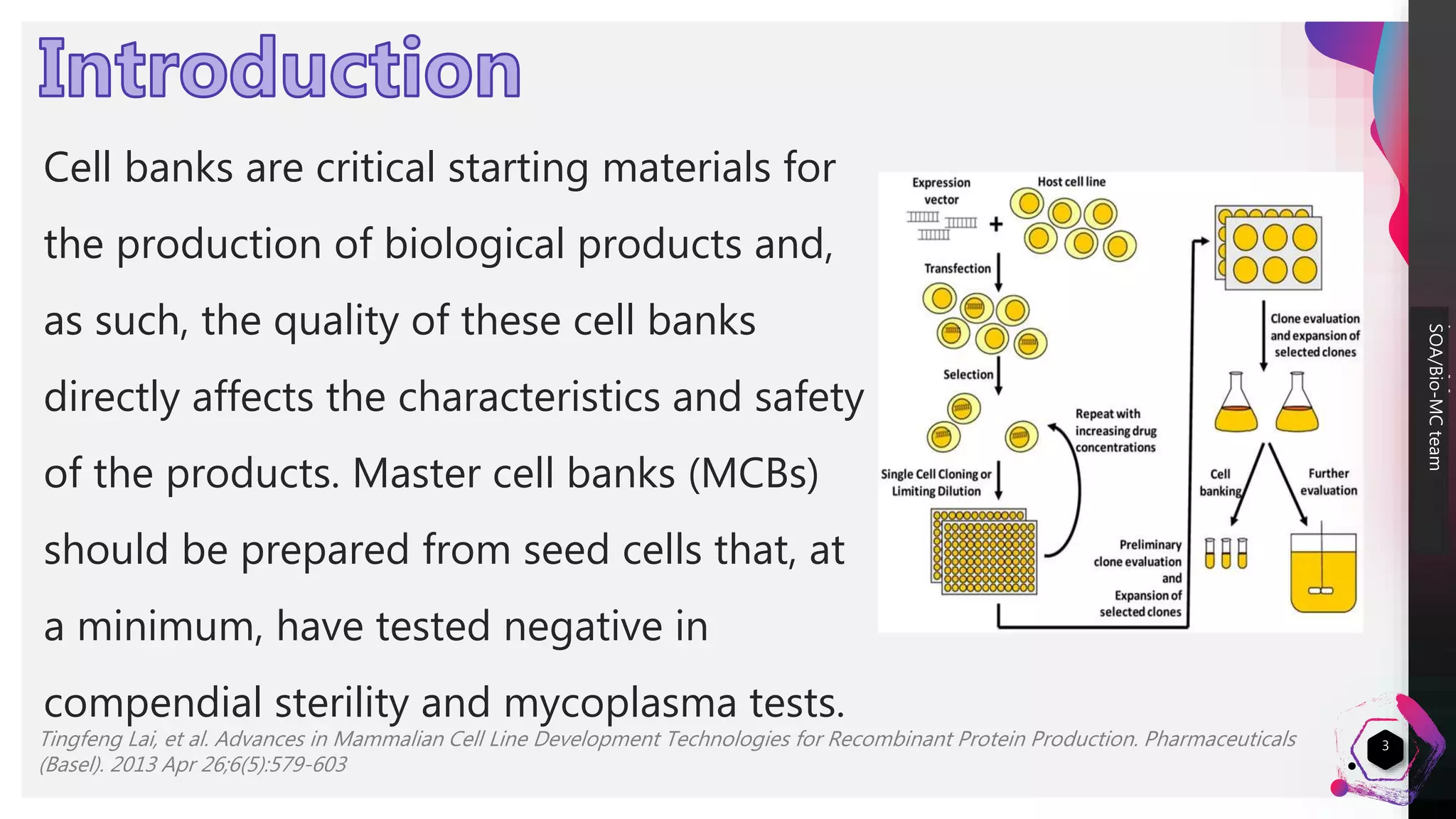
Cell banks are critical starting materials for
the production of biological products and,
as such, the quality of these cell banks
directly affects the characteristics and safety
of the products. Master cell banks (MCBs)
should be prepared from seed cells that, at
a minimum, have tested negative in
compendial sterility and mycoplasma tests.
Tingfeng Lai, et al. Advances in Mammalian Cell Line Development Technologies for Recombinant Protein Production. Pharmaceuticals
(Basel). 2013 Apr 26;6(5):579-603
SOA/Bio-MC
team
SOA/Bio-MC
team
Jens
Martensson
Cell lines used for manufacturing processes
need to fulfill the following criteria:
5
1- Cell lines need to be capable of producing the drug
substance with high productivity.
For example, CHO cell lines are the most frequently applied mammalian
manufacturing cell lines in the biopharmaceutical industry. They usually
express classical monoclonal therapeutic antibodies with titers of more
than 5 g/L.
Jens
Martensson
Cell lines used for manufacturing processes
need to fulfill the following criteria:
6
2- Cell lines need to produce the drug molecules with the appropriate
quality, meaning that the structure of the molecule needs to be ‘as
expected’.
For example, it is known that CHO cell lines express human antibodies with a suitable glycan
pattern.
Jens
Martensson
Cell lines used for manufacturing processes
need to fulfill the following criteria:
7
3- Cell lines need to accept foreign DNA, which provides the coding
instruction for the drug molecule together with elements directing the gene
expressions (e.g., promoters, enhancers, terminator structures).
The cell lines need to stably keep this genetic information within the cells, and they need
to be able to stably express this genetic information with a reproducibly high productivity
over a long time (i.e., in the case of mammalian cell lines over many generation times for
months, and after freezing and thawing cycles)..
Jens
Martensson
Cell lines used for manufacturing processes
need to fulfill the following criteria:
8
4- Cell lines need to be robust enough to grow to high density in large
bioreactors (i.e., thousands of liters)
5- The cell lines need to be free of any virus or other harmful contamination
and should not have been in contact with serum or undefined media
components.
Jens
Martensson
9
Culture mode
• Most mammalian upstream processes,
in which cells grow to high cell density
and produce the drug molecules, run as
fed-batch processes. This means that
the cells grow over a period of
approximately two weeks with optimal
feeding and then are harvested.
Perfusion
• Some upstream processes run as
continuous processes, in which cell
density is kept constant, while media is
continuously added and removed.
• Usually a cell line that is well suited for
fed-batch processes is not necessarily
good in continuous culturing processes
and vice versa.
Fed-batch
Jens
Martensson
The analytical processes required to
test cell-line quality
11
Jens
Martensson
The details in the testing program can vary
depending on the source of the cell line as well as on
the final product. However, there are standard
analytical procedures to be followed as described in
national and international guidelines and as
summarized in the International Conference on
Harmonization (ICH) Q5D
12
Jens
Martensson
13
test of cell´s identity (e.g., short tandem repeat analysis)
test of purity (absence of adventitious cellular or microbial
contaminants and potential cross-contaminations with other cell lines)
the complete package of in vitro, in vivo, and polymerase chain reaction
(PCR)-based assays for adventitious agents.
Depending on the source of the cell and the final product, tests for
tumorigenicity of the cells and oncogenicity of the cell´s genomic DNA
might be required.
Jens
Martensson
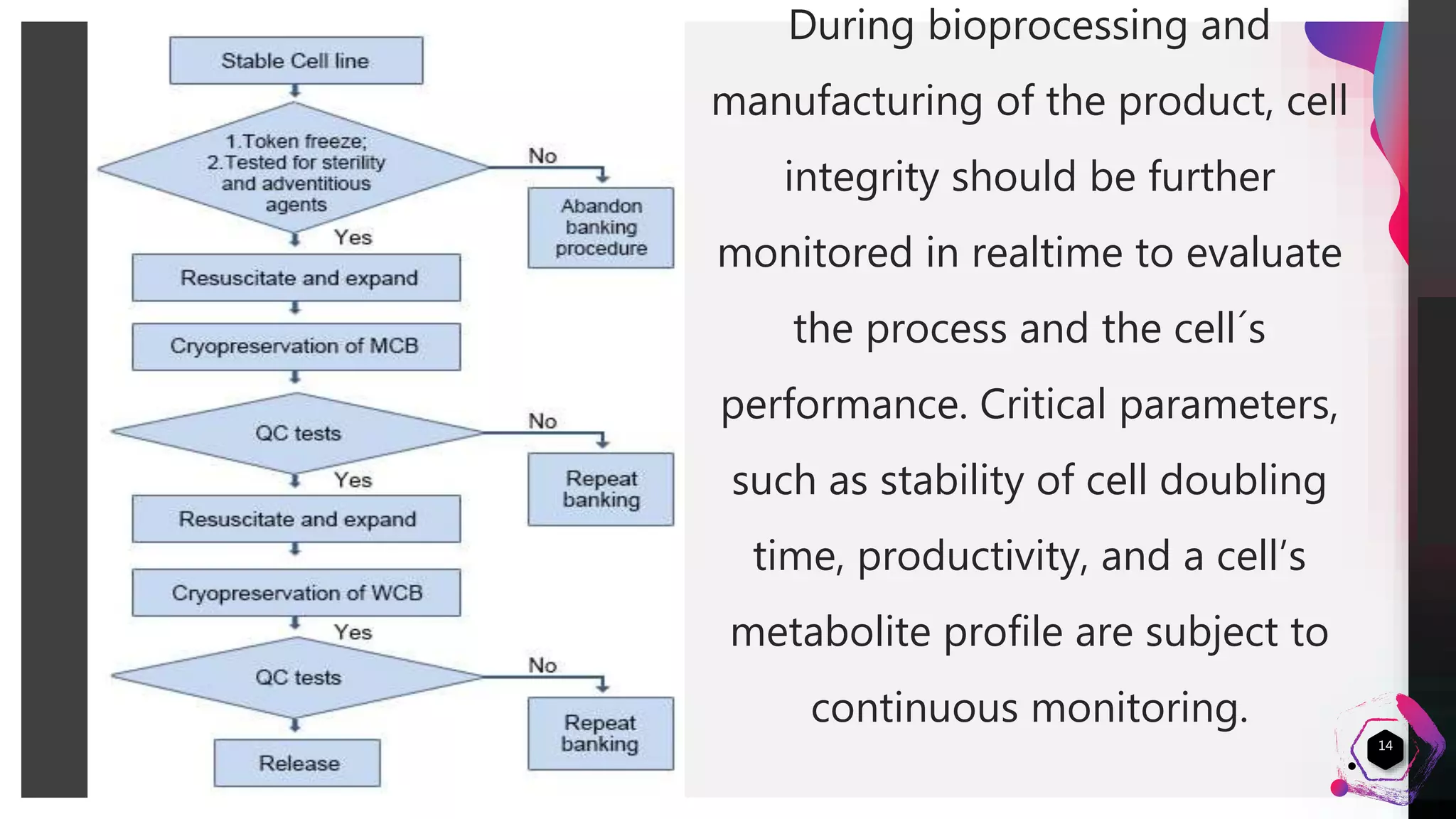
During bioprocessing and
manufacturing of the product, cell
integrity should be further
monitored in realtime to evaluate
the process and the cell´s
performance. Critical parameters,
such as stability of cell doubling
time, productivity, and a cell’s
metabolite profile are subject to
continuous monitoring.
14
Jens
Martensson
Cells should be purchased only from qualified vendors that have been
audited by the purchasing laboratory. At minimum, the vendor should
provide a full history of the cells being provided along with a CoA
demonstrating the cells to be free of bacterial and mycoplasma
contamination. Clear details as to the sterility and mycoplasma testing
methodologies should be provided and/or the purchaser should audit
these testing methods during vendor qualification.
A simple negative result on the CoA should not be considered
sufficient.
15
Jens
Martensson
With regard to the MCB testing should include:
1- identity testing.
2- sterility and mycoplasma testing
3- viral testing : using a variety of suitable tests designed to be both
broad ranging and specific for particular viruses.
4- Genetic stability testing should : performed using methods such as
good manufacturing practices (GMP) sequencing, Northern and
Southern blotting, and copy number by quantitative polymerase
chain reaction (qPCR).
16
Thank
You
Shaimaa Obaid Ahmadeen
0550502314
soahmadeen@gmail.com

The cell line integrity

  • 1.
    The cell line Integrity ShaimaaAhmadeen Biological products Quality Assessor
  • 2.
    Jens Martensson The quality ofthe cell lines used to manufacture biopharmaceuticals are crucial for the production of high-quality, stable biopharmaceuticals. 2 Aug 01, 2018 By Feliza Mirasol BioPharm International Volume 31, Issue 8, pg 10–15
  • 3.
    Jens Martensson 3 Cell banks arecritical starting materials for the production of biological products and, as such, the quality of these cell banks directly affects the characteristics and safety of the products. Master cell banks (MCBs) should be prepared from seed cells that, at a minimum, have tested negative in compendial sterility and mycoplasma tests. Tingfeng Lai, et al. Advances in Mammalian Cell Line Development Technologies for Recombinant Protein Production. Pharmaceuticals (Basel). 2013 Apr 26;6(5):579-603 SOA/Bio-MC team
  • 4.
  • 5.
    Jens Martensson Cell lines usedfor manufacturing processes need to fulfill the following criteria: 5 1- Cell lines need to be capable of producing the drug substance with high productivity. For example, CHO cell lines are the most frequently applied mammalian manufacturing cell lines in the biopharmaceutical industry. They usually express classical monoclonal therapeutic antibodies with titers of more than 5 g/L.
  • 6.
    Jens Martensson Cell lines usedfor manufacturing processes need to fulfill the following criteria: 6 2- Cell lines need to produce the drug molecules with the appropriate quality, meaning that the structure of the molecule needs to be ‘as expected’. For example, it is known that CHO cell lines express human antibodies with a suitable glycan pattern.
  • 7.
    Jens Martensson Cell lines usedfor manufacturing processes need to fulfill the following criteria: 7 3- Cell lines need to accept foreign DNA, which provides the coding instruction for the drug molecule together with elements directing the gene expressions (e.g., promoters, enhancers, terminator structures). The cell lines need to stably keep this genetic information within the cells, and they need to be able to stably express this genetic information with a reproducibly high productivity over a long time (i.e., in the case of mammalian cell lines over many generation times for months, and after freezing and thawing cycles)..
  • 8.
    Jens Martensson Cell lines usedfor manufacturing processes need to fulfill the following criteria: 8 4- Cell lines need to be robust enough to grow to high density in large bioreactors (i.e., thousands of liters) 5- The cell lines need to be free of any virus or other harmful contamination and should not have been in contact with serum or undefined media components.
  • 9.
    Jens Martensson 9 Culture mode • Mostmammalian upstream processes, in which cells grow to high cell density and produce the drug molecules, run as fed-batch processes. This means that the cells grow over a period of approximately two weeks with optimal feeding and then are harvested. Perfusion • Some upstream processes run as continuous processes, in which cell density is kept constant, while media is continuously added and removed. • Usually a cell line that is well suited for fed-batch processes is not necessarily good in continuous culturing processes and vice versa. Fed-batch
  • 11.
    Jens Martensson The analytical processesrequired to test cell-line quality 11
  • 12.
    Jens Martensson The details inthe testing program can vary depending on the source of the cell line as well as on the final product. However, there are standard analytical procedures to be followed as described in national and international guidelines and as summarized in the International Conference on Harmonization (ICH) Q5D 12
  • 13.
    Jens Martensson 13 test of cell´sidentity (e.g., short tandem repeat analysis) test of purity (absence of adventitious cellular or microbial contaminants and potential cross-contaminations with other cell lines) the complete package of in vitro, in vivo, and polymerase chain reaction (PCR)-based assays for adventitious agents. Depending on the source of the cell and the final product, tests for tumorigenicity of the cells and oncogenicity of the cell´s genomic DNA might be required.
  • 14.
    Jens Martensson During bioprocessing and manufacturingof the product, cell integrity should be further monitored in realtime to evaluate the process and the cell´s performance. Critical parameters, such as stability of cell doubling time, productivity, and a cell’s metabolite profile are subject to continuous monitoring. 14
  • 15.
    Jens Martensson Cells should bepurchased only from qualified vendors that have been audited by the purchasing laboratory. At minimum, the vendor should provide a full history of the cells being provided along with a CoA demonstrating the cells to be free of bacterial and mycoplasma contamination. Clear details as to the sterility and mycoplasma testing methodologies should be provided and/or the purchaser should audit these testing methods during vendor qualification. A simple negative result on the CoA should not be considered sufficient. 15
  • 16.
    Jens Martensson With regard tothe MCB testing should include: 1- identity testing. 2- sterility and mycoplasma testing 3- viral testing : using a variety of suitable tests designed to be both broad ranging and specific for particular viruses. 4- Genetic stability testing should : performed using methods such as good manufacturing practices (GMP) sequencing, Northern and Southern blotting, and copy number by quantitative polymerase chain reaction (qPCR). 16
  • 17.