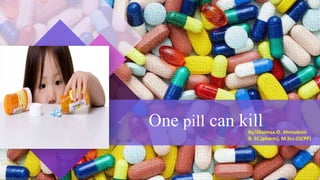
One pill can killBy/Shaimaa.O. Ahmadeen
B. SC,(pharm), M.Scs.(QCPP)
Disclaimer
I am here in a personal capacity and do not represent
my current or previous work. All that will be presented in
the lecture is information from personal experience,
previous training courses and studies conducted by me
with some colleagues for scientific research purpose.
Hard Facts about
Medication Safety
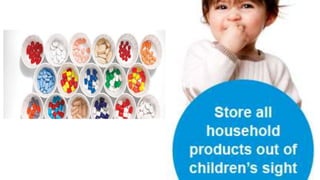
Medicines are the leading cause of child poisoning.
In 2017, nearly 52,000 children under the age of six
were seen in the emergency room for medicine
poisoning. That’s one child every ten minutes
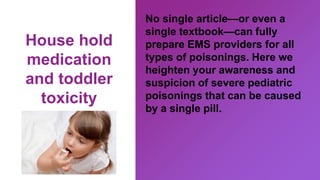
House hold
medication
and toddler
toxicity
No single article—or even a
single textbook—can fully
prepare EMS providers for all
types of poisonings. Here we
heighten your awareness and
suspicion of severe pediatric
poisonings that can be caused
by a single pill.
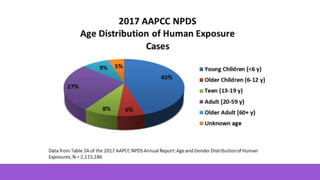
Children are the victims in 68% of all poisoning exposures.
Most of the reported exposures involve children under 6
years of age. Young children often explore their environment
by putting objects into their mouths. Because of the potential
for a child to
come in contact with medications in the home, it is important
to be aware of the toxic potential of medications that
members of the home may use, and to keep them out of the
reach of children. The following is a list of medications that
can be harmful if only a small amount (1-2 tablets) is
ingested.
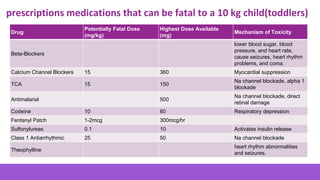
Drug
Potentially Fatal Dose
(mg/kg)
Highest Dose Available
(mg)
Mechanism of Toxicity
Beta-Blockers
lower blood sugar, blood
pressure, and heart rate,
cause seizures, heart rhythm
problems, and coma.
Calcium Channel Blockers 15 360 Myocardial suppression
TCA 15 150
Na channel blockade, alpha 1
blockade
Antimalarial 500
Na channel blockade, direct
retinal damage
Codeine 10 60 Respiratory depression
Fentanyl Patch 1-2mcg 300mcg/hr
Sulfonylureas 0.1 10 Activates insulin release
Class 1 Antiarrhythmic 25 50 Na channel blockade
Theophylline
heart rhythm abnormalities
and seizures.
prescriptions medications that can be fatal to a 10 kg child(toddlers)
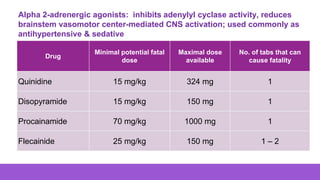
Drug
Minimal potential fatal
dose
Maximal dose
available
No. of tabs that can
cause fatality
Quinidine 15 mg/kg 324 mg 1
Disopyramide 15 mg/kg 150 mg 1
Procainamide 70 mg/kg 1000 mg 1
Flecainide 25 mg/kg 150 mg 1 – 2
Alpha 2-adrenergic agonists: inhibits adenylyl cyclase activity, reduces
brainstem vasomotor center-mediated CNS activation; used commonly as
antihypertensive & sedative
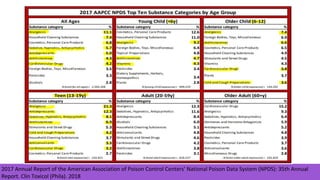
2017 Annual Report of the American Association of Poison Control Centers’ National Poison Data System (NPDS): 35th Annual
Report. Clin Toxicol (Phila). 2018
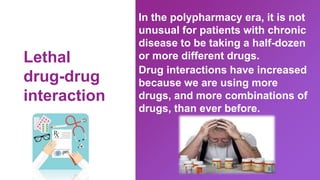
In the polypharmacy era, it is not
unusual for patients with chronic
disease to be taking a half-dozen
or more different drugs.
Drug interactions have increased
because we are using more
drugs, and more combinations of
drugs, than ever before.
Lethal
drug-drug
interaction
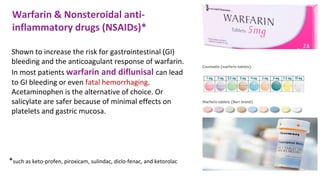
Shown to increase the risk for gastrointestinal (GI)
bleeding and the anticoagulant response of warfarin.
In most patients warfarin and diflunisal can lead
to GI bleeding or even fatal hemorrhaging.
Acetaminophen is the alternative of choice. Or
salicylate are safer because of minimal effects on
platelets and gastric mucosa.
Warfarin & Nonsteroidal anti-
inflammatory drugs (NSAIDs)*
*such as keto-profen, piroxicam, sulindac, diclo-fenac, and ketorolac
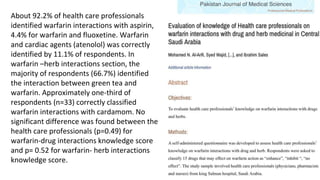
About 92.2% of health care professionals
identified warfarin interactions with aspirin,
4.4% for warfarin and fluoxetine. Warfarin
and cardiac agents (atenolol) was correctly
identified by 11.1% of respondents. In
warfarin –herb interactions section, the
majority of respondents (66.7%) identified
the interaction between green tea and
warfarin. Approximately one-third of
respondents (n=33) correctly classified
warfarin interactions with cardamom. No
significant difference was found between the
health care professionals (p=0.49) for
warfarin-drug interactions knowledge score
and p= 0.52 for warfarin- herb interactions
knowledge score.
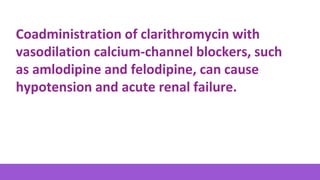
Coadministration of clarithromycin with
vasodilation calcium-channel blockers, such
as amlodipine and felodipine, can cause
hypotension and acute renal failure.
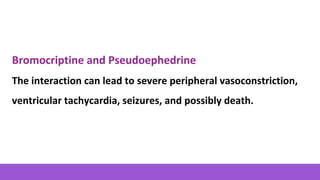
Bromocriptine and Pseudoephedrine
The interaction can lead to severe peripheral vasoconstriction,
ventricular tachycardia, seizures, and possibly death.
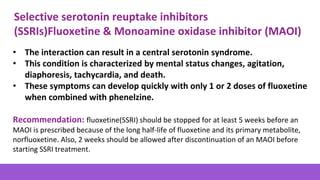
• The interaction can result in a central serotonin syndrome.
• This condition is characterized by mental status changes, agitation,
diaphoresis, tachycardia, and death.
• These symptoms can develop quickly with only 1 or 2 doses of fluoxetine
when combined with phenelzine.
Recommendation: fluoxetine(SSRI) should be stopped for at least 5 weeks before an
MAOI is prescribed because of the long half-life of fluoxetine and its primary metabolite,
norfluoxetine. Also, 2 weeks should be allowed after discontinuation of an MAOI before
starting SSRI treatment.
Selective serotonin reuptake inhibitors
(SSRIs)Fluoxetine & Monoamine oxidase inhibitor (MAOI)
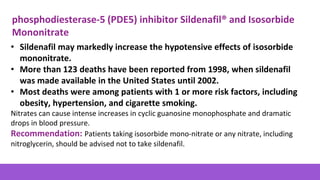
• Sildenafil may markedly increase the hypotensive effects of isosorbide
mononitrate.
• More than 123 deaths have been reported from 1998, when sildenafil
was made available in the United States until 2002.
• Most deaths were among patients with 1 or more risk factors, including
obesity, hypertension, and cigarette smoking.
Nitrates can cause intense increases in cyclic guanosine monophosphate and dramatic
drops in blood pressure.
Recommendation: Patients taking isosorbide mono-nitrate or any nitrate, including
nitroglycerin, should be advised not to take sildenafil.
phosphodiesterase-5 (PDE5) inhibitor Sildenafil® and Isosorbide
Mononitrate
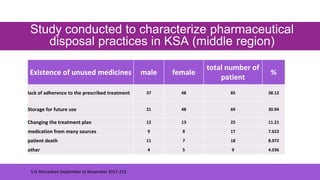
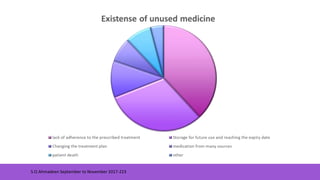
Study conducted to characterize pharmaceutical
disposal practices in KSA (middle region)
Existence of unused medicines male female
total number of
patient
%
lack of adherence to the prescribed treatment 37 48 85 38.12
Storage for future use 21 48 69 30.94
Changing the treatment plan 12 13 25 11.21
medication from many sources 9 8 17 7.623
patient death 11 7 18 8.072
other 4 5 9 4.036
S.O.Ahmadeen September to November 2017-223
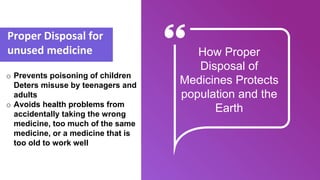
How Proper
Disposal of
Medicines Protects
population and the
Earth
o Prevents poisoning of children
Deters misuse by teenagers and
adults
o Avoids health problems from
accidentally taking the wrong
medicine, too much of the same
medicine, or a medicine that is
too old to work well
Proper Disposal for
unused medicine
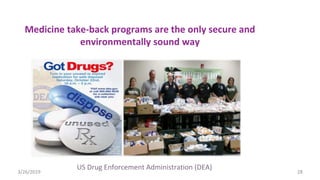
Medicine take-back programs are the only secure and
environmentally sound way
US Drug Enforcement Administration (DEA)
3/26/2019 28
• Unused drugs are a potential risk to public health from risk of poisoning.
• Proper collection and disposal of household pharmaceutical waste can
contribute to reducing the impact of pharmaceuticals in the environment.
• There is a need for a comprehensive program for safe disposal of unused
medications.
• Lack of awareness regarding the health and environmental implications
of medication accumulation.
• prescribing practices and an improved communication between doctors
and patients can contribute to a reduction in the amount of unused
medicines.
• providers must be familiar with common drugs that can be fatal to small
children in very small doses.
• Poison center number should be stickered on the outer label of
medication or the medication carry bag.
Conclusions :
THANK YOU
Increasing community health awareness is our responsibility

One pill can kill

  • 1.
    One pill cankillBy/Shaimaa.O. Ahmadeen B. SC,(pharm), M.Scs.(QCPP)
  • 2.
    Disclaimer I am herein a personal capacity and do not represent my current or previous work. All that will be presented in the lecture is information from personal experience, previous training courses and studies conducted by me with some colleagues for scientific research purpose.
  • 4.
    Hard Facts about MedicationSafety Medicines are the leading cause of child poisoning. In 2017, nearly 52,000 children under the age of six were seen in the emergency room for medicine poisoning. That’s one child every ten minutes
  • 5.
    House hold medication and toddler toxicity Nosingle article—or even a single textbook—can fully prepare EMS providers for all types of poisonings. Here we heighten your awareness and suspicion of severe pediatric poisonings that can be caused by a single pill.
  • 6.
    Children are thevictims in 68% of all poisoning exposures. Most of the reported exposures involve children under 6 years of age. Young children often explore their environment by putting objects into their mouths. Because of the potential for a child to come in contact with medications in the home, it is important to be aware of the toxic potential of medications that members of the home may use, and to keep them out of the reach of children. The following is a list of medications that can be harmful if only a small amount (1-2 tablets) is ingested.
  • 7.
    Drug Potentially Fatal Dose (mg/kg) HighestDose Available (mg) Mechanism of Toxicity Beta-Blockers lower blood sugar, blood pressure, and heart rate, cause seizures, heart rhythm problems, and coma. Calcium Channel Blockers 15 360 Myocardial suppression TCA 15 150 Na channel blockade, alpha 1 blockade Antimalarial 500 Na channel blockade, direct retinal damage Codeine 10 60 Respiratory depression Fentanyl Patch 1-2mcg 300mcg/hr Sulfonylureas 0.1 10 Activates insulin release Class 1 Antiarrhythmic 25 50 Na channel blockade Theophylline heart rhythm abnormalities and seizures. prescriptions medications that can be fatal to a 10 kg child(toddlers)
  • 8.
    Drug Minimal potential fatal dose Maximaldose available No. of tabs that can cause fatality Quinidine 15 mg/kg 324 mg 1 Disopyramide 15 mg/kg 150 mg 1 Procainamide 70 mg/kg 1000 mg 1 Flecainide 25 mg/kg 150 mg 1 – 2 Alpha 2-adrenergic agonists: inhibits adenylyl cyclase activity, reduces brainstem vasomotor center-mediated CNS activation; used commonly as antihypertensive & sedative
  • 9.
    2017 Annual Reportof the American Association of Poison Control Centers’ National Poison Data System (NPDS): 35th Annual Report. Clin Toxicol (Phila). 2018
  • 10.
    In the polypharmacyera, it is not unusual for patients with chronic disease to be taking a half-dozen or more different drugs. Drug interactions have increased because we are using more drugs, and more combinations of drugs, than ever before. Lethal drug-drug interaction
  • 11.
    Shown to increasethe risk for gastrointestinal (GI) bleeding and the anticoagulant response of warfarin. In most patients warfarin and diflunisal can lead to GI bleeding or even fatal hemorrhaging. Acetaminophen is the alternative of choice. Or salicylate are safer because of minimal effects on platelets and gastric mucosa. Warfarin & Nonsteroidal anti- inflammatory drugs (NSAIDs)* *such as keto-profen, piroxicam, sulindac, diclo-fenac, and ketorolac
  • 12.
    About 92.2% ofhealth care professionals identified warfarin interactions with aspirin, 4.4% for warfarin and fluoxetine. Warfarin and cardiac agents (atenolol) was correctly identified by 11.1% of respondents. In warfarin –herb interactions section, the majority of respondents (66.7%) identified the interaction between green tea and warfarin. Approximately one-third of respondents (n=33) correctly classified warfarin interactions with cardamom. No significant difference was found between the health care professionals (p=0.49) for warfarin-drug interactions knowledge score and p= 0.52 for warfarin- herb interactions knowledge score.
  • 13.
    Coadministration of clarithromycinwith vasodilation calcium-channel blockers, such as amlodipine and felodipine, can cause hypotension and acute renal failure.
  • 14.
    Bromocriptine and Pseudoephedrine Theinteraction can lead to severe peripheral vasoconstriction, ventricular tachycardia, seizures, and possibly death.
  • 15.
    • The interactioncan result in a central serotonin syndrome. • This condition is characterized by mental status changes, agitation, diaphoresis, tachycardia, and death. • These symptoms can develop quickly with only 1 or 2 doses of fluoxetine when combined with phenelzine. Recommendation: fluoxetine(SSRI) should be stopped for at least 5 weeks before an MAOI is prescribed because of the long half-life of fluoxetine and its primary metabolite, norfluoxetine. Also, 2 weeks should be allowed after discontinuation of an MAOI before starting SSRI treatment. Selective serotonin reuptake inhibitors (SSRIs)Fluoxetine & Monoamine oxidase inhibitor (MAOI)
  • 16.
    • Sildenafil maymarkedly increase the hypotensive effects of isosorbide mononitrate. • More than 123 deaths have been reported from 1998, when sildenafil was made available in the United States until 2002. • Most deaths were among patients with 1 or more risk factors, including obesity, hypertension, and cigarette smoking. Nitrates can cause intense increases in cyclic guanosine monophosphate and dramatic drops in blood pressure. Recommendation: Patients taking isosorbide mono-nitrate or any nitrate, including nitroglycerin, should be advised not to take sildenafil. phosphodiesterase-5 (PDE5) inhibitor Sildenafil® and Isosorbide Mononitrate
  • 20.
    Study conducted tocharacterize pharmaceutical disposal practices in KSA (middle region) Existence of unused medicines male female total number of patient % lack of adherence to the prescribed treatment 37 48 85 38.12 Storage for future use 21 48 69 30.94 Changing the treatment plan 12 13 25 11.21 medication from many sources 9 8 17 7.623 patient death 11 7 18 8.072 other 4 5 9 4.036 S.O.Ahmadeen September to November 2017-223
  • 21.
    S.O.Ahmadeen September toNovember 2017-223
  • 25.
    How Proper Disposal of MedicinesProtects population and the Earth o Prevents poisoning of children Deters misuse by teenagers and adults o Avoids health problems from accidentally taking the wrong medicine, too much of the same medicine, or a medicine that is too old to work well Proper Disposal for unused medicine
  • 28.
    Medicine take-back programsare the only secure and environmentally sound way US Drug Enforcement Administration (DEA) 3/26/2019 28
  • 30.
    • Unused drugsare a potential risk to public health from risk of poisoning. • Proper collection and disposal of household pharmaceutical waste can contribute to reducing the impact of pharmaceuticals in the environment. • There is a need for a comprehensive program for safe disposal of unused medications. • Lack of awareness regarding the health and environmental implications of medication accumulation. • prescribing practices and an improved communication between doctors and patients can contribute to a reduction in the amount of unused medicines. • providers must be familiar with common drugs that can be fatal to small children in very small doses. • Poison center number should be stickered on the outer label of medication or the medication carry bag. Conclusions :
  • 31.
    THANK YOU Increasing communityhealth awareness is our responsibility

Editor's Notes

  • #2 https://pixabay.com/photos/new-york-skyline-new-york-city-city-668616/
  • #5 https://pixabay.com/photos/skyscraper-building-vertical-1149478/
  • #26 https://pixabay.com/photos/model-businessman-corporate-2911363/