Krupanidhi College of Pharmacy
I SEM M.Pharm 2021-22
Modern Pharmaceutics
VALIDATION
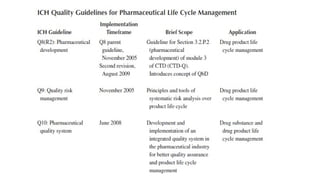
ICH guidelines
• Q8(R2): Pharmaceutical Development
• Q9: Quality Risk Management
• Q10: Pharmaceutical Quality System
Definition
Validation is a structured approach for translating user requirements,
design specification and quality aspirations into a manufacturing
facility
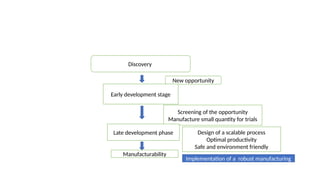
Discovery
New opportunity
Early development stage
Screening of the opportunity
Manufacture small quantity for trials
Late development phase Design of a scalable process
Optimal productivity
Safe and environment friendly
Manufacturability
Implementation of a robust manufacturing
process manufacturing
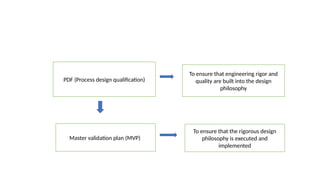
PDF (Process design qualification)
To ensure that engineering rigor and
quality are built into the design
philosophy
Master validation plan (MVP)
To ensure that the rigorous design
philosophy is executed and
implemented
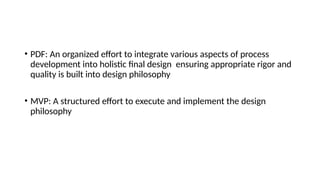
• PDF: An organized effort to integrate various aspects of process
development into holistic final design ensuring appropriate rigor and
quality is built into design philosophy
• MVP: A structured effort to execute and implement the design
philosophy
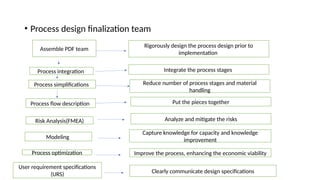
• Process design finalization team
Assemble PDF team
Rigorously design the process design prior to
implementation
Process integration Integrate the process stages
Process simplifications Reduce number of process stages and material
handling
Process flow description Put the pieces together
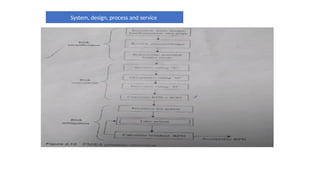
Risk Analysis(FMEA) Analyze and mitigate the risks
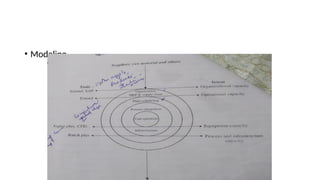
Modeling
Capture knowledge for capacity and knowledge
improvement
Process optimization Improve the process, enhancing the economic viability
User requirement specifications
(URS) Clearly communicate design specifications
• Process design finalization team:
Formation of a PDF team to integrate a diverse work force(Diff
departments) with a common objective of successfully launching the
product
• Process integration
Process integration is integration of various stages of infrastructure into
manufacturing facility
• Process simplification
The process simplification is done in terms of robustness, safety,cost,
efficiency, capacity and ease of operation
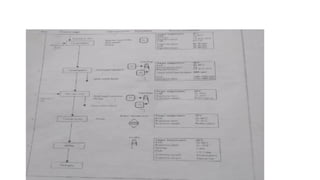
• Process flow description
It’s a systematic way of capturing manufacturing the process
information
• Process flow chart/ equipment flow chart, unit operations for the
manufacturing process
• Quality control strategies required to run a process with its specifications
• A narrative of the process
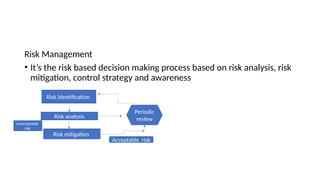
Risk Management
• It’s the risk based decision making process based on risk analysis, risk
mitigation, control strategy and awareness
Risk identification
Risk analysis
Risk mitigation
Periodic
review
Unacceptable
risk
Acceptable risk
Failure mode and effective analysis
Its an engineering technique to define, identify, eliminate known and
potential failures, problems, errors, and so on from design, process,
and / or service before they reach customer
System, design, process and service
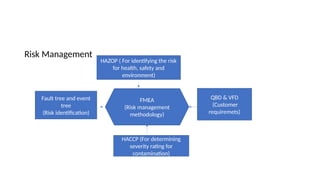
Risk Management
HAZOP ( For identifying the risk
for health, safety and
environment)
Fault tree and event
tree
(Risk identification)
FMEA
(Risk management
methodology)
QBD & VFD
(Customer
requiremets)
HACCP (For determining
severity rating for
contamination)
• HAZOPS
• It’s a structured brain storming exercise in which multidisciplinary
team of experts systematically considers each piece of equipment in
the plant defining its intentions to identify the possible deviations
from intentions
• FMECA
• It’s a stepwise step procedure for identifying the failure modes or
design weakness and criticality of the consequence of the failure for a
particular system under consideration
Fault tree analysis
• it depicts the way in which a particular system failure might occur
(Cause)
• working downwards through the branches using and /or logic gates,
analysis reveals the combination of the events themselves cause the
top event to occur
Event tree analysis
• it represents the consequences
Hazards analysis and critical control points (HACCP)
• It provides documentation to ensure that company understands its
product and process well enough to control or monitor the
parameters that are important to produce quality products
• Analyze each step hazards
• Identify all control points (CCPS)
• Verify the limits for each CCP
• Verify monitoring and testing of limits
• verify corrective actions
• Verify operational procedures for CCPs
• Verify records of each CCPs are documented in the batch record
• QFD
• It provides a systematic approach to determine, prioritize and
translate customer’s need to product design parameters, which
arranges the facts so that important issues, relationship among these
issues, significance of each and their measures of success can be
readily displayed
• VFD
• This focus on value
• Modeling
URS
• URS is a documentation of design intentions and sets the functional
requirements; requirements for product quality and business drive
• it include all stake holders system of performance requirements such
as operations, maintenance, environment, health, safety, engineering,
validation , QC, and automation
• URS will form the basis for system for equipment operational
qualification and performance qualification (PQ)
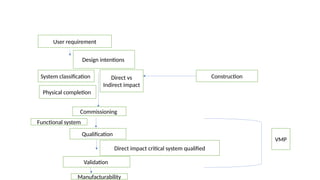
User requirement
Design intentions
System classification Direct vs
Indirect impact
Physical completion
Construction
Commissioning
Qualification
Direct impact critical system qualified
Validation
Manufacturability
Functional system
VMP
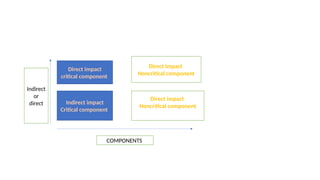
Direct impact
critical component
Direct impact
Noncritical component
Indirect impact
Critical component
Direct impact
Noncritical component
COMPONENTS
Indirect
or
direct
Commissioning
• Commissioning is the startup activities, typically occurs between
construction, physical completion and turn over to either operations
end users or validation team
• Start up activities: FAT, functional test, SAT etc
• The tests performed during commissioning should be designed to
provide assurance that the system has constructed and will perform
to the intended design criteria;
• Both functional and performance tests
• A validation plan is a comprehensive document describing applicable
validation requirements for the facility and providing plan for meeting those
requirements
FDA Definition
• Establishing a documented evidence that provides high degree of
assurance that the specific process will consistently produce product
meeting its predetermined specifications and quality attributes
• As per regulatory agencies the quality attributes of the product to be
identified
• After CPP, the companies must perform the studies to test the parameter
ranges; operating and validated
• The operating range is the range in which the product is
manufactured- narrowest
• Validated range :falls outside of operating range and is the range in
which the process will still perform adequately
• Once CPP is determined, the critical product or operating parameters
• ( time , tem, pressure, pH) to be controlled and monitored during
process validation studies
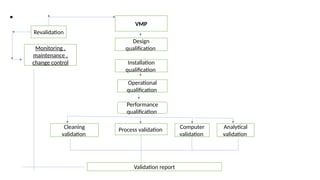
VMP
• A list of all studies that will validate manufacturing process the
question of what and how to validate a manufacturing process
•
VMP
Design
qualification
Installation
qualification
Operational
qualification
Performance
qualification
Process validation
Cleaning
validation
Computer
validation
Analytical
validation
Validation report
Monitoring ,
maintenance ,
change control
Revalidation
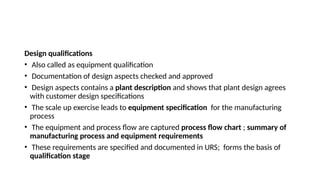
Design qualifications
• Also called as equipment qualification
• Documentation of design aspects checked and approved
• Design aspects contains a plant description and shows that plant design agrees
with customer design specifications
• The scale up exercise leads to equipment specification for the manufacturing
process
• The equipment and process flow are captured process flow chart ; summary of
manufacturing process and equipment requirements
• These requirements are specified and documented in URS; forms the basis of
qualification stage
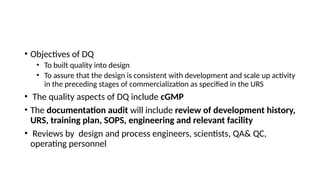
• Objectives of DQ
• To built quality into design
• To assure that the design is consistent with development and scale up activity
in the preceding stages of commercialization as specified in the URS
• The quality aspects of DQ include cGMP
• The documentation audit will include review of development history,
URS, training plan, SOPS, engineering and relevant facility
• Reviews by design and process engineers, scientists, QA& QC,
operating personnel
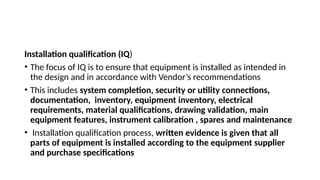
Installation qualification (IQ)
• The focus of IQ is to ensure that equipment is installed as intended in
the design and in accordance with Vendor’s recommendations
• This includes system completion, security or utility connections,
documentation, inventory, equipment inventory, electrical
requirements, material qualifications, drawing validation, main
equipment features, instrument calibration , spares and maintenance
• Installation qualification process, written evidence is given that all
parts of equipment is installed according to the equipment supplier
and purchase specifications
• It includes FAT,
• It documents that operating criteria for equipment is installed, and in
compliance with process and installation diagram, (P& I), plant
functional specifications and process flow diagrams
• IQ is the stage where the completeness and correctness of all
requirements are checked
Operational qualification
• OQ provides the assurance that equipment operates as intended throughout the
anticipated operating ranges
• This involves testing of equipment during operations using non product materials
such as air and water
• In OQ the documented evidence shows that all parts of plant and equipment work
within its specifications
• Process parameters are within the acceptable criteria
• PLC (Programmable logic control ) will be qualified during OQ process
• Computerized process controls should be qualified in CV
• A simulation of normal production conditions must be done to ensure that OQ are
successful
Performance qualification (PQ)
• PQ is the evaluation of overall equipment to confirm the system operates
throughout anticipated ranges as intended
• PQ is performed close to production conditions as possible and performed
without the real product
• The documentation of PQ includes approved protocol, system description ,
purpose, sampling regimen, testing regime, acceptance criteria, deviation and
corrective action
• PQ provides documented evidence that all parts of the plant and process
validated can operate as intended in the design
• PQ includes critical variable studies; simulating conditions of upper
and lower processing, processing at the operating limits of
equipment, circumstances, and worst case conditions
• It should show that such conditions do not necessary induce process
or product failure
• OQ: all parts of the plant and equipment are qualified separately
• PQ: qualify the entire plant with respect to production process
• ALL SOPS to be approved
• Values of critical and noncritical parameters to be recorded
Process validation
• Check list of validation and control documentation in respect to cGMP
A. Introduction
B. Organization – establishment of facility installation and qualification
C. Buildings and facilities- plant and facility installation and qualification ,maintenance and sanitization, microbial
and pest controls,
D. Equipment :installation qualification and cleaning methods
E. Control of raw materials, in process and product: incoming components, manufacturing nonsterile products
F. Production and process controls: process control systems , instrumentation and computers
G. Packaging and labeling controls: de pyrogenation sterile packing filling and closing
H. Holding and documentation: facilities
I. Laboratory controls :analytical methods
J. Records and reports: computer systems
K. Returned and salvaged drug product: batch processing: water treatment and steam systems,
L. Air and water quality: water treatment, air heat and vacuum handling
M. Sterilization: LVPS, , autoclaves and process, parameters , aseptic facilities, devices, sterilizing filters
Objectives
• Good engineering sense
• Fewer product recalls and trouble shooting assignments in
manufacturing operations
• Technically and economically sound products
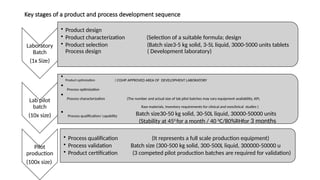
Key stages of a product and process development sequence
Laboratory
Batch
(1x Size)
• Product design
• Product characterization (Selection of a suitable formula; design
• Product selection (Batch size3-5 kg solid, 3-5L liquid, 3000-5000 units tablets
Process design ( Development laboratory)
Lab pilot
batch
(10x size)
• Product optimization ( CGMP APPROVED AREA OF DEVELOPMENT LABORATORY
• Process optimization
• Process characterization (The number and actual size of lab pilot batches may vary equipment availability, API,
Raw materials, Inventory requirements for clinical and nonclinical studies )
• Process qualification/ capability Batch size30-50 kg solid, 30-50L liquid, 30000-50000 units
(Stability at 450
for a month / 40 0
C/80%RHfor 3 months
Pilot
production
(100x size)
• Process qualification (It represents a full scale production equipment)
• Process validation Batch size (300-500 kg solid, 300-500L liquid, 300000-50000 u
• Product certification (3 competed pilot production batches are required for validation)
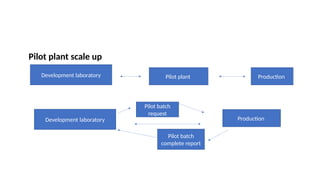
Pilot plant scale up
Development laboratory Pilot plant Production
Development laboratory
Pilot batch
request
Pilot batch
complete report
Production
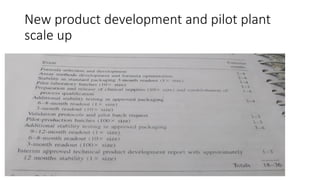
New product development and pilot plant
scale up
Pilot plant scale up and process validation
Development activities
• Formulation design, selection and optimization
• Preparation of first pilot lab batch
• Conduct of initial accelerated stability testing
• If the formulation is found to be stable, additional pilot batch for expanded
non clinical use
Pilot plant scale up program is the scale up operations conducted
subsequent to the product and process leaving the development laboratory
an prior to its acceptance by the full production manufacturing unit
Process validation: order priority
• Sterile products and their process
• Large volume parentrals
• Small volume parentrals
• Ophthalmic and other sterile products and medical device
• Non sterile products and their process
• Low dose / High potency tablets and capsule
• Drugs with stability problems
• Other tablets and capsules
• Oral liquids, topicals and diagnostic aids
• Process validation : specific responsibilities
• Engineering: install qualify and certify plant, facilities equipment and support
systems
• Development : Design, optimize, qualify manufacturing process within design
limits, specifications, and / or requirements ; establishing process capability
information
• Manufacturing: operate and maintain plant, facilities, equipment, support
system, and specific manufacturing process within its design limits,
specifications and requirements
• QA: Establish approved validation protocols, conduct process validation by
monitoring, sampling testing, challenging, auditing for compliance with
design limits, specifications and or requirements
Process capability studies:
• These studies determine critical process parameters(CPP) or operating variables that
influence process output and range of numerical data for each of these parameters
results acceptable process output
• Determination of number and relative importance of CP
• The numerical data generated for each CPP are within the least statistical QC limits
(plus or minus sd deviation)
Process qualifications
• It represents to actual studies or trials conducted to show that all systems,
subsystems, or unit operation of manufacturing process perform as intended that all
CPP operates within the assigned control limits, such studies form the basis of process
capability design and testing (OQ/PQ)
• Basic information is obtained from (1x ) size Lab batch
• Formula, rationale for inert ingredient
• Critical specification, test methods, acceptance criteria for each raw material,
• Proposed specification, test methods and acceptance criteria for finished dosage
form
• Interim stability of (1x) size lab batch
• Detailed operating instructions for preparing 10 x size batch
• Preparation of simple flow diagram of process
• Using flow diagram, list of process and control variables are next drawn up
for each operation step in the process
• Determine which process variable and /or unit operations are critical with
respect to product outcomes by process characterization
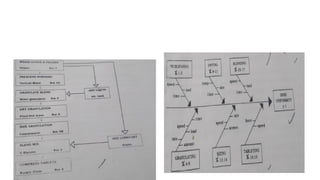
• Process characterization
• Cause and effect or fish bone diagram
• Constraint analysis
• Pareto principle
• Constraint analysis
• Previous successful experience
• Major processing equipment
• published scientific and technical literature
• Pareto analysis
• Based on 80: 20 principle
Process Qualification
• Replication of optimal or mid range values
• Pilot lab batch , SOPS and protocols for in processing
• Measures the outcomes, check within in process specification
• Process is continued to next step
• Representative finished product sample is subjected to end process testing
• The same process is done several times
• Fractional factorial design
Process optimization
• Parametric statistical design
• Selection of a suitable experimental design
• Selection of variables
• Performance of a set of statistically designed experiments
• Measurement of responses
• Development of a prediction polynomial equation based on statistical nad regression
analysis of the experiential data
• Development of set of optimized requiems for the formula based on mathematical and
graphical analysis of data
Non parametric search methods
• EVOP
• REVOP(Random)
PROCESS VALIDATION OPTIONS
• PROSPECTIVE PROCESS VALIDATION
• RETROSPECTIVE PROCESS VALIDATION
• CONCURRENT VALIDATION
• REVALIDATION
Prospective validation
In PPV, an experimental plan called as validation protocol is executed
(Following the completion of qualification trials) before the process is put into
commercial use
This type of validation carried out in connection with introduction of a new
drug product and manufacturing process
• A formalized process validation program should never be undertaken without
• Facilities and equipment ( IQ)
• Operators and supervising personnel , who will be running validation batches have an
understanding of process and its requirements
• The design, selection and optimization of the formula have been completed
• The qualification trials using (10x size) pilot batches have been completed, in which CPS,
CPV been identified and provisional operational control limits for each test parameter
have been provided
• Detailed technical information on product and manufacturing process
have been provided including stability
• Finally at least one qualification trial of a pilot production (100xsize)
has been made and shows, upon scale up, there were no significant
deviation from the expected performance of the process
• Use of different lots of raw materials should be included ; API and major
excipients
• Batches should run in succession and on different days and shifts
• Batches should be manufactured in the equipment and facility designed for
eventual commercial production
• Critical PV should be set within the ranges and should not exceed upper and
lower limits during process operation
• Output response should be within FP specification
• In case of failures to meet requirements of validation protocol, requalification
or revalidation should be done
Retrospective validation
• Retrospective validation is chosen for established products whose
manufacturing process are considered stable
• Economic considerations, prospective validation trails can not be
established
• Numerical in process and end product data of historic production
batches are subjected to statistical analysis
• Equipment facilities, subsystems used in connections with
manufacturing process must be qualified and validated in conformance
with cGMP requirements
Steps involved
• Gather the numerical values from completed batch record and include assay values, end product
test results, and in process data
• Organize these data in chronological sequence, according to batch manufacturing data using a
spread sheet format
• Include data from at least the last 20-30 manufactured batches for analysis, if less than 20, all
manufactured batches in your analysis
• Trim the data by eliminating test results from noncritical processing steps delete all gratuitous
numerical information
• Subject the resultant data to statistical analysis and evaluation
• Draw conclusion to state of control of manufacturing process based upon the analysis of
retrospective validation data
• Issue a report of your findings
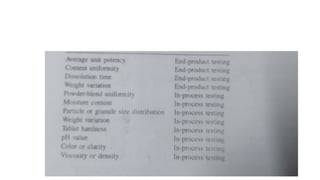
Solid dosage forms
• Individual assay results from content uniformity testing
• Tablet hardness values
• Individual thickness
• Tablet or capsule variation
• Individual capsule or tablet dissolution time (t50%)or DT
• Individual tablet capsule moisture
Semi solid and liquid dosage form
• pH values
• Viscosity
• Density
• Color or clarity values
• Average particle size or distribution
• Unit weight variation and/ or potency values
•
Statistical methods
• Basic statistics (SD, tolerance limits)
• Analysis of variance
• Regression analysis
• Cumulative analysis
• Cumulative difference analysis
• Control charting (averages and range)
Concurrent validation
• In processing n critical processing steps and end products testing
current production can provide documented evidence to show that
manufacturing process is state of control
• Revalidation
• Change in a critical component or raw materials
• Change or replacement in a critical piece of modular (capital)equipment
• Change in a facility and /or plant (usually)location or site
• Significant (usually order of magnitude)increase or decrease in batch size
• Sequential batches that fall to meet product or process specification
• Statistical process control (SPC) and process validation
• SPC comprise various mathematical tools (histograms, correlation
chart, scatter diagram, run diagram, and control chart) to monitor the
manufacturing process and keep it within the in process and final
product specifications
• Three ways of establishing quality products and manufacturing
process
• In process and final product testing, depends on sampling size(larger
the better)
• Establishment of tighter ‘in house’ specifications limits that hold the
product and manufacturing process to a more demanding standard
will reduce the need for more sampling
• Applications of zero defect – Japanese quality principle; (6 sigma )
NMT 3or 4 defects/ I million units
• Cleaning validation
It is done to prevent accumulation of dirt and microbial contamination
which could impact the quality of the product
It minimizes the cross contamination
During cleaning validation, written evidence to be shows that specified
cleaning procedure will lead to reliable and repeatable results in the
cleaning of surface with and without contact with product
• The criteria's t be fulfilled in CV
• The concentration of active substance on product contact surface will
not exceed specified limits
• The concentration of highly active substance ( hormones etc ) on
surfaces without contact with product will not exceed the specified limits
• The conc. of other pharmacologically inactive substance ( cleaning
materials and other disinfectants) in product will not exceed the limits
• Cleaning validation includes
• Cleaning cycle
• CLeanability by swab testing
Computer system validation (CSV)
• Software verification
SV provide an objective that evidence that the design outputs of particular phase of
software development cycle meet all the specified requirements for that phase
consistency, completeness and correctness of the software and supporting
documentation that and provides supports that subsequent conclusion that software
is validated
• Software validation
Confirmation by examination and provision of objective evidence that software
specification conform to the user need and intended uses and that particular
requirements implemented through software can be consistently fulfilled
• Analytical Validation
• It demonstrates the capability of analytical procedure for
• Specificity
• Linearity
• Range
• accuracy
• Precision
• Three main aspects
• Analytical methods
• Equipment calibration
• Training

VALIDATION validation in pharmacy and its importance

  • 1.
    Krupanidhi College ofPharmacy I SEM M.Pharm 2021-22 Modern Pharmaceutics VALIDATION
  • 2.
    ICH guidelines • Q8(R2):Pharmaceutical Development • Q9: Quality Risk Management • Q10: Pharmaceutical Quality System
  • 4.
    Definition Validation is astructured approach for translating user requirements, design specification and quality aspirations into a manufacturing facility
  • 5.
    Discovery New opportunity Early developmentstage Screening of the opportunity Manufacture small quantity for trials Late development phase Design of a scalable process Optimal productivity Safe and environment friendly Manufacturability Implementation of a robust manufacturing process manufacturing
  • 6.
    PDF (Process designqualification) To ensure that engineering rigor and quality are built into the design philosophy Master validation plan (MVP) To ensure that the rigorous design philosophy is executed and implemented
  • 7.
    • PDF: Anorganized effort to integrate various aspects of process development into holistic final design ensuring appropriate rigor and quality is built into design philosophy • MVP: A structured effort to execute and implement the design philosophy
  • 8.
    • Process designfinalization team Assemble PDF team Rigorously design the process design prior to implementation Process integration Integrate the process stages Process simplifications Reduce number of process stages and material handling Process flow description Put the pieces together Risk Analysis(FMEA) Analyze and mitigate the risks Modeling Capture knowledge for capacity and knowledge improvement Process optimization Improve the process, enhancing the economic viability User requirement specifications (URS) Clearly communicate design specifications
  • 9.
    • Process designfinalization team: Formation of a PDF team to integrate a diverse work force(Diff departments) with a common objective of successfully launching the product • Process integration Process integration is integration of various stages of infrastructure into manufacturing facility • Process simplification The process simplification is done in terms of robustness, safety,cost, efficiency, capacity and ease of operation
  • 10.
    • Process flowdescription It’s a systematic way of capturing manufacturing the process information • Process flow chart/ equipment flow chart, unit operations for the manufacturing process • Quality control strategies required to run a process with its specifications • A narrative of the process
  • 13.
    Risk Management • It’sthe risk based decision making process based on risk analysis, risk mitigation, control strategy and awareness Risk identification Risk analysis Risk mitigation Periodic review Unacceptable risk Acceptable risk
  • 14.
    Failure mode andeffective analysis Its an engineering technique to define, identify, eliminate known and potential failures, problems, errors, and so on from design, process, and / or service before they reach customer
  • 15.
  • 18.
    Risk Management HAZOP (For identifying the risk for health, safety and environment) Fault tree and event tree (Risk identification) FMEA (Risk management methodology) QBD & VFD (Customer requiremets) HACCP (For determining severity rating for contamination)
  • 19.
    • HAZOPS • It’sa structured brain storming exercise in which multidisciplinary team of experts systematically considers each piece of equipment in the plant defining its intentions to identify the possible deviations from intentions • FMECA • It’s a stepwise step procedure for identifying the failure modes or design weakness and criticality of the consequence of the failure for a particular system under consideration
  • 20.
    Fault tree analysis •it depicts the way in which a particular system failure might occur (Cause) • working downwards through the branches using and /or logic gates, analysis reveals the combination of the events themselves cause the top event to occur Event tree analysis • it represents the consequences
  • 21.
    Hazards analysis andcritical control points (HACCP) • It provides documentation to ensure that company understands its product and process well enough to control or monitor the parameters that are important to produce quality products • Analyze each step hazards • Identify all control points (CCPS) • Verify the limits for each CCP • Verify monitoring and testing of limits • verify corrective actions • Verify operational procedures for CCPs • Verify records of each CCPs are documented in the batch record
  • 22.
    • QFD • Itprovides a systematic approach to determine, prioritize and translate customer’s need to product design parameters, which arranges the facts so that important issues, relationship among these issues, significance of each and their measures of success can be readily displayed • VFD • This focus on value
  • 23.
  • 24.
    URS • URS isa documentation of design intentions and sets the functional requirements; requirements for product quality and business drive • it include all stake holders system of performance requirements such as operations, maintenance, environment, health, safety, engineering, validation , QC, and automation • URS will form the basis for system for equipment operational qualification and performance qualification (PQ)
  • 25.
    User requirement Design intentions Systemclassification Direct vs Indirect impact Physical completion Construction Commissioning Qualification Direct impact critical system qualified Validation Manufacturability Functional system VMP
  • 26.
    Direct impact critical component Directimpact Noncritical component Indirect impact Critical component Direct impact Noncritical component COMPONENTS Indirect or direct
  • 27.
    Commissioning • Commissioning isthe startup activities, typically occurs between construction, physical completion and turn over to either operations end users or validation team • Start up activities: FAT, functional test, SAT etc • The tests performed during commissioning should be designed to provide assurance that the system has constructed and will perform to the intended design criteria; • Both functional and performance tests
  • 28.
    • A validationplan is a comprehensive document describing applicable validation requirements for the facility and providing plan for meeting those requirements FDA Definition • Establishing a documented evidence that provides high degree of assurance that the specific process will consistently produce product meeting its predetermined specifications and quality attributes • As per regulatory agencies the quality attributes of the product to be identified • After CPP, the companies must perform the studies to test the parameter ranges; operating and validated
  • 29.
    • The operatingrange is the range in which the product is manufactured- narrowest • Validated range :falls outside of operating range and is the range in which the process will still perform adequately • Once CPP is determined, the critical product or operating parameters • ( time , tem, pressure, pH) to be controlled and monitored during process validation studies
  • 30.
    VMP • A listof all studies that will validate manufacturing process the question of what and how to validate a manufacturing process
  • 31.
  • 32.
    Design qualifications • Alsocalled as equipment qualification • Documentation of design aspects checked and approved • Design aspects contains a plant description and shows that plant design agrees with customer design specifications • The scale up exercise leads to equipment specification for the manufacturing process • The equipment and process flow are captured process flow chart ; summary of manufacturing process and equipment requirements • These requirements are specified and documented in URS; forms the basis of qualification stage
  • 33.
    • Objectives ofDQ • To built quality into design • To assure that the design is consistent with development and scale up activity in the preceding stages of commercialization as specified in the URS • The quality aspects of DQ include cGMP • The documentation audit will include review of development history, URS, training plan, SOPS, engineering and relevant facility • Reviews by design and process engineers, scientists, QA& QC, operating personnel
  • 34.
    Installation qualification (IQ) •The focus of IQ is to ensure that equipment is installed as intended in the design and in accordance with Vendor’s recommendations • This includes system completion, security or utility connections, documentation, inventory, equipment inventory, electrical requirements, material qualifications, drawing validation, main equipment features, instrument calibration , spares and maintenance • Installation qualification process, written evidence is given that all parts of equipment is installed according to the equipment supplier and purchase specifications
  • 35.
    • It includesFAT, • It documents that operating criteria for equipment is installed, and in compliance with process and installation diagram, (P& I), plant functional specifications and process flow diagrams • IQ is the stage where the completeness and correctness of all requirements are checked
  • 36.
    Operational qualification • OQprovides the assurance that equipment operates as intended throughout the anticipated operating ranges • This involves testing of equipment during operations using non product materials such as air and water • In OQ the documented evidence shows that all parts of plant and equipment work within its specifications • Process parameters are within the acceptable criteria • PLC (Programmable logic control ) will be qualified during OQ process • Computerized process controls should be qualified in CV • A simulation of normal production conditions must be done to ensure that OQ are successful
  • 37.
    Performance qualification (PQ) •PQ is the evaluation of overall equipment to confirm the system operates throughout anticipated ranges as intended • PQ is performed close to production conditions as possible and performed without the real product • The documentation of PQ includes approved protocol, system description , purpose, sampling regimen, testing regime, acceptance criteria, deviation and corrective action • PQ provides documented evidence that all parts of the plant and process validated can operate as intended in the design
  • 38.
    • PQ includescritical variable studies; simulating conditions of upper and lower processing, processing at the operating limits of equipment, circumstances, and worst case conditions • It should show that such conditions do not necessary induce process or product failure • OQ: all parts of the plant and equipment are qualified separately • PQ: qualify the entire plant with respect to production process • ALL SOPS to be approved • Values of critical and noncritical parameters to be recorded
  • 39.
    Process validation • Checklist of validation and control documentation in respect to cGMP A. Introduction B. Organization – establishment of facility installation and qualification C. Buildings and facilities- plant and facility installation and qualification ,maintenance and sanitization, microbial and pest controls, D. Equipment :installation qualification and cleaning methods E. Control of raw materials, in process and product: incoming components, manufacturing nonsterile products F. Production and process controls: process control systems , instrumentation and computers G. Packaging and labeling controls: de pyrogenation sterile packing filling and closing H. Holding and documentation: facilities I. Laboratory controls :analytical methods J. Records and reports: computer systems K. Returned and salvaged drug product: batch processing: water treatment and steam systems, L. Air and water quality: water treatment, air heat and vacuum handling M. Sterilization: LVPS, , autoclaves and process, parameters , aseptic facilities, devices, sterilizing filters
  • 40.
    Objectives • Good engineeringsense • Fewer product recalls and trouble shooting assignments in manufacturing operations • Technically and economically sound products
  • 41.
    Key stages ofa product and process development sequence Laboratory Batch (1x Size) • Product design • Product characterization (Selection of a suitable formula; design • Product selection (Batch size3-5 kg solid, 3-5L liquid, 3000-5000 units tablets Process design ( Development laboratory) Lab pilot batch (10x size) • Product optimization ( CGMP APPROVED AREA OF DEVELOPMENT LABORATORY • Process optimization • Process characterization (The number and actual size of lab pilot batches may vary equipment availability, API, Raw materials, Inventory requirements for clinical and nonclinical studies ) • Process qualification/ capability Batch size30-50 kg solid, 30-50L liquid, 30000-50000 units (Stability at 450 for a month / 40 0 C/80%RHfor 3 months Pilot production (100x size) • Process qualification (It represents a full scale production equipment) • Process validation Batch size (300-500 kg solid, 300-500L liquid, 300000-50000 u • Product certification (3 competed pilot production batches are required for validation)
  • 42.
    Pilot plant scaleup Development laboratory Pilot plant Production Development laboratory Pilot batch request Pilot batch complete report Production
  • 43.
    New product developmentand pilot plant scale up
  • 44.
    Pilot plant scaleup and process validation Development activities • Formulation design, selection and optimization • Preparation of first pilot lab batch • Conduct of initial accelerated stability testing • If the formulation is found to be stable, additional pilot batch for expanded non clinical use Pilot plant scale up program is the scale up operations conducted subsequent to the product and process leaving the development laboratory an prior to its acceptance by the full production manufacturing unit
  • 45.
    Process validation: orderpriority • Sterile products and their process • Large volume parentrals • Small volume parentrals • Ophthalmic and other sterile products and medical device • Non sterile products and their process • Low dose / High potency tablets and capsule • Drugs with stability problems • Other tablets and capsules • Oral liquids, topicals and diagnostic aids
  • 46.
    • Process validation: specific responsibilities • Engineering: install qualify and certify plant, facilities equipment and support systems • Development : Design, optimize, qualify manufacturing process within design limits, specifications, and / or requirements ; establishing process capability information • Manufacturing: operate and maintain plant, facilities, equipment, support system, and specific manufacturing process within its design limits, specifications and requirements • QA: Establish approved validation protocols, conduct process validation by monitoring, sampling testing, challenging, auditing for compliance with design limits, specifications and or requirements
  • 47.
    Process capability studies: •These studies determine critical process parameters(CPP) or operating variables that influence process output and range of numerical data for each of these parameters results acceptable process output • Determination of number and relative importance of CP • The numerical data generated for each CPP are within the least statistical QC limits (plus or minus sd deviation) Process qualifications • It represents to actual studies or trials conducted to show that all systems, subsystems, or unit operation of manufacturing process perform as intended that all CPP operates within the assigned control limits, such studies form the basis of process capability design and testing (OQ/PQ)
  • 48.
    • Basic informationis obtained from (1x ) size Lab batch • Formula, rationale for inert ingredient • Critical specification, test methods, acceptance criteria for each raw material, • Proposed specification, test methods and acceptance criteria for finished dosage form • Interim stability of (1x) size lab batch • Detailed operating instructions for preparing 10 x size batch • Preparation of simple flow diagram of process • Using flow diagram, list of process and control variables are next drawn up for each operation step in the process • Determine which process variable and /or unit operations are critical with respect to product outcomes by process characterization
  • 49.
    • Process characterization •Cause and effect or fish bone diagram • Constraint analysis • Pareto principle
  • 51.
    • Constraint analysis •Previous successful experience • Major processing equipment • published scientific and technical literature • Pareto analysis • Based on 80: 20 principle
  • 52.
    Process Qualification • Replicationof optimal or mid range values • Pilot lab batch , SOPS and protocols for in processing • Measures the outcomes, check within in process specification • Process is continued to next step • Representative finished product sample is subjected to end process testing • The same process is done several times • Fractional factorial design
  • 53.
    Process optimization • Parametricstatistical design • Selection of a suitable experimental design • Selection of variables • Performance of a set of statistically designed experiments • Measurement of responses • Development of a prediction polynomial equation based on statistical nad regression analysis of the experiential data • Development of set of optimized requiems for the formula based on mathematical and graphical analysis of data Non parametric search methods • EVOP • REVOP(Random)
  • 54.
    PROCESS VALIDATION OPTIONS •PROSPECTIVE PROCESS VALIDATION • RETROSPECTIVE PROCESS VALIDATION • CONCURRENT VALIDATION • REVALIDATION
  • 55.
    Prospective validation In PPV,an experimental plan called as validation protocol is executed (Following the completion of qualification trials) before the process is put into commercial use This type of validation carried out in connection with introduction of a new drug product and manufacturing process
  • 57.
    • A formalizedprocess validation program should never be undertaken without • Facilities and equipment ( IQ) • Operators and supervising personnel , who will be running validation batches have an understanding of process and its requirements • The design, selection and optimization of the formula have been completed • The qualification trials using (10x size) pilot batches have been completed, in which CPS, CPV been identified and provisional operational control limits for each test parameter have been provided
  • 58.
    • Detailed technicalinformation on product and manufacturing process have been provided including stability • Finally at least one qualification trial of a pilot production (100xsize) has been made and shows, upon scale up, there were no significant deviation from the expected performance of the process
  • 59.
    • Use ofdifferent lots of raw materials should be included ; API and major excipients • Batches should run in succession and on different days and shifts • Batches should be manufactured in the equipment and facility designed for eventual commercial production • Critical PV should be set within the ranges and should not exceed upper and lower limits during process operation • Output response should be within FP specification • In case of failures to meet requirements of validation protocol, requalification or revalidation should be done
  • 60.
    Retrospective validation • Retrospectivevalidation is chosen for established products whose manufacturing process are considered stable • Economic considerations, prospective validation trails can not be established • Numerical in process and end product data of historic production batches are subjected to statistical analysis • Equipment facilities, subsystems used in connections with manufacturing process must be qualified and validated in conformance with cGMP requirements
  • 61.
    Steps involved • Gatherthe numerical values from completed batch record and include assay values, end product test results, and in process data • Organize these data in chronological sequence, according to batch manufacturing data using a spread sheet format • Include data from at least the last 20-30 manufactured batches for analysis, if less than 20, all manufactured batches in your analysis • Trim the data by eliminating test results from noncritical processing steps delete all gratuitous numerical information • Subject the resultant data to statistical analysis and evaluation • Draw conclusion to state of control of manufacturing process based upon the analysis of retrospective validation data • Issue a report of your findings
  • 62.
    Solid dosage forms •Individual assay results from content uniformity testing • Tablet hardness values • Individual thickness • Tablet or capsule variation • Individual capsule or tablet dissolution time (t50%)or DT • Individual tablet capsule moisture
  • 63.
    Semi solid andliquid dosage form • pH values • Viscosity • Density • Color or clarity values • Average particle size or distribution • Unit weight variation and/ or potency values •
  • 64.
    Statistical methods • Basicstatistics (SD, tolerance limits) • Analysis of variance • Regression analysis • Cumulative analysis • Cumulative difference analysis • Control charting (averages and range)
  • 65.
    Concurrent validation • Inprocessing n critical processing steps and end products testing current production can provide documented evidence to show that manufacturing process is state of control
  • 67.
    • Revalidation • Changein a critical component or raw materials • Change or replacement in a critical piece of modular (capital)equipment • Change in a facility and /or plant (usually)location or site • Significant (usually order of magnitude)increase or decrease in batch size • Sequential batches that fall to meet product or process specification
  • 68.
    • Statistical processcontrol (SPC) and process validation • SPC comprise various mathematical tools (histograms, correlation chart, scatter diagram, run diagram, and control chart) to monitor the manufacturing process and keep it within the in process and final product specifications • Three ways of establishing quality products and manufacturing process
  • 69.
    • In processand final product testing, depends on sampling size(larger the better) • Establishment of tighter ‘in house’ specifications limits that hold the product and manufacturing process to a more demanding standard will reduce the need for more sampling • Applications of zero defect – Japanese quality principle; (6 sigma ) NMT 3or 4 defects/ I million units
  • 70.
    • Cleaning validation Itis done to prevent accumulation of dirt and microbial contamination which could impact the quality of the product It minimizes the cross contamination During cleaning validation, written evidence to be shows that specified cleaning procedure will lead to reliable and repeatable results in the cleaning of surface with and without contact with product
  • 71.
    • The criteria'st be fulfilled in CV • The concentration of active substance on product contact surface will not exceed specified limits • The concentration of highly active substance ( hormones etc ) on surfaces without contact with product will not exceed the specified limits • The conc. of other pharmacologically inactive substance ( cleaning materials and other disinfectants) in product will not exceed the limits • Cleaning validation includes • Cleaning cycle • CLeanability by swab testing
  • 72.
    Computer system validation(CSV) • Software verification SV provide an objective that evidence that the design outputs of particular phase of software development cycle meet all the specified requirements for that phase consistency, completeness and correctness of the software and supporting documentation that and provides supports that subsequent conclusion that software is validated • Software validation Confirmation by examination and provision of objective evidence that software specification conform to the user need and intended uses and that particular requirements implemented through software can be consistently fulfilled
  • 73.
    • Analytical Validation •It demonstrates the capability of analytical procedure for • Specificity • Linearity • Range • accuracy • Precision • Three main aspects • Analytical methods • Equipment calibration • Training