In-Process Quality
Assurance
QUALITY


What is quality?



Number of definitions are available in each
guidelines

QUALITY SHALL BE DEFINED AS
CONSUMER NEED


When we call a medicine as quality medicine?
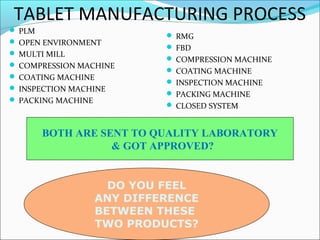
TABLET MANUFACTURING PROCESS
 PLM
 OPEN ENVIRONMENT
 MULTI MILL
 COMPRESSION MACHINE
 COATING MACHINE
 INSPECTION MACHINE
 PACKING MACHINE

 RMG
 FBD
 COMPRESSION MACHINE
 COATING MACHINE
 INSPECTION MACHINE
 PACKING MACHINE
 CLOSED SYSTEM

BOTH ARE SENT TO QUALITY LABORATORY
& GOT APPROVED?

DO YOU FEEL
ANY DIFFERENCE
BETWEEN THESE
TWO PRODUCTS?
QUALITY

QUALITY IS SOMETHING APART
FROM TESTING AND
APPROVING OF
MEDICINES
QUALITY

QUALITY NOT TO BE TESTED
TO BE BUILT DURING THE PROCESS.
QUALITY
 100 % testing of medicines are not done.
 Most of the testing are destructive testing.
 All impurities are not detected /analysed.

What to do?
 Quality to be built during the process.
HOW?
QUALITY
 By means of
 Following GMP thorough out the process.
 Control over input materials.
 Process control.
 Various checks during the process (IPC).
 Doier and checker system (cross checking) .
 Control over product release.
IPQA

FAULT FINDING ?
IPQA
To assure products are consistently produced as
per quality standards and predefined specifications

To guide the operator / supervisor regarding
any deviation observed during the process.
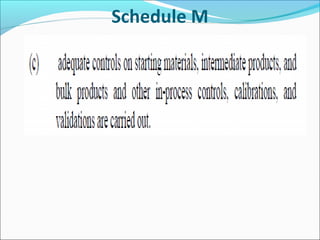
Schedule M
CFR 211
Sec. 211.110 Sampling and testing of in-process materials and drug

products. (a) To assure batch uniformity and integrity of drug
products, written procedures shall be established and followed
that describe the in-process controls, and tests, or examinations
to be conducted on appropriate samples of in-process materials
of each batch. Such control procedures shall be established to
monitor the output and to validate the performance of those
manufacturing processes that may be responsible for causing
variability in the characteristics of in-process material and the
drug product. Such control procedures shall include, but are not
limited to, the following, where appropriate:






(1) Tablet or capsule weight variation;
(2) Disintegration time;
(3) Adequacy of mixing to assure uniformity and homogeneity;
(4) Dissolution time and rate;
(5) Clarity, completeness, or pH of solutions.
CFR 211
(b) Valid in-process specifications for such characteristics shall

be consistent with drug product final specifications and shall
be derived from previous acceptable process average and
process variability estimates where possible and determined by
the application of suitable statistical procedures where
appropriate. Examination and testing of samples shall assure
that the drug product and in-process material conform to
specifications.
(c) In-process materials shall be tested for identity, strength,
quality, and purity as appropriate, and approved or rejected by
the quality control unit, during the production process, e.g., at
commencement or completion of significant phases or after
storage for long periods.
(d) Rejected in-process materials shall be identified and
controlled under a quarantine system designed to prevent
their use in manufacturing or processing operations for which
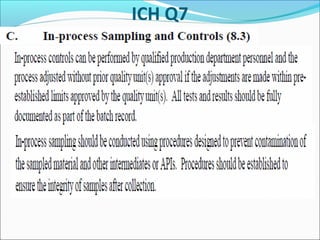
ICH Q7
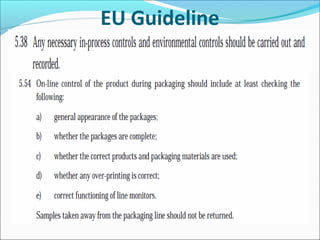
EU Guideline
LINE CLEARANCE
Objective

To assure that no traces of previous product

inside

the module.

To assure that correct materials brought for

processing / packing.
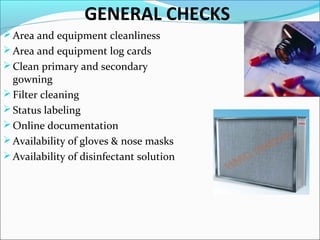
GENERAL CHECKS
 Area and equipment cleanliness
 Area and equipment log cards
 Clean primary and secondary

gowning
 Filter cleaning
 Status labeling
 Online documentation
 Availability of gloves & nose masks
 Availability of disinfectant solution
WAREHOUSE DISPENSING AREA
 Area and equipment cleanliness
 Area and equipment log cards
 Clean primary and secondary gowning
 Filter cleaning
 Status labeling
 Online documentation
 Availability of gloves & nose masks
 Availability of disinfectant solution
 Proper storage of actives and







execipients.
Material status.
Handling of materials
Dispensing Tools cleaning
Labeling details.
Balance calibration (log books).
Dispensing activity (log books).
PRODUCTION
 PROCESS
 Check all manufacturing activities are being performed

as per batch processing record.

 Process rate / time against specifications mentioned in

BMR.
SIFTING
 Check for :

 Right equipment in process as per BMR.
 Correctness of mesh /screen size.
 Black particles / foreign particles.
 Quantity retains over the mesh.
 Sieve integrity before and after sieving.
 Abnormal noise from the sifter.
GRANULATION
 Check for :
 Right equipment in process as per BMR.
 Amount of granulation fluid added.
 Time of granulation.
 Amperage/torque, if applicable.
 Formation of good granules.
DRYING
 Check for :
 Right equipment in process as per BMR.
 Filter bag integrity.
 Inlet / outlet temperature.
 Bed / Product temperature.
 Racking in tray drier / FBD.
 Proper fluidization in FBD.
 Formation of any lumps.
 Moisture content (Sampling).
BLENDING:
 Check for :
 Right equipment in process as per BMR.
 Blender speed.
 Blending time.
 Content uniformity.
 Bulk density.
 Particle size analysis.
 Moisture content.
 Compressibility index
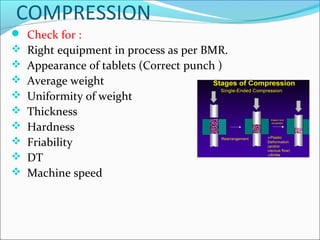
COMPRESSION











Check for :
Right equipment in process as per BMR.
Appearance of tablets (Correct punch )
Average weight
Uniformity of weight
Thickness
Hardness
Friability
DT
Machine speed
COATING
 Check for
 Spray pattern
 Spray rate
 Inlet /out let/ product temperature
 RPM of coating pan
 Amount of coating solution
 % Weight gain
 Color / shade variation (different lots)
 Mottling
 Chipping
 Orange peel effect
PACKING
 Check for
 Forming temperature

Check for

 Sealing temperature
 Appearance of blister

 Cleanliness of container /
closure.

 Speed of machine
 Pack specification

 Number of tablets / container

 Leak test

 Integrity of line.
 Closing /opening torque.
 Challenge test for sensors.
 Correctness of label

Check for correctness manufacturing and
expiry dates
YIELD RECONCILIATION
Manufacturing yield at all stages to be checked.
Any out of specification/ out of trend to be
investigated.
Printed packing material yield.
BMR /BPR to be reviewed at the time of sampling
IPQA
 Will reduce the batch rejections

 Will reduce the reprocessing

BY ADOPTING VARIOUS CONTROLS OVER THE PROCESS,
THE PRODUCT WILL BE OF QUALITY ONE

BUILDING QUALITY DURING THE PROCESS,
THERE BY GETTING THE QUALITY PRODUCT.
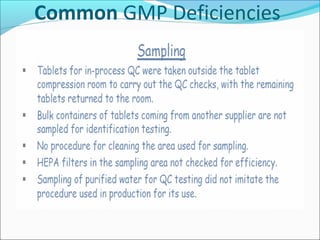
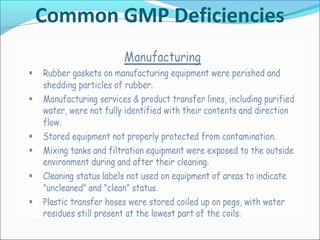
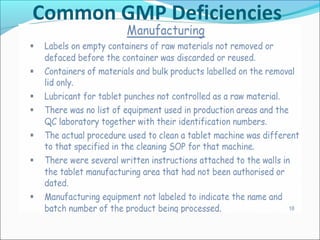
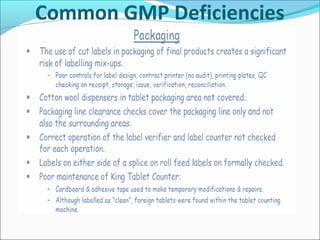
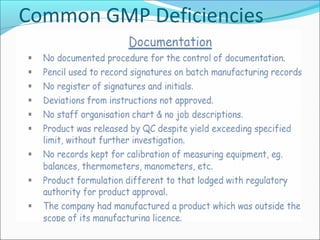
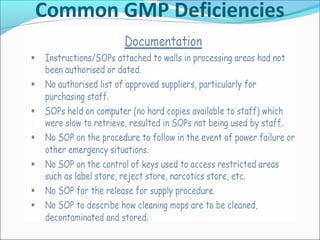
Common GMP Deficiencies
Line clearance ppt

Line clearance ppt

  • 1.
  • 2.
    QUALITY  What is quality?  Numberof definitions are available in each guidelines QUALITY SHALL BE DEFINED AS CONSUMER NEED  When we call a medicine as quality medicine?
  • 3.
    TABLET MANUFACTURING PROCESS PLM  OPEN ENVIRONMENT  MULTI MILL  COMPRESSION MACHINE  COATING MACHINE  INSPECTION MACHINE  PACKING MACHINE  RMG  FBD  COMPRESSION MACHINE  COATING MACHINE  INSPECTION MACHINE  PACKING MACHINE  CLOSED SYSTEM BOTH ARE SENT TO QUALITY LABORATORY & GOT APPROVED? DO YOU FEEL ANY DIFFERENCE BETWEEN THESE TWO PRODUCTS?
  • 4.
    QUALITY QUALITY IS SOMETHINGAPART FROM TESTING AND APPROVING OF MEDICINES
  • 5.
    QUALITY QUALITY NOT TOBE TESTED TO BE BUILT DURING THE PROCESS.
  • 6.
    QUALITY  100 %testing of medicines are not done.  Most of the testing are destructive testing.  All impurities are not detected /analysed. What to do?  Quality to be built during the process. HOW?
  • 7.
    QUALITY  By meansof  Following GMP thorough out the process.  Control over input materials.  Process control.  Various checks during the process (IPC).  Doier and checker system (cross checking) .  Control over product release.

  • 8.
  • 9.
    IPQA To assure productsare consistently produced as per quality standards and predefined specifications To guide the operator / supervisor regarding any deviation observed during the process.
  • 10.
  • 11.
    CFR 211 Sec. 211.110Sampling and testing of in-process materials and drug products. (a) To assure batch uniformity and integrity of drug products, written procedures shall be established and followed that describe the in-process controls, and tests, or examinations to be conducted on appropriate samples of in-process materials of each batch. Such control procedures shall be established to monitor the output and to validate the performance of those manufacturing processes that may be responsible for causing variability in the characteristics of in-process material and the drug product. Such control procedures shall include, but are not limited to, the following, where appropriate:      (1) Tablet or capsule weight variation; (2) Disintegration time; (3) Adequacy of mixing to assure uniformity and homogeneity; (4) Dissolution time and rate; (5) Clarity, completeness, or pH of solutions.
  • 12.
    CFR 211 (b) Validin-process specifications for such characteristics shall be consistent with drug product final specifications and shall be derived from previous acceptable process average and process variability estimates where possible and determined by the application of suitable statistical procedures where appropriate. Examination and testing of samples shall assure that the drug product and in-process material conform to specifications. (c) In-process materials shall be tested for identity, strength, quality, and purity as appropriate, and approved or rejected by the quality control unit, during the production process, e.g., at commencement or completion of significant phases or after storage for long periods. (d) Rejected in-process materials shall be identified and controlled under a quarantine system designed to prevent their use in manufacturing or processing operations for which
  • 13.
  • 14.
  • 15.
    LINE CLEARANCE Objective To assurethat no traces of previous product inside the module. To assure that correct materials brought for processing / packing.
  • 16.
    GENERAL CHECKS  Areaand equipment cleanliness  Area and equipment log cards  Clean primary and secondary gowning  Filter cleaning  Status labeling  Online documentation  Availability of gloves & nose masks  Availability of disinfectant solution
  • 17.
    WAREHOUSE DISPENSING AREA Area and equipment cleanliness  Area and equipment log cards  Clean primary and secondary gowning  Filter cleaning  Status labeling  Online documentation  Availability of gloves & nose masks  Availability of disinfectant solution  Proper storage of actives and       execipients. Material status. Handling of materials Dispensing Tools cleaning Labeling details. Balance calibration (log books). Dispensing activity (log books).
  • 18.
    PRODUCTION  PROCESS  Checkall manufacturing activities are being performed as per batch processing record.  Process rate / time against specifications mentioned in BMR.
  • 19.
    SIFTING  Check for:  Right equipment in process as per BMR.  Correctness of mesh /screen size.  Black particles / foreign particles.  Quantity retains over the mesh.  Sieve integrity before and after sieving.  Abnormal noise from the sifter.
  • 20.
    GRANULATION  Check for:  Right equipment in process as per BMR.  Amount of granulation fluid added.  Time of granulation.  Amperage/torque, if applicable.  Formation of good granules.
  • 21.
    DRYING  Check for:  Right equipment in process as per BMR.  Filter bag integrity.  Inlet / outlet temperature.  Bed / Product temperature.  Racking in tray drier / FBD.  Proper fluidization in FBD.  Formation of any lumps.  Moisture content (Sampling).
  • 22.
    BLENDING:  Check for:  Right equipment in process as per BMR.  Blender speed.  Blending time.  Content uniformity.  Bulk density.  Particle size analysis.  Moisture content.  Compressibility index
  • 23.
    COMPRESSION           Check for : Rightequipment in process as per BMR. Appearance of tablets (Correct punch ) Average weight Uniformity of weight Thickness Hardness Friability DT Machine speed
  • 24.
    COATING  Check for Spray pattern  Spray rate  Inlet /out let/ product temperature  RPM of coating pan  Amount of coating solution  % Weight gain  Color / shade variation (different lots)  Mottling  Chipping  Orange peel effect
  • 25.
    PACKING  Check for Forming temperature Check for  Sealing temperature  Appearance of blister  Cleanliness of container / closure.  Speed of machine  Pack specification  Number of tablets / container  Leak test  Integrity of line.  Closing /opening torque.  Challenge test for sensors.  Correctness of label Check for correctness manufacturing and expiry dates
  • 26.
    YIELD RECONCILIATION Manufacturing yieldat all stages to be checked. Any out of specification/ out of trend to be investigated. Printed packing material yield. BMR /BPR to be reviewed at the time of sampling
  • 27.
    IPQA  Will reducethe batch rejections  Will reduce the reprocessing BY ADOPTING VARIOUS CONTROLS OVER THE PROCESS, THE PRODUCT WILL BE OF QUALITY ONE BUILDING QUALITY DURING THE PROCESS, THERE BY GETTING THE QUALITY PRODUCT.
  • 28.
  • 29.
  • 30.
  • 31.
  • 32.
  • 33.