Chapter 6

                   Management Of Process
                         Quality

THE MANAGEMENT AND CONTROL OF QUALITY, 5e, Š 2002 South-Western/Thomson LearningTM   1
Management Of Process Quality

The Management of Process Quality Category
examines the systematic process the company
uses to pursue ever-higher quality and company
operation performance. The key elements of
process management are examined, including
research and development, design, management
of process quality for all work units and suppliers,
systematic quality improvement and quality
assessment.a

                                       2
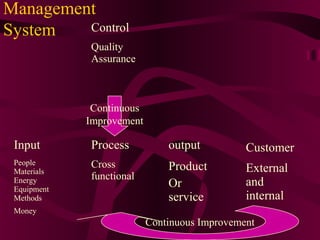
Management
System   Control
             Quality
             Assurance


              Continuous
             Improvement

 Input       Process           output          Customer
 People      Cross             Product         External
 Materials
             functional
 Energy
 Equipment
                               Or              and
 Methods                       service         internal
 Money
                           Continuous Improvement
                                             3
History of Quality Control (1 of 2)
• Skilled craftsmanship during Middle Ages
• Industrial Revolution: rise of inspection and
  separate quality departments
• Statistical methods at Bell System
• Quality control during World War II
• Quality management in Japan


                                     4
History of Quality Control (2 of 2)
• Quality awareness in U.S. manufacturing
  industry during 1980s: “Total Quality
  Management”
• Malcolm Baldrige National Quality Award
  (1987)
• Quality in service industries, government,
  health care, and education
• Current and future challenge: keep progress in
  quality management alive
                                   5
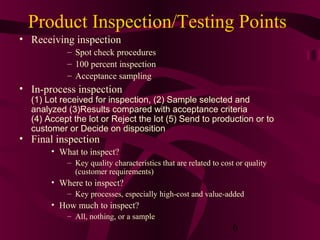
Product Inspection/Testing Points
• Receiving inspection
           – Spot check procedures
           – 100 percent inspection
           – Acceptance sampling
• In-process inspection
  (1) Lot received for inspection, (2) Sample selected and
  analyzed (3)Results compared with acceptance criteria
  (4) Accept the lot or Reject the lot (5) Send to production or to
  customer or Decide on disposition
• Final inspection
       • What to inspect?
           – Key quality characteristics that are related to cost or quality
             (customer requirements)
       • Where to inspect?
           – Key processes, especially high-cost and value-added
       • How much to inspect?
           – All, nothing, or a sample
                                                                6
Process Control
• Control – the activity of ensuring conformance to requirements and
  taking corrective action when necessary to correct problems
• Importance
   – Daily management of processes
   – Prerequisite to longer-term improvements
• Quality Policy and Quality Manual
    – Contract management, design control and purchasing
    – Process control, inspection and testing
    – Corrective action and continual improvement
    – Controlling inspection, measuring and test equipment
      (metrology, measurement system analysis and
      calibration)
    – Records, documentation and audits
                                                  7
Moving From Inspection To
         Process Control
  Process control now become problem solving for
  continuous improvement, moving from inspection to
  process control take place in step or phases:
• Process characterization (definition, requirement
  and identification)
• Develop standard and measures of out put
• Monitor compliance to standards and review
  control
• Identify and remove causes of defects or
  variations
• Achievement of process control with improved
  stability and reduced variation         8
Statistical Process Control (SPC)
• A methodology for monitoring a process to
  identify special causes of variation and
  signal the need to take corrective action
  when appropriate
• SPC relies on control charts


                                  9
Basic Approach To Statistical
           Quality Control
    Identifying any deviation between what “should be” and
    what “is” that is important enough to need correcting. The
    activity associated with changing the state of what “is” to
    what “should be” contains the following steps:
• Awareness that a problem exists.
• Determine the specific problem to be solved
• Diagnose the causes of the problem
• Determine and implement remedies to solve
  problem
• Implement control to hold the gains achieved by
  solution
                                                10
Tools for statistical Quality Control
The basic techniques are
(1) Data Collection
         Establish Metric of statistical control,
         Monitor a process and signal when it goes out of control,
         Determine process capability
(2) Data Display :
                (After data are collected, they can be converted into
a variety of form for display and analysis)
(3) Problem analysis:
                (The cause-and-effect diagram, sometime know as the
“fishbone”or Ishikawa diagram, it is an excellent tool for organizing
and documenting potential causes of problem in all area and at all
level in the organization. As a brainstorming device, it is a good way
to stimulate ideas during problem solving meeting.)


                                                       11
Pareto Analysis

Any cause that result from a multiplicity of
effects is primarily the result of the impact
of minor percentage of all causes. this
technique is similar to the “80-20” rule.


                                  12
Manufacturing To Specification vs.
     Manufacturing To Reduce Variations
      Common causes of variation include:
1.    Material balance disturbances
2.    Energy balance changes
3.    Process instabilities
4.    Equipment failure and wear
5.    Poor control loop performance


                                    13
Process Control In Service Industries
 The service process is more difficult to
 control because quality is typically
 measured at the customer interface, final
 inspection will always be a part of the
 process; the customer serves as the
 inspector.
 SPC can be used to measure consistency of
 service and determine causes of
 deterioration the from prescribed standards
 and the causes of variation.
                                  14
Process Control For Internal
            Services
• The general manager was committed to
  internal as well as external quality. In
  support of this commitment, the following
  policy was adopted, widely disseminated,
  and implemented through excellent plus
  groups: excellence Plus Commitment


                                  15
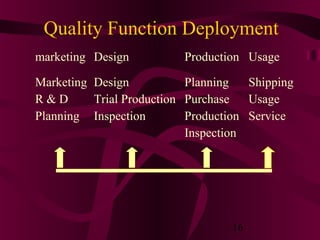
Quality Function Deployment
marketing Design          Production Usage

Marketing Design           Planning   Shipping
R&D       Trial Production Purchase   Usage
Planning Inspection        Production Service
                           Inspection


                                   16
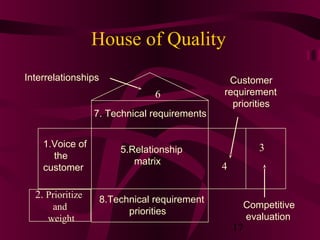
House of Quality
Interrelationships                              Customer
                                 6             requirement
                                                 priorities
                  7. Technical requirements


    1.Voice of                                             3
                         5.Relationship
      the
                            matrix
    customer                                   4

  2. Prioritize      8.Technical requirement
      and                                               Competitive
                           priorities
     weight                                             evaluation
                                                   17
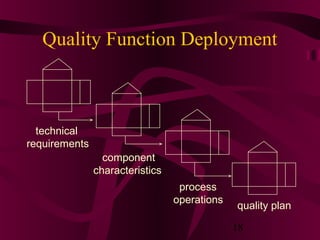
Quality Function Deployment


  technical
requirements
                 component
               characteristics
                                  process
                                 operations
                                              quality plan

                                              18
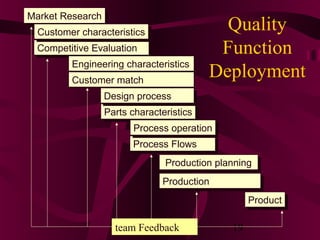
Market Research
Market Research
 Customer characteristics
  Customer characteristics
                                          Quality
  Competitive Evaluation
  Competitive Evaluation                 Function
        Engineering characteristics
         Customer match
                                        Deployment
                Design process
                Design process
                Parts characteristics
                Parts characteristics
                      Process operation
                      Process operation
                      Process Flows
                      Process Flows
                              Production planning
                              Production planning
                             Production
                             Production
                                                 Product
                                                 Product

                  team Feedback             19
Benefits of Just-In-Time
• Reduction of direct and indirect labor by eliminating
  extraneous activities
• Reduction of floor space and warehouse space per unit of
  output
• Reduction of setup time and schedule delays as the factory
  becomes a continuous production process
• Reduction of waste, rejects, and rework by detecting errors
  at the source
• Reduction of lead time due to small lot sizes, so that
  downstream work centers provide feedback on quality
  problems
• Better utilization of machines and facilities
• Better relations with suppliers
• Better plant layout
• Better integration of and communication between
  functions such as marketing, purchasing, design, and
                                                20
  production
The Human Side Of Process Control
  Attention to the human resource dimension
  provides a basis for signification improvement in
  job development, job satisfaction, training, and
  morale. Suggested actions to improve the change
  include:
• Like all major change, top management support is
  essential.
• Change the focus from production volume to
  quality, from speed to flow, from execution to task
  design, from performing to learning.
• Invest in training, a necessary prerequisite.

                                         21

Tqm ch 06

  • 1.
    Chapter 6 Management Of Process Quality THE MANAGEMENT AND CONTROL OF QUALITY, 5e, Š 2002 South-Western/Thomson LearningTM 1
  • 2.
    Management Of ProcessQuality The Management of Process Quality Category examines the systematic process the company uses to pursue ever-higher quality and company operation performance. The key elements of process management are examined, including research and development, design, management of process quality for all work units and suppliers, systematic quality improvement and quality assessment.a 2
  • 3.
    Management System Control Quality Assurance Continuous Improvement Input Process output Customer People Cross Product External Materials functional Energy Equipment Or and Methods service internal Money Continuous Improvement 3
  • 4.
    History of QualityControl (1 of 2) • Skilled craftsmanship during Middle Ages • Industrial Revolution: rise of inspection and separate quality departments • Statistical methods at Bell System • Quality control during World War II • Quality management in Japan 4
  • 5.
    History of QualityControl (2 of 2) • Quality awareness in U.S. manufacturing industry during 1980s: “Total Quality Management” • Malcolm Baldrige National Quality Award (1987) • Quality in service industries, government, health care, and education • Current and future challenge: keep progress in quality management alive 5
  • 6.
    Product Inspection/Testing Points •Receiving inspection – Spot check procedures – 100 percent inspection – Acceptance sampling • In-process inspection (1) Lot received for inspection, (2) Sample selected and analyzed (3)Results compared with acceptance criteria (4) Accept the lot or Reject the lot (5) Send to production or to customer or Decide on disposition • Final inspection • What to inspect? – Key quality characteristics that are related to cost or quality (customer requirements) • Where to inspect? – Key processes, especially high-cost and value-added • How much to inspect? – All, nothing, or a sample 6
  • 7.
    Process Control • Control– the activity of ensuring conformance to requirements and taking corrective action when necessary to correct problems • Importance – Daily management of processes – Prerequisite to longer-term improvements • Quality Policy and Quality Manual – Contract management, design control and purchasing – Process control, inspection and testing – Corrective action and continual improvement – Controlling inspection, measuring and test equipment (metrology, measurement system analysis and calibration) – Records, documentation and audits 7
  • 8.
    Moving From InspectionTo Process Control Process control now become problem solving for continuous improvement, moving from inspection to process control take place in step or phases: • Process characterization (definition, requirement and identification) • Develop standard and measures of out put • Monitor compliance to standards and review control • Identify and remove causes of defects or variations • Achievement of process control with improved stability and reduced variation 8
  • 9.
    Statistical Process Control(SPC) • A methodology for monitoring a process to identify special causes of variation and signal the need to take corrective action when appropriate • SPC relies on control charts 9
  • 10.
    Basic Approach ToStatistical Quality Control Identifying any deviation between what “should be” and what “is” that is important enough to need correcting. The activity associated with changing the state of what “is” to what “should be” contains the following steps: • Awareness that a problem exists. • Determine the specific problem to be solved • Diagnose the causes of the problem • Determine and implement remedies to solve problem • Implement control to hold the gains achieved by solution 10
  • 11.
    Tools for statisticalQuality Control The basic techniques are (1) Data Collection Establish Metric of statistical control, Monitor a process and signal when it goes out of control, Determine process capability (2) Data Display : (After data are collected, they can be converted into a variety of form for display and analysis) (3) Problem analysis: (The cause-and-effect diagram, sometime know as the “fishbone”or Ishikawa diagram, it is an excellent tool for organizing and documenting potential causes of problem in all area and at all level in the organization. As a brainstorming device, it is a good way to stimulate ideas during problem solving meeting.) 11
  • 12.
    Pareto Analysis Any causethat result from a multiplicity of effects is primarily the result of the impact of minor percentage of all causes. this technique is similar to the “80-20” rule. 12
  • 13.
    Manufacturing To Specificationvs. Manufacturing To Reduce Variations Common causes of variation include: 1. Material balance disturbances 2. Energy balance changes 3. Process instabilities 4. Equipment failure and wear 5. Poor control loop performance 13
  • 14.
    Process Control InService Industries The service process is more difficult to control because quality is typically measured at the customer interface, final inspection will always be a part of the process; the customer serves as the inspector. SPC can be used to measure consistency of service and determine causes of deterioration the from prescribed standards and the causes of variation. 14
  • 15.
    Process Control ForInternal Services • The general manager was committed to internal as well as external quality. In support of this commitment, the following policy was adopted, widely disseminated, and implemented through excellent plus groups: excellence Plus Commitment 15
  • 16.
    Quality Function Deployment marketingDesign Production Usage Marketing Design Planning Shipping R&D Trial Production Purchase Usage Planning Inspection Production Service Inspection 16
  • 17.
    House of Quality Interrelationships Customer 6 requirement priorities 7. Technical requirements 1.Voice of 3 5.Relationship the matrix customer 4 2. Prioritize 8.Technical requirement and Competitive priorities weight evaluation 17
  • 18.
    Quality Function Deployment technical requirements component characteristics process operations quality plan 18
  • 19.
    Market Research Market Research Customer characteristics Customer characteristics Quality Competitive Evaluation Competitive Evaluation Function Engineering characteristics Customer match Deployment Design process Design process Parts characteristics Parts characteristics Process operation Process operation Process Flows Process Flows Production planning Production planning Production Production Product Product team Feedback 19
  • 20.
    Benefits of Just-In-Time •Reduction of direct and indirect labor by eliminating extraneous activities • Reduction of floor space and warehouse space per unit of output • Reduction of setup time and schedule delays as the factory becomes a continuous production process • Reduction of waste, rejects, and rework by detecting errors at the source • Reduction of lead time due to small lot sizes, so that downstream work centers provide feedback on quality problems • Better utilization of machines and facilities • Better relations with suppliers • Better plant layout • Better integration of and communication between functions such as marketing, purchasing, design, and 20 production
  • 21.
    The Human SideOf Process Control Attention to the human resource dimension provides a basis for signification improvement in job development, job satisfaction, training, and morale. Suggested actions to improve the change include: • Like all major change, top management support is essential. • Change the focus from production volume to quality, from speed to flow, from execution to task design, from performing to learning. • Invest in training, a necessary prerequisite. 21