• Base Station:
–Base Station or Access Point which is located at
the center or edge position of coverage region,
and it consist of radio channels, Transmitting
antenna and receiving antenna which are
mounted on tower
1
Basic Terms and Definitions
2.
• Mobile Stations
–A Station in the cellular radio service which intend
for use while in motion at unspecified location.
– Mobile station may be hand-held personal unit,
otherwise portables
2
Basic Terms and Definitions
3.
• MSC (MobileSwitching Center)
– It is a switching center which coordinates the routing of calls in
a large service area in cellular system
– It connects mobile and base stations to PSTN (Public Switched
Telephone Network)
– It is a computerized center that is responsible for
• Connecting calls
• Recording Call information
• Billing
– Also performs management of mobile service like
• Registration
• Authentication
• Location updating
• Call Routing to roaming subscriber
3
Basic Terms and Definitions
4.
• MSC (MobileSwitching Center)
4
Basic Terms and Definitions
5.
• Channel: Itis a physical medium or path that
are intended to carrying message In the form
of electromagnetic wave in free space
5
Basic Terms and Definitions
6.
• Mode ofCommunication or Transmission
6
Basic Terms and Definitions
7.
• Forward Channel:It is a Radio channel used for
transmission of information from the Base station (BS) to
Mobile station(MS) also called Downlink process
• Reverse Channel: Also a radio channel used for
transmission of information from the Mobile Station to
Base station also called Uplink process
7
Basic Terms and Definitions
8.
• Control Channel:Another type of radio channel
used for transmission of
– Call setup
– Call Request
– Call Initiate
• Handoff: While call in progress transferring a call
or channel or mobile station connection from one
base station to another base station
8
Basic Terms and Definitions
9.
Cellular communication
⦿Cell- Basicgeographic unit of cellular system
⦿Cell consist of
⮚ Base station with Antennas
o Important Factor to focus
Size and Shape of the Cell
o The actual shape of the cell may not be either circle or a regular
geometrical shape
o Goal of the cellular system
⮚High Capacity
⮚Large Coverage area
⮚Efficient Utilization of Spectrum
10.
Shapes of thecell
• A radio coverage area with single base station
called as cell or footprint
Circl
e
Triang
le
Square
Hexag
on
11.
DEFINITION OF ACELL
November 16, 2023 11
It is defined as a basic geographical area covered by a single base
station and use group of radio channels for communication In the
cellular system
12.
In a cellularsystem each of the base
station in the cell is connected to the
MSC(MTSO) by wired line
November 16, 2023 12
13.
Cluster and cellstructures
• Cluster- A groups of cells which are arranged
together and create a coverage area.
• Important aspects to construct cellular system
❖Cells do not overlaps
❖Cells should tightly packed without any
deadly spot
❖In all shapes Hexagon shape and topology is
suitable 1
2
3
4
5
6
7
7
cell
cluster
14.
Illustration of cellstructure
⦿All the cell models represents the
cell boundary or coverage area
with radius R from the centre of
cell.
⦿In that the periphery of the circle
cell is equal to the acceptable
received signal level from TX end.
⦿I.e.. If the BS and its periphery is
determined through by signal
strength within the region.
⦿The above depends upon factors
like, Height of Bs, Contour of the
terrains, presence of tall
buildings, hills, valleys and
vegetations.
15.
Why hexagon topologyis best
• Its offers best and non overlapping cell radio
coverage.
• The coverage area having a large possible distance.
• It allows to divide a large region into non overlapping
sub-regions with equal size.
• Note- Octagons and Decagons are also closer to
circular shape as compared to hexagon, but not
possible to divide larger area into smaller
Purpose of microand macro cells
• Smaller Cells- Micro Cells
⮚During the requirement to support a large number of
mobile user in small geographical area.
⮚Especially for low speed vehicles and pedestrians
⮚The low transmission power is enough to reduced the effect
of interferences.
• Larger cells –Macro cells
⮚This macro cells are covered minimum number of cell sites
or base station.
⮚Especially for high speed vehicles in areas like Remote area,
Coastal regions and etc.,
Frequency reuse orFrequency Planning
Frequency Reuse Pattern
❖ Process of using the same
radio frequency cells with in a
geographic area that
separated by sufficient
distance.
❖ These frequency reuse
channels is simply improve
the capacity and efficiency.
❖ Neighboring cells are assigned
different channel groups.
❖ By limiting the coverage area
to within the boundary of the
cell, the channel groups may
be reused to cover different
cells.
❖ Keep interference levels
within tolerable limits.
20.
Method of locatingco-channel cell
⦿ Total number of available
radio channels expressed as
‘S’
S=kN
K-group of channels in a cell
N- No of cells in cluster
Capacity of the system- ‘C’
C=MkN=MS
M-Number of times cluster
replicated
Frequency Reuse factor F=1/N
N= i2
+ ij + J2
i=3, j=2
N= 32
+ 6 + 22
= 19
•
To find nearest co-
channel cell
Move i cells along any chain of
hexagon
Turn 60 degree counter clockwise
and then move j cells
1
4
3
2
7
6
5
9 8
19
18
17
16
15
14
13
10
11
12
Cont….
• To findNumber of channels per cell (K)
w.k.t S=KN
K=S/N
• To find Coverage Area of cluster
Acluster = N x Acell (Area of cell)
• To find no of times cluster replication (M)
• To find total number of channels
November 16, 2023 22
23.
• To Findtotal number of control channels in system
• To find total number of voice channels per cell
• For specific reuse factor find the total number of
channels per cell
November 16, 2023 23
Cont….
Channel Assignment
• Purpose
❖Forefficient utilization of spectrum, and
to increase the capacity and reduce the
interference two channel assignment
strategies are used
❖Fixed Channel Assignment.
❖Dynamic Channel Assignment.
.
Note: For both the cases MSC allocates the channel to all
mobile users
26.
Fixed Channel Assignment
Strategies:
•Each cell is allocated a predetermined set of voice channels
• A Call attempt can only be served if unused channel in that particular cell
is available
• If all channels are occupied then the call is blocked, several variation exist
like “Borrowing Strategy”
– A cell is allowed to borrow a channel from neighboring cell incase of all
channels are occupied
– The above procedure is supervise by MSC, and it esure that borrowing channels
does not disrupt or interfere with any calls that are in progress in donor cell
November 16, 2023 26
27.
Dynamic Channel Assignment
Strategy:
•Voice channels are not allocated to cells
permanently
• On the basis of each call request, the MSC
allocates the channels
November 16, 2023 27
28.
How MSC allocatesa channels
• Mobile switching center is allocates the channel once
it received the request from the mobile subscriber.
• During allocation of channel MSC focus.
1. Likelihood of future blocking with in the
cell.
2. Frequency Band of the user.
3. Reuse distance.
4. Other cost and functions.
29.
METHODS TO IMPROVINGCOVERAGE
AND CAPACITY OF CELLULAR SYSTEMS
November 16, 2023 29
30.
Methods to improvethe coverage and capacity
of cellular system
• Goals
– Low power transmitter system
– Increase subscriber capacity
– Frequency reuse for extending the channel
capacity
– Build robust scalable system
31.
Idea’s And MethodologyTo Improve
Coverage
• Partition the region into smaller regions called
cells.
• Each cell gets at least one base station or tower.
• Types and Methodology's used
• Cell Splitting
• Cell sectoring
• Repeaters and Range of Extensions
• Micro cell zone concept
32.
Cell splitting
• Theprocess of subdividing
a congested cell into
smaller cells.
• Each with its own base
stations and a
corresponding antenna
height.
• Leads to increase in
capacity
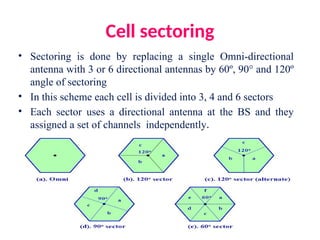
Cell sectoring
• Sectoringis done by replacing a single Omni-directional
antenna with 3 or 6 directional antennas by 60º, 90° and 120º
angle of sectoring
• In this scheme each cell is divided into 3, 4 and 6 sectors
• Each sector uses a directional antenna at the BS and they
assigned a set of channels independently.
Repeaters Range ofextension
• Useful for hard to reach areas.
Buildings
Tunnels
Valleys
– Radio transmitters called Repeaters, it can be used
to provide a coverage in the above areas
– Repeaters are bi-directional in nature RX signal
from BS
– Amplify the signals
– Reradiates the signal to required destination
37.
Micro cell zoneconcept
• Large control BS replaced by
lower power transmitters and
receivers on the edge of the cell.
• The mobile retains the same
channel and the BS simply
switches the channel to different
zone site, by keep on the mobile
moves from zone to zone
38.
HANDOFF AND ITSTYPES,
SCENARIOS AND STRATEGIES
November 16, 2023 38
HANDOFF
39.
Handoff
• When amobile moves into a different cell while a conversation is
in progress, the MSC automatically transfers the call to a new
channel belonging to the new base station.
• Simply transferring a call from current base station to new base
station.
November 16, 2023 39
Occurrence of Handoff
Proper and ImproperHandoff
November 16, 2023 42
Signal drops < Min Acceptable level
Signal strength ≥ Min Acceptable level
43.
Handoff
• Dwell Time:The time over which a call may be
maintained within a cell without handoff.
• Dwell time depends on
– propagation
– interference
– distance
– speed
November 16, 2023 43
44.
Types of Handoff
1.Inter-Cell (Or) System Handoff
2. Intra-Cell Handoff
3. Hard Handoff
4. Soft Handoff
5. Prioritized Handoff
6. Queuing of Handoff
7. Mobile Controlled Handoff (MCHO)
8. Mobile Assisted Handoff (MAHO)
9. Network Controlled Handoff (NCHO)
November 16, 2023 44
45.
• Inter CellHandoff
Mobile moves from one cellular system or network to different
cellular system or network and effectively controlled by MSC
(eg BSNL to AIRCEL)
• Intra-Cell Handoff
Mobile moves from one cellular system or n/w to same cellular type of
system or n/w also effectively controlled by MSC
(eg: AIRTEL to AIRTEL)
November 16, 2023 45
Types of Handoff
• Prioritized Handoff
–A Method of giving priority to the handoff called “Guard channel
concept”, some of the channels are reserved for handoff for
ongoing calls.
• Queuing of Handoff
– A method to decrease the “Probability of forced termination of
call” due to lack of channel availability
• MCHO and MAHO
– Process that allows a mobile phone to assist the base station in the
decision to transfer call to another BS
– Mobile measures signal levels from the various AP using periodic
beacon generated by AP (Tracking location of mobiles)
– Mobile decided for itself by monitoring signal strength and quality
(most of work done by mobile device)
November 16, 2023 47
Types of Handoff
48.
• NCHO
– BSor AP monitor the signal quality from the
mobile and report to MSC and initiating the
handoff
• Evaluating Performance of Handoff by
– Probability of Call Blocking- Block new call
request
– Probability of Forced call Termination- Simply
about dropping a active call or present call due to
handoff failure (lack of channel availability)
November 16, 2023 48
Types of Handoff
49.
Need of Handoff
•The requirement of handoff for Mobile
stations during the following situations
– During Power Variations
– During in very high traffic consideration
– Depends upon poor channel quality
– Depends upon distance consideration
– During Administrative and Maintenance
November 16, 2023 49
Interference And SystemCapacity
• Sources of interference
❖another mobile in the same cell
❖a call in progress in the neighboring cell
❖other base stations operating in the same frequency band
❖noncellular system leaks energy into the cellular frequency
band
• Two major cellular interference
❖co-channel interference
❖adjacent channel interference
November 16, 2023 53
54.
Co-channel Interference andSystem Capacity
• Frequency reuse - there are several cells that use the same set
of frequencies
– co-channel cells
– co-channel interference
• To reduce co-channel interference, co-channel cell must be
separated by a minimum distance.
• When the size of the cell is approximately the same
– co-channel interference is independent of the transmitted power
– co-channel interference is a function of
• R: Radius of the cell
• D: distance to the center of the nearest co-channel cell
• Increasing the ratio Q=D/R, the interference is reduced.
• Q is called the co-channel reuse ratio
November 16, 2023 54
Trunking
⮚ To accommodatelarge no. of users in a limited radio spectrum.
⮚ allows large number of users to share small no. of channels
⮚ Each user is allocated a channel as per call basis.
⮚ Channels are busy – blocking of user takes place else queuing occurs until
channel becomes free.
⮚ Trunking theory – developed by Erlang. A Danish a mathematician in the late
19th
century.
⮚ Erlang – measure of traffic intensity
⮚ 1 Erlang – amount of traffic intensity carried by a completely occupied channel.
Eg. A radio channel occupied for 30 minutes during an hour carries 0.5 Erlangs
of traffic.
November 16, 2023 61
Trunking Terminology's andImportant
Definitions
1. Traffic intensity is measured in Erlangs:
– One Erlang: traffic in a channel completely occupied. 0.5
Erlang: channel occupied 30 minutes in an hour.
2. Grade of Service (GOS): probability that a call is blocked
(or delayed).
3. Set-Up Time: time to allocate a channel.
4. Blocked Call: Call that cannot be completed at time of
request due to congestion. Also referred to as Lost Call.
5. Holding Time: (H) average duration of typical call.
6. Load: Traffic intensity across the whole system.
7. Request Rate: (λ) average number of call requests per unit
time.
November 16, 2023 64
65.
Other Traffic Quantities
•Each user generates traffic intensity of Au Erlangs
is given by
November 16, 2023 65
U- Users utilize unspecified # of
Channels
66.
Types of TrunkingSystems
• Commonly two types of trunked systems
1. Block Call Cleared (BCC- Erlangs –B System)
2. Block Call Delayed (BCD-Erlangs-C System)
• 1. Block Call Cleared (Erlang B):
– It offers no Queuing for call request
– User who requests service, it assumed that there is no
setup time and given immediate access if channel
available
– If channels unavailable the requesting user get blocked,
not possible to access the channel and free to try again
later
– Calls arrives determined by Poisson Distribution
November 16, 2023 66
November 16, 202377
Capacity of Cellular CDMA
Capacity is limited by Interference
.
Reduction in interference will increase the
capacity
of CDMA linearly
78.
November 16, 202378
Directional Antennas -
Sectoring
To overcome some limitations like cochannel interference, cell sectoring is
done
.
Involves replacing an omni- directional antenna at the base station by
several directional antennas
Directional antennas receive signals only from the fraction of current users
thereby reducing the interference
.
November 16, 202382
Bit Energy to Noise Ratio
Eb- Bit Energy
W- Bandwidth
R-Information Bit Rate
S-Signal Power
N-Noise Power
N0 - PSD of Noise
Considering thermal
noise
,
Thermal Noise
83.
November 16, 202383
To Determine N (number of users who can
access the system)