WIRELESS NETWORKS….
6.2.1 Fundamentals of Cellular Comns
Learning Objectives
• Frequencies in use in Wireless Communication
Networks
• Wireless Communication Environment
• Evolution of Mobile Communication Networks
• Concept of a Cell
• Types of Cells
• Why Hexagonal Cells?
• Frequency Reuse Techniques.
Cellular System Definitions
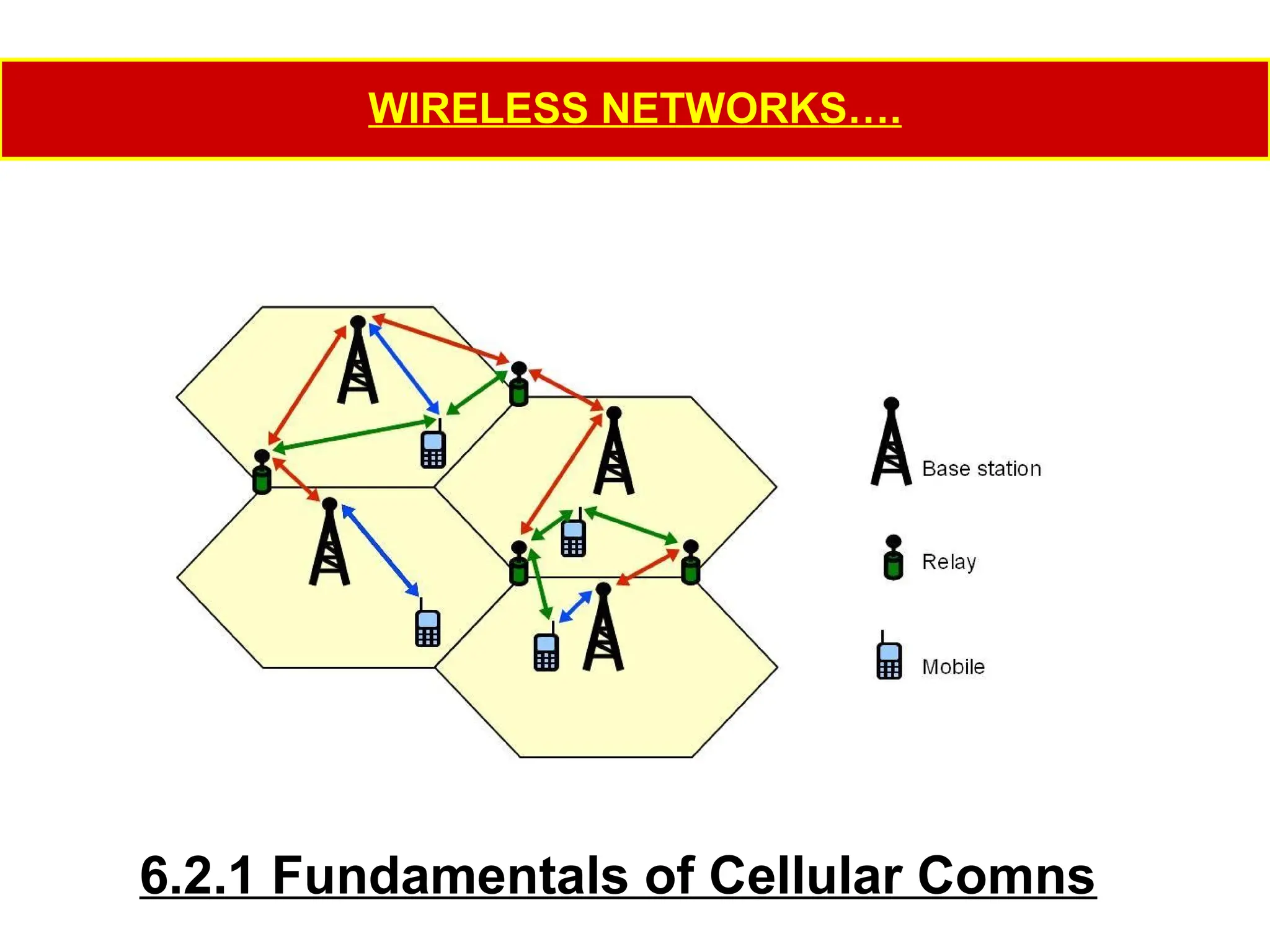
• Mobile Station
• A station in the cellular radio service intended for use while in
motion at unspecified locations. They can be either hand-held
personal units (portables) or installed on vehicles (mobiles)
• Base station
• A fixed station in a mobile radio system used for radio
communication with the mobile stations. Base stations are located at
the center or edge of a coverage region. They consists of radio
channels and transmitter and receiver antennas mounted on top of a
tower.
Cellular System Definitions
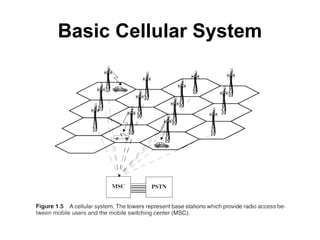
• Mobile Switching Center
• Switching center which coordinates the routing of calls in a
large service area. In a cellular radio system, the MSC
connections the cellular base stations and the mobiles to the
PSTN (telephone network). It is also called Mobile Telephone
Switching Office (MTSO)
• Subscriber
• A user who pays subscription charges for using a mobile
communication system
• Transceiver
• A device capable of simultaneously transmitting and receiving
radio signals
Cellular System Definitions
• Control Channel
• Radio channel used for transmission of call setup, call request,
call initiation and other beacon and control purposes.
• Downlink
• Radio channel used for transmission of information from the
base station to the mobile
• Uplink
• Radio channel used for transmission of information from
mobile to base station
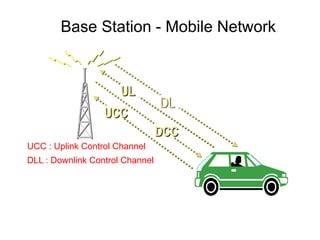
DL
UL
UL
DCC
DCC
UCC
UCC
Base Station - Mobile Network
UCC : Uplink Control Channel
DLL : Downlink Control Channel
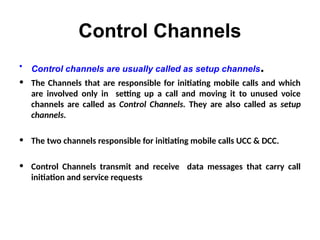
Control Channels
• Control channels are usually called as setup channels.
• The Channels that are responsible for initiating mobile calls and which
are involved only in setting up a call and moving it to unused voice
channels are called as Control Channels. They are also called as setup
channels.
• The two channels responsible for initiating mobile calls UCC & DCC.
• Control Channels transmit and receive data messages that carry call
initiation and service requests
Basic Cellular System
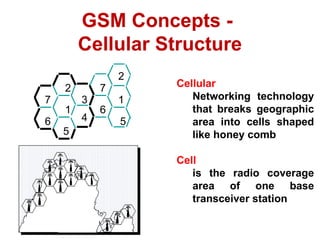
Cellular Networks
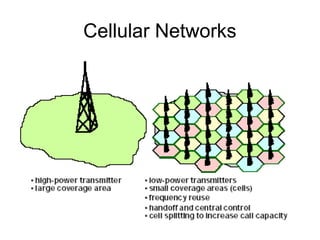
Cellular
Networking technology
that breaks geographic
area into cells shaped
like honey comb
Cell
is the radio coverage
area of one base
transceiver station
1
2
3
4
5
6
7
6
7
2
1
5
GSM Concepts -
Cellular Structure
Basic principles of cellular systems
• Communication is always between mobile and base
station (not directly between mobiles)
• Each cellular base station is allocated a group of radio
channels within a small geographic area called a cell.
• Neighboring cells are assigned different channel
groups.
• By limiting the coverage area to within the boundary
of the cell, the channel groups may be reused to cover
different cells.
• Keep interference levels within tolerable limits.
• Frequency reuse or frequency planning
Rationale behind cellular
systems
• Solves the problem of spectral congestion
and increases user capacity.
• Offer very high capacity in a limited
spectrum
• Reuse of radio channel in different cells.
• Enable a fixed number of channels to serve
an arbitrarily large number of users by
reusing the channel throughout the coverage
region.
Consequences
• Transmit frequencies are re-used across these
cells and the system becomes interference
rather than noise limited
– the need for careful radio frequency planning
– a mechanism for handling the call as the user
crosses the cell boundary - call handoff (or
handover)
– increased network complexity to route the call and
track the users as they move around
• But one significant benefit: very much
increased traffic capacity, the ability to service
many users
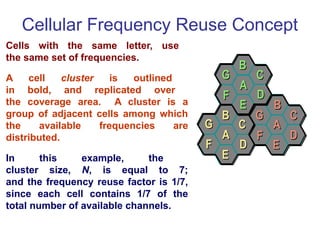
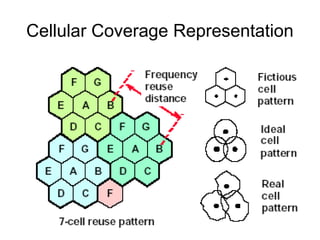
Cells with the same letter, use
the same set of frequencies.
A cell cluster is outlined
in bold, and replicated over
the coverage area. A cluster is a
group of adjacent cells among which
the available frequencies are
distributed.
In this example, the
cluster size, N, is equal to 7;
and the frequency reuse factor is 1/7,
since each cell contains 1/7 of the
total number of available channels.
A
A
C
C
B
B
G
G
F
F D
D
G
G
E
E
D
D
B
B
B
B
F
F
F
F
E
E
E
E
C
C
A
A
A
A
G
G
C
C
D
D
Cellular Frequency Reuse Concept
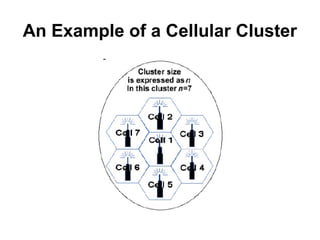
An Example of a Cellular Cluster
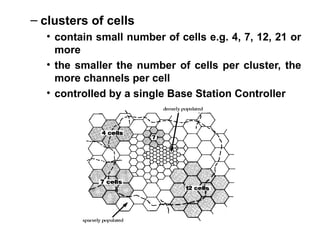
– clusters of cells
• contain small number of cells e.g. 4, 7, 12, 21 or
more
• the smaller the number of cells per cluster, the
more channels per cell
• controlled by a single Base Station Controller
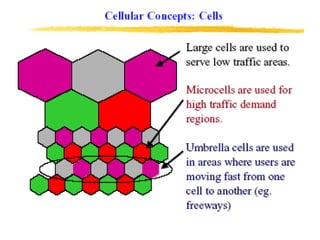
– types of cell
• macrocells : large higher power cells for remote and sparsely
populated areas
• microcells : small lower power cells used for densely populated areas
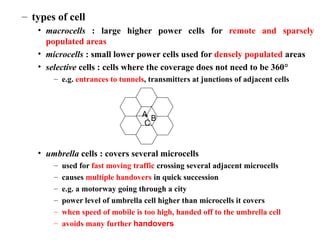
• selective cells : cells where the coverage does not need to be 360°
– e.g. entrances to tunnels, transmitters at junctions of adjacent cells
• umbrella cells : covers several microcells
– used for fast moving traffic crossing several adjacent microcells
– causes multiple handovers in quick succession
– e.g. a motorway going through a city
– power level of umbrella cell higher than microcells it covers
– when speed of mobile is too high, handed off to the umbrella cell
– avoids many further handovers
A
B
C
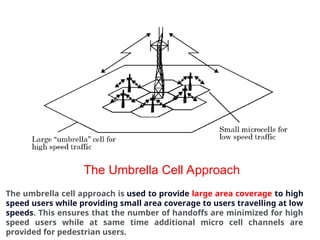
The Umbrella Cell Approach
The umbrella cell approach is used to provide large area coverage to high
speed users while providing small area coverage to users travelling at low
speeds. This ensures that the number of handoffs are minimized for high
speed users while at same time additional micro cell channels are
provided for pedestrian users.
Umbrella cell approach:
• Minimizes the number of hand offs for high speed users,
• Provides additional micro-cell users for pedestrians.
• A High speed user converting into a low speed user may be
switched to smaller micro-cell by the Base Station, without
MSC intervention.
• Speed Estimation can be performed by slope of short term
average calculations of the received power, or by some more
more sophisticated algorithms.
20
Coverage Area
• Pico-cell – O(10m)
– covers a room
• Micro-cell – O(100m)
– covers a floor/street
• Macro-cell – O(10 mi.)
– big towers
• Satellites
– regions/countries
Choices:
Factors:
Factors:
Choices of Hexagonal Cell
• No overlap or gap between
cells
A1
A1
S
S
S
S
S
S
A
A2
2 A
A3
3
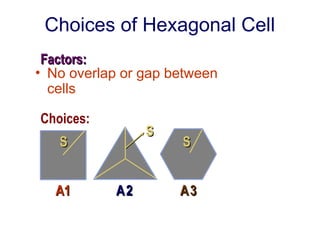
For a given S
A3 > A1
A3 > A2
Here, A3 provides maximum coverage area
for a given value of S.
Actual cellular footprint is determined by the
radiation pattern of a given transmitting
antenna and ideal footprint is circular.
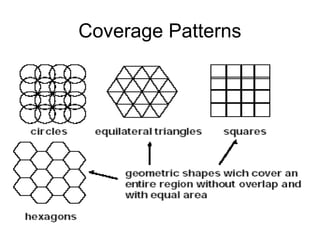
By using hexagon geometry, the fewest
number of cells covers a given geographic
region, approximating a circular footprint.
Coverage Patterns
Cellular Coverage Representation
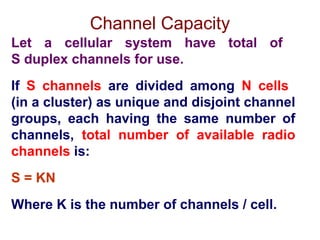
Channel Capacity
Let a cellular system have total of
S duplex channels for use.
If S channels are divided among N cells
(in a cluster) as unique and disjoint channel
groups, each having the same number of
channels, total number of available radio
channels is:
S = KN
Where K is the number of channels / cell.
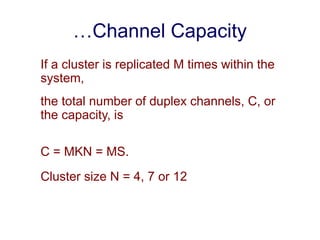
…Channel Capacity
If a cluster is replicated M times within the
system,
the total number of duplex channels, C, or
the capacity, is
C = MKN = MS.
Cluster size N = 4, 7 or 12
Capacity Improvement
• Initially, cellular systems are often noise
limited:
– The main deployment concern is coverage
• As traffic increases, systems become
interference limited:
– The main deployment concern is capacity
How to increase capacity?
• Use sectorised antenna
• Cell splitting
• Discontinuous Transmission (DTX)
• Use speech detection / silence suppression
• Power control
• Adapt transmission power to what is just needed
(given the position of the mobile)
• Dynamic Channel Allocation
• Adding new channels – often expensive or impossible
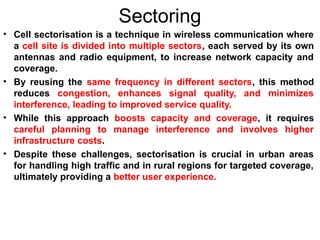
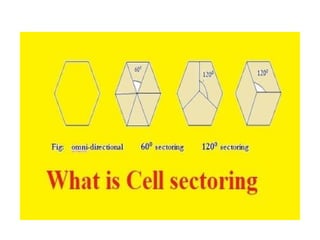
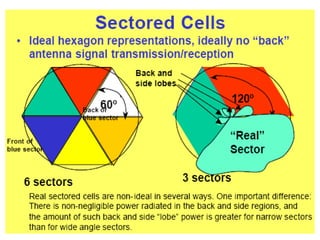
Sectoring
• Cell sectorisation is a technique in wireless communication where
a cell site is divided into multiple sectors, each served by its own
antennas and radio equipment, to increase network capacity and
coverage.
• By reusing the same frequency in different sectors, this method
reduces congestion, enhances signal quality, and minimizes
interference, leading to improved service quality.
• While this approach boosts capacity and coverage, it requires
careful planning to manage interference and involves higher
infrastructure costs.
• Despite these challenges, sectorisation is crucial in urban areas
for handling high traffic and in rural regions for targeted coverage,
ultimately providing a better user experience.
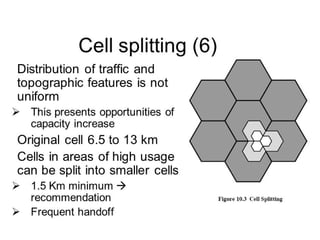
• Cell splitting in mobile communication is the process in which the
bigger cells split up into smaller ones. In mobile communication we
use cell splitting so that we can expand the capacity of the system.
Cell splitting also helps to increase the number of channels.
• Cell Splitting is the process of subdividing a cell into smaller cells
each with its own Base Station. On splitting, new cells with smaller
radius are added called microcells.
• Each new cell created is independent and has reduced antenna height
and transmitter power. The creation of new smaller cells increases the
capacity of the system as a whole. Cell Splitting increases the
frequency reuse factor. A higher frequency reuse factor increases the
capacity of the cellular system in Cell Splitting.
Design Tradeoff
• Smaller cell means higher capacity
• However, smaller cell also results in
higher handoff probability, which also
means higher overhead
• Moreover, cell splitting should not
introduce too much interference to users
in other cells
How to increase capacity?
• Use sectorised antenna
• Cell splitting
• Discontinuous Transmission (DTX)
• Use speech detection / silence suppression
• Power control
• Adapt transmission power to what is just needed
(given the position of the mobile)
• Dynamic Channel Allocation
• Adding new channels – often expensive or impossible
Cell Splitting. Dividing large cells into smaller cells (microcells, picocells, femtocells) to
serve more users and reduce congestion. Smaller cells can provide higher capacity and
better signal quality.
Cell Sectorisation. Dividing a cell into multiple sectors, each served by its own
antennas and radio equipment. Allows for frequency reuse within the same cell,
increasing overall capacity.
Frequency Reuse. Efficiently reusing frequencies in non-adjacent cells to maximize
spectrum utilization. Requires careful planning to minimize interference.
Carrier Aggregation. Combining multiple frequency bands to increase the available
bandwidth for users. Enhances data rates and network capacity.
Advanced Antenna Technologies. Implementing Multiple Input Multiple Output
(MIMO) systems, which use multiple antennas at both the transmitter and receiver to
improve communication performance. Beamforming technology focuses the signal in
specific directions to enhance coverage and capacity.
How to increase capacity?
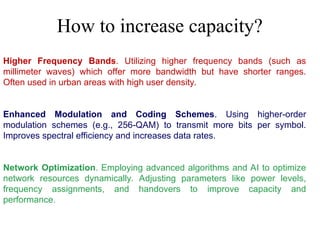
Higher Frequency Bands. Utilizing higher frequency bands (such as
millimeter waves) which offer more bandwidth but have shorter ranges.
Often used in urban areas with high user density.
Enhanced Modulation and Coding Schemes. Using higher-order
modulation schemes (e.g., 256-QAM) to transmit more bits per symbol.
Improves spectral efficiency and increases data rates.
Network Optimization. Employing advanced algorithms and AI to optimize
network resources dynamically. Adjusting parameters like power levels,
frequency assignments, and handovers to improve capacity and
performance.
How to increase capacity?
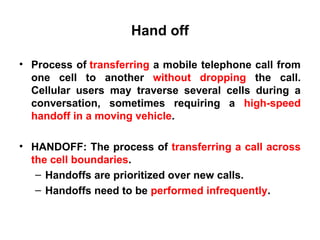
Hand off
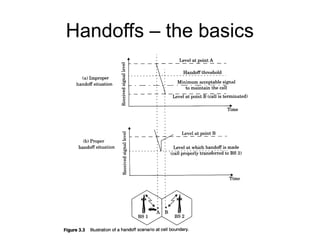
• Process of transferring a mobile telephone call from
one cell to another without dropping the call.
Cellular users may traverse several cells during a
conversation, sometimes requiring a high-speed
handoff in a moving vehicle.
• HANDOFF: The process of transferring a call across
the cell boundaries.
– Handoffs are prioritized over new calls.
– Handoffs need to be performed infrequently.
Handoffs – the basics
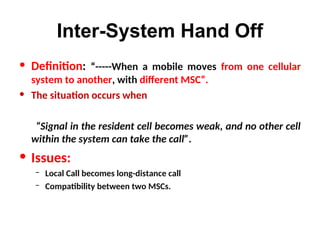
Inter-System Hand Off
• Definition: “-----When a mobile moves from one cellular
system to another, with different MSC”.
• The situation occurs when
“Signal in the resident cell becomes weak, and no other cell
within the system can take the call”.
• Issues:
– Local Call becomes long-distance call
– Compatibility between two MSCs.
Prioritizing Hand off
• Systems differ in methods and policies of hand off:
– Some systems take hand off like a new call initiation: user will be more
annoyed in case of call drop than call blocking for some time.
– Various Methods of Prioritizing Hand off have been devised and
implemented.
Guard Channel Concept
• Reserve some channels exclusively for hand off--- do not use them
for call initiation.
• Advantage is increased probability of successful hand off.
Disadvantage is lower capacity because of less number of channels
for call initiation.

6.1.2.1 cellular comn fundamentals about

  • 1.
  • 2.
    Learning Objectives • Frequenciesin use in Wireless Communication Networks • Wireless Communication Environment • Evolution of Mobile Communication Networks • Concept of a Cell • Types of Cells • Why Hexagonal Cells? • Frequency Reuse Techniques.
  • 3.
    Cellular System Definitions •Mobile Station • A station in the cellular radio service intended for use while in motion at unspecified locations. They can be either hand-held personal units (portables) or installed on vehicles (mobiles) • Base station • A fixed station in a mobile radio system used for radio communication with the mobile stations. Base stations are located at the center or edge of a coverage region. They consists of radio channels and transmitter and receiver antennas mounted on top of a tower.
  • 4.
    Cellular System Definitions •Mobile Switching Center • Switching center which coordinates the routing of calls in a large service area. In a cellular radio system, the MSC connections the cellular base stations and the mobiles to the PSTN (telephone network). It is also called Mobile Telephone Switching Office (MTSO) • Subscriber • A user who pays subscription charges for using a mobile communication system • Transceiver • A device capable of simultaneously transmitting and receiving radio signals
  • 5.
    Cellular System Definitions •Control Channel • Radio channel used for transmission of call setup, call request, call initiation and other beacon and control purposes. • Downlink • Radio channel used for transmission of information from the base station to the mobile • Uplink • Radio channel used for transmission of information from mobile to base station
  • 6.
    DL UL UL DCC DCC UCC UCC Base Station -Mobile Network UCC : Uplink Control Channel DLL : Downlink Control Channel
  • 7.
    Control Channels • Controlchannels are usually called as setup channels. • The Channels that are responsible for initiating mobile calls and which are involved only in setting up a call and moving it to unused voice channels are called as Control Channels. They are also called as setup channels. • The two channels responsible for initiating mobile calls UCC & DCC. • Control Channels transmit and receive data messages that carry call initiation and service requests
  • 8.
  • 9.
  • 10.
    Cellular Networking technology that breaksgeographic area into cells shaped like honey comb Cell is the radio coverage area of one base transceiver station 1 2 3 4 5 6 7 6 7 2 1 5 GSM Concepts - Cellular Structure
  • 11.
    Basic principles ofcellular systems • Communication is always between mobile and base station (not directly between mobiles) • Each cellular base station is allocated a group of radio channels within a small geographic area called a cell. • Neighboring cells are assigned different channel groups. • By limiting the coverage area to within the boundary of the cell, the channel groups may be reused to cover different cells. • Keep interference levels within tolerable limits. • Frequency reuse or frequency planning
  • 12.
    Rationale behind cellular systems •Solves the problem of spectral congestion and increases user capacity. • Offer very high capacity in a limited spectrum • Reuse of radio channel in different cells. • Enable a fixed number of channels to serve an arbitrarily large number of users by reusing the channel throughout the coverage region.
  • 13.
    Consequences • Transmit frequenciesare re-used across these cells and the system becomes interference rather than noise limited – the need for careful radio frequency planning – a mechanism for handling the call as the user crosses the cell boundary - call handoff (or handover) – increased network complexity to route the call and track the users as they move around • But one significant benefit: very much increased traffic capacity, the ability to service many users
  • 14.
    Cells with thesame letter, use the same set of frequencies. A cell cluster is outlined in bold, and replicated over the coverage area. A cluster is a group of adjacent cells among which the available frequencies are distributed. In this example, the cluster size, N, is equal to 7; and the frequency reuse factor is 1/7, since each cell contains 1/7 of the total number of available channels. A A C C B B G G F F D D G G E E D D B B B B F F F F E E E E C C A A A A G G C C D D Cellular Frequency Reuse Concept
  • 15.
    An Example ofa Cellular Cluster
  • 16.
    – clusters ofcells • contain small number of cells e.g. 4, 7, 12, 21 or more • the smaller the number of cells per cluster, the more channels per cell • controlled by a single Base Station Controller
  • 17.
    – types ofcell • macrocells : large higher power cells for remote and sparsely populated areas • microcells : small lower power cells used for densely populated areas • selective cells : cells where the coverage does not need to be 360° – e.g. entrances to tunnels, transmitters at junctions of adjacent cells • umbrella cells : covers several microcells – used for fast moving traffic crossing several adjacent microcells – causes multiple handovers in quick succession – e.g. a motorway going through a city – power level of umbrella cell higher than microcells it covers – when speed of mobile is too high, handed off to the umbrella cell – avoids many further handovers A B C
  • 19.
    The Umbrella CellApproach The umbrella cell approach is used to provide large area coverage to high speed users while providing small area coverage to users travelling at low speeds. This ensures that the number of handoffs are minimized for high speed users while at same time additional micro cell channels are provided for pedestrian users.
  • 20.
    Umbrella cell approach: •Minimizes the number of hand offs for high speed users, • Provides additional micro-cell users for pedestrians. • A High speed user converting into a low speed user may be switched to smaller micro-cell by the Base Station, without MSC intervention. • Speed Estimation can be performed by slope of short term average calculations of the received power, or by some more more sophisticated algorithms. 20
  • 21.
    Coverage Area • Pico-cell– O(10m) – covers a room • Micro-cell – O(100m) – covers a floor/street • Macro-cell – O(10 mi.) – big towers • Satellites – regions/countries
  • 22.
    Choices: Factors: Factors: Choices of HexagonalCell • No overlap or gap between cells A1 A1 S S S S S S A A2 2 A A3 3
  • 23.
    For a givenS A3 > A1 A3 > A2 Here, A3 provides maximum coverage area for a given value of S. Actual cellular footprint is determined by the radiation pattern of a given transmitting antenna and ideal footprint is circular. By using hexagon geometry, the fewest number of cells covers a given geographic region, approximating a circular footprint.
  • 24.
  • 25.
  • 26.
    Channel Capacity Let acellular system have total of S duplex channels for use. If S channels are divided among N cells (in a cluster) as unique and disjoint channel groups, each having the same number of channels, total number of available radio channels is: S = KN Where K is the number of channels / cell.
  • 27.
    …Channel Capacity If acluster is replicated M times within the system, the total number of duplex channels, C, or the capacity, is C = MKN = MS. Cluster size N = 4, 7 or 12
  • 28.
    Capacity Improvement • Initially,cellular systems are often noise limited: – The main deployment concern is coverage • As traffic increases, systems become interference limited: – The main deployment concern is capacity
  • 29.
    How to increasecapacity? • Use sectorised antenna • Cell splitting • Discontinuous Transmission (DTX) • Use speech detection / silence suppression • Power control • Adapt transmission power to what is just needed (given the position of the mobile) • Dynamic Channel Allocation • Adding new channels – often expensive or impossible
  • 30.
    Sectoring • Cell sectorisationis a technique in wireless communication where a cell site is divided into multiple sectors, each served by its own antennas and radio equipment, to increase network capacity and coverage. • By reusing the same frequency in different sectors, this method reduces congestion, enhances signal quality, and minimizes interference, leading to improved service quality. • While this approach boosts capacity and coverage, it requires careful planning to manage interference and involves higher infrastructure costs. • Despite these challenges, sectorisation is crucial in urban areas for handling high traffic and in rural regions for targeted coverage, ultimately providing a better user experience.
  • 34.
    • Cell splittingin mobile communication is the process in which the bigger cells split up into smaller ones. In mobile communication we use cell splitting so that we can expand the capacity of the system. Cell splitting also helps to increase the number of channels. • Cell Splitting is the process of subdividing a cell into smaller cells each with its own Base Station. On splitting, new cells with smaller radius are added called microcells. • Each new cell created is independent and has reduced antenna height and transmitter power. The creation of new smaller cells increases the capacity of the system as a whole. Cell Splitting increases the frequency reuse factor. A higher frequency reuse factor increases the capacity of the cellular system in Cell Splitting.
  • 35.
    Design Tradeoff • Smallercell means higher capacity • However, smaller cell also results in higher handoff probability, which also means higher overhead • Moreover, cell splitting should not introduce too much interference to users in other cells
  • 36.
    How to increasecapacity? • Use sectorised antenna • Cell splitting • Discontinuous Transmission (DTX) • Use speech detection / silence suppression • Power control • Adapt transmission power to what is just needed (given the position of the mobile) • Dynamic Channel Allocation • Adding new channels – often expensive or impossible
  • 37.
    Cell Splitting. Dividinglarge cells into smaller cells (microcells, picocells, femtocells) to serve more users and reduce congestion. Smaller cells can provide higher capacity and better signal quality. Cell Sectorisation. Dividing a cell into multiple sectors, each served by its own antennas and radio equipment. Allows for frequency reuse within the same cell, increasing overall capacity. Frequency Reuse. Efficiently reusing frequencies in non-adjacent cells to maximize spectrum utilization. Requires careful planning to minimize interference. Carrier Aggregation. Combining multiple frequency bands to increase the available bandwidth for users. Enhances data rates and network capacity. Advanced Antenna Technologies. Implementing Multiple Input Multiple Output (MIMO) systems, which use multiple antennas at both the transmitter and receiver to improve communication performance. Beamforming technology focuses the signal in specific directions to enhance coverage and capacity. How to increase capacity?
  • 38.
    Higher Frequency Bands.Utilizing higher frequency bands (such as millimeter waves) which offer more bandwidth but have shorter ranges. Often used in urban areas with high user density. Enhanced Modulation and Coding Schemes. Using higher-order modulation schemes (e.g., 256-QAM) to transmit more bits per symbol. Improves spectral efficiency and increases data rates. Network Optimization. Employing advanced algorithms and AI to optimize network resources dynamically. Adjusting parameters like power levels, frequency assignments, and handovers to improve capacity and performance. How to increase capacity?
  • 39.
    Hand off • Processof transferring a mobile telephone call from one cell to another without dropping the call. Cellular users may traverse several cells during a conversation, sometimes requiring a high-speed handoff in a moving vehicle. • HANDOFF: The process of transferring a call across the cell boundaries. – Handoffs are prioritized over new calls. – Handoffs need to be performed infrequently.
  • 40.
  • 41.
    Inter-System Hand Off •Definition: “-----When a mobile moves from one cellular system to another, with different MSC”. • The situation occurs when “Signal in the resident cell becomes weak, and no other cell within the system can take the call”. • Issues: – Local Call becomes long-distance call – Compatibility between two MSCs.
  • 42.
    Prioritizing Hand off •Systems differ in methods and policies of hand off: – Some systems take hand off like a new call initiation: user will be more annoyed in case of call drop than call blocking for some time. – Various Methods of Prioritizing Hand off have been devised and implemented. Guard Channel Concept • Reserve some channels exclusively for hand off--- do not use them for call initiation. • Advantage is increased probability of successful hand off. Disadvantage is lower capacity because of less number of channels for call initiation.