Wireless Communications 
The Cellular Concept 
Transferring knowledge to future leaders 
Reference: 
Professor Johnson I Agbinya 
(University of the Western Cape)
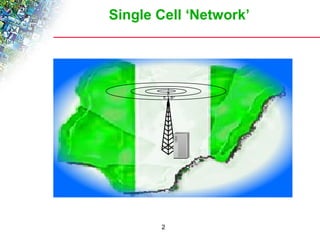
Single Cell ‘Network’ 
2
History of Cellular Networks 
Why cellular networks? 
To address requirement for greater capacity 
For efficient use of frequency 
To address the poor quality of non cellular mobile 
networks and increases coverage 
– replaces a large transmitter with smaller ones in cells 
– smaller transmitting power 
– each cell serves a small geographical service area 
– each cell is assigned a portion of the total frequency 
3
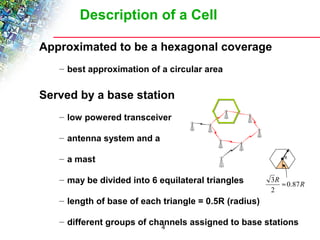
Description of a Cell 
Approximated to be a hexagonal coverage 
– best approximation of a circular area 
Served by a base station 
– low powered transceiver 
– antenna system and a 
– a mast 
– may be divided into 6 equilateral triangles 
– length of base of each triangle = 0.5R (radius) 
– different groups of channels assigned to base stations 
4 
R 
R 0.87R 
2 
3 »
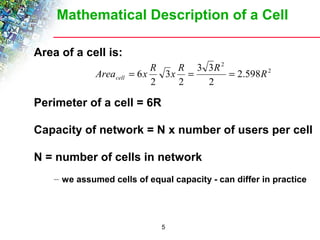
Mathematical Description of a Cell 
Area 6x R x R R R cell = = = 
5 
Area of a cell is: 
2 
Perimeter of a cell = 6R 
2 
2 
2.598 
3 3 
2 
2 
3 
Capacity of network = N x number of users per cell 
N = number of cells in network 
– we assumed cells of equal capacity - can differ in practice
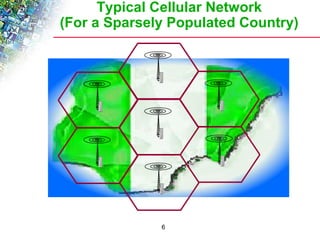
Typical Cellular Network 
(For a Sparsely Populated Country) 
6
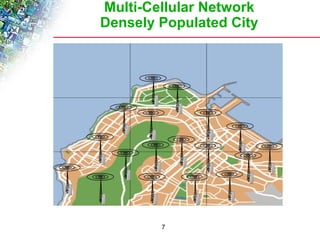
Multi-Cellular Network 
Densely Populated City 
7
Definitions 
Definition of ‘channel’ 
depends on the system 
– frequency (radio station) 
– frequency band (TV transmissions) 
– time slot of a frequency (GSM, GPRS) 
– orthogonal code (CDMA networks) 
8
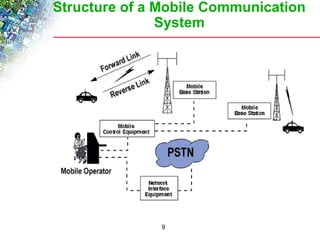
Structure of a Mobile Communication 
System 
9
Types of Mobile Communication Cells 
The size of a cell is dictated by capacity demand 
10 
Macrocell 
– large, covering a wide area 
– range of several hundred kilometres (km) to ten km 
– mostly deployed in rural and sparsely populated areas 
Microcell 
– medium cell, coverage area smaller than in macro cells 
– range of several hundred metres to a couple of metres 
– deployed mostly in crowded areas, stadiums, shopping malls
Types of Mobile Communication Cells (1) 
The size of a cell is dictated by capacity demand 
11 
Picocell 
– small, covering a very small area 
– range of several tens of metres 
– low power antennas 
– can be mounted on walls or ceilings 
– used in densely populated areas, offices, lifts, tunnels etc
Means of Increasing Cells Capacity 
There are several approaches for increasing 
cellular system capacity including: 
12 
Cell clustering 
Sectoring of cells 
Cell splitting 
Frequency reuse 
Reduction of adjacent cell interference and co-channel 
interference
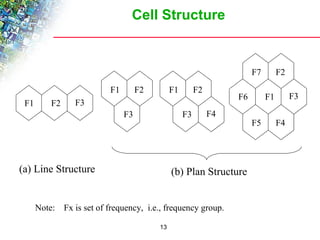
Cell Structure 
13 
F1 F2 F3 
F1 F2 
F3 
F3 
F2 
F4 
F1 
F1 
F2 
F3 
F5 F4 
F6 
F7 
(a) Line Structure (b) Plan Structure 
Note: Fx is set of frequency, i.e., frequency group.
Cell Clusters 
Service areas are normally divided into clusters 
of cells to facilitate system design and increased 
capacity 
14 
Definition 
a group of cells in which each cell is assigned a 
different frequency 
– cell clusters may contain any number of cells, but clusters 
of 3, 4, 5, 7 and 9 cells are very popular in practice
Cell Clusters 
15 
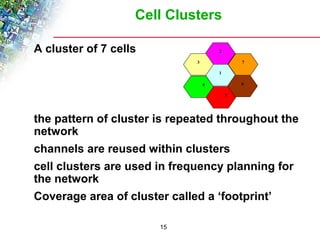
A cluster of 7 cells 
2 
1 
5 
7 
6 
4 
3 
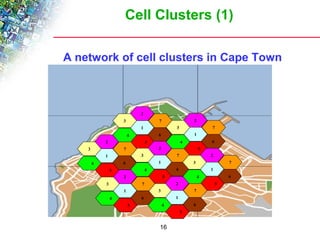
the pattern of cluster is repeated throughout the 
network 
channels are reused within clusters 
cell clusters are used in frequency planning for 
the network 
Coverage area of cluster called a ‘footprint’
Cell Clusters (1) 
A network of cell clusters in Cape Town 
7 
2 
16 
2 
1 
5 
6 
4 
3 
1 
5 
7 
6 
4 
3 
2 
1 
5 
7 
6 
4 
3 
2 
1 
5 
7 
6 
4 
3 
2 
1 
5 
7 
6 
4 
7 
2 
7 
1 3 
5 
6 
4 
2 
1 
3 
5 
6 
4 
3
Frequency Plan 
Intelligent allocation of frequencies used 
– Each base station is allocated a group of channels to be 
used within its geographical area of coverage called a 
‘cell’ 
Adjacent cell base stations are assigned completely 
different channel groups to their neighbors 
base stations antennas designed to provide just the 
cell coverage, so frequency reuse is possible 
17
Frequency Reuse Concept 
 Assign to each cluster a group of radio channels to 
be used within its geographical footprint 
 ensure this group of frequencies is completely different 
from that assigned to neighbors of the cells 
 Therefore this group of frequencies can be reused in 
a cell cluster ‘far away’ from this one 
 Cells with the same number have the same sets of 
frequencies 
18
Frequency Reuse Factor 
19 
 Definition 
 When each cell in a cluster of N cells uses one of N 
frequencies, the frequency reuse factor is 1/N 
 Frequency reuse is an example of space diversity 
multiplex access 
 frequency reuse limits adjacent cell interference 
because cells using same frequencies are separated 
far from each other
Factors Affecting Frequency Reuse 
 Factors affecting frequency reuse include: 
 Types of antenna used 
– omni-directional or sectored 
 placement of base stations 
 coverage for distance (highways) vs area (city) 
 capacity through macro and micro overlays 
20
Excitation of Cells 
 Once a frequency reuse plan is agreed upon overlay the 
frequency reuse plan on the coverage map and assign 
frequencies 
 The location of the base station within the cell is referred 
to as cell excitation 
 In hexagonal cells, base stations transmitters are either: 
– centre-excited, base station is at the centre of the cell or 
– edge-excited, base station at 3 of the 6 cell vertices 
21
Frequency Assignment Plan 
22 
 Example 
 S duplex channels 
 S channels divided into N cells 
 Each cell allocated a group of k channels 
 Total # available channels S = k N 
 Replicate a cluster M times in the network 
 Total number of duplex channels, C=MkN=MS
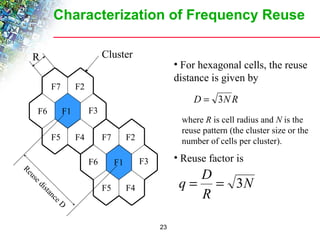
Characterization of Frequency Reuse 
23 
F1 
F2 
F3 
F5 F4 
F6 
F7 
F1 
F2 
F3 
F5 F4 
F6 
F7 
F1 
Reuse distance D 
• For hexagonal cells, the reuse 
distance is given by 
D = 3NR 
R 
where R is cell radius and N is the 
reuse pattern (the cluster size or the 
number of cells per cluster). 
N 
• Reuse factor is 
q = D = 3 
R 
Cluster
Characterization of Frequency Reuse 
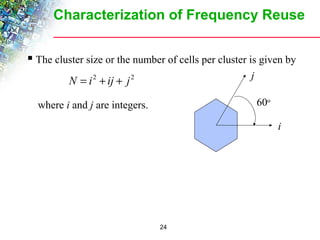
 The cluster size or the number of cells per cluster is given by 
24 
N = i2 + ij + j2 
where i and j are integers. 
i 
j 
60o
Finding the Nearest Co-Channel 
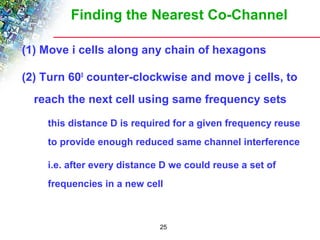
(1) Move i cells along any chain of hexagons 
(2) Turn 600 counter-clockwise and move j cells, to 
reach the next cell using same frequency sets 
 this distance D is required for a given frequency reuse 
to provide enough reduced same channel interference 
 i.e. after every distance D we could reuse a set of 
frequencies in a new cell 
25
Channel Assignment Strategies 
 Three assignment approaches 
 Fixed and static (most common) 
26 
 Dynamic 
 Hybrid 
 Fixed channel assignment 
 all channels in a cell could be in use all the time 
– new calls are then blocked (no channels left) 
– may be solved by borrowing spare channels from 
nearby cells
Channel Assignment Strategies (1) 
Dynamic channel assignment 
 MSC allocates frequencies when a call is made 
 Provides high channel utilization 
To do this it needs real-time information on 
 channel occupancy 
 traffic distribution and 
 radio signal strength indication (RSSI) 
 high computational load and increased storage 
27
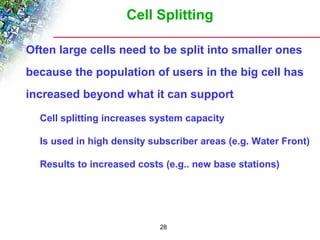
Cell Splitting 
 Often large cells need to be split into smaller ones 
because the population of users in the big cell has 
increased beyond what it can support 
 Cell splitting increases system capacity 
 Is used in high density subscriber areas (e.g. Water Front) 
 Results to increased costs (e.g.. new base stations) 
28
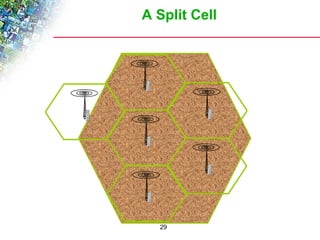
A Split Cell 
29
Handover (Handoff) 
Provides continuity of communication across cells 
30 
 Difficulty 
 dropping a call before reconnecting is unacceptable 
 different cells use different frequencies 
 mobile phone users usually move from place to place 
and very quickly too 
 therefore the current location of the mobile phone must 
somehow be known and kept
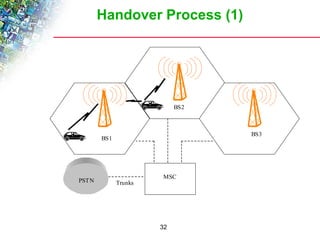
Handover Process 
Parties in communication share the same channels 
 Received signal weakens as mobile moves out of cell 
 Cell site at some point requests handover to cell with 
stronger signal strength 
 MSC switches call to new cell after allocating channels, and 
informing the two mobiles of the new channels (voice and 
control channels) 
31
Handover Process (1) 
32 
BS1 
BS2 
BS3 
PSTN MSC Trunks
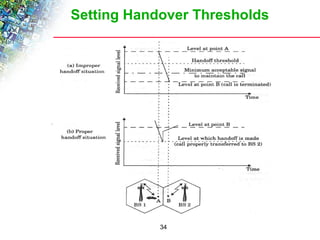
Handover Process (2) 
Handover must not be too frequent or 
 system is kept busy servicing handover requests 
 handover threshold is set with the above in mind 
 Minimum usable signal level is normally set to be between 
-90 dBm and -100 dBm 
33
Setting Handover Thresholds 
34
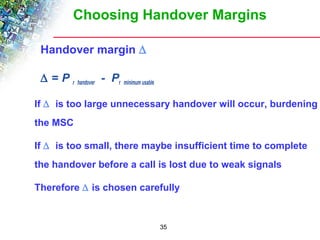
Choosing Handover Margins 
35 
Handover margin D 
D = P r handover - Pr minimum usable 
 If D is too large unnecessary handover will occur, burdening 
the MSC 
 If D is too small, there maybe insufficient time to complete 
the handover before a call is lost due to weak signals 
 Therefore D is chosen carefully
Interference Sources in Mobile Networks 
 Interference comes from many sources: 
36 
 Multipath 
 Mobile phones in the same cell 
 Other users in neighboring cells 
 Environmental effects 
 base stations operating at the same frequencies 
 Radiation leakage from other sources into the 
mobile communication band
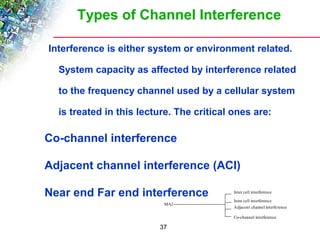
Types of Channel Interference 
Interference is either system or environment related. 
System capacity as affected by interference related 
to the frequency channel used by a cellular system 
is treated in this lecture. The critical ones are: 
 Co-channel interference 
 Adjacent channel interference (ACI) 
 Near end Far end interference 
MAI 
37 
Inter cell interference 
Intra cell interference 
Adjacent channel interference 
Co-channel interference
Capacity and Co-Channel Interference 
38 
Definition 
Interference from co-channel cells is called co-channel 
interference. Such cells use identical frequencies or 
channels 
– Independent of transmitted power for cells of same size 
– Is a function of the radius (R) of cell and distance (D) to co-channel 
cell 
– Cannot be overcome by increased transmission power 
– Overcome by separating such cells by a required minimum 
distance - by increasing the ratio Q = D/R, where Q is the 
co-channel reuse ratio
Capacity and Co-Channel Interference (1) 
Desired Signal 
39 
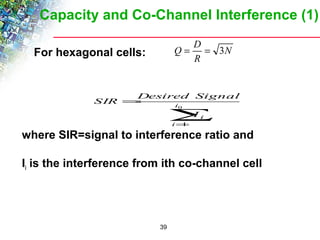
 For hexagonal cells: 
 
N 
Q = D = 3 
R 
i 
0 
å= 
= 
1 
i 
I i 
SIR 
where SIR=signal to interference ratio and 
Ii is the interference from ith co-channel cell
Capacity and Co-Channel Interference (2) 
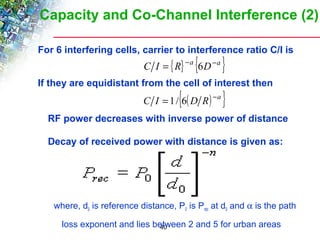
For 6 interfering cells, carrier to interference ratio C/I is 
C I = {R} -a {6D-a } 
If they are equidistant from the cell of interest then 
C I = 1/{6(D R) -a } 
 RF power decreases with inverse power of distance 
 Decay of received power with distance is given as: 
where, d0 is reference distance, P0 is Prec at d0 and a is the path 
loss exponent and lies between 2 and 5 for urban areas 
40
Effects of Q on Capacity 
 A small value of Q is desirable for larger capacity. This 
means a small value of N (small clusters) 
 A large value of Q improves transmission quality due to 
small values of co-channel interference 
 In practice the value of Q is a trade off between capacity 
and transmission quality 
41
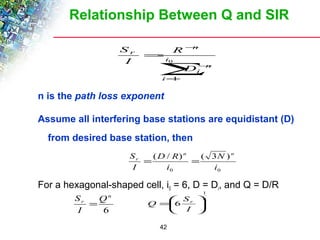
Relationship Between Q and SIR 
n 
å= - 
S 
n is the path loss exponent 
Assume all interfering base stations are equidistant (D) 
from desired base station, then 
S n n 
N 
D R 
( / ) ( 3 ) 
i 
r = = 
For a hexagonal-shaped cell, i0 = 6, D = Di, and Q = D/R 
S = Q =æ 
S 
n 
42 
- 
= 
0 
1 
i 
i 
n 
i 
r 
D 
R 
I 
0 0 
i 
I 
n 
r Q 
I 
6 
r 
ö I 
çè 
1 
6 ÷ø
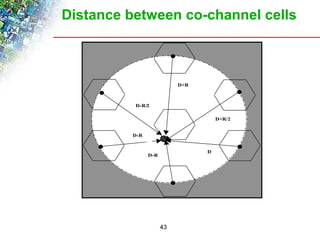
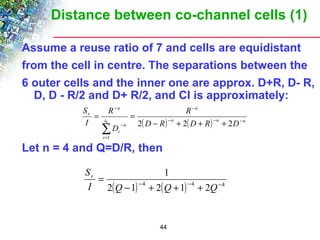
Distance between co-channel cells 
43 
D 
D-R/2 
D-R 
D-R 
D+R 
D+R/2
Distance between co-channel cells (1) 
Assume a reuse ratio of 7 and cells are equidistant 
from the cell in centre. The separations between the 
6 outer cells and the inner one are approx. D+R, D- R, 
D, D - R/2 and D+ R/2, and CI is approximately: 
R 
- 
= = 
å0 2 2 2 
( ) n ( ) n n 
n 
R 
S 
Let n = 4 and Q=D/R, then 
1 
= 
I Q Q Q 
44 
n 
i 
i 
n 
i 
r 
D R D R D 
D 
I 
- - - 
= 
- 
- 
- + + + 
1 
2( - 1) - 4 + 2( + 1) - 4 + 2 - 
4 
Sr
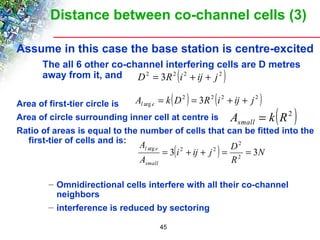
Distance between co-channel cells (3) 
Assume in this case the base station is centre-excited 
 The all 6 other co-channel interfering cells are D metres 
away from it, and 
D2 = 3R2 (i2 + ij + j 2 ) 
Area of first-tier circle is 
Area of circle surrounding inner cell at centre is 
Ratio of areas is equal to the number of cells that can be fitted into the 
first-tier of cells and is: 
i ij j D 
A 
l e 3 3 2 
– Omnidirectional cells interfere with all their co-channel 
neighbors 
– interference is reduced by sectoring 
45 
( 2 ) 2 ( 2 2 ) 
arg A k D 3R i ij j l e = = + + 
A k(R2 ) small = 
( ) N 
R 
A 
small 
2 
arg = 2 + + 2 = =
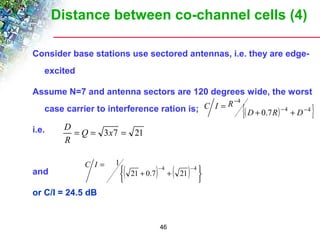
Distance between co-channel cells (4) 
Consider base stations use sectored antennas, i.e. they are edge-excited 
Assume N=7 and antenna sectors are 120 degrees wide, the worst 
case carrier to interference ration is; 
i.e. 
= -4 -4 21 0.7 21 
46 
D 
and 
or C/I = 24.5 dB 
{( ) 4 4 } 
4 
0.7 - - 
- 
+ + 
= 
D R D 
C I R 
= Q = 3x7 = 21 
R 
( ) ( ) þ ý ü 
î í ì 
+ + 
C I 1
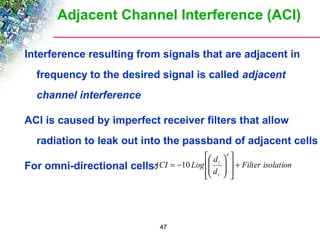
Adjacent Channel Interference (ACI) 
Interference resulting from signals that are adjacent in 
frequency to the desired signal is called adjacent 
channel interference 
ACI is caused by imperfect receiver filters that allow 
radiation to leak out into the passband of adjacent cells 
é 
For omni-directional cells: æ 
ACI Log d 
Filter isolation 
47 
d 
n 
ù 
ö 
i + 
c 
ú ú 
û 
ê ê 
ë 
÷ ÷ø 
ç çè 
= -10
How to Reduce Adjacent Channel 
Interference 
 ACI is a function of the distance between the 
two cells under consideration 
 ACI can be minimized through: 
 careful channel assignment 
48 
 filtering 
 using isolation filters is not the best solution 
 Worst case ACI occurs when one of the mobiles is 
close to the base station and the other is at the edge 
of the cell
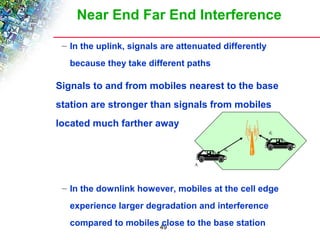
Near End Far End Interference 
– In the uplink, signals are attenuated differently 
because they take different paths 
 Signals to and from mobiles nearest to the base 
station are stronger than signals from mobiles 
located much farther away 
– In the downlink however, mobiles at the cell edge 
experience larger degradation and interference 
compared to mobiles close to the base station 
49 
A 
d1 
d0 
B
Solution to Near Far Effect 
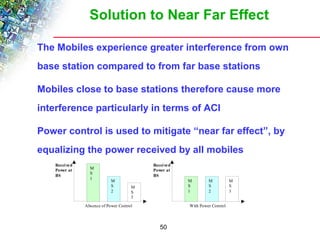
 The Mobiles experience greater interference from own 
base station compared to from far base stations 
 Mobiles close to base stations therefore cause more 
interference particularly in terms of ACI 
 Power control is used to mitigate “near far effect”, by 
equalizing the power received by all mobiles 
50 
Absence of Power Control 
Received 
Power at 
BS 
MS1 
MS2 
MS3 
With Power Control 
Received 
Power at 
BS 
MS1 
MS2 
MS3
Traffic Engineering 
Problems with Connecting Phones with Switches 
 Many switches required - to connect n phones 
together, s = (n-1)*n/2 switches are required 
 slow connection speeds 
 too many regular faults 
 high maintenance costs and cost of switches 
51
Traffic Engineering – Design Objectives 
52 
 Traffic 
 System Capacity 
 Quality of Service
Traffic Engineering - Considerations 
 Design for flexibility and account for low 
and high traffic periods 
 peak traffic period occur sometimes in the 
mornings and afternoons. Low traffic weekends 
 high traffic usually 10 to 20% of total capacity, 
all users need not be directly connected 
 cellular systems depend on trunking to connect 
a large number of users 
53
Trunking 
 In a trunked radio system, each user is allocated a 
channel on a per call basis, and on termination of 
call, previously occupied channel is immediately 
returned to the pool of available channels 
 Therefore a large number of users share a small 
pool of channels in a cell on a per call basis 
 Access is provided to each user on demand 
 When all channels are in use, a new user or 
demand is (denied) blocked 
54
Unit of Traffic - Erlang 
The unit of telephone traffic intensity is called the 
Erlang, in honor of a Danish mathematician 
Definition: One Erlang is one channel occupied 
continuously for one hour. In data communications, 
an 1 E = 64 kbps 
55
How To Estimate Telephone Traffic 
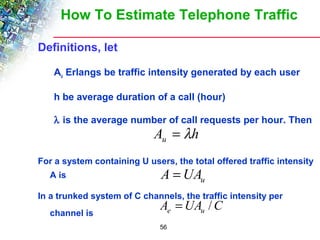
A h u = l 
56 
Definitions, let 
Au Erlangs be traffic intensity generated by each user 
h be average duration of a call (hour) 
l is the average number of call requests per hour. Then 
For a system containing U users, the total offered traffic intensity 
A is 
A =UA 
u In a trunked system of C channels, the traffic intensity per 
A = UA / 
C channel is 
e u
Busy Hour 
The traffic level is an average, taken over several days, 
and over the busiest period. The period is usually 1 
Hour, and average over that hour is called “Busy 
Hour” traffic. 
Example: if the circuit is said to carry 0.6 Erlangs, it will 
be busy, an average, for 0.6 hours (36 min) during the 
busy hour. 
57
Grade of Service (GoS) 
A measure of the performance of a telephone system 
GOS is a measure of the ability of a user to access a 
trunked system during the busiest hour 
Also an indication of the user not being able to secure a 
channel during the busiest hour 
Telephone networks are designed with specified GOS, 
usually for the busiest hour. If a subscriber is able to 
make a call during the busiest hour, he will be able to 
make a call at any other time 
58
Grade of Service (1) 
59 
Definition 
GOS is the probability of having a call blocked during the 
busiest hour. For example, if GOS = 0.05, one call in 20 
will be blocked during the busiest hour because of 
insufficient capacity 
GOS is used to determine the number of channels required; 
GOS could be determined by 
– competition between operators (measure of good service) 
– regulation - a national communication authority might 
decide to impose a grade of service on its operators
Types of Trunked Systems 
Two types of trunked systems are used 
(a) blocked calls cleared (Erlang B, M/M/m queue) 
(b) blocked calls delayed (Erlang C formula) 
Characteristics of Blocked calls Cleared Model 
 Call arrival rate = Poisson (exponential) distribution 
 Infinite number of users 
 Memoryless, channel requests at any time 
 infinite number of channels in pool 
60
Traffic Intensity Models 
 Three traffic intensity model tables are used in 
practice 
 Erlang B tables (blocked calls cleared); can over estimate 
 Engset formula (probability of blocking in low density 
areas); used where Erlang B model fails 
 Erlang C tables (blocked calls delayed or held in queue 
indefinitely) 
 Poisson tables (blocked calls held in queue for a limited 
time only) 
61
Erlang B Formula 
Determines the probability that a call is blocked 
 Is a measure of the GOS for trunked systems with blocked 
calls cleared 
[ ] ! 
Erlang B formula: GOS 
62 
A 
k 
A 
C 
P blocking C 
k 
k 
C 
r = = 
å= 
0 !
Using the Erlang B Table 
The objective is to determine the number of trunks 
required for a given Erlang value and a blockage 
level. Three steps are required: 
 Locate the column with the desired blockage level; 
 While staying in the same column, find the row with 
the desired Erlang value (round off the Erlang value 
as necessary); 
 Find the number of trunks in the selected row (at the 
intersection); 
63
Planning for Cell Capacity 
Assume that in a telephone network the call arrival rate is l calls 
per hour and the mean holding time for a call is tn (hours per call). 
Example: There are 100 subscribers with the following telephone traffic 
profile: 20 make 1 call/hour for 6 minutes; 20 make 3 calls/hour for 
half a minute; 60 make 1 call/hour for 1 minute. The traffic they 
generate is: 
64 
20x1x (6/60) = 2 E 
20x3x(0.5/60) = 0.5 E 
60x1x(1/60) = 1 E 
i.e. a total of 3.5 E. On average, each subscriber generates 35 mE. 
In practice on average telephone subscribers generate between 
25 to 35 mE during the busiest hour
Planning for Cell Capacity 
Example: Use the Erlang B table to compute the number of channels 
required for a cell when the expected number of calls per hour is 3000, 
blocking probability of 2% and the average length of a call is 1.8 
minutes. 
Solution: The offered traffic for this case is A = qxT/60 = 3000x1.8/60 
= 90 Erlangs. Erlang B table indicates that 103 channels 
are required. 
65
Questions and Answers 
66

Thr cellular concept

  • 1.
    Wireless Communications TheCellular Concept Transferring knowledge to future leaders Reference: Professor Johnson I Agbinya (University of the Western Cape)
  • 2.
  • 3.
    History of CellularNetworks Why cellular networks? To address requirement for greater capacity For efficient use of frequency To address the poor quality of non cellular mobile networks and increases coverage – replaces a large transmitter with smaller ones in cells – smaller transmitting power – each cell serves a small geographical service area – each cell is assigned a portion of the total frequency 3
  • 4.
    Description of aCell Approximated to be a hexagonal coverage – best approximation of a circular area Served by a base station – low powered transceiver – antenna system and a – a mast – may be divided into 6 equilateral triangles – length of base of each triangle = 0.5R (radius) – different groups of channels assigned to base stations 4 R R 0.87R 2 3 »
  • 5.
    Mathematical Description ofa Cell Area 6x R x R R R cell = = = 5 Area of a cell is: 2 Perimeter of a cell = 6R 2 2 2.598 3 3 2 2 3 Capacity of network = N x number of users per cell N = number of cells in network – we assumed cells of equal capacity - can differ in practice
  • 6.
    Typical Cellular Network (For a Sparsely Populated Country) 6
  • 7.
  • 8.
    Definitions Definition of‘channel’ depends on the system – frequency (radio station) – frequency band (TV transmissions) – time slot of a frequency (GSM, GPRS) – orthogonal code (CDMA networks) 8
  • 9.
    Structure of aMobile Communication System 9
  • 10.
    Types of MobileCommunication Cells The size of a cell is dictated by capacity demand 10 Macrocell – large, covering a wide area – range of several hundred kilometres (km) to ten km – mostly deployed in rural and sparsely populated areas Microcell – medium cell, coverage area smaller than in macro cells – range of several hundred metres to a couple of metres – deployed mostly in crowded areas, stadiums, shopping malls
  • 11.
    Types of MobileCommunication Cells (1) The size of a cell is dictated by capacity demand 11 Picocell – small, covering a very small area – range of several tens of metres – low power antennas – can be mounted on walls or ceilings – used in densely populated areas, offices, lifts, tunnels etc
  • 12.
    Means of IncreasingCells Capacity There are several approaches for increasing cellular system capacity including: 12 Cell clustering Sectoring of cells Cell splitting Frequency reuse Reduction of adjacent cell interference and co-channel interference
  • 13.
    Cell Structure 13 F1 F2 F3 F1 F2 F3 F3 F2 F4 F1 F1 F2 F3 F5 F4 F6 F7 (a) Line Structure (b) Plan Structure Note: Fx is set of frequency, i.e., frequency group.
  • 14.
    Cell Clusters Serviceareas are normally divided into clusters of cells to facilitate system design and increased capacity 14 Definition a group of cells in which each cell is assigned a different frequency – cell clusters may contain any number of cells, but clusters of 3, 4, 5, 7 and 9 cells are very popular in practice
  • 15.
    Cell Clusters 15 A cluster of 7 cells 2 1 5 7 6 4 3 the pattern of cluster is repeated throughout the network channels are reused within clusters cell clusters are used in frequency planning for the network Coverage area of cluster called a ‘footprint’
  • 16.
    Cell Clusters (1) A network of cell clusters in Cape Town 7 2 16 2 1 5 6 4 3 1 5 7 6 4 3 2 1 5 7 6 4 3 2 1 5 7 6 4 3 2 1 5 7 6 4 7 2 7 1 3 5 6 4 2 1 3 5 6 4 3
  • 17.
    Frequency Plan Intelligentallocation of frequencies used – Each base station is allocated a group of channels to be used within its geographical area of coverage called a ‘cell’ Adjacent cell base stations are assigned completely different channel groups to their neighbors base stations antennas designed to provide just the cell coverage, so frequency reuse is possible 17
  • 18.
    Frequency Reuse Concept Assign to each cluster a group of radio channels to be used within its geographical footprint ensure this group of frequencies is completely different from that assigned to neighbors of the cells Therefore this group of frequencies can be reused in a cell cluster ‘far away’ from this one Cells with the same number have the same sets of frequencies 18
  • 19.
    Frequency Reuse Factor 19 Definition When each cell in a cluster of N cells uses one of N frequencies, the frequency reuse factor is 1/N Frequency reuse is an example of space diversity multiplex access frequency reuse limits adjacent cell interference because cells using same frequencies are separated far from each other
  • 20.
    Factors Affecting FrequencyReuse Factors affecting frequency reuse include: Types of antenna used – omni-directional or sectored placement of base stations coverage for distance (highways) vs area (city) capacity through macro and micro overlays 20
  • 21.
    Excitation of Cells Once a frequency reuse plan is agreed upon overlay the frequency reuse plan on the coverage map and assign frequencies The location of the base station within the cell is referred to as cell excitation In hexagonal cells, base stations transmitters are either: – centre-excited, base station is at the centre of the cell or – edge-excited, base station at 3 of the 6 cell vertices 21
  • 22.
    Frequency Assignment Plan 22 Example S duplex channels S channels divided into N cells Each cell allocated a group of k channels Total # available channels S = k N Replicate a cluster M times in the network Total number of duplex channels, C=MkN=MS
  • 23.
    Characterization of FrequencyReuse 23 F1 F2 F3 F5 F4 F6 F7 F1 F2 F3 F5 F4 F6 F7 F1 Reuse distance D • For hexagonal cells, the reuse distance is given by D = 3NR R where R is cell radius and N is the reuse pattern (the cluster size or the number of cells per cluster). N • Reuse factor is q = D = 3 R Cluster
  • 24.
    Characterization of FrequencyReuse  The cluster size or the number of cells per cluster is given by 24 N = i2 + ij + j2 where i and j are integers. i j 60o
  • 25.
    Finding the NearestCo-Channel (1) Move i cells along any chain of hexagons (2) Turn 600 counter-clockwise and move j cells, to reach the next cell using same frequency sets this distance D is required for a given frequency reuse to provide enough reduced same channel interference i.e. after every distance D we could reuse a set of frequencies in a new cell 25
  • 26.
    Channel Assignment Strategies Three assignment approaches Fixed and static (most common) 26 Dynamic Hybrid Fixed channel assignment all channels in a cell could be in use all the time – new calls are then blocked (no channels left) – may be solved by borrowing spare channels from nearby cells
  • 27.
    Channel Assignment Strategies(1) Dynamic channel assignment MSC allocates frequencies when a call is made Provides high channel utilization To do this it needs real-time information on channel occupancy traffic distribution and radio signal strength indication (RSSI) high computational load and increased storage 27
  • 28.
    Cell Splitting Often large cells need to be split into smaller ones because the population of users in the big cell has increased beyond what it can support Cell splitting increases system capacity Is used in high density subscriber areas (e.g. Water Front) Results to increased costs (e.g.. new base stations) 28
  • 29.
  • 30.
    Handover (Handoff) Providescontinuity of communication across cells 30 Difficulty dropping a call before reconnecting is unacceptable different cells use different frequencies mobile phone users usually move from place to place and very quickly too therefore the current location of the mobile phone must somehow be known and kept
  • 31.
    Handover Process Partiesin communication share the same channels Received signal weakens as mobile moves out of cell Cell site at some point requests handover to cell with stronger signal strength MSC switches call to new cell after allocating channels, and informing the two mobiles of the new channels (voice and control channels) 31
  • 32.
    Handover Process (1) 32 BS1 BS2 BS3 PSTN MSC Trunks
  • 33.
    Handover Process (2) Handover must not be too frequent or system is kept busy servicing handover requests handover threshold is set with the above in mind Minimum usable signal level is normally set to be between -90 dBm and -100 dBm 33
  • 34.
  • 35.
    Choosing Handover Margins 35 Handover margin D D = P r handover - Pr minimum usable If D is too large unnecessary handover will occur, burdening the MSC If D is too small, there maybe insufficient time to complete the handover before a call is lost due to weak signals Therefore D is chosen carefully
  • 36.
    Interference Sources inMobile Networks Interference comes from many sources: 36 Multipath Mobile phones in the same cell Other users in neighboring cells Environmental effects base stations operating at the same frequencies Radiation leakage from other sources into the mobile communication band
  • 37.
    Types of ChannelInterference Interference is either system or environment related. System capacity as affected by interference related to the frequency channel used by a cellular system is treated in this lecture. The critical ones are: Co-channel interference Adjacent channel interference (ACI) Near end Far end interference MAI 37 Inter cell interference Intra cell interference Adjacent channel interference Co-channel interference
  • 38.
    Capacity and Co-ChannelInterference 38 Definition Interference from co-channel cells is called co-channel interference. Such cells use identical frequencies or channels – Independent of transmitted power for cells of same size – Is a function of the radius (R) of cell and distance (D) to co-channel cell – Cannot be overcome by increased transmission power – Overcome by separating such cells by a required minimum distance - by increasing the ratio Q = D/R, where Q is the co-channel reuse ratio
  • 39.
    Capacity and Co-ChannelInterference (1) Desired Signal 39 For hexagonal cells: N Q = D = 3 R i 0 å= = 1 i I i SIR where SIR=signal to interference ratio and Ii is the interference from ith co-channel cell
  • 40.
    Capacity and Co-ChannelInterference (2) For 6 interfering cells, carrier to interference ratio C/I is C I = {R} -a {6D-a } If they are equidistant from the cell of interest then C I = 1/{6(D R) -a } RF power decreases with inverse power of distance Decay of received power with distance is given as: where, d0 is reference distance, P0 is Prec at d0 and a is the path loss exponent and lies between 2 and 5 for urban areas 40
  • 41.
    Effects of Qon Capacity A small value of Q is desirable for larger capacity. This means a small value of N (small clusters) A large value of Q improves transmission quality due to small values of co-channel interference In practice the value of Q is a trade off between capacity and transmission quality 41
  • 42.
    Relationship Between Qand SIR n å= - S n is the path loss exponent Assume all interfering base stations are equidistant (D) from desired base station, then S n n N D R ( / ) ( 3 ) i r = = For a hexagonal-shaped cell, i0 = 6, D = Di, and Q = D/R S = Q =æ S n 42 - = 0 1 i i n i r D R I 0 0 i I n r Q I 6 r ö I çè 1 6 ÷ø
  • 43.
    Distance between co-channelcells 43 D D-R/2 D-R D-R D+R D+R/2
  • 44.
    Distance between co-channelcells (1) Assume a reuse ratio of 7 and cells are equidistant from the cell in centre. The separations between the 6 outer cells and the inner one are approx. D+R, D- R, D, D - R/2 and D+ R/2, and CI is approximately: R - = = å0 2 2 2 ( ) n ( ) n n n R S Let n = 4 and Q=D/R, then 1 = I Q Q Q 44 n i i n i r D R D R D D I - - - = - - - + + + 1 2( - 1) - 4 + 2( + 1) - 4 + 2 - 4 Sr
  • 45.
    Distance between co-channelcells (3) Assume in this case the base station is centre-excited The all 6 other co-channel interfering cells are D metres away from it, and D2 = 3R2 (i2 + ij + j 2 ) Area of first-tier circle is Area of circle surrounding inner cell at centre is Ratio of areas is equal to the number of cells that can be fitted into the first-tier of cells and is: i ij j D A l e 3 3 2 – Omnidirectional cells interfere with all their co-channel neighbors – interference is reduced by sectoring 45 ( 2 ) 2 ( 2 2 ) arg A k D 3R i ij j l e = = + + A k(R2 ) small = ( ) N R A small 2 arg = 2 + + 2 = =
  • 46.
    Distance between co-channelcells (4) Consider base stations use sectored antennas, i.e. they are edge-excited Assume N=7 and antenna sectors are 120 degrees wide, the worst case carrier to interference ration is; i.e. = -4 -4 21 0.7 21 46 D and or C/I = 24.5 dB {( ) 4 4 } 4 0.7 - - - + + = D R D C I R = Q = 3x7 = 21 R ( ) ( ) þ ý ü î í ì + + C I 1
  • 47.
    Adjacent Channel Interference(ACI) Interference resulting from signals that are adjacent in frequency to the desired signal is called adjacent channel interference ACI is caused by imperfect receiver filters that allow radiation to leak out into the passband of adjacent cells é For omni-directional cells: æ ACI Log d Filter isolation 47 d n ù ö i + c ú ú û ê ê ë ÷ ÷ø ç çè = -10
  • 48.
    How to ReduceAdjacent Channel Interference ACI is a function of the distance between the two cells under consideration ACI can be minimized through: careful channel assignment 48 filtering using isolation filters is not the best solution Worst case ACI occurs when one of the mobiles is close to the base station and the other is at the edge of the cell
  • 49.
    Near End FarEnd Interference – In the uplink, signals are attenuated differently because they take different paths Signals to and from mobiles nearest to the base station are stronger than signals from mobiles located much farther away – In the downlink however, mobiles at the cell edge experience larger degradation and interference compared to mobiles close to the base station 49 A d1 d0 B
  • 50.
    Solution to NearFar Effect The Mobiles experience greater interference from own base station compared to from far base stations Mobiles close to base stations therefore cause more interference particularly in terms of ACI Power control is used to mitigate “near far effect”, by equalizing the power received by all mobiles 50 Absence of Power Control Received Power at BS MS1 MS2 MS3 With Power Control Received Power at BS MS1 MS2 MS3
  • 51.
    Traffic Engineering Problemswith Connecting Phones with Switches Many switches required - to connect n phones together, s = (n-1)*n/2 switches are required slow connection speeds too many regular faults high maintenance costs and cost of switches 51
  • 52.
    Traffic Engineering –Design Objectives 52 Traffic System Capacity Quality of Service
  • 53.
    Traffic Engineering -Considerations Design for flexibility and account for low and high traffic periods peak traffic period occur sometimes in the mornings and afternoons. Low traffic weekends high traffic usually 10 to 20% of total capacity, all users need not be directly connected cellular systems depend on trunking to connect a large number of users 53
  • 54.
    Trunking Ina trunked radio system, each user is allocated a channel on a per call basis, and on termination of call, previously occupied channel is immediately returned to the pool of available channels Therefore a large number of users share a small pool of channels in a cell on a per call basis Access is provided to each user on demand When all channels are in use, a new user or demand is (denied) blocked 54
  • 55.
    Unit of Traffic- Erlang The unit of telephone traffic intensity is called the Erlang, in honor of a Danish mathematician Definition: One Erlang is one channel occupied continuously for one hour. In data communications, an 1 E = 64 kbps 55
  • 56.
    How To EstimateTelephone Traffic A h u = l 56 Definitions, let Au Erlangs be traffic intensity generated by each user h be average duration of a call (hour) l is the average number of call requests per hour. Then For a system containing U users, the total offered traffic intensity A is A =UA u In a trunked system of C channels, the traffic intensity per A = UA / C channel is e u
  • 57.
    Busy Hour Thetraffic level is an average, taken over several days, and over the busiest period. The period is usually 1 Hour, and average over that hour is called “Busy Hour” traffic. Example: if the circuit is said to carry 0.6 Erlangs, it will be busy, an average, for 0.6 hours (36 min) during the busy hour. 57
  • 58.
    Grade of Service(GoS) A measure of the performance of a telephone system GOS is a measure of the ability of a user to access a trunked system during the busiest hour Also an indication of the user not being able to secure a channel during the busiest hour Telephone networks are designed with specified GOS, usually for the busiest hour. If a subscriber is able to make a call during the busiest hour, he will be able to make a call at any other time 58
  • 59.
    Grade of Service(1) 59 Definition GOS is the probability of having a call blocked during the busiest hour. For example, if GOS = 0.05, one call in 20 will be blocked during the busiest hour because of insufficient capacity GOS is used to determine the number of channels required; GOS could be determined by – competition between operators (measure of good service) – regulation - a national communication authority might decide to impose a grade of service on its operators
  • 60.
    Types of TrunkedSystems Two types of trunked systems are used (a) blocked calls cleared (Erlang B, M/M/m queue) (b) blocked calls delayed (Erlang C formula) Characteristics of Blocked calls Cleared Model Call arrival rate = Poisson (exponential) distribution Infinite number of users Memoryless, channel requests at any time infinite number of channels in pool 60
  • 61.
    Traffic Intensity Models Three traffic intensity model tables are used in practice Erlang B tables (blocked calls cleared); can over estimate Engset formula (probability of blocking in low density areas); used where Erlang B model fails Erlang C tables (blocked calls delayed or held in queue indefinitely) Poisson tables (blocked calls held in queue for a limited time only) 61
  • 62.
    Erlang B Formula Determines the probability that a call is blocked Is a measure of the GOS for trunked systems with blocked calls cleared [ ] ! Erlang B formula: GOS 62 A k A C P blocking C k k C r = = å= 0 !
  • 63.
    Using the ErlangB Table The objective is to determine the number of trunks required for a given Erlang value and a blockage level. Three steps are required: Locate the column with the desired blockage level; While staying in the same column, find the row with the desired Erlang value (round off the Erlang value as necessary); Find the number of trunks in the selected row (at the intersection); 63
  • 64.
    Planning for CellCapacity Assume that in a telephone network the call arrival rate is l calls per hour and the mean holding time for a call is tn (hours per call). Example: There are 100 subscribers with the following telephone traffic profile: 20 make 1 call/hour for 6 minutes; 20 make 3 calls/hour for half a minute; 60 make 1 call/hour for 1 minute. The traffic they generate is: 64 20x1x (6/60) = 2 E 20x3x(0.5/60) = 0.5 E 60x1x(1/60) = 1 E i.e. a total of 3.5 E. On average, each subscriber generates 35 mE. In practice on average telephone subscribers generate between 25 to 35 mE during the busiest hour
  • 65.
    Planning for CellCapacity Example: Use the Erlang B table to compute the number of channels required for a cell when the expected number of calls per hour is 3000, blocking probability of 2% and the average length of a call is 1.8 minutes. Solution: The offered traffic for this case is A = qxT/60 = 3000x1.8/60 = 90 Erlangs. Erlang B table indicates that 103 channels are required. 65
  • 66.