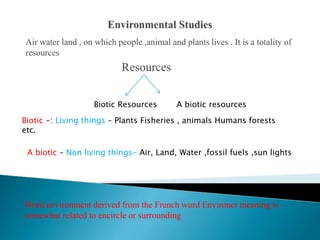
Air water land , on which people ,animal and plants lives . It is a totality of
resources
Resources
Biotic Resources A biotic resources
Biotic -: Living things – Plants Fisheries , animals Humans forests
etc.
A biotic – Non living things- Air, Land, Water ,fossil fuels ,sun lights
Word environment derived from the French word Environer meaning is
somewhat related to encircle or surrounding
Definition: Every organism in this earth is surrounded by a lot of things
;say other organism plants water air light land etc.
These surroundings of the organism , all the living and non living things
constitute its environment
Environment can be defined as the natural surroundings of that organism which
directly or indirectly influences the growth and development of organism
Environment is defined as the surrounding in which an organization operates
including air ,water land and natural resources ,flora humans and their inter
relations
Environment is the sum
Total of all living and non living factors that compose the
surrounding of man
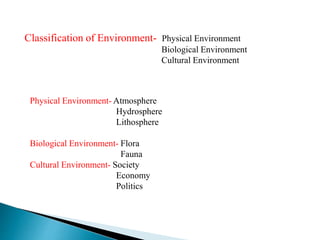
Classification of Environment- Physical Environment
Biological Environment
Cultural Environment
Physical Environment- Atmosphere
Hydrosphere
Lithosphere
Biological Environment- Flora
Fauna
Cultural Environment- Society
Economy
Politics
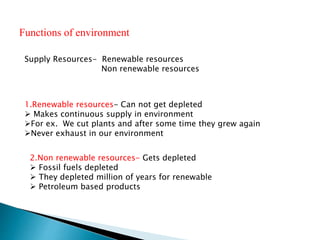
Functions of environment
Supply Resources- Renewable resources
Non renewable resources
1.Renewable resources- Can not get depleted
 Makes continuous supply in environment
For ex. We cut plants and after some time they grew again
Never exhaust in our environment
2.Non renewable resources- Gets depleted
 Fossil fuels depleted
 They depleted million of years for renewable
 Petroleum based products
3. Provides Bio-diversity
Habitat
 Environment provide habitat for living
 EX. Animals lives in forest
 Environment provide land for living humans
 Sustain life
4. Provide aesthetics resources – Something which is related
to beauty
like sceneries
5. Assimilates waste-
Collect and process waste
Multidisciplinary nature of the environmental studies-
The science of the environment studies is a multidisciplinary science
because it depends on various disciplines like-
Physics
Chemistry
Medical sciences
Environmental science etc.
This is not only depends scientific studies otherwise it is also depends
upon the non scientific studies like-
Law
Social Science
Economics etc.
Sustainable Development-
Phrase : We do not inherit the earth from our ancestors , we have
borrowed it from our children
Hand it over
Take care earth
Better environment for future generation
Strategies for sustainable development-
1. Use of non conventional resources
2. LPG and Goober gas in rural area
3. CNG in urban area
4. Wind power
5. Solar power through photovoltaic cell
6. Mini hydel plants
7. Traditional knowledge and practices – Without using chemicals
8. Bio-composting
9. Bio-pest control
Bio sphere - Hydrosphere
Lithosphere
Atmosphere
14 km area
6 km above the earth and 8 km below the earth or 8 km below from sea level
Atmosphere
Lithosphere
Hydrosphere
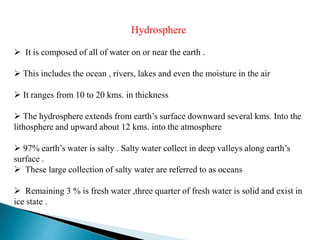
Hydrosphere
 It is composed of all of water on or near the earth .
 This includes the ocean , rivers, lakes and even the moisture in the air
 It ranges from 10 to 20 kms. in thickness
 The hydrosphere extends from earth’s surface downward several kms. Into the
lithosphere and upward about 12 kms. into the atmosphere
 97% earth’s water is salty . Salty water collect in deep valleys along earth’s
surface .
 These large collection of salty water are referred to as oceans
 Remaining 3 % is fresh water ,three quarter of fresh water is solid and exist in
ice state .
Lithosphere
 Contains all of the cold hard , solid land of the planet’s crust
 semi solid land underneath the crust and the liquid land near the crust of
the planet.
 It composed of soil particles and the underlying rocks down to a depth of
50 kms.
 Soil layer is also referred to as the pedosphere a mixture of inorganic and
organic solid matter air, water and micro-organism .
 Crust average thickness 100 kms
 Crust is called Sial – Silicon and aluminum
 Downward 2900 kms – Lower mantle layer
Si, Fe, mg – Melted form
 Downward 350 kms- Metal core
Ni, Fe- In melted form at 2000 degree c
Atmosphere
The atmosphere surrounds earth and protects us by blocking out dangerous rays
from the sun .
The atmosphere is a mixture of gases that becomes thinner until it gradually
reaches space
It is composed of N2 78% ,Oxygen 21% and other gases 1% like Al Co2
Earth atmosphere contains several different layers that can be defined according to
air temperature
According to temperature the atmosphere contains four different layers
Atmosphere
Troposphere Stratosphere Mesosphere Thermosphere
Troposphere
Area above 11 kms from earths surface
Stratosphere
Upward 11 to 49 kms
Mesosphere
Above 49 to 95 kms
Ozone layer 32-60 kms- Ozonosphere
Thermosphere
Above or upward 95 to 500000kms.
Eco-System - Greek word Oikos- Home
Logos-Study
 A biotic community lives in abiotic environment called biotope
Biotope provides materials as well as energy to bio community in
habiting it.
 This show there is an interaction between biotic community and
it environment
 This biotic community and its biotope together = Ecological
system
or ecology
 Term Ecosystem- 1935 AG Tensely
Structure of Ecosystem- Adom divided ecosystem into two main
components - Biotic component
Abiotic component
Biotic component:
 Auto tropic component
Self feeder
Producer
ex. Green plants
 Hetro tropic component
Other feeder – Depend others
Consumer
Macro consumer Micro consumer
1.Macro consumer- Which eat producers directly or indirectly
Primary consumers – Consumer of first order
Ex- Cow Goat Rabbit (Harbiviours)
Secondary consumer- feed on harbiviours and omniviours
Tertiory consumer- Consumer of third order
Ex- Lion, Tiger
Parasite (Living plants tissues) and Scavengers (Animals – Consume dead
animals and plants )
2. Micro consumers- Decomposers , Saprotropes –feed from dead organism
Abiotic component:
 Inorganic component – C, H2,O2, P etc.
 Organic component- Carbohydrates , Protein , Nucleac acid
 Climate edaphic factor- Light temperature and humidity are climate conditions
and edaphic factor are related to soil structure
Functions of Eco-system
Primary Function Secondary function Tertiary Function
Primary Function
To manufacture food by photo synthesis i.e. productivity
Secondary Function
To distribute energy to all consumers in the form of food i.e. energy law
Tertiary Function
All living organism die , these dead systems are decomposed – Material cycling
THANK YOU
Harish Kumar
Assistant Professor
Deptt. Of Mechanical
Engineering
TMU Moradabad

Ppt unit 1.1 tmu101

  • 1.
    Air water land, on which people ,animal and plants lives . It is a totality of resources Resources Biotic Resources A biotic resources Biotic -: Living things – Plants Fisheries , animals Humans forests etc. A biotic – Non living things- Air, Land, Water ,fossil fuels ,sun lights Word environment derived from the French word Environer meaning is somewhat related to encircle or surrounding
  • 2.
    Definition: Every organismin this earth is surrounded by a lot of things ;say other organism plants water air light land etc. These surroundings of the organism , all the living and non living things constitute its environment Environment can be defined as the natural surroundings of that organism which directly or indirectly influences the growth and development of organism Environment is defined as the surrounding in which an organization operates including air ,water land and natural resources ,flora humans and their inter relations Environment is the sum Total of all living and non living factors that compose the surrounding of man
  • 3.
    Classification of Environment-Physical Environment Biological Environment Cultural Environment Physical Environment- Atmosphere Hydrosphere Lithosphere Biological Environment- Flora Fauna Cultural Environment- Society Economy Politics
  • 4.
    Functions of environment SupplyResources- Renewable resources Non renewable resources 1.Renewable resources- Can not get depleted  Makes continuous supply in environment For ex. We cut plants and after some time they grew again Never exhaust in our environment 2.Non renewable resources- Gets depleted  Fossil fuels depleted  They depleted million of years for renewable  Petroleum based products
  • 5.
    3. Provides Bio-diversity Habitat Environment provide habitat for living  EX. Animals lives in forest  Environment provide land for living humans  Sustain life 4. Provide aesthetics resources – Something which is related to beauty like sceneries 5. Assimilates waste- Collect and process waste
  • 6.
    Multidisciplinary nature ofthe environmental studies- The science of the environment studies is a multidisciplinary science because it depends on various disciplines like- Physics Chemistry Medical sciences Environmental science etc. This is not only depends scientific studies otherwise it is also depends upon the non scientific studies like- Law Social Science Economics etc.
  • 7.
    Sustainable Development- Phrase :We do not inherit the earth from our ancestors , we have borrowed it from our children Hand it over Take care earth Better environment for future generation Strategies for sustainable development- 1. Use of non conventional resources 2. LPG and Goober gas in rural area 3. CNG in urban area 4. Wind power 5. Solar power through photovoltaic cell 6. Mini hydel plants 7. Traditional knowledge and practices – Without using chemicals 8. Bio-composting 9. Bio-pest control
  • 8.
    Bio sphere -Hydrosphere Lithosphere Atmosphere 14 km area 6 km above the earth and 8 km below the earth or 8 km below from sea level Atmosphere Lithosphere Hydrosphere
  • 9.
    Hydrosphere  It iscomposed of all of water on or near the earth .  This includes the ocean , rivers, lakes and even the moisture in the air  It ranges from 10 to 20 kms. in thickness  The hydrosphere extends from earth’s surface downward several kms. Into the lithosphere and upward about 12 kms. into the atmosphere  97% earth’s water is salty . Salty water collect in deep valleys along earth’s surface .  These large collection of salty water are referred to as oceans  Remaining 3 % is fresh water ,three quarter of fresh water is solid and exist in ice state .
  • 10.
    Lithosphere  Contains allof the cold hard , solid land of the planet’s crust  semi solid land underneath the crust and the liquid land near the crust of the planet.  It composed of soil particles and the underlying rocks down to a depth of 50 kms.  Soil layer is also referred to as the pedosphere a mixture of inorganic and organic solid matter air, water and micro-organism .  Crust average thickness 100 kms  Crust is called Sial – Silicon and aluminum  Downward 2900 kms – Lower mantle layer Si, Fe, mg – Melted form  Downward 350 kms- Metal core Ni, Fe- In melted form at 2000 degree c
  • 11.
    Atmosphere The atmosphere surroundsearth and protects us by blocking out dangerous rays from the sun . The atmosphere is a mixture of gases that becomes thinner until it gradually reaches space It is composed of N2 78% ,Oxygen 21% and other gases 1% like Al Co2 Earth atmosphere contains several different layers that can be defined according to air temperature According to temperature the atmosphere contains four different layers
  • 12.
    Atmosphere Troposphere Stratosphere MesosphereThermosphere Troposphere Area above 11 kms from earths surface Stratosphere Upward 11 to 49 kms Mesosphere Above 49 to 95 kms Ozone layer 32-60 kms- Ozonosphere Thermosphere Above or upward 95 to 500000kms.
  • 13.
    Eco-System - Greekword Oikos- Home Logos-Study  A biotic community lives in abiotic environment called biotope Biotope provides materials as well as energy to bio community in habiting it.  This show there is an interaction between biotic community and it environment  This biotic community and its biotope together = Ecological system or ecology  Term Ecosystem- 1935 AG Tensely
  • 14.
    Structure of Ecosystem-Adom divided ecosystem into two main components - Biotic component Abiotic component Biotic component:  Auto tropic component Self feeder Producer ex. Green plants  Hetro tropic component Other feeder – Depend others Consumer Macro consumer Micro consumer
  • 15.
    1.Macro consumer- Whicheat producers directly or indirectly Primary consumers – Consumer of first order Ex- Cow Goat Rabbit (Harbiviours) Secondary consumer- feed on harbiviours and omniviours Tertiory consumer- Consumer of third order Ex- Lion, Tiger Parasite (Living plants tissues) and Scavengers (Animals – Consume dead animals and plants ) 2. Micro consumers- Decomposers , Saprotropes –feed from dead organism
  • 16.
    Abiotic component:  Inorganiccomponent – C, H2,O2, P etc.  Organic component- Carbohydrates , Protein , Nucleac acid  Climate edaphic factor- Light temperature and humidity are climate conditions and edaphic factor are related to soil structure Functions of Eco-system Primary Function Secondary function Tertiary Function
  • 17.
    Primary Function To manufacturefood by photo synthesis i.e. productivity Secondary Function To distribute energy to all consumers in the form of food i.e. energy law Tertiary Function All living organism die , these dead systems are decomposed – Material cycling
  • 18.
    THANK YOU Harish Kumar AssistantProfessor Deptt. Of Mechanical Engineering TMU Moradabad