Multiprocessor Architecture for Image processing Mayank Kumar – 2006EE10331 Pushpendre Rastogi – 2006EE50412 Under the guidance of  Dr.Anshul Kumar
Objectives To learn to work on FPGA platform. Learning the design philosophy of a soft core  multiprocessor architecture.  Using multiprocessor architecture to implement adaptive background mixture model  for motion segmentation. i.e Background modeling and change detection algorithm. (Cris stauffer)
Motivation Signal processing, especially Image processing involves repetitive computation which can easily be divided into parallel computations  There are many algorithm that follows “locally sequential globally parallel” computation.  Surveillance camera related processing need economic real time solutions.  FPGA provides an easy way to alter design depending on algorithm requirements – making soft multicore processing feasible. Architecture of the Processing Elements (PE) could be optimized for image processing.
Adaptive background mixture model The algorithm helps to generate an adaptive model for the background and helps in motion detection.  This can be applied for surveillance.  The algorithm is spatially parallel, thus computations for different part of the image can be done  simultaneously.  This will help in real time operation of this algorithm on embedded platform.
Nature of parallelism  Data Partitioning:  The task is partitioned so that each processor performs exactly the same function, but on different sub-blocks of data. For different image regions, our chosen algorithm is sequential in nature, which can be efficiently implemented through a processor.
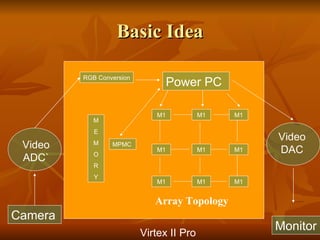
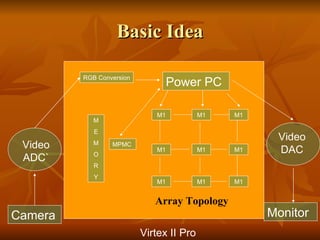
Basic Idea Camera Video ADC` Virtex II Pro RGB Conversion Power PC M1 M1 M1 M1 M1 M1 M1 M1 M1 M E M O R Y Video DAC MPMC Monitor Array Topology
Inter-processor Communication  [12] For transferring large chunks of image data, we will be using shared external DDR Ram as It provides large memory space for storing multiple frames.  Multiple processors can access the RAM simultaneously using MPMC.  For sharing intermediate computation results we will use FSL Links between neighboring processors.  Unidirectional point-to-point communication. Unshared non-arbitrated communication mechanism.  FIFO based communication.
Network Topology  [1] Completely meshed:  Each node is connected to all other nodes. Adv: Reduce inter processor communication time. Disadvantage: Max 9 processors possible. Ring Network : Star Network Array Network:  (our choice)
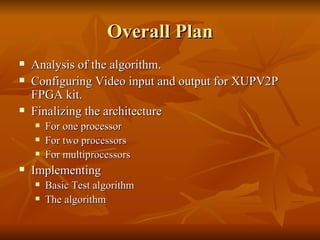
Overall Plan Analysis of the algorithm. Configuring Video input and output for XUPV2P FPGA kit. Finalizing the architecture For one processor For two processors For multiprocessors Implementing  Basic Test algorithm The algorithm
Work Done Studied Background mixture Model for foreground subtraction algorithm  [2], [3] , as a case study. Analysis of the algorithm for: Parallelism exploitation Length of code for implementation Memory requirements to store data. Feasibility
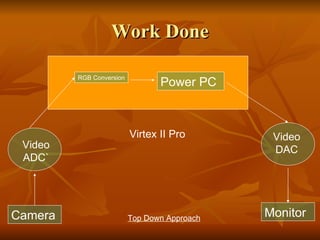
Work Done Camera Video ADC` Virtex II Pro RGB Conversion Power PC Video DAC Monitor Top Down Approach
Work Done Studied Microblaze architecture.  [4]   Studied FSL Link  [5] PLB, LMB, OPB Buses  [6]   XPS Design Flow  [7] Literary survey on related works  [8],[9], [10], [11] Configuration Video input and output for XUPV2P FPGA kit. Bottom Up Approach
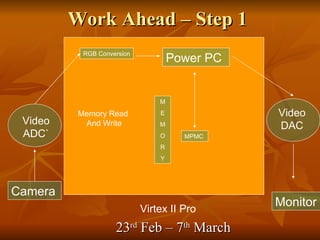
Work Ahead – Step 1  Camera Video ADC` Virtex II Pro RGB Conversion Power PC M E M O R Y Video DAC MPMC Monitor Memory Read  And Write 23 rd  Feb – 7 th  March
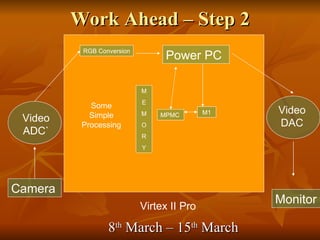
Work Ahead – Step 2 Camera Video ADC` Virtex II Pro RGB Conversion Power PC M1 M E M O R Y Video DAC MPMC Monitor Some Simple Processing 8 th  March – 15 th  March
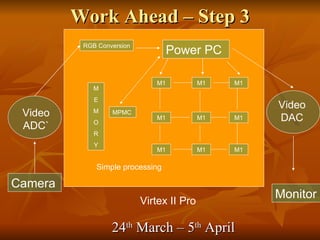
Work Ahead – Step 3 Camera Video ADC` Virtex II Pro RGB Conversion Power PC M1 M1 M1 M1 M1 M1 M1 M1 M1 M E M O R Y Video DAC MPMC Monitor Simple processing 24 th  March – 5 th  April
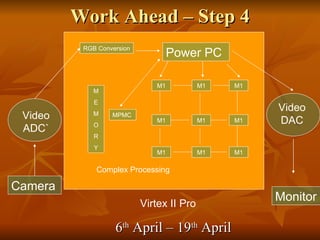
Work Ahead – Step 4 Camera Video ADC` Virtex II Pro RGB Conversion Power PC M1 M1 M1 M1 M1 M1 M1 M1 M1 M E M O R Y Video DAC MPMC Monitor Complex Processing 6 th  April – 19 th  April
Time Line Step 1 – 23 rd  Feb – 7 th  March Step 2 – 8 th  March – 15 th  March Step 3 – 24 th  March – 5 th  April Step 4 – 6 th  April – 19 th  April
Related Works Design Development and performance evaluation of multiprocessor system on FPGA.  Somen Barma, CSE IITD.  [8].  A Microblaze based Multiprocessor SoC[1] An FPGA based soft multiprocessor system for IPv4 packet forwarding. [9] An automated framework for FPGA based soft Multiprocessor System. [10] Multiprocessor interconnection based on DMA for FPGA.[11]
REFERENCES [1] A Microblaze based Multiprocessor SOC – 2003 [2] Adaptive background mixture model for real-time tracking – 1999 [3] Understanding background mixture model for foreground segmentation – 2002 [4] Microblaze processor reference guide [5] Xilinx FSL datasheet [6] Xilinx Microblaze bus interface (ppt) [7] Virtex II Pro design flow – getting started [8] Design Development and performance evaluation of multiprocessor system on FPGA.  Somen Barma, CSE IITD.  Under Prof Kolin Paul [9] An FPGA based soft multiprocessor system for IPv4 packet forwarding.  [10] An automated framework for FPGA based soft Multiprocessor System.  [11] Multiprocessor interconnection based on DMA for FPGA. [12] XPS White paper – Designing multiprocessor System on Platform Stdio.  Visit  www.cse.iiitd.ernet.in/~ee5060412

Multiprocessor Architecture for Image Processing

  • 1.
    Multiprocessor Architecture forImage processing Mayank Kumar – 2006EE10331 Pushpendre Rastogi – 2006EE50412 Under the guidance of Dr.Anshul Kumar
  • 2.
    Objectives To learnto work on FPGA platform. Learning the design philosophy of a soft core multiprocessor architecture. Using multiprocessor architecture to implement adaptive background mixture model for motion segmentation. i.e Background modeling and change detection algorithm. (Cris stauffer)
  • 3.
    Motivation Signal processing,especially Image processing involves repetitive computation which can easily be divided into parallel computations There are many algorithm that follows “locally sequential globally parallel” computation. Surveillance camera related processing need economic real time solutions. FPGA provides an easy way to alter design depending on algorithm requirements – making soft multicore processing feasible. Architecture of the Processing Elements (PE) could be optimized for image processing.
  • 4.
    Adaptive background mixturemodel The algorithm helps to generate an adaptive model for the background and helps in motion detection. This can be applied for surveillance. The algorithm is spatially parallel, thus computations for different part of the image can be done simultaneously. This will help in real time operation of this algorithm on embedded platform.
  • 5.
    Nature of parallelism Data Partitioning: The task is partitioned so that each processor performs exactly the same function, but on different sub-blocks of data. For different image regions, our chosen algorithm is sequential in nature, which can be efficiently implemented through a processor.
  • 6.
    Basic Idea CameraVideo ADC` Virtex II Pro RGB Conversion Power PC M1 M1 M1 M1 M1 M1 M1 M1 M1 M E M O R Y Video DAC MPMC Monitor Array Topology
  • 7.
    Basic Idea CameraVideo ADC` Virtex II Pro RGB Conversion Power PC M1 M1 M1 M1 M1 M1 M1 M1 M1 M E M O R Y Video DAC MPMC Monitor Array Topology
  • 8.
    Inter-processor Communication [12] For transferring large chunks of image data, we will be using shared external DDR Ram as It provides large memory space for storing multiple frames. Multiple processors can access the RAM simultaneously using MPMC. For sharing intermediate computation results we will use FSL Links between neighboring processors. Unidirectional point-to-point communication. Unshared non-arbitrated communication mechanism. FIFO based communication.
  • 9.
    Network Topology [1] Completely meshed: Each node is connected to all other nodes. Adv: Reduce inter processor communication time. Disadvantage: Max 9 processors possible. Ring Network : Star Network Array Network: (our choice)
  • 10.
    Overall Plan Analysisof the algorithm. Configuring Video input and output for XUPV2P FPGA kit. Finalizing the architecture For one processor For two processors For multiprocessors Implementing Basic Test algorithm The algorithm
  • 11.
    Work Done StudiedBackground mixture Model for foreground subtraction algorithm [2], [3] , as a case study. Analysis of the algorithm for: Parallelism exploitation Length of code for implementation Memory requirements to store data. Feasibility
  • 12.
    Work Done CameraVideo ADC` Virtex II Pro RGB Conversion Power PC Video DAC Monitor Top Down Approach
  • 13.
    Work Done StudiedMicroblaze architecture. [4] Studied FSL Link [5] PLB, LMB, OPB Buses [6] XPS Design Flow [7] Literary survey on related works [8],[9], [10], [11] Configuration Video input and output for XUPV2P FPGA kit. Bottom Up Approach
  • 14.
    Work Ahead –Step 1 Camera Video ADC` Virtex II Pro RGB Conversion Power PC M E M O R Y Video DAC MPMC Monitor Memory Read And Write 23 rd Feb – 7 th March
  • 15.
    Work Ahead –Step 2 Camera Video ADC` Virtex II Pro RGB Conversion Power PC M1 M E M O R Y Video DAC MPMC Monitor Some Simple Processing 8 th March – 15 th March
  • 16.
    Work Ahead –Step 3 Camera Video ADC` Virtex II Pro RGB Conversion Power PC M1 M1 M1 M1 M1 M1 M1 M1 M1 M E M O R Y Video DAC MPMC Monitor Simple processing 24 th March – 5 th April
  • 17.
    Work Ahead –Step 4 Camera Video ADC` Virtex II Pro RGB Conversion Power PC M1 M1 M1 M1 M1 M1 M1 M1 M1 M E M O R Y Video DAC MPMC Monitor Complex Processing 6 th April – 19 th April
  • 18.
    Time Line Step1 – 23 rd Feb – 7 th March Step 2 – 8 th March – 15 th March Step 3 – 24 th March – 5 th April Step 4 – 6 th April – 19 th April
  • 19.
    Related Works DesignDevelopment and performance evaluation of multiprocessor system on FPGA. Somen Barma, CSE IITD. [8]. A Microblaze based Multiprocessor SoC[1] An FPGA based soft multiprocessor system for IPv4 packet forwarding. [9] An automated framework for FPGA based soft Multiprocessor System. [10] Multiprocessor interconnection based on DMA for FPGA.[11]
  • 20.
    REFERENCES [1] AMicroblaze based Multiprocessor SOC – 2003 [2] Adaptive background mixture model for real-time tracking – 1999 [3] Understanding background mixture model for foreground segmentation – 2002 [4] Microblaze processor reference guide [5] Xilinx FSL datasheet [6] Xilinx Microblaze bus interface (ppt) [7] Virtex II Pro design flow – getting started [8] Design Development and performance evaluation of multiprocessor system on FPGA. Somen Barma, CSE IITD. Under Prof Kolin Paul [9] An FPGA based soft multiprocessor system for IPv4 packet forwarding. [10] An automated framework for FPGA based soft Multiprocessor System. [11] Multiprocessor interconnection based on DMA for FPGA. [12] XPS White paper – Designing multiprocessor System on Platform Stdio. Visit www.cse.iiitd.ernet.in/~ee5060412