Title: RT Linux
Seyed Navid Ashrafi
Telecommunication Networks Group
Technische Universität Berlin
Summer Semester 2018
35-minute presentation
NES SS2018 1
Over view
>> Introduction to RTOS
- Definitions and history
- Usages & requirements
NES SS2018 2
>> PREEMPT_RT patch
- Overview
- Features
>> Latency measurement test
>> Conclusion
>> Different approaches
- Xenomai
- PREEMPT_RT
- Cons & pros
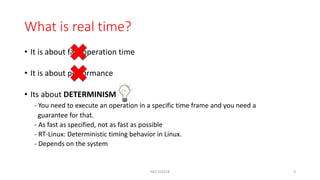
What is real time?
• It is about fast operation time
• It is about performance
• Its about DETERMINISM
- You need to execute an operation in a specific time frame and you need a
guarantee for that.
- As fast as specified, not as fast as possible
- RT-Linux: Deterministic timing behavior in Linux.
- Depends on the system
NES SS2018 3
Usage and requirements of RT-Linux
• Usages:
- Industrial applications
- Multimedia systems
- Aerospace system
- Automative
- Financial services
• Requirements:
- Deterministic timing behavior
- Preemption
- priority inheritance
NES SS2018 4
Soft Realtime??
• It is in contrast with deterministic behavior
• We concentrate on 100% and 95% hard RT.
• 100% hard RT: Realtime requirements should be met 100% otherwise
it will lead to an error condition (industry)
• 95% hard RT: Realtime requirements should be met 95% (data
collection)
NES SS2018 5
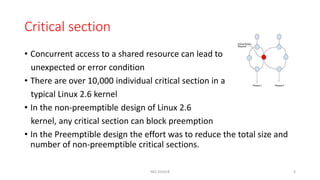
Critical section
• Concurrent access to a shared resource can lead to
unexpected or error condition
• There are over 10,000 individual critical section in a
typical Linux 2.6 kernel
• In the non-preemptible design of Linux 2.6
kernel, any critical section can block preemption
• In the Preemptible design the effort was to reduce the total size and
number of non-preemptible critical sections.
NES SS2018 6
Approaches
Dual-kernel / Co-kernel
Single-kernel / In-kernel
NES SS2018 7
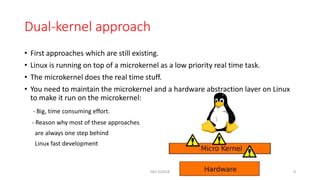
Dual-kernel approach
• First approaches which are still existing.
• Linux is running on top of a microkernel as a low priority real time task.
• The microkernel does the real time stuff.
• You need to maintain the microkernel and a hardware abstraction layer on Linux
to make it run on the microkernel:
- Big, time consuming effort.
- Reason why most of these approaches
are always one step behind
Linux fast development
NES SS2018 8
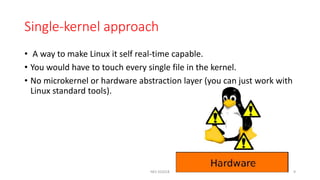
Single-kernel approach
• A way to make Linux it self real-time capable.
• You would have to touch every single file in the kernel.
• No microkernel or hardware abstraction layer (you can just work with
Linux standard tools).
NES SS2018 9
Xenomai
Xenomai 1.0
• Announced in 2001 – as portability framework for RTOS applications
• Required a real-time basis
• Development of ADEOS layer for Linux and RTAI
• Merged with RTAI
Xenomai 2.0
• Departed from RTAI in 2005 – incompatible design goals
• Evolved ADEOS to I-pipe layer (also used by RTAI)
• Ported to 6 architectures
Xenomai 3.0
• Released in 2015 after 5 years of development
• Rework of in-kernel core (now POSIX-centric)
• Support for native Linux
NES SS2018 10
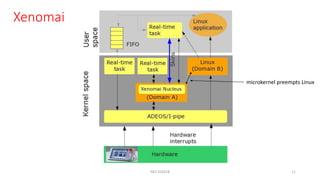
Xenomai
NES SS2018 11
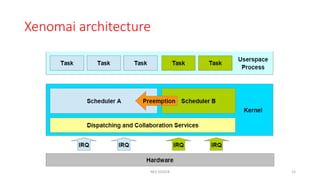
microkernel preempts Linux
Xenomai architecture
NES SS2018 12
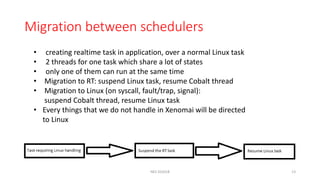
Migration between schedulers
• creating realtime task in application, over a normal Linux task
• 2 threads for one task which share a lot of states
• only one of them can run at the same time
• Migration to RT: suspend Linux task, resume Cobalt thread
• Migration to Linux (on syscall, fault/trap, signal):
suspend Cobalt thread, resume Linux task
• Every things that we do not handle in Xenomai will be directed
to Linux
NES SS2018 13
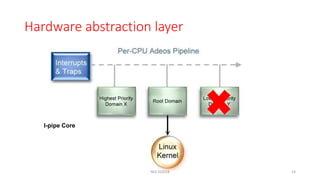
Hardware abstraction layer
I-pipe Core
NES SS2018 14
Issues of dual-kernel approach
• Special API
• Special tools and libraries
• Microkernel needs to be ported for new HW and new Linux versions
• Bad scaling on big platforms
• Various number of not palatable patches
• Changes to critical subsystems regularly cause regressions
• Porting efforts consume core developer resources
-Most work done by Philippe and Gilles so far
-Time would be better spent on feature improvements...
NES SS2018 15
Xenomai application
• Machine control systems, PLCs
• Printing machines (manroland)
• Printers / copying machines
• Network switches (e.g. Ruggedcom)
• Magnetic resonance tomographs (Siemens Healthcare)
• OROCOS (OSS robotics framework)
• Robotic research projects
• … (many, many incognito applications)
NES SS2018 16
Preempt_RT
• Founded 14 years ago by: Thomas Gleixner & Ingo Molnar
• Huge community
• In-kernel approach
• Main idea: only code that, absolutely must be non-preemptible, is allowed
to be non-preemptible
• Most of the features already made it into the “mainline”
• Interrupt handlers run in a kernel thread which has two advantages:
- The kernel thread is interruptible
- It shows up in a process list with a PID
• First mainline integration 2006
NES SS2018 17
Preempt_RT Goals
• 100% Preemptible kernel
- not possible yet, but let’s try regardless
- Removal of interrupts and preemption disabling
- Fast “worst case” time.
• Quick reaction time
- Bring latencies down to a minimum
• Minimize non-Preemptible kernel code
- at the meantime Minimize code changing amount
NES SS2018 18
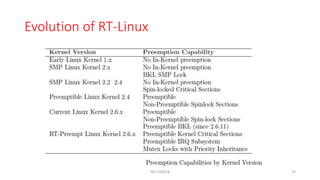
Evolution of RT-Linux
NES SS2018 19
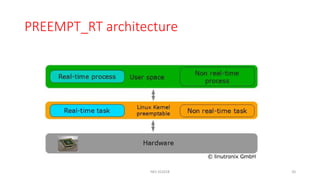
PREEMPT_RT architecture
NES SS2018 20
Fully Preemptible kernel (the RT patch)
• Preemption almost everywhere
• Spinlocks turn into mutexes
• No hard interrupt context
• Preemptible critical section
• Preemptible interrupt handlers
• Preemptible “interrupt disable” code sequence
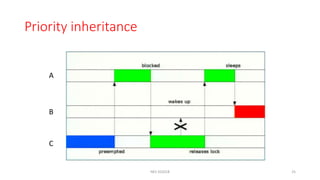
• Priority inheritance
• Deferred operation
• Latency reduction
NES SS2018 21
Mutex
• Critical sections are still protected without disabling preemption
• A Mutex guarantees data integrity while extending the operation of the
spinlock
- we have priority inheritance
- All locks are assumed to be preemptible
- This design eliminates the possibility that an inefficient locking
implementation in a driver can introduce un-detected latency into
the system.
- Only a small subset of locks stay unpreemptible which are manageable.
NES SS2018 22
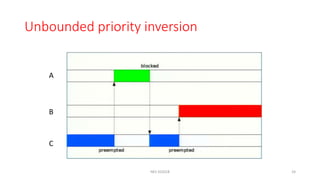
Priority inversion
• When a high priority task wants to run but it can not because a lower
priority task is holding that lock
• It is bad but we can not get rid of it, what we can get rid of is
unbounded priority inversion
NES SS2018 23
Unbounded priority inversion
NES SS2018 24
A
B
C
Priority inheritance
NES SS2018 25
A
B
C
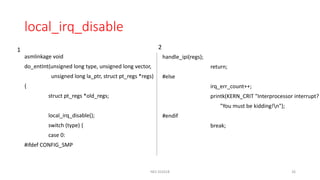
local_irq_disable
asmlinkage void
do_entInt(unsigned long type, unsigned long vector,
unsigned long la_ptr, struct pt_regs *regs)
{
struct pt_regs *old_regs;
local_irq_disable();
switch (type) {
case 0:
#ifdef CONFIG_SMP
NES SS2018 26
handle_ipi(regs);
return;
#else
irq_err_count++;
printk(KERN_CRIT "Interprocessor interrupt?
"You must be kidding!n");
#endif
break;
1 2
Preempt_disable
NES SS2018 27
• Local_irq_disable younger sibling
• Also does not give a hint to what does it do!
• Has the exact same problems of local_irq_disable
• Preempt_enable_no_resched
- only should be used within preempt_disable locations
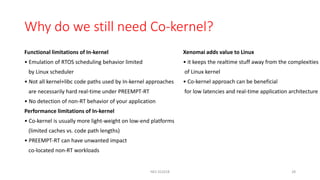
Why do we still need Co-kernel?
Functional limitations of In-kernel
• Emulation of RTOS scheduling behavior limited
by Linux scheduler
• Not all kernel+libc code paths used by In-kernel approaches
are necessarily hard real-time under PREEMPT-RT
• No detection of non-RT behavior of your application
Performance limitations of In-kernel
• Co-kernel is usually more light-weight on low-end platforms
(limited caches vs. code path lengths)
• PREEMPT-RT can have unwanted impact
co-located non-RT workloads
Xenomai adds value to Linux
• it keeps the realtime stuff away from the complexities
of Linux kernel
• Co-kernel approach can be beneficial
for low latencies and real-time application architecture
NES SS2018 28
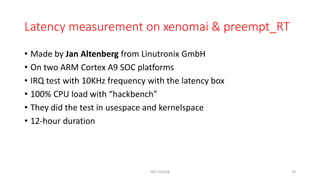
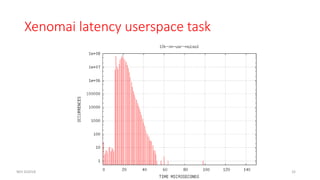
Latency measurement on xenomai & preempt_RT
• Made by Jan Altenberg from Linutronix GmbH
• On two ARM Cortex A9 SOC platforms
• IRQ test with 10KHz frequency with the latency box
• 100% CPU load with “hackbench”
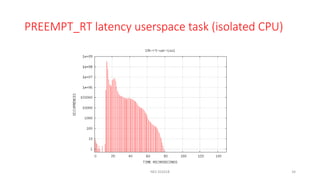
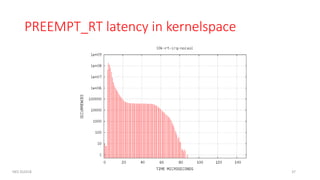
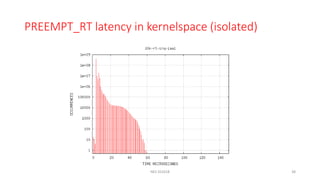
• They did the test in usespace and kernelspace
• 12-hour duration
NES SS2018 29
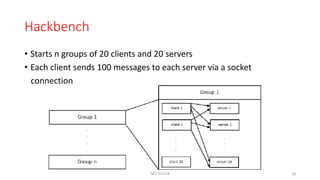
Hackbench
• Starts n groups of 20 clients and 20 servers
• Each client sends 100 messages to each server via a socket
connection
NES SS2018 30
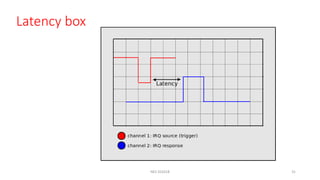
Latency box
NES SS2018 31
Xenomai latency userspace task
NES SS2018 32
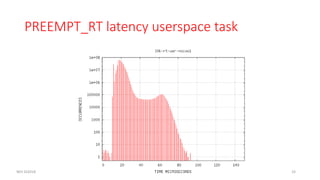
PREEMPT_RT latency userspace task
NES SS2018 33
PREEMPT_RT latency userspace task (isolated CPU)
NES SS2018 34
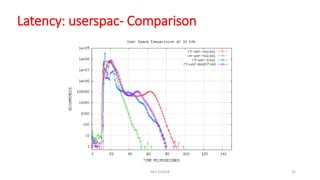
Latency: userspac- Comparison
NES SS2018 35
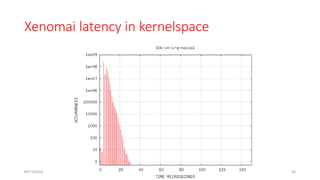
Xenomai latency in kernelspace
NES SS2018 36
PREEMPT_RT latency in kernelspace
NES SS2018 37
PREEMPT_RT latency in kernelspace (isolated)
NES SS2018 38
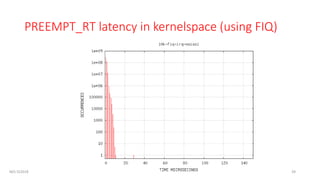
PREEMPT_RT latency in kernelspace (using FIQ)
NES SS2018 39
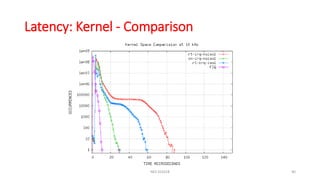
Latency: Kernel - Comparison
NES SS2018 40
Test results
• Which approach to choose?
- If timing is vital, choose Xenomai, it separates the realtime interrupt
handling from complexities of Linux kernel
• You can go with PREEMPT_RT using FIQ
• Xenomai kernelspace is the best for 100% hard performance
• Xenomai userspace is slower than it’s kernelspace
• Tests only can help you in the field of latency which is dependent on
the hardware
• No guarantee for results repeatation
NES SS2018 41
Conclusion
• PREEMPT_RT is getting integrated in Linux mainline
- Download here: https://www.kernel.org/
• PREEMPT_RT Increases Linux stability and quality
• PREEMPT_RT is simple to use
• Xenomai has it’s own advantages over PREEMPT_RT
• Microkernels are hard to handle
• For the most use cases the latency of the both approaches is almost
the same
• FIQ offers very fast latency but brings limitations
NES SS2018 42
Thank you
NES SS2018 43

Real time Linux

  • 1.
    Title: RT Linux SeyedNavid Ashrafi Telecommunication Networks Group Technische Universität Berlin Summer Semester 2018 35-minute presentation NES SS2018 1
  • 2.
    Over view >> Introductionto RTOS - Definitions and history - Usages & requirements NES SS2018 2 >> PREEMPT_RT patch - Overview - Features >> Latency measurement test >> Conclusion >> Different approaches - Xenomai - PREEMPT_RT - Cons & pros
  • 3.
    What is realtime? • It is about fast operation time • It is about performance • Its about DETERMINISM - You need to execute an operation in a specific time frame and you need a guarantee for that. - As fast as specified, not as fast as possible - RT-Linux: Deterministic timing behavior in Linux. - Depends on the system NES SS2018 3
  • 4.
    Usage and requirementsof RT-Linux • Usages: - Industrial applications - Multimedia systems - Aerospace system - Automative - Financial services • Requirements: - Deterministic timing behavior - Preemption - priority inheritance NES SS2018 4
  • 5.
    Soft Realtime?? • Itis in contrast with deterministic behavior • We concentrate on 100% and 95% hard RT. • 100% hard RT: Realtime requirements should be met 100% otherwise it will lead to an error condition (industry) • 95% hard RT: Realtime requirements should be met 95% (data collection) NES SS2018 5
  • 6.
    Critical section • Concurrentaccess to a shared resource can lead to unexpected or error condition • There are over 10,000 individual critical section in a typical Linux 2.6 kernel • In the non-preemptible design of Linux 2.6 kernel, any critical section can block preemption • In the Preemptible design the effort was to reduce the total size and number of non-preemptible critical sections. NES SS2018 6
  • 7.
  • 8.
    Dual-kernel approach • Firstapproaches which are still existing. • Linux is running on top of a microkernel as a low priority real time task. • The microkernel does the real time stuff. • You need to maintain the microkernel and a hardware abstraction layer on Linux to make it run on the microkernel: - Big, time consuming effort. - Reason why most of these approaches are always one step behind Linux fast development NES SS2018 8
  • 9.
    Single-kernel approach • Away to make Linux it self real-time capable. • You would have to touch every single file in the kernel. • No microkernel or hardware abstraction layer (you can just work with Linux standard tools). NES SS2018 9
  • 10.
    Xenomai Xenomai 1.0 • Announcedin 2001 – as portability framework for RTOS applications • Required a real-time basis • Development of ADEOS layer for Linux and RTAI • Merged with RTAI Xenomai 2.0 • Departed from RTAI in 2005 – incompatible design goals • Evolved ADEOS to I-pipe layer (also used by RTAI) • Ported to 6 architectures Xenomai 3.0 • Released in 2015 after 5 years of development • Rework of in-kernel core (now POSIX-centric) • Support for native Linux NES SS2018 10
  • 11.
  • 12.
  • 13.
    Migration between schedulers •creating realtime task in application, over a normal Linux task • 2 threads for one task which share a lot of states • only one of them can run at the same time • Migration to RT: suspend Linux task, resume Cobalt thread • Migration to Linux (on syscall, fault/trap, signal): suspend Cobalt thread, resume Linux task • Every things that we do not handle in Xenomai will be directed to Linux NES SS2018 13
  • 14.
  • 15.
    Issues of dual-kernelapproach • Special API • Special tools and libraries • Microkernel needs to be ported for new HW and new Linux versions • Bad scaling on big platforms • Various number of not palatable patches • Changes to critical subsystems regularly cause regressions • Porting efforts consume core developer resources -Most work done by Philippe and Gilles so far -Time would be better spent on feature improvements... NES SS2018 15
  • 16.
    Xenomai application • Machinecontrol systems, PLCs • Printing machines (manroland) • Printers / copying machines • Network switches (e.g. Ruggedcom) • Magnetic resonance tomographs (Siemens Healthcare) • OROCOS (OSS robotics framework) • Robotic research projects • … (many, many incognito applications) NES SS2018 16
  • 17.
    Preempt_RT • Founded 14years ago by: Thomas Gleixner & Ingo Molnar • Huge community • In-kernel approach • Main idea: only code that, absolutely must be non-preemptible, is allowed to be non-preemptible • Most of the features already made it into the “mainline” • Interrupt handlers run in a kernel thread which has two advantages: - The kernel thread is interruptible - It shows up in a process list with a PID • First mainline integration 2006 NES SS2018 17
  • 18.
    Preempt_RT Goals • 100%Preemptible kernel - not possible yet, but let’s try regardless - Removal of interrupts and preemption disabling - Fast “worst case” time. • Quick reaction time - Bring latencies down to a minimum • Minimize non-Preemptible kernel code - at the meantime Minimize code changing amount NES SS2018 18
  • 19.
  • 20.
  • 21.
    Fully Preemptible kernel(the RT patch) • Preemption almost everywhere • Spinlocks turn into mutexes • No hard interrupt context • Preemptible critical section • Preemptible interrupt handlers • Preemptible “interrupt disable” code sequence • Priority inheritance • Deferred operation • Latency reduction NES SS2018 21
  • 22.
    Mutex • Critical sectionsare still protected without disabling preemption • A Mutex guarantees data integrity while extending the operation of the spinlock - we have priority inheritance - All locks are assumed to be preemptible - This design eliminates the possibility that an inefficient locking implementation in a driver can introduce un-detected latency into the system. - Only a small subset of locks stay unpreemptible which are manageable. NES SS2018 22
  • 23.
    Priority inversion • Whena high priority task wants to run but it can not because a lower priority task is holding that lock • It is bad but we can not get rid of it, what we can get rid of is unbounded priority inversion NES SS2018 23
  • 24.
  • 25.
  • 26.
    local_irq_disable asmlinkage void do_entInt(unsigned longtype, unsigned long vector, unsigned long la_ptr, struct pt_regs *regs) { struct pt_regs *old_regs; local_irq_disable(); switch (type) { case 0: #ifdef CONFIG_SMP NES SS2018 26 handle_ipi(regs); return; #else irq_err_count++; printk(KERN_CRIT "Interprocessor interrupt? "You must be kidding!n"); #endif break; 1 2
  • 27.
    Preempt_disable NES SS2018 27 •Local_irq_disable younger sibling • Also does not give a hint to what does it do! • Has the exact same problems of local_irq_disable • Preempt_enable_no_resched - only should be used within preempt_disable locations
  • 28.
    Why do westill need Co-kernel? Functional limitations of In-kernel • Emulation of RTOS scheduling behavior limited by Linux scheduler • Not all kernel+libc code paths used by In-kernel approaches are necessarily hard real-time under PREEMPT-RT • No detection of non-RT behavior of your application Performance limitations of In-kernel • Co-kernel is usually more light-weight on low-end platforms (limited caches vs. code path lengths) • PREEMPT-RT can have unwanted impact co-located non-RT workloads Xenomai adds value to Linux • it keeps the realtime stuff away from the complexities of Linux kernel • Co-kernel approach can be beneficial for low latencies and real-time application architecture NES SS2018 28
  • 29.
    Latency measurement onxenomai & preempt_RT • Made by Jan Altenberg from Linutronix GmbH • On two ARM Cortex A9 SOC platforms • IRQ test with 10KHz frequency with the latency box • 100% CPU load with “hackbench” • They did the test in usespace and kernelspace • 12-hour duration NES SS2018 29
  • 30.
    Hackbench • Starts ngroups of 20 clients and 20 servers • Each client sends 100 messages to each server via a socket connection NES SS2018 30
  • 31.
  • 32.
    Xenomai latency userspacetask NES SS2018 32
  • 33.
    PREEMPT_RT latency userspacetask NES SS2018 33
  • 34.
    PREEMPT_RT latency userspacetask (isolated CPU) NES SS2018 34
  • 35.
  • 36.
    Xenomai latency inkernelspace NES SS2018 36
  • 37.
    PREEMPT_RT latency inkernelspace NES SS2018 37
  • 38.
    PREEMPT_RT latency inkernelspace (isolated) NES SS2018 38
  • 39.
    PREEMPT_RT latency inkernelspace (using FIQ) NES SS2018 39
  • 40.
    Latency: Kernel -Comparison NES SS2018 40
  • 41.
    Test results • Whichapproach to choose? - If timing is vital, choose Xenomai, it separates the realtime interrupt handling from complexities of Linux kernel • You can go with PREEMPT_RT using FIQ • Xenomai kernelspace is the best for 100% hard performance • Xenomai userspace is slower than it’s kernelspace • Tests only can help you in the field of latency which is dependent on the hardware • No guarantee for results repeatation NES SS2018 41
  • 42.
    Conclusion • PREEMPT_RT isgetting integrated in Linux mainline - Download here: https://www.kernel.org/ • PREEMPT_RT Increases Linux stability and quality • PREEMPT_RT is simple to use • Xenomai has it’s own advantages over PREEMPT_RT • Microkernels are hard to handle • For the most use cases the latency of the both approaches is almost the same • FIQ offers very fast latency but brings limitations NES SS2018 42
  • 43.