American International
University-Bangladesh (AIUB)
Presenter
Nusrat Irin Chowdhury Mary
Superscalar
Architecture
 Superscalar Architecture (SSA) describes a
microprocessor design that execute more than one
instruction at a time during a single clock cycle .
 In a SSA design, the processor or the instruction compiler
is able to determine whether an instruction can be
carried out independently of other sequential
instructions, or whether it has a dependency on another
instruction and must be executed sequentially.
 The design is sometimes called “Second Generation
RISC”. Another term used to describe superscalar
processors is multiple instruction issue processors. 2
Superscalar Architecture
 In a SSA, several scalar instructions can be initiated
simultaneously and executed independently.
 A long series of innovations aimed at producing ever-
faster microprocessors.
 Includes all features of pipelining but, in addition, there
can be several instructions executing simultaneously in
the same pipeline stage.
 SSA introduces a new level of parallelism, called
instruction-level parallelism.
3
Superscalar Architecture cont’d
 In Superscalar CPU Architecture implementation of
Instruction Level Parallelism (ILP) within a single
processor allows faster CPU at a given clock rate.
 A superscalar processor executes more than one
instruction during a clock cycle by simultaneously
dispatching multiple instructions to functional units.
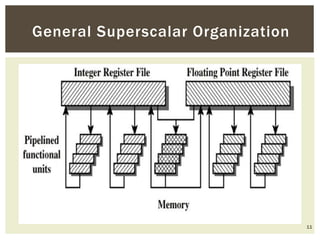
 Each functional unit is not a separate CPU core but an
execution resource within a single CPU such as an
arithmetic logic unit, a bit shifter, or a multiplier.
4
Superscalar CPU Architecture
 SimpleScalar is an open source computer architecture
simulator which is written using ‘C’ programming language.
 A set of tools that model a virtual computer system with
CPU, Cache and Memory Hierarchy.
 Using the tool, users can model applications that simulate
programs running on a range of modern processors and
systems.
 The tool set includes sample simulators ranging from a fast
functional simulator to a detailed.
5
SimpleScalar Architecture
 The simplest processors are scalar processors. Each
instruction executed by a scalar processor typically
manipulates one or two data items at a time.
 In a superscalar CPU the dispatcher reads instructions
from memory and decides which one can be run in
parallel.
 Therefore a superscalar processor can be proposed
having multiple parallel pipelines, each of which is
processing instructions simultaneously from a single
instruction thread.
6
Scalar to Superscalar
 Pipelining is the process of breaking down task
into substeps and executing them in different
parts of processor.
 In order to fully utilise a superscalar processor of
degree m with pipelining, m instructions must be
executable parallely. This situation may not be
true in all clock cycles.
 In a superscalar processor, the simple operation
latency should require only one cycle, as in the
base scalar processor.
7
Pipelining in Superscalar Architecture
A SSA processor fetches multiple instructions at a time,
and attempts to find nearby instructions that are
independent of each other and therefore can be executed
in parallel.
Based on the dependency analysis, the processor may
issue and execute instructions in an order that differs
from that of the original machine code.
The processor may eliminate some unnecessary
dependencies by the use of additional registers.
8
Implement Superscalar
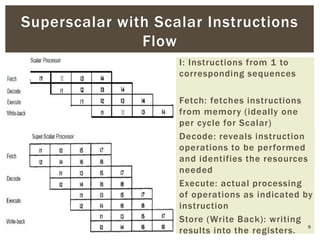
I: Instructions from 1 to
corresponding sequences
Fetch: fetches instructions
from memory (ideally one
per cycle for Scalar)
Decode: reveals instruction
operations to be performed
and identifies the resources
needed
Execute: actual processing
of operations as indicated by
instruction
Store (Write Back): writing
results into the registers.
9
Superscalar with Scalar Instructions
Flow
10
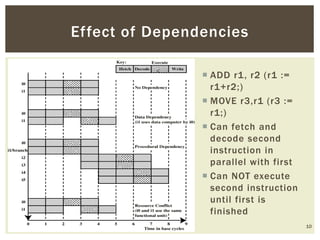
Effect of Dependencies
 ADD r1, r2 (r1 :=
r1+r2;)
 MOVE r3,r1 (r3 :=
r1;)
 Can fetch and
decode second
instruction in
parallel with first
 Can NOT execute
second instruction
until first is
finished
11
General Superscalar Organization
12
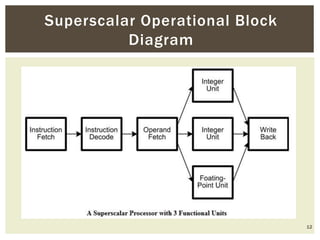
Superscalar Operational Block
Diagram
13
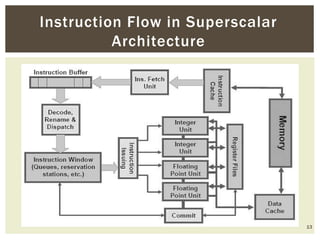
Instruction Flow in Superscalar
Architecture
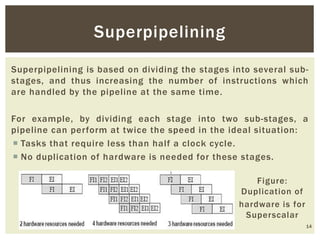
Superpipelining is based on dividing the stages into several sub-
stages, and thus increasing the number of instructions which
are handled by the pipeline at the same time.
For example, by dividing each stage into two sub-stages, a
pipeline can perform at twice the speed in the ideal situation:
 Tasks that require less than half a clock cycle.
 No duplication of hardware is needed for these stages.
14
Superpipelining
Figure:
Duplication of
hardware is for
Superscalar
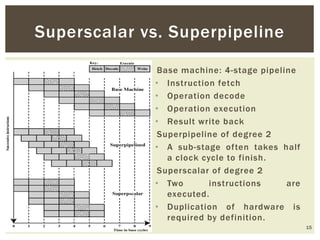
Base machine: 4-stage pipeline
• Instruction fetch
• Operation decode
• Operation execution
• Result write back
Superpipeline of degree 2
• A sub-stage often takes half
a clock cycle to finish.
Superscalar of degree 2
• Two instructions are
executed.
• Duplication of hardware is
required by definition.
15
Superscalar vs. Superpipeline
16
Superpipelined Superscalar
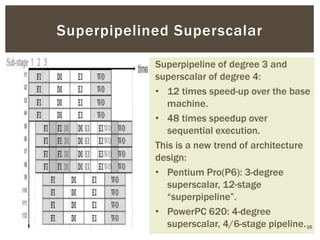
Superpipeline of degree 3 and
superscalar of degree 4:
• 12 times speed-up over the base
machine.
• 48 times speedup over
sequential execution.
This is a new trend of architecture
design:
• Pentium Pro(P6): 3-degree
superscalar, 12-stage
“superpipeline”.
• PowerPC 620: 4-degree
superscalar, 4/6-stage pipeline.
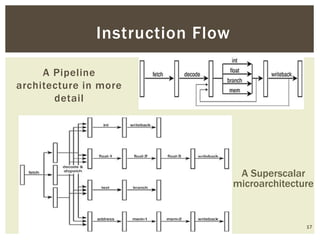
A Pipeline
architecture in more
detail
17
Instruction Flow
A Superscalar
microarchitecture
18
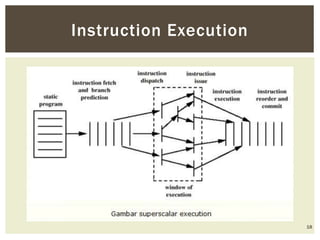
Instruction Execution
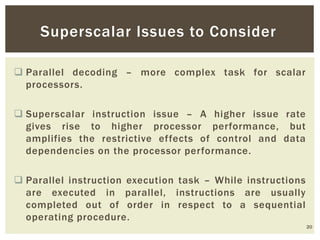
Tasks can be divided into the following
 Parallel decoding
 Superscalar instruction issue
 Parallel instruction execution
preserving sequential consistency of exception
processing
preserving sequential consistency of execution
19
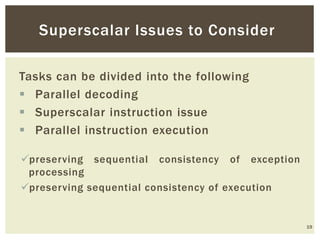
Superscalar Issues to Consider
 Parallel decoding – more complex task for scalar
processors.
 Superscalar instruction issue – A higher issue rate
gives rise to higher processor performance, but
amplifies the restrictive effects of control and data
dependencies on the processor performance.
 Parallel instruction execution task – While instructions
are executed in parallel, instructions are usually
completed out of order in respect to a sequential
operating procedure.
20
Superscalar Issues to Consider
21
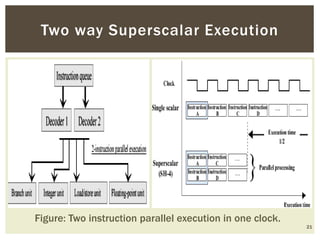
Two way Superscalar Execution
Figure: Two instruction parallel execution in one clock.
 Instruction-fetch inefficiencies caused by both branch
delays and instruction misalignment
 not worthwhile to explore highly- concurrent execution
hardware, rather, it is more appropriate to explore
economical execution hardware
 degree of intrinsic parallelism in the instruction
stream (instructions requiring the same
computational resources from the CPU)
 complexity and time cost of the dispatcher and
associated dependency checking logic
 branch instruction processing.
22
Limitations of Superscalar
[1] Zebo Peng. (2010). General format, “Superscalar Architecture – IDA”, Lecture 3
Introduction to Parallel Architectures.
[2] William M. Johnson, “Super-Scalar Processor Design”, Stanford University
Since 1989
[3] James E. Smith (1995), “The Microarchitecture of Superscalar Processors”,
senior member IEEE
[4] Subbarao Palacharla, “Complexity -Effective Superscalar Processors”,
UNIVERSITY OF WISCONSIN—MADISON, Since 1998
[5] Alaa Alameldeen and Haitham Akkary, "The Microarchitecture of Superscalar
Processors", Portland State University, since 2014
[5] http://www.techterms.com/definition/superscalar
[6] https://www.google.com.bd/search?q=superscalar+archit
ecture&newwindow=1&tbm=isch&tbo=u&source=univ&sa=X&ei
=Ll1oU9umJNWHuASgwoDACA&ved=0CDUQsAQ&biw=1048&bih=921 23
Citation
Superscalar Architecture_AIUB

Superscalar Architecture_AIUB

  • 1.
  • 2.
     Superscalar Architecture(SSA) describes a microprocessor design that execute more than one instruction at a time during a single clock cycle .  In a SSA design, the processor or the instruction compiler is able to determine whether an instruction can be carried out independently of other sequential instructions, or whether it has a dependency on another instruction and must be executed sequentially.  The design is sometimes called “Second Generation RISC”. Another term used to describe superscalar processors is multiple instruction issue processors. 2 Superscalar Architecture
  • 3.
     In aSSA, several scalar instructions can be initiated simultaneously and executed independently.  A long series of innovations aimed at producing ever- faster microprocessors.  Includes all features of pipelining but, in addition, there can be several instructions executing simultaneously in the same pipeline stage.  SSA introduces a new level of parallelism, called instruction-level parallelism. 3 Superscalar Architecture cont’d
  • 4.
     In SuperscalarCPU Architecture implementation of Instruction Level Parallelism (ILP) within a single processor allows faster CPU at a given clock rate.  A superscalar processor executes more than one instruction during a clock cycle by simultaneously dispatching multiple instructions to functional units.  Each functional unit is not a separate CPU core but an execution resource within a single CPU such as an arithmetic logic unit, a bit shifter, or a multiplier. 4 Superscalar CPU Architecture
  • 5.
     SimpleScalar isan open source computer architecture simulator which is written using ‘C’ programming language.  A set of tools that model a virtual computer system with CPU, Cache and Memory Hierarchy.  Using the tool, users can model applications that simulate programs running on a range of modern processors and systems.  The tool set includes sample simulators ranging from a fast functional simulator to a detailed. 5 SimpleScalar Architecture
  • 6.
     The simplestprocessors are scalar processors. Each instruction executed by a scalar processor typically manipulates one or two data items at a time.  In a superscalar CPU the dispatcher reads instructions from memory and decides which one can be run in parallel.  Therefore a superscalar processor can be proposed having multiple parallel pipelines, each of which is processing instructions simultaneously from a single instruction thread. 6 Scalar to Superscalar
  • 7.
     Pipelining isthe process of breaking down task into substeps and executing them in different parts of processor.  In order to fully utilise a superscalar processor of degree m with pipelining, m instructions must be executable parallely. This situation may not be true in all clock cycles.  In a superscalar processor, the simple operation latency should require only one cycle, as in the base scalar processor. 7 Pipelining in Superscalar Architecture
  • 8.
    A SSA processorfetches multiple instructions at a time, and attempts to find nearby instructions that are independent of each other and therefore can be executed in parallel. Based on the dependency analysis, the processor may issue and execute instructions in an order that differs from that of the original machine code. The processor may eliminate some unnecessary dependencies by the use of additional registers. 8 Implement Superscalar
  • 9.
    I: Instructions from1 to corresponding sequences Fetch: fetches instructions from memory (ideally one per cycle for Scalar) Decode: reveals instruction operations to be performed and identifies the resources needed Execute: actual processing of operations as indicated by instruction Store (Write Back): writing results into the registers. 9 Superscalar with Scalar Instructions Flow
  • 10.
    10 Effect of Dependencies ADD r1, r2 (r1 := r1+r2;)  MOVE r3,r1 (r3 := r1;)  Can fetch and decode second instruction in parallel with first  Can NOT execute second instruction until first is finished
  • 11.
  • 12.
  • 13.
    13 Instruction Flow inSuperscalar Architecture
  • 14.
    Superpipelining is basedon dividing the stages into several sub- stages, and thus increasing the number of instructions which are handled by the pipeline at the same time. For example, by dividing each stage into two sub-stages, a pipeline can perform at twice the speed in the ideal situation:  Tasks that require less than half a clock cycle.  No duplication of hardware is needed for these stages. 14 Superpipelining Figure: Duplication of hardware is for Superscalar
  • 15.
    Base machine: 4-stagepipeline • Instruction fetch • Operation decode • Operation execution • Result write back Superpipeline of degree 2 • A sub-stage often takes half a clock cycle to finish. Superscalar of degree 2 • Two instructions are executed. • Duplication of hardware is required by definition. 15 Superscalar vs. Superpipeline
  • 16.
    16 Superpipelined Superscalar Superpipeline ofdegree 3 and superscalar of degree 4: • 12 times speed-up over the base machine. • 48 times speedup over sequential execution. This is a new trend of architecture design: • Pentium Pro(P6): 3-degree superscalar, 12-stage “superpipeline”. • PowerPC 620: 4-degree superscalar, 4/6-stage pipeline.
  • 17.
    A Pipeline architecture inmore detail 17 Instruction Flow A Superscalar microarchitecture
  • 18.
  • 19.
    Tasks can bedivided into the following  Parallel decoding  Superscalar instruction issue  Parallel instruction execution preserving sequential consistency of exception processing preserving sequential consistency of execution 19 Superscalar Issues to Consider
  • 20.
     Parallel decoding– more complex task for scalar processors.  Superscalar instruction issue – A higher issue rate gives rise to higher processor performance, but amplifies the restrictive effects of control and data dependencies on the processor performance.  Parallel instruction execution task – While instructions are executed in parallel, instructions are usually completed out of order in respect to a sequential operating procedure. 20 Superscalar Issues to Consider
  • 21.
    21 Two way SuperscalarExecution Figure: Two instruction parallel execution in one clock.
  • 22.
     Instruction-fetch inefficienciescaused by both branch delays and instruction misalignment  not worthwhile to explore highly- concurrent execution hardware, rather, it is more appropriate to explore economical execution hardware  degree of intrinsic parallelism in the instruction stream (instructions requiring the same computational resources from the CPU)  complexity and time cost of the dispatcher and associated dependency checking logic  branch instruction processing. 22 Limitations of Superscalar
  • 23.
    [1] Zebo Peng.(2010). General format, “Superscalar Architecture – IDA”, Lecture 3 Introduction to Parallel Architectures. [2] William M. Johnson, “Super-Scalar Processor Design”, Stanford University Since 1989 [3] James E. Smith (1995), “The Microarchitecture of Superscalar Processors”, senior member IEEE [4] Subbarao Palacharla, “Complexity -Effective Superscalar Processors”, UNIVERSITY OF WISCONSIN—MADISON, Since 1998 [5] Alaa Alameldeen and Haitham Akkary, "The Microarchitecture of Superscalar Processors", Portland State University, since 2014 [5] http://www.techterms.com/definition/superscalar [6] https://www.google.com.bd/search?q=superscalar+archit ecture&newwindow=1&tbm=isch&tbo=u&source=univ&sa=X&ei =Ll1oU9umJNWHuASgwoDACA&ved=0CDUQsAQ&biw=1048&bih=921 23 Citation