Download as PDF, PPTX

































![What happens on a CPU
int main() {
int a[5], b[5], output[5];
for(int i=0;i<5;i++){
output[i]=a[i]+b[i];
}
}
main:
str fp, [sp, #-4]!
add fp, sp, #0
sub sp, sp, #68
mov r3, #0
str r3, [fp, #-8]
.L3:
ldr r3, [fp, #-8]
cmp r3, #4
bgt .L2
ldr r3, [fp, #-8]
lsl r3, r3, #2
sub r2, fp, #4
add r3, r2, r3
ldr r2, [r3, #-24]
ldr r3, [fp, #-8]
lsl r3, r3, #2
sub r1, fp, #4
add r3, r1, r3
ldr r3, [r3, #-44]
add r2, r2, r3
ldr r3, [fp, #-8]
lsl r3, r3, #2
sub r1, fp, #4
add r3, r1, r3
str r2, [r3, #-64]
ldr r3, [fp, #-8]
add r3, r3, #1
str r3, [fp, #-8]
b .L3
.L2:
mov r3, #0
mov r0, r3
add sp, fp, #0
ldr fp, [sp], #4
bx lr
• Variable latency](https://image.slidesharecdn.com/implementingai-runningaiattheedge-200616142707/85/Implementing-AI-Running-AI-at-the-Edge-44-320.jpg)
![What happens on a FPGA
int main() {
int a[5], b[5], output[5];
for(int i=0;i<5;i++){
output[i]=a[i]+b[i];
}
} + +
a[0] b[0] a[1] b[1] a[2] b[2] a[3] b[3] a[4] b[4]
+ + +
output[0] output[1] output[2] output[3] output[4]
• Control over the design
• Control over the latency
• Control over the clock (power consumption)](https://image.slidesharecdn.com/implementingai-runningaiattheedge-200616142707/85/Implementing-AI-Running-AI-at-the-Edge-45-320.jpg)


























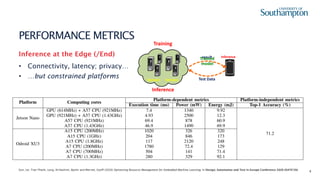
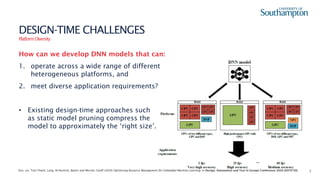
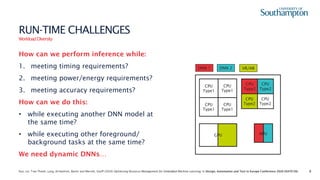
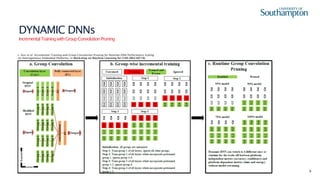
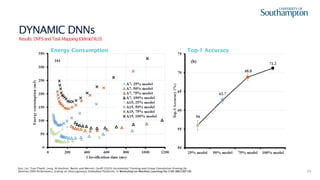
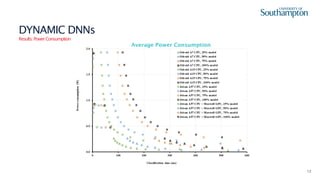
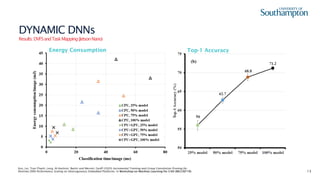
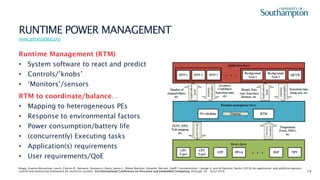
- Dynamic neural networks (DNNs) can adapt to varying resource availability on edge devices through techniques like incremental training and group convolution pruning. This allows meeting requirements for timing, power/energy, and accuracy. - Experiments on two embedded platforms showed that dynamic DNNs combined with DVFS and task mapping can reduce energy consumption while maintaining classification accuracy compared to static DNNs. - Runtime power management is needed to coordinate heterogeneous processors, respond to environmental factors, balance power consumption and battery life, and meet requirements for concurrently executing tasks and applications under varying conditions on edge devices.


