






















EXPLORING
HUGGING
FACE
Introduction
•
Outline
•
•
•
•
•
•
•
•
•
•
What is Hugging
Face?
•
Core Components and Features
Transformers
library
Model Hub Tokenizers Datasets
Transformers
library
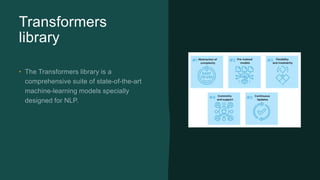
•
•
1.
2.
3.
4.
5.
Model Hub
•
Tokenizers
•
Datasets
•
Hugging Face in Action
•

•

Hugging Face in Action
cont.
•

•

Hugging Face in Action
cont.
•

•

Hugging Face in Action
cont.
•

•

Collaborative
Environment
Hugging Face
Spaces
•
Collaboration
Features for Teams
and Communities
•
Examples of Collaborative Projects
Model Fine-Tuning
Collaboratively:
Teams can collectively fine-tune language
models for specific tasks, benefiting from
diverse perspectives and expertise.
Knowledge Sharing and
Documentation:
Community members collaboratively
contribute to documentation, ensuring a
comprehensive resource for users and
newcomers.
Joint Research Initiatives:
Researchers collaborate on exploring novel
approaches, sharing findings, and
collectively pushing the boundaries of NLP.
Integrations
Integration with Popular
Deep Learning
Frameworks
•
Compatibility with Other AI
Tools and Libraries
•
Community and
Support
Discussion Forums,
Community Engagement,
and Knowledge Sharing
•
Documentation and
Support Resources
•
Hugging Face’s
Active Community
and Contributions
•
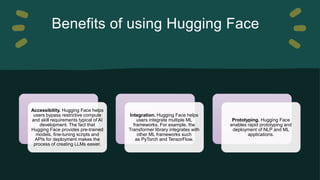
Benefits of using Hugging Face
Accessibility. Hugging Face helps
users bypass restrictive compute
and skill requirements typical of AI
development. The fact that
Hugging Face provides pre-trained
models, fine-tuning scripts and
APIs for deployment makes the
process of creating LLMs easier.
Integration. Hugging Face helps
users integrate multiple ML
frameworks. For example, the
Transformer library integrates with
other ML frameworks such
as PyTorch and TensorFlow.
Prototyping. Hugging Face
enables rapid prototyping and
deployment of NLP and ML
applications.
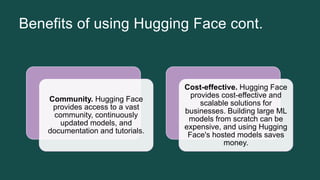
Benefits of using Hugging Face cont.
Community. Hugging Face
provides access to a vast
community, continuously
updated models, and
documentation and tutorials.
Cost-effective. Hugging Face
provides cost-effective and
scalable solutions for
businesses. Building large ML
models from scratch can be
expensive, and using Hugging
Face's hosted models saves
money.
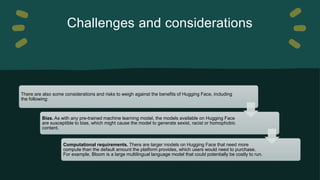
Challenges and considerations
There are also some considerations and risks to weigh against the benefits of Hugging Face, including
the following:
Bias. As with any pre-trained machine learning model, the models available on Hugging Face
are susceptible to bias, which might cause the model to generate sexist, racist or homophobic
content.
Computational requirements. There are larger models on Hugging Face that need more
compute than the default amount the platform provides, which users would need to purchase.
For example, Bloom is a large multilingual language model that could potentially be costly to run.
Challenges and considerations cont.
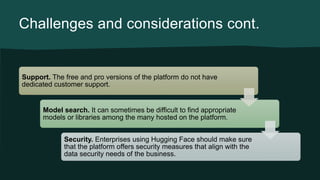
Support. The free and pro versions of the platform do not have
dedicated customer support.
Model search. It can sometimes be difficult to find appropriate
models or libraries among the many hosted on the platform.
Security. Enterprises using Hugging Face should make sure
that the platform offers security measures that align with the
data security needs of the business.
Future
Developments
Upcoming Features and
Enhancements
•
Hugging Face's
Roadmap
•
Vision for the Future
•
Conclusion
Hugging Face stands as a transformative force in Natural Language Processing,
democratizing access to advanced AI tools. With a powerful Transformers Library,
collaborative Spaces, and a vibrant community, it empowers developers worldwide.
Anticipate continual innovation as Hugging Face evolves, driving the future of NLP. Embrace
this platform for its commitment to accessibility, collaboration, and the relentless pursuit of
cutting-edge advancements in AI.
Thank You!

HuggingFace AI - Hugging Face lets users create interactive, in-browser demos of machine learning models.