• High Performance Computing
• Parallel Computing
HPC Definition
• High Performance Computing (HPC) most
generally refers to the practice of aggregating
computing power in a way that delivers much
higher performance than one could get out of a
typical desktop computer or workstation in
order to solve large problems in science,
engineering, or business.
Importance of HPC
• HPC has had tremendous impact on all areas of
computational science and engineering in
academia, government, and industry.
• Many problems have been solved with HPC
techniques that were impossible to solve with
individual workstations or personal computers.
Parallel Computer
• Parallel computing: the use of multiple computers or
processors working together on a common task
• Parallel computer: A set of independent processors that can
work cooperatively to solve a problem or a computer that
contains multiple processors:
▫ each processor works on its section of the problem
▫ processors are allowed to exchange information with other
processors
• Computing performance is defined in terms FLOPS
Why use parallel computing
▫ Single processor speeds are reaching their ultimate limits
▫ Multi-core processors and multiple processors are the most
promising paths to performance improvements
Parallel vs. Serial Computers
• Two big advantages of parallel computers:
1. total performance
2. total memory
• Parallel computers enable us to solve problems
that:
▫ benefit from, or require, fast solution
▫ require large amounts of memory
▫ example that requires both: weather forecasting
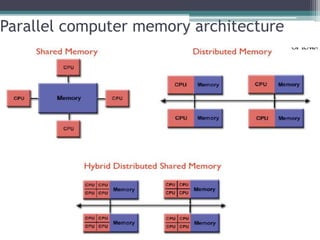
Parallel computer memory architecture
• Shared memory approach
• Distributed memory approach
• Hybrid distributed shared memory approach
Parallel computer memory architecture
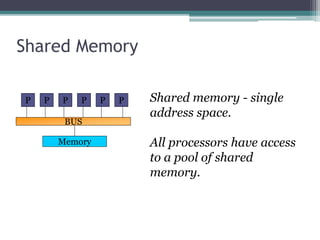
P P P P P P
BUS
Memory
Shared memory - single
address space.
All processors have access
to a pool of shared
memory.
Shared Memory
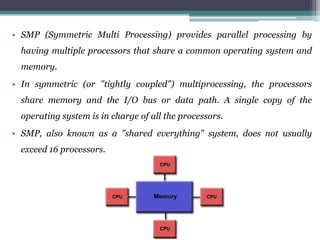
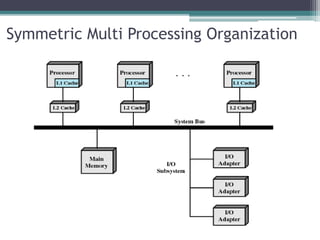
• SMP (Symmetric Multi Processing) provides parallel processing by
having multiple processors that share a common operating system and
memory.
• In symmetric (or "tightly coupled") multiprocessing, the processors
share memory and the I/O bus or data path. A single copy of the
operating system is in charge of all the processors.
• SMP, also known as a "shared everything" system, does not usually
exceed 16 processors.
Symmetric Multi Processing Organization
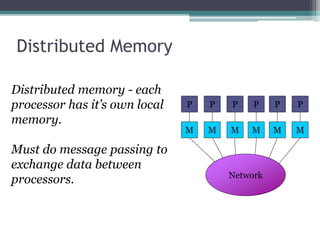
Distributed memory - each
processor has it’s own local
memory.
Must do message passing to
exchange data between
processors.
Distributed Memory
M
P
M
P
M
P
M
P
M
P
M
P
Network
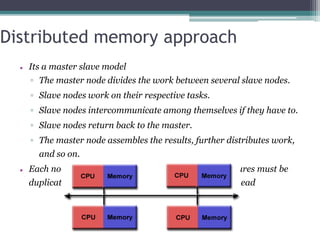
Distributed memory approach
 Its a master slave model
▫ The master node divides the work between several slave nodes.
▫ Slave nodes work on their respective tasks.
▫ Slave nodes intercommunicate among themselves if they have to.
▫ Slave nodes return back to the master.
▫ The master node assembles the results, further distributes work,
and so on.
 Each node has access its own memory so data structures must be
duplicated and send over the n/w, leading n/w overhead
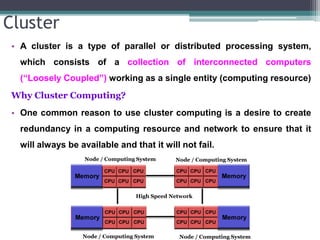
Cluster
• A cluster is a type of parallel or distributed processing system,
which consists of a collection of interconnected computers
(“Loosely Coupled”) working as a single entity (computing resource)
Why Cluster Computing?
• One common reason to use cluster computing is a desire to create
redundancy in a computing resource and network to ensure that it
will always be available and that it will not fail.
Node / Computing System Node / Computing System
High Speed Network
Clustering Requirements:
1. Very HP Microprocessors
2. High speed communication
3. Standard tools for parallel / distributed computing
HPC Cluster Stack
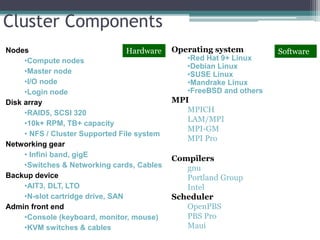
Cluster Components
Nodes
•Compute nodes
•Master node
•I/O node
•Login node
Disk array
•RAID5, SCSI 320
•10k+ RPM, TB+ capacity
• NFS / Cluster Supported File system
Networking gear
• Infini band, gigE
•Switches & Networking cards, Cables
Backup device
•AIT3, DLT, LTO
•N-slot cartridge drive, SAN
Admin front end
•Console (keyboard, monitor, mouse)
•KVM switches & cables
Hardware Operating system
•Red Hat 9+ Linux
•Debian Linux
•SUSE Linux
•Mandrake Linux
•FreeBSD and others
MPI
MPICH
LAM/MPI
MPI-GM
MPI Pro
Compilers
gnu
Portland Group
Intel
Scheduler
OpenPBS
PBS Pro
Maui
Software
Overview of HPC.pptx

Overview of HPC.pptx

  • 2.
    • High PerformanceComputing • Parallel Computing
  • 3.
    HPC Definition • HighPerformance Computing (HPC) most generally refers to the practice of aggregating computing power in a way that delivers much higher performance than one could get out of a typical desktop computer or workstation in order to solve large problems in science, engineering, or business.
  • 4.
    Importance of HPC •HPC has had tremendous impact on all areas of computational science and engineering in academia, government, and industry. • Many problems have been solved with HPC techniques that were impossible to solve with individual workstations or personal computers.
  • 5.
    Parallel Computer • Parallelcomputing: the use of multiple computers or processors working together on a common task • Parallel computer: A set of independent processors that can work cooperatively to solve a problem or a computer that contains multiple processors: ▫ each processor works on its section of the problem ▫ processors are allowed to exchange information with other processors • Computing performance is defined in terms FLOPS Why use parallel computing ▫ Single processor speeds are reaching their ultimate limits ▫ Multi-core processors and multiple processors are the most promising paths to performance improvements
  • 6.
    Parallel vs. SerialComputers • Two big advantages of parallel computers: 1. total performance 2. total memory • Parallel computers enable us to solve problems that: ▫ benefit from, or require, fast solution ▫ require large amounts of memory ▫ example that requires both: weather forecasting
  • 7.
    Parallel computer memoryarchitecture • Shared memory approach • Distributed memory approach • Hybrid distributed shared memory approach
  • 8.
  • 9.
    P P PP P P BUS Memory Shared memory - single address space. All processors have access to a pool of shared memory. Shared Memory
  • 10.
    • SMP (SymmetricMulti Processing) provides parallel processing by having multiple processors that share a common operating system and memory. • In symmetric (or "tightly coupled") multiprocessing, the processors share memory and the I/O bus or data path. A single copy of the operating system is in charge of all the processors. • SMP, also known as a "shared everything" system, does not usually exceed 16 processors.
  • 11.
  • 12.
    Distributed memory -each processor has it’s own local memory. Must do message passing to exchange data between processors. Distributed Memory M P M P M P M P M P M P Network
  • 13.
    Distributed memory approach Its a master slave model ▫ The master node divides the work between several slave nodes. ▫ Slave nodes work on their respective tasks. ▫ Slave nodes intercommunicate among themselves if they have to. ▫ Slave nodes return back to the master. ▫ The master node assembles the results, further distributes work, and so on.  Each node has access its own memory so data structures must be duplicated and send over the n/w, leading n/w overhead
  • 14.
    Cluster • A clusteris a type of parallel or distributed processing system, which consists of a collection of interconnected computers (“Loosely Coupled”) working as a single entity (computing resource) Why Cluster Computing? • One common reason to use cluster computing is a desire to create redundancy in a computing resource and network to ensure that it will always be available and that it will not fail. Node / Computing System Node / Computing System Node / Computing System Node / Computing System High Speed Network
  • 15.
    Clustering Requirements: 1. VeryHP Microprocessors 2. High speed communication 3. Standard tools for parallel / distributed computing HPC Cluster Stack
  • 16.
    Cluster Components Nodes •Compute nodes •Masternode •I/O node •Login node Disk array •RAID5, SCSI 320 •10k+ RPM, TB+ capacity • NFS / Cluster Supported File system Networking gear • Infini band, gigE •Switches & Networking cards, Cables Backup device •AIT3, DLT, LTO •N-slot cartridge drive, SAN Admin front end •Console (keyboard, monitor, mouse) •KVM switches & cables Hardware Operating system •Red Hat 9+ Linux •Debian Linux •SUSE Linux •Mandrake Linux •FreeBSD and others MPI MPICH LAM/MPI MPI-GM MPI Pro Compilers gnu Portland Group Intel Scheduler OpenPBS PBS Pro Maui Software