INCOSE
Systems Engineering
Competency Framework
( ISECF )
Leganés (Madrid) , Spain, 20th June 2019
Bernardo A. Delicado
INCOSE Competency Working Group (CWG)
Bernardo.Delicado@incose.org
About me
2
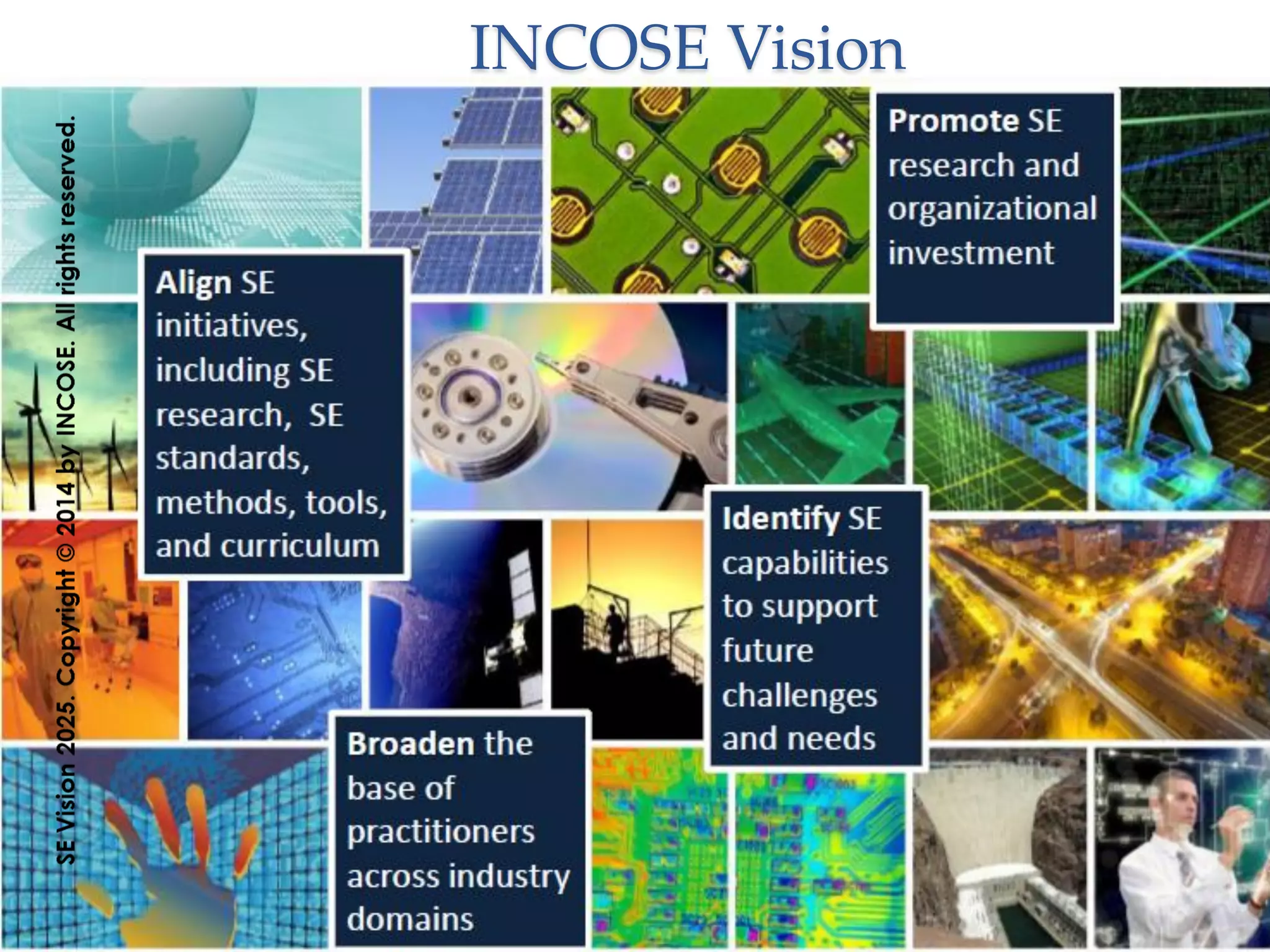
INCOSE Vision
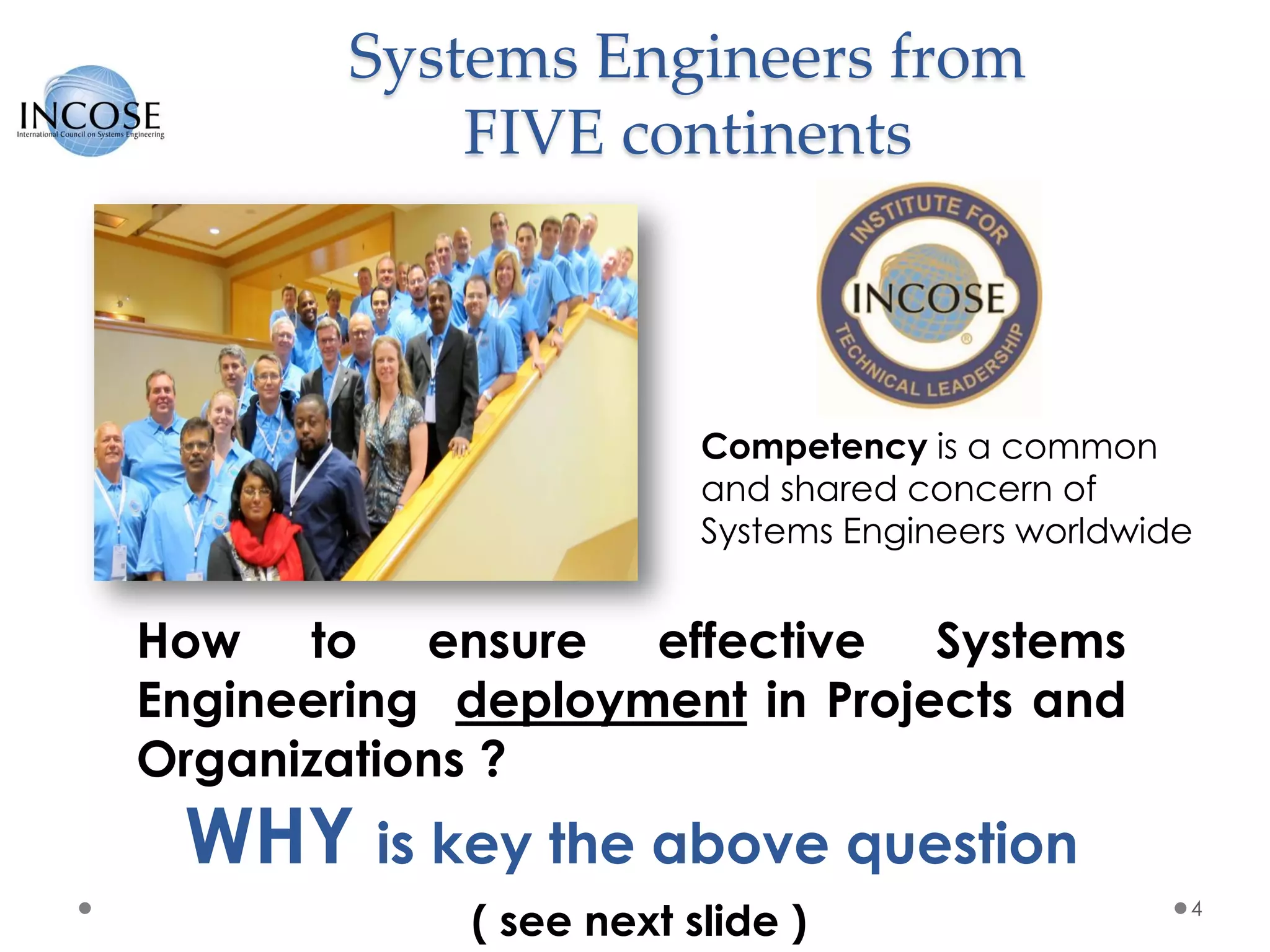
Systems Engineers from
FIVE continents
4
How to ensure effective Systems
Engineering deployment in Projects and
Organizations ?
WHY is key the above question
( see next slide )
Competency is a common
and shared concern of
Systems Engineers worldwide
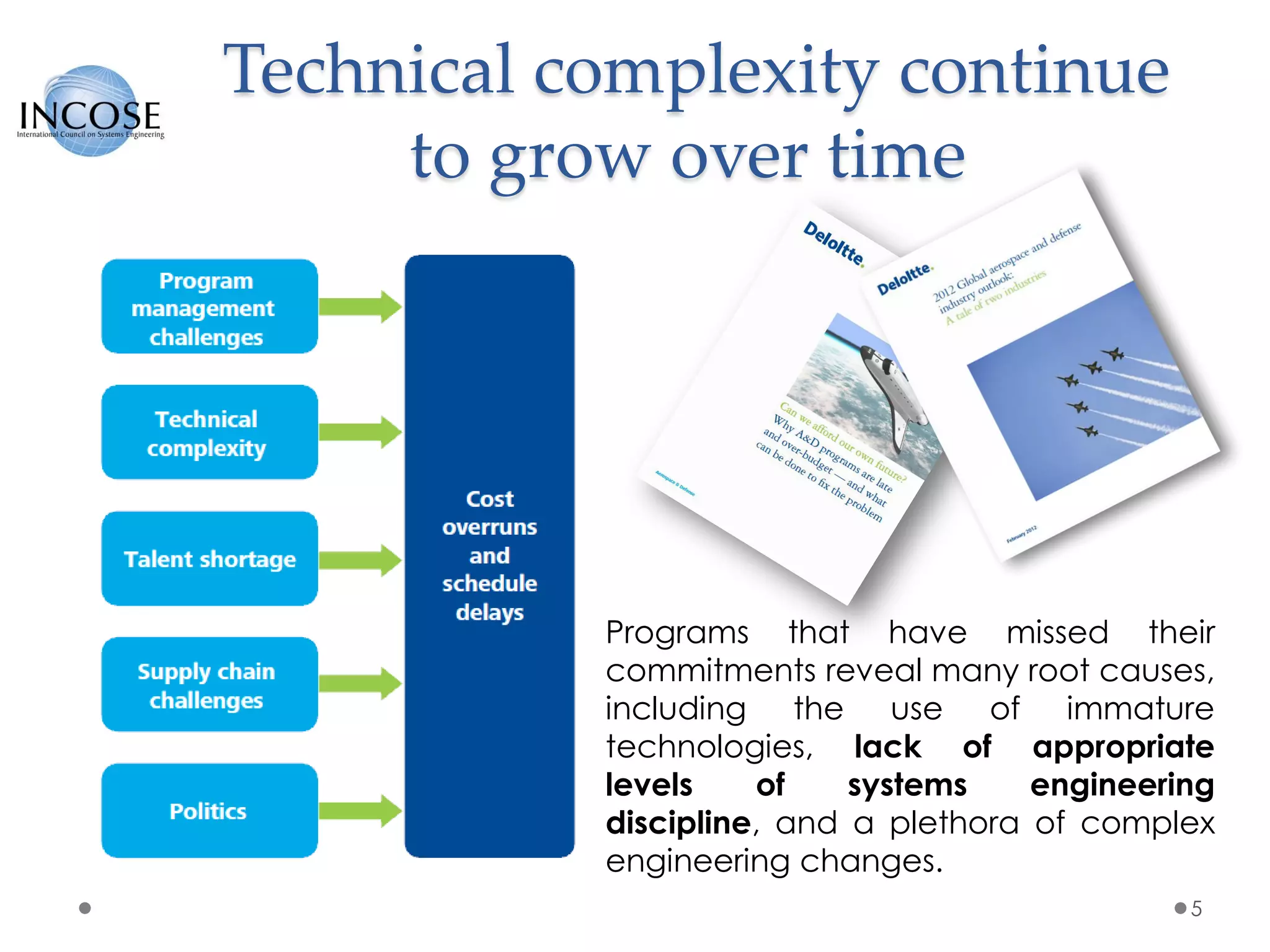
Technical complexity continue
to grow over time
5
Programs that have missed their
commitments reveal many root causes,
including the use of immature
technologies, lack of appropriate
levels of systems engineering
discipline, and a plethora of complex
engineering changes.
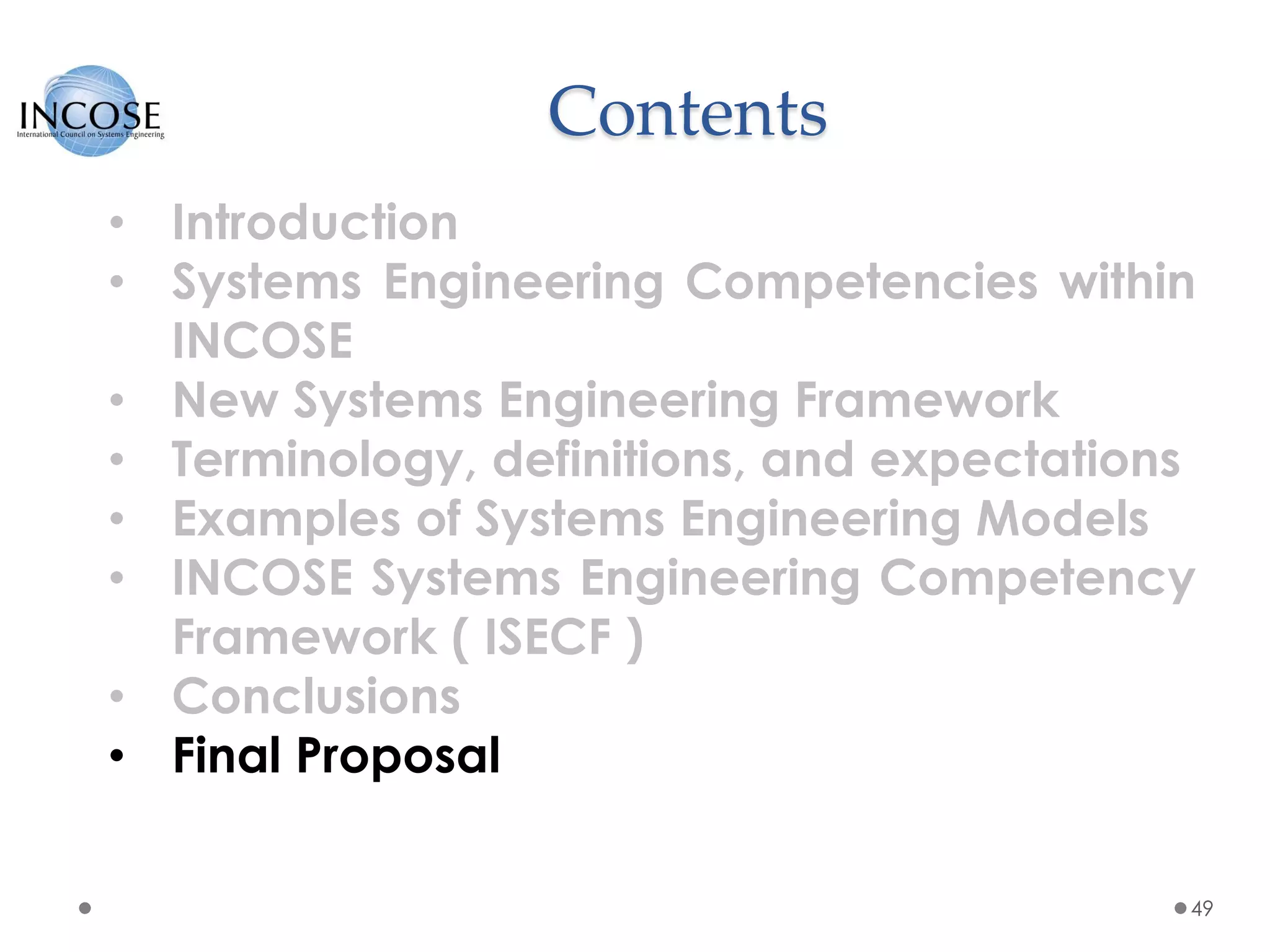
Contents
6
• Introduction
• Systems Engineering Competencies within
INCOSE
• New Systems Engineering Framework
• Terminology, definitions, and expectations
• Examples of Systems Engineering Models
• INCOSE Systems Engineering Competency
Framework ( ISECF )
• Conclusions
• Final Proposal
Contents
7
• Introduction
• Systems Engineering Competencies within
INCOSE
• New Systems Engineering Framework
• Terminology, definitions, and expectations
• Examples of Systems Engineering Models
• INCOSE Systems Engineering Competency
Framework ( ISECF )
• Conclusions
• Final Proposal
The practice of Systems
Engineering is…..
8
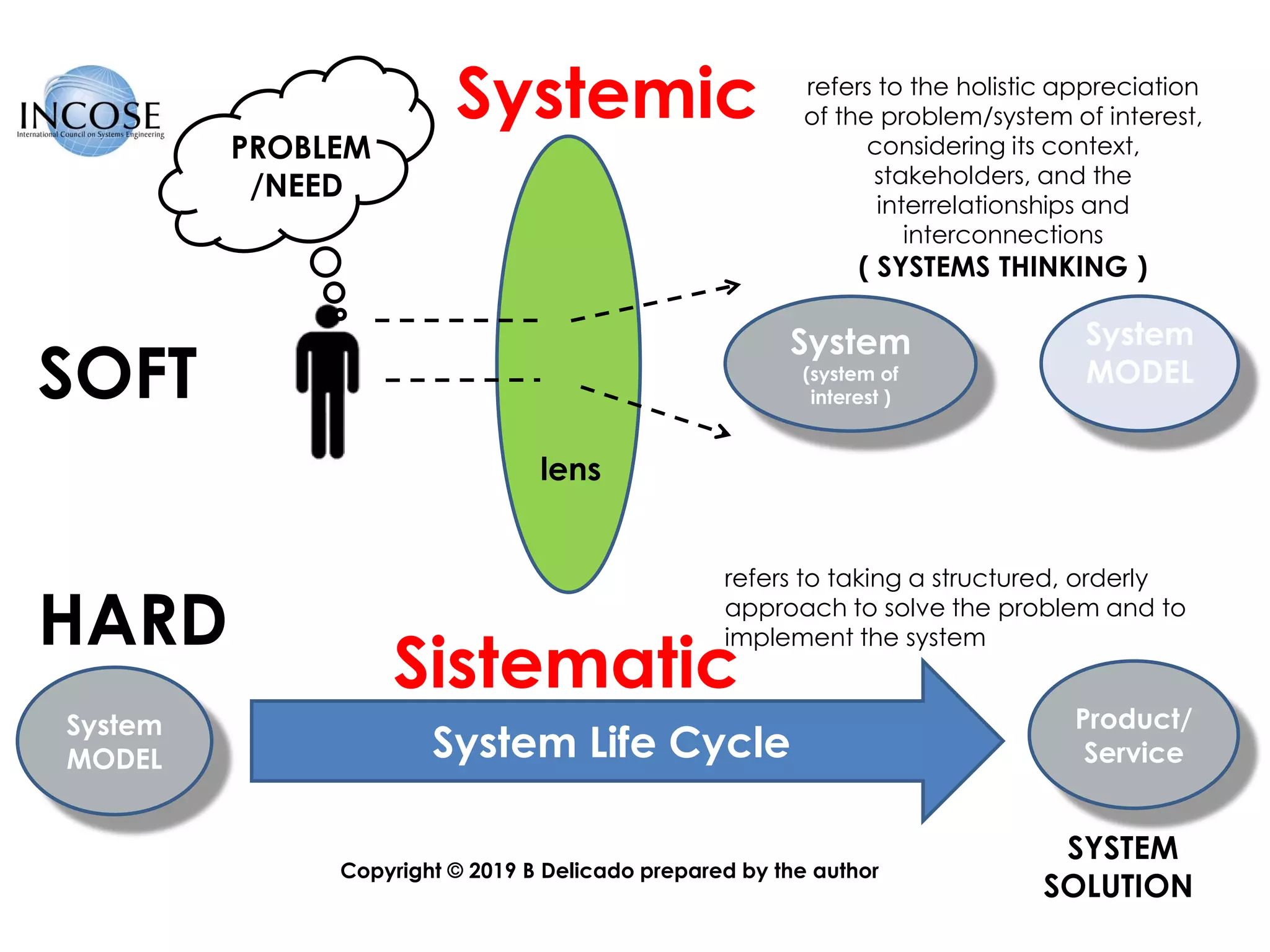
…..a balance between Systemic and Systematic
aspects:
Systemic - thinking about the whole system, its
context and stakeholders
Systematic - following a structured approach to
the realization of the system
( INCOSE UK website )
Systemic
System
(system of
interest )
Sistematic
System Life Cycle
System
MODEL
PROBLEM
/NEED
SYSTEM
SOLUTION
Product/
Service
lens
refers to the holistic appreciation
of the problem/system of interest,
considering its context,
stakeholders, and the
interrelationships and
interconnections
( SYSTEMS THINKING )
refers to taking a structured, orderly
approach to solve the problem and to
implement the system
SOFT
HARD
System
MODEL
Copyright © 2019 B Delicado prepared by the author
Relevant Characteristics of
Systems Engineers
10
Systems Engineers are the glue that enables a
complex project to succeed
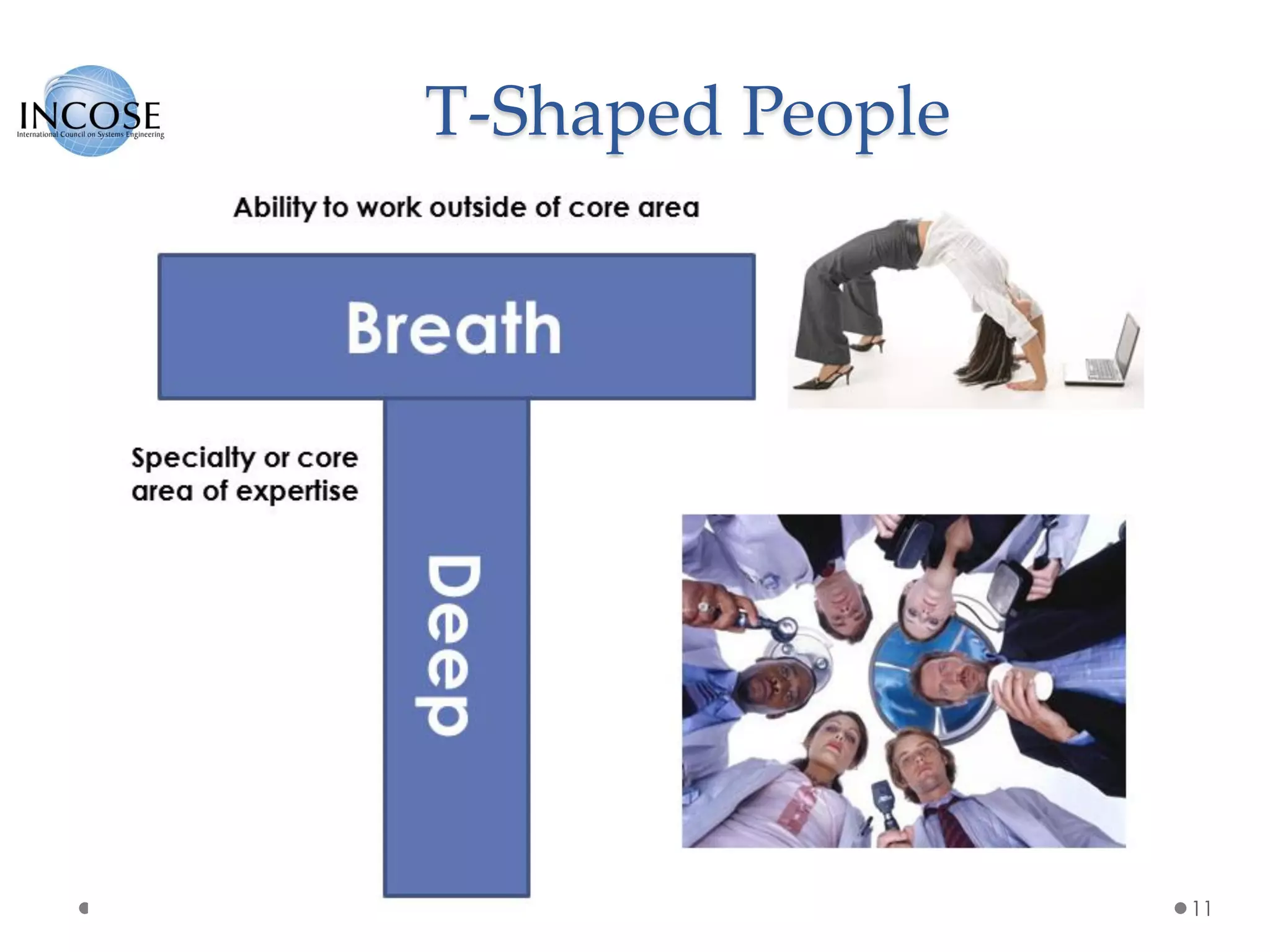
• Most good Systems Engineers are “T-shaped people“
• Broad understanding across domains/disciplines
• Deep specialist competence in systems approaches
• May also have secondary disciplines
• MOST systems engineers are interesting, and inquisitive people
open to new ideas
( INCOSE UK website )
T-Shaped People
11
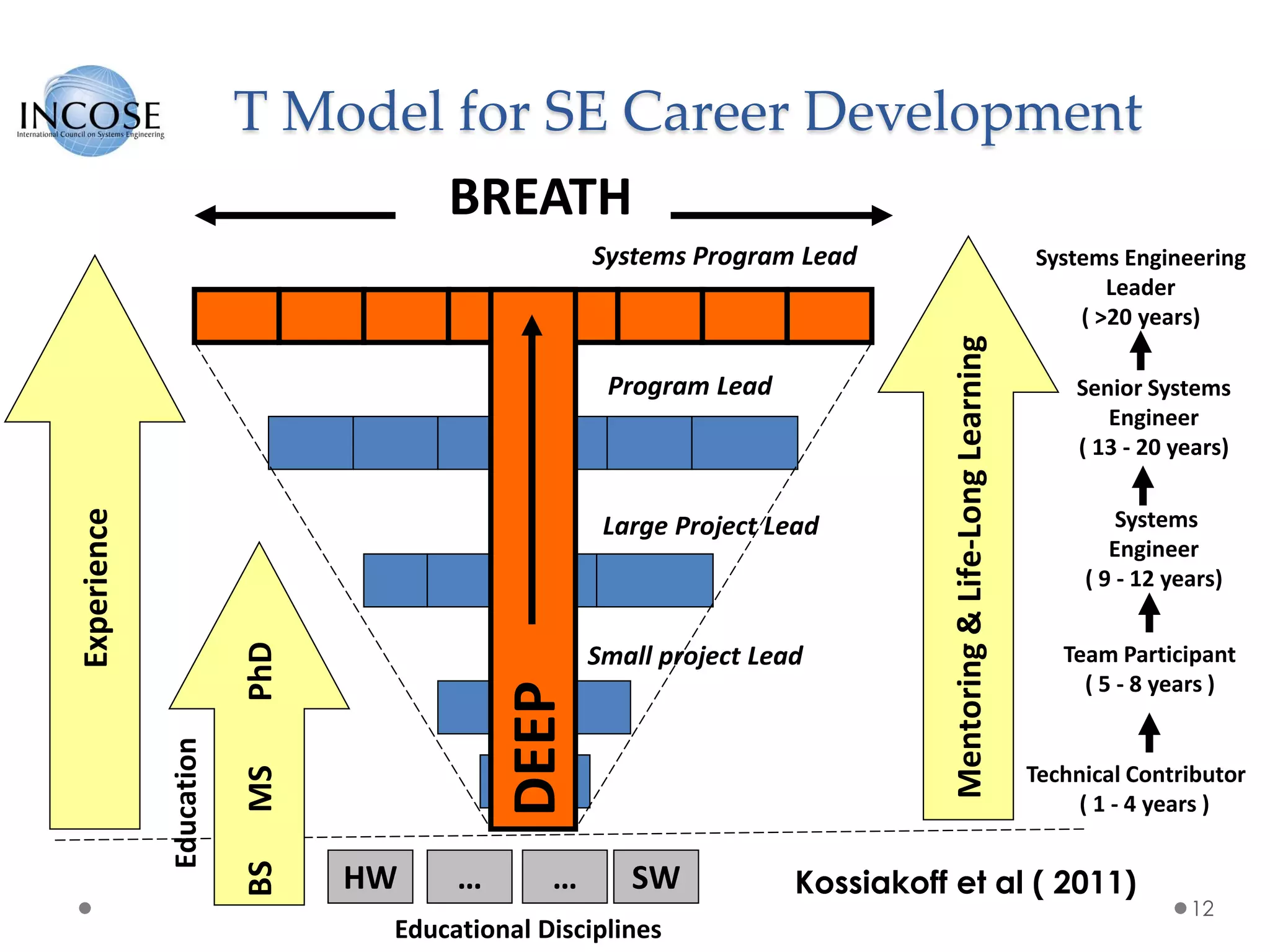
T Model for SE Career Development
12
HW …
DEEP Large Project Lead
BREATH
Educational Disciplines
SW…
Experience
Mentoring&Life-LongLearning
Program Lead
Small project Lead
Systems Program LeadBSMSPhD
Education
Technical Contributor
( 1 - 4 years )
Team Participant
( 5 - 8 years )
Senior Systems
Engineer
( 13 - 20 years)
Systems Engineering
Leader
( >20 years)
Systems
Engineer
( 9 - 12 years)
Kossiakoff et al ( 2011)
Contents
13
• Introduction
• Systems Engineering Competencies within
INCOSE
• New Systems Engineering Framework
• Terminology, definitions, and expectations
• Examples of Systems Engineering Models
• INCOSE Systems Engineering Competency
Framework ( ISECF )
• Conclusions
• Final Proposal
Most Relevant Activities on SE
Competencies
• Understanding what makes an
Effective Systems Engineer
o INCOSE Competency Working Group
o INCOSE Competency Framework
• Qualifications
o INCOSE SE Certification
14
CWG Scope
15
• Focused on the development and continual improvement of the SE Role
Based Competency Framework and Assessment Guide through collaboration
with users, academia, industry and Working Groups as it relates to changes in
SE processes and methods employed throughout a product or system
lifecycle.
• Maintain a broad membership to enhance knowledge base.
• Evaluate competency alignment with other organizations/functions such as
Program Management.
• Ensure consistency of product with INCOSE SE Handbook and Certification.
• Produce papers for publication.
• Provide training related to framework content and assessment capabilities.
• Collaborate with the INCOSE Professional Development Initiative with training
needs assessments.
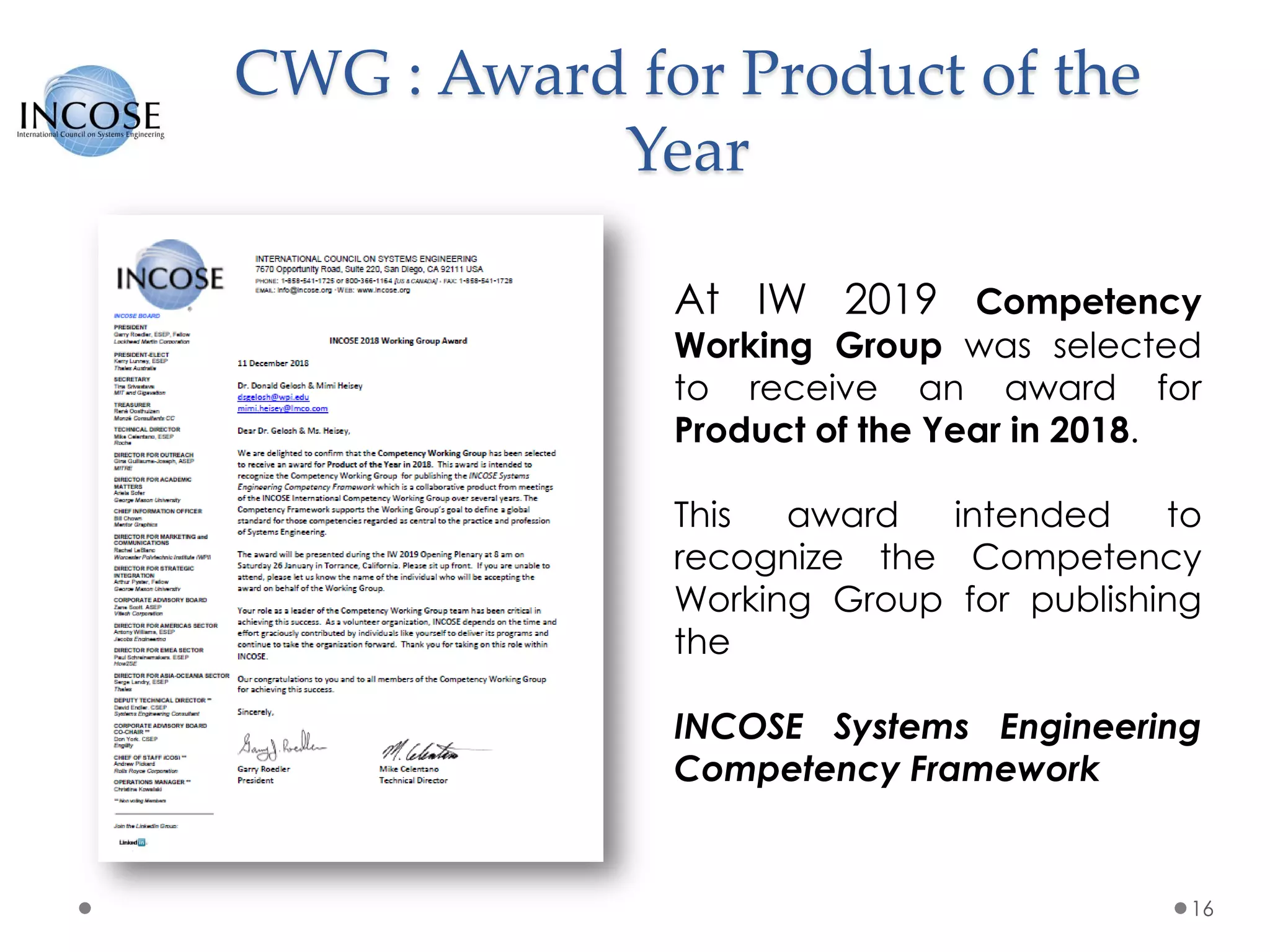
CWG : Award for Product of the
Year
16
At IW 2019 Competency
Working Group was selected
to receive an award for
Product of the Year in 2018.
This award intended to
recognize the Competency
Working Group for publishing
the
INCOSE Systems Engineering
Competency Framework
INCOSE Competency Framework
(ISECF)
17
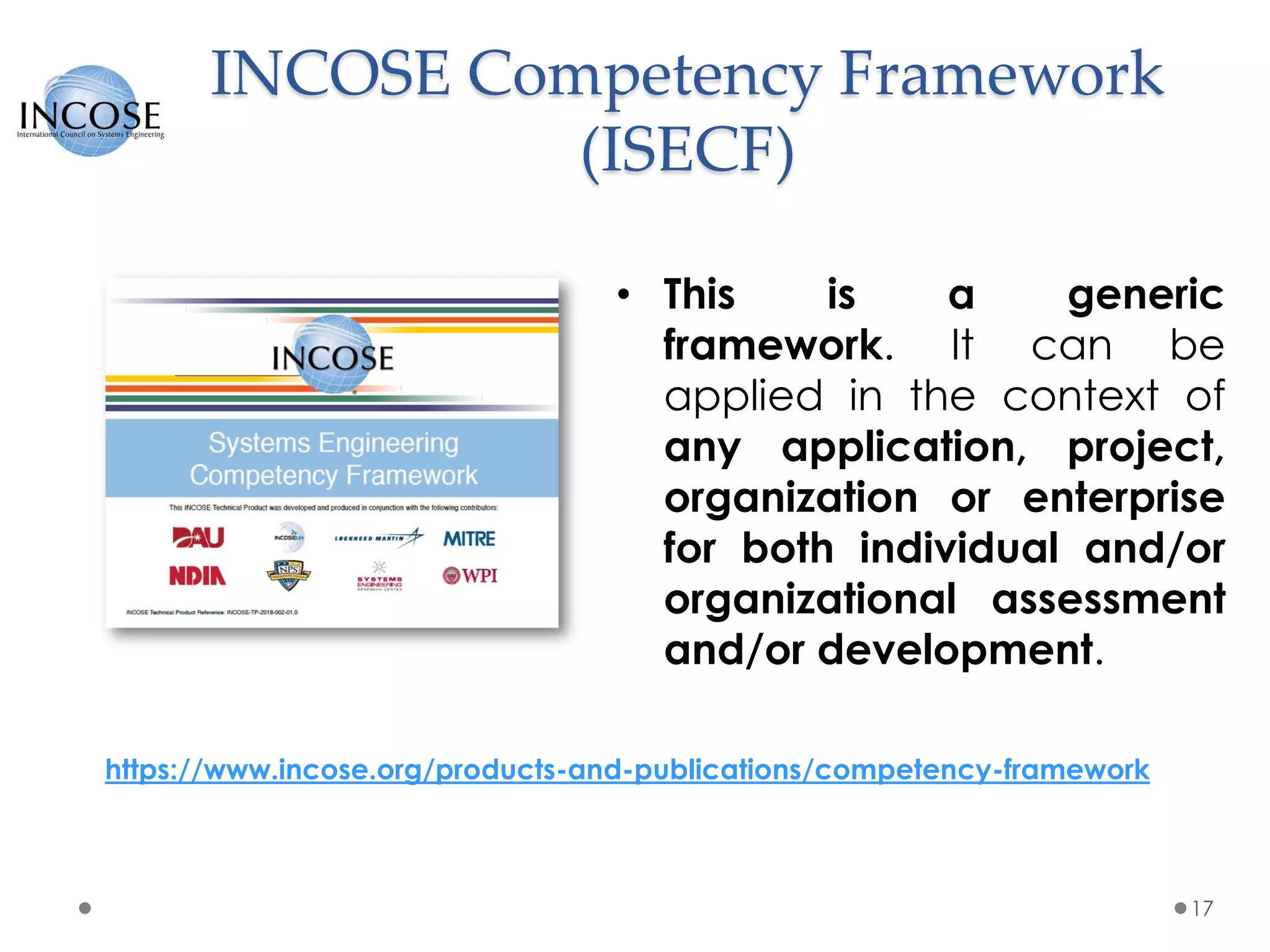
• This is a generic
framework. It can be
applied in the context of
any application, project,
organization or enterprise
for both individual and/or
organizational assessment
and/or development.
https://www.incose.org/products-and-publications/competency-framework
INCOSE SEP Architecture
18
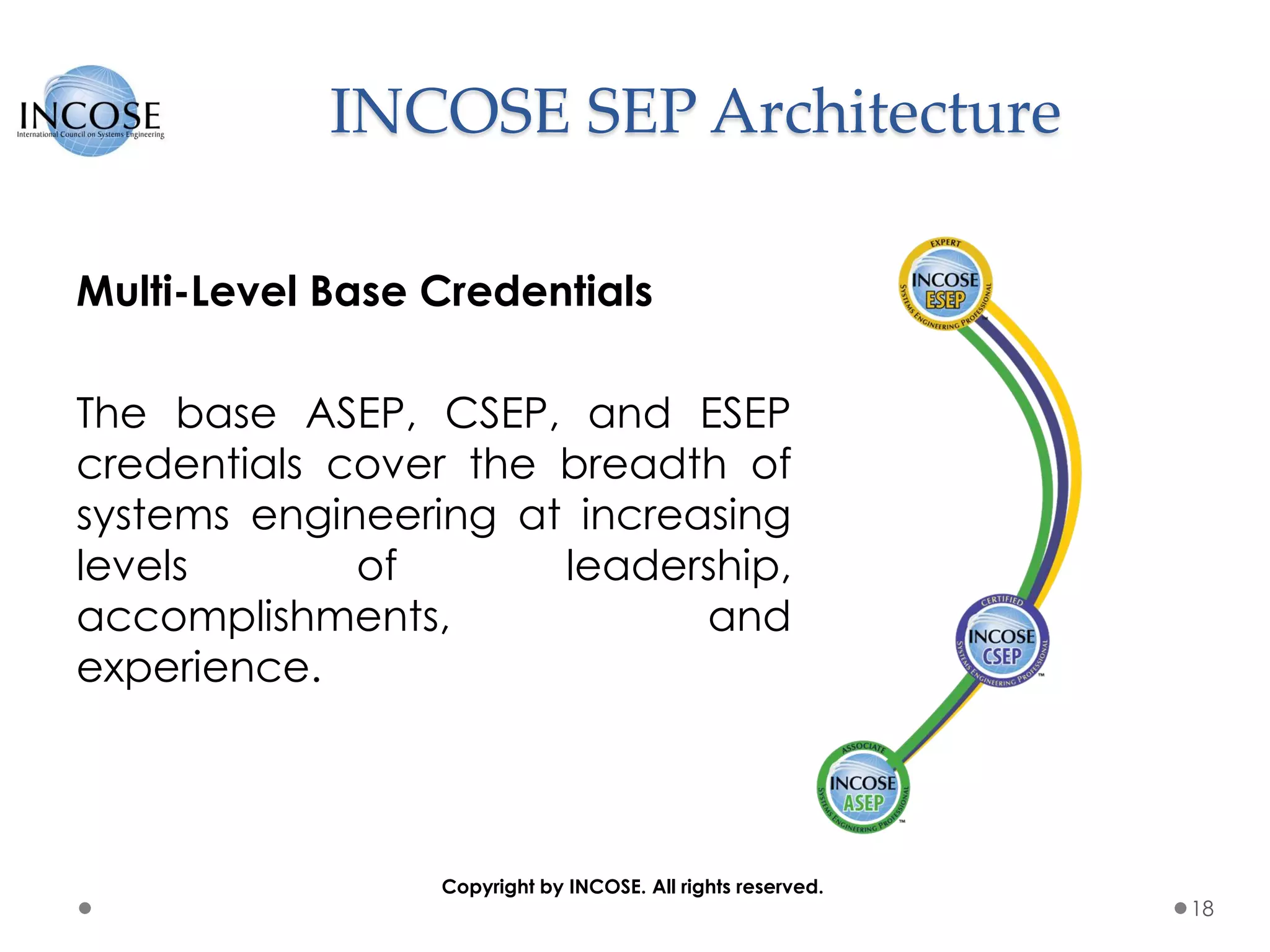
Multi-Level Base Credentials
The base ASEP, CSEP, and ESEP
credentials cover the breadth of
systems engineering at increasing
levels of leadership,
accomplishments, and
experience.
Copyright by INCOSE. All rights reserved.
Contents
19
• Introduction
• Systems Engineering Competencies within
INCOSE
• New Systems Engineering Framework
• Terminology, definitions, and expectations
• Examples of Systems Engineering Models
• INCOSE Systems Engineering Competency
Framework ( ISECF )
• Conclusions
• Final Proposal
INCOSE BoD tasked CWG
20
In 2014, INCOSE leadership tasked the Competency Working Group
( CWG ) with two objectives:
• The first objective was to evolve the former INCOSE UK Competency
Framework to a globally accepted (i.e., approved for release as an
INCOSE product) and marketed standard competency framework,
based on systems engineering effectiveness, that could be used to
produce competency models tailored to the needs of organizations.
This is an important distinction, the competency framework is not itself
a competency model.
• The second objective was to create a globally used standard
assessment instrument/tool based on the competency framework
that is tailorable to the needs of the customer organizations.
Done so far and on-going activities
21
• Originally developed in UK ( 2005 )
o Adopted as an INCOSE Technical Product in UK
o Defines competencies of a Systems Engineer
o In use by UK industry and Government.
• Version 1.0 ( 2018 )
o Evolution to a role-based competency framework that is extensible,
scalable, and can be tailored adding the Concepts of Roles and
Activities.
o Enhance the proficiency levels by adding a new level: Senior Practitioner
• On-going ( 2020 )
o Assessment Guide Development
o Use cases
Contents
22
• Introduction
• Systems Engineering Competencies within
INCOSE
• New Systems Engineering Framework
• Terminology, definitions, and expectations
• Examples of Systems Engineering Models
• INCOSE Systems Engineering Competency
Framework ( ISECF )
• Conclusions
• Final Proposal
Competency
• A measure of an individual’s ability in
terms of their knowledge, skills, and
behaviour to perform a given role
Holt and Perry (2011)
23
Competence vs Competency
• Competence – the ability to do something well;
• Competency – an important skill that is needed to do a
job.
The key difference here is that competence reflects the
total ability of the individual, whereas a competency is a
single skill; (hopefully) one of many that the individual will
hold. The sum of an individual’s competencies will make up
their competence and it is these individual competencies
that are assessed to provide an overall indication of
competence.
Holt and Perry ( 2011)
24
Capability vs Competence
• Capability describes the ability of an organization or
organizational unit.
• Competence describes the ability of an individual
to do something.
Holt and Perry ( 2011)
25
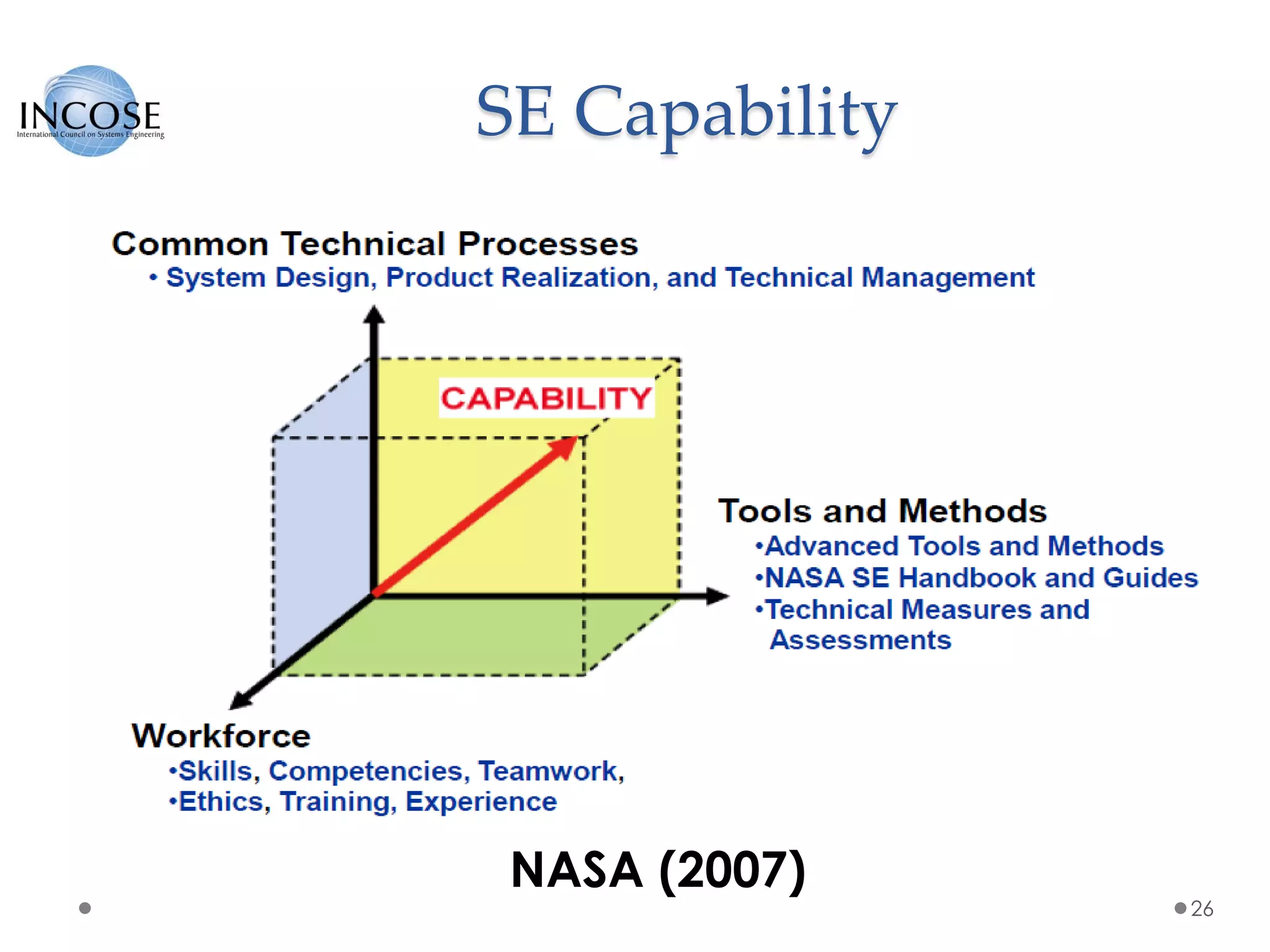
SE Capability
26
NASA (2007)
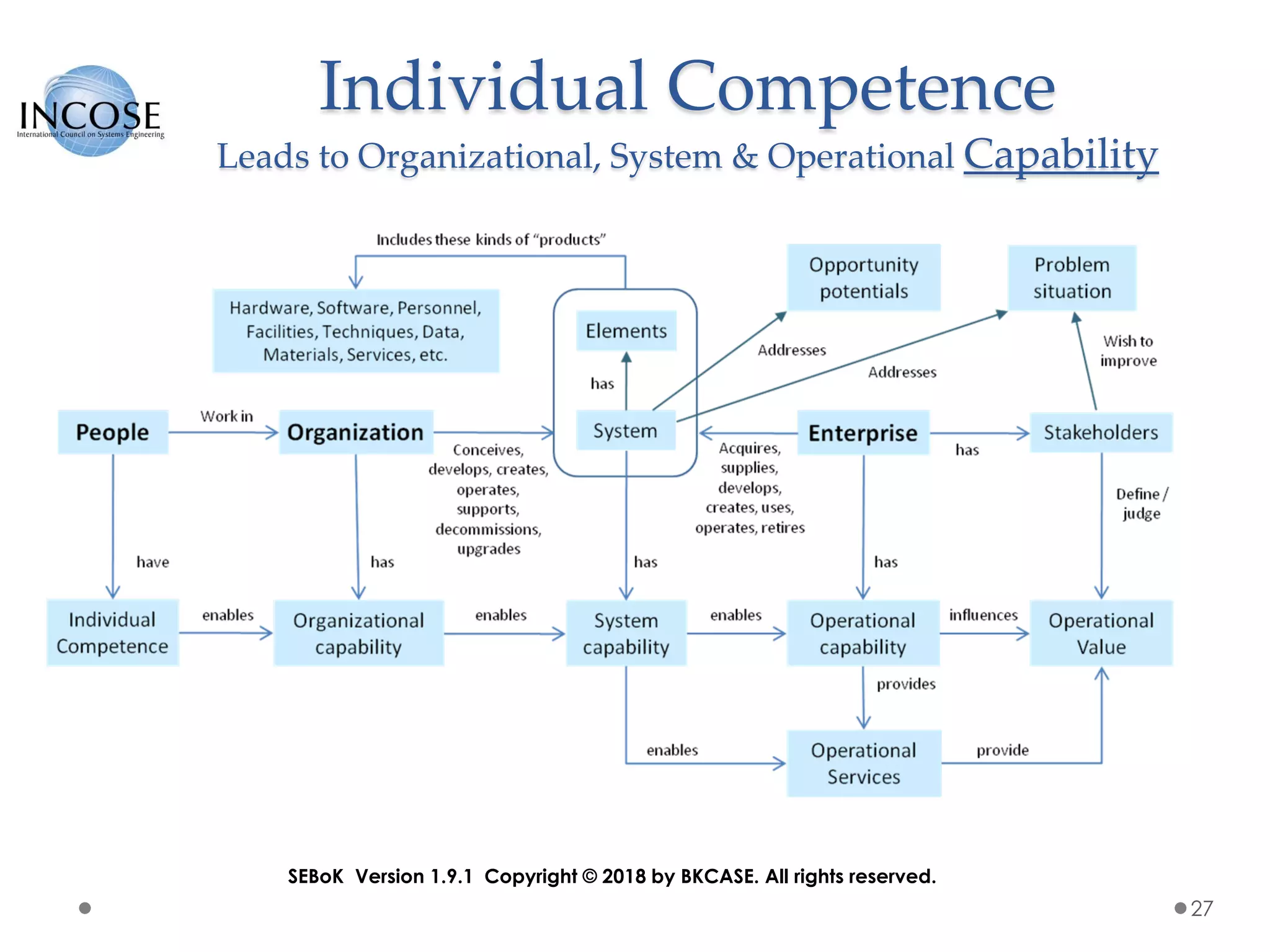
Individual Competence
Leads to Organizational, System & Operational Capability
27
SEBoK Version 1.9.1 Copyright © 2018 by BKCASE. All rights reserved.
Future of Systems Engineering
Competencies
F R O M
• The competency of today’s systems engineer vary
significantly in the depth and breadth of their
systems engineering knowledge. Their
competencies are often based on their domain
specific engineering background.
TO
• The expected competencies of a systems engineer
will be more consistently defined and broadened to
support the expanded systems engineering roles.
28
INCOSEa ( 2014 )
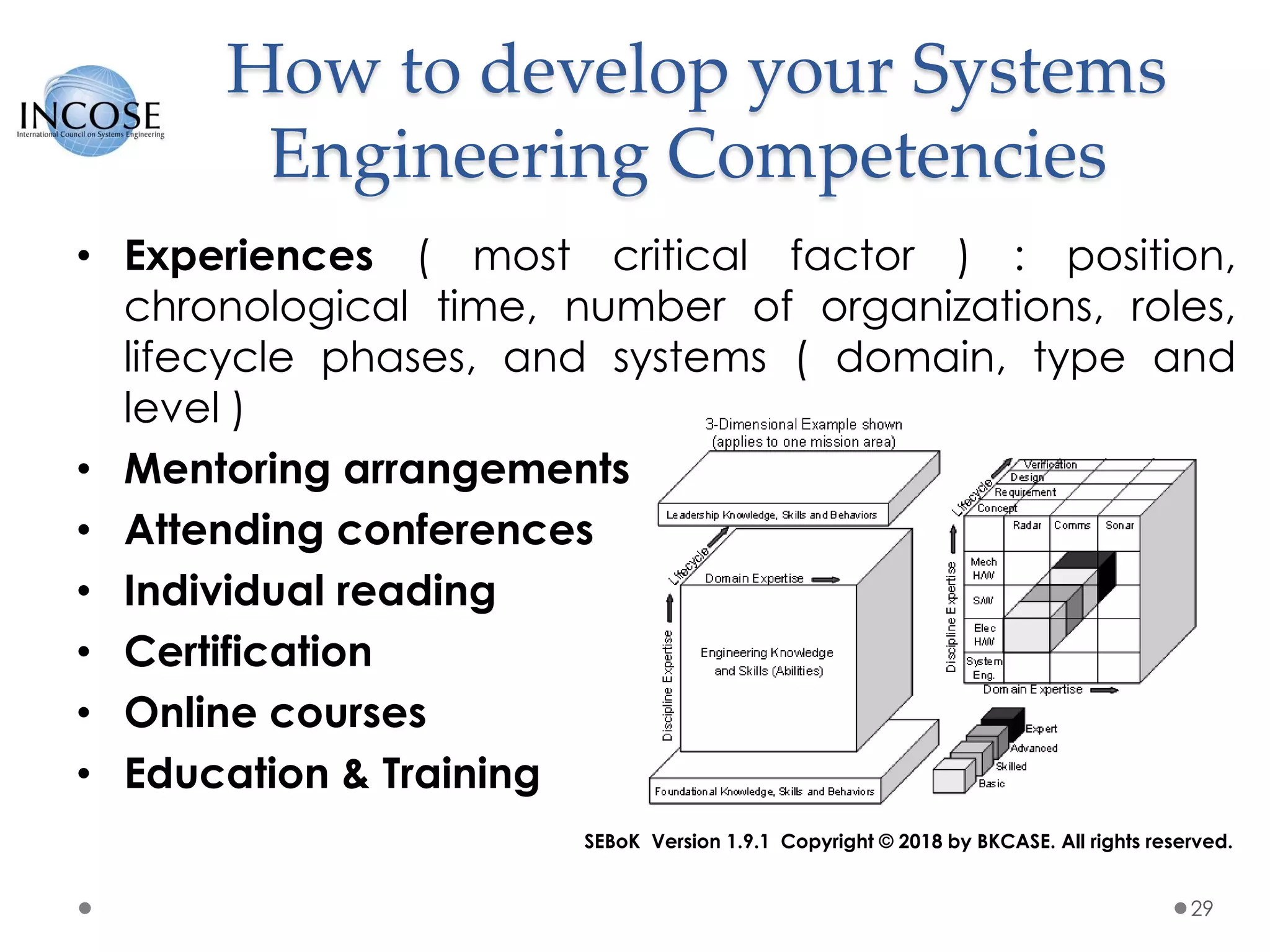
How to develop your Systems
Engineering Competencies
• Experiences ( most critical factor ) : position,
chronological time, number of organizations, roles,
lifecycle phases, and systems ( domain, type and
level )
• Mentoring arrangements
• Attending conferences
• Individual reading
• Certification
• Online courses
• Education & Training
29
SEBoK Version 1.9.1 Copyright © 2018 by BKCASE. All rights reserved.
Roles and Competencies
• A typical systems engineering role varies from
managing requirements to being the technical
leader on a project.
• A job role is a description of what a person does. A
job title is a convenient name for a role.
• A role is the part that is played within a specific
work process within the company.
30
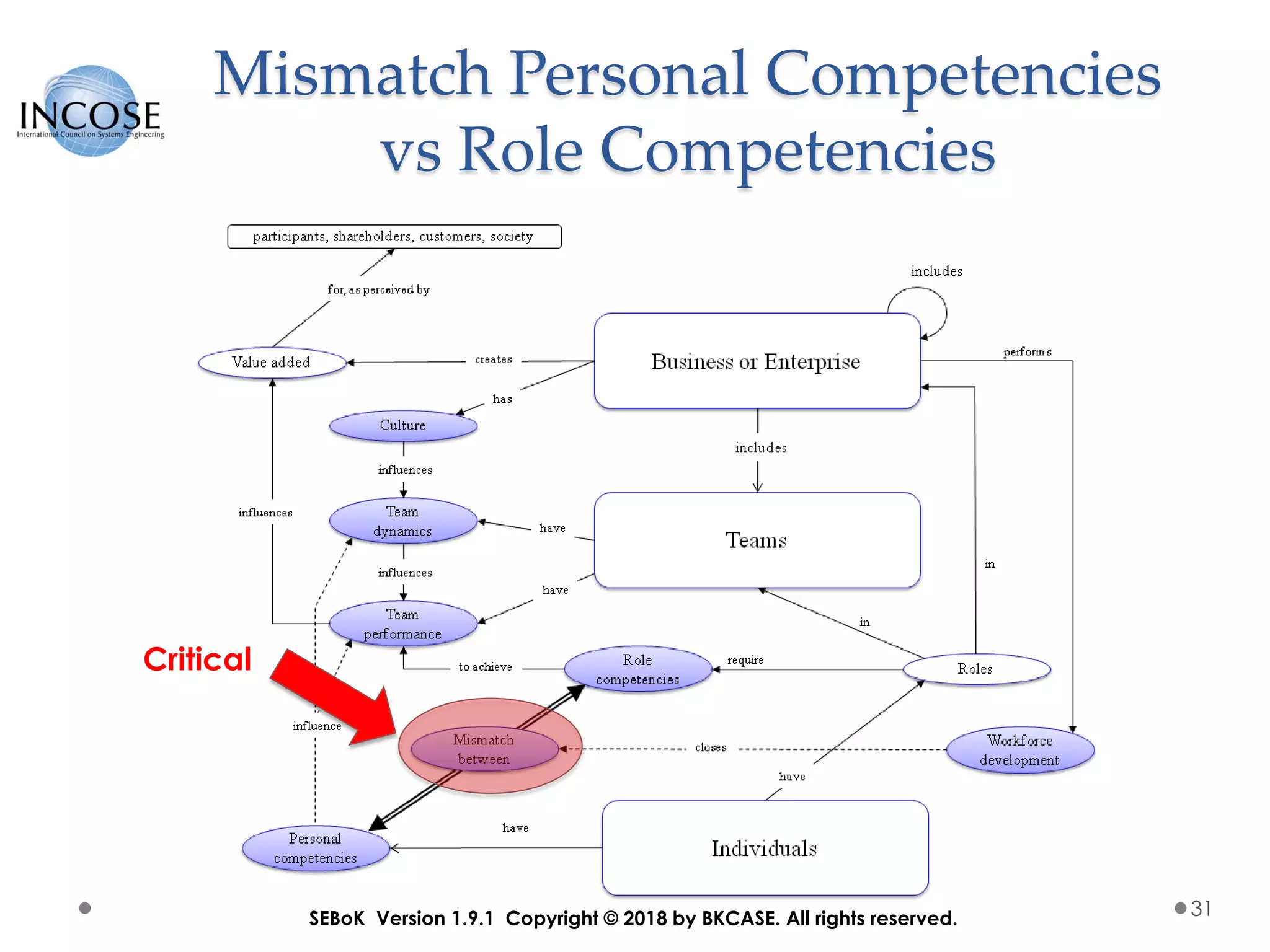
Mismatch Personal Competencies
vs Role Competencies
31SEBoK Version 1.9.1 Copyright © 2018 by BKCASE. All rights reserved.
Critical
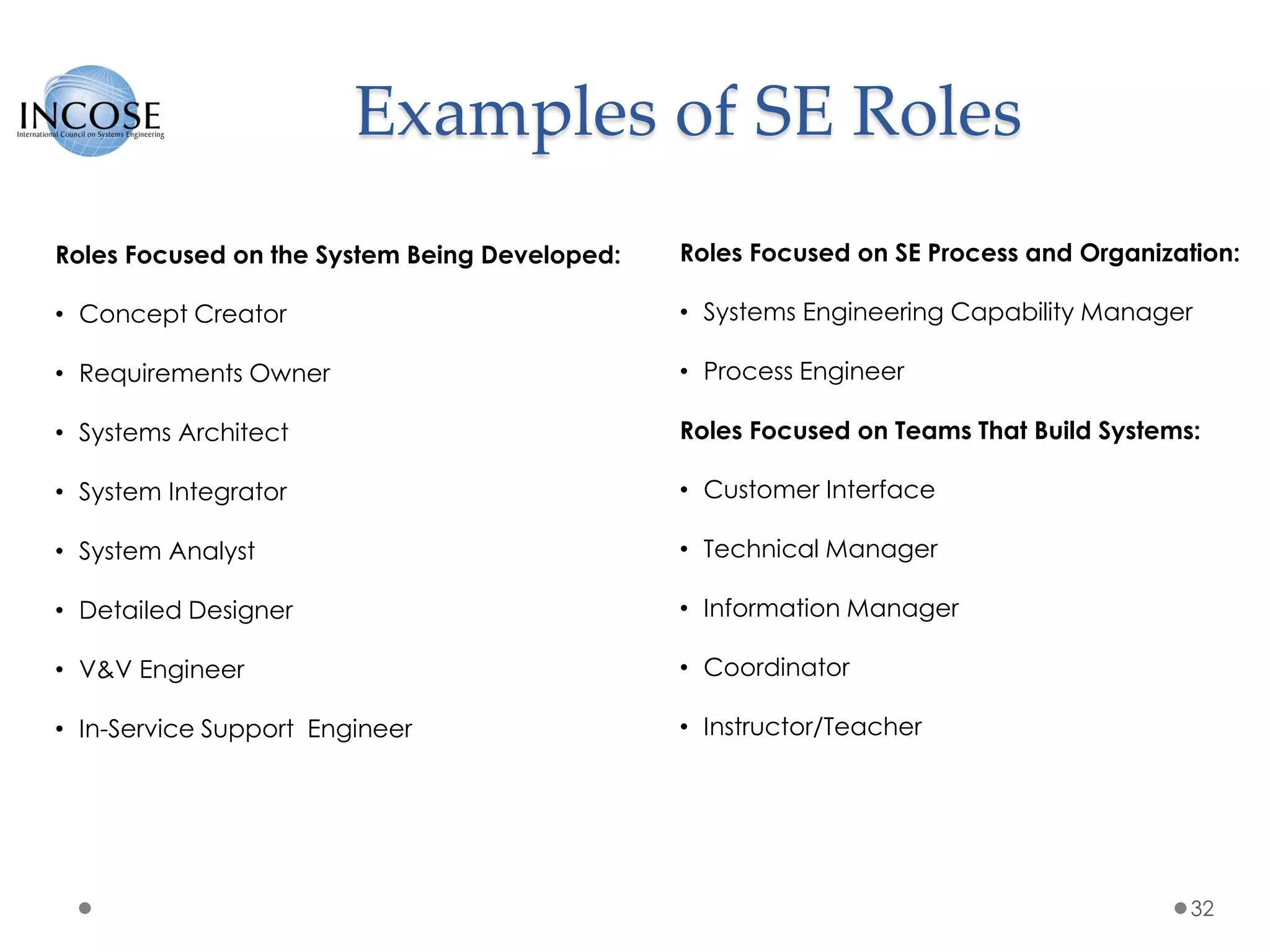
Examples of SE Roles
32
Roles Focused on the System Being Developed:
• Concept Creator
• Requirements Owner
• Systems Architect
• System Integrator
• System Analyst
• Detailed Designer
• V&V Engineer
• In-Service Support Engineer
Roles Focused on SE Process and Organization:
• Systems Engineering Capability Manager
• Process Engineer
Roles Focused on Teams That Build Systems:
• Customer Interface
• Technical Manager
• Information Manager
• Coordinator
• Instructor/Teacher
Contents
33
• Introduction
• Systems Engineering Competencies within
INCOSE
• New Systems Engineering Framework
• Terminology, definitions, and expectations
• Examples of Systems Engineering Models
• INCOSE Systems Engineering Competency
Framework ( ISECF )
• Conclusions
• Final Proposal
34
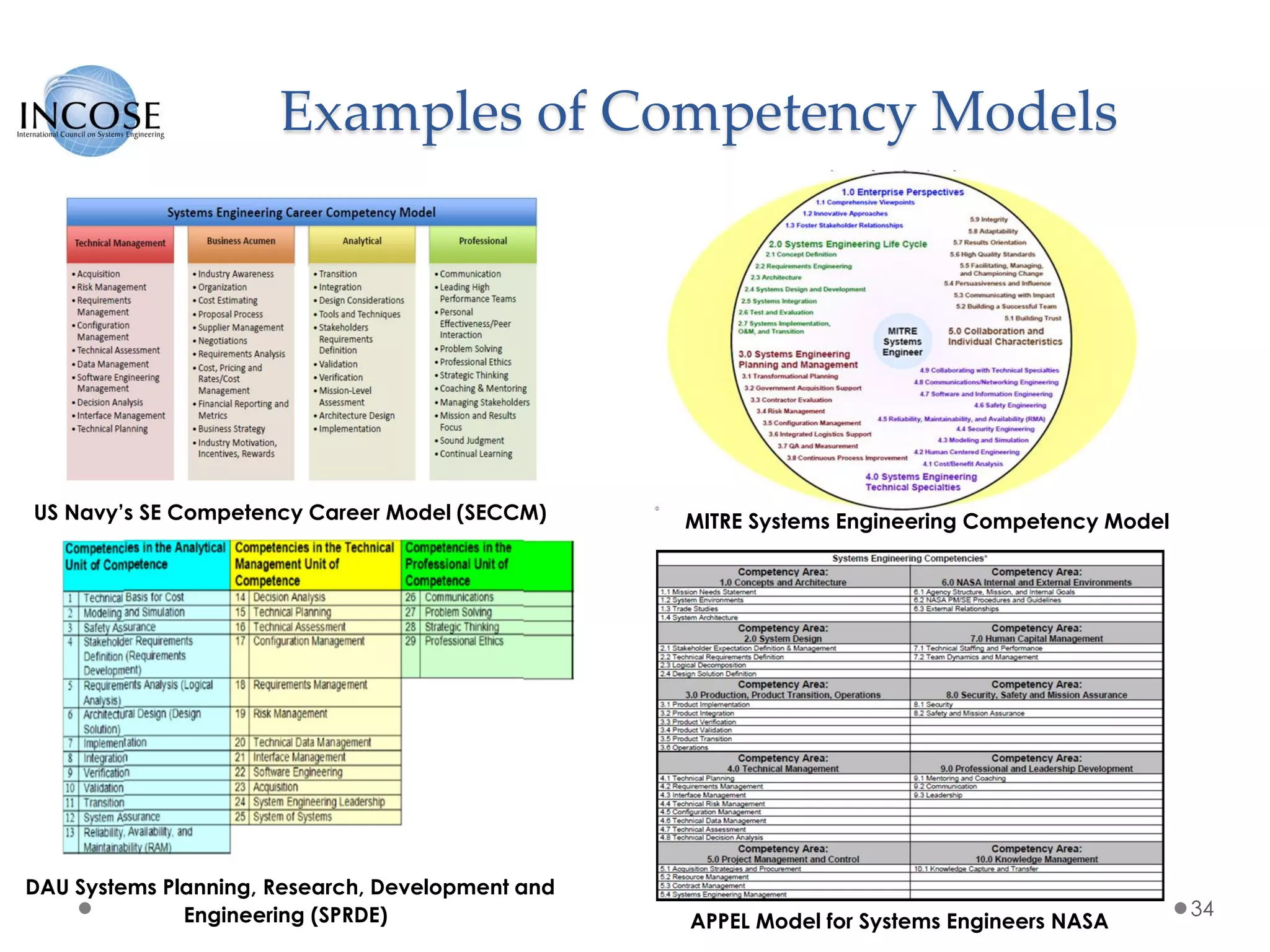
Examples of Competency Models
DAU Systems Planning, Research, Development and
Engineering (SPRDE) APPEL Model for Systems Engineers NASA
US Navy’s SE Competency Career Model (SECCM) MITRE Systems Engineering Competency Model
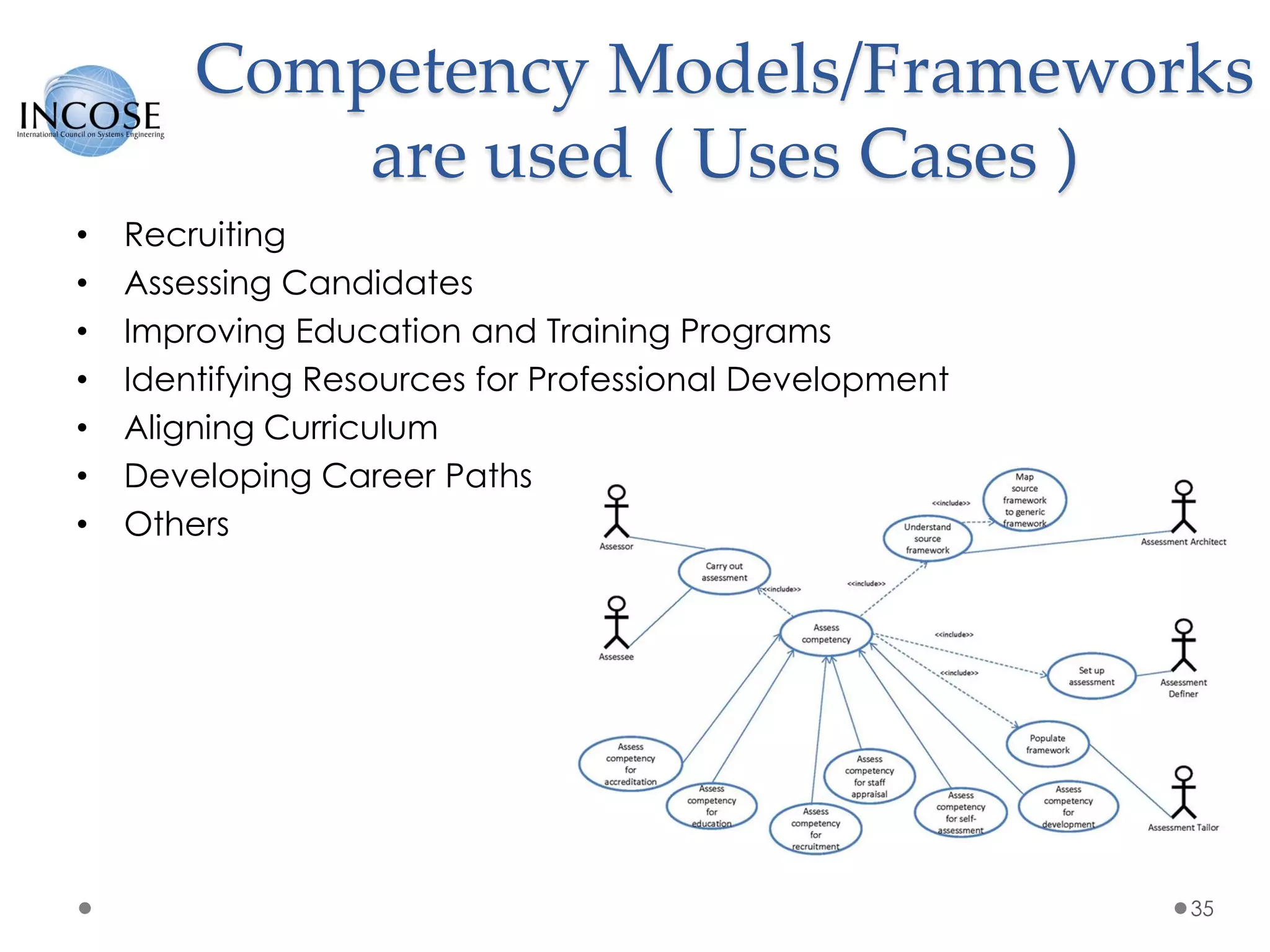
Competency Models/Frameworks
are used ( Uses Cases )
35
• Recruiting
• Assessing Candidates
• Improving Education and Training Programs
• Identifying Resources for Professional Development
• Aligning Curriculum
• Developing Career Paths
• Others
Contents
36
• Introduction
• Systems Engineering Competencies within
INCOSE
• New Systems Engineering Framework
• Terminology, definitions, and expectations
• Examples of Systems Engineering Models
• INCOSE Systems Engineering Competency
Framework ( ISECF )
• Conclusions
• Final Proposal
Why was the ISECF created?
• The INCOSE Competency Working Group (CWG)
produced the framework to improve the practice of
Systems Engineering.
• The framework along with adoption of effective
competency management approaches is intended
to be used by customer organizations to produce
competency models specifically tailored to their
unique needs.
37
Aligned with
• US Navy’s SE Competency Career Model (SECCM)
• DAU Competency Model and Acquisition Workforce
Qualification Initiative (AWQI)
• INCOSE Systems Engineering Handbook V 4.0
• INCOSE Professional Development Initiative
• Systems Engineering Research Center’s Helix Study
• Systems Engineering Body of Knowledge (SEBoK Part 5)
38
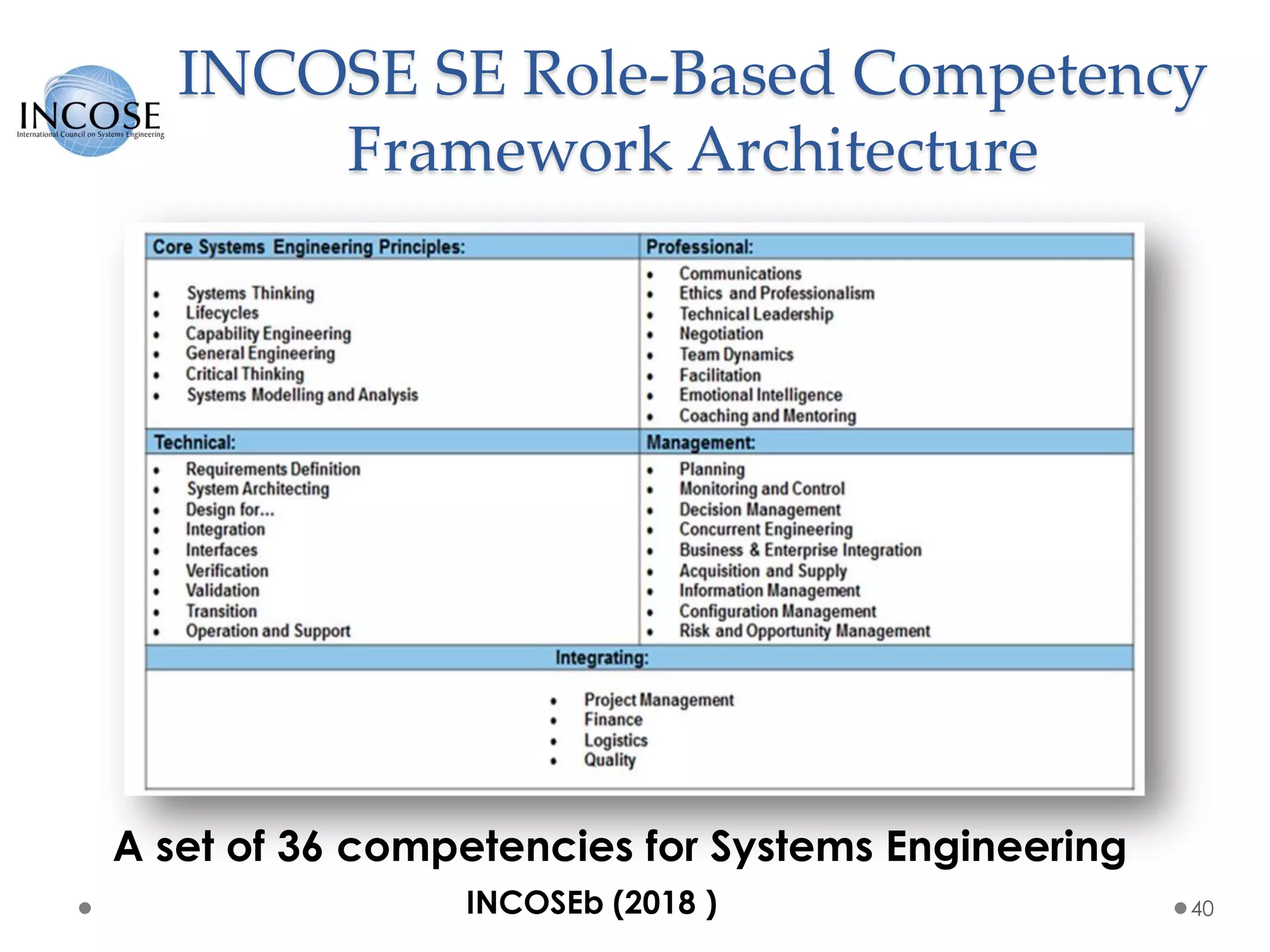
INCOSE SE Role-Based Competency
Framework Architecture
39
INCOSEb ( 2018 )
INCOSE SE Role-Based Competency
Framework Architecture
40
A set of 36 competencies for Systems Engineering
INCOSEb (2018 )
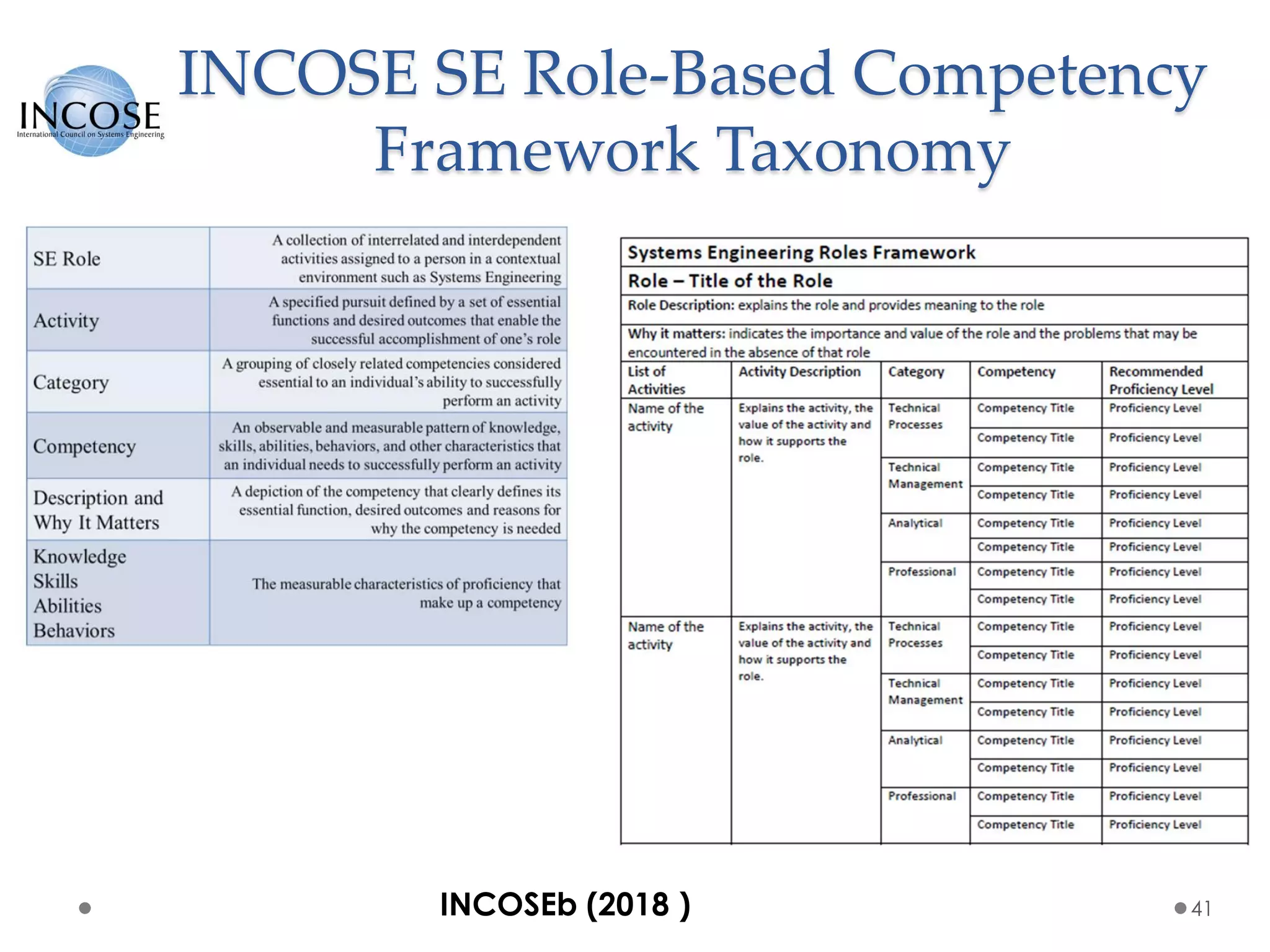
INCOSE SE Role-Based Competency
Framework Taxonomy
41INCOSEb (2018 )
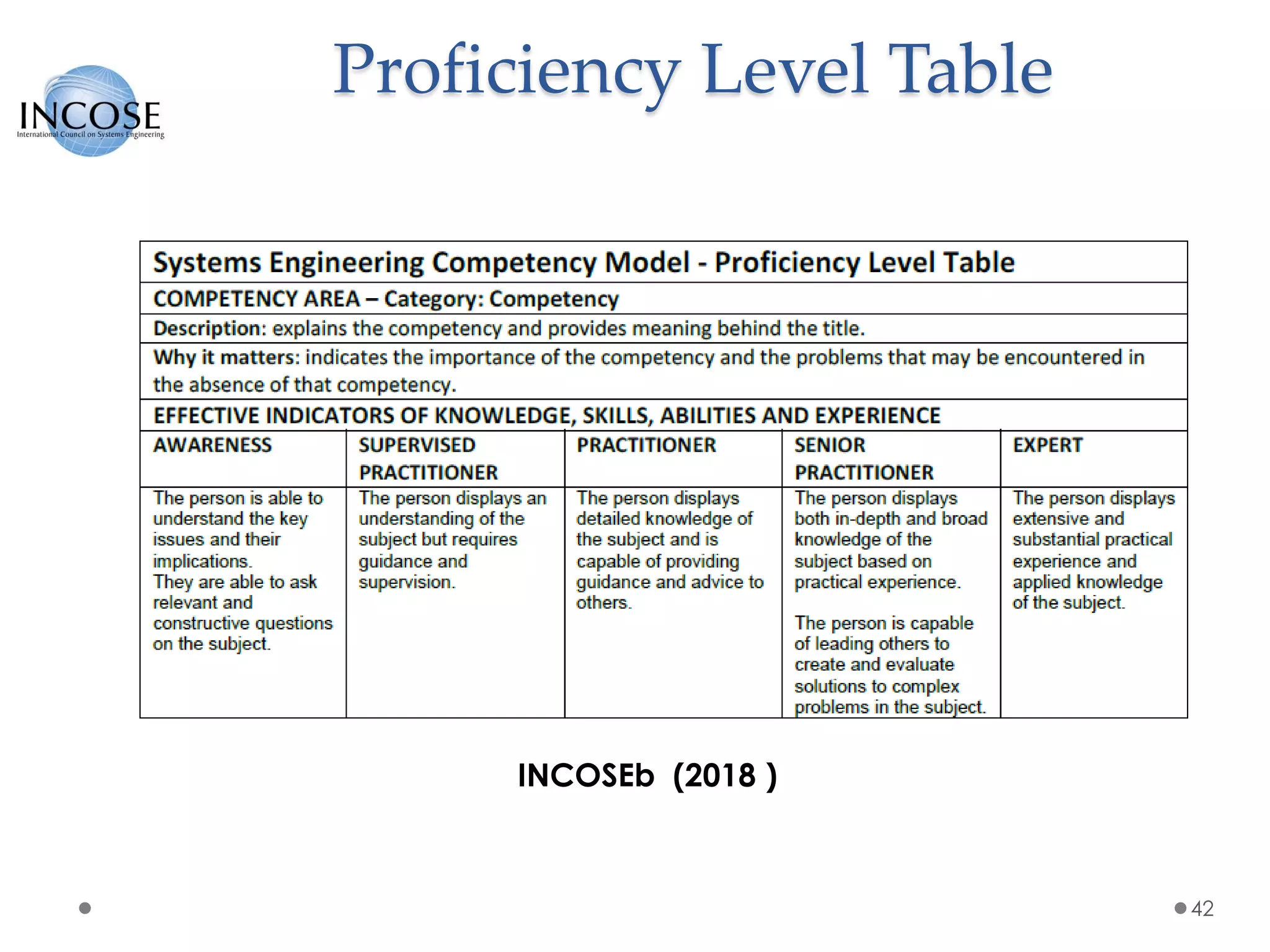
Proficiency Level Table
42
INCOSEb (2018 )
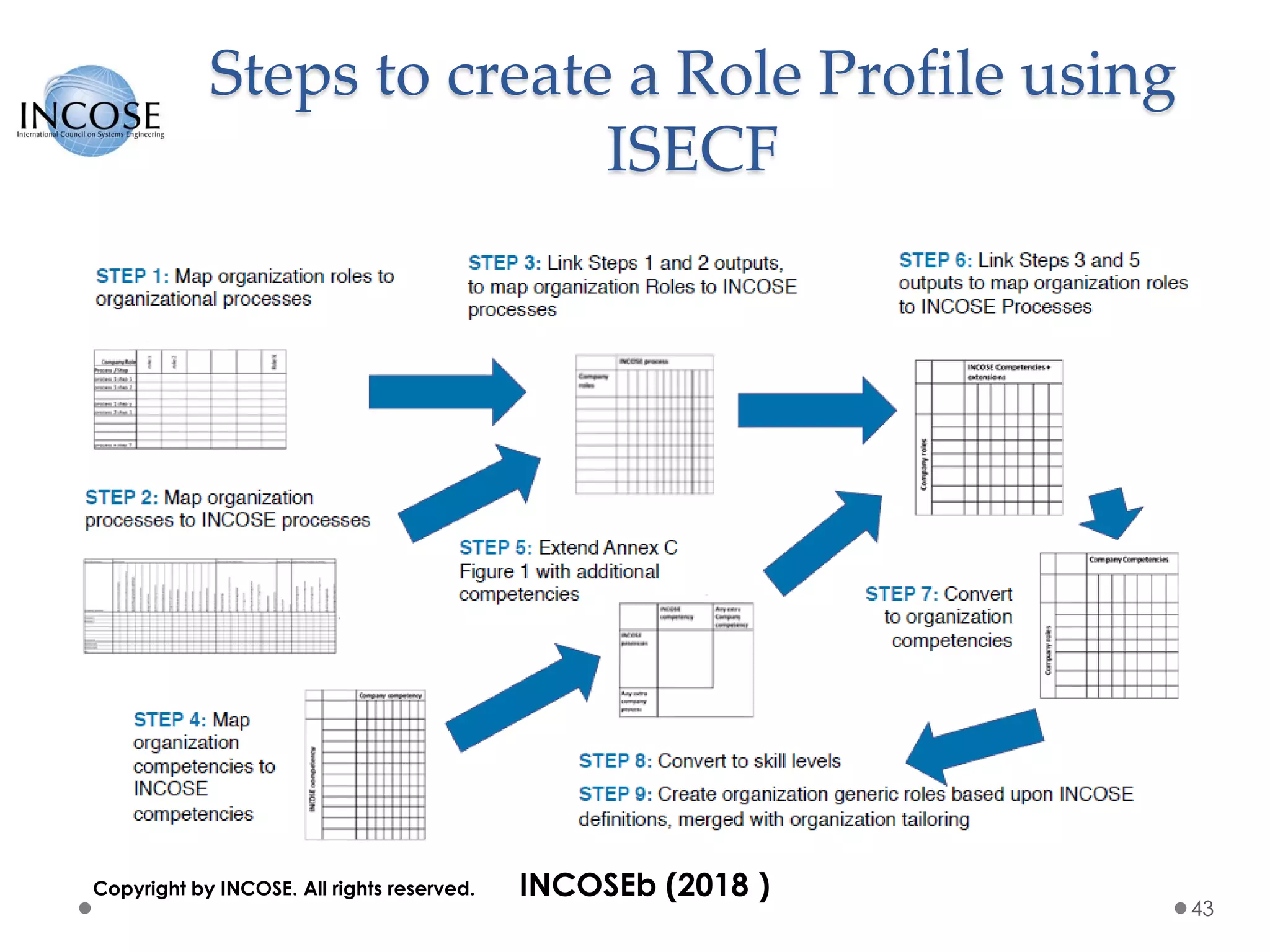
Steps to create a Role Profile using
ISECF
43
INCOSEb (2018 )Copyright by INCOSE. All rights reserved.
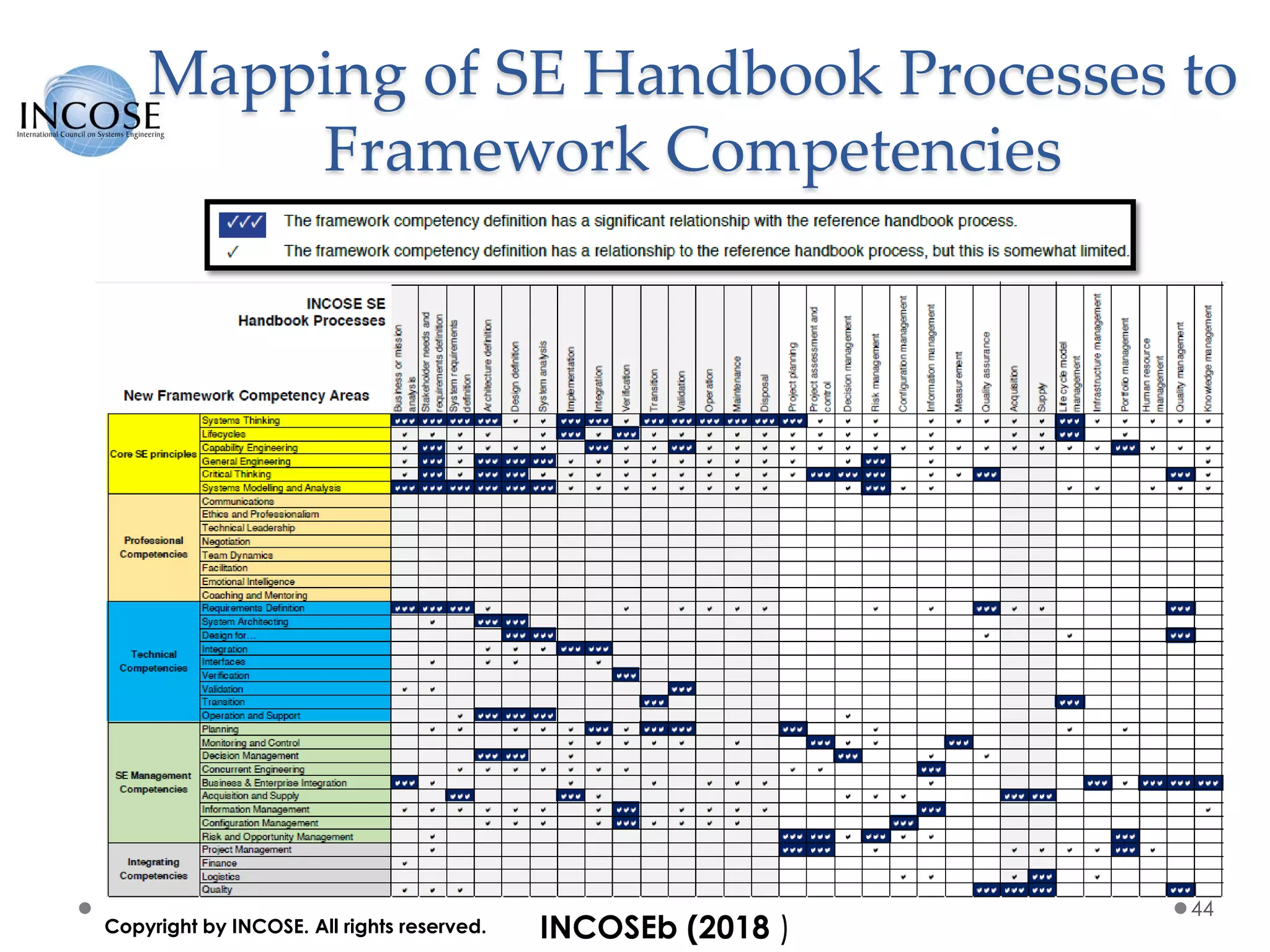
Mapping of SE Handbook Processes to
Framework Competencies
44
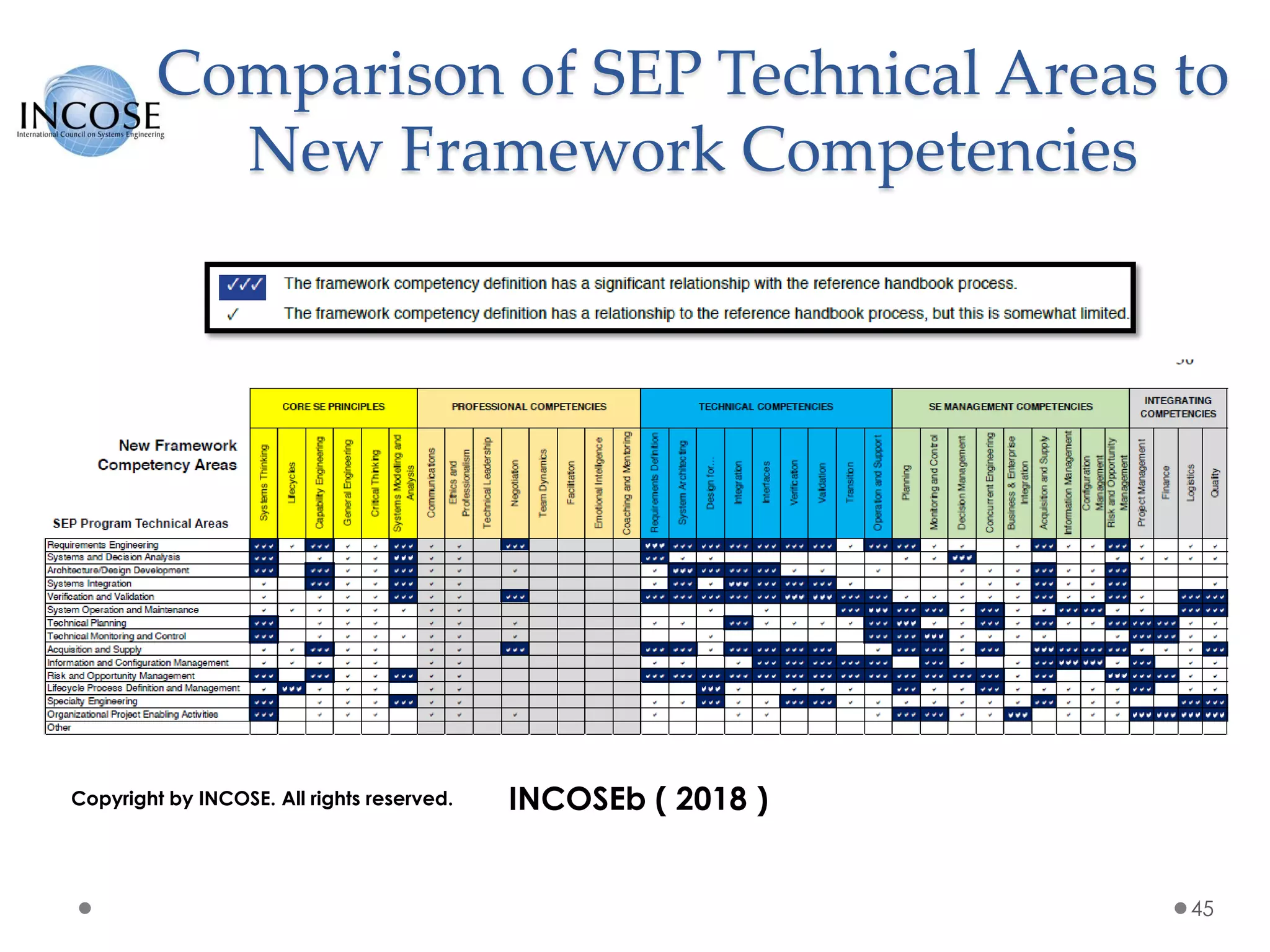
INCOSEb (2018 )Copyright by INCOSE. All rights reserved.
Comparison of SEP Technical Areas to
New Framework Competencies
45
INCOSEb ( 2018 )Copyright by INCOSE. All rights reserved.
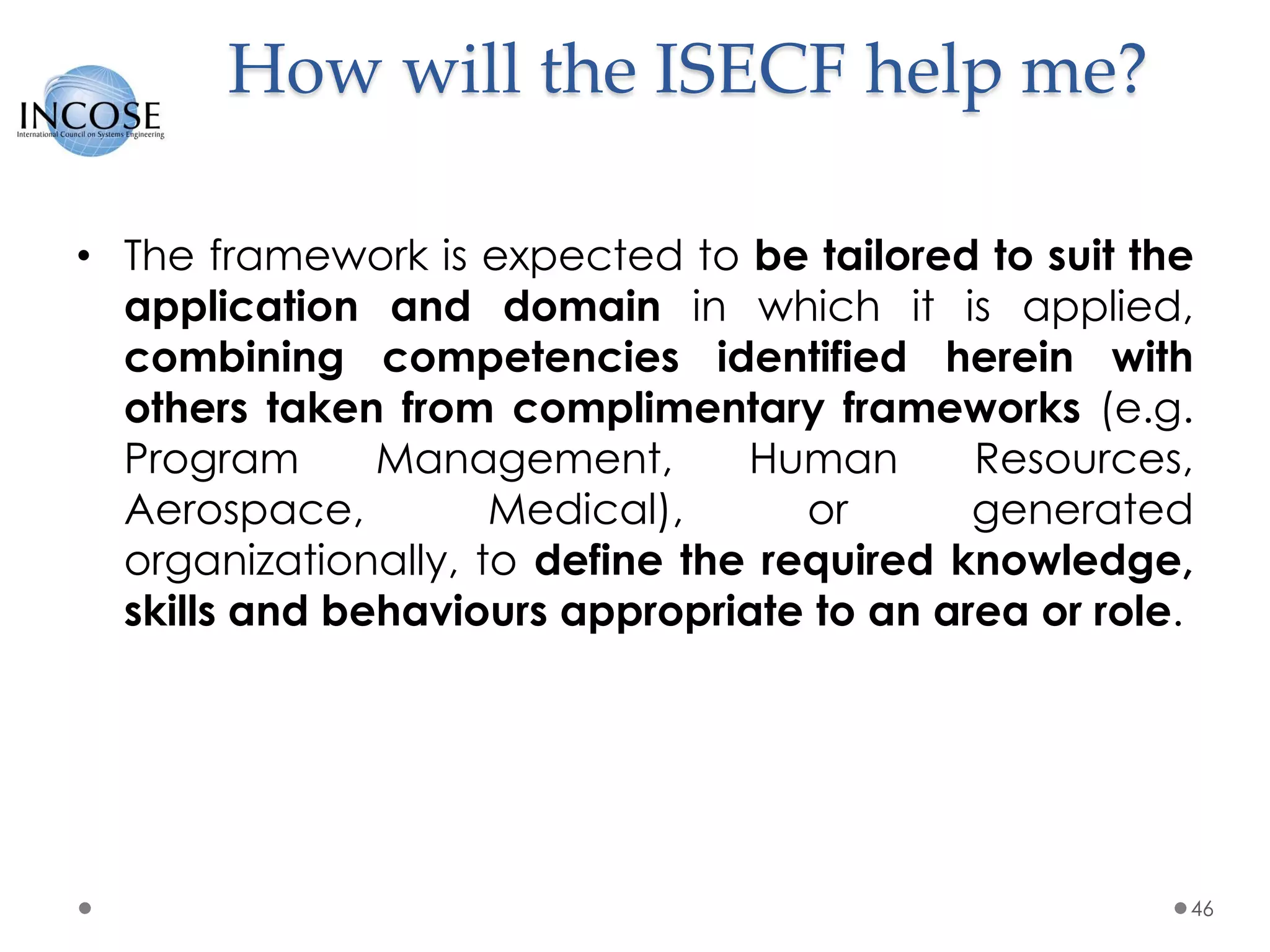
How will the ISECF help me?
• The framework is expected to be tailored to suit the
application and domain in which it is applied,
combining competencies identified herein with
others taken from complimentary frameworks (e.g.
Program Management, Human Resources,
Aerospace, Medical), or generated
organizationally, to define the required knowledge,
skills and behaviours appropriate to an area or role.
46
Contents
47
• Introduction
• Systems Engineering Competencies within
INCOSE
• New Systems Engineering Framework
• Terminology, definitions, and expectations
• Examples of Systems Engineering Models
• INCOSE Systems Engineering Competency
Framework ( ISECF )
• Conclusions
• Final Proposal
Conclusions
• INCOSE Competency Framework creates generic role
statements embedding Systems Engineering
competencies into the people that make up the
enterprise.
• Role statements can be considered the “requirements” for
the individuals who make up the enterprise (the system).
• A role statement must be a combination of describing
what the role does (activities) and the competencies
(knowledge, skills, abilities & behaviors) that the
individual needs to perform the activities.
• INCOSE Competency Framework is only a guide – the
definitions of Systems Engineering roles must be consistent
with the HR policies of the organization.
48
Contents
49
• Introduction
• Systems Engineering Competencies within
INCOSE
• New Systems Engineering Framework
• Terminology, definitions, and expectations
• Examples of Systems Engineering Models
• INCOSE Systems Engineering Competency
Framework ( ISECF )
• Conclusions
• Final Proposal
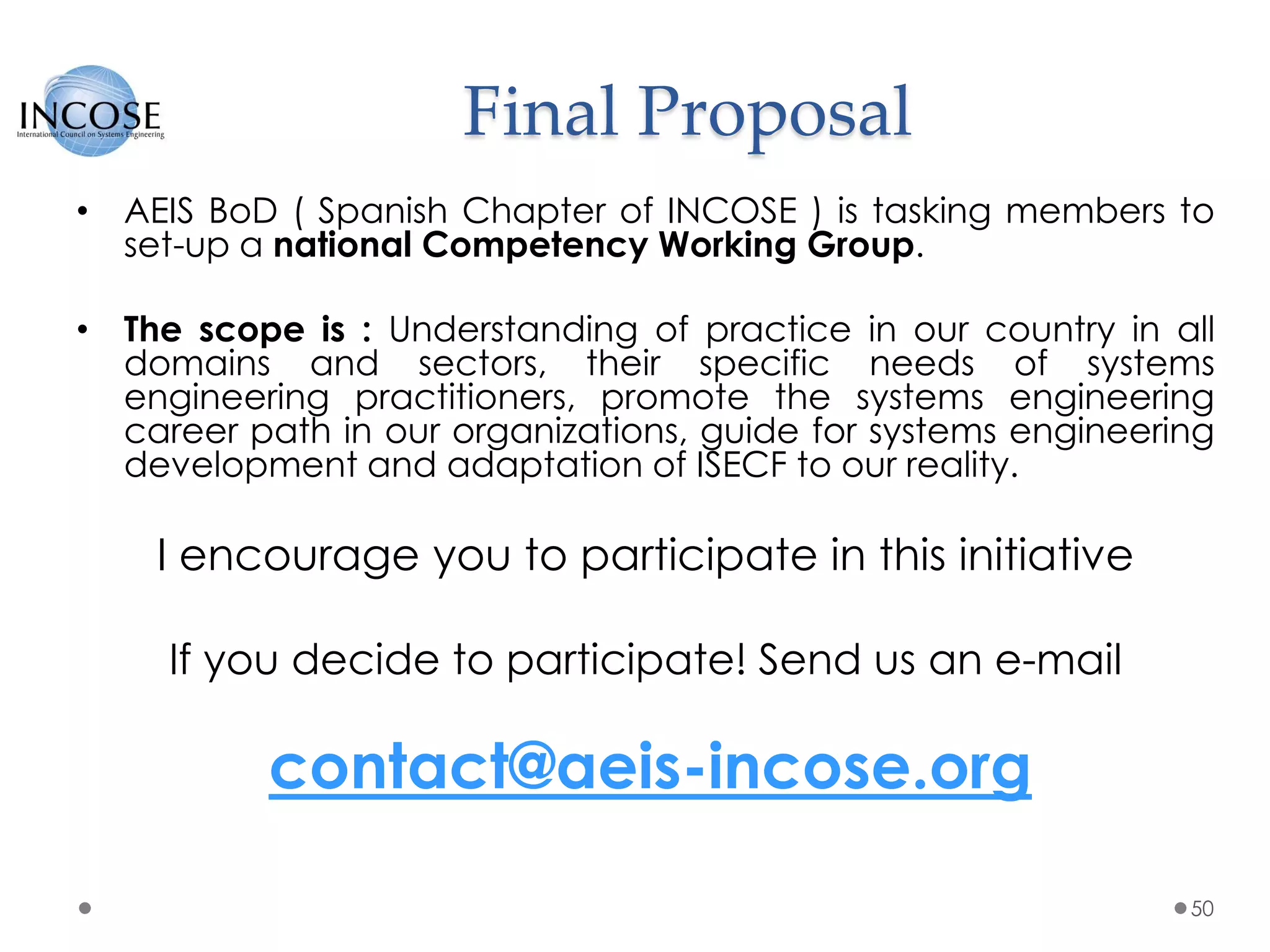
Final Proposal
• AEIS BoD ( Spanish Chapter of INCOSE ) is tasking members to
set-up a national Competency Working Group.
• The scope is : Understanding of practice in our country in all
domains and sectors, their specific needs of systems
engineering practitioners, promote the systems engineering
career path in our organizations, guide for systems engineering
development and adaptation of ISECF to our reality.
I encourage you to participate in this initiative
If you decide to participate! Send us an e-mail
contact@aeis-incose.org
50
51
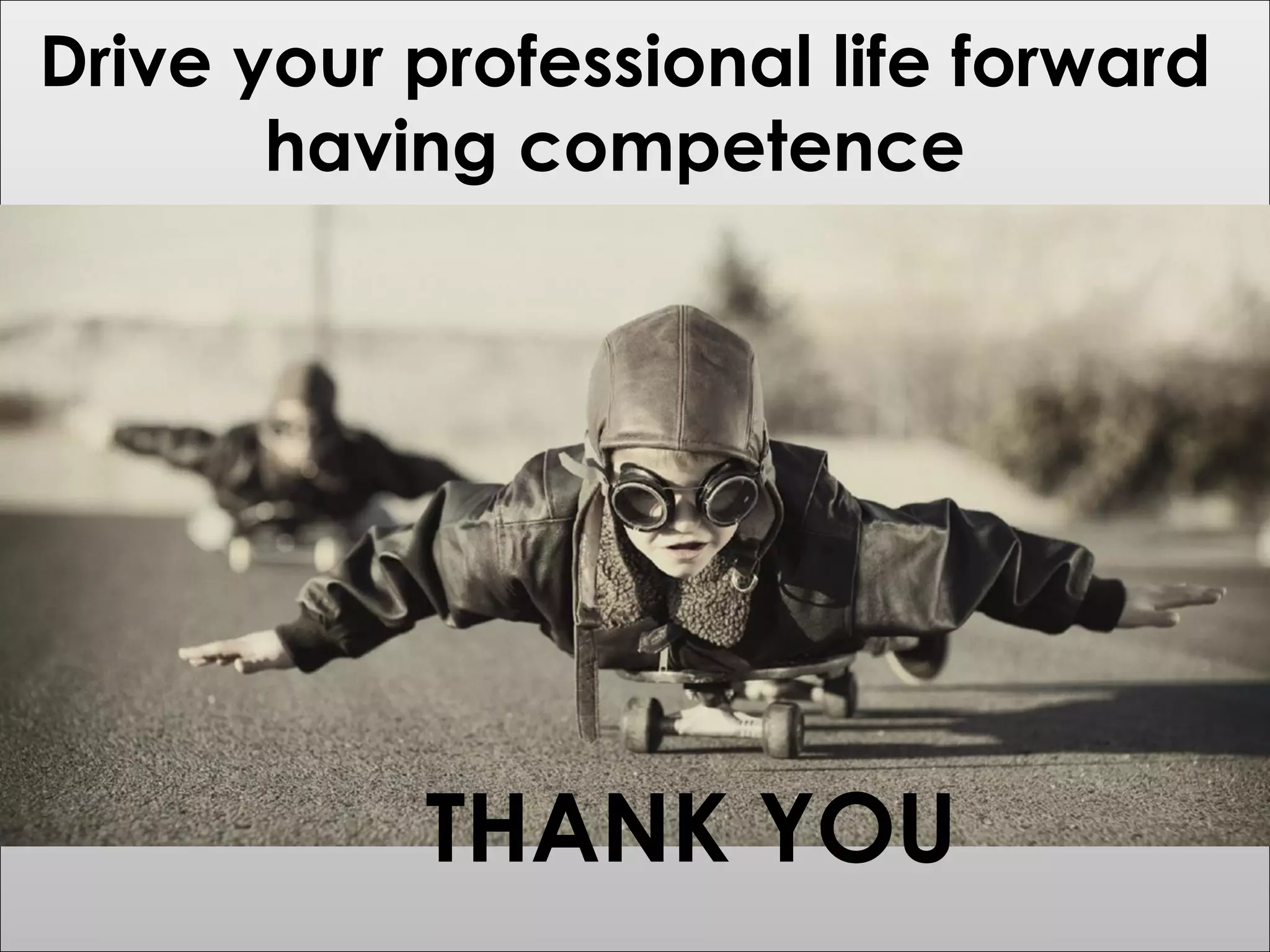
Drive your professional life forward
having competence
THANK YOU
References
• Holt, Jon; Perry, Simon ( 2011), “ A PRAGMATIC GUIDE TO COMPETENCY Tools,
Frameworks and Assessment”, ISBN 978-1-906124-70-0
• INCOSEa ( 2014 ) , “ A World in Motion – Systems Engineering Vision 2025”
Copyright ©2014 by INCOSE
• INCOSEb ( 2018 ), “ Systems Engineering Competency Framework”, INCOSE
Technical Product Reference: INCOSE-TP-2018-002-01.0
• Kossiakoff, Alexander; Sweet, William N.; Seymour, Samuel J. ; Biemer; Steven
M. ( 2011), “ Systems Engineering Principles and Practice”, ISBN: 978-0- 470-
40548-2, Wiley , 2nd Edition
• NASA (2007), “ NPR 7123.1A - NASA Interim Directive (NID) - NASA Systems
Engineering Processes and Requirements”, NASA Procedural Requirements -
March 26, 2007
52

INCOSE Systems Engineering Competency Framework ( ISECF)

  • 1.
    INCOSE Systems Engineering Competency Framework (ISECF ) Leganés (Madrid) , Spain, 20th June 2019 Bernardo A. Delicado INCOSE Competency Working Group (CWG) Bernardo.Delicado@incose.org
  • 2.
  • 3.
  • 4.
    Systems Engineers from FIVEcontinents 4 How to ensure effective Systems Engineering deployment in Projects and Organizations ? WHY is key the above question ( see next slide ) Competency is a common and shared concern of Systems Engineers worldwide
  • 5.
    Technical complexity continue togrow over time 5 Programs that have missed their commitments reveal many root causes, including the use of immature technologies, lack of appropriate levels of systems engineering discipline, and a plethora of complex engineering changes.
  • 6.
    Contents 6 • Introduction • SystemsEngineering Competencies within INCOSE • New Systems Engineering Framework • Terminology, definitions, and expectations • Examples of Systems Engineering Models • INCOSE Systems Engineering Competency Framework ( ISECF ) • Conclusions • Final Proposal
  • 7.
    Contents 7 • Introduction • SystemsEngineering Competencies within INCOSE • New Systems Engineering Framework • Terminology, definitions, and expectations • Examples of Systems Engineering Models • INCOSE Systems Engineering Competency Framework ( ISECF ) • Conclusions • Final Proposal
  • 8.
    The practice ofSystems Engineering is….. 8 …..a balance between Systemic and Systematic aspects: Systemic - thinking about the whole system, its context and stakeholders Systematic - following a structured approach to the realization of the system ( INCOSE UK website )
  • 9.
    Systemic System (system of interest ) Sistematic SystemLife Cycle System MODEL PROBLEM /NEED SYSTEM SOLUTION Product/ Service lens refers to the holistic appreciation of the problem/system of interest, considering its context, stakeholders, and the interrelationships and interconnections ( SYSTEMS THINKING ) refers to taking a structured, orderly approach to solve the problem and to implement the system SOFT HARD System MODEL Copyright © 2019 B Delicado prepared by the author
  • 10.
    Relevant Characteristics of SystemsEngineers 10 Systems Engineers are the glue that enables a complex project to succeed • Most good Systems Engineers are “T-shaped people“ • Broad understanding across domains/disciplines • Deep specialist competence in systems approaches • May also have secondary disciplines • MOST systems engineers are interesting, and inquisitive people open to new ideas ( INCOSE UK website )
  • 11.
  • 12.
    T Model forSE Career Development 12 HW … DEEP Large Project Lead BREATH Educational Disciplines SW… Experience Mentoring&Life-LongLearning Program Lead Small project Lead Systems Program LeadBSMSPhD Education Technical Contributor ( 1 - 4 years ) Team Participant ( 5 - 8 years ) Senior Systems Engineer ( 13 - 20 years) Systems Engineering Leader ( >20 years) Systems Engineer ( 9 - 12 years) Kossiakoff et al ( 2011)
  • 13.
    Contents 13 • Introduction • SystemsEngineering Competencies within INCOSE • New Systems Engineering Framework • Terminology, definitions, and expectations • Examples of Systems Engineering Models • INCOSE Systems Engineering Competency Framework ( ISECF ) • Conclusions • Final Proposal
  • 14.
    Most Relevant Activitieson SE Competencies • Understanding what makes an Effective Systems Engineer o INCOSE Competency Working Group o INCOSE Competency Framework • Qualifications o INCOSE SE Certification 14
  • 15.
    CWG Scope 15 • Focusedon the development and continual improvement of the SE Role Based Competency Framework and Assessment Guide through collaboration with users, academia, industry and Working Groups as it relates to changes in SE processes and methods employed throughout a product or system lifecycle. • Maintain a broad membership to enhance knowledge base. • Evaluate competency alignment with other organizations/functions such as Program Management. • Ensure consistency of product with INCOSE SE Handbook and Certification. • Produce papers for publication. • Provide training related to framework content and assessment capabilities. • Collaborate with the INCOSE Professional Development Initiative with training needs assessments.
  • 16.
    CWG : Awardfor Product of the Year 16 At IW 2019 Competency Working Group was selected to receive an award for Product of the Year in 2018. This award intended to recognize the Competency Working Group for publishing the INCOSE Systems Engineering Competency Framework
  • 17.
    INCOSE Competency Framework (ISECF) 17 •This is a generic framework. It can be applied in the context of any application, project, organization or enterprise for both individual and/or organizational assessment and/or development. https://www.incose.org/products-and-publications/competency-framework
  • 18.
    INCOSE SEP Architecture 18 Multi-LevelBase Credentials The base ASEP, CSEP, and ESEP credentials cover the breadth of systems engineering at increasing levels of leadership, accomplishments, and experience. Copyright by INCOSE. All rights reserved.
  • 19.
    Contents 19 • Introduction • SystemsEngineering Competencies within INCOSE • New Systems Engineering Framework • Terminology, definitions, and expectations • Examples of Systems Engineering Models • INCOSE Systems Engineering Competency Framework ( ISECF ) • Conclusions • Final Proposal
  • 20.
    INCOSE BoD taskedCWG 20 In 2014, INCOSE leadership tasked the Competency Working Group ( CWG ) with two objectives: • The first objective was to evolve the former INCOSE UK Competency Framework to a globally accepted (i.e., approved for release as an INCOSE product) and marketed standard competency framework, based on systems engineering effectiveness, that could be used to produce competency models tailored to the needs of organizations. This is an important distinction, the competency framework is not itself a competency model. • The second objective was to create a globally used standard assessment instrument/tool based on the competency framework that is tailorable to the needs of the customer organizations.
  • 21.
    Done so farand on-going activities 21 • Originally developed in UK ( 2005 ) o Adopted as an INCOSE Technical Product in UK o Defines competencies of a Systems Engineer o In use by UK industry and Government. • Version 1.0 ( 2018 ) o Evolution to a role-based competency framework that is extensible, scalable, and can be tailored adding the Concepts of Roles and Activities. o Enhance the proficiency levels by adding a new level: Senior Practitioner • On-going ( 2020 ) o Assessment Guide Development o Use cases
  • 22.
    Contents 22 • Introduction • SystemsEngineering Competencies within INCOSE • New Systems Engineering Framework • Terminology, definitions, and expectations • Examples of Systems Engineering Models • INCOSE Systems Engineering Competency Framework ( ISECF ) • Conclusions • Final Proposal
  • 23.
    Competency • A measureof an individual’s ability in terms of their knowledge, skills, and behaviour to perform a given role Holt and Perry (2011) 23
  • 24.
    Competence vs Competency •Competence – the ability to do something well; • Competency – an important skill that is needed to do a job. The key difference here is that competence reflects the total ability of the individual, whereas a competency is a single skill; (hopefully) one of many that the individual will hold. The sum of an individual’s competencies will make up their competence and it is these individual competencies that are assessed to provide an overall indication of competence. Holt and Perry ( 2011) 24
  • 25.
    Capability vs Competence •Capability describes the ability of an organization or organizational unit. • Competence describes the ability of an individual to do something. Holt and Perry ( 2011) 25
  • 26.
  • 27.
    Individual Competence Leads toOrganizational, System & Operational Capability 27 SEBoK Version 1.9.1 Copyright © 2018 by BKCASE. All rights reserved.
  • 28.
    Future of SystemsEngineering Competencies F R O M • The competency of today’s systems engineer vary significantly in the depth and breadth of their systems engineering knowledge. Their competencies are often based on their domain specific engineering background. TO • The expected competencies of a systems engineer will be more consistently defined and broadened to support the expanded systems engineering roles. 28 INCOSEa ( 2014 )
  • 29.
    How to developyour Systems Engineering Competencies • Experiences ( most critical factor ) : position, chronological time, number of organizations, roles, lifecycle phases, and systems ( domain, type and level ) • Mentoring arrangements • Attending conferences • Individual reading • Certification • Online courses • Education & Training 29 SEBoK Version 1.9.1 Copyright © 2018 by BKCASE. All rights reserved.
  • 30.
    Roles and Competencies •A typical systems engineering role varies from managing requirements to being the technical leader on a project. • A job role is a description of what a person does. A job title is a convenient name for a role. • A role is the part that is played within a specific work process within the company. 30
  • 31.
    Mismatch Personal Competencies vsRole Competencies 31SEBoK Version 1.9.1 Copyright © 2018 by BKCASE. All rights reserved. Critical
  • 32.
    Examples of SERoles 32 Roles Focused on the System Being Developed: • Concept Creator • Requirements Owner • Systems Architect • System Integrator • System Analyst • Detailed Designer • V&V Engineer • In-Service Support Engineer Roles Focused on SE Process and Organization: • Systems Engineering Capability Manager • Process Engineer Roles Focused on Teams That Build Systems: • Customer Interface • Technical Manager • Information Manager • Coordinator • Instructor/Teacher
  • 33.
    Contents 33 • Introduction • SystemsEngineering Competencies within INCOSE • New Systems Engineering Framework • Terminology, definitions, and expectations • Examples of Systems Engineering Models • INCOSE Systems Engineering Competency Framework ( ISECF ) • Conclusions • Final Proposal
  • 34.
    34 Examples of CompetencyModels DAU Systems Planning, Research, Development and Engineering (SPRDE) APPEL Model for Systems Engineers NASA US Navy’s SE Competency Career Model (SECCM) MITRE Systems Engineering Competency Model
  • 35.
    Competency Models/Frameworks are used( Uses Cases ) 35 • Recruiting • Assessing Candidates • Improving Education and Training Programs • Identifying Resources for Professional Development • Aligning Curriculum • Developing Career Paths • Others
  • 36.
    Contents 36 • Introduction • SystemsEngineering Competencies within INCOSE • New Systems Engineering Framework • Terminology, definitions, and expectations • Examples of Systems Engineering Models • INCOSE Systems Engineering Competency Framework ( ISECF ) • Conclusions • Final Proposal
  • 37.
    Why was theISECF created? • The INCOSE Competency Working Group (CWG) produced the framework to improve the practice of Systems Engineering. • The framework along with adoption of effective competency management approaches is intended to be used by customer organizations to produce competency models specifically tailored to their unique needs. 37
  • 38.
    Aligned with • USNavy’s SE Competency Career Model (SECCM) • DAU Competency Model and Acquisition Workforce Qualification Initiative (AWQI) • INCOSE Systems Engineering Handbook V 4.0 • INCOSE Professional Development Initiative • Systems Engineering Research Center’s Helix Study • Systems Engineering Body of Knowledge (SEBoK Part 5) 38
  • 39.
    INCOSE SE Role-BasedCompetency Framework Architecture 39 INCOSEb ( 2018 )
  • 40.
    INCOSE SE Role-BasedCompetency Framework Architecture 40 A set of 36 competencies for Systems Engineering INCOSEb (2018 )
  • 41.
    INCOSE SE Role-BasedCompetency Framework Taxonomy 41INCOSEb (2018 )
  • 42.
  • 43.
    Steps to createa Role Profile using ISECF 43 INCOSEb (2018 )Copyright by INCOSE. All rights reserved.
  • 44.
    Mapping of SEHandbook Processes to Framework Competencies 44 INCOSEb (2018 )Copyright by INCOSE. All rights reserved.
  • 45.
    Comparison of SEPTechnical Areas to New Framework Competencies 45 INCOSEb ( 2018 )Copyright by INCOSE. All rights reserved.
  • 46.
    How will theISECF help me? • The framework is expected to be tailored to suit the application and domain in which it is applied, combining competencies identified herein with others taken from complimentary frameworks (e.g. Program Management, Human Resources, Aerospace, Medical), or generated organizationally, to define the required knowledge, skills and behaviours appropriate to an area or role. 46
  • 47.
    Contents 47 • Introduction • SystemsEngineering Competencies within INCOSE • New Systems Engineering Framework • Terminology, definitions, and expectations • Examples of Systems Engineering Models • INCOSE Systems Engineering Competency Framework ( ISECF ) • Conclusions • Final Proposal
  • 48.
    Conclusions • INCOSE CompetencyFramework creates generic role statements embedding Systems Engineering competencies into the people that make up the enterprise. • Role statements can be considered the “requirements” for the individuals who make up the enterprise (the system). • A role statement must be a combination of describing what the role does (activities) and the competencies (knowledge, skills, abilities & behaviors) that the individual needs to perform the activities. • INCOSE Competency Framework is only a guide – the definitions of Systems Engineering roles must be consistent with the HR policies of the organization. 48
  • 49.
    Contents 49 • Introduction • SystemsEngineering Competencies within INCOSE • New Systems Engineering Framework • Terminology, definitions, and expectations • Examples of Systems Engineering Models • INCOSE Systems Engineering Competency Framework ( ISECF ) • Conclusions • Final Proposal
  • 50.
    Final Proposal • AEISBoD ( Spanish Chapter of INCOSE ) is tasking members to set-up a national Competency Working Group. • The scope is : Understanding of practice in our country in all domains and sectors, their specific needs of systems engineering practitioners, promote the systems engineering career path in our organizations, guide for systems engineering development and adaptation of ISECF to our reality. I encourage you to participate in this initiative If you decide to participate! Send us an e-mail contact@aeis-incose.org 50
  • 51.
    51 Drive your professionallife forward having competence THANK YOU
  • 52.
    References • Holt, Jon;Perry, Simon ( 2011), “ A PRAGMATIC GUIDE TO COMPETENCY Tools, Frameworks and Assessment”, ISBN 978-1-906124-70-0 • INCOSEa ( 2014 ) , “ A World in Motion – Systems Engineering Vision 2025” Copyright ©2014 by INCOSE • INCOSEb ( 2018 ), “ Systems Engineering Competency Framework”, INCOSE Technical Product Reference: INCOSE-TP-2018-002-01.0 • Kossiakoff, Alexander; Sweet, William N.; Seymour, Samuel J. ; Biemer; Steven M. ( 2011), “ Systems Engineering Principles and Practice”, ISBN: 978-0- 470- 40548-2, Wiley , 2nd Edition • NASA (2007), “ NPR 7123.1A - NASA Interim Directive (NID) - NASA Systems Engineering Processes and Requirements”, NASA Procedural Requirements - March 26, 2007 52