Submitted by
Gopi chand
IMPEDENCE
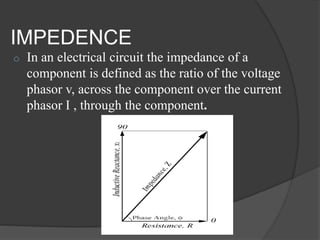
o In an electrical circuit the impedance of a
component is defined as the ratio of the voltage
phasor v, across the component over the current
phasor I , through the component.
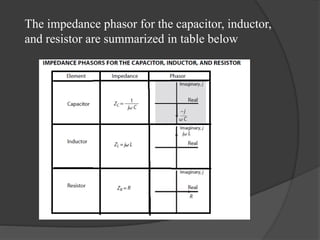
The impedance phasor for the capacitor, inductor,
and resistor are summarized in table below
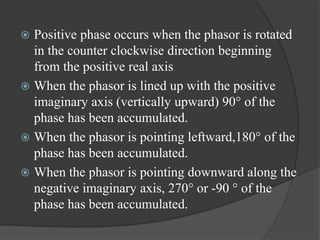
 Positive phase occurs when the phasor is rotated
in the counter clockwise direction beginning
from the positive real axis
 When the phasor is lined up with the positive
imaginary axis (vertically upward) 90° of the
phase has been accumulated.
 When the phasor is pointing leftward,180° of the
phase has been accumulated.
 When the phasor is pointing downward along the
negative imaginary axis, 270° or -90 ° of the
phase has been accumulated.
 Keeping in mind that impedance is voltage
divided by current, a positive imaginary
component indicates voltage leading current, and
a negative imaginary component indicates
voltage lagging current.
 Because j occurs in the denominator of the
capacitor impedance, the capacitor voltage lags
its current by 90°.
 Similarly, because j occurs in the numerator of
the inductor impedance, the inductor voltage
leads its current by 90°.
 Consider the sinusoid x(t) = sin ωt . If we
differentiate x(t) analytically with respect to
time, we obtain
X ‘(t) =d(sin(ωt))/dt = ω’cos(ωt)
 Further more, since cos λ = sin(λ + 90°)ω ,
the right side of X ‘(t) may be written as ω‘
sin(ωt + 90°) or simply jω’ sin(ωt)
 This means that differentiation of a
sinusoid of frequency ω is the same as
multiplication of the sinusoid by j ω .
 The impedance of a component is often
represented as ZX, where X is the
component name or description.
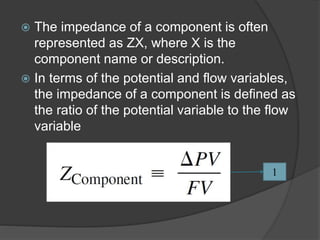
 In terms of the potential and flow variables,
the impedance of a component is defined as
the ratio of the potential variable to the flow
variable
1
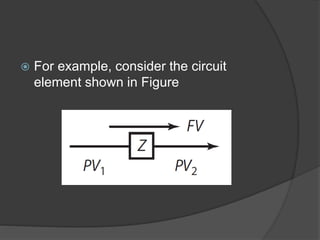
 For example, consider the circuit
element shown in Figure
 In accordance with Equation 1, the
impedance of the circuit element
becomes
Z = PV1 - PV2/FV
=ΔPV/FV

Impedence

  • 1.
  • 2.
    IMPEDENCE o In anelectrical circuit the impedance of a component is defined as the ratio of the voltage phasor v, across the component over the current phasor I , through the component.
  • 3.
    The impedance phasorfor the capacitor, inductor, and resistor are summarized in table below
  • 4.
     Positive phaseoccurs when the phasor is rotated in the counter clockwise direction beginning from the positive real axis  When the phasor is lined up with the positive imaginary axis (vertically upward) 90° of the phase has been accumulated.  When the phasor is pointing leftward,180° of the phase has been accumulated.  When the phasor is pointing downward along the negative imaginary axis, 270° or -90 ° of the phase has been accumulated.
  • 5.
     Keeping inmind that impedance is voltage divided by current, a positive imaginary component indicates voltage leading current, and a negative imaginary component indicates voltage lagging current.  Because j occurs in the denominator of the capacitor impedance, the capacitor voltage lags its current by 90°.  Similarly, because j occurs in the numerator of the inductor impedance, the inductor voltage leads its current by 90°.
  • 6.
     Consider thesinusoid x(t) = sin ωt . If we differentiate x(t) analytically with respect to time, we obtain X ‘(t) =d(sin(ωt))/dt = ω’cos(ωt)  Further more, since cos λ = sin(λ + 90°)ω , the right side of X ‘(t) may be written as ω‘ sin(ωt + 90°) or simply jω’ sin(ωt)  This means that differentiation of a sinusoid of frequency ω is the same as multiplication of the sinusoid by j ω .
  • 7.
     The impedanceof a component is often represented as ZX, where X is the component name or description.  In terms of the potential and flow variables, the impedance of a component is defined as the ratio of the potential variable to the flow variable 1
  • 8.
     For example,consider the circuit element shown in Figure
  • 9.
     In accordancewith Equation 1, the impedance of the circuit element becomes Z = PV1 - PV2/FV =ΔPV/FV