Introduction to Electrochemical 
Impedance Spectroscopy 
Gamry Instruments
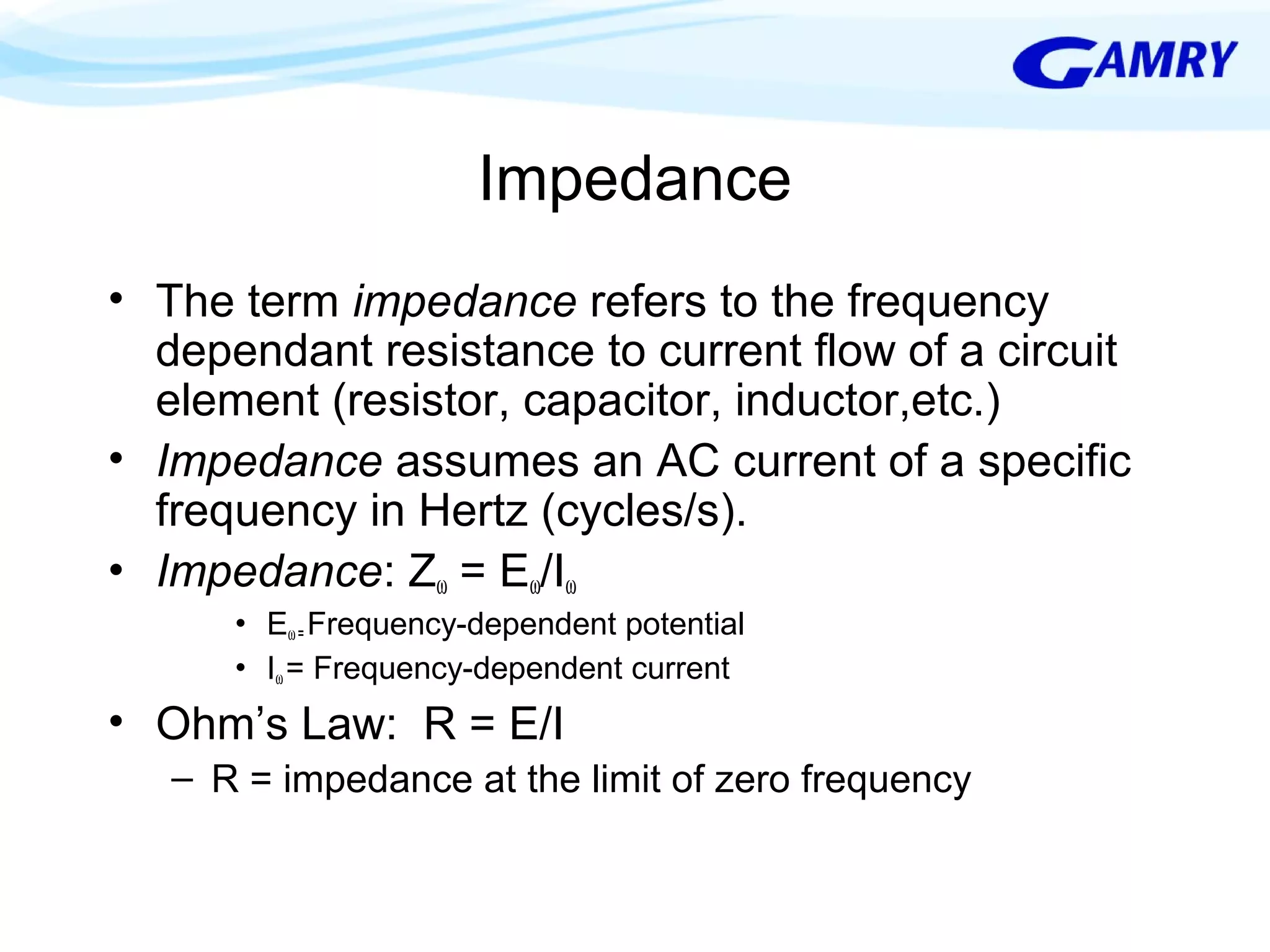
Impedance 
• The term impedance refers to the frequency 
dependant resistance to current flow of a circuit 
element (resistor, capacitor, inductor,etc.) 
• Impedance assumes an AC current of a specific 
frequency in Hertz (cycles/s). 
• Impedance: Zw = Ew/Iw 
• Ew = Frequency-dependent potential 
• Iw = Frequency-dependent current 
• Ohm’s Law: R = E/I 
– R = impedance at the limit of zero frequency
Reasons To Run EIS 
• EIS is theoretically complex (and can be expensive) – 
why bother? 
– The information content of EIS is much higher than DC 
techniques or single frequency measurements. 
– EIS may be able to distinguish between two or more 
electrochemical reactions taking place. 
– EIS can identify diffusion-limited reactions, e.g., diffusion 
through a passive film. 
– EIS provides information on the capacitive behavior of the 
system. 
– EIS can test components within an assembled device using 
the device’s own electrodes.
Making EIS Measurements 
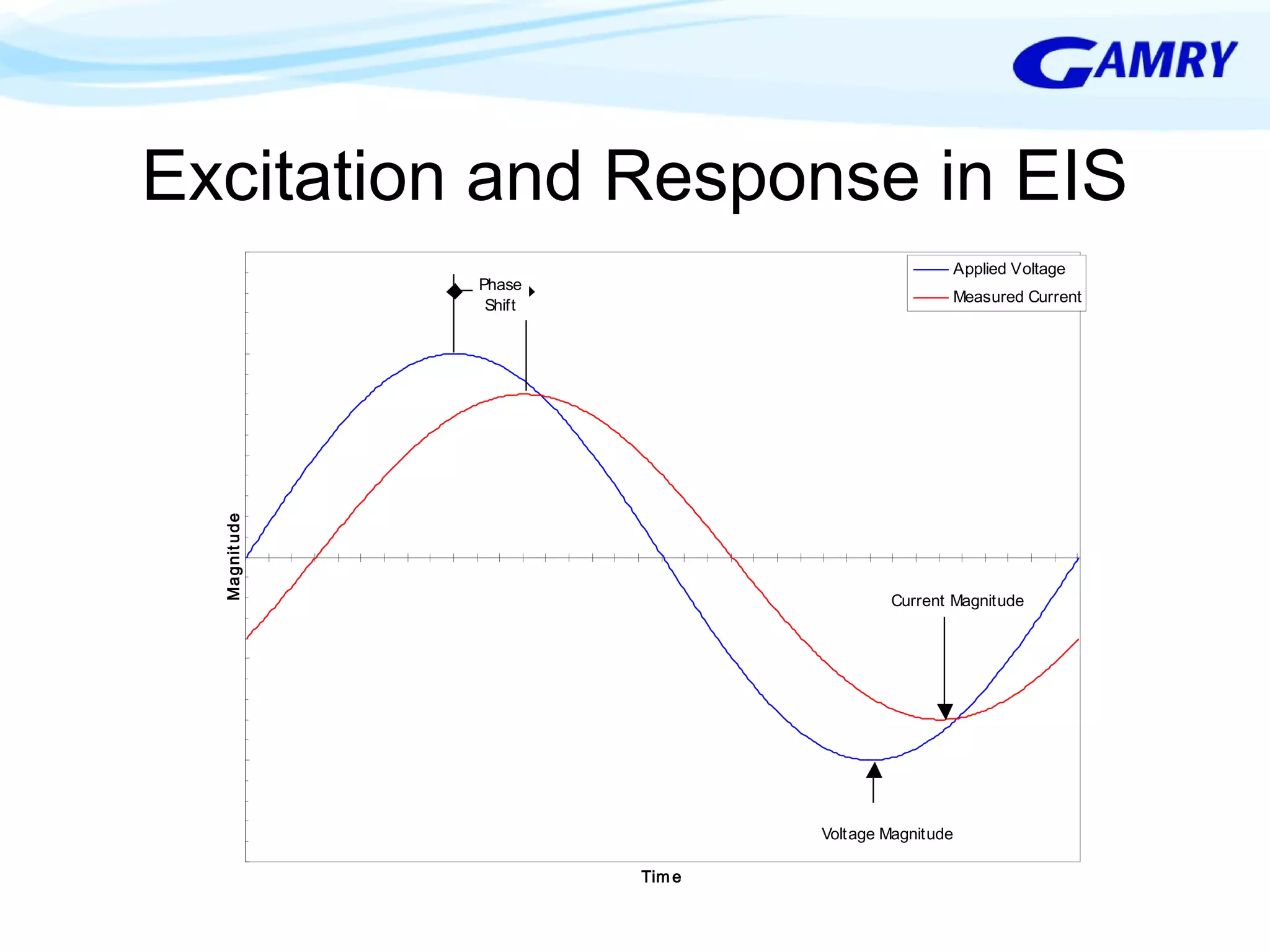
• Apply a small sinusoidal perturbation 
(potential or current) of fixed frequency 
• Measure the response and compute the 
impedance at each frequency. 
– Zw = Ew/Iw 
• Ew = Frequency-dependent potential 
• Iw = Frequency-dependent current 
• Repeat for a wide range of frequencies 
• Plot and analyze
Excitation and Response in EIS 
Time 
Magnit ude 
Applied Voltage 
Measured Current 
Phase 
Shift 
Current Magnitude 
Voltage Magnitude
EIS Data Presentation 
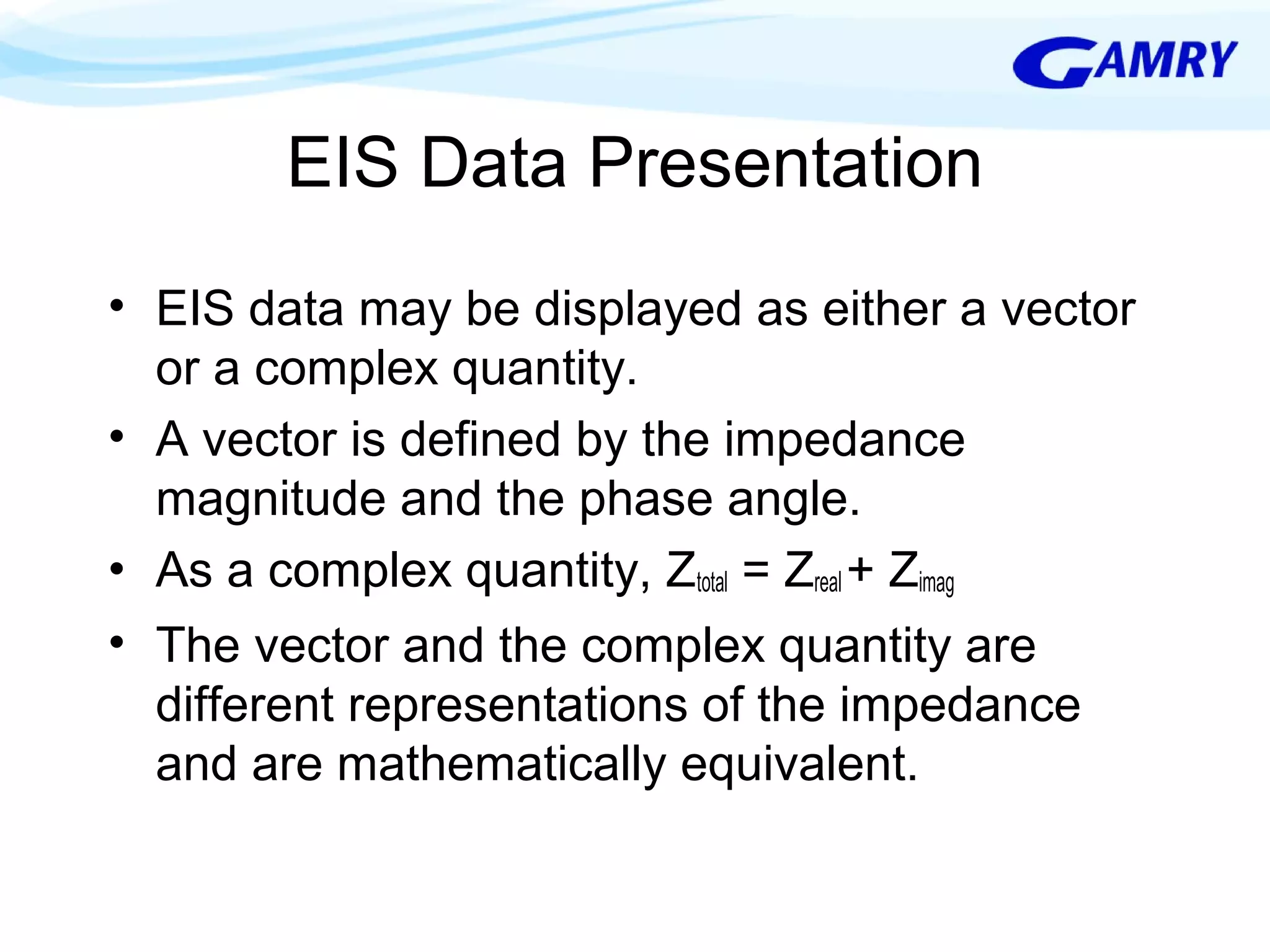
• EIS data may be displayed as either a vector 
or a complex quantity. 
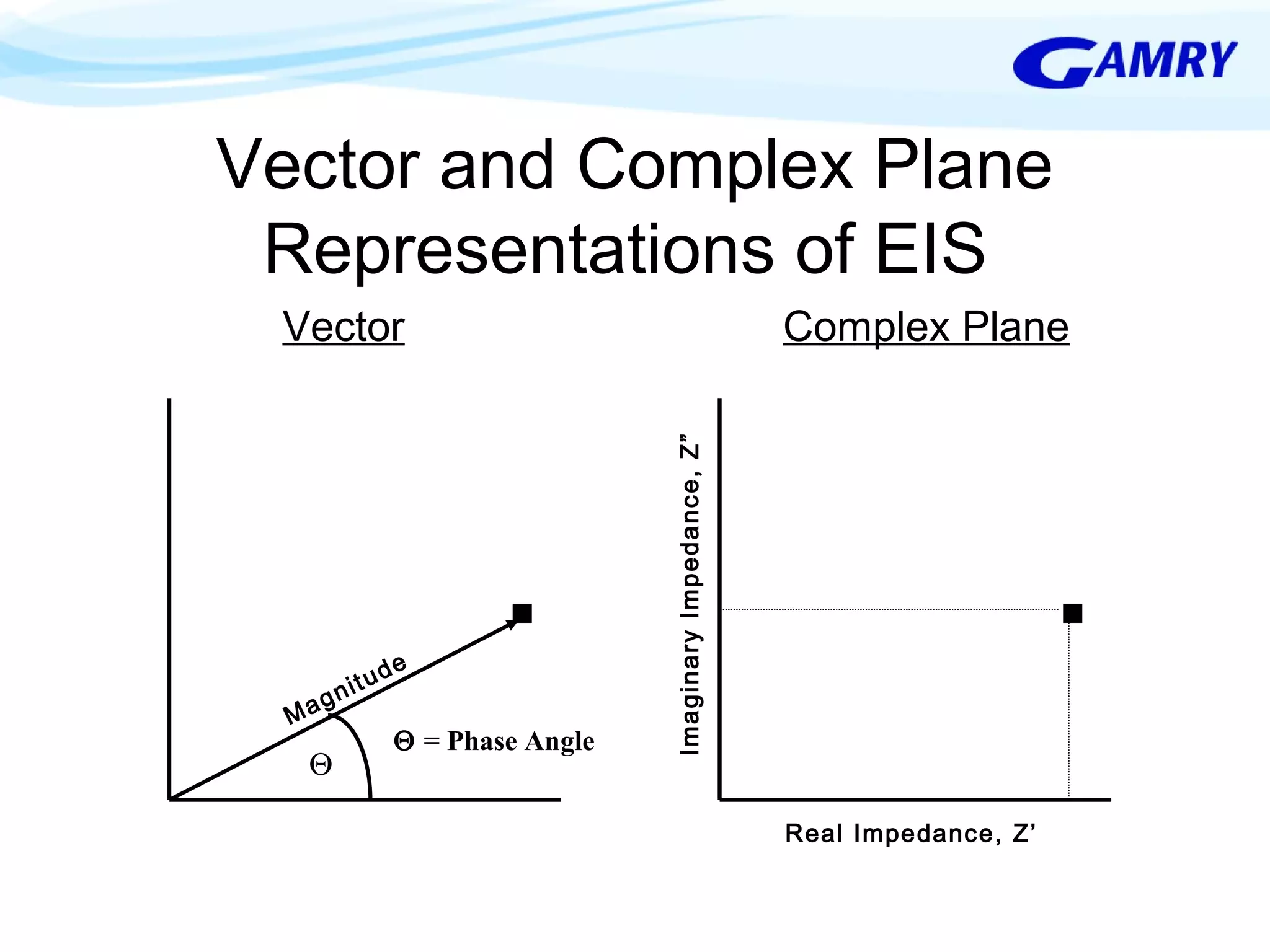
• A vector is defined by the impedance 
magnitude and the phase angle. 
• As a complex quantity, Ztotal = Zreal + Zimag 
• The vector and the complex quantity are 
different representations of the impedance 
and are mathematically equivalent.
Vector and Complex Plane 
Representations of EIS 
Vector Complex Plane 
Ma g n i t u d e 
Real Impedance, Z’ 
Imaginary Impedance, Z” 
Q 
Q = Phase Angle
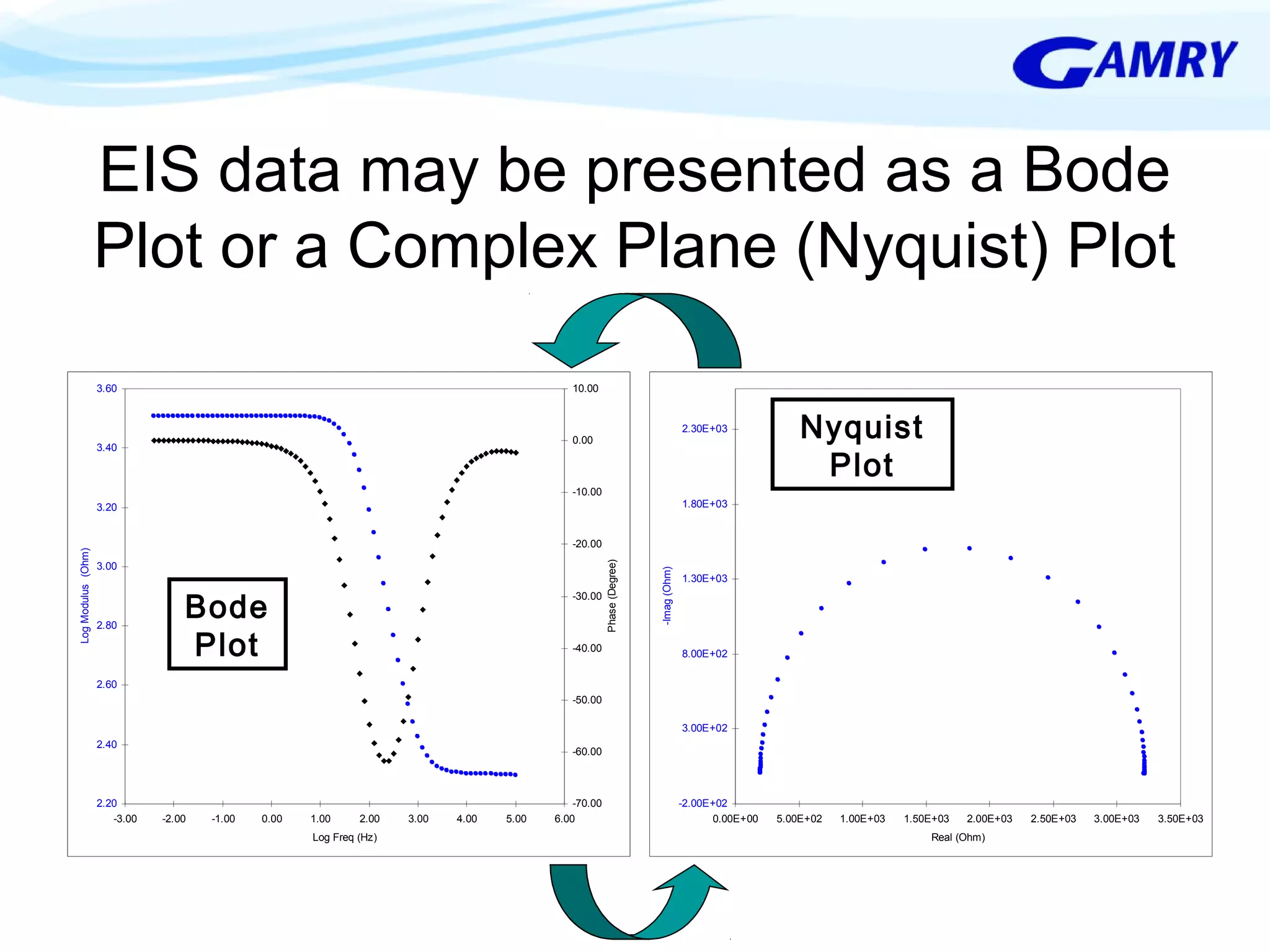
EIS data may be presented as a Bode 
Plot or a Complex Plane (Nyquist) Plot 
3.60 
3.40 
3.20 
3.00 
2.80 
2.60 
2.40 
2.20 
10.00 
0.00 
-10.00 
-20.00 
-30.00 
-40.00 
-50.00 
-60.00 
-3.00 -2.00 -1.00 0.00 1.00 2.00 3.00 4.00 5.00 6.00 
Log Freq (Hz) 
Log Modulus (Ohm) 
-70.00 
Phase (Degree) 
2.30E+03 
1.80E+03 
1.30E+03 
8.00E+02 
3.00E+02 
-2.00E+02 
0.00E+00 5.00E+02 1.00E+03 1.50E+03 2.00E+03 2.50E+03 3.00E+03 3.50E+03 
Real (Ohm) 
-Imag (Ohm) 
Bode 
Plot 
Nyquist 
Plot
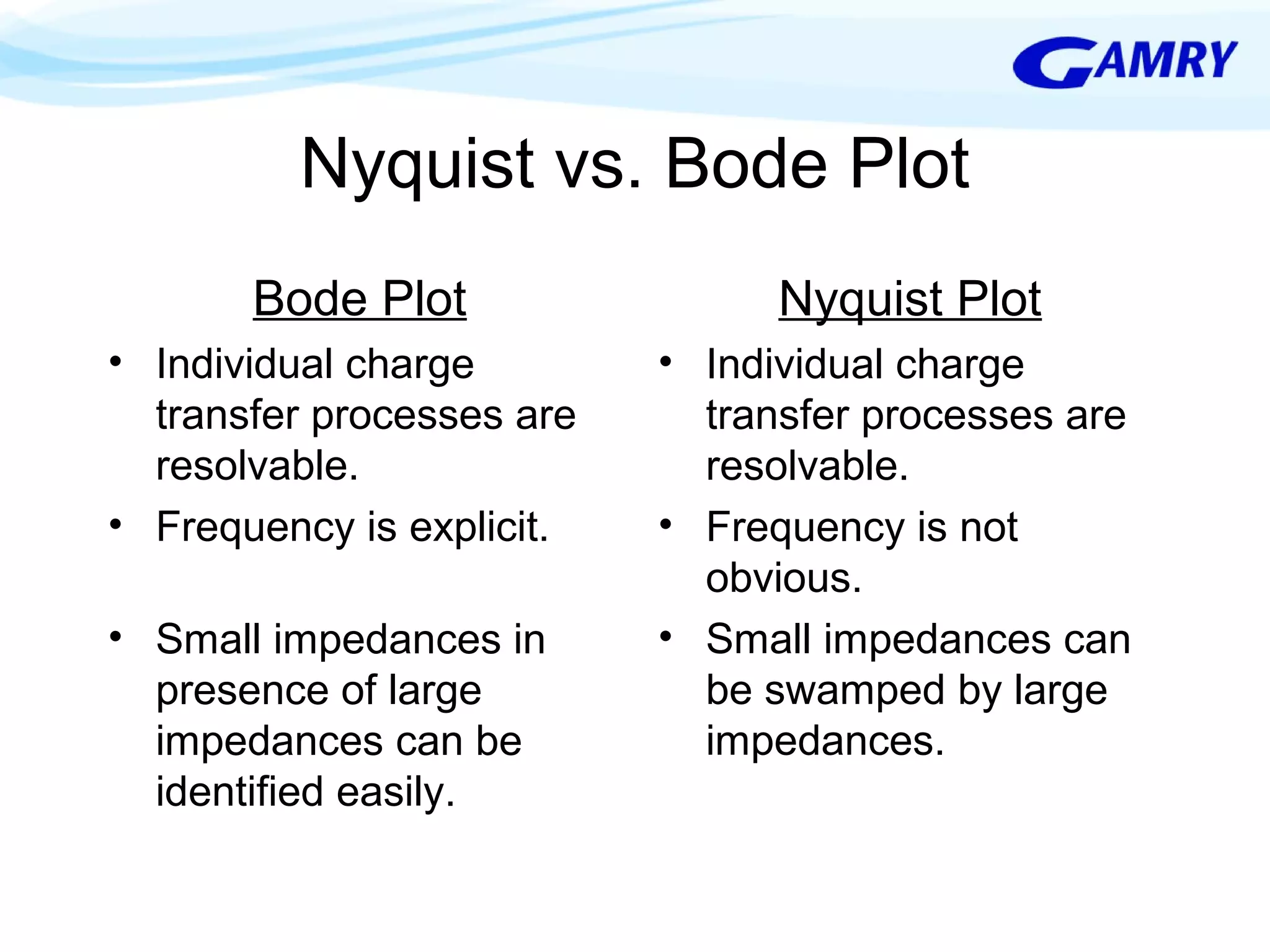
Nyquist vs. Bode Plot 
Bode Plot 
• Individual charge 
transfer processes are 
resolvable. 
• Frequency is explicit. 
• Small impedances in 
presence of large 
impedances can be 
identified easily. 
Nyquist Plot 
• Individual charge 
transfer processes are 
resolvable. 
• Frequency is not 
obvious. 
• Small impedances can 
be swamped by large 
impedances.
Analyzing EIS: Modeling 
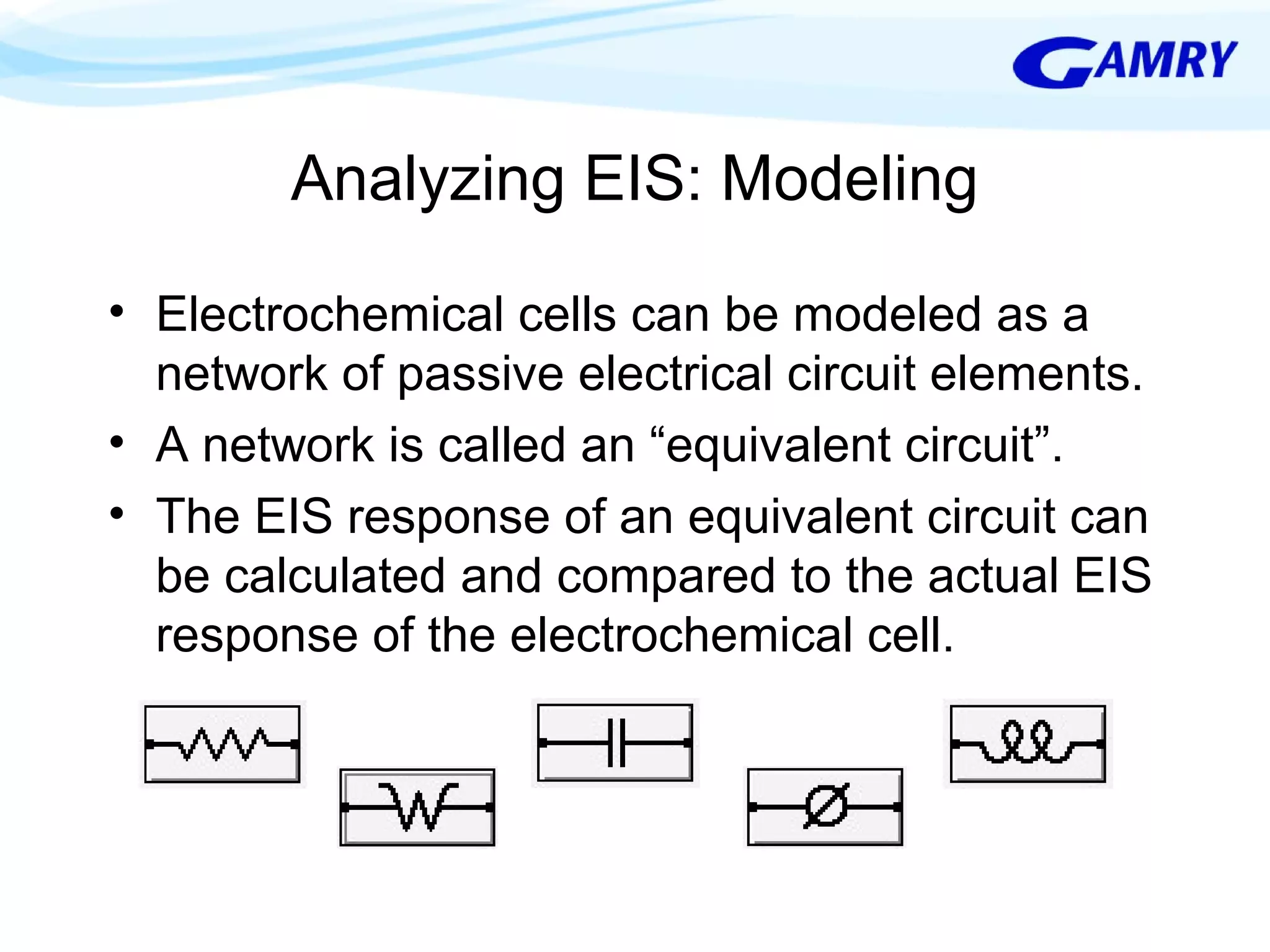
• Electrochemical cells can be modeled as a 
network of passive electrical circuit elements. 
• A network is called an “equivalent circuit”. 
• The EIS response of an equivalent circuit can 
be calculated and compared to the actual EIS 
response of the electrochemical cell.
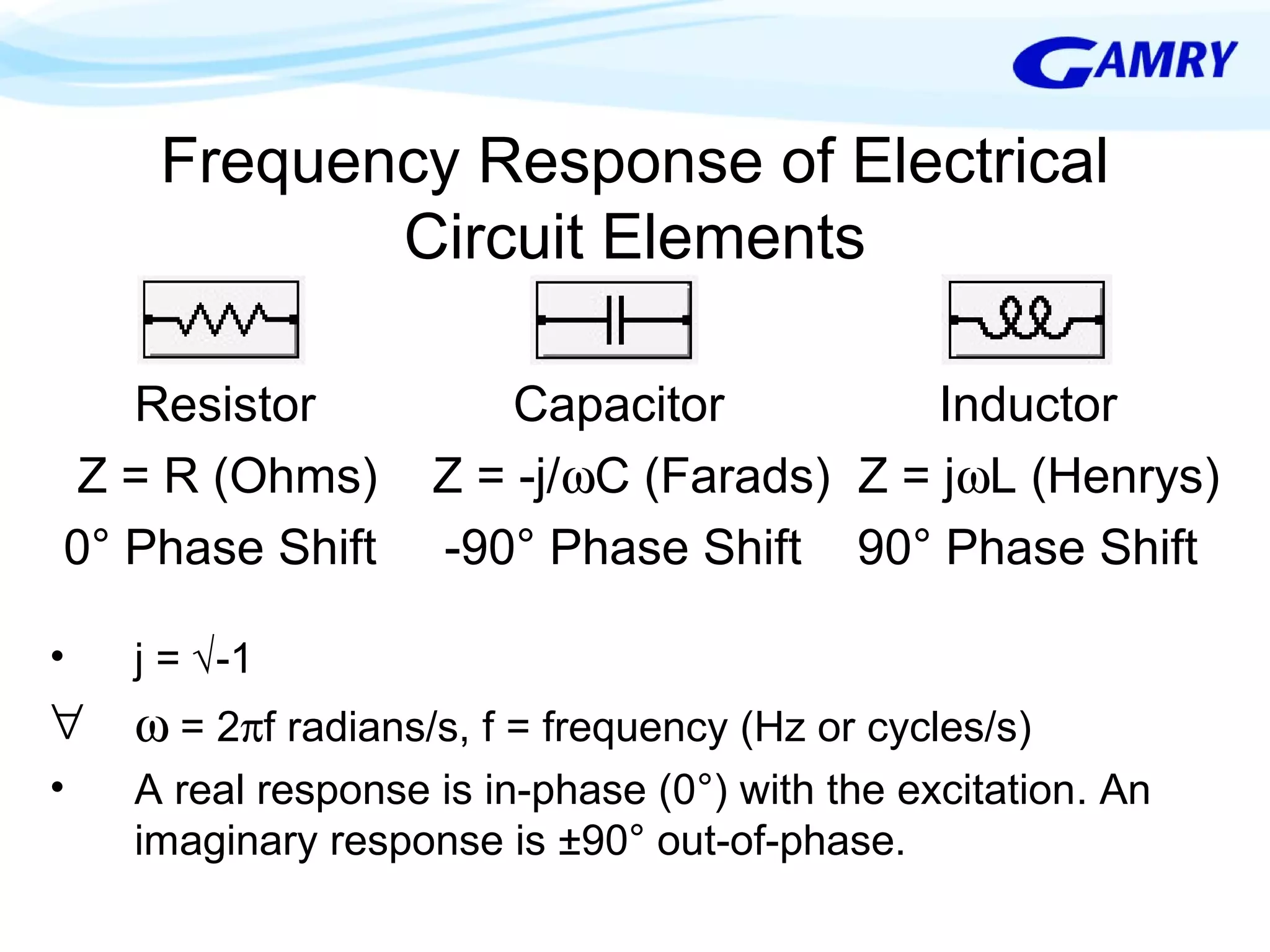
Frequency Response of Electrical 
Circuit Elements 
Resistor Capacitor Inductor 
Z = R (Ohms) Z = -j/wC (Farads) Z = jwL (Henrys) 
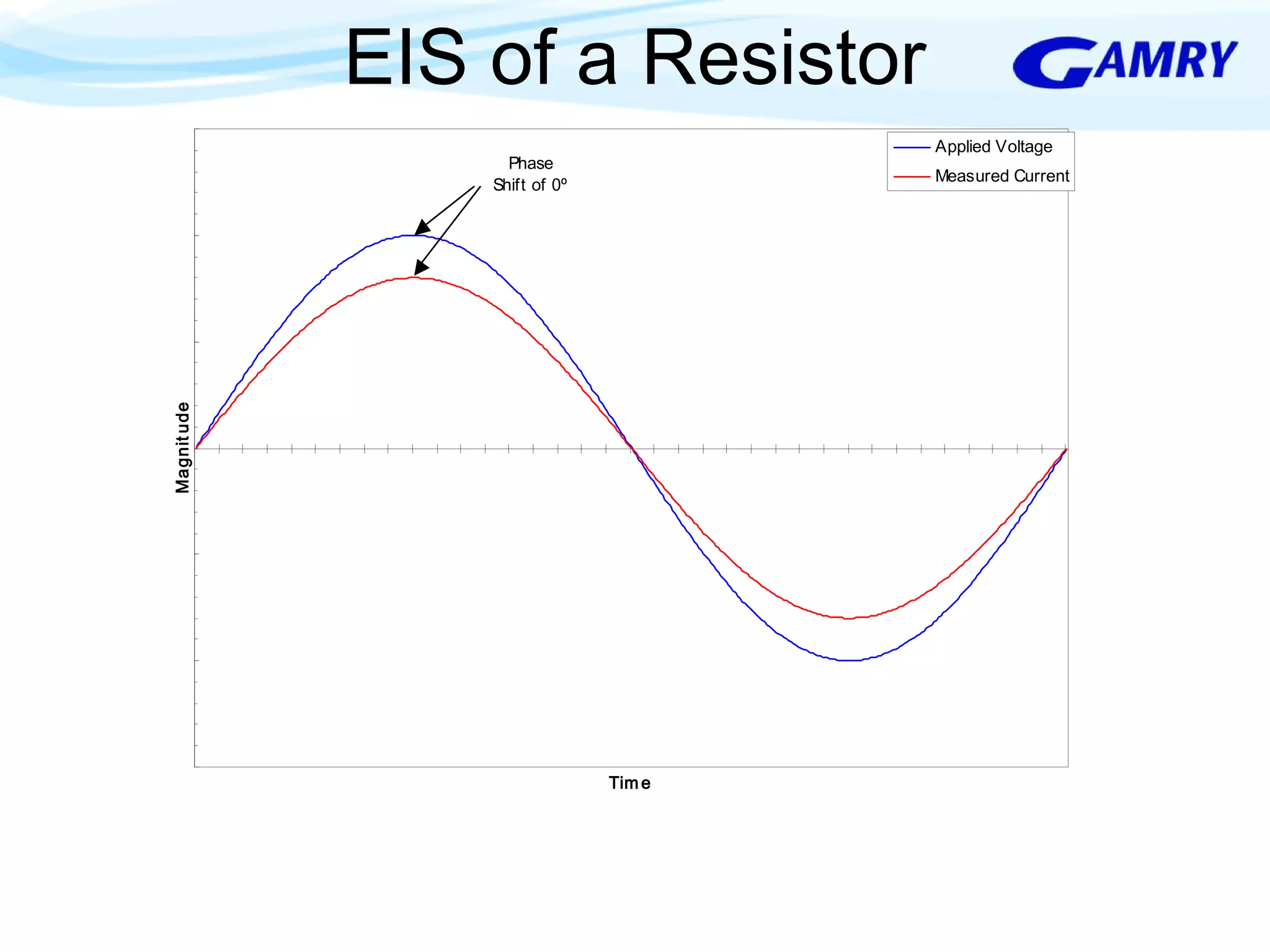
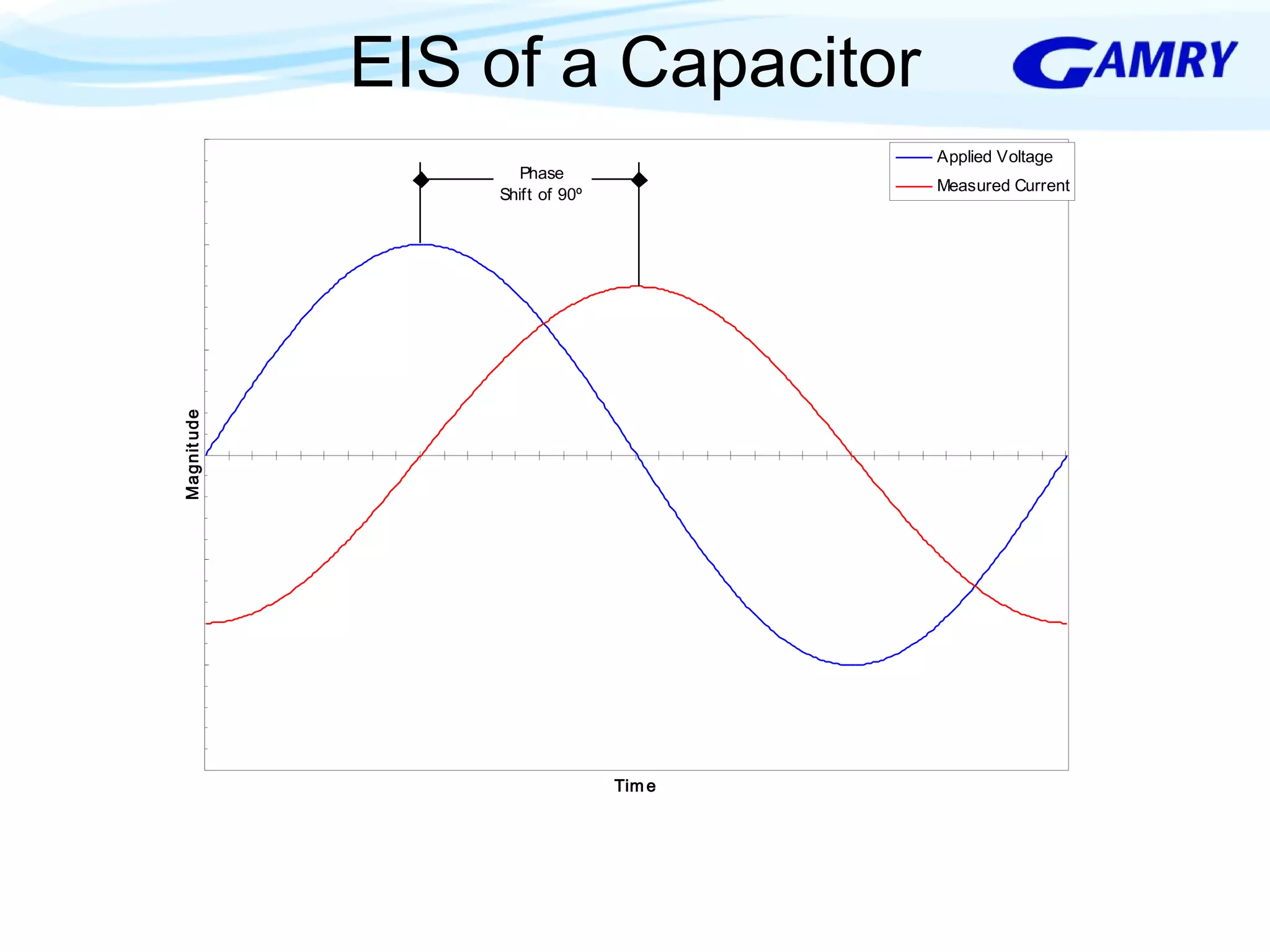
0° Phase Shift -90° Phase Shift 90° Phase Shift 
• j = Ö-1 
" w = 2pf radians/s, f = frequency (Hz or cycles/s) 
• A real response is in-phase (0°) with the excitation. An 
imaginary response is ±90° out-of-phase.
EIS of a Resistor 
Time Magnit ude 
Applied Voltage 
Measured Current 
Phase 
Shift of 0º
EIS of a Capacitor 
Time 
Magnit ude 
Applied Voltage 
Measured Current 
Phase 
Shift of 90º
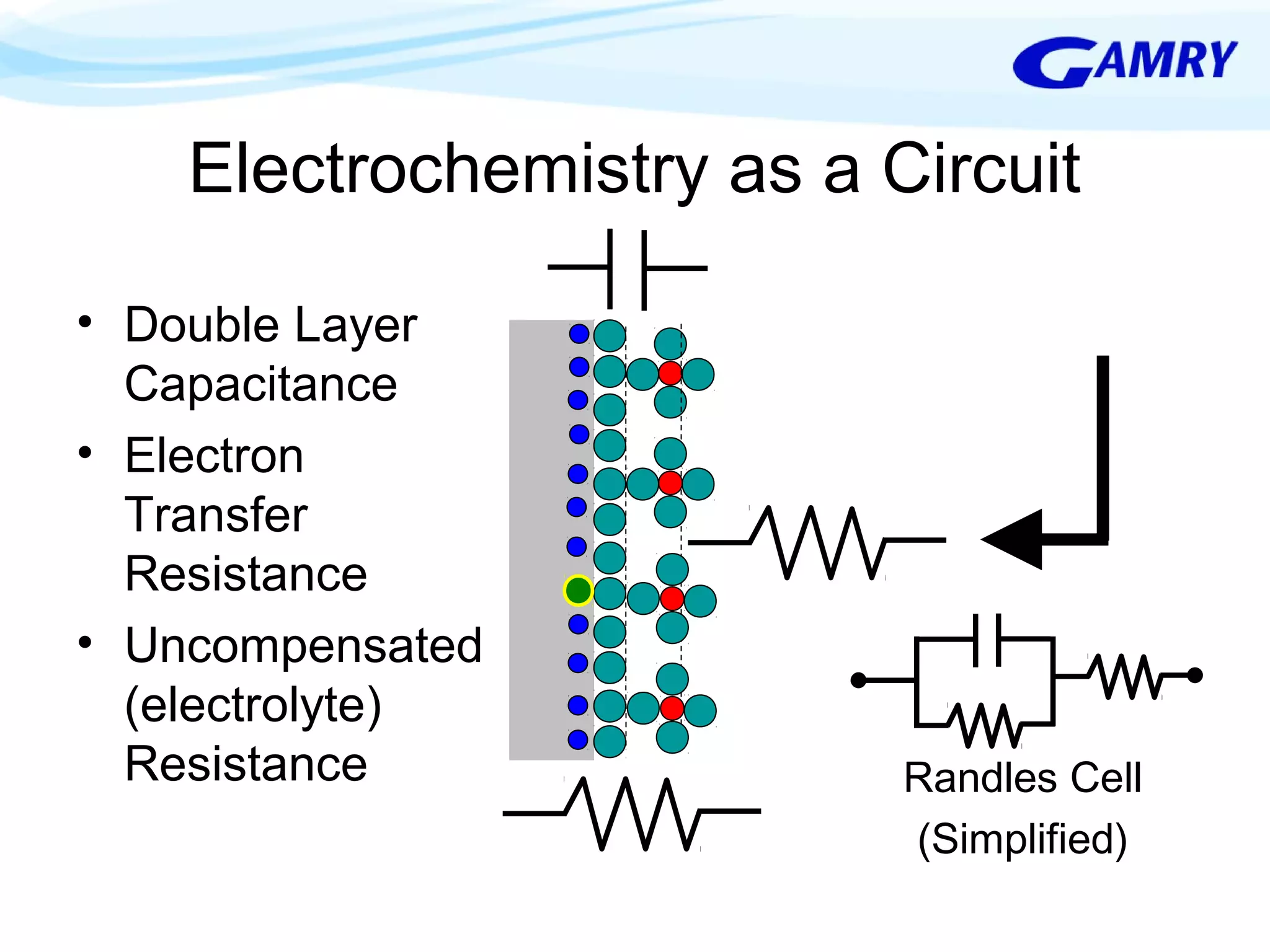
Electrochemistry as a Circuit 
• Double Layer 
Capacitance 
• Electron 
Transfer 
Resistance 
• Uncompensated 
(electrolyte) 
Resistance Randles Cell 
(Simplified)
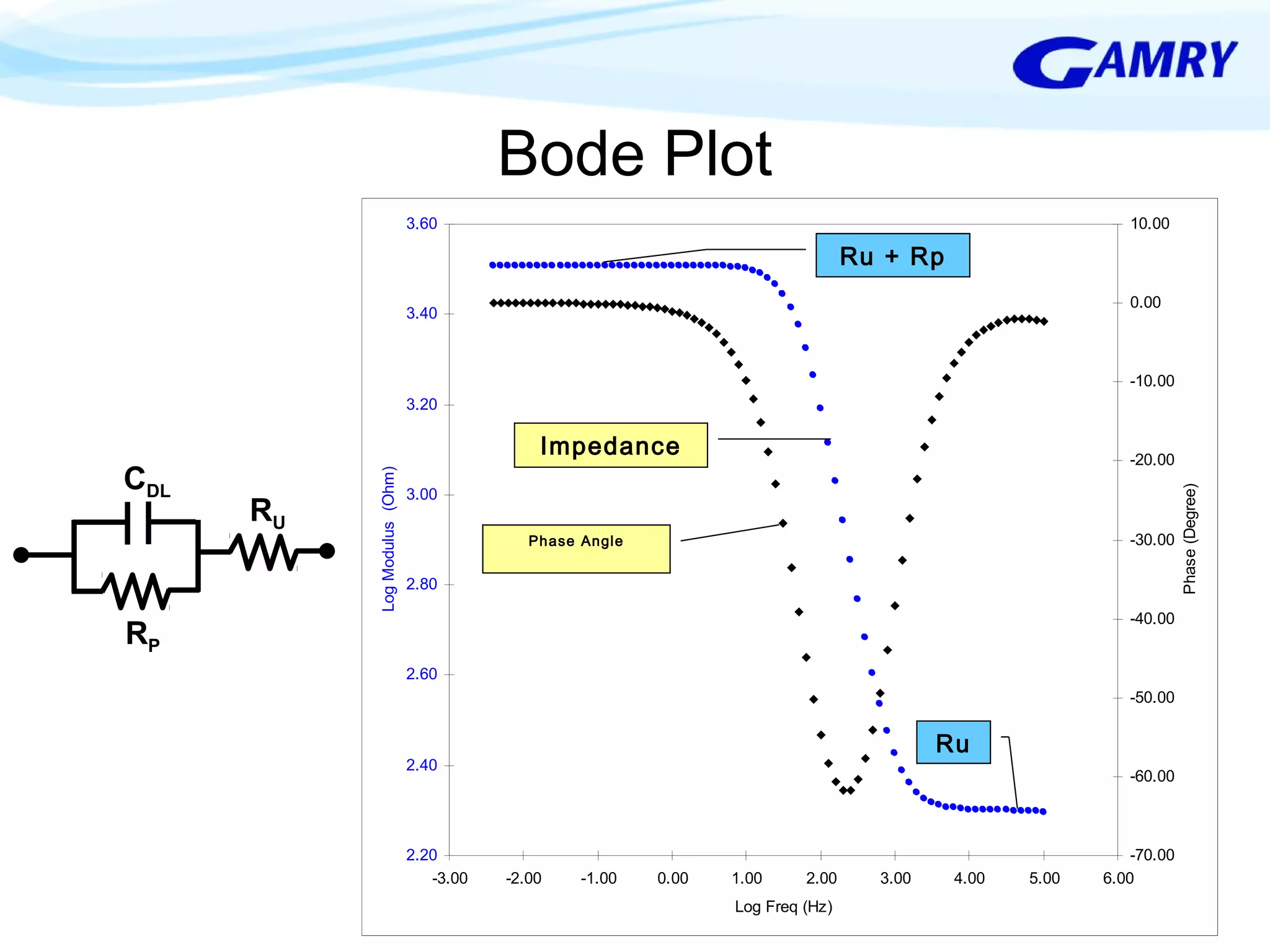
Bode Plot 
3.60 
3.40 
3.20 
3.00 
2.80 
2.60 
2.40 
2.20 
10.00 
0.00 
-10.00 
-20.00 
-30.00 
-40.00 
-50.00 
-60.00 
Impedance 
Ru + Rp 
-3.00 -2.00 -1.00 0.00 1.00 2.00 3.00 4.00 5.00 6.00 
Log Freq (Hz) 
Log Modulus (Ohm) 
-70.00 
Phase (Degree) 
Phase Angle 
Ru 
RU 
CDL 
RP
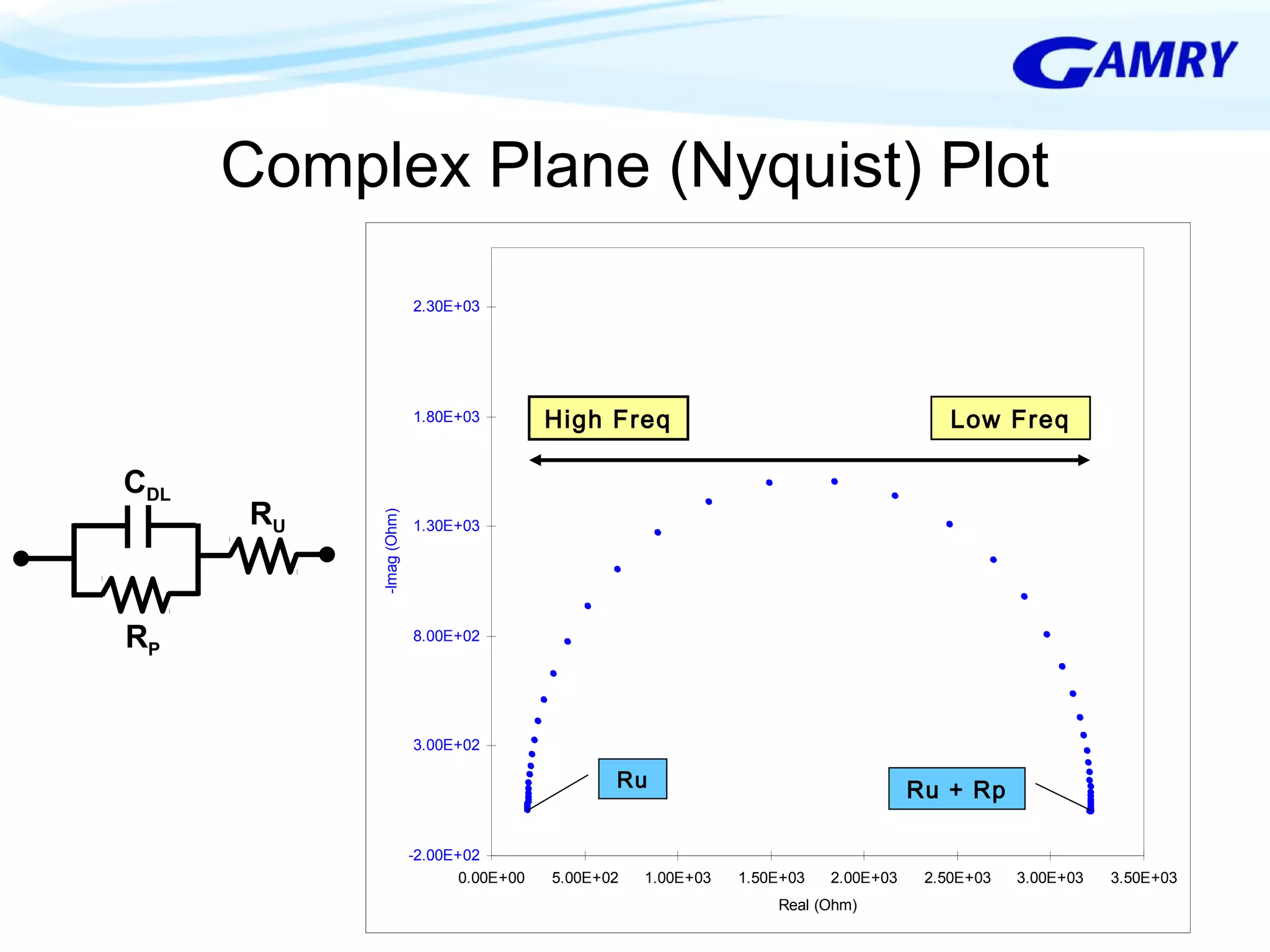
Complex Plane (Nyquist) Plot 
2.30E+03 
1.80E+03 
1.30E+03 
8.00E+02 
3.00E+02 
-2.00E+02 
High Freq Low Freq 
0.00E+00 5.00E+02 1.00E+03 1.50E+03 2.00E+03 2.50E+03 3.00E+03 3.50E+03 
Real (Ohm) 
-Imag (Ohm) 
Ru Ru + Rp 
RU 
CDL 
RP
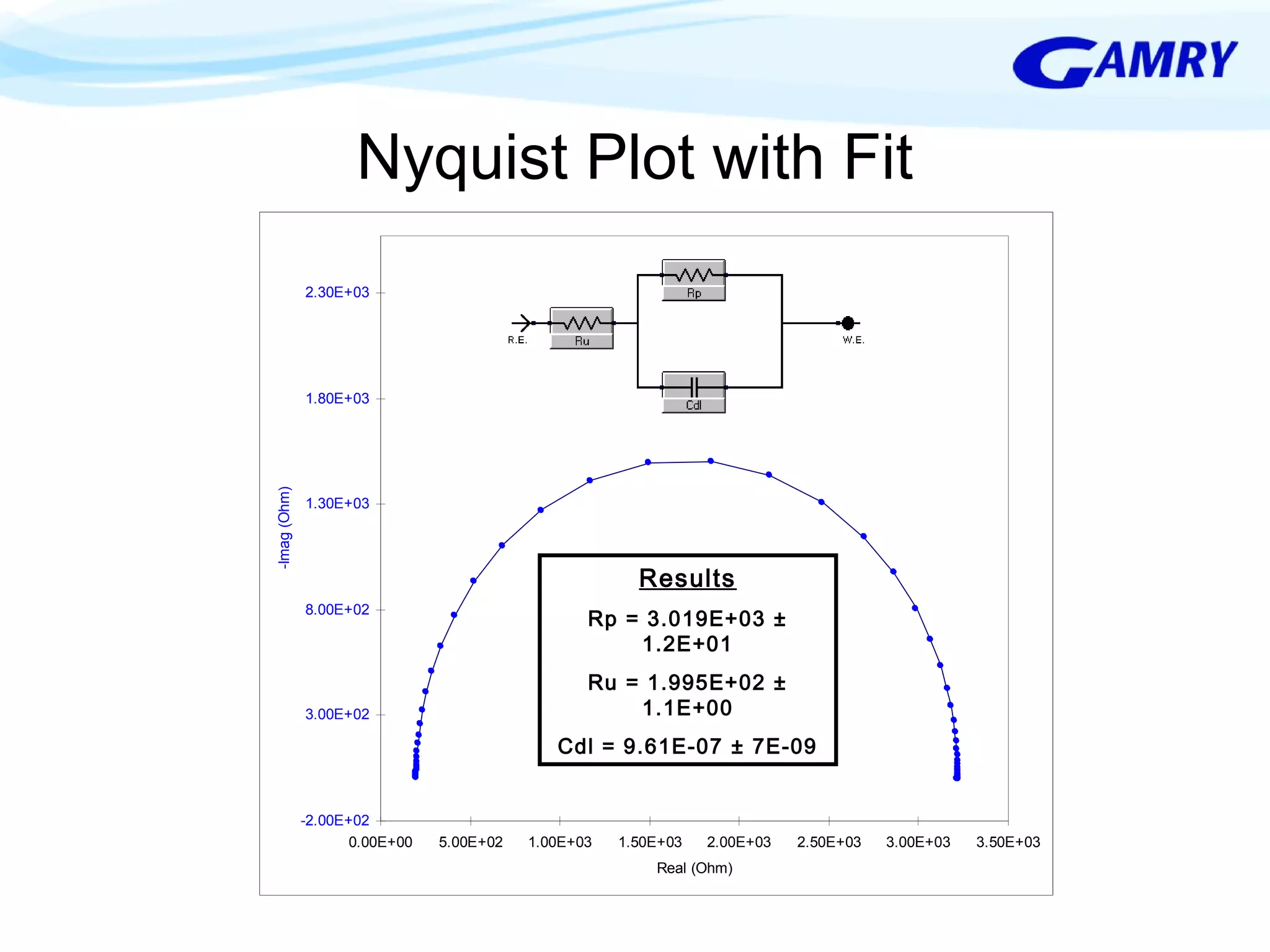
Nyquist Plot with Fit 
2.30E+03 
1.80E+03 
1.30E+03 
8.00E+02 
3.00E+02 
-2.00E+02 
0.00E+00 5.00E+02 1.00E+03 1.50E+03 2.00E+03 2.50E+03 3.00E+03 3.50E+03 
Real (Ohm) 
-Imag (Ohm) 
Results 
Rp = 3.019E+03 ± 
1.2E+01 
Ru = 1.995E+02 ± 
1.1E+00 
Cdl = 9.61E-07 ± 7E-09
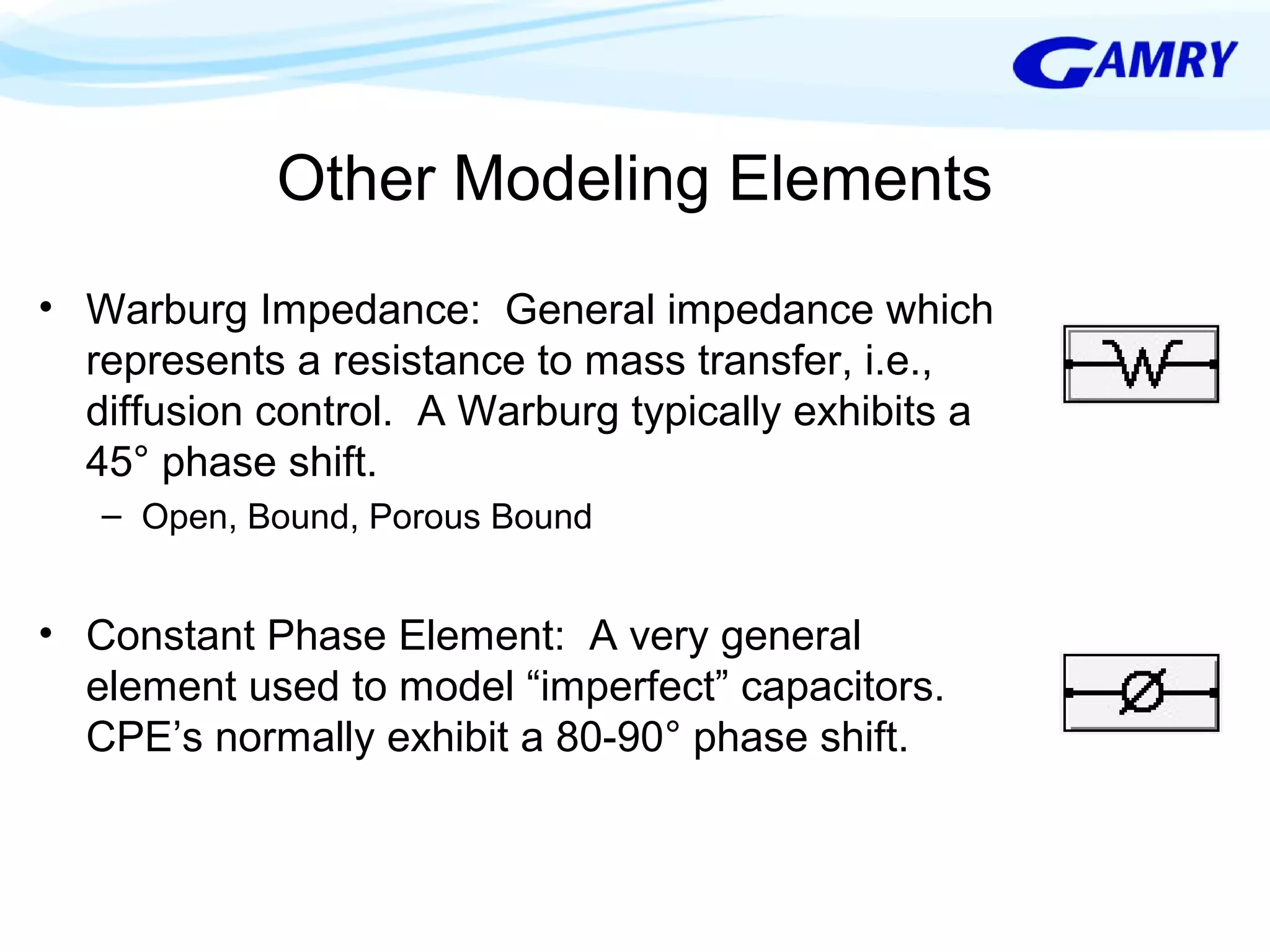
Other Modeling Elements 
• Warburg Impedance: General impedance which 
represents a resistance to mass transfer, i.e., 
diffusion control. A Warburg typically exhibits a 
45° phase shift. 
– Open, Bound, Porous Bound 
• Constant Phase Element: A very general 
element used to model “imperfect” capacitors. 
CPE’s normally exhibit a 80-90° phase shift.
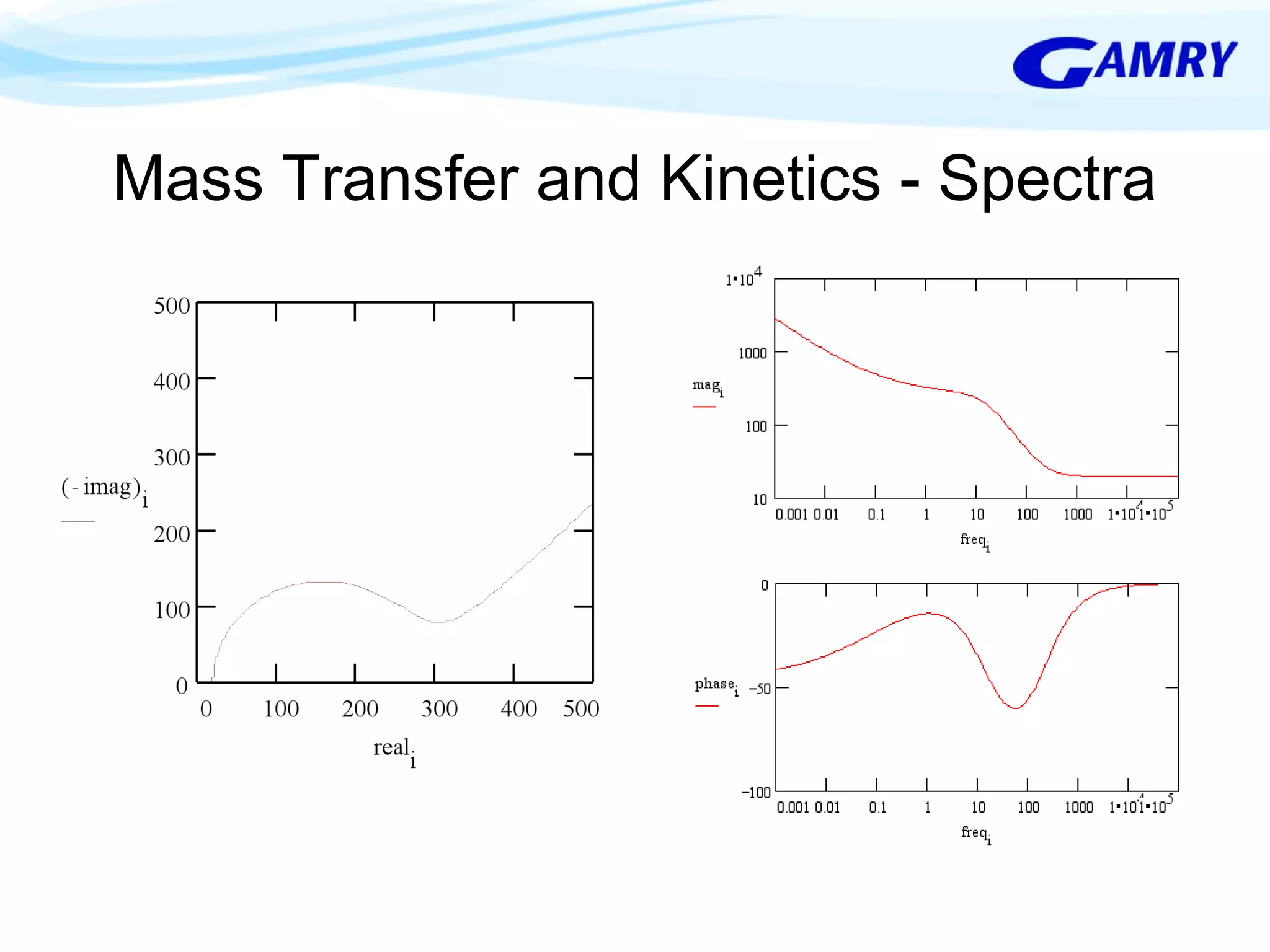
Mass Transfer and Kinetics - Spectra
EIS Modeling 
• Complex systems may require complex 
models. 
• Each element in the equivalent circuit should 
correspond to some specific activity in the 
electrochemical cell. 
• It is not acceptable to simply add elements 
until a good fit is obtained. 
• Use the simplest model that fits the data.
Criteria For Valid EIS 
Linear – Stable - Causal 
• Linear: The system obeys Ohm’s Law, E = iZ. The 
value of Z is independent of the magnitude of the 
perturbation. If linear, no harmonics are generated 
during the experiment. 
• Stable: The system does not change with time and 
returns to its original state after the perturbation is 
removed. 
• Causal: The response of the system is due only to 
the applied perturbation.
Electrochemistry: A Linear System? 
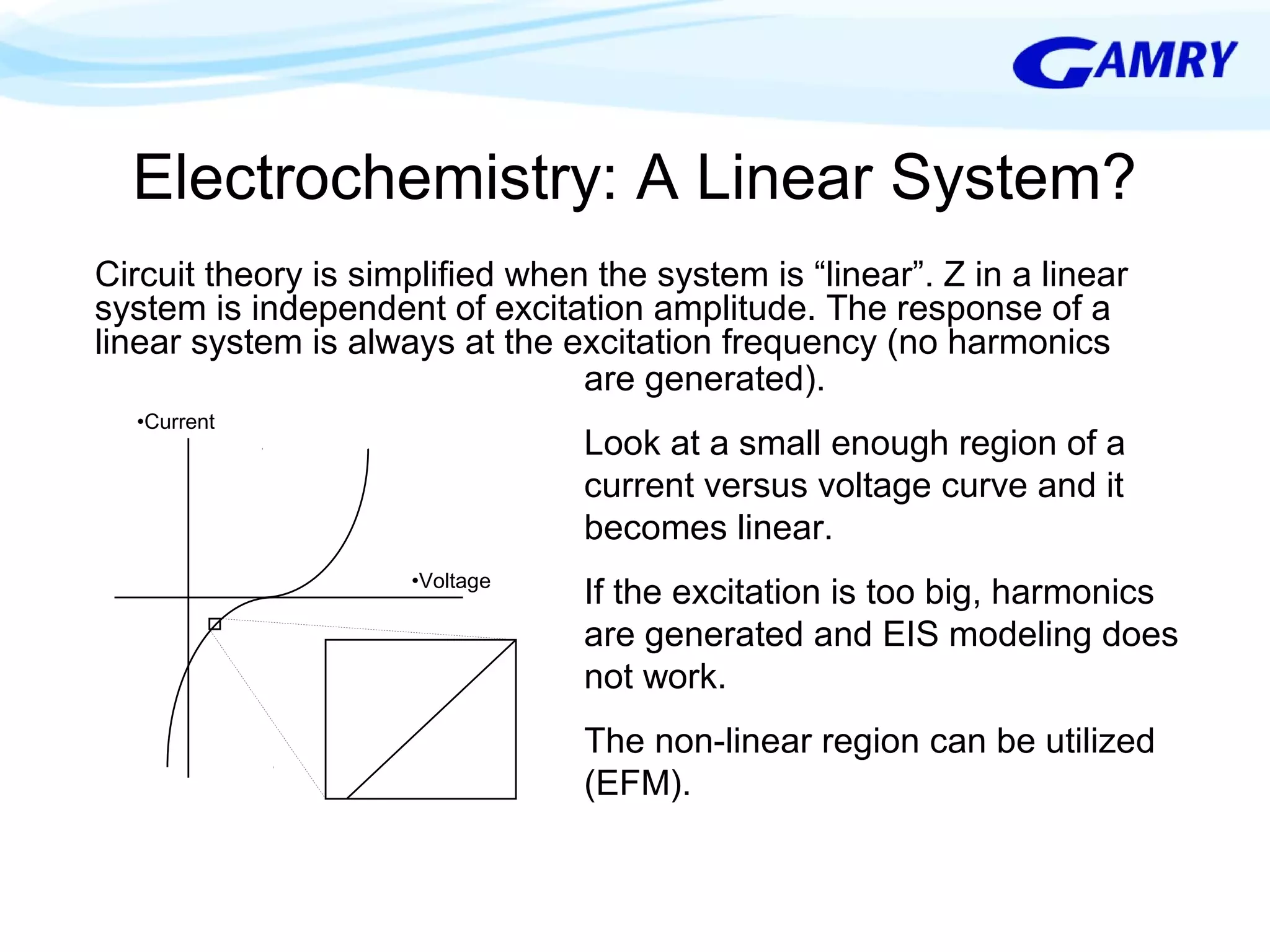
Circuit theory is simplified when the system is “linear”. Z in a linear 
system is independent of excitation amplitude. The response of a 
linear system is always at the excitation frequency (no harmonics 
are generated). 
Look at a small enough region of a 
current versus voltage curve and it 
becomes linear. 
If the excitation is too big, harmonics 
are generated and EIS modeling does 
not work. 
The non-linear region can be utilized 
(EFM). 
•Current 
•Voltage
Electrochemistry: A Stable System? 
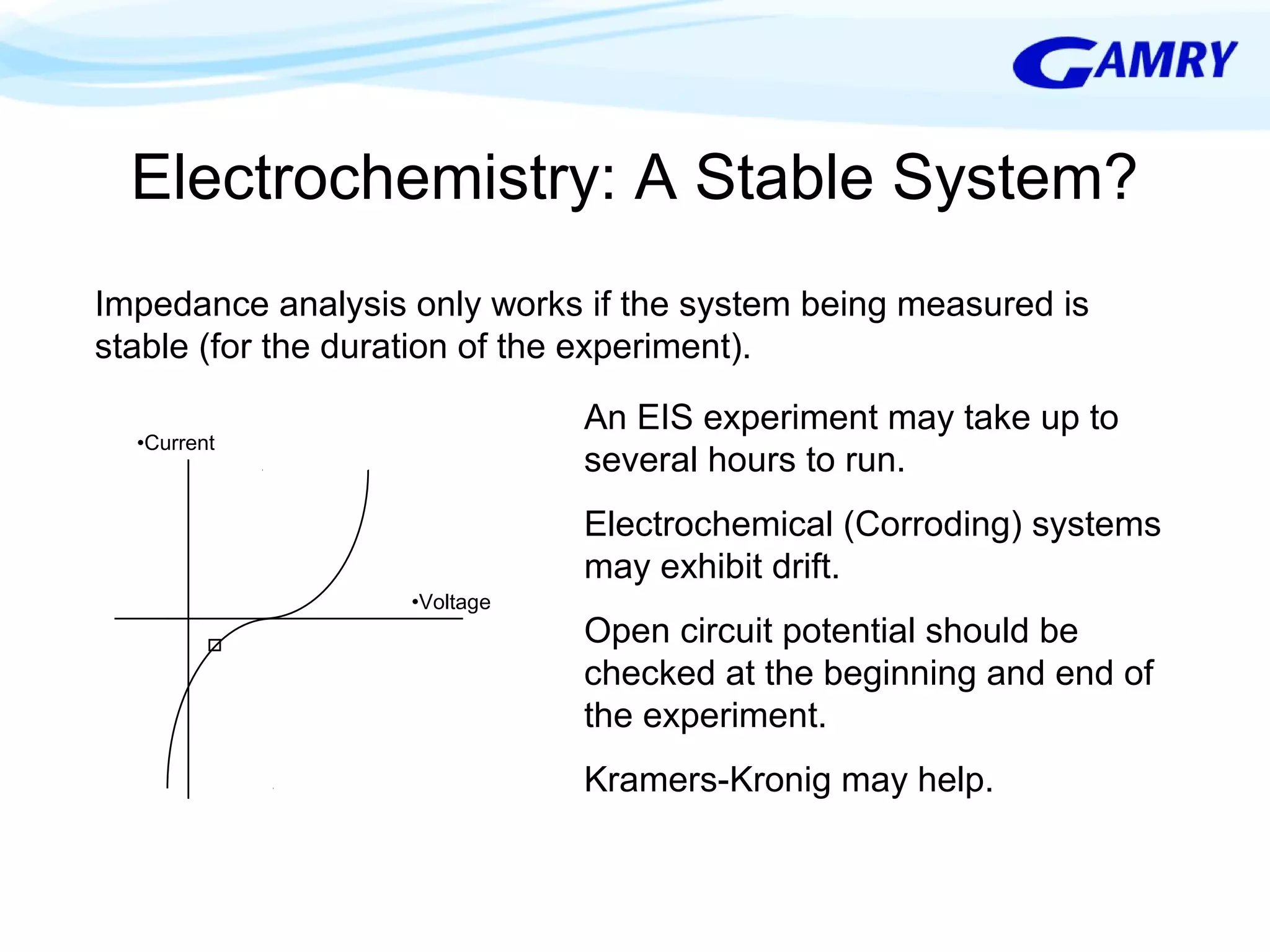
Impedance analysis only works if the system being measured is 
stable (for the duration of the experiment). 
An EIS experiment may take up to 
several hours to run. 
Electrochemical (Corroding) systems 
may exhibit drift. 
Open circuit potential should be 
checked at the beginning and end of 
the experiment. 
Kramers-Kronig may help. 
•Current 
•Voltage
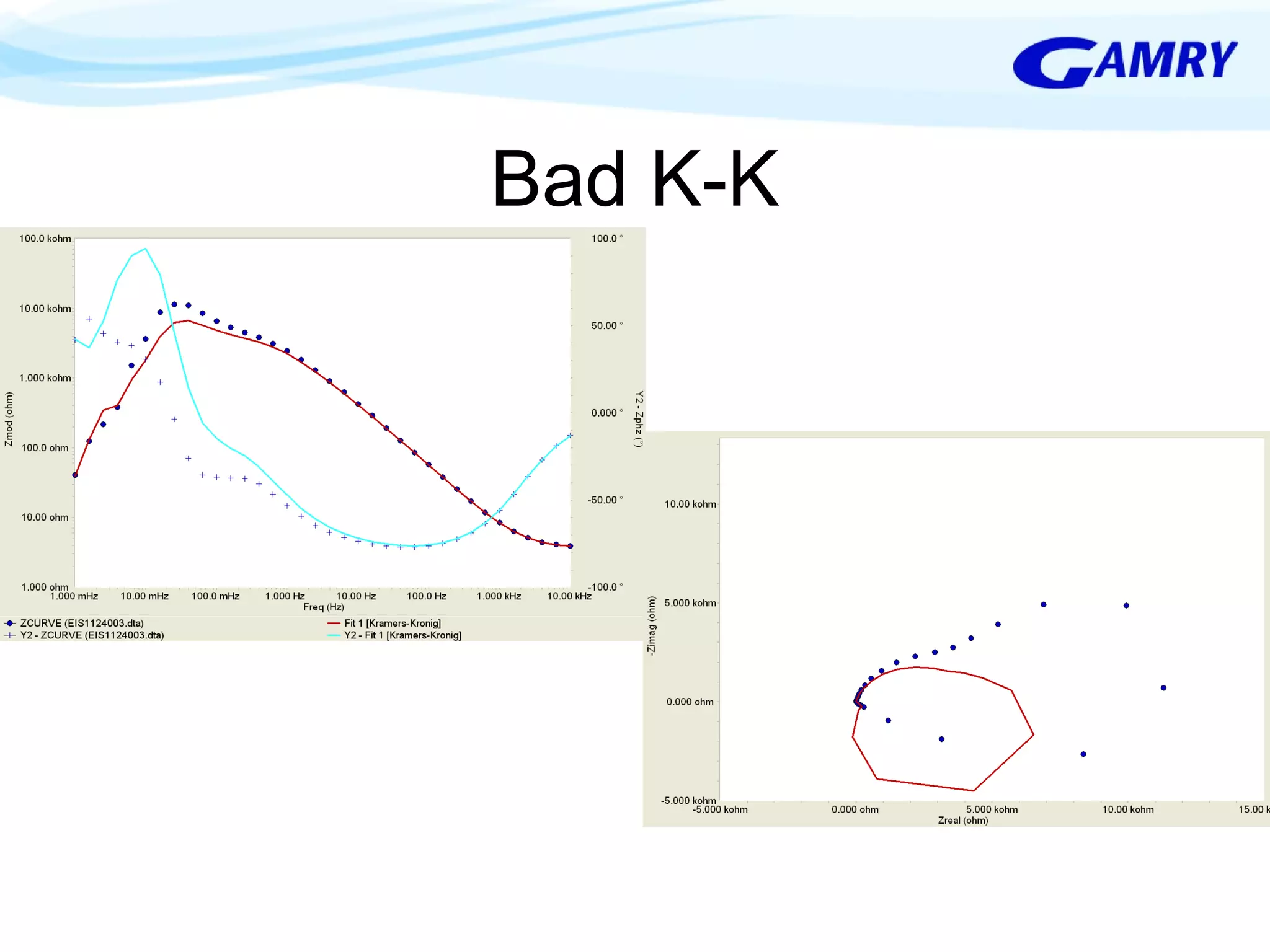
Kramers-Kronig Transform 
• The K-K Transform states that the phase and magnitude in a 
real (linear, stable, and causal) system are related. 
• Apply the Transform to the EIS data. Calculate the magnitude 
from the experimental phase. If the calculated magnitudes 
match the experimental magnitudes, then you can have some 
confidence in the data. The converse is also true. 
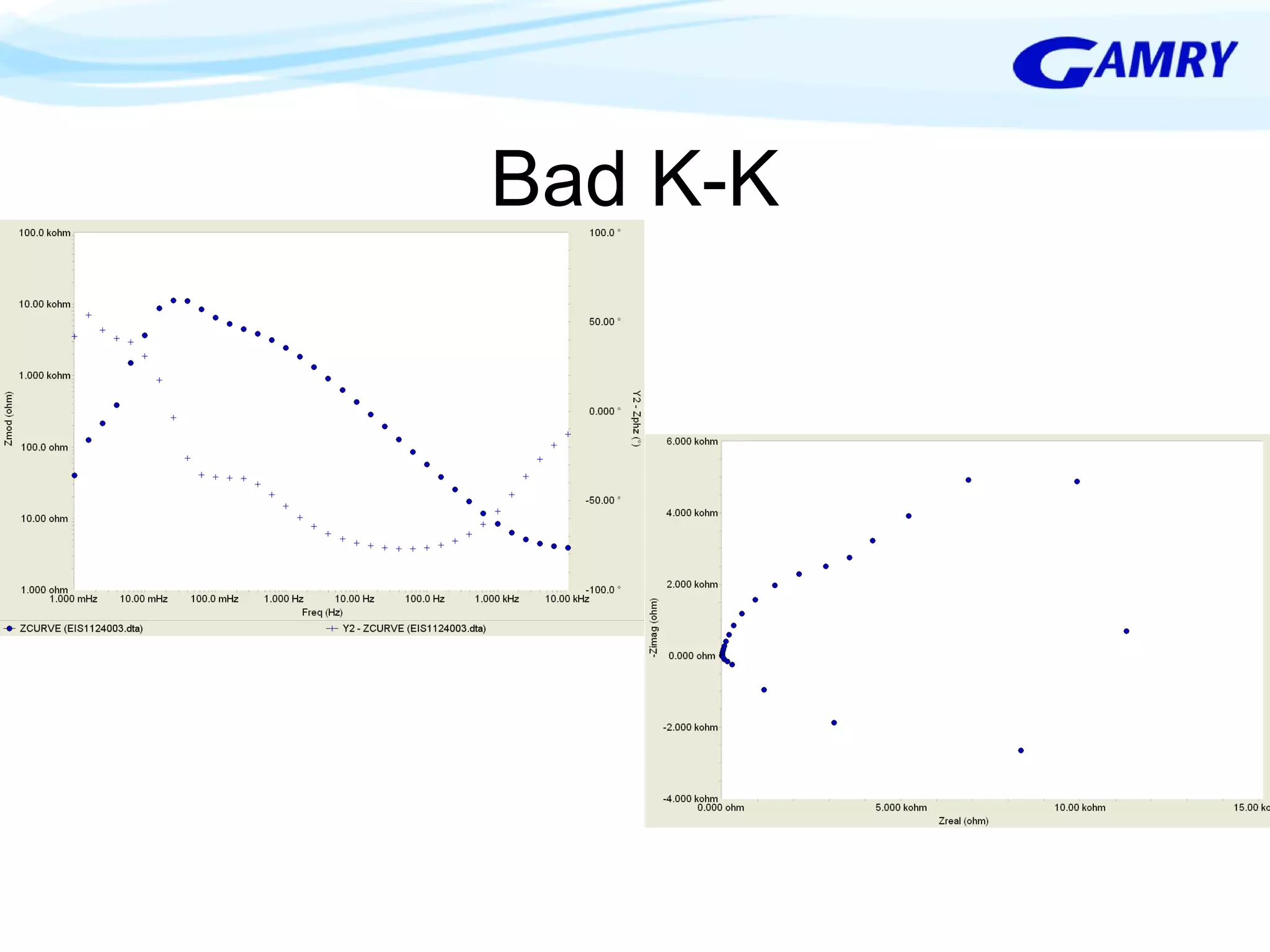
• If the values do not match, then the probability is high that your 
system is not linear, not stable, or not causal. 
• The K-K Transform as a validator of the data is not accepted by 
all of the electrochemical community.
Bad K-K
Bad K-K
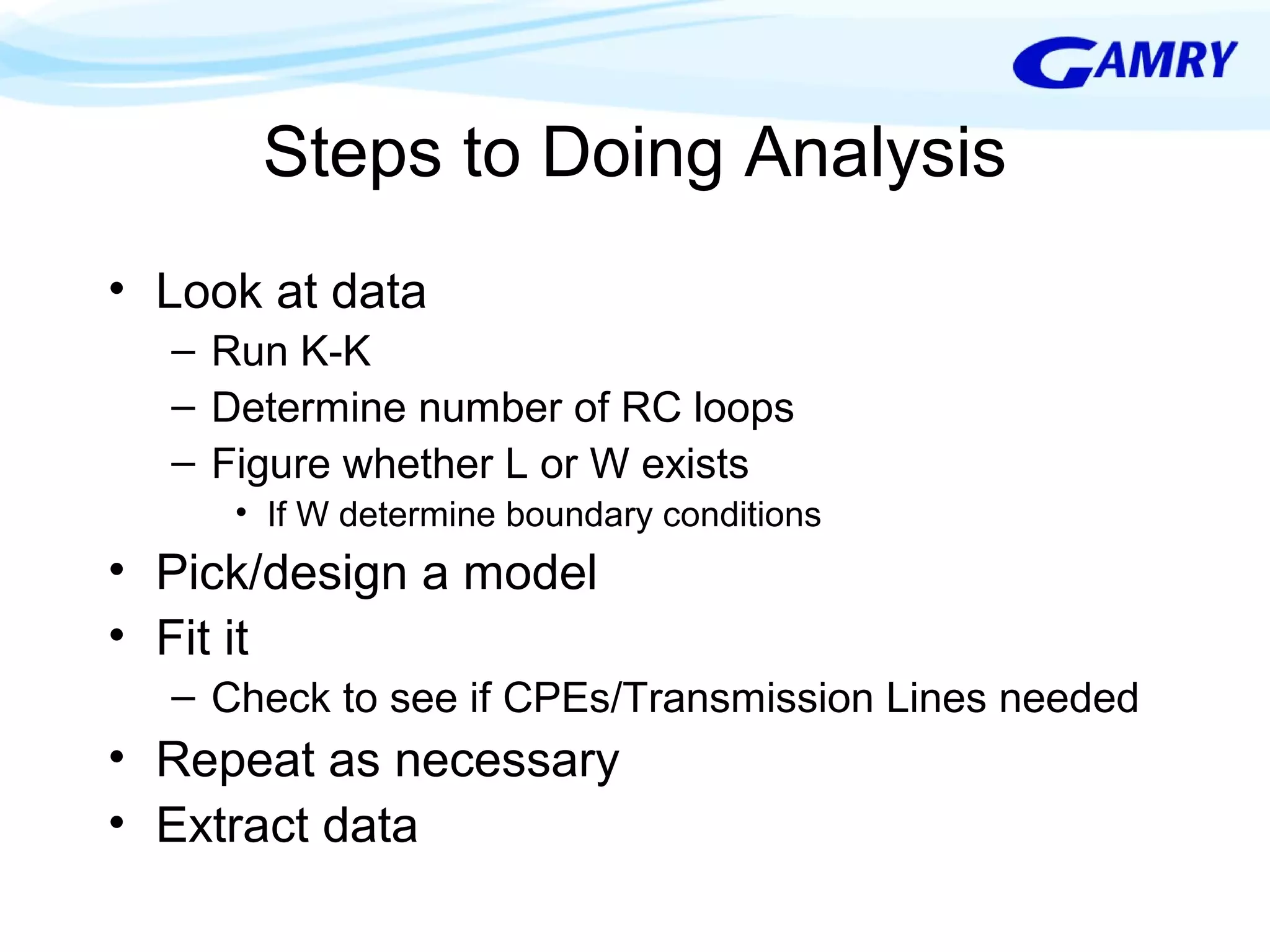
Steps to Doing Analysis 
• Look at data 
– Run K-K 
– Determine number of RC loops 
– Figure whether L or W exists 
• If W determine boundary conditions 
• Pick/design a model 
• Fit it 
– Check to see if CPEs/Transmission Lines needed 
• Repeat as necessary 
• Extract data
EIS Instrumentation 
• Potentiostat/Galvanostat 
• Sine wave generator 
• Time synchronization (phase locking) 
• All-in-ones, Portable & Floating Systems 
Things to be aware of… 
• Software – Control & Analysis 
• Accuracy 
• Performance limitations
EIS Take Home 
• EIS is a versatile technique 
– Non-destructive 
– High information content 
• Running EIS is easy 
• EIS modeling analysis is very powerful 
– Simplest working model is best 
– Complex system analysis is possible 
– User expertise can be helpful
References for EIS 
• Electrochemical Impedance and Noise, R. Cottis and S. 
Turgoose, NACE International, 1999. ISBN 1-57590-093-9. 
An excellent tutorial that is highly recommended. 
• Electrochemical Techniques in Corrosion Engineering, 1986, 
NACE International 
Proceedings from a Symposium held in 1986. 36 papers. 
Covers the basics of the various electrochemical techniques 
and a wide variety of papers on the application of these 
techniques. Includes impedance spectroscopy. 
• Electrochemical Impedance: Analysis and Interpretation, STP 
1188, Edited by Scully, Silverman, and Kendig, ASTM, ISBN 0- 
8031-1861-9. 
26 papers covering modeling, corrosion, inhibitors, soil, 
concrete, and coatings. 
• EIS Primer, Gamry Instruments website, www.gamry.com

Basics of Electrochemical Impedance Spectroscopy

  • 1.
    Introduction to Electrochemical Impedance Spectroscopy Gamry Instruments
  • 2.
    Impedance • Theterm impedance refers to the frequency dependant resistance to current flow of a circuit element (resistor, capacitor, inductor,etc.) • Impedance assumes an AC current of a specific frequency in Hertz (cycles/s). • Impedance: Zw = Ew/Iw • Ew = Frequency-dependent potential • Iw = Frequency-dependent current • Ohm’s Law: R = E/I – R = impedance at the limit of zero frequency
  • 3.
    Reasons To RunEIS • EIS is theoretically complex (and can be expensive) – why bother? – The information content of EIS is much higher than DC techniques or single frequency measurements. – EIS may be able to distinguish between two or more electrochemical reactions taking place. – EIS can identify diffusion-limited reactions, e.g., diffusion through a passive film. – EIS provides information on the capacitive behavior of the system. – EIS can test components within an assembled device using the device’s own electrodes.
  • 4.
    Making EIS Measurements • Apply a small sinusoidal perturbation (potential or current) of fixed frequency • Measure the response and compute the impedance at each frequency. – Zw = Ew/Iw • Ew = Frequency-dependent potential • Iw = Frequency-dependent current • Repeat for a wide range of frequencies • Plot and analyze
  • 5.
    Excitation and Responsein EIS Time Magnit ude Applied Voltage Measured Current Phase Shift Current Magnitude Voltage Magnitude
  • 6.
    EIS Data Presentation • EIS data may be displayed as either a vector or a complex quantity. • A vector is defined by the impedance magnitude and the phase angle. • As a complex quantity, Ztotal = Zreal + Zimag • The vector and the complex quantity are different representations of the impedance and are mathematically equivalent.
  • 7.
    Vector and ComplexPlane Representations of EIS Vector Complex Plane Ma g n i t u d e Real Impedance, Z’ Imaginary Impedance, Z” Q Q = Phase Angle
  • 8.
    EIS data maybe presented as a Bode Plot or a Complex Plane (Nyquist) Plot 3.60 3.40 3.20 3.00 2.80 2.60 2.40 2.20 10.00 0.00 -10.00 -20.00 -30.00 -40.00 -50.00 -60.00 -3.00 -2.00 -1.00 0.00 1.00 2.00 3.00 4.00 5.00 6.00 Log Freq (Hz) Log Modulus (Ohm) -70.00 Phase (Degree) 2.30E+03 1.80E+03 1.30E+03 8.00E+02 3.00E+02 -2.00E+02 0.00E+00 5.00E+02 1.00E+03 1.50E+03 2.00E+03 2.50E+03 3.00E+03 3.50E+03 Real (Ohm) -Imag (Ohm) Bode Plot Nyquist Plot
  • 9.
    Nyquist vs. BodePlot Bode Plot • Individual charge transfer processes are resolvable. • Frequency is explicit. • Small impedances in presence of large impedances can be identified easily. Nyquist Plot • Individual charge transfer processes are resolvable. • Frequency is not obvious. • Small impedances can be swamped by large impedances.
  • 10.
    Analyzing EIS: Modeling • Electrochemical cells can be modeled as a network of passive electrical circuit elements. • A network is called an “equivalent circuit”. • The EIS response of an equivalent circuit can be calculated and compared to the actual EIS response of the electrochemical cell.
  • 11.
    Frequency Response ofElectrical Circuit Elements Resistor Capacitor Inductor Z = R (Ohms) Z = -j/wC (Farads) Z = jwL (Henrys) 0° Phase Shift -90° Phase Shift 90° Phase Shift • j = Ö-1 " w = 2pf radians/s, f = frequency (Hz or cycles/s) • A real response is in-phase (0°) with the excitation. An imaginary response is ±90° out-of-phase.
  • 12.
    EIS of aResistor Time Magnit ude Applied Voltage Measured Current Phase Shift of 0º
  • 13.
    EIS of aCapacitor Time Magnit ude Applied Voltage Measured Current Phase Shift of 90º
  • 14.
    Electrochemistry as aCircuit • Double Layer Capacitance • Electron Transfer Resistance • Uncompensated (electrolyte) Resistance Randles Cell (Simplified)
  • 15.
    Bode Plot 3.60 3.40 3.20 3.00 2.80 2.60 2.40 2.20 10.00 0.00 -10.00 -20.00 -30.00 -40.00 -50.00 -60.00 Impedance Ru + Rp -3.00 -2.00 -1.00 0.00 1.00 2.00 3.00 4.00 5.00 6.00 Log Freq (Hz) Log Modulus (Ohm) -70.00 Phase (Degree) Phase Angle Ru RU CDL RP
  • 16.
    Complex Plane (Nyquist)Plot 2.30E+03 1.80E+03 1.30E+03 8.00E+02 3.00E+02 -2.00E+02 High Freq Low Freq 0.00E+00 5.00E+02 1.00E+03 1.50E+03 2.00E+03 2.50E+03 3.00E+03 3.50E+03 Real (Ohm) -Imag (Ohm) Ru Ru + Rp RU CDL RP
  • 17.
    Nyquist Plot withFit 2.30E+03 1.80E+03 1.30E+03 8.00E+02 3.00E+02 -2.00E+02 0.00E+00 5.00E+02 1.00E+03 1.50E+03 2.00E+03 2.50E+03 3.00E+03 3.50E+03 Real (Ohm) -Imag (Ohm) Results Rp = 3.019E+03 ± 1.2E+01 Ru = 1.995E+02 ± 1.1E+00 Cdl = 9.61E-07 ± 7E-09
  • 18.
    Other Modeling Elements • Warburg Impedance: General impedance which represents a resistance to mass transfer, i.e., diffusion control. A Warburg typically exhibits a 45° phase shift. – Open, Bound, Porous Bound • Constant Phase Element: A very general element used to model “imperfect” capacitors. CPE’s normally exhibit a 80-90° phase shift.
  • 19.
    Mass Transfer andKinetics - Spectra
  • 20.
    EIS Modeling •Complex systems may require complex models. • Each element in the equivalent circuit should correspond to some specific activity in the electrochemical cell. • It is not acceptable to simply add elements until a good fit is obtained. • Use the simplest model that fits the data.
  • 21.
    Criteria For ValidEIS Linear – Stable - Causal • Linear: The system obeys Ohm’s Law, E = iZ. The value of Z is independent of the magnitude of the perturbation. If linear, no harmonics are generated during the experiment. • Stable: The system does not change with time and returns to its original state after the perturbation is removed. • Causal: The response of the system is due only to the applied perturbation.
  • 22.
    Electrochemistry: A LinearSystem? Circuit theory is simplified when the system is “linear”. Z in a linear system is independent of excitation amplitude. The response of a linear system is always at the excitation frequency (no harmonics are generated). Look at a small enough region of a current versus voltage curve and it becomes linear. If the excitation is too big, harmonics are generated and EIS modeling does not work. The non-linear region can be utilized (EFM). •Current •Voltage
  • 23.
    Electrochemistry: A StableSystem? Impedance analysis only works if the system being measured is stable (for the duration of the experiment). An EIS experiment may take up to several hours to run. Electrochemical (Corroding) systems may exhibit drift. Open circuit potential should be checked at the beginning and end of the experiment. Kramers-Kronig may help. •Current •Voltage
  • 24.
    Kramers-Kronig Transform •The K-K Transform states that the phase and magnitude in a real (linear, stable, and causal) system are related. • Apply the Transform to the EIS data. Calculate the magnitude from the experimental phase. If the calculated magnitudes match the experimental magnitudes, then you can have some confidence in the data. The converse is also true. • If the values do not match, then the probability is high that your system is not linear, not stable, or not causal. • The K-K Transform as a validator of the data is not accepted by all of the electrochemical community.
  • 25.
  • 26.
  • 27.
    Steps to DoingAnalysis • Look at data – Run K-K – Determine number of RC loops – Figure whether L or W exists • If W determine boundary conditions • Pick/design a model • Fit it – Check to see if CPEs/Transmission Lines needed • Repeat as necessary • Extract data
  • 28.
    EIS Instrumentation •Potentiostat/Galvanostat • Sine wave generator • Time synchronization (phase locking) • All-in-ones, Portable & Floating Systems Things to be aware of… • Software – Control & Analysis • Accuracy • Performance limitations
  • 29.
    EIS Take Home • EIS is a versatile technique – Non-destructive – High information content • Running EIS is easy • EIS modeling analysis is very powerful – Simplest working model is best – Complex system analysis is possible – User expertise can be helpful
  • 30.
    References for EIS • Electrochemical Impedance and Noise, R. Cottis and S. Turgoose, NACE International, 1999. ISBN 1-57590-093-9. An excellent tutorial that is highly recommended. • Electrochemical Techniques in Corrosion Engineering, 1986, NACE International Proceedings from a Symposium held in 1986. 36 papers. Covers the basics of the various electrochemical techniques and a wide variety of papers on the application of these techniques. Includes impedance spectroscopy. • Electrochemical Impedance: Analysis and Interpretation, STP 1188, Edited by Scully, Silverman, and Kendig, ASTM, ISBN 0- 8031-1861-9. 26 papers covering modeling, corrosion, inhibitors, soil, concrete, and coatings. • EIS Primer, Gamry Instruments website, www.gamry.com

Editor's Notes

  • #22 Bob
  • #23 10 mV rms is 28.8 mV peak to peak Small enough that linearity is not an issue Analogous to LPR
  • #24 10 mV rms is 28.8 mV peak to peak Small enough that linearity is not an issue Analogous to LPR
  • #25 Bob