© Festo Didactic 30328-00 165
When you have completed this unit, you will be able to determine the active,
reactive and apparent power in ac circuits, and calculate the power factor. You
will use vector diagrams to solve ac circuits and determine circuit impedance.
Concepts associated with phasors, impedance and ac power will be verified
through circuit measurements and waveform observations.

As seen in the last two units, an ac circuit containing pure reactance, either
capacitive or inductive, has voltages and currents that are 90° out-of-phase with
each other, and no active power is consumed. Most practical ac circuits have
both resistance and reactance, and the apparent power in volt-amperes is
greater than the active power in watts. The difference between apparent power
and active power is caused by the reactance, and is known as reactive power,
expressed in var. Since capacitive reactive power has the opposite sign to
inductive reactive power, apparent power in ac circuits can be minimized by
adjusting the amount of capacitive and inductive reactance in the circuit. This
allows the current drawn from the ac power source (line current) to be reduced to
a minimum value without changing the active power consumed by the load.
Minimizing the line current corresponds to increasing the power factor (cos )
which in the case of a purely resistive load equals 1. Circuits with purely reactive
loads have a power factor of zero since they consume no active power, even
though they draw line current and are a load on the source.
Power, Phasors, and Impedance in AC Circuits
Unit 5
UNIT OBJECTIVE
DISCUSSION OF
FUNDAMENTALS
Unit 5 – Power, Phasors, and Impedance in AC Circuits  Discussion of Fundamentals
166 © Festo Didactic 30328-00
In preceding exercises, sine waves were used to aid in understanding the
concept of phase shift in ac circuits. However, when a circuit contains three, four,
or even more sine waves, it becomes very confusing to try and use drawings of
the various waveforms to determine the phase relationships between the
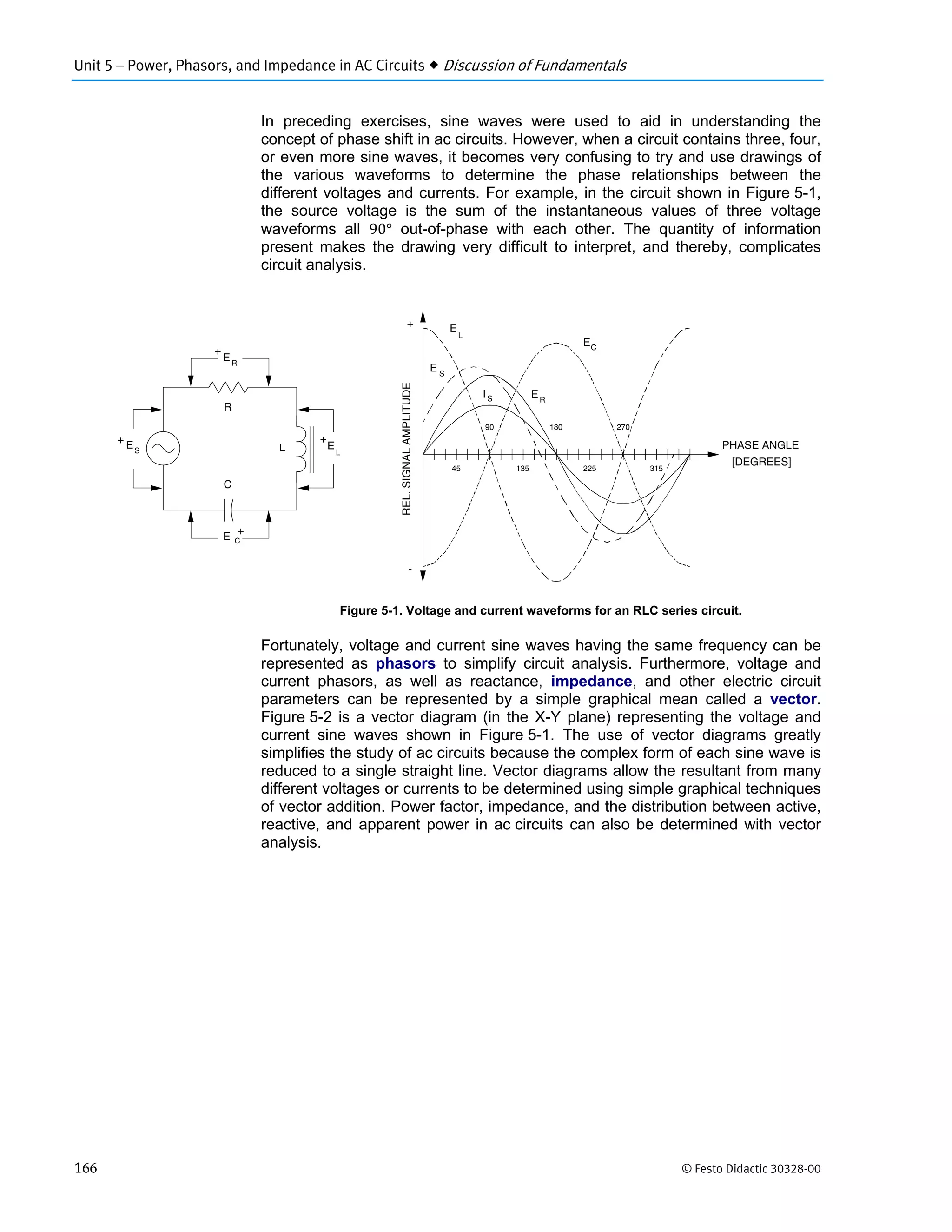
different voltages and currents. For example, in the circuit shown in Figure 5-1,
the source voltage is the sum of the instantaneous values of three voltage
waveforms all 90° out-of-phase with each other. The quantity of information
present makes the drawing very difficult to interpret, and thereby, complicates
circuit analysis.
Figure 5-1. Voltage and current waveforms for an RLC series circuit.
Fortunately, voltage and current sine waves having the same frequency can be
represented as phasors to simplify circuit analysis. Furthermore, voltage and
current phasors, as well as reactance, impedance, and other electric circuit
parameters can be represented by a simple graphical mean called a vector.
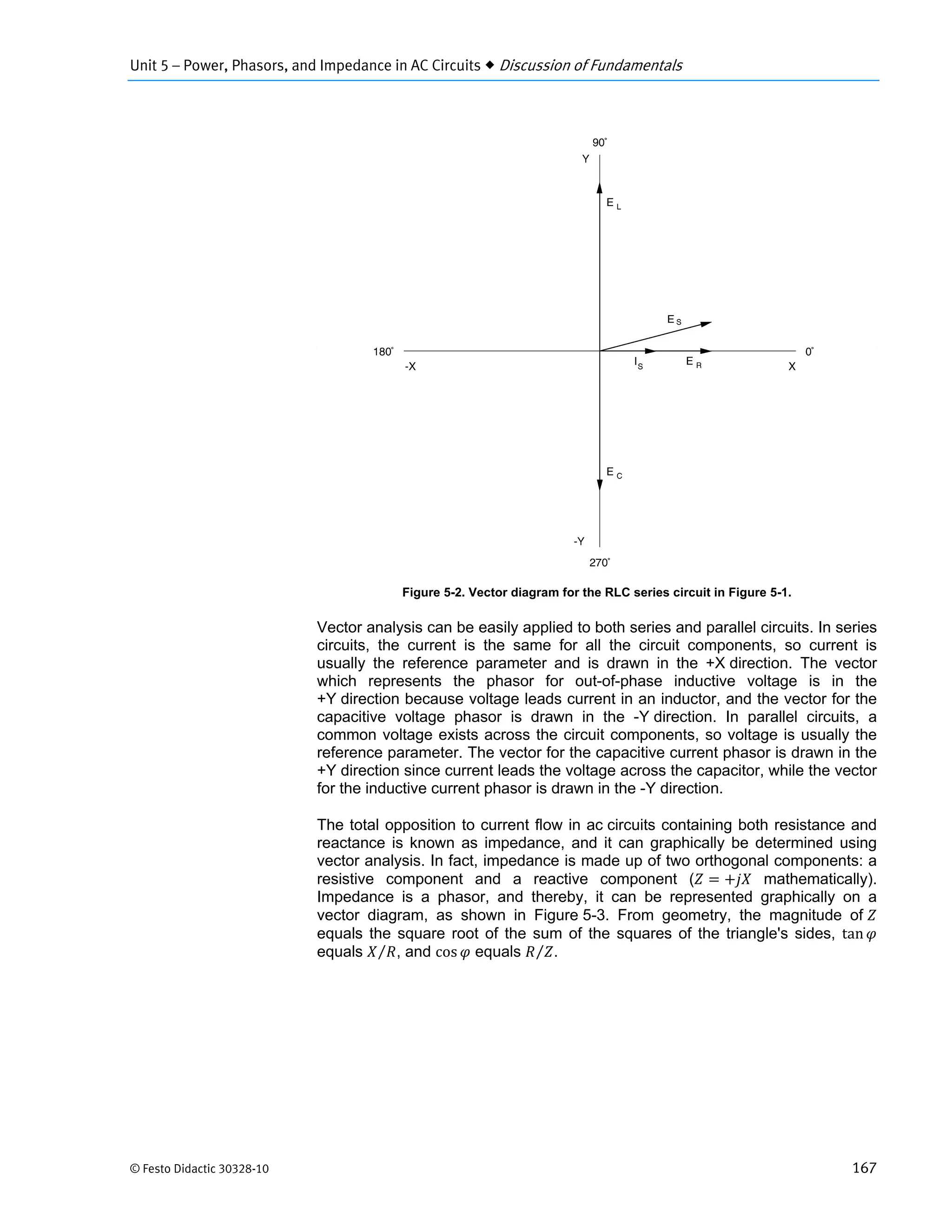
Figure 5-2 is a vector diagram (in the X-Y plane) representing the voltage and
current sine waves shown in Figure 5-1. The use of vector diagrams greatly
simplifies the study of ac circuits because the complex form of each sine wave is
reduced to a single straight line. Vector diagrams allow the resultant from many
different voltages or currents to be determined using simple graphical techniques
of vector addition. Power factor, impedance, and the distribution between active,
reactive, and apparent power in ac circuits can also be determined with vector
analysis.
Unit 5 – Power, Phasors, and Impedance in AC Circuits  Discussion of Fundamentals
© Festo Didactic 30328-10 167
Figure 5-2. Vector diagram for the RLC series circuit in Figure 5-1.
Vector analysis can be easily applied to both series and parallel circuits. In series
circuits, the current is the same for all the circuit components, so current is
usually the reference parameter and is drawn in the +X direction. The vector
which represents the phasor for out-of-phase inductive voltage is in the
+Y direction because voltage leads current in an inductor, and the vector for the
capacitive voltage phasor is drawn in the -Y direction. In parallel circuits, a
common voltage exists across the circuit components, so voltage is usually the
reference parameter. The vector for the capacitive current phasor is drawn in the
+Y direction since current leads the voltage across the capacitor, while the vector
for the inductive current phasor is drawn in the -Y direction.
The total opposition to current flow in ac circuits containing both resistance and
reactance is known as impedance, and it can graphically be determined using
vector analysis. In fact, impedance is made up of two orthogonal components: a
resistive component and a reactive component ( mathematically).
Impedance is a phasor, and thereby, it can be represented graphically on a
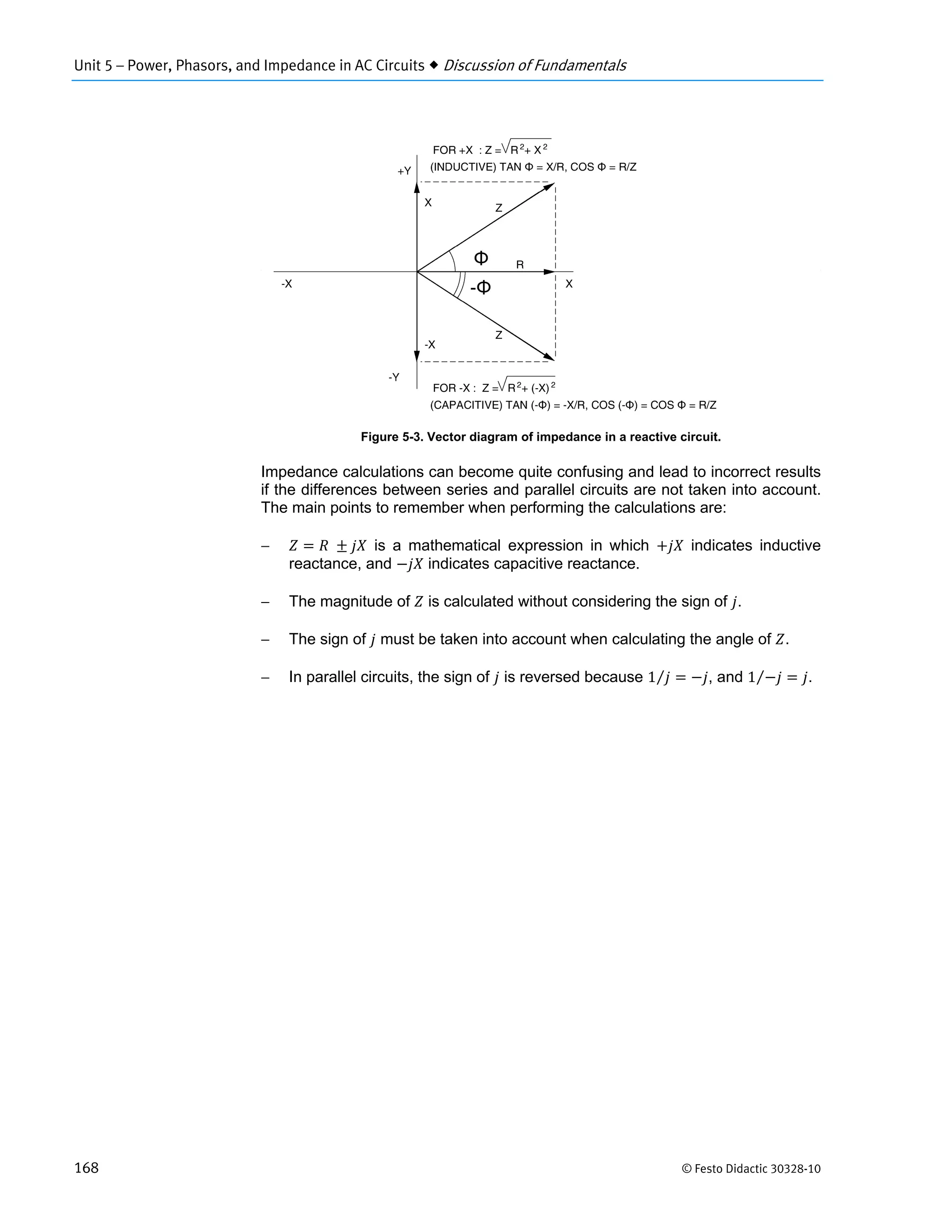
vector diagram, as shown in Figure 5-3. From geometry, the magnitude of
equals the square root of the sum of the squares of the triangle's sides, tan
equals ⁄ , and cos equals ⁄ .
Unit 5 – Power, Phasors, and Impedance in AC Circuits  Discussion of Fundamentals
168 © Festo Didactic 30328-10
Figure 5-3. Vector diagram of impedance in a reactive circuit.
Impedance calculations can become quite confusing and lead to incorrect results
if the differences between series and parallel circuits are not taken into account.
The main points to remember when performing the calculations are:
 	 is a mathematical expression in which indicates inductive
reactance, and indicates capacitive reactance.
 The magnitude of is calculated without considering the sign of .
 The sign of must be taken into account when calculating the angle of .
 In parallel circuits, the sign of is reversed because 1⁄ , and 1⁄ .
© Festo Didactic 30328-10 169
When you have completed this exercise, you will be able to determine the active,
reactive, and apparent power supplied to an inductive load by using
measurements of circuit currents and voltages. You will also learn how to
improve the power factor.
As stated previously, the apparent power supplied to a load equals the product of
the load voltage and current. In ac circuits, apparent power is always greater
than active power when the load contains reactance, because reactive power
must be supplied by the source. The reactive power may be inductive or
capacitive, but in most electromechanical devices it will be inductive because of
the inductance of the coils in transformers and motors.
The formula for determining reactive power in an ac circuit is as follows:
where is the reactive power in var.
is the apparent power in VA.
is the active power in W.
When the phase shift between the voltage and current is known, active
power can be determined from the following formula:
cos cos
In ac circuits where the voltage and current are sine waves, the term cos is
called the power factor and it is equal to the ratio of active power to apparent
power, ⁄ . The actual value of the power factor depends on how much the
current and voltage are out-of-phase. If and are in phase (purely resistive
circuit), meaning phase shift is 0°, then cos 1 and the active power is equal
to the product (apparent power). When the phase shift between current and
voltage is 90° (purely reactive circuit), cos 0, therefore the active power is
zero. When a circuit contains both resistance and reactance, the phase shift
lies between 0° and 	90°, depending on whether circuit reactance is inductive or
capacitive, cos has a value between 0 and 1, and the active power equals a
fraction of the apparent power.
Power in AC Circuits
Exercise 5-1
EXERCISE OBJECTIVE
DISCUSSION
Ex. 5-1 – Power in AC Circuits  Discussion
170 © Festo Didactic 30328-10
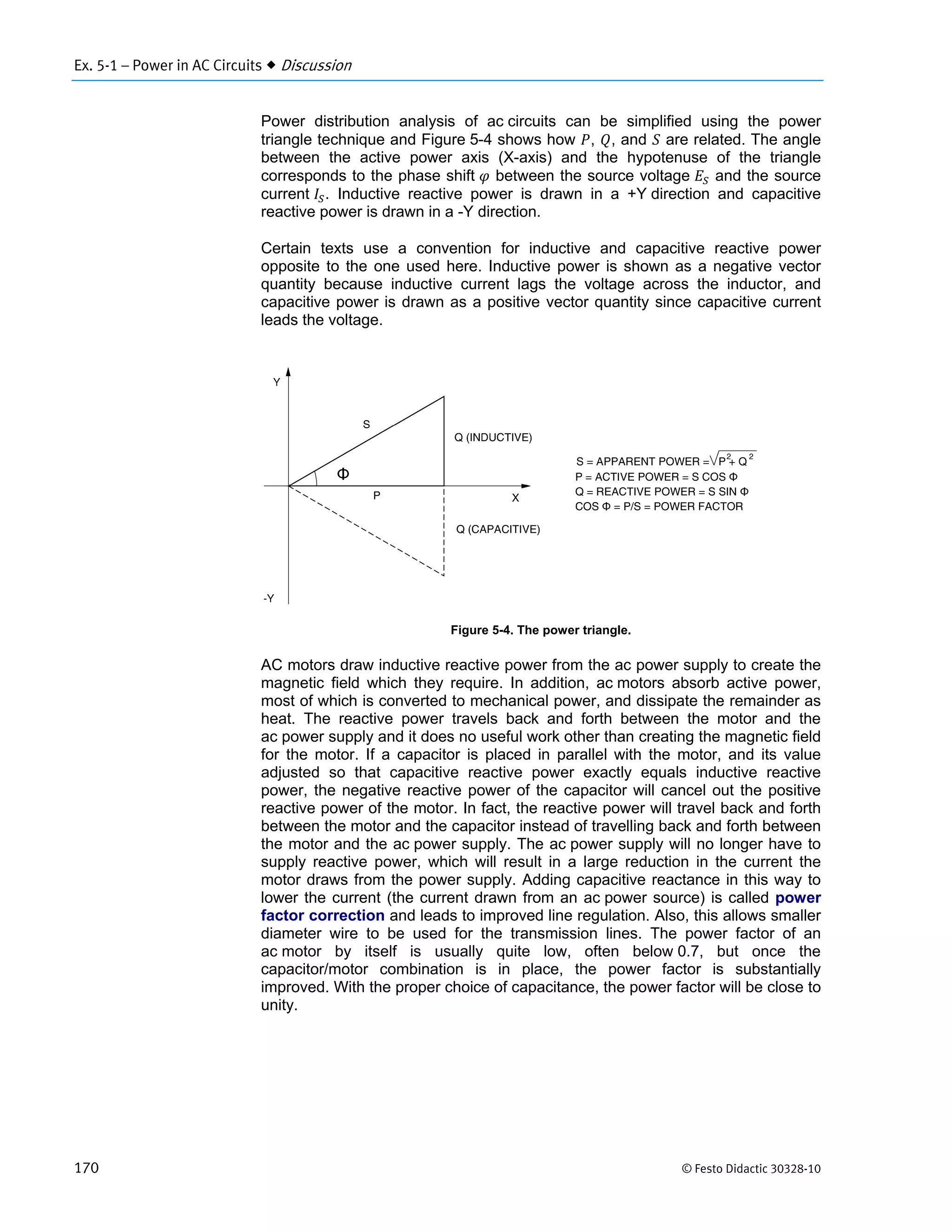
Power distribution analysis of ac circuits can be simplified using the power
triangle technique and Figure 5-4 shows how , , and are related. The angle
between the active power axis (X-axis) and the hypotenuse of the triangle
corresponds to the phase shift between the source voltage and the source
current . Inductive reactive power is drawn in a +Y direction and capacitive
reactive power is drawn in a -Y direction.
Certain texts use a convention for inductive and capacitive reactive power
opposite to the one used here. Inductive power is shown as a negative vector
quantity because inductive current lags the voltage across the inductor, and
capacitive power is drawn as a positive vector quantity since capacitive current
leads the voltage.
Figure 5-4. The power triangle.
AC motors draw inductive reactive power from the ac power supply to create the
magnetic field which they require. In addition, ac motors absorb active power,
most of which is converted to mechanical power, and dissipate the remainder as
heat. The reactive power travels back and forth between the motor and the
ac power supply and it does no useful work other than creating the magnetic field
for the motor. If a capacitor is placed in parallel with the motor, and its value
adjusted so that capacitive reactive power exactly equals inductive reactive
power, the negative reactive power of the capacitor will cancel out the positive
reactive power of the motor. In fact, the reactive power will travel back and forth
between the motor and the capacitor instead of travelling back and forth between
the motor and the ac power supply. The ac power supply will no longer have to
supply reactive power, which will result in a large reduction in the current the
motor draws from the power supply. Adding capacitive reactance in this way to
lower the current (the current drawn from an ac power source) is called power
factor correction and leads to improved line regulation. Also, this allows smaller
diameter wire to be used for the transmission lines. The power factor of an
ac motor by itself is usually quite low, often below 0.7, but once the
capacitor/motor combination is in place, the power factor is substantially
improved. With the proper choice of capacitance, the power factor will be close to
unity.
Ex. 5-1 – Power in AC Circuits  Procedure
© Festo Didactic 30328-10 171
EQUIPMENT REQUIRED
Refer to the Equipment Utilization Chart in Appendix C to obtain the list of
equipment required for this exercise.
High voltages are present in this laboratory exercise. Do not make or modify any
banana jack connections with the power on unless otherwise specified.
1. Install the Power Supply, data acquisition module, Resistive Load, Inductive
Load, and Capacitive Load modules in the EMS Workstation.
2. Make sure that the main switch of the Power Supply is set to the O (OFF)
position, and the voltage control knob is turned fully counterclockwise. Set
the voltmeter select switch to the 4-N position, then make sure that the
Power Supply is connected to a three-phase wall receptacle.
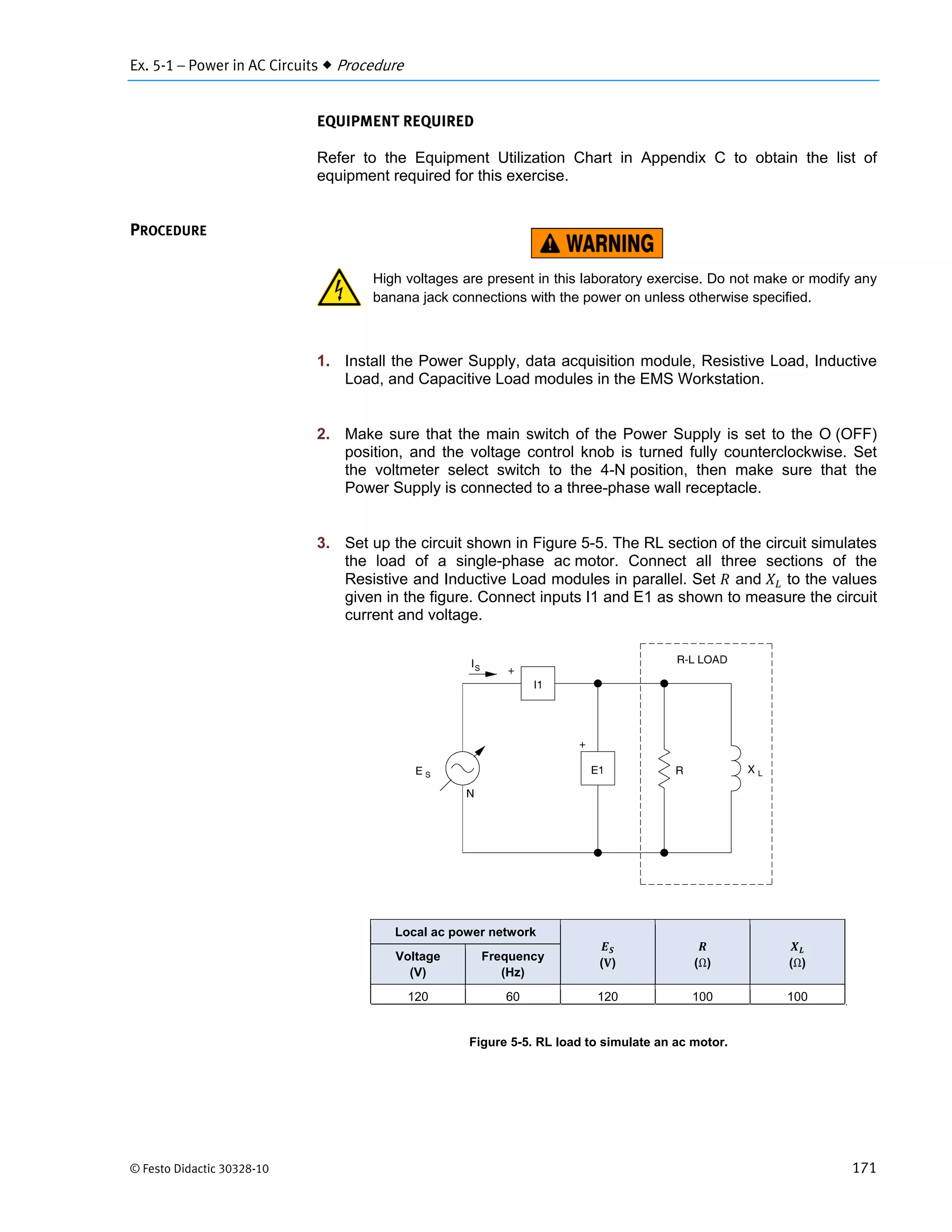
3. Set up the circuit shown in Figure 5-5. The RL section of the circuit simulates
the load of a single-phase ac motor. Connect all three sections of the
Resistive and Inductive Load modules in parallel. Set and to the values
given in the figure. Connect inputs I1 and E1 as shown to measure the circuit
current and voltage.
Figure 5-5. RL load to simulate an ac motor.
PROCEDURE
Local ac power network
( ) (Ω) (Ω)
Voltage
(V)
Frequency
(Hz)
120 60 120 100 100
Ex. 5-1 – Power in AC Circuits  Procedure
172 © Festo Didactic 30328-10
4. Make sure that the data acquisition module is connected to a USB port of the
computer.
Connect the POWER INPUT of the data acquisition module to the
24 V - AC output of the Power Supply. Set the 24 V - AC power switch to the
I (ON) position.
5. Start the Data Acquisition software (LVDAC or LVDAM). Open setup
configuration file ES15-1.dai.
a The metering setup configuration can be changed during the exercise if
desired. This exercise was written using those given.
Make sure that the continuous refresh mode is selected.
6. Turn on the main Power Supply and adjust the voltage control knob to obtain
the value of voltage given in Figure 5-5.
7. Measure the load voltage and current, and the active power ( ) consumed by
the circuit. Note the results, then turn off the Power Supply.
	V
	A
	W
8. Use the measured values of and to determine the apparent power ( )
supplied to the load.
	VA
Ex. 5-1 – Power in AC Circuits  Procedure
© Festo Didactic 30328-10 173
9. Determine the power factor cos , and the reactive power .
cos 	
	var
10. Do the values calculated in step 9 demonstrate a low power factor and a
notable amount of reactive power for the simulated motor load?
 Yes  No
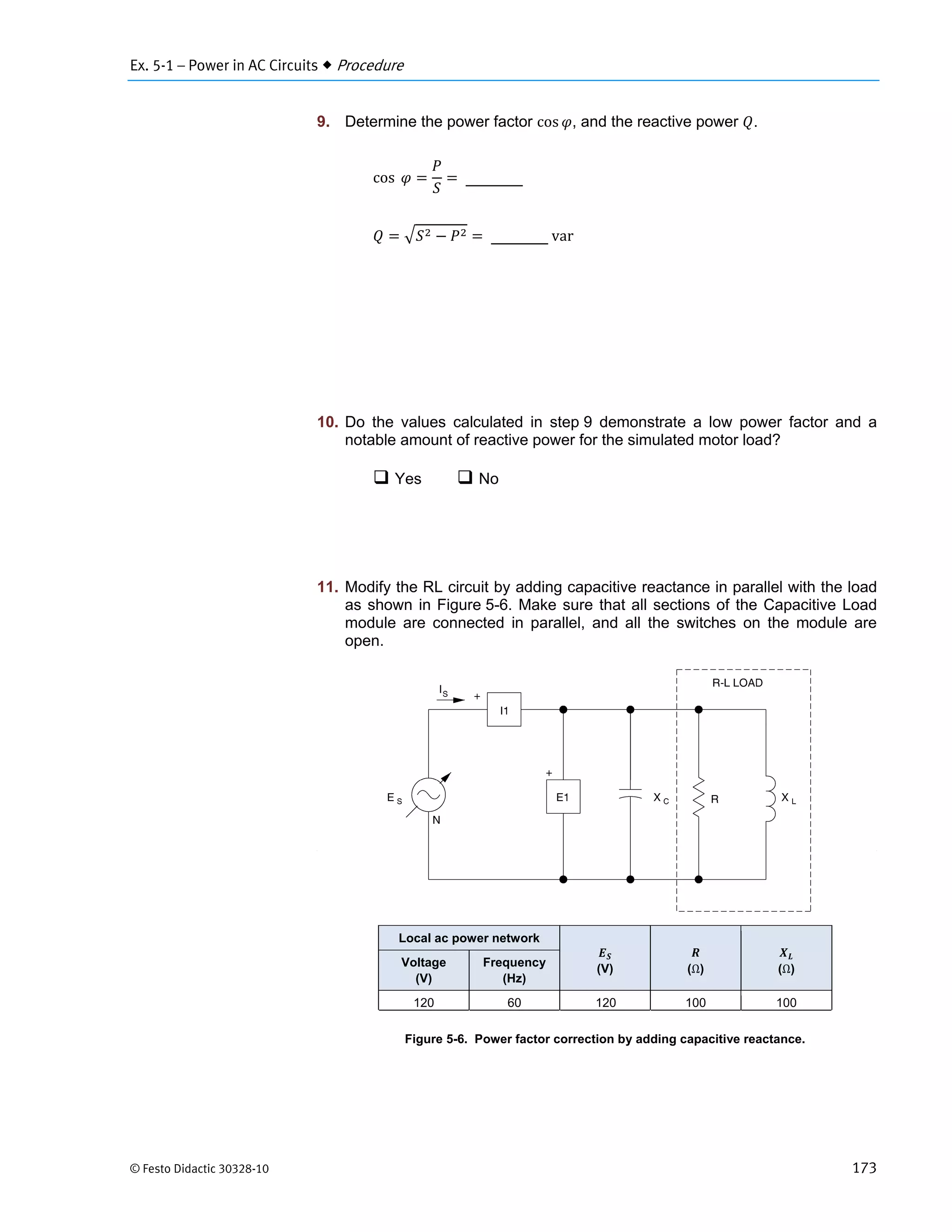
11. Modify the RL circuit by adding capacitive reactance in parallel with the load
as shown in Figure 5-6. Make sure that all sections of the Capacitive Load
module are connected in parallel, and all the switches on the module are
open.
Figure 5-6. Power factor correction by adding capacitive reactance.
Local ac power network
(V) (Ω) (Ω)
Voltage
(V)
Frequency
(Hz)
120 60 120 100 100
Ex. 5-1 – Power in AC Circuits  Procedure
174 © Festo Didactic 30328-10
12. Turn on the Power Supply and add capacitance to the circuit by closing the
first switch in each section one after the other, then the middle switches, and
finally the third switch in each section, until all switches have been closed.
For each new value of capacitance, click the Record Data button to record
the measured value of the source current in the Data Table.
Source (line) current.
Sample
number
Source current ( )
(A)
Ex. 5-1 – Power in AC Circuits  Procedure
© Festo Didactic 30328-10 175
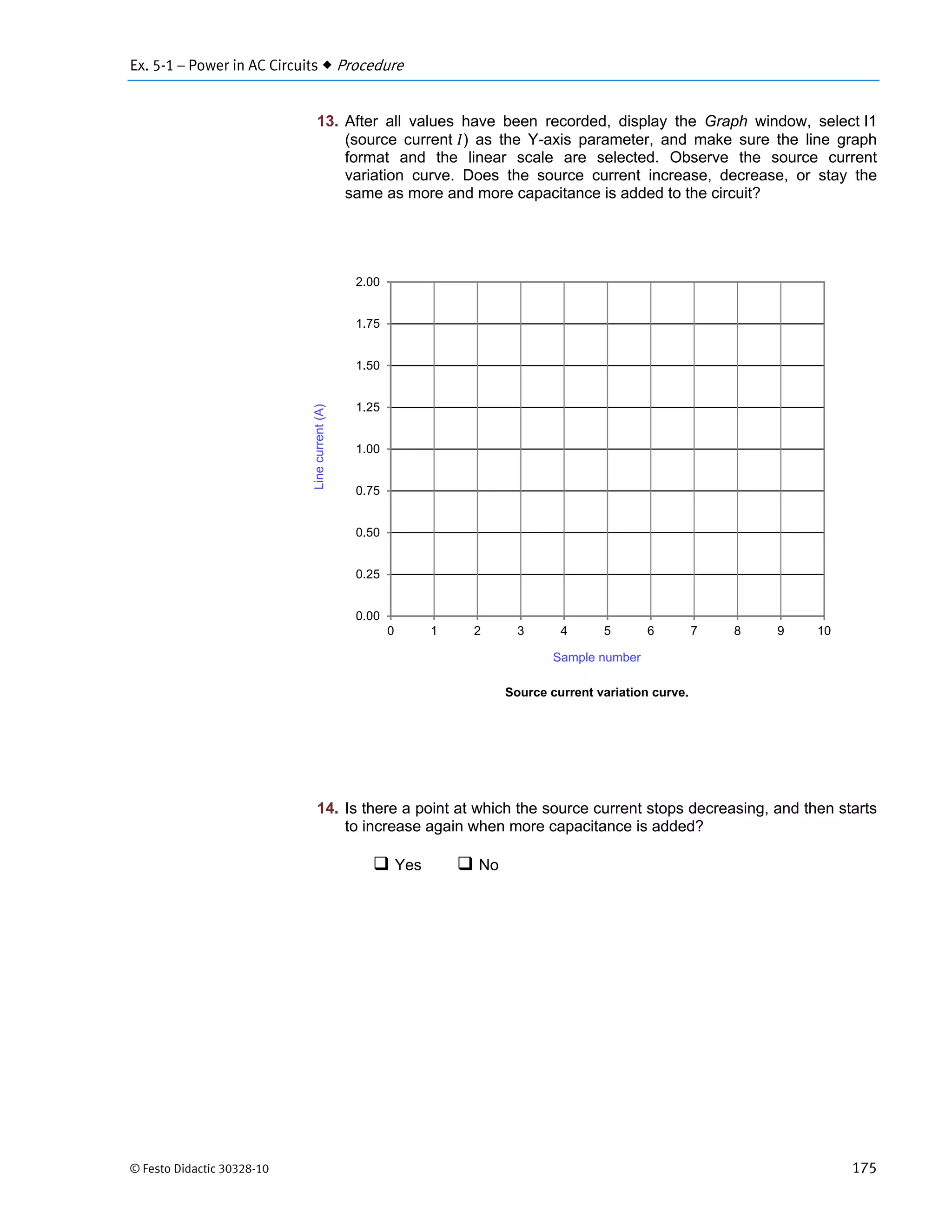
13. After all values have been recorded, display the Graph window, select I1
(source current ) as the Y-axis parameter, and make sure the line graph
format and the linear scale are selected. Observe the source current
variation curve. Does the source current increase, decrease, or stay the
same as more and more capacitance is added to the circuit?
14. Is there a point at which the source current stops decreasing, and then starts
to increase again when more capacitance is added?
 Yes  No
0.00
0.25
0.50
0.75
1.00
1.25
1.50
1.75
2.00
0 1 2 3 4 5 6 7 8 9 10
Sample number
Source current variation curve.
Linecurrent(A)
Ex. 5-1 – Power in AC Circuits  Procedure
176 © Festo Didactic 30328-10
15. Carefully adjust the switches on the Capacitive Load module to obtain
minimum source current, while readjusting the voltage control knob as
necessary to maintain the exact value of voltage given in the table. Use
the settings on the module to determine the value of capacitive reactance
that produces minimum source current.
1
2
	Ω
a You will have noticed that the source current is minimum when the capacitive
reactance equals the inductive reactance. The negative reactive power then
cancels the positive reactive power, and line current is minimized.
16. With adjusted for minimum source current, record the value of , , and
the active power .
	V
	A
	W
17. Determine the apparent power .
	VA
Ex. 5-1 – Power in AC Circuits  Procedure
© Festo Didactic 30328-10 177
18. Calculate the power factor cos , and the reactive power .
cos
	var
19. Has the reactive power consumed by the circuit decreased between step 9
and step 18?
 Yes  No
20. Has the line current been reduced by a significant amount with the addition of
capacitance?
 Yes  No
21. Is the active power consumed by the RL load approximately the same with
and without capacitance?
 Yes  No
22. Ensure that the Power Supply is turned off, and that the voltage control knob
is turned fully counterclockwise. Remove all leads and cables.
Ex. 5-1 – Power in AC Circuits  Conclusion
178 © Festo Didactic 30328-10
In this exercise, you determined the active, reactive and apparent power for an
inductive load, and were able to observe the effect produced by adding
capacitance in parallel with the load. You saw how the power factor can be
improved with the addition of capacitance, and you were able to demonstrate that
line current can be reduced without affecting the amount of active power
consumed by the load.
1. An electromagnet draws 3 kW of active power and 4 kvar of inductive
reactive power. What is the apparent power?
a. 500 VA
b. 5 kVA
c. 50 kVA
d. 7 kVA
2. What is the power factor cos for the electromagnet in Question 1?
a. 0.75
b. 1.33
c. 0.60
d. 1.00
3. A capacitor drawing 4 kvar of reactive power is placed in parallel with the
electromagnet in Question 1. How does this affect the apparent power and
the power factor cos ?
a. Apparent power now equals the active power and cos
equals 1.
b. Apparent power is doubled and cos remains the same.
c. Apparent power remains the same and cos decreases.
d. Both apparent power and cos increase.
4. What is the formula used to determine reactive power ?
a.
b. 	 cos
c. 	 cos
d. √
CONCLUSION
REVIEW QUESTIONS
Ex. 5-1 – Power in AC Circuits  Review Questions
© Festo Didactic 30328-10 179
5. A capacitor drawing 8 kvar is placed in parallel with an electromagnet that
draws 3 kW of active power and 4 kvar of reactive power. What effect does
this have on the reactive power provided by the ac power source and the
power factor cos ?
a. goes from +4 to −4 kvar and cos is corrected to unity.
b. goes from +4 to −8 kvar and cos remains the same.
c. goes from +4 to −4 kvar and cos remains the same.
d. goes from +4 to −8 kvar and cos is corrected to unity.
© Festo Didactic 30328-10 181
When you have completed this exercise, you will be able to use phasors to solve
series ac circuits and determine the circuit voltages. Basic vector concepts
combined with measurements of circuit currents and voltages will be used to
verify your work.
In ac circuits, sine-wave currents flow through the circuit components and sine-
wave voltages appear across the components. Each of the voltage and current
sine waves has its own amplitude, but all these sine waves have the same
frequency. As a result, there is a fixed phase relationship between the various
voltage and current sine waves. Each of the voltage and current sine waves in
ac circuits can be described by an amplitude and a phase angle. This allows a
phasor (in polar coordinates) to be used to represent each of the voltage and
current sine waves, the modulus and phase angle of the phasor corresponding to
the amplitude and phase angle of the sine wave, respectively.
Phasors representing voltage and current sine waves in ac circuits (voltage and
current phasors) can be represented graphically using vectors drawn in the X-Y
plane. This graphical representation is referred to as a vector diagram. This
allows each of the sine waves in an ac circuit to be reduced to a single line in the
vector diagram. This greatly simplifies ac circuit analysis as will be demonstrated
in the rest of this discussion.
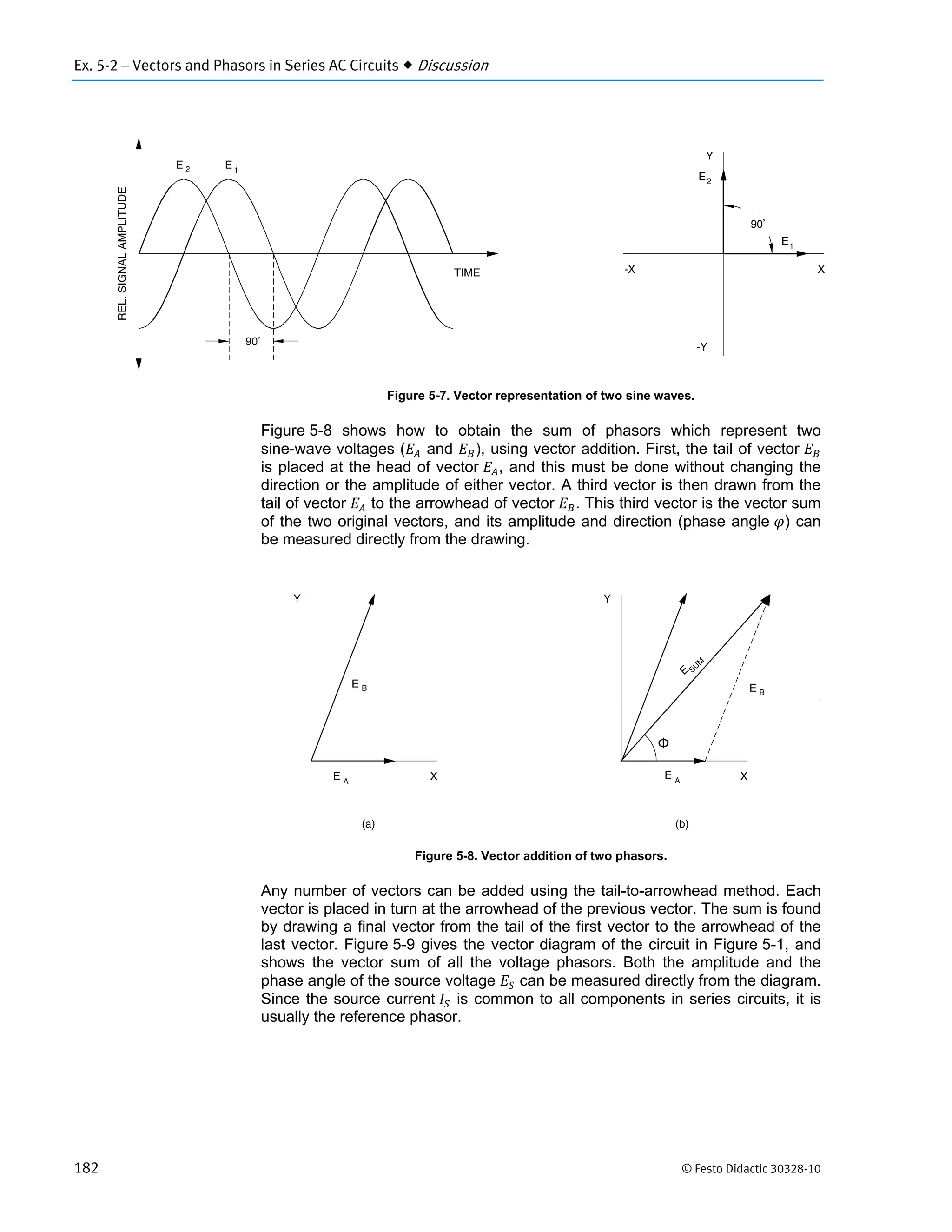
Figure 5-7 shows two voltage sine waves and the corresponding vector diagram.
Sine wave leads sine wave by 90°. In this example, sine wave is
selected as the reference. It is therefore described by a voltage phasor having a
magnitude equal to the amplitude of sine wave and a phase angle
of 0° 		0° . As a result, sine wave will be described by a voltage phasor
having a magnitude equal to the amplitude of sine wave and a phase angle
of 90°	 		 90° because sine wave leads sine wave by 90°. The
vector corresponding to voltage phasor is drawn along the positive-value
X-axis because it is used as the reference. Its length corresponds to
magnitude . The vector corresponding to voltage phasor is drawn in the
+Y direction so that it is at right angle with vector . Its length corresponds to
magnitude . The vector diagram clearly shows that leads by 90°, and
and have the same amplitude.
a Angles measured in the counterclockwise direction from the reference phasor
are considered positive, and thereby, indicate a phase lead. Conversely,
angles measured in the clockwise direction from the reference phasor are
considered negative, and thereby, indicate a phase lag.
Vectors and Phasors in Series AC Circuits
Exercise 5-2
EXERCISE OBJECTIVE
DISCUSSION
Ex. 5-2 – Vectors and Phasors in Series AC Circuits  Discussion
182 © Festo Didactic 30328-10
Figure 5-7. Vector representation of two sine waves.
Figure 5-8 shows how to obtain the sum of phasors which represent two
sine-wave voltages ( and ), using vector addition. First, the tail of vector
is placed at the head of vector , and this must be done without changing the
direction or the amplitude of either vector. A third vector is then drawn from the
tail of vector to the arrowhead of vector . This third vector is the vector sum
of the two original vectors, and its amplitude and direction (phase angle ) can
be measured directly from the drawing.
Figure 5-8. Vector addition of two phasors.
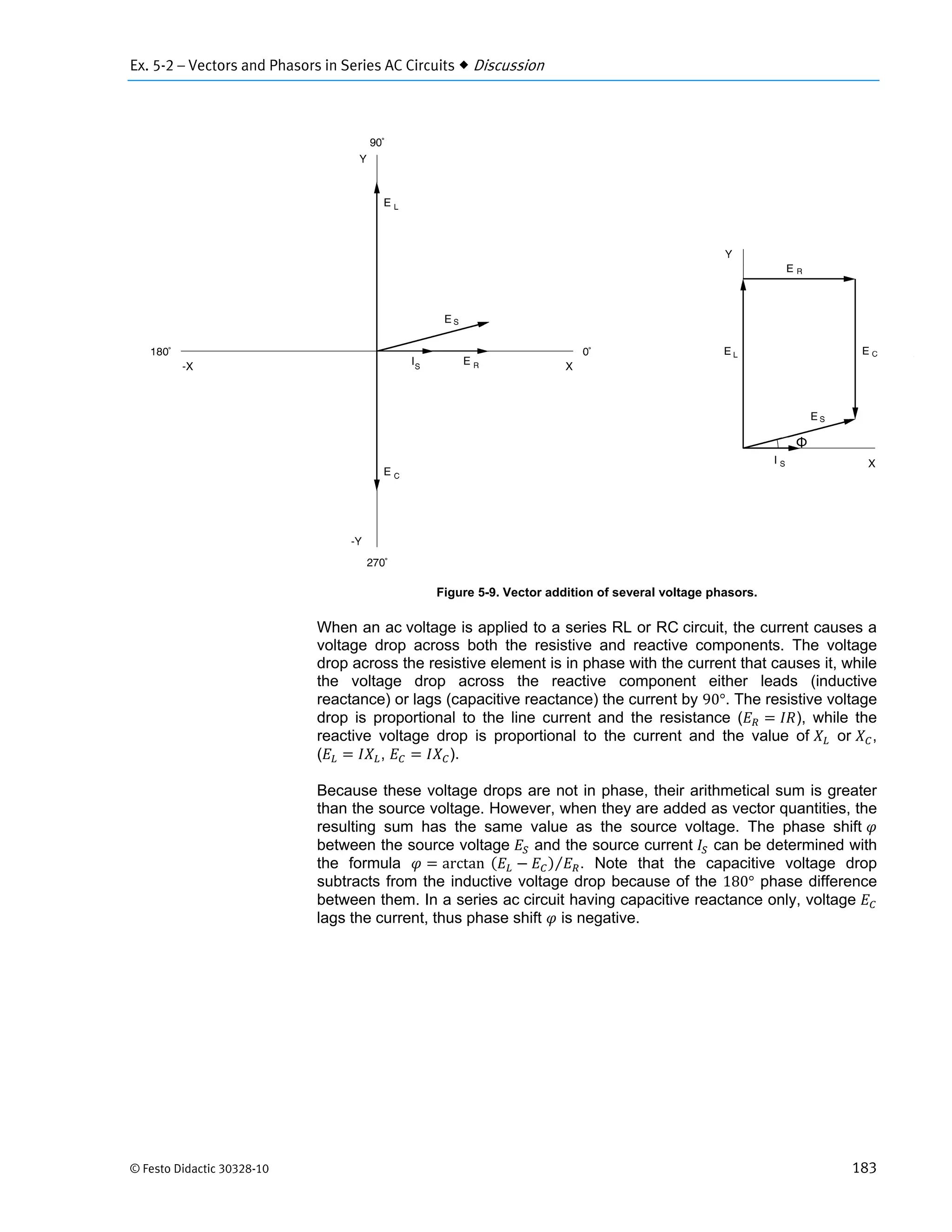
Any number of vectors can be added using the tail-to-arrowhead method. Each
vector is placed in turn at the arrowhead of the previous vector. The sum is found
by drawing a final vector from the tail of the first vector to the arrowhead of the
last vector. Figure 5-9 gives the vector diagram of the circuit in Figure 5-1, and
shows the vector sum of all the voltage phasors. Both the amplitude and the
phase angle of the source voltage can be measured directly from the diagram.
Since the source current is common to all components in series circuits, it is
usually the reference phasor.
Ex. 5-2 – Vectors and Phasors in Series AC Circuits  Discussion
© Festo Didactic 30328-10 183
Figure 5-9. Vector addition of several voltage phasors.
When an ac voltage is applied to a series RL or RC circuit, the current causes a
voltage drop across both the resistive and reactive components. The voltage
drop across the resistive element is in phase with the current that causes it, while
the voltage drop across the reactive component either leads (inductive
reactance) or lags (capacitive reactance) the current by 90°. The resistive voltage
drop is proportional to the line current and the resistance ( ), while the
reactive voltage drop is proportional to the current and the value of or ,
( , ).
Because these voltage drops are not in phase, their arithmetical sum is greater
than the source voltage. However, when they are added as vector quantities, the
resulting sum has the same value as the source voltage. The phase shift
between the source voltage and the source current can be determined with
the formula arctan 	 ⁄ . Note that the capacitive voltage drop
subtracts from the inductive voltage drop because of the 180° phase difference
between them. In a series ac circuit having capacitive reactance only, voltage
lags the current, thus phase shift is negative.
Ex. 5-2 – Vectors and Phasors in Series AC Circuits  Procedure
184 © Festo Didactic 30328-10
EQUIPMENT REQUIRED
Refer to the Equipment Utilization Chart in Appendix C to obtain the list of
equipment required for this exercise.
High voltages are present in this laboratory exercise. Do not make or modify any
banana jack connections with the power on unless otherwise specified.
1. Install the Power Supply, data acquisition module, Resistive Load, Inductive
Load, and Capacitive Load modules in the EMS Workstation.
2. Make sure that the main switch of the Power Supply is set to the O (OFF)
position, and the voltage control knob is turned fully counterclockwise. Set
the voltmeter select switch to the 4-N position, then make sure the Power
Supply is connected to a three-phase wall receptacle.
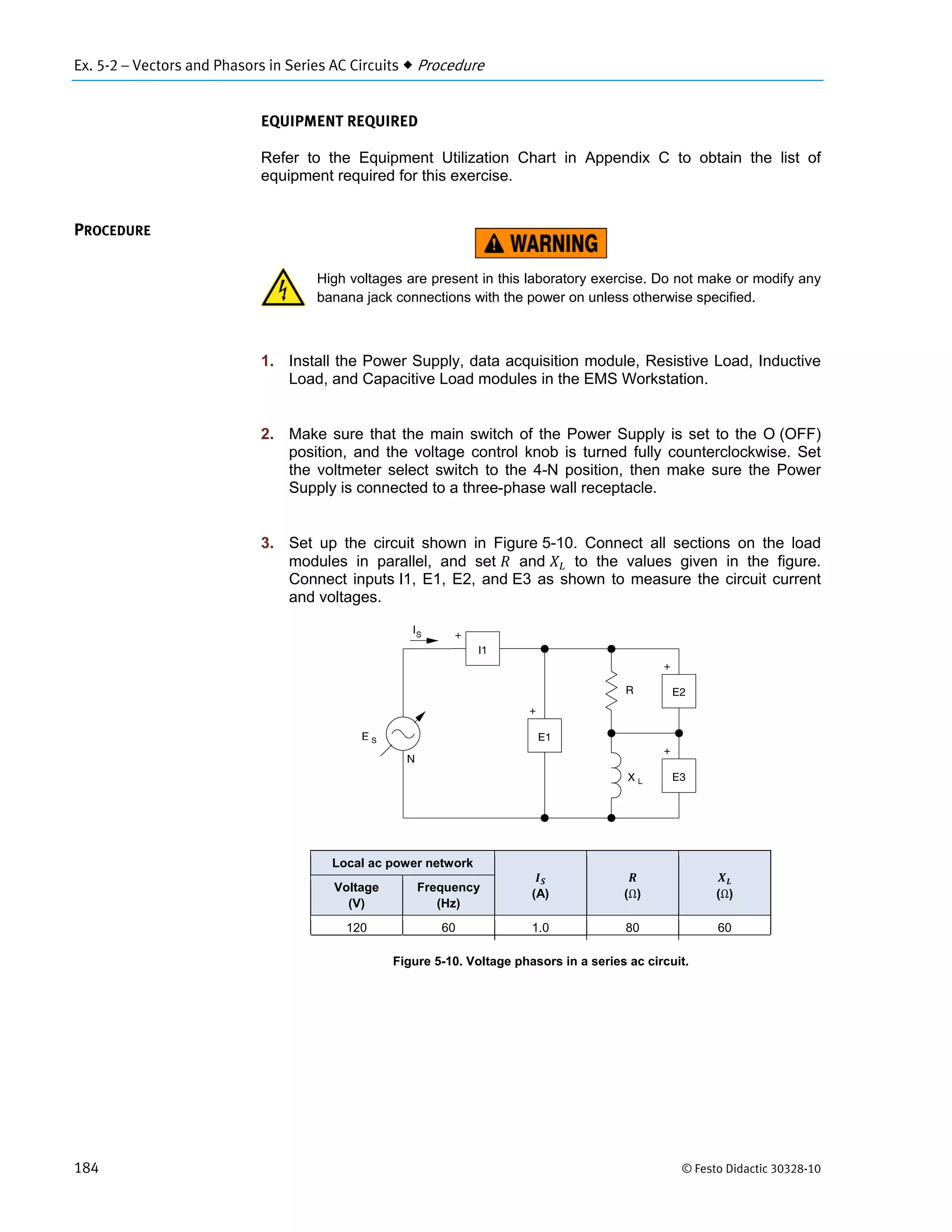
3. Set up the circuit shown in Figure 5-10. Connect all sections on the load
modules in parallel, and set and to the values given in the figure.
Connect inputs I1, E1, E2, and E3 as shown to measure the circuit current
and voltages.
Figure 5-10. Voltage phasors in a series ac circuit.
PROCEDURE
Local ac power network
(A) (Ω) (Ω)
Voltage
(V)
Frequency
(Hz)
120 60 1.0 80 60
Ex. 5-2 – Vectors and Phasors in Series AC Circuits  Procedure
© Festo Didactic 30328-10 185
4. Make sure that the data acquisition module is connected to a USB port of the
computer.
Connect the POWER INPUT of the data acquisition module to the
24 V - AC output of the Power Supply. Set the 24 V - AC power switch to the
I (ON) position.
5. Start the Data Acquisition software (LVDAC or LVDAM). Open setup
configuration file ES15-2.dai.
a The metering setup configuration can be changed during the exercise if
desired. This exercise was written using those given.
Make sure that the continuous refresh mode is selected. If an error occurs
when opening the configuration file, the background and phasor colors may
need to be changed on the Phasor Analysis graph.
6. Turn on the main Power Supply and slowly adjust the voltage control knob to
obtain the exact value of current given in Figure 5-10.
7. Measure the circuit voltages, and note the results below.
	V
	V
	V
8. Determine the arithmetical sum of and , and compare it to the
measured value of .
	V
Ex. 5-2 – Vectors and Phasors in Series AC Circuits  Procedure
186 © Festo Didactic 30328-10
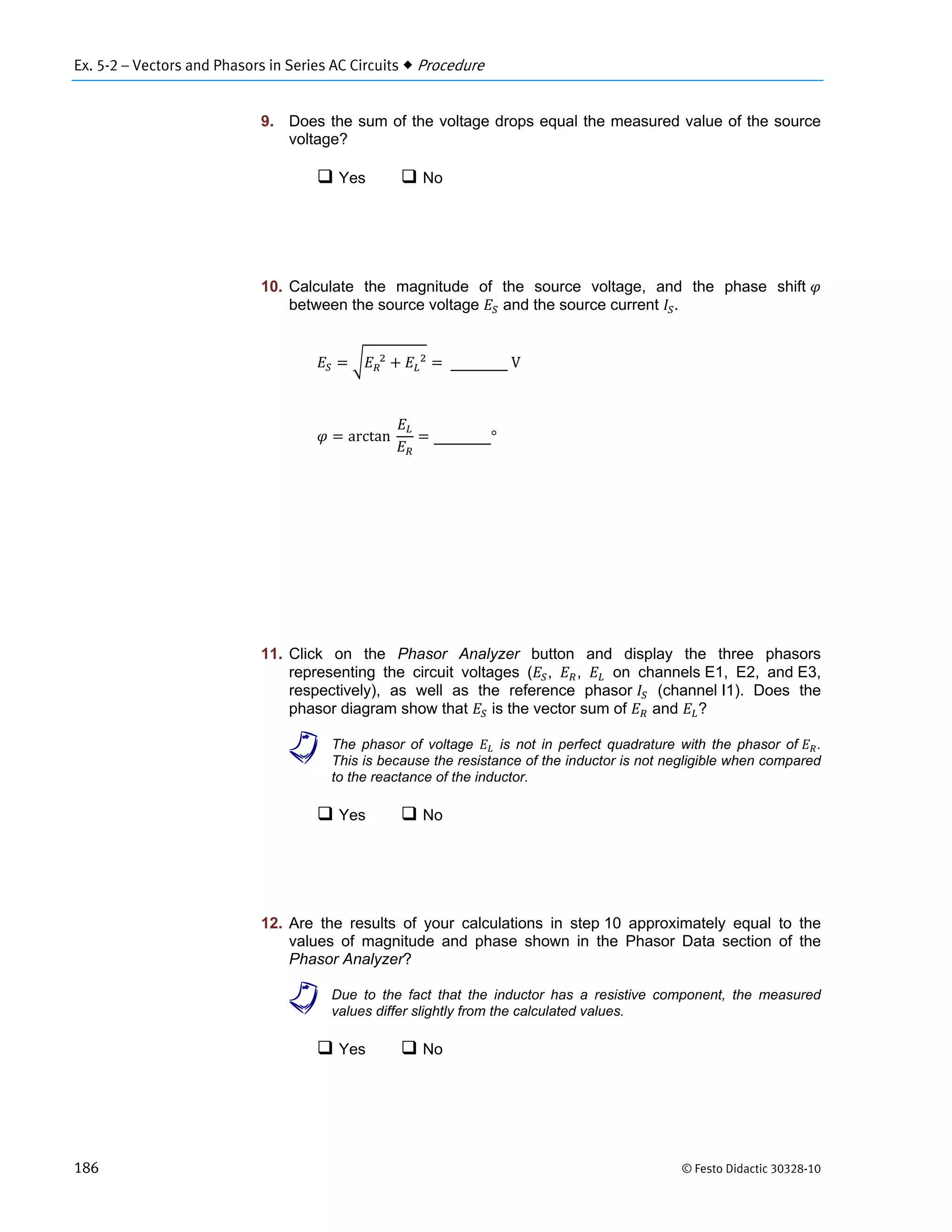
9. Does the sum of the voltage drops equal the measured value of the source
voltage?
 Yes  No
10. Calculate the magnitude of the source voltage, and the phase shift
between the source voltage and the source current .
		 		
	V
arctan		 °
11. Click on the Phasor Analyzer button and display the three phasors
representing the circuit voltages ( , , on channels E1, E2, and E3,
respectively), as well as the reference phasor (channel I1). Does the
phasor diagram show that is the vector sum of and ?
a The phasor of voltage is not in perfect quadrature with the phasor of .
This is because the resistance of the inductor is not negligible when compared
to the reactance of the inductor.
 Yes  No
12. Are the results of your calculations in step 10 approximately equal to the
values of magnitude and phase shown in the Phasor Data section of the
Phasor Analyzer?
a Due to the fact that the inductor has a resistive component, the measured
values differ slightly from the calculated values.
 Yes  No
Ex. 5-2 – Vectors and Phasors in Series AC Circuits  Procedure
© Festo Didactic 30328-10 187
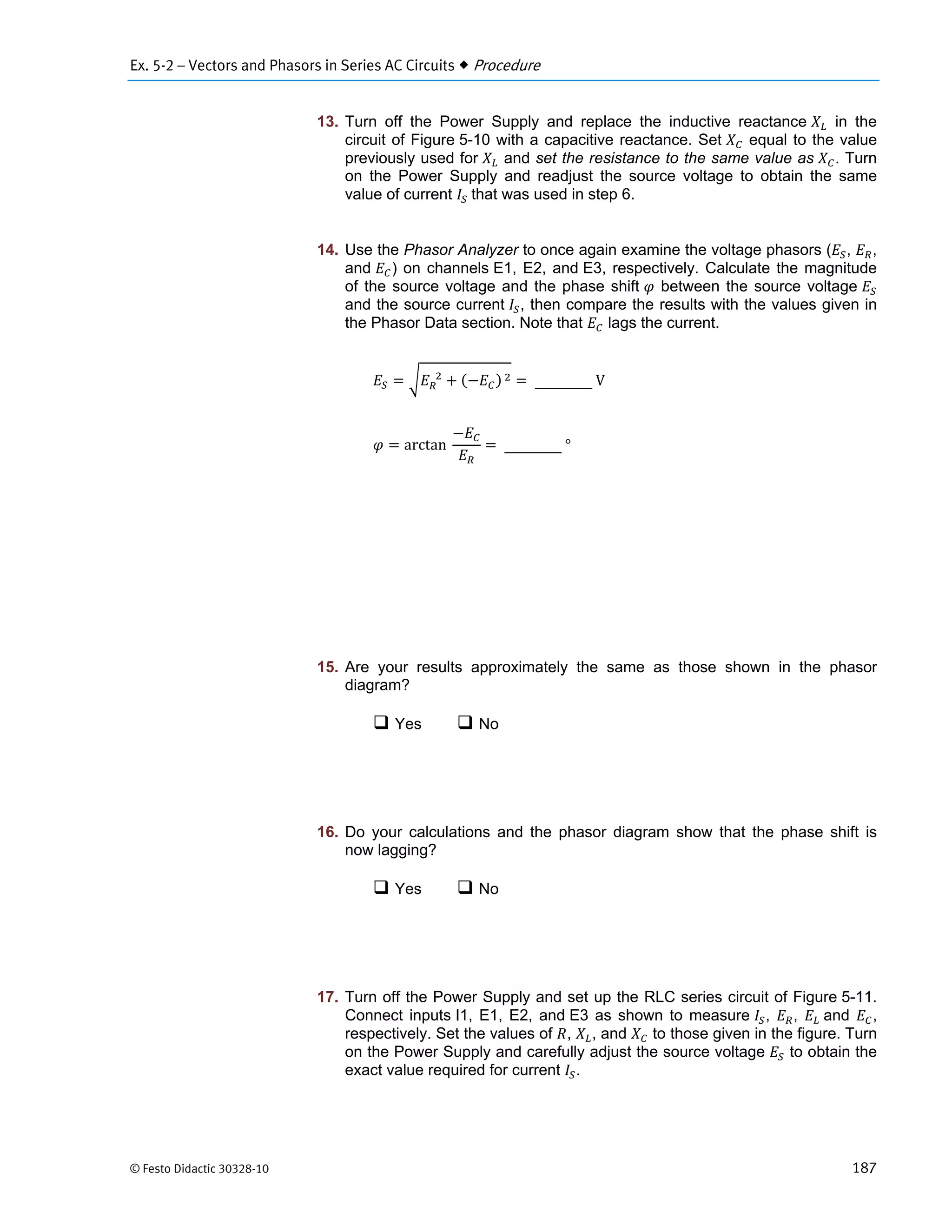
13. Turn off the Power Supply and replace the inductive reactance in the
circuit of Figure 5-10 with a capacitive reactance. Set equal to the value
previously used for and set the resistance to the same value as . Turn
on the Power Supply and readjust the source voltage to obtain the same
value of current 	that was used in step 6.
14. Use the Phasor Analyzer to once again examine the voltage phasors ( , ,
and ) on channels E1, E2, and E3, respectively. Calculate the magnitude
of the source voltage and the phase shift between the source voltage
and the source current , then compare the results with the values given in
the Phasor Data section. Note that lags the current.
		 	 	V
arctan		 	°
15. Are your results approximately the same as those shown in the phasor
diagram?
 Yes  No
16. Do your calculations and the phasor diagram show that the phase shift is
now lagging?
 Yes  No
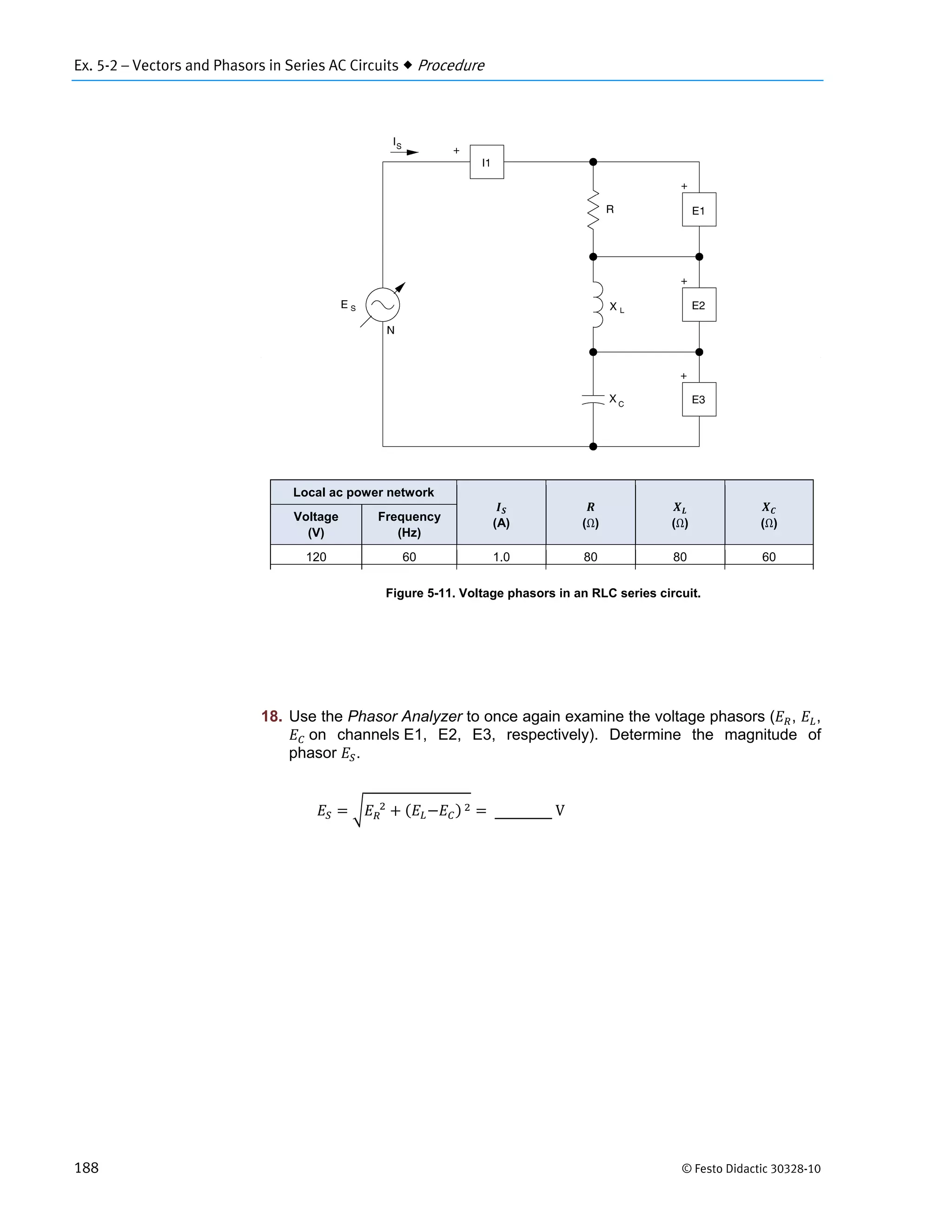
17. Turn off the Power Supply and set up the RLC series circuit of Figure 5-11.
Connect inputs I1, E1, E2, and E3 as shown to measure , , 	and ,
respectively. Set the values of , , and to those given in the figure. Turn
on the Power Supply and carefully adjust the source voltage to obtain the
exact value required for current .
Ex. 5-2 – Vectors and Phasors in Series AC Circuits  Procedure
188 © Festo Didactic 30328-10
Figure 5-11. Voltage phasors in an RLC series circuit.
18. Use the Phasor Analyzer to once again examine the voltage phasors ( , ,
	on channels E1, E2, E3, respectively). Determine the magnitude of
phasor .
		 	 	V
Local ac power network
(A) (Ω) (Ω) (Ω)
Voltage
(V)
Frequency
(Hz)
120 60 1.0 80 80 60
Ex. 5-2 – Vectors and Phasors in Series AC Circuits  Procedure
© Festo Didactic 30328-10 189
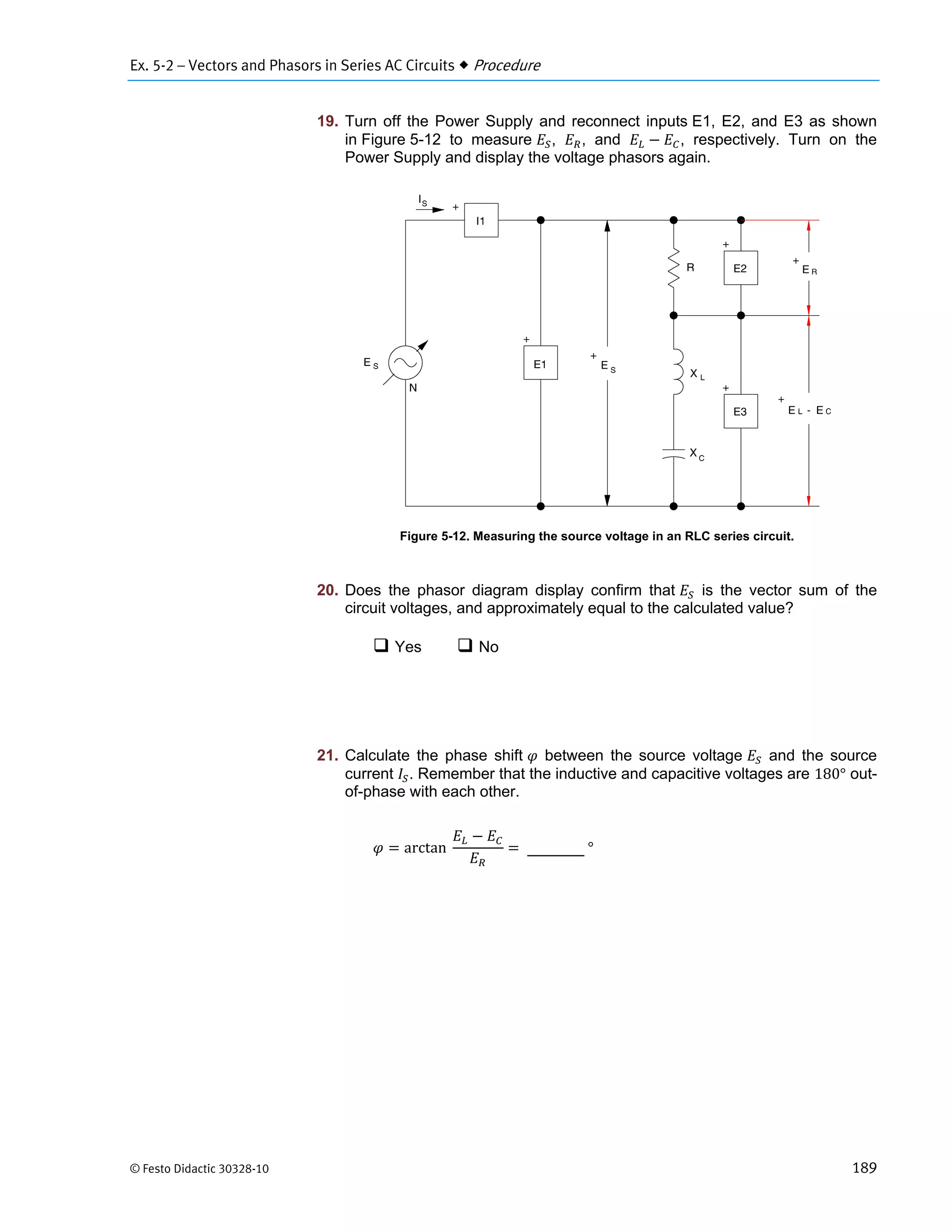
19. Turn off the Power Supply and reconnect inputs E1, E2, and E3 as shown
in Figure 5-12 to measure , , and , respectively. Turn on the
Power Supply and display the voltage phasors again.
Figure 5-12. Measuring the source voltage in an RLC series circuit.
20. Does the phasor diagram display confirm that is the vector sum of the
circuit voltages, and approximately equal to the calculated value?
 Yes  No
21. Calculate the phase shift between the source voltage and the source
current . Remember that the inductive and capacitive voltages are 180° out-
of-phase with each other.
arctan		 	°
Ex. 5-2 – Vectors and Phasors in Series AC Circuits  Procedure
190 © Festo Didactic 30328-10
22. Is the calculated phase shift approximately equal to the value given in the
Phasor Data section of the Phasor Analyzer?
 Yes  No
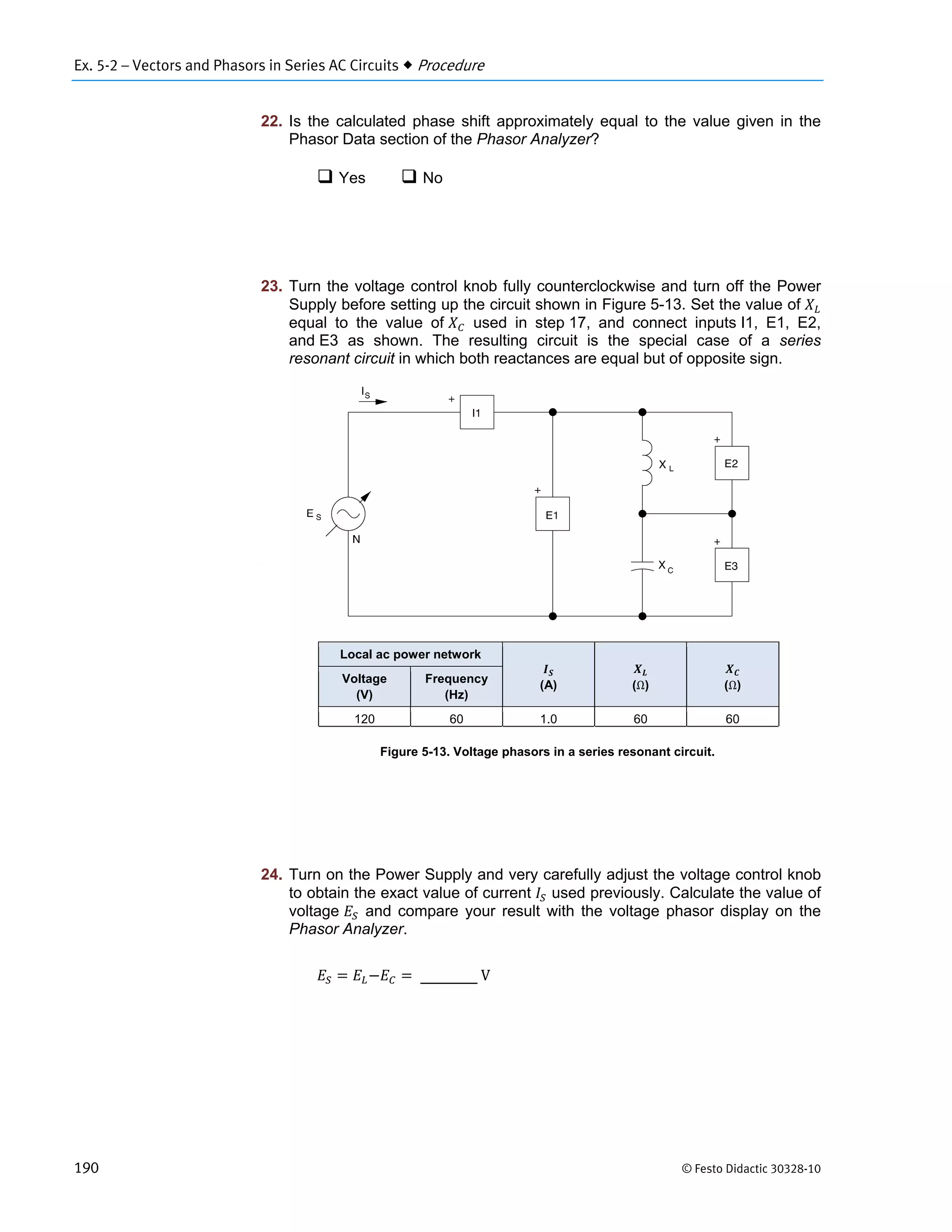
23. Turn the voltage control knob fully counterclockwise and turn off the Power
Supply before setting up the circuit shown in Figure 5-13. Set the value of
equal to the value of used in step 17, and connect inputs I1, E1, E2,
and E3 as shown. The resulting circuit is the special case of a series
resonant circuit in which both reactances are equal but of opposite sign.
Figure 5-13. Voltage phasors in a series resonant circuit.
24. Turn on the Power Supply and very carefully adjust the voltage control knob
to obtain the exact value of current used previously. Calculate the value of
voltage and compare your result with the voltage phasor display on the
Phasor Analyzer.
	V
Local ac power network
(A) (Ω) (Ω)
Voltage
(V)
Frequency
(Hz)
120 60 1.0 60 60
Ex. 5-2 – Vectors and Phasors in Series AC Circuits  Procedure
© Festo Didactic 30328-10 191
25. Does the Phasor Analyzer data confirm that the source voltage is
approximately zero?
a The inductor wire has some dc resistance so there will be a small amount of in-
phase voltage. will therefore have some small value close to zero volts.
 Yes  No
26. Ensure that the Power Supply is turned off, and that the voltage control knob
is turned fully counterclockwise. Remove all leads and cables.
Ex. 5-2 – Vectors and Phasors in Series AC Circuits  Conclusion
192 © Festo Didactic 30328-10
In this exercise, you used phasors and vector analysis techniques to determine
the different voltages in series ac circuits. You used source current as the
reference phasor since it is common to all components of series circuits. You
saw that the equal but opposite-sign reactances in a series-resonant circuit
reduced the opposition to source current to a very small value. Phasor displays
(vector diagrams) of the different circuit voltages were used to confirm your
calculations.
1. In an RL series circuit, what is the phase shift between the source voltage
and current when and are both equal to 100 Ω?
a. 37°
b. 53°
c. 45°
d. 90°
2. The main characteristic of a series resonant circuit is that the
a. source voltage is a high value.
b. source current is a low value.
c. source voltage is almost equal to zero.
d. source current is almost equal to zero.
3. In an RL series circuit, the parameter used as reference for drawing a vector
diagram is the
a. voltage.
b. current.
c. reactance.
d. resistance.
4. The magnitude of the vector sum of the two voltages in an RL series circuit
can be determined with the formula
a.
b.
c. 2	
d. 		
	 		
CONCLUSION
REVIEW QUESTIONS
Ex. 5-2 – Vectors and Phasors in Series AC Circuits  Review Questions
© Festo Didactic 30328-10 193
5. When an ac voltage is applied to a series RL or RC circuit, the current
causes a voltage drop across
a. the resistive component of the circuit.
b. the reactive component of the circuit, and this voltage drop lags the
current by 90° when the component has a capacitive reactance.
c. the reactive component of the circuit, and this voltage drop leads the
current by 90° when the component has an inductive reactance.
d. all of the above.
© Festo Didactic 30328-10 195
When you have completed this exercise, you will be able to use phasors to solve
parallel ac circuits and determine branch currents. Basic vector concepts and
measurements of circuit currents and voltages will be used to verify your work.
When an ac voltage is applied to a parallel RL or RC circuit, the source voltage
causes current to flow through both the resistive and reactive components. The
resistive current is in phase with the source voltage, while the reactive current
either leads (capacitive reactance) or lags (inductive reactance) the source
voltage by 90°.
Because the same voltage is present across all components in a parallel circuit, it
is used as the reference phasor. In vector diagrams, the vector which represents
the phasor for capacitive current is drawn in the +Y direction because it leads the
voltage across the capacitor, while the vector which represents the inductive
current phasor is drawn in the -Y direction.
Since the different branch currents in a parallel circuit are out-of-phase with each
other, their arithmetical sum is greater than the actual current supplied by the
source. However, when the branch currents are presented as phasors, their
vector sum equals the source current. The phase shift between the source
voltage and the source current can be determined with the formula
arctan	 ⁄ . Notice that the inductive current subtracts from the capacitive
current because of the 180° phase difference between them. In a parallel
ac circuit having inductive reactance only, current lags the voltage, thus phase
shift will be negative. Note that this laboratory exercise is very similar to the
previous one, but the parallel circuits are solved by performing vector addition of
current phasors instead of voltage phasors.
EQUIPMENT REQUIRED
Refer to the Equipment Utilization Chart in Appendix C to obtain the list of
equipment required for this exercise.
High voltages are present in this laboratory exercise. Do not make or modify any
banana jack connections with the power on unless otherwise specified.
1. Install the Power Supply, data acquisition module, Resistive Load, Inductive
Load, and Capacitive Load modules in the EMS Workstation.
Vectors and Phasors in Parallel AC Circuits
Exercise 5-3
EXERCISE OBJECTIVE
DISCUSSION
PROCEDURE
Ex. 5-3 – Vectors and Phasors in Parallel AC Circuits  Procedure
196 © Festo Didactic 30328-10
2. Make sure that the main switch of the Power Supply is set to the O (OFF)
position, and the voltage control knob is turned fully counterclockwise. Set
the voltmeter select switch to the 4-N position, then make sure that the
Power Supply is connected to a three-phase wall receptacle.
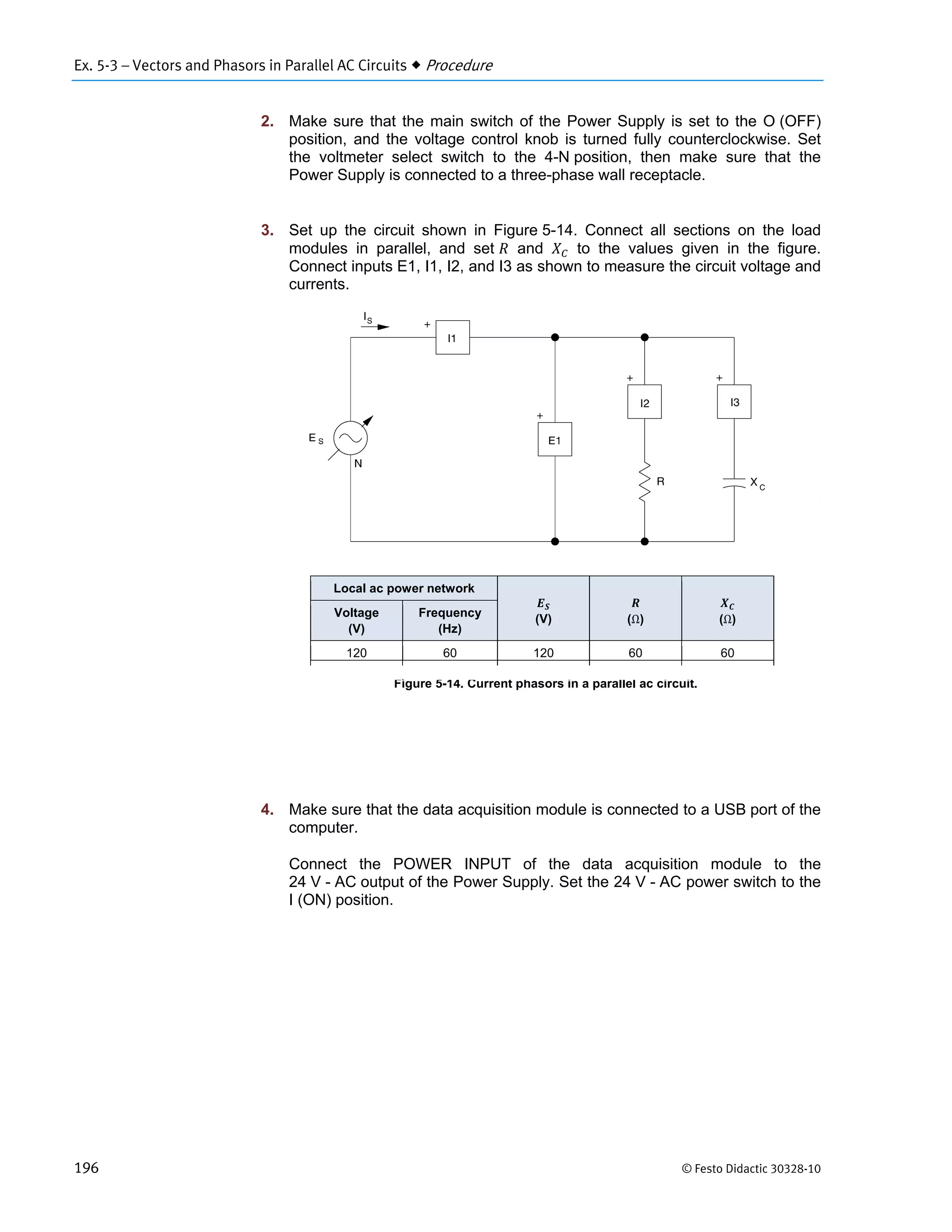
3. Set up the circuit shown in Figure 5-14. Connect all sections on the load
modules in parallel, and set and to the values given in the figure.
Connect inputs E1, I1, I2, and I3 as shown to measure the circuit voltage and
currents.
Figure 5-14. Current phasors in a parallel ac circuit.
4. Make sure that the data acquisition module is connected to a USB port of the
computer.
Connect the POWER INPUT of the data acquisition module to the
24 V - AC output of the Power Supply. Set the 24 V - AC power switch to the
I (ON) position.
Local ac power network
(V) (Ω) (Ω)
Voltage
(V)
Frequency
(Hz)
120 60 120 60 60
Ex. 5-3 – Vectors and Phasors in Parallel AC Circuits  Procedure
© Festo Didactic 30328-10 197
5. Start the Data Acquisition software (LVDAC or LVDAM). Open setup
configuration file ES15-3.dai.
a The metering setup configuration can be changed during the exercise if
desired. This exercise was written using those given.
Make sure that the continuous refresh mode is selected.
6. Turn on the main Power Supply and slowly adjust the voltage control knob to
obtain the exact value of voltage given in Figure 5-14.
7. Measure the circuit currents, and note the results below.
(current 1) 	A
(current 2)	 	A
(current 3)	 	A
8. Determine the arithmetical sum of and , and compare it to the measured
value of .
	 	A
9. Does the sum of the branch currents equal the measured value of the source
current?
 Yes  No
Ex. 5-3 – Vectors and Phasors in Parallel AC Circuits  Procedure
198 © Festo Didactic 30328-10
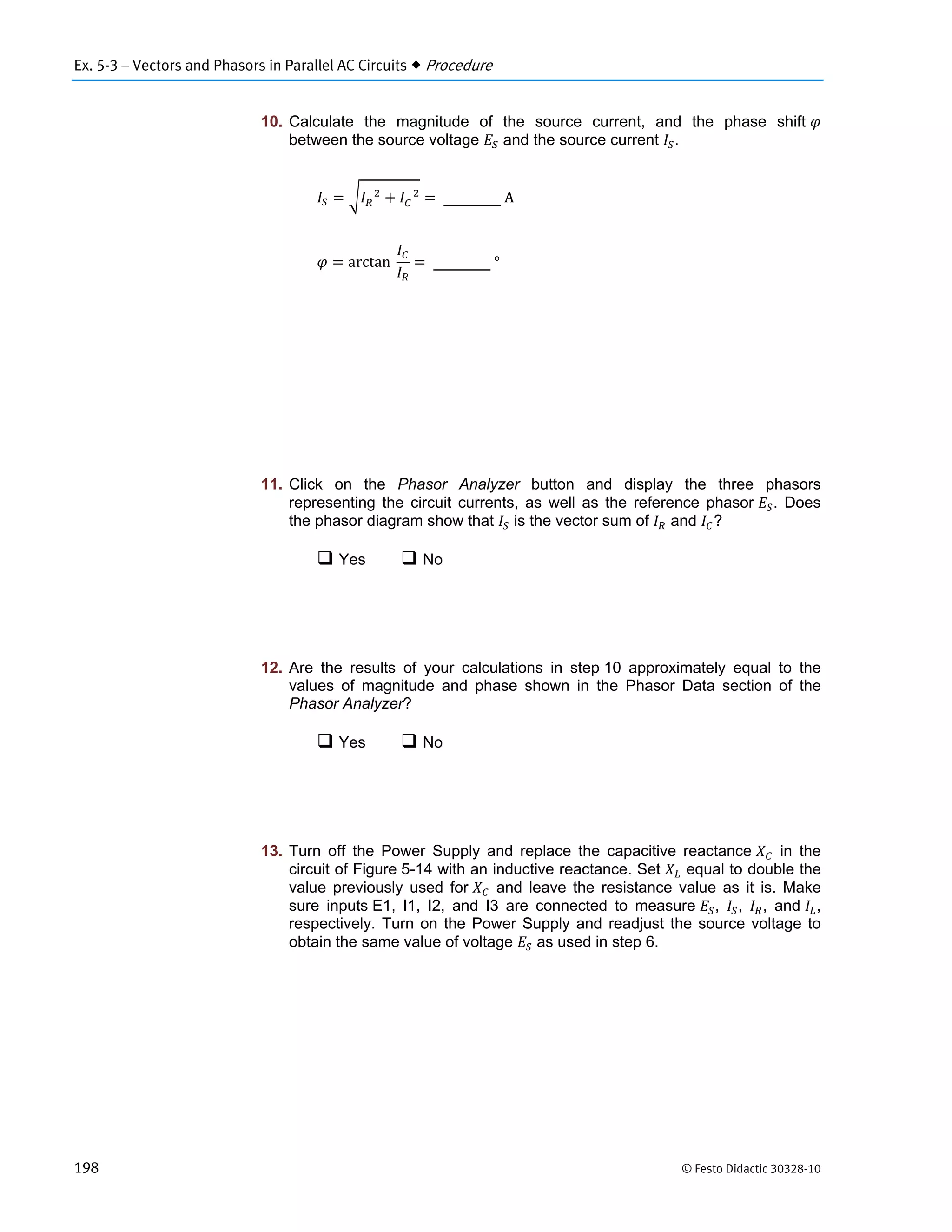
10. Calculate the magnitude of the source current, and the phase shift
between the source voltage and the source current .
			 			
	A
arctan		 	°
11. Click on the Phasor Analyzer button and display the three phasors
representing the circuit currents, as well as the reference phasor . Does
the phasor diagram show that is the vector sum of and ?
 Yes  No
12. Are the results of your calculations in step 10 approximately equal to the
values of magnitude and phase shown in the Phasor Data section of the
Phasor Analyzer?
 Yes  No
13. Turn off the Power Supply and replace the capacitive reactance in the
circuit of Figure 5-14 with an inductive reactance. Set equal to double the
value previously used for and leave the resistance value as it is. Make
sure inputs E1, I1, I2, and I3 are connected to measure , , , and ,
respectively. Turn on the Power Supply and readjust the source voltage to
obtain the same value of voltage as used in step 6.
Ex. 5-3 – Vectors and Phasors in Parallel AC Circuits  Procedure
© Festo Didactic 30328-10 199
14. Use the Phasor Analyzer to once again examine the current phasors.
Calculate the magnitude of the source current and the phase shift between
the source voltage and the source current , then compare the results
with the values given in the Phasor Data section.
		 		 	 	A
arctan		 	°
15. Are your results approximately the same as those shown in the phasor
diagram?
 Yes  No
16. Do your calculations and the phasor diagram show that the phase shift is
now lagging?
 Yes  No
17. Turn off the Power Supply and set up the RLC parallel circuit of Figure 5-15.
Set the values of , , and to those given in the figure. Connect
inputs E1, I1, I2, and I3 as shown to measure , , , and , respectively.
Turn on the Power Supply and carefully adjust the source voltage to obtain
the exact value of voltage given in Figure 5-15.
Ex. 5-3 – Vectors and Phasors in Parallel AC Circuits  Procedure
200 © Festo Didactic 30328-10
Figure 5-15. Current phasors in an RLC parallel circuit.
18. Use the Phasor Analyzer to once again examine the current phasors.
Determine the magnitude of phasor .
			 		 	 	A
Local ac power network
(V) (Ω) (Ω) (Ω)
Voltage
(V)
Frequency
(Hz)
120 60 120 60 80 100
Ex. 5-3 – Vectors and Phasors in Parallel AC Circuits  Procedure
© Festo Didactic 30328-10 201
19. Turn off the Power Supply and reconnect inputs E1, I1, I2, and I3 as shown
in Figure 5-16 to measure , , and , respectively. Turn on the Power
Supply and display the current phasors again.
Figure 5-16. Measuring the source current in a parallel resonant circuit.
20. Does the phasor diagram display show that is the vector sum of the circuit
currents, and approximately equal to the calculated value?
 Yes  No
21. Calculate the phase shift between the source voltage and the source
current . Remember that the phase shift between the inductive and
capacitive currents is 180°.
arctan		 	°
22. Is the calculated phase shift approximately equal to the value given in the
Phasor Data section of the Phasor Analyzer?
 Yes  No
Ex. 5-3 – Vectors and Phasors in Parallel AC Circuits  Procedure
202 © Festo Didactic 30328-10
23. Turn off the Power Supply and set up the circuit shown in Figure 5-17. Set
and to the given values, and connect inputs E1, I1, I2, and I3 as shown to
measure , , , and . This circuit is the special case of a parallel
resonant circuit in which both reactances are equal but of opposite sign.
Figure 5-17. Current phasors in an RLC parallel circuit.
24. Turn on the Power Supply and very carefully adjust the voltage control knob
to obtain the exact value of voltage given in Figure 5-17. Calculate and
compare your result with the Phasor Analyzer data.
		 	 	A
25. Does the Phasor Data confirm that the source current is approximately zero?
a The inductor wire has some dc resistance so there will be a small amount of in-
phase current. will therefore have some small value close to 0 A.
 Yes  No
Local ac power network
(V) (Ω) (Ω)
Voltage
(V)
Frequency
(Hz)
120 60 120 60 60
Ex. 5-3 – Vectors and Phasors in Parallel AC Circuits  Conclusion
© Festo Didactic 30328-10 203
26. Ensure that the Power Supply is turned off, and that the voltage control knob
is turned fully counterclockwise. Remove all leads and cables.
In this exercise, you used phasors and vector analysis to determine the different
currents in parallel ac circuits. Source voltage was used as the reference phasor
since it is common to all components of parallel circuits. You saw that the equal
but opposite-sign reactances in a parallel-resonant circuit caused the source
current to be a very small value. Phasor displays (vector diagrams) of the
different circuit currents were used to confirm your calculations.
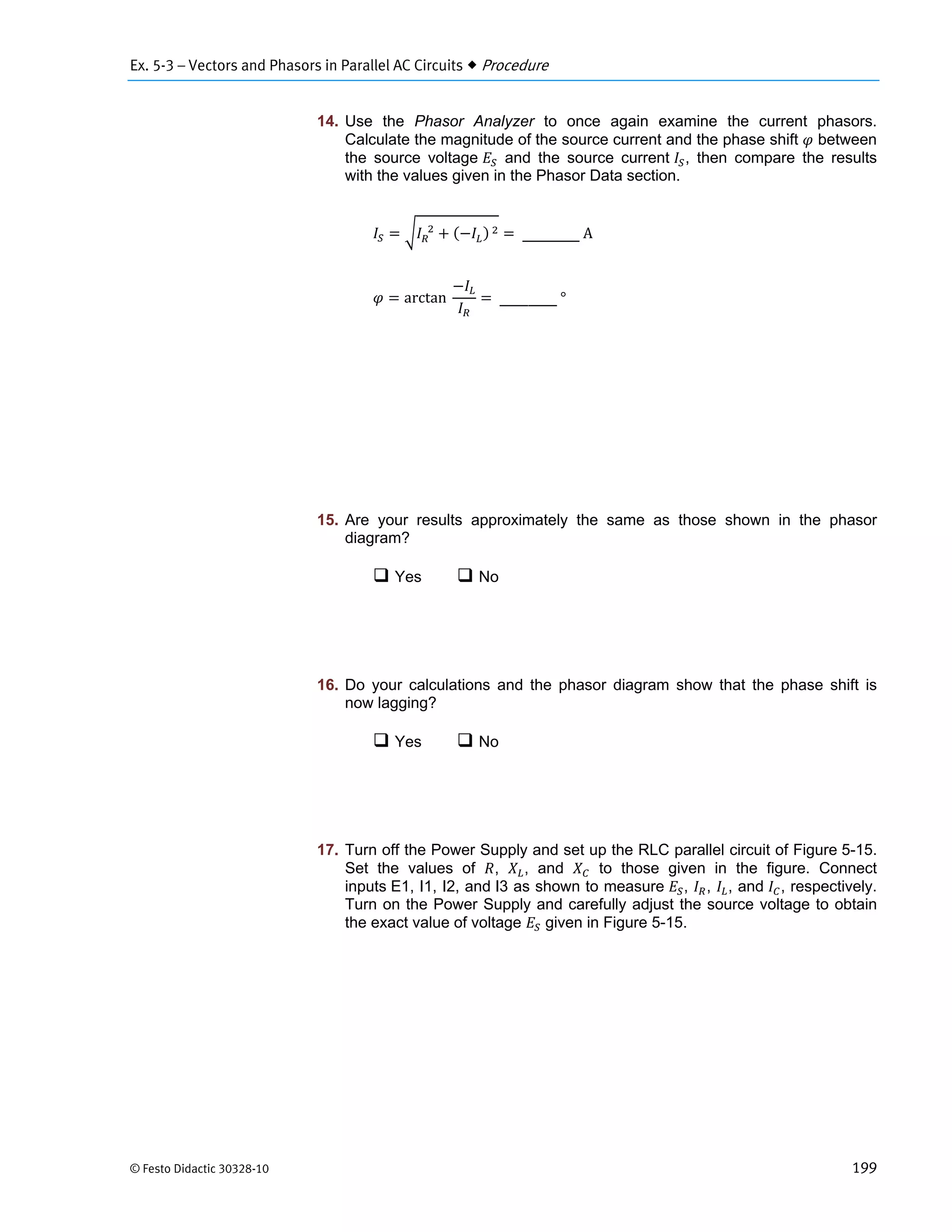
1. In an RC parallel circuit, what is the phase shift between the source voltage
and current when and are 30 Ω and 40 Ω, respectively?
a. 37°
b. 53°
c. 45°
d. 90°
2. The main characteristic of a parallel resonant circuit is that the
a. source current is a high value.
b. source voltage is a low value.
c. source current is almost equal to zero.
d. source voltage is almost equal to zero.
3. In an RL parallel circuit, the parameter used as reference for drawing a
vector diagram is the
a. voltage.
b. current.
c. reactance.
d. resistance.
CONCLUSION
REVIEW QUESTIONS
Ex. 5-3 – Vectors and Phasors in Parallel AC Circuits  Review Questions
204 © Festo Didactic 30328-10
4. The formula used to determine the magnitude of the vector sum of the two
currents in an RL parallel circuit is
a. 			 			
b. ⁄
c. 2
d. 			 	 			
5. The phase shift between the source voltage and the source current in
an RL parallel circuit can be determined from
a. the ratio ⁄
b. the ratio ⁄
c. the ratio ⁄
d. none of the above.
© Festo Didactic 30328-10 205
When you have completed this exercise, you will be able to determine and
demonstrate the impedance of ac circuits. Circuit measurements of currents and
voltages will be used to verify the theory and formulas presented with the
impedance equations.
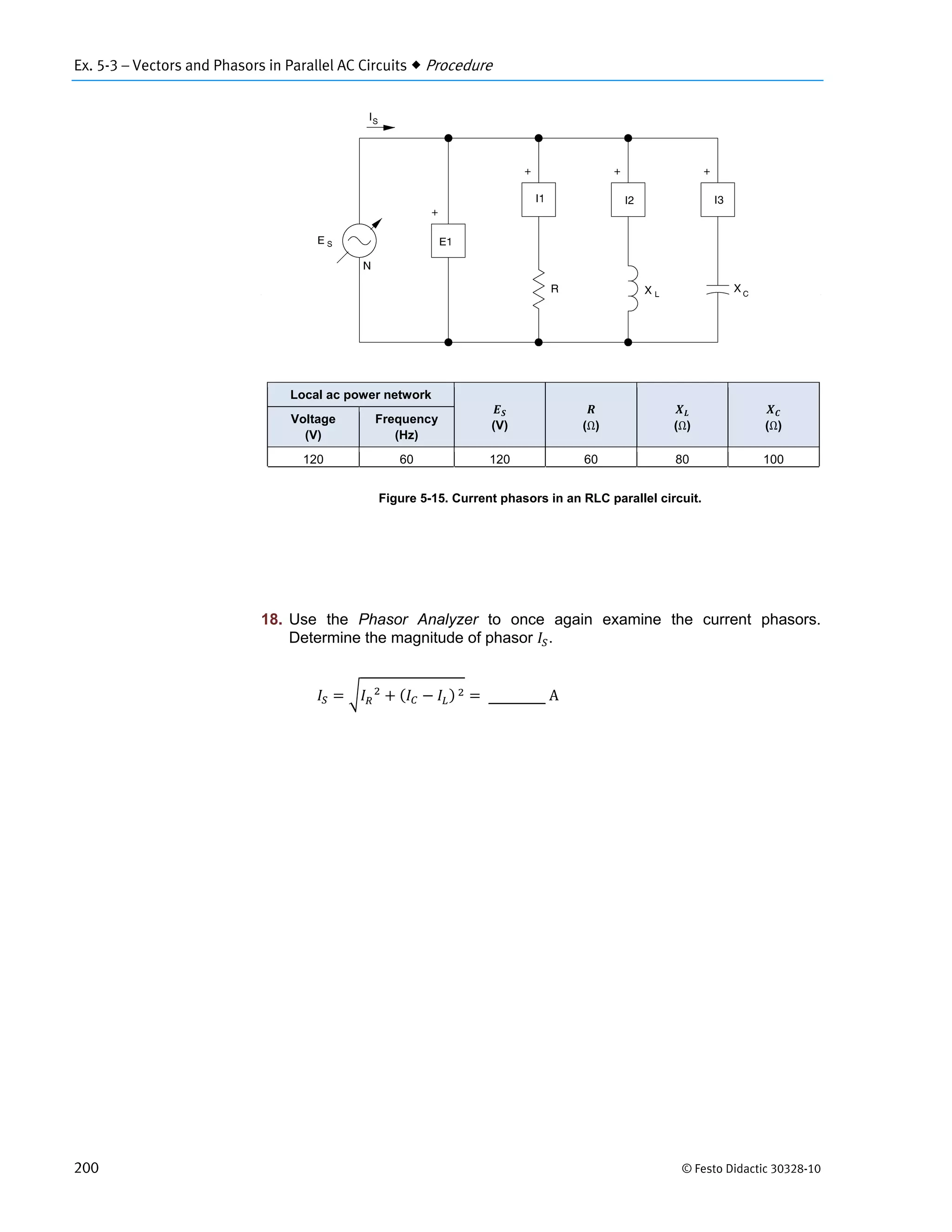
You observed in previous exercises that the total opposition to current flow in
circuits containing both resistance and reactance ( or ) is not the simple sum
of resistance and reactance. The reactance must be added to the resistance in
such a way as to take into account the 90° phase difference between the two
voltages in series circuits, or the two currents in parallel circuits. The total
opposition to current flow is called impedance ( ), and is expressed
mathematically as a phasor using either rectangular or polar coordinates:
(rectangular coordinates)
 (polar coordinates)
where is the magnitude of the impedance.
is the phase angle related to the impedance.
In a series RL or RC circuit, the voltage across a resistor, inductor or capacitor
equals the product of the current and the resistance, the inductive reactance or
the capacitive reactance. Ohm's law for the RL series circuit in Figure 5-18 gives:
and 	
The total voltage is the current times the total opposition to current flow in the
circuit and is expressed as . The impedance, as the total voltage drop
across the components (the source voltage ), may also be determined
graphically using vectors, as shown in Figure 5-18.
Impedance
Exercise 5-4
EXERCISE OBJECTIVE
DISCUSSION
Ex. 5-4 – Impedance  Discussion
206 © Festo Didactic 30328-10
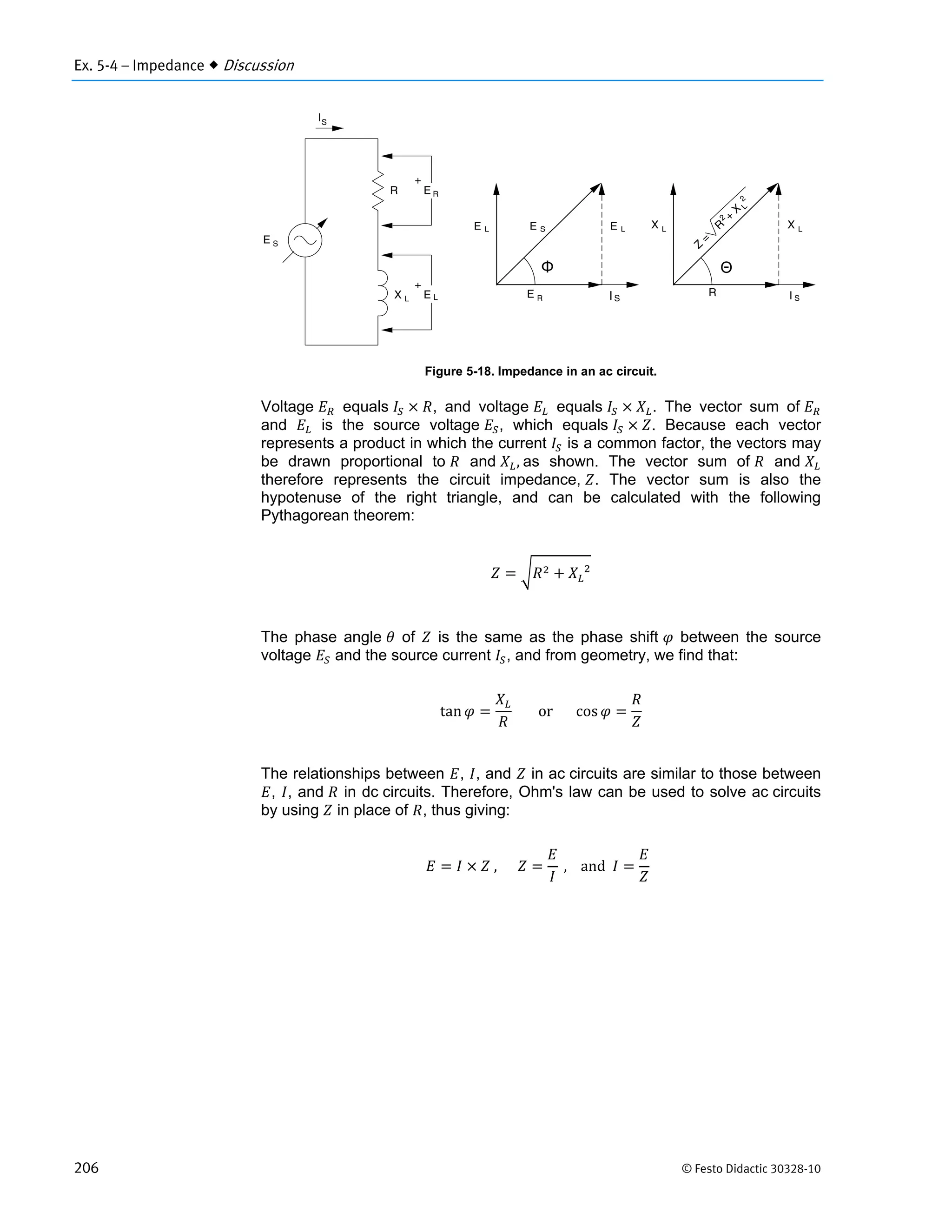
Figure 5-18. Impedance in an ac circuit.
Voltage equals , and voltage equals . The vector sum of
and is the source voltage , which equals . Because each vector
represents a product in which the current is a common factor, the vectors may
be drawn proportional to and ,	as shown. The vector sum of and
therefore represents the circuit impedance, . The vector sum is also the
hypotenuse of the right triangle, and can be calculated with the following
Pythagorean theorem:
The phase angle of is the same as the phase shift between the source
voltage and the source current , and from geometry, we find that:
tan or cos
The relationships between , , and in ac circuits are similar to those between
, , and in dc circuits. Therefore, Ohm's law can be used to solve ac circuits
by using in place of , thus giving:
, , and
Ex. 5-4 – Impedance  Discussion
© Festo Didactic 30328-10 207
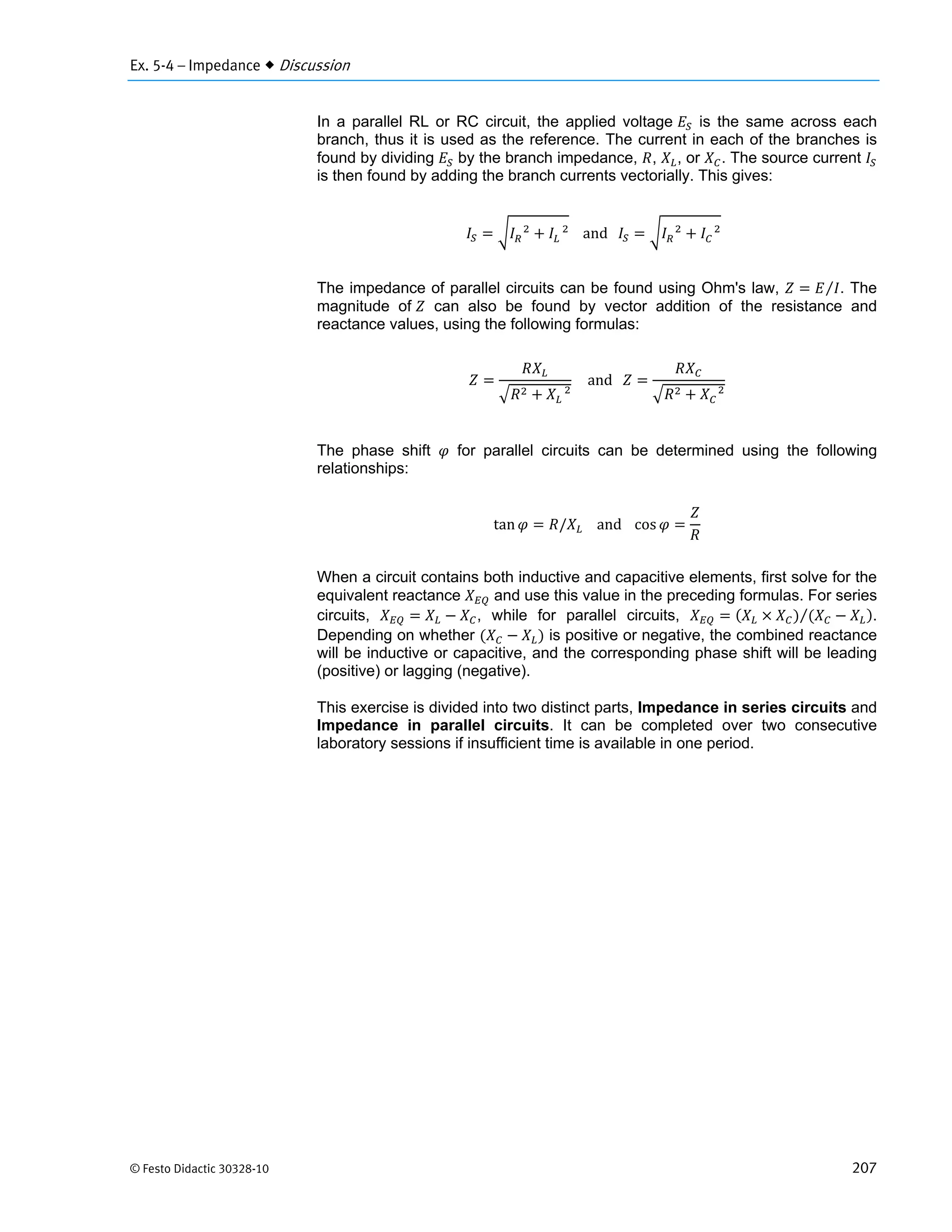
In a parallel RL or RC circuit, the applied voltage is the same across each
branch, thus it is used as the reference. The current in each of the branches is
found by dividing by the branch impedance, , , or . The source current
is then found by adding the branch currents vectorially. This gives:
and 			 			
		
The impedance of parallel circuits can be found using Ohm's law, ⁄ . The
magnitude of can also be found by vector addition of the resistance and
reactance values, using the following formulas:
			
and
			
The phase shift for parallel circuits can be determined using the following
relationships:
tan / and cos
When a circuit contains both inductive and capacitive elements, first solve for the
equivalent reactance and use this value in the preceding formulas. For series
circuits, , while for parallel circuits, ⁄ .
Depending on whether is positive or negative, the combined reactance
will be inductive or capacitive, and the corresponding phase shift will be leading
(positive) or lagging (negative).
This exercise is divided into two distinct parts, Impedance in series circuits and
Impedance in parallel circuits. It can be completed over two consecutive
laboratory sessions if insufficient time is available in one period.
Ex. 5-4 – Impedance  Procedure
208 © Festo Didactic 30328-10
EQUIPMENT REQUIRED
Refer to the Equipment Utilization Chart in Appendix C to obtain the list of
equipment required for this exercise.
High voltages are present in this laboratory exercise. Do not make or modify any
banana jack connections with the power on unless otherwise specified.
Impedance in series circuits
1. Install the Power Supply, data acquisition module, Resistive Load, Inductive
Load, and Capacitive Load modules in the EMS Workstation.
2. Make sure that the main switch of the Power Supply is set to the O (OFF)
position, and the voltage control knob is turned fully counterclockwise. Set
the voltmeter select switch to the 4-N position, then make sure the Power
Supply is connected to a three-phase wall receptacle.
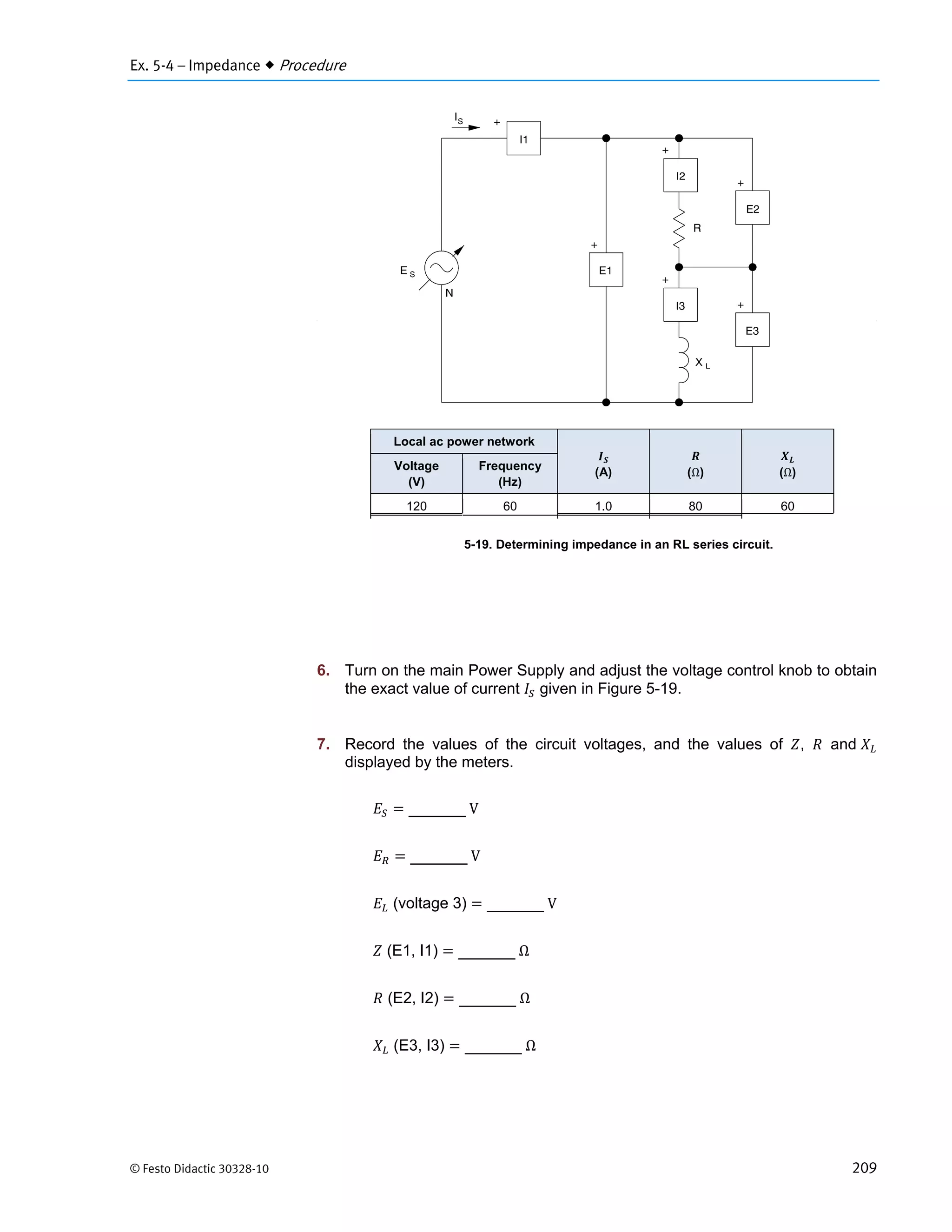
3. Set up the circuit shown in Figure 5-19. Connect all sections on the load
modules in parallel, and set and to the values given in the figure.
Connect inputs I1, I2, I3, E1, E2, and E3 as shown to measure the circuit
currents and voltages.
4. Make sure that the data acquisition module is connected to a USB port of the
computer.
Connect the POWER INPUT of the data acquisition module to the
24 V - AC output of the Power Supply. Set the 24 V - AC power switch to
the I (ON) position.
5. Start the Data Acquisition software (LVDAC or LVDAM). Open setup
configuration file ES15-4.dai.
a The metering setup configuration can be changed during the exercise if
desired. This exercise was written using those given.
Make sure that the continuous refresh mode is selected.
PROCEDURE
Ex. 5-4 – Impedance  Procedure
© Festo Didactic 30328-10 209
Figure 5-19. Determining impedance in an RL series circuit.
6. Turn on the main Power Supply and adjust the voltage control knob to obtain
the exact value of current given in Figure 5-19.
7. Record the values of the circuit voltages, and the values of , and
displayed by the meters.
	V
	V
(voltage 3) 	V
(E1, I1) 	Ω
(E2, I2) 	Ω
(E3, I3) 	Ω
Local ac power network
(A) (Ω) (Ω)
Voltage
(V)
Frequency
(Hz)
120 60 1.0 80 60
Ex. 5-4 – Impedance  Procedure
210 © Festo Didactic 30328-10
8. Calculate and using the circuit values given in Figure 5-19.
	 		
	Ω
arctan		 	°
9. Use Ohm's law, the value of calculated in the previous step, and the values
of , , and given in Figure 5-19 to calculate the circuit voltages (
), , and ).
	V
	V
	V
Ex. 5-4 – Impedance  Procedure
© Festo Didactic 30328-10 211
10. Compare the calculated and measured values of and those for the different
voltages. Are they approximately the same?
a The actual results should slightly differ from the calculated values since the
inductor coil resistance is not negligible.
 Yes  No
11. Are the measured values of and approximately the same as the values
set on the load modules?
 Yes  No
12. Use the Phasor Analyzer to observe the phase shift between the source
voltage and the source current . Is the magnitude of the measured
phase shift approximately equal to the calculated value?
a The actual results should slightly differ from the calculated values since the
inductor coil resistance is not negligible.
 Yes  No
13. Turn off the Power Supply and replace the inductive reactance in the circuit
of Figure 5-19 with a capacitive reactance. Set the value of equal to the
value used for , and set the value of equal to that of . Turn on the
Power Supply and adjust the voltage control knob to obtain the same value
of current used in step 6.
Ex. 5-4 – Impedance  Procedure
212 © Festo Didactic 30328-10
14. Record the values displayed by the meters.
a The minus sign on meter X (E3,I3) indicates that a capacitive reactance is
measured. Neglect the minus sign when recording the value of .
	V
	V
(voltage 3) 	V
(E1, I1) 	Ω
(E2, I2) 	Ω
(E3, I3) 	Ω
15. Calculate Z and φ using the circuit values set in step 13.
	 	 			
	Ω
arctan		 	°
Ex. 5-4 – Impedance  Procedure
© Festo Didactic 30328-10 213
16. Once again, use Ohm's law, the value of calculated in the previous step,
and the values of , , and used in step 13 to calculate the circuit
voltages.
	V
	V
	V
17. Compare the calculated and measured values of and those for the different
voltages. Are they approximately the same?
 Yes  No
18. Are the measured values of and approximately the same as the values
set on the load modules?
 Yes  No
19. Use the Phasor Analyzer to observe the phase shift between the source
voltage and the source current . Is the magnitude of the measured
phase shift approximately equal to the calculated value?
 Yes  No
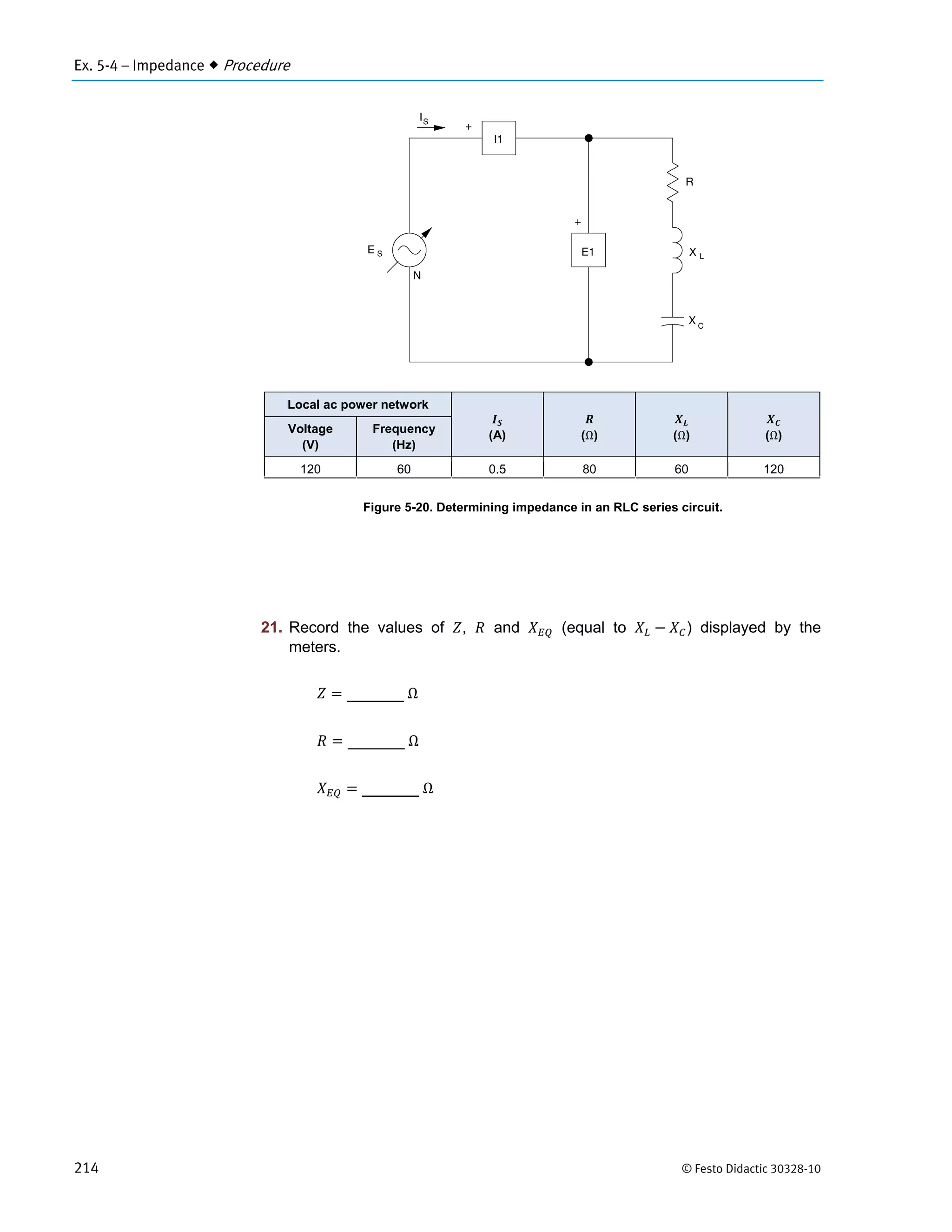
20. Turn off the Power Supply and add inductive reactance to set up the
RLC series circuit shown in Figure 5-20. Connect inputs I1 and E1 as shown
in the figure and set , , and to the given values. Open configuration
file ES15-5.dai. Turn on the Power Supply and slowly adjust the voltage
control knob to obtain the exact value of current given in Figure 5-20.
Ex. 5-4 – Impedance  Procedure
214 © Festo Didactic 30328-10
Figure 5-20. Determining impedance in an RLC series circuit.
21. Record the values of , and (equal to ) displayed by the
meters.
	Ω
	Ω
	Ω
Local ac power network
(A) (Ω) (Ω) (Ω)
Voltage
(V)
Frequency
(Hz)
120 60 0.5 80 60 120
Ex. 5-4 – Impedance  Procedure
© Festo Didactic 30328-10 215
22. Calculate and using the circuit values given in Figure 5-20.
	 			
	Ω
arctan		 	°
23. Compare the calculated and measured values of . Are they approximately
the same?
 Yes  No
24. Are the measured values of and approximately the same as those set
in the circuit?
 Yes  No
25. Use the Phasor Analyzer to observe the phase shift between the source
voltage and the source current . Is the magnitude of the measured
phase shift approximately equal to the calculated value?
a The actual results should slightly differ from the calculated values since the
inductor coil resistance is not negligible.
 Yes  No
Ex. 5-4 – Impedance  Procedure
216 © Festo Didactic 30328-10
Impedance in parallel circuits
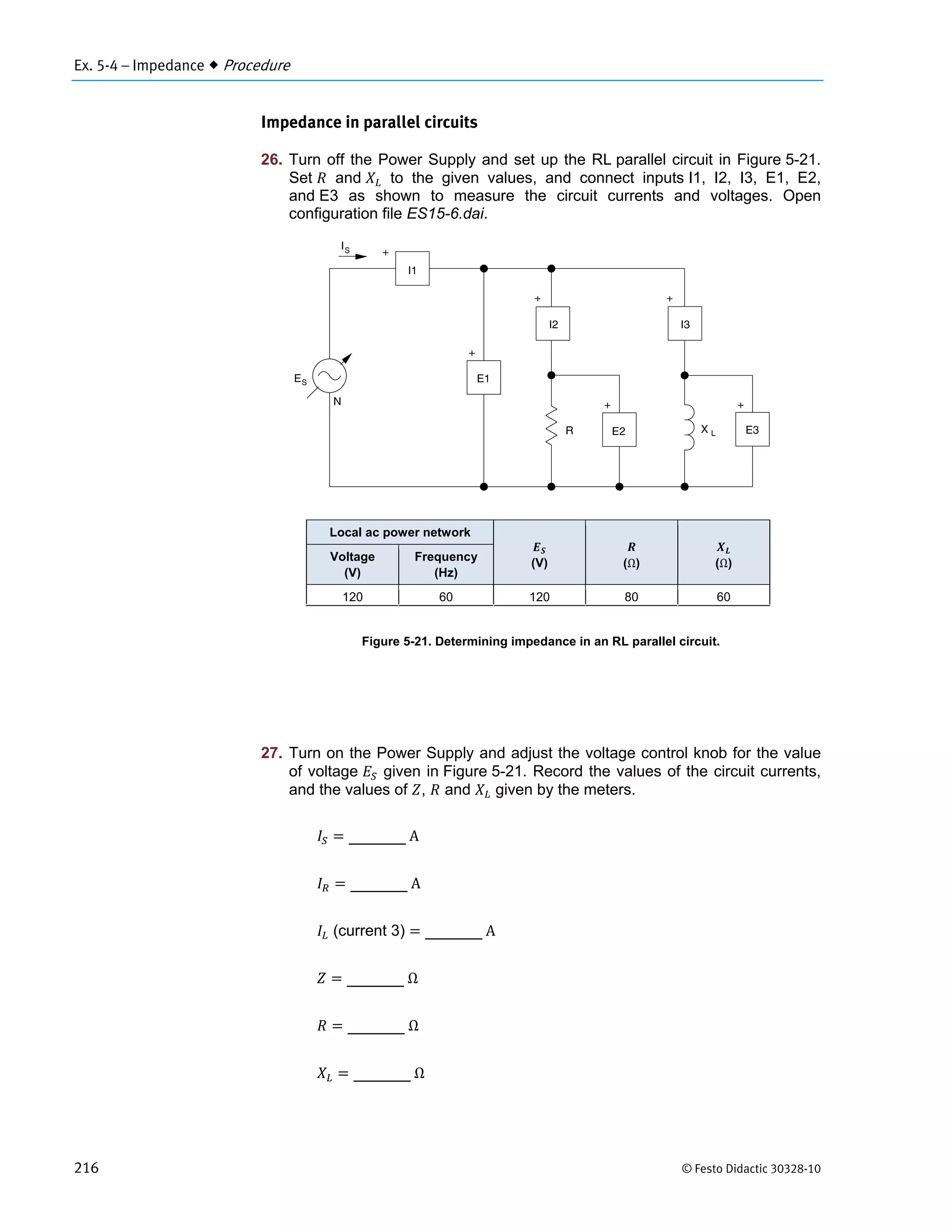
26. Turn off the Power Supply and set up the RL parallel circuit in Figure 5-21.
Set and to the given values, and connect inputs I1, I2, I3, E1, E2,
and E3 as shown to measure the circuit currents and voltages. Open
configuration file ES15-6.dai.
Figure 5-21. Determining impedance in an RL parallel circuit.
27. Turn on the Power Supply and adjust the voltage control knob for the value
of voltage given in Figure 5-21. Record the values of the circuit currents,
and the values of , and given by the meters.
	A
	A
(current 3) 	A
	Ω
	Ω
	Ω
Local ac power network
(V) (Ω) (Ω)
Voltage
(V)
Frequency
(Hz)
120 60 120 80 60
Ex. 5-4 – Impedance  Procedure
© Festo Didactic 30328-10 217
28. Calculate and using the circuit values given in Figure 5-21.
	 		
	Ω
arctan		 	°
29. Use the value of calculated in the previous step and the values of , ,
and given in Figure 5-21 to calculate the currents.
	A
	A
	A
Ex. 5-4 – Impedance  Procedure
218 © Festo Didactic 30328-10
30. Compare the calculated and measured values of and those for the different
currents. Are they approximately the same?
 Yes  No
31. Are the measured values of and approximately the same as the values
set on the load modules?
 Yes  No
32. Use the Phasor Analyzer to observe the phase shift between the source
voltage and the source current . Is the magnitude of the measured
phase shift approximately equal to the calculated value?
a The actual results should slightly differ from the calculated values since the
inductor coil resistance is not negligible.
 Yes  No
33. Turn off the Power Supply and replace in the circuit of Figure 5-21 with a
capacitive reactance to obtain an RC parallel circuit. Set at the same
value used for , and leave set at the same value. Turn on the Power
Supply and slowly adjust the voltage control knob to obtain the same value of
voltage used in step 27.
Ex. 5-4 – Impedance  Procedure
© Festo Didactic 30328-10 219
34. Record the values indicated by the meters.
a A minus sign indicates that a capacitive reactance is measured. Neglect the
minus sign when recording the value of .
	A
	A
(current 3) 	A
	Ω
	Ω
	Ω
35. Calculate and using the circuit values set in step 33.
	 			
	Ω
arctan		 	°
Ex. 5-4 – Impedance  Procedure
220 © Festo Didactic 30328-10
36. Use Ohm's law, the value of calculated in the previous step, and the values
of , , and set in step 33 to calculate the circuit currents.
	A
	A
	A
37. Compare the calculated and measured values of and those for the different
currents. Are they approximately the same?
 Yes  No
38. Are the measured values of and approximately the same as the values
set on the load modules?
 Yes  No
39. Use the Phasor Analyzer to observe the phase shift between the source
voltage and the source current . Is the magnitude of the phase shift
approximately equal to the calculated value?
 Yes  No
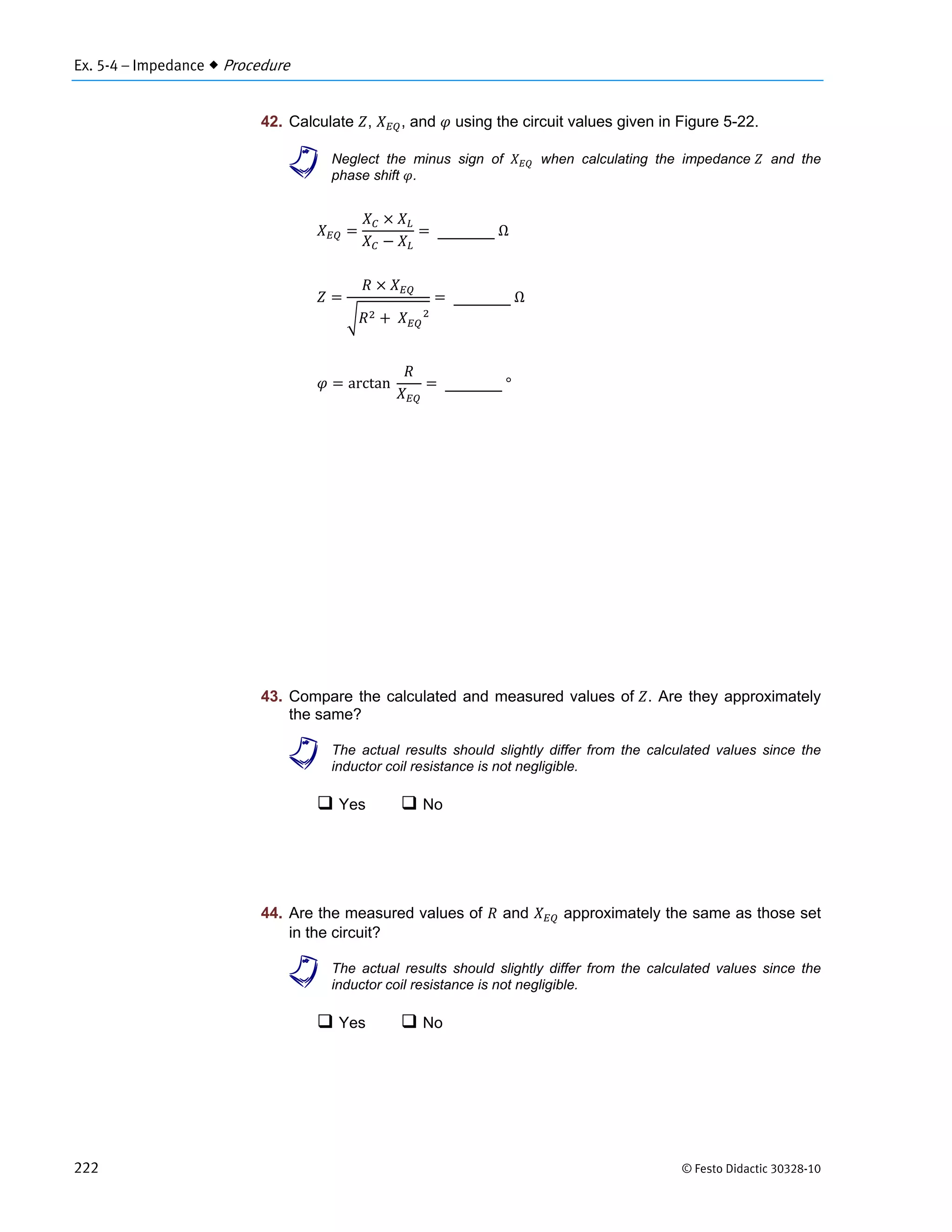
40. Turn off the Power Supply and set up the RLC parallel circuit of Figure 5-22.
Connect inputs I1, I2, I3, E1, E2, and E3 as shown. Set , , and to the
given values. Open configuration file ES15-7.dai. Turn on the Power Supply
and slowly adjust the voltage control knob to obtain the exact value of
voltage given in Figure 5-22.
Ex. 5-4 – Impedance  Procedure
© Festo Didactic 30328-10 221
Figure 5-22. Determining impedance in an RLC parallel circuit.
41. Record the values of , , and [equal to ⁄ ] displayed by
the meters.
	Ω
	Ω
	Ω
Local ac power network
(V) (Ω) (Ω) (Ω)
Voltage
(V)
Frequency
(Hz)
120 60 120 80 80 60
If needed, change the , , and "functions" to 2//(E1I1), 2//(E2I2), or
2//(E3I3), and "mode" to "X", "Z", or "R" to obtain the correct values. This ensures the
software is using the parallel calculation functions to calculate and display the
appropriate readings for your measurements.
Ex. 5-4 – Impedance  Procedure
222 © Festo Didactic 30328-10
42. Calculate , , and using the circuit values given in Figure 5-22.
a Neglect the minus sign of when calculating the impedance and the
phase shift .
	Ω
	 						
	Ω
arctan		 	°
43. Compare the calculated and measured values of . Are they approximately
the same?
a The actual results should slightly differ from the calculated values since the
inductor coil resistance is not negligible.
 Yes  No
44. Are the measured values of and approximately the same as those set
in the circuit?
a The actual results should slightly differ from the calculated values since the
inductor coil resistance is not negligible.
 Yes  No
Ex. 5-4 – Impedance  Procedure
© Festo Didactic 30328-10 223
45. Use the Phasor Analyzer to observe the phase shift between the source
voltage and the source current . Is the magnitude of the measured
phase shift approximately equal to the calculated value?
 Yes  No
46. Ensure that the Power Supply is turned off, and that the voltage control knob
is turned fully counterclockwise. Remove all leads and cables.
Ex. 5-4 – Impedance  Conclusion
224 © Festo Didactic 30328-10
In this exercise, you calculated the impedance in series and parallel circuits and
compared your results with those obtained using measurements of the current
and voltage. You demonstrated that impedance is the quotient of source voltage
to current, and that the combined reactance in RLC circuits is either inductive or
capacitive, depending on the relative values of and . Finally, observation of
the voltage and current phasors with the Phasor Analyzer allowed you to verify
your calculations of the impedance phase shift.
1. The total opposition to current flow in an ac circuit is called
a. resistance.
b. reactance.
c. impedance.
d. inductance.
2. Circuit impedance can be determined from
a. ⁄
b.
c.
d. ⁄
3. What is the impedance of an RLC parallel circuit when , , and are all
equal, equals 120 V, and is 2 A?
a. 60 Ω
b. 240 Ω
c. 20 Ω
d. 180 Ω
CONCLUSION
REVIEW QUESTIONS
Ex. 5-4 – Impedance  Review Questions
© Festo Didactic 30328-10 225
4. The combined reactance in a series ac circuit results in the impedance
having a positive phase shift. Does the circuit current lead or lag the source
voltage?
a. The current leads the voltage because the reactance is
capacitive.
b. The current lags the voltage because the reactance is
inductive.
c. The current leads the voltage because the reactance is
inductive.
d. The current lags the voltage because the reactance is
capacitive.
5. The impedance of an RLC parallel circuit can be determined from
a. the quotient of source voltage to circuit current.
b. the product of source voltage with circuit current.
c. the formula
	 	
	 	 							
.
d. Both a and c.
Unit 5 – Power, Phasors, and Impedance in AC Circuits  Unit Test
© Festo Didactic 30328-10 227
Unit Test
1. A motor whose power factor is 0.8 draws 4 kW of active power. What is the
apparent power supplied to the motor?
a. cos 0.80⁄ , therefore 5	kVA
b. cos 0.80⁄ , therefore 3.2	kVA
c. cos 0.80, therefore 7.2	kVA
d. cos 0.8⁄ , therefore 8.8	kVA
2. Apparent power is related to active and reactive power by the formula
a.
b.
c.
d.
3. A capacitor drawing 8 kvar is placed in parallel with an electromagnet that
draws 6 kW of active power and 6 kvar of reactive power. What effect does
this have on cos ?
a. The power factor is corrected to unity.
b. The power factor goes from 0.5 to 0.67.
c. The power factor changes polarity from positive to negative.
d. None of the above.
4. In an RLC series circuit, what is the phase shift between the voltage and
current when , , and are all equal to 100 Ω?
a. 45°
b. 37°
c. 0°
d. 30°
Unit 5 – Power, Phasors, and Impedance in AC Circuits  Unit Test
228 © Festo Didactic 30328-10
5. The parameter used as reference for vector analysis is
a. voltage in series circuits, and current in parallel circuits.
b. current in series circuits, and voltage in parallel circuits.
c. reactance in both series and parallel circuits.
d. always the voltage.
6. The phase shift between and in an RL series circuit can be determined
a. from the ratio .⁄
b. from the ratio .⁄
c. from the ratio .⁄
d. none of the above.
7. In an RC parallel circuit, what is the phase shift between the voltage and
current when and are 60 Ω and 100 Ω, respectively?
a. 53°
b. 31°
c. 59°
d. 37°
8. Impedance is the total opposition to current in a circuit and is made up of
a. resistance and reactance.
b. reactance only.
c. capacitance only.
d. inductance only.
9. What is the impedance of an RLC series circuit when , , and are all
equal, equals 120 V, and is 2 A?
a. 60 Ω
b. 240 Ω
c. 20 Ω
d. 180 Ω
Unit 5 – Power, Phasors, and Impedance in AC Circuits  Unit Test
© Festo Didactic 30328-10 229
10. The impedance in a parallel ac circuit has a positive phase shift. Does the
source current lead or lag the source voltage?
a. The current leads the voltage because the reactance is capacitive.
b. The current lags the voltage because the reactance is inductive.
c. The current leads the voltage because the reactance is inductive.
d. The current lags the voltage because the reactance is capacitive.
© Festo Didactic 30328-10 411
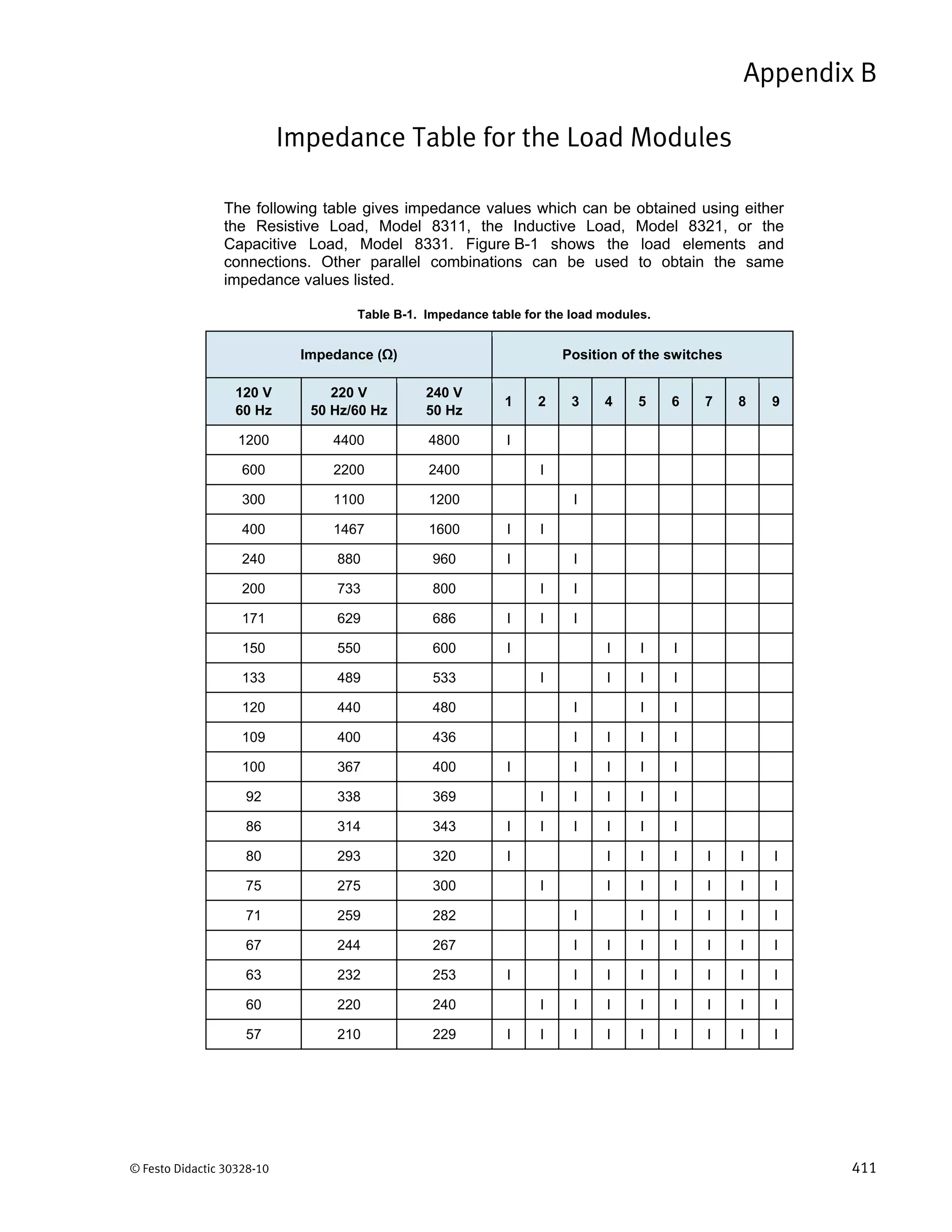
The following table gives impedance values which can be obtained using either
the Resistive Load, Model 8311, the Inductive Load, Model 8321, or the
Capacitive Load, Model 8331. Figure B-1 shows the load elements and
connections. Other parallel combinations can be used to obtain the same
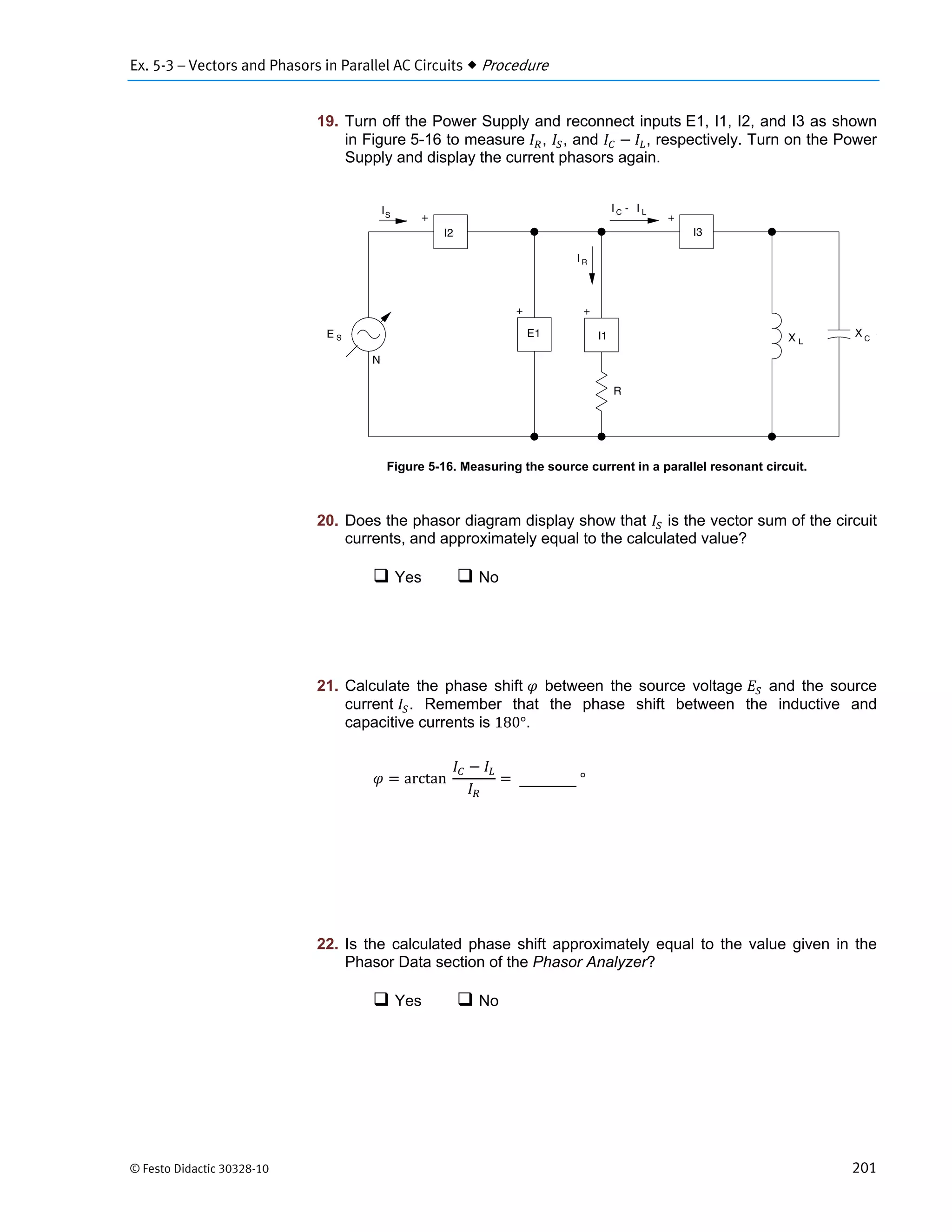
impedance values listed.
Table B-1. Impedance table for the load modules.
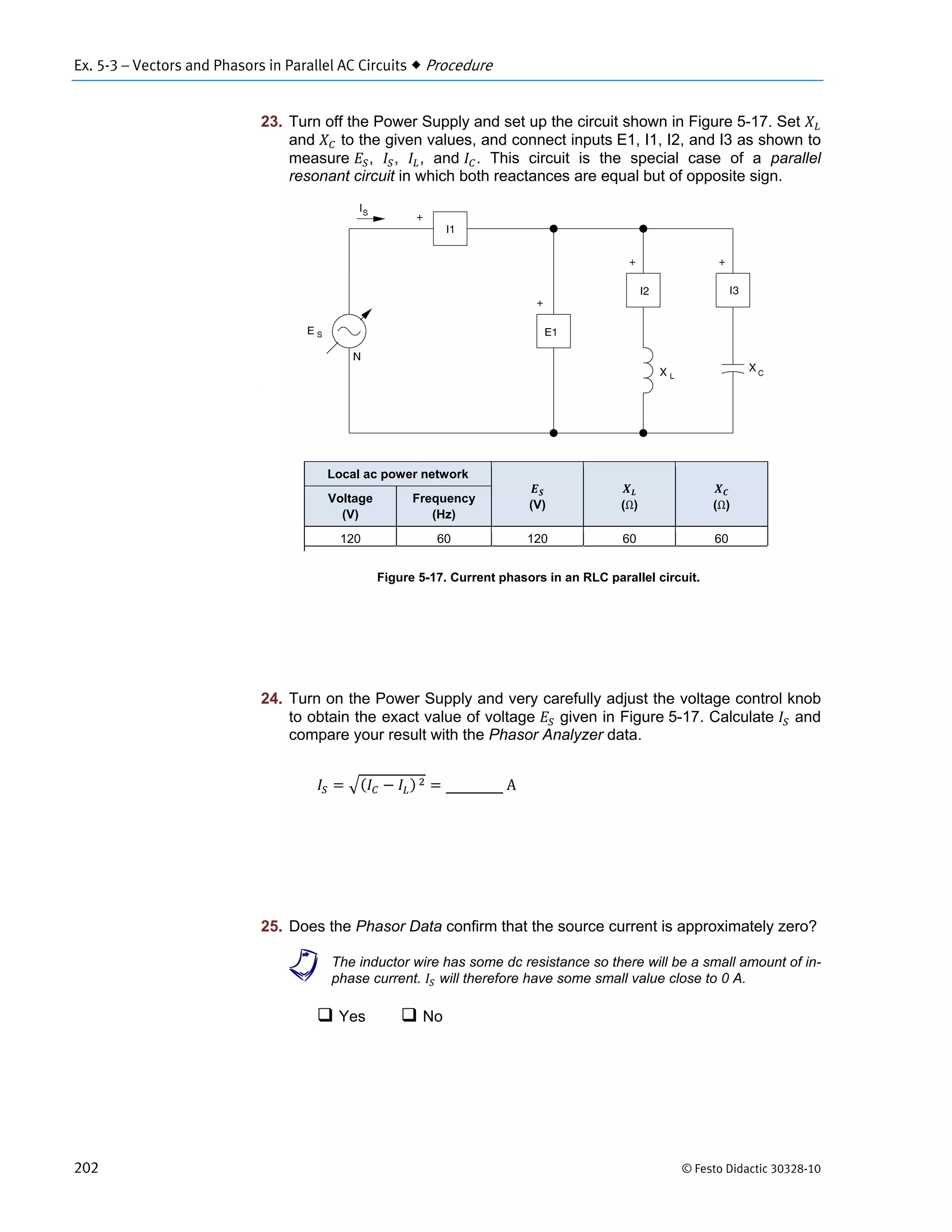
Impedance (Ω) Position of the switches
120 V
60 Hz
220 V
50 Hz/60 Hz
240 V
50 Hz
1 2 3 4 5 6 7 8 9
1200 4400 4800 I
600 2200 2400 I
300 1100 1200 I
400 1467 1600 I I
240 880 960 I I
200 733 800 I I
171 629 686 I I I
150 550 600 I I I I
133 489 533 I I I I
120 440 480 I I I
109 400 436 I I I I
100 367 400 I I I I I
92 338 369 I I I I I
86 314 343 I I I I I I
80 293 320 I I I I I I I
75 275 300 I I I I I I I
71 259 282 I I I I I I
67 244 267 I I I I I I I
63 232 253 I I I I I I I I
60 220 240 I I I I I I I I
57 210 229 I I I I I I I I I
Impedance Table for the Load Modules
Appendix B
Appendix B Impedance Table for the Load Modules
412 © Festo Didactic 30328-10
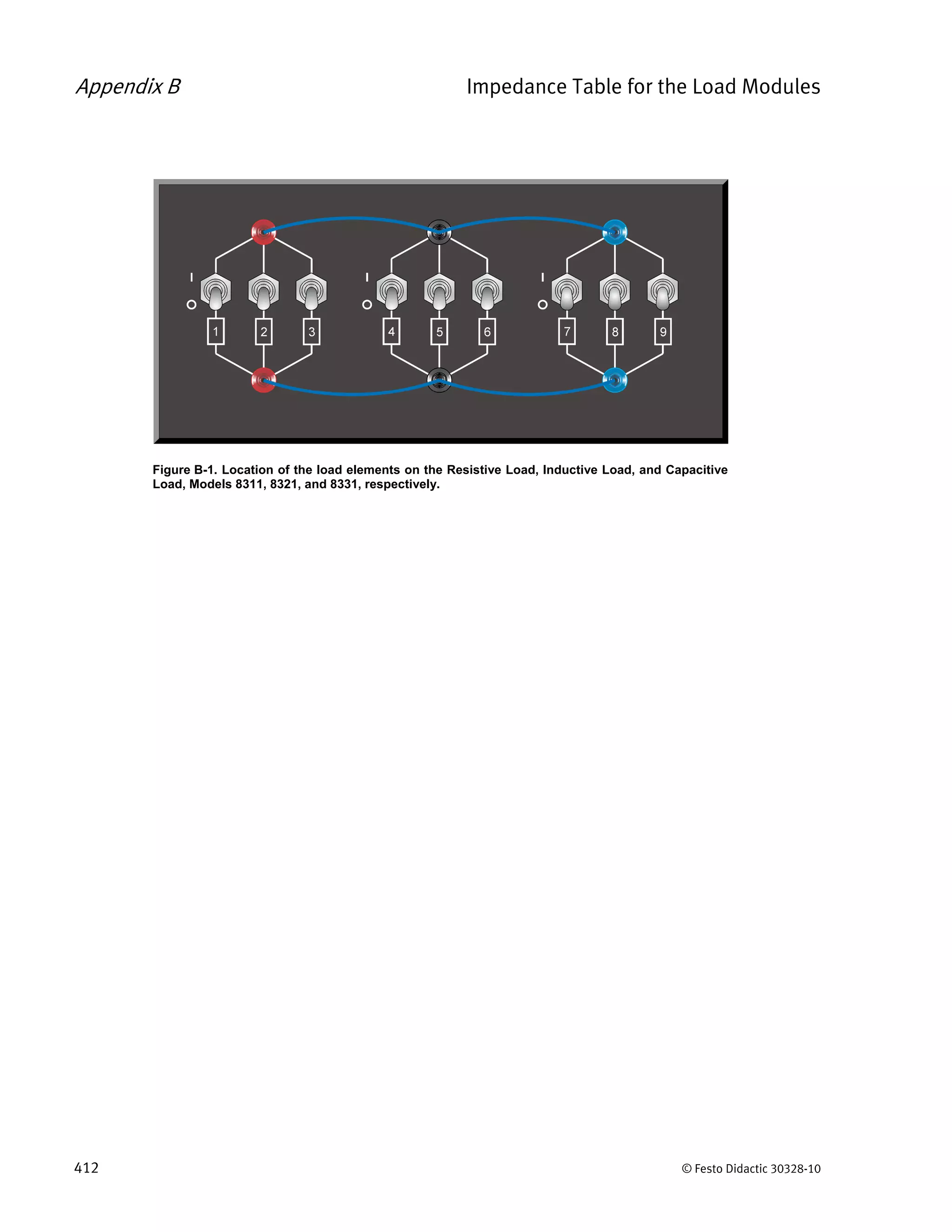
Figure B-1. Location of the load elements on the Resistive Load, Inductive Load, and Capacitive

Load, Models 8311, 8321, and 8331, respectively.
Appendix B Impedance Table for the Load Modules
© Festo Didactic 30328-10 413
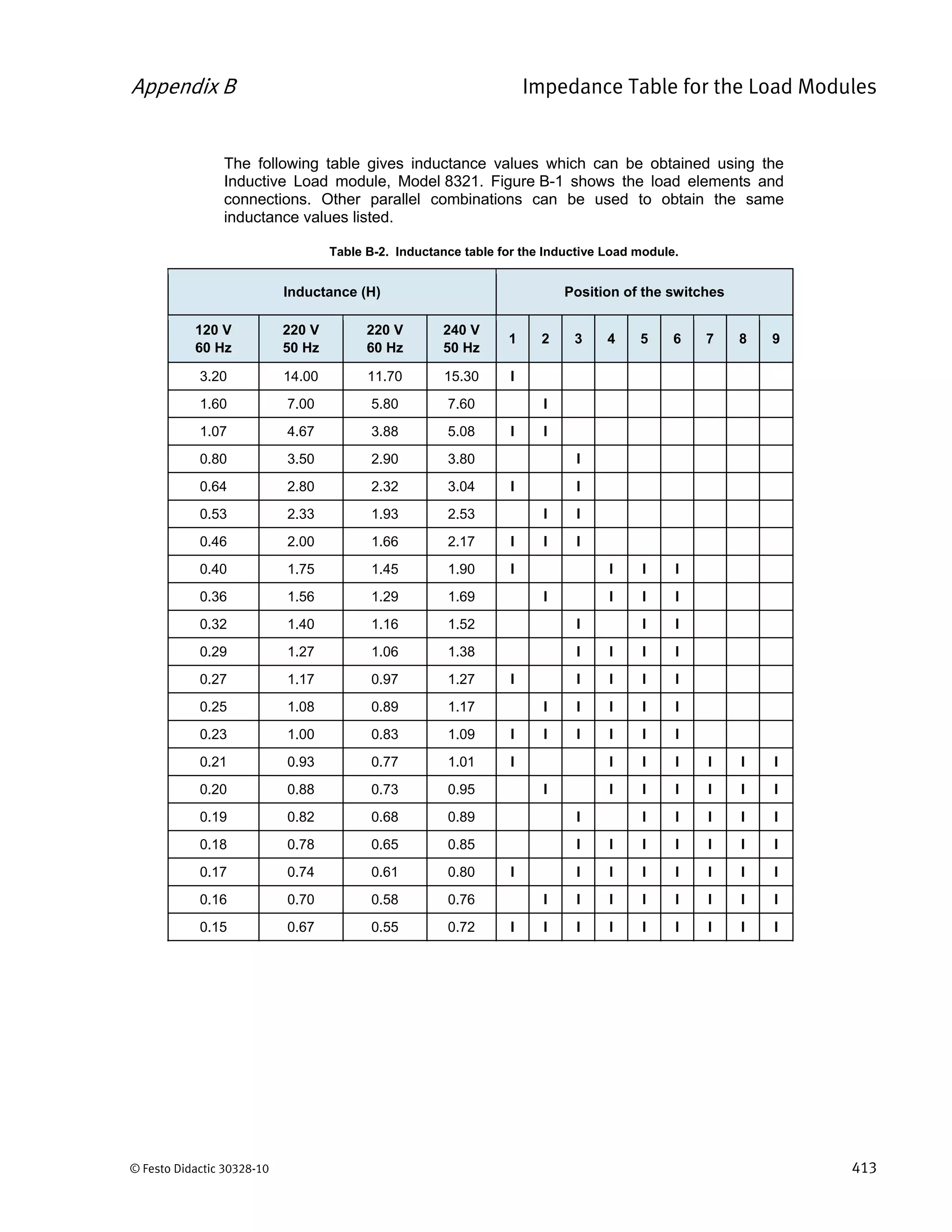
The following table gives inductance values which can be obtained using the
Inductive Load module, Model 8321. Figure B-1 shows the load elements and
connections. Other parallel combinations can be used to obtain the same
inductance values listed.
Table B-2. Inductance table for the Inductive Load module.
Inductance (H) Position of the switches
120 V
60 Hz
220 V
50 Hz
220 V
60 Hz
240 V
50 Hz
1 2 3 4 5 6 7 8 9
3.20 14.00 11.70 15.30 I
1.60 7.00 5.80 7.60 I
1.07 4.67 3.88 5.08 I I
0.80 3.50 2.90 3.80 I
0.64 2.80 2.32 3.04 I I
0.53 2.33 1.93 2.53 I I
0.46 2.00 1.66 2.17 I I I
0.40 1.75 1.45 1.90 I I I I
0.36 1.56 1.29 1.69 I I I I
0.32 1.40 1.16 1.52 I I I
0.29 1.27 1.06 1.38 I I I I
0.27 1.17 0.97 1.27 I I I I I
0.25 1.08 0.89 1.17 I I I I I
0.23 1.00 0.83 1.09 I I I I I I
0.21 0.93 0.77 1.01 I I I I I I I
0.20 0.88 0.73 0.95 I I I I I I I
0.19 0.82 0.68 0.89 I I I I I I
0.18 0.78 0.65 0.85 I I I I I I I
0.17 0.74 0.61 0.80 I I I I I I I I
0.16 0.70 0.58 0.76 I I I I I I I I
0.15 0.67 0.55 0.72 I I I I I I I I I

Power Circuits and Transforers-Unit 5 Labvolt Student Manual

  • 1.
    © Festo Didactic30328-00 165 When you have completed this unit, you will be able to determine the active, reactive and apparent power in ac circuits, and calculate the power factor. You will use vector diagrams to solve ac circuits and determine circuit impedance. Concepts associated with phasors, impedance and ac power will be verified through circuit measurements and waveform observations. As seen in the last two units, an ac circuit containing pure reactance, either capacitive or inductive, has voltages and currents that are 90° out-of-phase with each other, and no active power is consumed. Most practical ac circuits have both resistance and reactance, and the apparent power in volt-amperes is greater than the active power in watts. The difference between apparent power and active power is caused by the reactance, and is known as reactive power, expressed in var. Since capacitive reactive power has the opposite sign to inductive reactive power, apparent power in ac circuits can be minimized by adjusting the amount of capacitive and inductive reactance in the circuit. This allows the current drawn from the ac power source (line current) to be reduced to a minimum value without changing the active power consumed by the load. Minimizing the line current corresponds to increasing the power factor (cos ) which in the case of a purely resistive load equals 1. Circuits with purely reactive loads have a power factor of zero since they consume no active power, even though they draw line current and are a load on the source. Power, Phasors, and Impedance in AC Circuits Unit 5 UNIT OBJECTIVE DISCUSSION OF FUNDAMENTALS
  • 2.
    Unit 5 –Power, Phasors, and Impedance in AC Circuits  Discussion of Fundamentals 166 © Festo Didactic 30328-00 In preceding exercises, sine waves were used to aid in understanding the concept of phase shift in ac circuits. However, when a circuit contains three, four, or even more sine waves, it becomes very confusing to try and use drawings of the various waveforms to determine the phase relationships between the different voltages and currents. For example, in the circuit shown in Figure 5-1, the source voltage is the sum of the instantaneous values of three voltage waveforms all 90° out-of-phase with each other. The quantity of information present makes the drawing very difficult to interpret, and thereby, complicates circuit analysis. Figure 5-1. Voltage and current waveforms for an RLC series circuit. Fortunately, voltage and current sine waves having the same frequency can be represented as phasors to simplify circuit analysis. Furthermore, voltage and current phasors, as well as reactance, impedance, and other electric circuit parameters can be represented by a simple graphical mean called a vector. Figure 5-2 is a vector diagram (in the X-Y plane) representing the voltage and current sine waves shown in Figure 5-1. The use of vector diagrams greatly simplifies the study of ac circuits because the complex form of each sine wave is reduced to a single straight line. Vector diagrams allow the resultant from many different voltages or currents to be determined using simple graphical techniques of vector addition. Power factor, impedance, and the distribution between active, reactive, and apparent power in ac circuits can also be determined with vector analysis.
  • 3.
    Unit 5 –Power, Phasors, and Impedance in AC Circuits  Discussion of Fundamentals © Festo Didactic 30328-10 167 Figure 5-2. Vector diagram for the RLC series circuit in Figure 5-1. Vector analysis can be easily applied to both series and parallel circuits. In series circuits, the current is the same for all the circuit components, so current is usually the reference parameter and is drawn in the +X direction. The vector which represents the phasor for out-of-phase inductive voltage is in the +Y direction because voltage leads current in an inductor, and the vector for the capacitive voltage phasor is drawn in the -Y direction. In parallel circuits, a common voltage exists across the circuit components, so voltage is usually the reference parameter. The vector for the capacitive current phasor is drawn in the +Y direction since current leads the voltage across the capacitor, while the vector for the inductive current phasor is drawn in the -Y direction. The total opposition to current flow in ac circuits containing both resistance and reactance is known as impedance, and it can graphically be determined using vector analysis. In fact, impedance is made up of two orthogonal components: a resistive component and a reactive component ( mathematically). Impedance is a phasor, and thereby, it can be represented graphically on a vector diagram, as shown in Figure 5-3. From geometry, the magnitude of equals the square root of the sum of the squares of the triangle's sides, tan equals ⁄ , and cos equals ⁄ .
  • 4.
    Unit 5 –Power, Phasors, and Impedance in AC Circuits  Discussion of Fundamentals 168 © Festo Didactic 30328-10 Figure 5-3. Vector diagram of impedance in a reactive circuit. Impedance calculations can become quite confusing and lead to incorrect results if the differences between series and parallel circuits are not taken into account. The main points to remember when performing the calculations are:  is a mathematical expression in which indicates inductive reactance, and indicates capacitive reactance.  The magnitude of is calculated without considering the sign of .  The sign of must be taken into account when calculating the angle of .  In parallel circuits, the sign of is reversed because 1⁄ , and 1⁄ .
  • 5.
    © Festo Didactic30328-10 169 When you have completed this exercise, you will be able to determine the active, reactive, and apparent power supplied to an inductive load by using measurements of circuit currents and voltages. You will also learn how to improve the power factor. As stated previously, the apparent power supplied to a load equals the product of the load voltage and current. In ac circuits, apparent power is always greater than active power when the load contains reactance, because reactive power must be supplied by the source. The reactive power may be inductive or capacitive, but in most electromechanical devices it will be inductive because of the inductance of the coils in transformers and motors. The formula for determining reactive power in an ac circuit is as follows: where is the reactive power in var. is the apparent power in VA. is the active power in W. When the phase shift between the voltage and current is known, active power can be determined from the following formula: cos cos In ac circuits where the voltage and current are sine waves, the term cos is called the power factor and it is equal to the ratio of active power to apparent power, ⁄ . The actual value of the power factor depends on how much the current and voltage are out-of-phase. If and are in phase (purely resistive circuit), meaning phase shift is 0°, then cos 1 and the active power is equal to the product (apparent power). When the phase shift between current and voltage is 90° (purely reactive circuit), cos 0, therefore the active power is zero. When a circuit contains both resistance and reactance, the phase shift lies between 0° and 90°, depending on whether circuit reactance is inductive or capacitive, cos has a value between 0 and 1, and the active power equals a fraction of the apparent power. Power in AC Circuits Exercise 5-1 EXERCISE OBJECTIVE DISCUSSION
  • 6.
    Ex. 5-1 –Power in AC Circuits  Discussion 170 © Festo Didactic 30328-10 Power distribution analysis of ac circuits can be simplified using the power triangle technique and Figure 5-4 shows how , , and are related. The angle between the active power axis (X-axis) and the hypotenuse of the triangle corresponds to the phase shift between the source voltage and the source current . Inductive reactive power is drawn in a +Y direction and capacitive reactive power is drawn in a -Y direction. Certain texts use a convention for inductive and capacitive reactive power opposite to the one used here. Inductive power is shown as a negative vector quantity because inductive current lags the voltage across the inductor, and capacitive power is drawn as a positive vector quantity since capacitive current leads the voltage. Figure 5-4. The power triangle. AC motors draw inductive reactive power from the ac power supply to create the magnetic field which they require. In addition, ac motors absorb active power, most of which is converted to mechanical power, and dissipate the remainder as heat. The reactive power travels back and forth between the motor and the ac power supply and it does no useful work other than creating the magnetic field for the motor. If a capacitor is placed in parallel with the motor, and its value adjusted so that capacitive reactive power exactly equals inductive reactive power, the negative reactive power of the capacitor will cancel out the positive reactive power of the motor. In fact, the reactive power will travel back and forth between the motor and the capacitor instead of travelling back and forth between the motor and the ac power supply. The ac power supply will no longer have to supply reactive power, which will result in a large reduction in the current the motor draws from the power supply. Adding capacitive reactance in this way to lower the current (the current drawn from an ac power source) is called power factor correction and leads to improved line regulation. Also, this allows smaller diameter wire to be used for the transmission lines. The power factor of an ac motor by itself is usually quite low, often below 0.7, but once the capacitor/motor combination is in place, the power factor is substantially improved. With the proper choice of capacitance, the power factor will be close to unity.
  • 7.
    Ex. 5-1 –Power in AC Circuits  Procedure © Festo Didactic 30328-10 171 EQUIPMENT REQUIRED Refer to the Equipment Utilization Chart in Appendix C to obtain the list of equipment required for this exercise. High voltages are present in this laboratory exercise. Do not make or modify any banana jack connections with the power on unless otherwise specified. 1. Install the Power Supply, data acquisition module, Resistive Load, Inductive Load, and Capacitive Load modules in the EMS Workstation. 2. Make sure that the main switch of the Power Supply is set to the O (OFF) position, and the voltage control knob is turned fully counterclockwise. Set the voltmeter select switch to the 4-N position, then make sure that the Power Supply is connected to a three-phase wall receptacle. 3. Set up the circuit shown in Figure 5-5. The RL section of the circuit simulates the load of a single-phase ac motor. Connect all three sections of the Resistive and Inductive Load modules in parallel. Set and to the values given in the figure. Connect inputs I1 and E1 as shown to measure the circuit current and voltage. Figure 5-5. RL load to simulate an ac motor. PROCEDURE Local ac power network ( ) (Ω) (Ω) Voltage (V) Frequency (Hz) 120 60 120 100 100
  • 8.
    Ex. 5-1 –Power in AC Circuits  Procedure 172 © Festo Didactic 30328-10 4. Make sure that the data acquisition module is connected to a USB port of the computer. Connect the POWER INPUT of the data acquisition module to the 24 V - AC output of the Power Supply. Set the 24 V - AC power switch to the I (ON) position. 5. Start the Data Acquisition software (LVDAC or LVDAM). Open setup configuration file ES15-1.dai. a The metering setup configuration can be changed during the exercise if desired. This exercise was written using those given. Make sure that the continuous refresh mode is selected. 6. Turn on the main Power Supply and adjust the voltage control knob to obtain the value of voltage given in Figure 5-5. 7. Measure the load voltage and current, and the active power ( ) consumed by the circuit. Note the results, then turn off the Power Supply. V A W 8. Use the measured values of and to determine the apparent power ( ) supplied to the load. VA
  • 9.
    Ex. 5-1 –Power in AC Circuits  Procedure © Festo Didactic 30328-10 173 9. Determine the power factor cos , and the reactive power . cos var 10. Do the values calculated in step 9 demonstrate a low power factor and a notable amount of reactive power for the simulated motor load?  Yes  No 11. Modify the RL circuit by adding capacitive reactance in parallel with the load as shown in Figure 5-6. Make sure that all sections of the Capacitive Load module are connected in parallel, and all the switches on the module are open. Figure 5-6. Power factor correction by adding capacitive reactance. Local ac power network (V) (Ω) (Ω) Voltage (V) Frequency (Hz) 120 60 120 100 100
  • 10.
    Ex. 5-1 –Power in AC Circuits  Procedure 174 © Festo Didactic 30328-10 12. Turn on the Power Supply and add capacitance to the circuit by closing the first switch in each section one after the other, then the middle switches, and finally the third switch in each section, until all switches have been closed. For each new value of capacitance, click the Record Data button to record the measured value of the source current in the Data Table. Source (line) current. Sample number Source current ( ) (A)
  • 11.
    Ex. 5-1 –Power in AC Circuits  Procedure © Festo Didactic 30328-10 175 13. After all values have been recorded, display the Graph window, select I1 (source current ) as the Y-axis parameter, and make sure the line graph format and the linear scale are selected. Observe the source current variation curve. Does the source current increase, decrease, or stay the same as more and more capacitance is added to the circuit? 14. Is there a point at which the source current stops decreasing, and then starts to increase again when more capacitance is added?  Yes  No 0.00 0.25 0.50 0.75 1.00 1.25 1.50 1.75 2.00 0 1 2 3 4 5 6 7 8 9 10 Sample number Source current variation curve. Linecurrent(A)
  • 12.
    Ex. 5-1 –Power in AC Circuits  Procedure 176 © Festo Didactic 30328-10 15. Carefully adjust the switches on the Capacitive Load module to obtain minimum source current, while readjusting the voltage control knob as necessary to maintain the exact value of voltage given in the table. Use the settings on the module to determine the value of capacitive reactance that produces minimum source current. 1 2 Ω a You will have noticed that the source current is minimum when the capacitive reactance equals the inductive reactance. The negative reactive power then cancels the positive reactive power, and line current is minimized. 16. With adjusted for minimum source current, record the value of , , and the active power . V A W 17. Determine the apparent power . VA
  • 13.
    Ex. 5-1 –Power in AC Circuits  Procedure © Festo Didactic 30328-10 177 18. Calculate the power factor cos , and the reactive power . cos var 19. Has the reactive power consumed by the circuit decreased between step 9 and step 18?  Yes  No 20. Has the line current been reduced by a significant amount with the addition of capacitance?  Yes  No 21. Is the active power consumed by the RL load approximately the same with and without capacitance?  Yes  No 22. Ensure that the Power Supply is turned off, and that the voltage control knob is turned fully counterclockwise. Remove all leads and cables.
  • 14.
    Ex. 5-1 –Power in AC Circuits  Conclusion 178 © Festo Didactic 30328-10 In this exercise, you determined the active, reactive and apparent power for an inductive load, and were able to observe the effect produced by adding capacitance in parallel with the load. You saw how the power factor can be improved with the addition of capacitance, and you were able to demonstrate that line current can be reduced without affecting the amount of active power consumed by the load. 1. An electromagnet draws 3 kW of active power and 4 kvar of inductive reactive power. What is the apparent power? a. 500 VA b. 5 kVA c. 50 kVA d. 7 kVA 2. What is the power factor cos for the electromagnet in Question 1? a. 0.75 b. 1.33 c. 0.60 d. 1.00 3. A capacitor drawing 4 kvar of reactive power is placed in parallel with the electromagnet in Question 1. How does this affect the apparent power and the power factor cos ? a. Apparent power now equals the active power and cos equals 1. b. Apparent power is doubled and cos remains the same. c. Apparent power remains the same and cos decreases. d. Both apparent power and cos increase. 4. What is the formula used to determine reactive power ? a. b. cos c. cos d. √ CONCLUSION REVIEW QUESTIONS
  • 15.
    Ex. 5-1 –Power in AC Circuits  Review Questions © Festo Didactic 30328-10 179 5. A capacitor drawing 8 kvar is placed in parallel with an electromagnet that draws 3 kW of active power and 4 kvar of reactive power. What effect does this have on the reactive power provided by the ac power source and the power factor cos ? a. goes from +4 to −4 kvar and cos is corrected to unity. b. goes from +4 to −8 kvar and cos remains the same. c. goes from +4 to −4 kvar and cos remains the same. d. goes from +4 to −8 kvar and cos is corrected to unity.
  • 17.
    © Festo Didactic30328-10 181 When you have completed this exercise, you will be able to use phasors to solve series ac circuits and determine the circuit voltages. Basic vector concepts combined with measurements of circuit currents and voltages will be used to verify your work. In ac circuits, sine-wave currents flow through the circuit components and sine- wave voltages appear across the components. Each of the voltage and current sine waves has its own amplitude, but all these sine waves have the same frequency. As a result, there is a fixed phase relationship between the various voltage and current sine waves. Each of the voltage and current sine waves in ac circuits can be described by an amplitude and a phase angle. This allows a phasor (in polar coordinates) to be used to represent each of the voltage and current sine waves, the modulus and phase angle of the phasor corresponding to the amplitude and phase angle of the sine wave, respectively. Phasors representing voltage and current sine waves in ac circuits (voltage and current phasors) can be represented graphically using vectors drawn in the X-Y plane. This graphical representation is referred to as a vector diagram. This allows each of the sine waves in an ac circuit to be reduced to a single line in the vector diagram. This greatly simplifies ac circuit analysis as will be demonstrated in the rest of this discussion. Figure 5-7 shows two voltage sine waves and the corresponding vector diagram. Sine wave leads sine wave by 90°. In this example, sine wave is selected as the reference. It is therefore described by a voltage phasor having a magnitude equal to the amplitude of sine wave and a phase angle of 0°  0° . As a result, sine wave will be described by a voltage phasor having a magnitude equal to the amplitude of sine wave and a phase angle of 90°  90° because sine wave leads sine wave by 90°. The vector corresponding to voltage phasor is drawn along the positive-value X-axis because it is used as the reference. Its length corresponds to magnitude . The vector corresponding to voltage phasor is drawn in the +Y direction so that it is at right angle with vector . Its length corresponds to magnitude . The vector diagram clearly shows that leads by 90°, and and have the same amplitude. a Angles measured in the counterclockwise direction from the reference phasor are considered positive, and thereby, indicate a phase lead. Conversely, angles measured in the clockwise direction from the reference phasor are considered negative, and thereby, indicate a phase lag. Vectors and Phasors in Series AC Circuits Exercise 5-2 EXERCISE OBJECTIVE DISCUSSION
  • 18.
    Ex. 5-2 –Vectors and Phasors in Series AC Circuits  Discussion 182 © Festo Didactic 30328-10 Figure 5-7. Vector representation of two sine waves. Figure 5-8 shows how to obtain the sum of phasors which represent two sine-wave voltages ( and ), using vector addition. First, the tail of vector is placed at the head of vector , and this must be done without changing the direction or the amplitude of either vector. A third vector is then drawn from the tail of vector to the arrowhead of vector . This third vector is the vector sum of the two original vectors, and its amplitude and direction (phase angle ) can be measured directly from the drawing. Figure 5-8. Vector addition of two phasors. Any number of vectors can be added using the tail-to-arrowhead method. Each vector is placed in turn at the arrowhead of the previous vector. The sum is found by drawing a final vector from the tail of the first vector to the arrowhead of the last vector. Figure 5-9 gives the vector diagram of the circuit in Figure 5-1, and shows the vector sum of all the voltage phasors. Both the amplitude and the phase angle of the source voltage can be measured directly from the diagram. Since the source current is common to all components in series circuits, it is usually the reference phasor.
  • 19.
    Ex. 5-2 –Vectors and Phasors in Series AC Circuits  Discussion © Festo Didactic 30328-10 183 Figure 5-9. Vector addition of several voltage phasors. When an ac voltage is applied to a series RL or RC circuit, the current causes a voltage drop across both the resistive and reactive components. The voltage drop across the resistive element is in phase with the current that causes it, while the voltage drop across the reactive component either leads (inductive reactance) or lags (capacitive reactance) the current by 90°. The resistive voltage drop is proportional to the line current and the resistance ( ), while the reactive voltage drop is proportional to the current and the value of or , ( , ). Because these voltage drops are not in phase, their arithmetical sum is greater than the source voltage. However, when they are added as vector quantities, the resulting sum has the same value as the source voltage. The phase shift between the source voltage and the source current can be determined with the formula arctan ⁄ . Note that the capacitive voltage drop subtracts from the inductive voltage drop because of the 180° phase difference between them. In a series ac circuit having capacitive reactance only, voltage lags the current, thus phase shift is negative.
  • 20.
    Ex. 5-2 –Vectors and Phasors in Series AC Circuits  Procedure 184 © Festo Didactic 30328-10 EQUIPMENT REQUIRED Refer to the Equipment Utilization Chart in Appendix C to obtain the list of equipment required for this exercise. High voltages are present in this laboratory exercise. Do not make or modify any banana jack connections with the power on unless otherwise specified. 1. Install the Power Supply, data acquisition module, Resistive Load, Inductive Load, and Capacitive Load modules in the EMS Workstation. 2. Make sure that the main switch of the Power Supply is set to the O (OFF) position, and the voltage control knob is turned fully counterclockwise. Set the voltmeter select switch to the 4-N position, then make sure the Power Supply is connected to a three-phase wall receptacle. 3. Set up the circuit shown in Figure 5-10. Connect all sections on the load modules in parallel, and set and to the values given in the figure. Connect inputs I1, E1, E2, and E3 as shown to measure the circuit current and voltages. Figure 5-10. Voltage phasors in a series ac circuit. PROCEDURE Local ac power network (A) (Ω) (Ω) Voltage (V) Frequency (Hz) 120 60 1.0 80 60
  • 21.
    Ex. 5-2 –Vectors and Phasors in Series AC Circuits  Procedure © Festo Didactic 30328-10 185 4. Make sure that the data acquisition module is connected to a USB port of the computer. Connect the POWER INPUT of the data acquisition module to the 24 V - AC output of the Power Supply. Set the 24 V - AC power switch to the I (ON) position. 5. Start the Data Acquisition software (LVDAC or LVDAM). Open setup configuration file ES15-2.dai. a The metering setup configuration can be changed during the exercise if desired. This exercise was written using those given. Make sure that the continuous refresh mode is selected. If an error occurs when opening the configuration file, the background and phasor colors may need to be changed on the Phasor Analysis graph. 6. Turn on the main Power Supply and slowly adjust the voltage control knob to obtain the exact value of current given in Figure 5-10. 7. Measure the circuit voltages, and note the results below. V V V 8. Determine the arithmetical sum of and , and compare it to the measured value of . V
  • 22.
    Ex. 5-2 –Vectors and Phasors in Series AC Circuits  Procedure 186 © Festo Didactic 30328-10 9. Does the sum of the voltage drops equal the measured value of the source voltage?  Yes  No 10. Calculate the magnitude of the source voltage, and the phase shift between the source voltage and the source current . V arctan ° 11. Click on the Phasor Analyzer button and display the three phasors representing the circuit voltages ( , , on channels E1, E2, and E3, respectively), as well as the reference phasor (channel I1). Does the phasor diagram show that is the vector sum of and ? a The phasor of voltage is not in perfect quadrature with the phasor of . This is because the resistance of the inductor is not negligible when compared to the reactance of the inductor.  Yes  No 12. Are the results of your calculations in step 10 approximately equal to the values of magnitude and phase shown in the Phasor Data section of the Phasor Analyzer? a Due to the fact that the inductor has a resistive component, the measured values differ slightly from the calculated values.  Yes  No
  • 23.
    Ex. 5-2 –Vectors and Phasors in Series AC Circuits  Procedure © Festo Didactic 30328-10 187 13. Turn off the Power Supply and replace the inductive reactance in the circuit of Figure 5-10 with a capacitive reactance. Set equal to the value previously used for and set the resistance to the same value as . Turn on the Power Supply and readjust the source voltage to obtain the same value of current that was used in step 6. 14. Use the Phasor Analyzer to once again examine the voltage phasors ( , , and ) on channels E1, E2, and E3, respectively. Calculate the magnitude of the source voltage and the phase shift between the source voltage and the source current , then compare the results with the values given in the Phasor Data section. Note that lags the current. V arctan ° 15. Are your results approximately the same as those shown in the phasor diagram?  Yes  No 16. Do your calculations and the phasor diagram show that the phase shift is now lagging?  Yes  No 17. Turn off the Power Supply and set up the RLC series circuit of Figure 5-11. Connect inputs I1, E1, E2, and E3 as shown to measure , , and , respectively. Set the values of , , and to those given in the figure. Turn on the Power Supply and carefully adjust the source voltage to obtain the exact value required for current .
  • 24.
    Ex. 5-2 –Vectors and Phasors in Series AC Circuits  Procedure 188 © Festo Didactic 30328-10 Figure 5-11. Voltage phasors in an RLC series circuit. 18. Use the Phasor Analyzer to once again examine the voltage phasors ( , , on channels E1, E2, E3, respectively). Determine the magnitude of phasor . V Local ac power network (A) (Ω) (Ω) (Ω) Voltage (V) Frequency (Hz) 120 60 1.0 80 80 60
  • 25.
    Ex. 5-2 –Vectors and Phasors in Series AC Circuits  Procedure © Festo Didactic 30328-10 189 19. Turn off the Power Supply and reconnect inputs E1, E2, and E3 as shown in Figure 5-12 to measure , , and , respectively. Turn on the Power Supply and display the voltage phasors again. Figure 5-12. Measuring the source voltage in an RLC series circuit. 20. Does the phasor diagram display confirm that is the vector sum of the circuit voltages, and approximately equal to the calculated value?  Yes  No 21. Calculate the phase shift between the source voltage and the source current . Remember that the inductive and capacitive voltages are 180° out- of-phase with each other. arctan °
  • 26.
    Ex. 5-2 –Vectors and Phasors in Series AC Circuits  Procedure 190 © Festo Didactic 30328-10 22. Is the calculated phase shift approximately equal to the value given in the Phasor Data section of the Phasor Analyzer?  Yes  No 23. Turn the voltage control knob fully counterclockwise and turn off the Power Supply before setting up the circuit shown in Figure 5-13. Set the value of equal to the value of used in step 17, and connect inputs I1, E1, E2, and E3 as shown. The resulting circuit is the special case of a series resonant circuit in which both reactances are equal but of opposite sign. Figure 5-13. Voltage phasors in a series resonant circuit. 24. Turn on the Power Supply and very carefully adjust the voltage control knob to obtain the exact value of current used previously. Calculate the value of voltage and compare your result with the voltage phasor display on the Phasor Analyzer. V Local ac power network (A) (Ω) (Ω) Voltage (V) Frequency (Hz) 120 60 1.0 60 60
  • 27.
    Ex. 5-2 –Vectors and Phasors in Series AC Circuits  Procedure © Festo Didactic 30328-10 191 25. Does the Phasor Analyzer data confirm that the source voltage is approximately zero? a The inductor wire has some dc resistance so there will be a small amount of in- phase voltage. will therefore have some small value close to zero volts.  Yes  No 26. Ensure that the Power Supply is turned off, and that the voltage control knob is turned fully counterclockwise. Remove all leads and cables.
  • 28.
    Ex. 5-2 –Vectors and Phasors in Series AC Circuits  Conclusion 192 © Festo Didactic 30328-10 In this exercise, you used phasors and vector analysis techniques to determine the different voltages in series ac circuits. You used source current as the reference phasor since it is common to all components of series circuits. You saw that the equal but opposite-sign reactances in a series-resonant circuit reduced the opposition to source current to a very small value. Phasor displays (vector diagrams) of the different circuit voltages were used to confirm your calculations. 1. In an RL series circuit, what is the phase shift between the source voltage and current when and are both equal to 100 Ω? a. 37° b. 53° c. 45° d. 90° 2. The main characteristic of a series resonant circuit is that the a. source voltage is a high value. b. source current is a low value. c. source voltage is almost equal to zero. d. source current is almost equal to zero. 3. In an RL series circuit, the parameter used as reference for drawing a vector diagram is the a. voltage. b. current. c. reactance. d. resistance. 4. The magnitude of the vector sum of the two voltages in an RL series circuit can be determined with the formula a. b. c. 2 d. CONCLUSION REVIEW QUESTIONS
  • 29.
    Ex. 5-2 –Vectors and Phasors in Series AC Circuits  Review Questions © Festo Didactic 30328-10 193 5. When an ac voltage is applied to a series RL or RC circuit, the current causes a voltage drop across a. the resistive component of the circuit. b. the reactive component of the circuit, and this voltage drop lags the current by 90° when the component has a capacitive reactance. c. the reactive component of the circuit, and this voltage drop leads the current by 90° when the component has an inductive reactance. d. all of the above.
  • 31.
    © Festo Didactic30328-10 195 When you have completed this exercise, you will be able to use phasors to solve parallel ac circuits and determine branch currents. Basic vector concepts and measurements of circuit currents and voltages will be used to verify your work. When an ac voltage is applied to a parallel RL or RC circuit, the source voltage causes current to flow through both the resistive and reactive components. The resistive current is in phase with the source voltage, while the reactive current either leads (capacitive reactance) or lags (inductive reactance) the source voltage by 90°. Because the same voltage is present across all components in a parallel circuit, it is used as the reference phasor. In vector diagrams, the vector which represents the phasor for capacitive current is drawn in the +Y direction because it leads the voltage across the capacitor, while the vector which represents the inductive current phasor is drawn in the -Y direction. Since the different branch currents in a parallel circuit are out-of-phase with each other, their arithmetical sum is greater than the actual current supplied by the source. However, when the branch currents are presented as phasors, their vector sum equals the source current. The phase shift between the source voltage and the source current can be determined with the formula arctan ⁄ . Notice that the inductive current subtracts from the capacitive current because of the 180° phase difference between them. In a parallel ac circuit having inductive reactance only, current lags the voltage, thus phase shift will be negative. Note that this laboratory exercise is very similar to the previous one, but the parallel circuits are solved by performing vector addition of current phasors instead of voltage phasors. EQUIPMENT REQUIRED Refer to the Equipment Utilization Chart in Appendix C to obtain the list of equipment required for this exercise. High voltages are present in this laboratory exercise. Do not make or modify any banana jack connections with the power on unless otherwise specified. 1. Install the Power Supply, data acquisition module, Resistive Load, Inductive Load, and Capacitive Load modules in the EMS Workstation. Vectors and Phasors in Parallel AC Circuits Exercise 5-3 EXERCISE OBJECTIVE DISCUSSION PROCEDURE
  • 32.
    Ex. 5-3 –Vectors and Phasors in Parallel AC Circuits  Procedure 196 © Festo Didactic 30328-10 2. Make sure that the main switch of the Power Supply is set to the O (OFF) position, and the voltage control knob is turned fully counterclockwise. Set the voltmeter select switch to the 4-N position, then make sure that the Power Supply is connected to a three-phase wall receptacle. 3. Set up the circuit shown in Figure 5-14. Connect all sections on the load modules in parallel, and set and to the values given in the figure. Connect inputs E1, I1, I2, and I3 as shown to measure the circuit voltage and currents. Figure 5-14. Current phasors in a parallel ac circuit. 4. Make sure that the data acquisition module is connected to a USB port of the computer. Connect the POWER INPUT of the data acquisition module to the 24 V - AC output of the Power Supply. Set the 24 V - AC power switch to the I (ON) position. Local ac power network (V) (Ω) (Ω) Voltage (V) Frequency (Hz) 120 60 120 60 60
  • 33.
    Ex. 5-3 –Vectors and Phasors in Parallel AC Circuits  Procedure © Festo Didactic 30328-10 197 5. Start the Data Acquisition software (LVDAC or LVDAM). Open setup configuration file ES15-3.dai. a The metering setup configuration can be changed during the exercise if desired. This exercise was written using those given. Make sure that the continuous refresh mode is selected. 6. Turn on the main Power Supply and slowly adjust the voltage control knob to obtain the exact value of voltage given in Figure 5-14. 7. Measure the circuit currents, and note the results below. (current 1) A (current 2) A (current 3) A 8. Determine the arithmetical sum of and , and compare it to the measured value of . A 9. Does the sum of the branch currents equal the measured value of the source current?  Yes  No
  • 34.
    Ex. 5-3 –Vectors and Phasors in Parallel AC Circuits  Procedure 198 © Festo Didactic 30328-10 10. Calculate the magnitude of the source current, and the phase shift between the source voltage and the source current . A arctan ° 11. Click on the Phasor Analyzer button and display the three phasors representing the circuit currents, as well as the reference phasor . Does the phasor diagram show that is the vector sum of and ?  Yes  No 12. Are the results of your calculations in step 10 approximately equal to the values of magnitude and phase shown in the Phasor Data section of the Phasor Analyzer?  Yes  No 13. Turn off the Power Supply and replace the capacitive reactance in the circuit of Figure 5-14 with an inductive reactance. Set equal to double the value previously used for and leave the resistance value as it is. Make sure inputs E1, I1, I2, and I3 are connected to measure , , , and , respectively. Turn on the Power Supply and readjust the source voltage to obtain the same value of voltage as used in step 6.
  • 35.
    Ex. 5-3 –Vectors and Phasors in Parallel AC Circuits  Procedure © Festo Didactic 30328-10 199 14. Use the Phasor Analyzer to once again examine the current phasors. Calculate the magnitude of the source current and the phase shift between the source voltage and the source current , then compare the results with the values given in the Phasor Data section. A arctan ° 15. Are your results approximately the same as those shown in the phasor diagram?  Yes  No 16. Do your calculations and the phasor diagram show that the phase shift is now lagging?  Yes  No 17. Turn off the Power Supply and set up the RLC parallel circuit of Figure 5-15. Set the values of , , and to those given in the figure. Connect inputs E1, I1, I2, and I3 as shown to measure , , , and , respectively. Turn on the Power Supply and carefully adjust the source voltage to obtain the exact value of voltage given in Figure 5-15.
  • 36.
    Ex. 5-3 –Vectors and Phasors in Parallel AC Circuits  Procedure 200 © Festo Didactic 30328-10 Figure 5-15. Current phasors in an RLC parallel circuit. 18. Use the Phasor Analyzer to once again examine the current phasors. Determine the magnitude of phasor . A Local ac power network (V) (Ω) (Ω) (Ω) Voltage (V) Frequency (Hz) 120 60 120 60 80 100
  • 37.
    Ex. 5-3 –Vectors and Phasors in Parallel AC Circuits  Procedure © Festo Didactic 30328-10 201 19. Turn off the Power Supply and reconnect inputs E1, I1, I2, and I3 as shown in Figure 5-16 to measure , , and , respectively. Turn on the Power Supply and display the current phasors again. Figure 5-16. Measuring the source current in a parallel resonant circuit. 20. Does the phasor diagram display show that is the vector sum of the circuit currents, and approximately equal to the calculated value?  Yes  No 21. Calculate the phase shift between the source voltage and the source current . Remember that the phase shift between the inductive and capacitive currents is 180°. arctan ° 22. Is the calculated phase shift approximately equal to the value given in the Phasor Data section of the Phasor Analyzer?  Yes  No
  • 38.
    Ex. 5-3 –Vectors and Phasors in Parallel AC Circuits  Procedure 202 © Festo Didactic 30328-10 23. Turn off the Power Supply and set up the circuit shown in Figure 5-17. Set and to the given values, and connect inputs E1, I1, I2, and I3 as shown to measure , , , and . This circuit is the special case of a parallel resonant circuit in which both reactances are equal but of opposite sign. Figure 5-17. Current phasors in an RLC parallel circuit. 24. Turn on the Power Supply and very carefully adjust the voltage control knob to obtain the exact value of voltage given in Figure 5-17. Calculate and compare your result with the Phasor Analyzer data. A 25. Does the Phasor Data confirm that the source current is approximately zero? a The inductor wire has some dc resistance so there will be a small amount of in- phase current. will therefore have some small value close to 0 A.  Yes  No Local ac power network (V) (Ω) (Ω) Voltage (V) Frequency (Hz) 120 60 120 60 60
  • 39.
    Ex. 5-3 –Vectors and Phasors in Parallel AC Circuits  Conclusion © Festo Didactic 30328-10 203 26. Ensure that the Power Supply is turned off, and that the voltage control knob is turned fully counterclockwise. Remove all leads and cables. In this exercise, you used phasors and vector analysis to determine the different currents in parallel ac circuits. Source voltage was used as the reference phasor since it is common to all components of parallel circuits. You saw that the equal but opposite-sign reactances in a parallel-resonant circuit caused the source current to be a very small value. Phasor displays (vector diagrams) of the different circuit currents were used to confirm your calculations. 1. In an RC parallel circuit, what is the phase shift between the source voltage and current when and are 30 Ω and 40 Ω, respectively? a. 37° b. 53° c. 45° d. 90° 2. The main characteristic of a parallel resonant circuit is that the a. source current is a high value. b. source voltage is a low value. c. source current is almost equal to zero. d. source voltage is almost equal to zero. 3. In an RL parallel circuit, the parameter used as reference for drawing a vector diagram is the a. voltage. b. current. c. reactance. d. resistance. CONCLUSION REVIEW QUESTIONS
  • 40.
    Ex. 5-3 –Vectors and Phasors in Parallel AC Circuits  Review Questions 204 © Festo Didactic 30328-10 4. The formula used to determine the magnitude of the vector sum of the two currents in an RL parallel circuit is a. b. ⁄ c. 2 d. 5. The phase shift between the source voltage and the source current in an RL parallel circuit can be determined from a. the ratio ⁄ b. the ratio ⁄ c. the ratio ⁄ d. none of the above.
  • 41.
    © Festo Didactic30328-10 205 When you have completed this exercise, you will be able to determine and demonstrate the impedance of ac circuits. Circuit measurements of currents and voltages will be used to verify the theory and formulas presented with the impedance equations. You observed in previous exercises that the total opposition to current flow in circuits containing both resistance and reactance ( or ) is not the simple sum of resistance and reactance. The reactance must be added to the resistance in such a way as to take into account the 90° phase difference between the two voltages in series circuits, or the two currents in parallel circuits. The total opposition to current flow is called impedance ( ), and is expressed mathematically as a phasor using either rectangular or polar coordinates: (rectangular coordinates)  (polar coordinates) where is the magnitude of the impedance. is the phase angle related to the impedance. In a series RL or RC circuit, the voltage across a resistor, inductor or capacitor equals the product of the current and the resistance, the inductive reactance or the capacitive reactance. Ohm's law for the RL series circuit in Figure 5-18 gives: and The total voltage is the current times the total opposition to current flow in the circuit and is expressed as . The impedance, as the total voltage drop across the components (the source voltage ), may also be determined graphically using vectors, as shown in Figure 5-18. Impedance Exercise 5-4 EXERCISE OBJECTIVE DISCUSSION
  • 42.
    Ex. 5-4 –Impedance  Discussion 206 © Festo Didactic 30328-10 Figure 5-18. Impedance in an ac circuit. Voltage equals , and voltage equals . The vector sum of and is the source voltage , which equals . Because each vector represents a product in which the current is a common factor, the vectors may be drawn proportional to and , as shown. The vector sum of and therefore represents the circuit impedance, . The vector sum is also the hypotenuse of the right triangle, and can be calculated with the following Pythagorean theorem: The phase angle of is the same as the phase shift between the source voltage and the source current , and from geometry, we find that: tan or cos The relationships between , , and in ac circuits are similar to those between , , and in dc circuits. Therefore, Ohm's law can be used to solve ac circuits by using in place of , thus giving: , , and
  • 43.
    Ex. 5-4 –Impedance  Discussion © Festo Didactic 30328-10 207 In a parallel RL or RC circuit, the applied voltage is the same across each branch, thus it is used as the reference. The current in each of the branches is found by dividing by the branch impedance, , , or . The source current is then found by adding the branch currents vectorially. This gives: and The impedance of parallel circuits can be found using Ohm's law, ⁄ . The magnitude of can also be found by vector addition of the resistance and reactance values, using the following formulas: and The phase shift for parallel circuits can be determined using the following relationships: tan / and cos When a circuit contains both inductive and capacitive elements, first solve for the equivalent reactance and use this value in the preceding formulas. For series circuits, , while for parallel circuits, ⁄ . Depending on whether is positive or negative, the combined reactance will be inductive or capacitive, and the corresponding phase shift will be leading (positive) or lagging (negative). This exercise is divided into two distinct parts, Impedance in series circuits and Impedance in parallel circuits. It can be completed over two consecutive laboratory sessions if insufficient time is available in one period.
  • 44.
    Ex. 5-4 –Impedance  Procedure 208 © Festo Didactic 30328-10 EQUIPMENT REQUIRED Refer to the Equipment Utilization Chart in Appendix C to obtain the list of equipment required for this exercise. High voltages are present in this laboratory exercise. Do not make or modify any banana jack connections with the power on unless otherwise specified. Impedance in series circuits 1. Install the Power Supply, data acquisition module, Resistive Load, Inductive Load, and Capacitive Load modules in the EMS Workstation. 2. Make sure that the main switch of the Power Supply is set to the O (OFF) position, and the voltage control knob is turned fully counterclockwise. Set the voltmeter select switch to the 4-N position, then make sure the Power Supply is connected to a three-phase wall receptacle. 3. Set up the circuit shown in Figure 5-19. Connect all sections on the load modules in parallel, and set and to the values given in the figure. Connect inputs I1, I2, I3, E1, E2, and E3 as shown to measure the circuit currents and voltages. 4. Make sure that the data acquisition module is connected to a USB port of the computer. Connect the POWER INPUT of the data acquisition module to the 24 V - AC output of the Power Supply. Set the 24 V - AC power switch to the I (ON) position. 5. Start the Data Acquisition software (LVDAC or LVDAM). Open setup configuration file ES15-4.dai. a The metering setup configuration can be changed during the exercise if desired. This exercise was written using those given. Make sure that the continuous refresh mode is selected. PROCEDURE
  • 45.
    Ex. 5-4 –Impedance  Procedure © Festo Didactic 30328-10 209 Figure 5-19. Determining impedance in an RL series circuit. 6. Turn on the main Power Supply and adjust the voltage control knob to obtain the exact value of current given in Figure 5-19. 7. Record the values of the circuit voltages, and the values of , and displayed by the meters. V V (voltage 3) V (E1, I1) Ω (E2, I2) Ω (E3, I3) Ω Local ac power network (A) (Ω) (Ω) Voltage (V) Frequency (Hz) 120 60 1.0 80 60
  • 46.
    Ex. 5-4 –Impedance  Procedure 210 © Festo Didactic 30328-10 8. Calculate and using the circuit values given in Figure 5-19. Ω arctan ° 9. Use Ohm's law, the value of calculated in the previous step, and the values of , , and given in Figure 5-19 to calculate the circuit voltages ( ), , and ). V V V
  • 47.
    Ex. 5-4 –Impedance  Procedure © Festo Didactic 30328-10 211 10. Compare the calculated and measured values of and those for the different voltages. Are they approximately the same? a The actual results should slightly differ from the calculated values since the inductor coil resistance is not negligible.  Yes  No 11. Are the measured values of and approximately the same as the values set on the load modules?  Yes  No 12. Use the Phasor Analyzer to observe the phase shift between the source voltage and the source current . Is the magnitude of the measured phase shift approximately equal to the calculated value? a The actual results should slightly differ from the calculated values since the inductor coil resistance is not negligible.  Yes  No 13. Turn off the Power Supply and replace the inductive reactance in the circuit of Figure 5-19 with a capacitive reactance. Set the value of equal to the value used for , and set the value of equal to that of . Turn on the Power Supply and adjust the voltage control knob to obtain the same value of current used in step 6.
  • 48.
    Ex. 5-4 –Impedance  Procedure 212 © Festo Didactic 30328-10 14. Record the values displayed by the meters. a The minus sign on meter X (E3,I3) indicates that a capacitive reactance is measured. Neglect the minus sign when recording the value of . V V (voltage 3) V (E1, I1) Ω (E2, I2) Ω (E3, I3) Ω 15. Calculate Z and φ using the circuit values set in step 13. Ω arctan °
  • 49.
    Ex. 5-4 –Impedance  Procedure © Festo Didactic 30328-10 213 16. Once again, use Ohm's law, the value of calculated in the previous step, and the values of , , and used in step 13 to calculate the circuit voltages. V V V 17. Compare the calculated and measured values of and those for the different voltages. Are they approximately the same?  Yes  No 18. Are the measured values of and approximately the same as the values set on the load modules?  Yes  No 19. Use the Phasor Analyzer to observe the phase shift between the source voltage and the source current . Is the magnitude of the measured phase shift approximately equal to the calculated value?  Yes  No 20. Turn off the Power Supply and add inductive reactance to set up the RLC series circuit shown in Figure 5-20. Connect inputs I1 and E1 as shown in the figure and set , , and to the given values. Open configuration file ES15-5.dai. Turn on the Power Supply and slowly adjust the voltage control knob to obtain the exact value of current given in Figure 5-20.
  • 50.
    Ex. 5-4 –Impedance  Procedure 214 © Festo Didactic 30328-10 Figure 5-20. Determining impedance in an RLC series circuit. 21. Record the values of , and (equal to ) displayed by the meters. Ω Ω Ω Local ac power network (A) (Ω) (Ω) (Ω) Voltage (V) Frequency (Hz) 120 60 0.5 80 60 120
  • 51.
    Ex. 5-4 –Impedance  Procedure © Festo Didactic 30328-10 215 22. Calculate and using the circuit values given in Figure 5-20. Ω arctan ° 23. Compare the calculated and measured values of . Are they approximately the same?  Yes  No 24. Are the measured values of and approximately the same as those set in the circuit?  Yes  No 25. Use the Phasor Analyzer to observe the phase shift between the source voltage and the source current . Is the magnitude of the measured phase shift approximately equal to the calculated value? a The actual results should slightly differ from the calculated values since the inductor coil resistance is not negligible.  Yes  No
  • 52.
    Ex. 5-4 –Impedance  Procedure 216 © Festo Didactic 30328-10 Impedance in parallel circuits 26. Turn off the Power Supply and set up the RL parallel circuit in Figure 5-21. Set and to the given values, and connect inputs I1, I2, I3, E1, E2, and E3 as shown to measure the circuit currents and voltages. Open configuration file ES15-6.dai. Figure 5-21. Determining impedance in an RL parallel circuit. 27. Turn on the Power Supply and adjust the voltage control knob for the value of voltage given in Figure 5-21. Record the values of the circuit currents, and the values of , and given by the meters. A A (current 3) A Ω Ω Ω Local ac power network (V) (Ω) (Ω) Voltage (V) Frequency (Hz) 120 60 120 80 60
  • 53.
    Ex. 5-4 –Impedance  Procedure © Festo Didactic 30328-10 217 28. Calculate and using the circuit values given in Figure 5-21. Ω arctan ° 29. Use the value of calculated in the previous step and the values of , , and given in Figure 5-21 to calculate the currents. A A A
  • 54.
    Ex. 5-4 –Impedance  Procedure 218 © Festo Didactic 30328-10 30. Compare the calculated and measured values of and those for the different currents. Are they approximately the same?  Yes  No 31. Are the measured values of and approximately the same as the values set on the load modules?  Yes  No 32. Use the Phasor Analyzer to observe the phase shift between the source voltage and the source current . Is the magnitude of the measured phase shift approximately equal to the calculated value? a The actual results should slightly differ from the calculated values since the inductor coil resistance is not negligible.  Yes  No 33. Turn off the Power Supply and replace in the circuit of Figure 5-21 with a capacitive reactance to obtain an RC parallel circuit. Set at the same value used for , and leave set at the same value. Turn on the Power Supply and slowly adjust the voltage control knob to obtain the same value of voltage used in step 27.
  • 55.
    Ex. 5-4 –Impedance  Procedure © Festo Didactic 30328-10 219 34. Record the values indicated by the meters. a A minus sign indicates that a capacitive reactance is measured. Neglect the minus sign when recording the value of . A A (current 3) A Ω Ω Ω 35. Calculate and using the circuit values set in step 33. Ω arctan °
  • 56.
    Ex. 5-4 –Impedance  Procedure 220 © Festo Didactic 30328-10 36. Use Ohm's law, the value of calculated in the previous step, and the values of , , and set in step 33 to calculate the circuit currents. A A A 37. Compare the calculated and measured values of and those for the different currents. Are they approximately the same?  Yes  No 38. Are the measured values of and approximately the same as the values set on the load modules?  Yes  No 39. Use the Phasor Analyzer to observe the phase shift between the source voltage and the source current . Is the magnitude of the phase shift approximately equal to the calculated value?  Yes  No 40. Turn off the Power Supply and set up the RLC parallel circuit of Figure 5-22. Connect inputs I1, I2, I3, E1, E2, and E3 as shown. Set , , and to the given values. Open configuration file ES15-7.dai. Turn on the Power Supply and slowly adjust the voltage control knob to obtain the exact value of voltage given in Figure 5-22.
  • 57.
    Ex. 5-4 –Impedance  Procedure © Festo Didactic 30328-10 221 Figure 5-22. Determining impedance in an RLC parallel circuit. 41. Record the values of , , and [equal to ⁄ ] displayed by the meters. Ω Ω Ω Local ac power network (V) (Ω) (Ω) (Ω) Voltage (V) Frequency (Hz) 120 60 120 80 80 60 If needed, change the , , and "functions" to 2//(E1I1), 2//(E2I2), or 2//(E3I3), and "mode" to "X", "Z", or "R" to obtain the correct values. This ensures the software is using the parallel calculation functions to calculate and display the appropriate readings for your measurements.
  • 58.
    Ex. 5-4 –Impedance  Procedure 222 © Festo Didactic 30328-10 42. Calculate , , and using the circuit values given in Figure 5-22. a Neglect the minus sign of when calculating the impedance and the phase shift . Ω Ω arctan ° 43. Compare the calculated and measured values of . Are they approximately the same? a The actual results should slightly differ from the calculated values since the inductor coil resistance is not negligible.  Yes  No 44. Are the measured values of and approximately the same as those set in the circuit? a The actual results should slightly differ from the calculated values since the inductor coil resistance is not negligible.  Yes  No
  • 59.
    Ex. 5-4 –Impedance  Procedure © Festo Didactic 30328-10 223 45. Use the Phasor Analyzer to observe the phase shift between the source voltage and the source current . Is the magnitude of the measured phase shift approximately equal to the calculated value?  Yes  No 46. Ensure that the Power Supply is turned off, and that the voltage control knob is turned fully counterclockwise. Remove all leads and cables.
  • 60.
    Ex. 5-4 –Impedance  Conclusion 224 © Festo Didactic 30328-10 In this exercise, you calculated the impedance in series and parallel circuits and compared your results with those obtained using measurements of the current and voltage. You demonstrated that impedance is the quotient of source voltage to current, and that the combined reactance in RLC circuits is either inductive or capacitive, depending on the relative values of and . Finally, observation of the voltage and current phasors with the Phasor Analyzer allowed you to verify your calculations of the impedance phase shift. 1. The total opposition to current flow in an ac circuit is called a. resistance. b. reactance. c. impedance. d. inductance. 2. Circuit impedance can be determined from a. ⁄ b. c. d. ⁄ 3. What is the impedance of an RLC parallel circuit when , , and are all equal, equals 120 V, and is 2 A? a. 60 Ω b. 240 Ω c. 20 Ω d. 180 Ω CONCLUSION REVIEW QUESTIONS
  • 61.
    Ex. 5-4 –Impedance  Review Questions © Festo Didactic 30328-10 225 4. The combined reactance in a series ac circuit results in the impedance having a positive phase shift. Does the circuit current lead or lag the source voltage? a. The current leads the voltage because the reactance is capacitive. b. The current lags the voltage because the reactance is inductive. c. The current leads the voltage because the reactance is inductive. d. The current lags the voltage because the reactance is capacitive. 5. The impedance of an RLC parallel circuit can be determined from a. the quotient of source voltage to circuit current. b. the product of source voltage with circuit current. c. the formula . d. Both a and c.
  • 63.
    Unit 5 –Power, Phasors, and Impedance in AC Circuits  Unit Test © Festo Didactic 30328-10 227 Unit Test 1. A motor whose power factor is 0.8 draws 4 kW of active power. What is the apparent power supplied to the motor? a. cos 0.80⁄ , therefore 5 kVA b. cos 0.80⁄ , therefore 3.2 kVA c. cos 0.80, therefore 7.2 kVA d. cos 0.8⁄ , therefore 8.8 kVA 2. Apparent power is related to active and reactive power by the formula a. b. c. d. 3. A capacitor drawing 8 kvar is placed in parallel with an electromagnet that draws 6 kW of active power and 6 kvar of reactive power. What effect does this have on cos ? a. The power factor is corrected to unity. b. The power factor goes from 0.5 to 0.67. c. The power factor changes polarity from positive to negative. d. None of the above. 4. In an RLC series circuit, what is the phase shift between the voltage and current when , , and are all equal to 100 Ω? a. 45° b. 37° c. 0° d. 30°
  • 64.
    Unit 5 –Power, Phasors, and Impedance in AC Circuits  Unit Test 228 © Festo Didactic 30328-10 5. The parameter used as reference for vector analysis is a. voltage in series circuits, and current in parallel circuits. b. current in series circuits, and voltage in parallel circuits. c. reactance in both series and parallel circuits. d. always the voltage. 6. The phase shift between and in an RL series circuit can be determined a. from the ratio .⁄ b. from the ratio .⁄ c. from the ratio .⁄ d. none of the above. 7. In an RC parallel circuit, what is the phase shift between the voltage and current when and are 60 Ω and 100 Ω, respectively? a. 53° b. 31° c. 59° d. 37° 8. Impedance is the total opposition to current in a circuit and is made up of a. resistance and reactance. b. reactance only. c. capacitance only. d. inductance only. 9. What is the impedance of an RLC series circuit when , , and are all equal, equals 120 V, and is 2 A? a. 60 Ω b. 240 Ω c. 20 Ω d. 180 Ω
  • 65.
    Unit 5 –Power, Phasors, and Impedance in AC Circuits  Unit Test © Festo Didactic 30328-10 229 10. The impedance in a parallel ac circuit has a positive phase shift. Does the source current lead or lag the source voltage? a. The current leads the voltage because the reactance is capacitive. b. The current lags the voltage because the reactance is inductive. c. The current leads the voltage because the reactance is inductive. d. The current lags the voltage because the reactance is capacitive.
  • 67.
    © Festo Didactic30328-10 411 The following table gives impedance values which can be obtained using either the Resistive Load, Model 8311, the Inductive Load, Model 8321, or the Capacitive Load, Model 8331. Figure B-1 shows the load elements and connections. Other parallel combinations can be used to obtain the same impedance values listed. Table B-1. Impedance table for the load modules. Impedance (Ω) Position of the switches 120 V 60 Hz 220 V 50 Hz/60 Hz 240 V 50 Hz 1 2 3 4 5 6 7 8 9 1200 4400 4800 I 600 2200 2400 I 300 1100 1200 I 400 1467 1600 I I 240 880 960 I I 200 733 800 I I 171 629 686 I I I 150 550 600 I I I I 133 489 533 I I I I 120 440 480 I I I 109 400 436 I I I I 100 367 400 I I I I I 92 338 369 I I I I I 86 314 343 I I I I I I 80 293 320 I I I I I I I 75 275 300 I I I I I I I 71 259 282 I I I I I I 67 244 267 I I I I I I I 63 232 253 I I I I I I I I 60 220 240 I I I I I I I I 57 210 229 I I I I I I I I I Impedance Table for the Load Modules Appendix B
  • 68.
    Appendix B ImpedanceTable for the Load Modules 412 © Festo Didactic 30328-10 Figure B-1. Location of the load elements on the Resistive Load, Inductive Load, and Capacitive Load, Models 8311, 8321, and 8331, respectively.
  • 69.
    Appendix B ImpedanceTable for the Load Modules © Festo Didactic 30328-10 413 The following table gives inductance values which can be obtained using the Inductive Load module, Model 8321. Figure B-1 shows the load elements and connections. Other parallel combinations can be used to obtain the same inductance values listed. Table B-2. Inductance table for the Inductive Load module. Inductance (H) Position of the switches 120 V 60 Hz 220 V 50 Hz 220 V 60 Hz 240 V 50 Hz 1 2 3 4 5 6 7 8 9 3.20 14.00 11.70 15.30 I 1.60 7.00 5.80 7.60 I 1.07 4.67 3.88 5.08 I I 0.80 3.50 2.90 3.80 I 0.64 2.80 2.32 3.04 I I 0.53 2.33 1.93 2.53 I I 0.46 2.00 1.66 2.17 I I I 0.40 1.75 1.45 1.90 I I I I 0.36 1.56 1.29 1.69 I I I I 0.32 1.40 1.16 1.52 I I I 0.29 1.27 1.06 1.38 I I I I 0.27 1.17 0.97 1.27 I I I I I 0.25 1.08 0.89 1.17 I I I I I 0.23 1.00 0.83 1.09 I I I I I I 0.21 0.93 0.77 1.01 I I I I I I I 0.20 0.88 0.73 0.95 I I I I I I I 0.19 0.82 0.68 0.89 I I I I I I 0.18 0.78 0.65 0.85 I I I I I I I 0.17 0.74 0.61 0.80 I I I I I I I I 0.16 0.70 0.58 0.76 I I I I I I I I 0.15 0.67 0.55 0.72 I I I I I I I I I