


WELCME
t
My
Presentatin
06/08/1706/08/17 11IMMUNOGLOBULINIMMUNOGLOBULIN
FINE STRUCTUREFINE STRUCTURE
OFOF
IMMUNOGLOBULIIMMUNOGLOBULI
NNDivya SrivastavaDivya Srivastava
M.Tech Biotechnology 2M.Tech Biotechnology 2NDND
Sem.Sem.
06/08/1706/08/17 22IMMUNOGLOBULINIMMUNOGLOBULIN
06/08/1706/08/17 IMMUNOGLOBULINIMMUNOGLOBULIN 33
Immunoglobulin (Ig)
Immunoglobulins are glycoprotein molecules that are produced by
plasma cells in response to an immunogen and which function as
antibodies. The immunoglobulins derive their name from the
finding that they migrate with globular proteins when antibody-
containing serum is placed in an electrical field.
INTRODUCTIONINTRODUCTION
 Arne Tiselius and Elvin A. Kabat (1939) immunized a rabit
with the protein ovalbumin, prepared the serum and then
divided the serum into two aliquots.
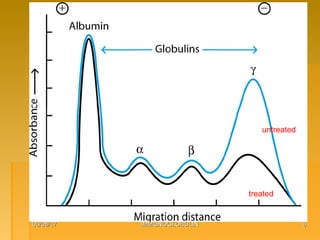
 Electrophoresis separation of one serum aliquot revealed
four major fraction corresponding to serum: albumin, the ά,
β, and γ globulins.
 Prior to electrophoresis, the other serum aliquot was mixed
with the immunized Ag, allowing the formation of an
immune precipitate that was removed, leaving the remaining
serum proteins which did not react with the Ag.
06/08/1706/08/17 IMMUNOGLOBULINIMMUNOGLOBULIN 44
06/08/1706/08/17 IMMUNOGLOBULINIMMUNOGLOBULIN 55
 A comparison of the electrophoretic profiles of these two
serum aliquot revealed that there was a significant drop in γ
globulin peak in the aliquot that had been reacted with
antigen.
 Thus the γ globulin fraction was identified as containing
serum Abs which were called Immunoglobulin to distinguish
them from any other proteins that might be contained in the γ
globulin fraction.
 Thus the γ globulin fraction was identified as containing
serum Abs which were called Immunoglobulin to distinguish
them from any other proteins that might be contained in the γ
globulin fraction.
06/08/1706/08/17 IMMUNOGLOBULINIMMUNOGLOBULIN 66
untreated
treated
06/08/1706/08/17 IMMUNOGLOBULINIMMUNOGLOBULIN 77
Heavy and Light Chains
All immunoglobulins have a four chain structure as their basic
unit. They are composed of two identical light chains (23kD)
and two identical heavy chains (50-70kD)
06/08/1706/08/17 IMMUNOGLOBULINIMMUNOGLOBULIN 88
Variable (V) and Constant (C) Regions
When the amino acid sequences of many different heavy
chains and light chains were compared, it became clear that
both the heavy and light chain could be divided into two
regions based on variability in the amino acid sequences.
These are the:
1. Light Chain - VL
(110 amino acids) and CL
(110 amino
acids)
2. Heavy Chain - VH
(110 amino acids) and CH
(330-440
amino acids)
06/08/1706/08/17 IMMUNOGLOBULINIMMUNOGLOBULIN 99
•Immunoglobulin Domains
•Variable-Region Domains:Variable-Region Domains: 110 or so amino acids of heavy and
light chains varies among Abs of different Ags specificity, called
VH and VL respectively.
•The variable domain is also referred to as the FV region and is
the most important region for binding to antigens.
•To be specific, variable loops of β-strands, three each on the
light (VL) and heavy (VH) chains are responsible for binding to
the antigen. These loops are referred to as the complementarity
determining regions (CDRs).
•The structures of these CDRs have been clustered and classified
by Chothia et al.and more recently by North et al.
•CDRs are also called idiotypes. According to immune network
theory, the adaptive immune system is regulated by interactions
between idiotypes.
06/08/1706/08/17 IMMUNOGLOBULINIMMUNOGLOBULIN 1010
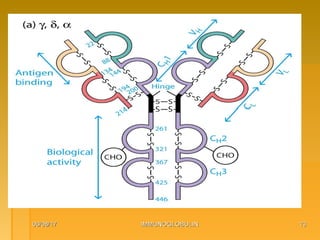
Constant region :
It is the same for all immunoglobulins of the same class but
differs between classes).Heavy chains γ, α and δ have a constant
region composed of three tandem immunoglobulin domains but
also have a hinge region for added flexibility.
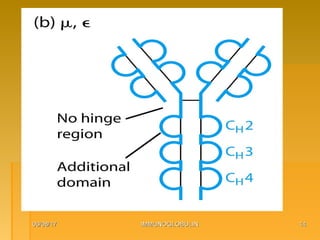
Heavy chains μ and ε have a constant region composed of four
domains.
Hinge Region
This is the region at which the arms of the antibody molecule
forms a Y. It is called the hinge region because there is some
flexibility in the molecule at this point. It is proline rich region.
Light chains of ImmunoglobulinLight chains of Immunoglobulin
22,000 Da22,000 Da
 There are two types of light chain in humans (as in other
mammals),
 kappa (κ) chain: 60% in human and 95 % in mice
 lambda (λ) chain: 40% in human and 5 % in mice
These chains are called Bence- Jones Proteins and produced by
neoplastic plasma cell as well as multiple myeloma cell.
06/08/1706/08/17 IMMUNOGLOBULINIMMUNOGLOBULIN 1111
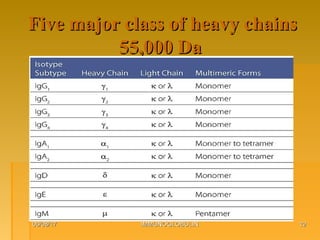
Five major class of heavy chainsFive major class of heavy chains
55,000 Da55,000 Da
06/08/1706/08/17 IMMUNOGLOBULINIMMUNOGLOBULIN 1212
06/08/1706/08/17 IMMUNOGLOBULINIMMUNOGLOBULIN 1313
06/08/1706/08/17 IMMUNOGLOBULINIMMUNOGLOBULIN 1414
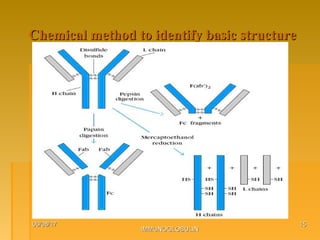
Chemical method to identify basic structureChemical method to identify basic structure
06/08/1706/08/17
IMMUNOGLOBULINIMMUNOGLOBULIN
1515
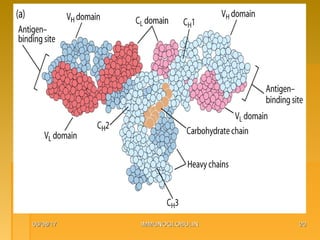
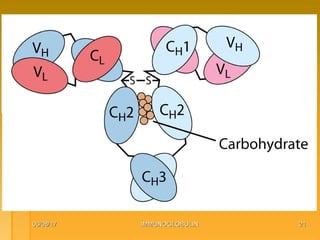
IMMUNOGLOBULIN FRAGMENTS: STRUCTURE/FUNCTIONIMMUNOGLOBULIN FRAGMENTS: STRUCTURE/FUNCTION
RELATIONSHIPSRELATIONSHIPS
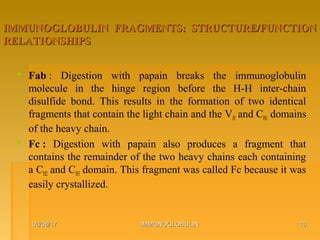
 Fab : Digestion with papain breaks the immunoglobulin
molecule in the hinge region before the H-H inter-chain
disulfide bond. This results in the formation of two identical
fragments that contain the light chain and the VH and CH1 domains
of the heavy chain.
 Fc : Digestion with papain also produces a fragment that
contains the remainder of the two heavy chains each containing
a CH2 and CH3 domain. This fragment was called Fc because it was
easily crystallized.
06/08/1706/08/17 IMMUNOGLOBULINIMMUNOGLOBULIN 1616
06/08/1706/08/17 IMMUNOGLOBULINIMMUNOGLOBULIN 1717
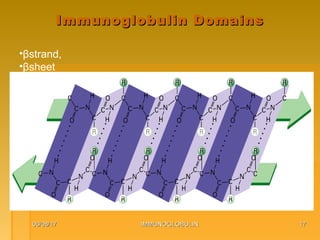
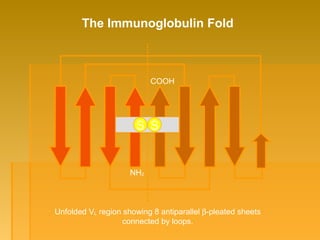
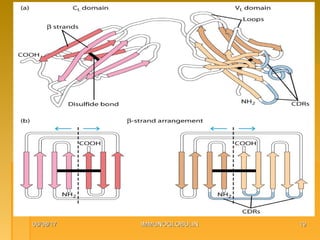
Immunoglobulin DomainsImmunoglobulin Domains
•βstrand,
•βsheet
Unfolded VL region showing 8 antiparallel β-pleated sheets
connected by loops.
NH2
COOH
S S
The Immunoglobulin Fold
06/08/1706/08/17 IMMUNOGLOBULINIMMUNOGLOBULIN 1919
06/08/1706/08/17 IMMUNOGLOBULINIMMUNOGLOBULIN 2020
06/08/1706/08/17 IMMUNOGLOBULINIMMUNOGLOBULIN 2121
06/08/1706/08/17 IMMUNOGLOBULINIMMUNOGLOBULIN 2222
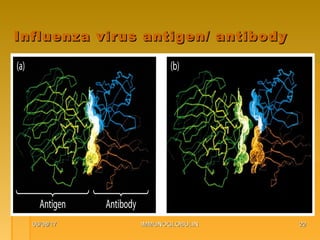
Influenza virus antigen/ antibodyInfluenza virus antigen/ antibody
06/08/1706/08/17 IMMUNOGLOBULINIMMUNOGLOBULIN 2323
GENERAL FUNCTIONS OF IMMUNOGLOBULINS
A. Antigen binding 
Immunoglobulins  bind  specifically  to  one  or  a  few  closely  related 
antigens. Each immunoglobulin actually binds to a specific antigenic 
determinant. Antigen binding by antibodies is the primary function of 
antibodies  and  can  result  in  protection  of  the  host.   The  valency  of 
antibody  refers  to  the  number  of  antigenic  determinants  that  an 
individual antibody molecule can bind. The valency of all antibodies 
is at least two and in some instances more.
06/08/1706/08/17 IMMUNOGLOBULINIMMUNOGLOBULIN 2424
B. Effector Functions
Frequently the binding of an antibody to an antigen has no direct biological 
effect.  Rather,  the  significant  biological  effects  are  a  consequence  of 
secondary  "effector  functions"  of  antibodies.  The  immunoglobulins 
mediate a variety of these effector functions. Usually the ability to carry out 
a particular effector function requires that the antibody bind to its antigen. 
Not  every  immunoglobulin  will  mediate  all  effector  functions.  Such 
effector functions include:
06/08/1706/08/17 IMMUNOGLOBULINIMMUNOGLOBULIN 2525
1. Fixation of complement - This results in lysis of cells and release of
biologically active molecules .
2. Binding to various cell types - Phagocytic cells, lymphocytes,
platelets, mast cells, and basophils have receptors that bind
immunoglobulins. This binding can activate the cells to perform some
function. Some immunoglobulins also bind to receptors on placental
trophoblasts, which results in transfer of the immunoglobulin across the
placenta. As a result, the transferred maternal antibodies provide
immunity to the fetus and newborn.
06/08/1706/08/17 IMMUNOGLOBULINIMMUNOGLOBULIN 2626
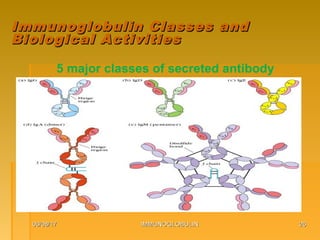
Immunoglobulin Classes andImmunoglobulin Classes and
Biological ActivitiesBiological Activities
5 major classes of secreted antibody
06/08/1706/08/17 IMMUNOGLOBULINIMMUNOGLOBULIN 2727
ReferencesReferences
 Litman GW, Rast JP, Shamblott MJ, Haire RN, Hulst M, Roess W,
Litman RT, Hinds-Frey KR, Zilch A, Amemiya CT (January 1993).
"Phylogenetic diversification of immunoglobulin genes and the antibody
repertoire“.
 Johansson SG (2006). "The discovery of immunoglobulin E". Allergy
and asthma proceedings : the official journal of regional and state allergy
societies 27(2 Suppl 1): S3–6.
 Lieber MR, Yu K, Raghavan SC (2006). "Roles of nonhomologous
DNA end joining, V(D)J recombination, and class switch recombination
in chromosomal translocations".
 Immunology - chapter four immunoglobulins structure and function by
Dr. Gene Mayer
06/08/1706/08/17 IMMUNOGLOBULINIMMUNOGLOBULIN 2828
06/08/1706/08/17 IMMUNOGLOBULINIMMUNOGLOBULIN 2929

Immunoglobulin

  • 1.
  • 2.
    FINE STRUCTUREFINE STRUCTURE OFOF IMMUNOGLOBULIIMMUNOGLOBULI NNDivyaSrivastavaDivya Srivastava M.Tech Biotechnology 2M.Tech Biotechnology 2NDND Sem.Sem. 06/08/1706/08/17 22IMMUNOGLOBULINIMMUNOGLOBULIN
  • 3.
    06/08/1706/08/17 IMMUNOGLOBULINIMMUNOGLOBULIN 33 Immunoglobulin(Ig) Immunoglobulins are glycoprotein molecules that are produced by plasma cells in response to an immunogen and which function as antibodies. The immunoglobulins derive their name from the finding that they migrate with globular proteins when antibody- containing serum is placed in an electrical field.
  • 4.
    INTRODUCTIONINTRODUCTION  Arne Tiseliusand Elvin A. Kabat (1939) immunized a rabit with the protein ovalbumin, prepared the serum and then divided the serum into two aliquots.  Electrophoresis separation of one serum aliquot revealed four major fraction corresponding to serum: albumin, the ά, β, and γ globulins.  Prior to electrophoresis, the other serum aliquot was mixed with the immunized Ag, allowing the formation of an immune precipitate that was removed, leaving the remaining serum proteins which did not react with the Ag. 06/08/1706/08/17 IMMUNOGLOBULINIMMUNOGLOBULIN 44
  • 5.
    06/08/1706/08/17 IMMUNOGLOBULINIMMUNOGLOBULIN 55 A comparison of the electrophoretic profiles of these two serum aliquot revealed that there was a significant drop in γ globulin peak in the aliquot that had been reacted with antigen.  Thus the γ globulin fraction was identified as containing serum Abs which were called Immunoglobulin to distinguish them from any other proteins that might be contained in the γ globulin fraction.  Thus the γ globulin fraction was identified as containing serum Abs which were called Immunoglobulin to distinguish them from any other proteins that might be contained in the γ globulin fraction.
  • 6.
  • 7.
    06/08/1706/08/17 IMMUNOGLOBULINIMMUNOGLOBULIN 77 Heavyand Light Chains All immunoglobulins have a four chain structure as their basic unit. They are composed of two identical light chains (23kD) and two identical heavy chains (50-70kD)
  • 8.
    06/08/1706/08/17 IMMUNOGLOBULINIMMUNOGLOBULIN 88 Variable(V) and Constant (C) Regions When the amino acid sequences of many different heavy chains and light chains were compared, it became clear that both the heavy and light chain could be divided into two regions based on variability in the amino acid sequences. These are the: 1. Light Chain - VL (110 amino acids) and CL (110 amino acids) 2. Heavy Chain - VH (110 amino acids) and CH (330-440 amino acids)
  • 9.
    06/08/1706/08/17 IMMUNOGLOBULINIMMUNOGLOBULIN 99 •ImmunoglobulinDomains •Variable-Region Domains:Variable-Region Domains: 110 or so amino acids of heavy and light chains varies among Abs of different Ags specificity, called VH and VL respectively. •The variable domain is also referred to as the FV region and is the most important region for binding to antigens. •To be specific, variable loops of β-strands, three each on the light (VL) and heavy (VH) chains are responsible for binding to the antigen. These loops are referred to as the complementarity determining regions (CDRs). •The structures of these CDRs have been clustered and classified by Chothia et al.and more recently by North et al. •CDRs are also called idiotypes. According to immune network theory, the adaptive immune system is regulated by interactions between idiotypes.
  • 10.
    06/08/1706/08/17 IMMUNOGLOBULINIMMUNOGLOBULIN 1010 Constantregion : It is the same for all immunoglobulins of the same class but differs between classes).Heavy chains γ, α and δ have a constant region composed of three tandem immunoglobulin domains but also have a hinge region for added flexibility. Heavy chains μ and ε have a constant region composed of four domains. Hinge Region This is the region at which the arms of the antibody molecule forms a Y. It is called the hinge region because there is some flexibility in the molecule at this point. It is proline rich region.
  • 11.
    Light chains ofImmunoglobulinLight chains of Immunoglobulin 22,000 Da22,000 Da  There are two types of light chain in humans (as in other mammals),  kappa (κ) chain: 60% in human and 95 % in mice  lambda (λ) chain: 40% in human and 5 % in mice These chains are called Bence- Jones Proteins and produced by neoplastic plasma cell as well as multiple myeloma cell. 06/08/1706/08/17 IMMUNOGLOBULINIMMUNOGLOBULIN 1111
  • 12.
    Five major classof heavy chainsFive major class of heavy chains 55,000 Da55,000 Da 06/08/1706/08/17 IMMUNOGLOBULINIMMUNOGLOBULIN 1212
  • 13.
  • 14.
  • 15.
    Chemical method toidentify basic structureChemical method to identify basic structure 06/08/1706/08/17 IMMUNOGLOBULINIMMUNOGLOBULIN 1515
  • 16.
    IMMUNOGLOBULIN FRAGMENTS: STRUCTURE/FUNCTIONIMMUNOGLOBULINFRAGMENTS: STRUCTURE/FUNCTION RELATIONSHIPSRELATIONSHIPS  Fab : Digestion with papain breaks the immunoglobulin molecule in the hinge region before the H-H inter-chain disulfide bond. This results in the formation of two identical fragments that contain the light chain and the VH and CH1 domains of the heavy chain.  Fc : Digestion with papain also produces a fragment that contains the remainder of the two heavy chains each containing a CH2 and CH3 domain. This fragment was called Fc because it was easily crystallized. 06/08/1706/08/17 IMMUNOGLOBULINIMMUNOGLOBULIN 1616
  • 17.
    06/08/1706/08/17 IMMUNOGLOBULINIMMUNOGLOBULIN 1717 ImmunoglobulinDomainsImmunoglobulin Domains •βstrand, •βsheet
  • 18.
    Unfolded VL regionshowing 8 antiparallel β-pleated sheets connected by loops. NH2 COOH S S The Immunoglobulin Fold
  • 19.
  • 20.
  • 21.
  • 22.
    06/08/1706/08/17 IMMUNOGLOBULINIMMUNOGLOBULIN 2222 Influenzavirus antigen/ antibodyInfluenza virus antigen/ antibody
  • 23.
    06/08/1706/08/17 IMMUNOGLOBULINIMMUNOGLOBULIN 2323 GENERALFUNCTIONS OF IMMUNOGLOBULINS A. Antigen binding  Immunoglobulins  bind  specifically  to  one  or  a  few  closely  related  antigens. Each immunoglobulin actually binds to a specific antigenic  determinant. Antigen binding by antibodies is the primary function of  antibodies  and  can  result  in  protection  of  the  host.   The  valency  of  antibody  refers  to  the  number  of  antigenic  determinants  that  an  individual antibody molecule can bind. The valency of all antibodies  is at least two and in some instances more.
  • 24.
    06/08/1706/08/17 IMMUNOGLOBULINIMMUNOGLOBULIN 2424 B.Effector Functions Frequently the binding of an antibody to an antigen has no direct biological  effect.  Rather,  the  significant  biological  effects  are  a  consequence  of  secondary  "effector  functions"  of  antibodies.  The  immunoglobulins  mediate a variety of these effector functions. Usually the ability to carry out  a particular effector function requires that the antibody bind to its antigen.  Not  every  immunoglobulin  will  mediate  all  effector  functions.  Such  effector functions include:
  • 25.
    06/08/1706/08/17 IMMUNOGLOBULINIMMUNOGLOBULIN 2525 1.Fixation of complement - This results in lysis of cells and release of biologically active molecules . 2. Binding to various cell types - Phagocytic cells, lymphocytes, platelets, mast cells, and basophils have receptors that bind immunoglobulins. This binding can activate the cells to perform some function. Some immunoglobulins also bind to receptors on placental trophoblasts, which results in transfer of the immunoglobulin across the placenta. As a result, the transferred maternal antibodies provide immunity to the fetus and newborn.
  • 26.
    06/08/1706/08/17 IMMUNOGLOBULINIMMUNOGLOBULIN 2626 ImmunoglobulinClasses andImmunoglobulin Classes and Biological ActivitiesBiological Activities 5 major classes of secreted antibody
  • 27.
  • 28.
    ReferencesReferences  Litman GW,Rast JP, Shamblott MJ, Haire RN, Hulst M, Roess W, Litman RT, Hinds-Frey KR, Zilch A, Amemiya CT (January 1993). "Phylogenetic diversification of immunoglobulin genes and the antibody repertoire“.  Johansson SG (2006). "The discovery of immunoglobulin E". Allergy and asthma proceedings : the official journal of regional and state allergy societies 27(2 Suppl 1): S3–6.  Lieber MR, Yu K, Raghavan SC (2006). "Roles of nonhomologous DNA end joining, V(D)J recombination, and class switch recombination in chromosomal translocations".  Immunology - chapter four immunoglobulins structure and function by Dr. Gene Mayer 06/08/1706/08/17 IMMUNOGLOBULINIMMUNOGLOBULIN 2828
  • 29.