Antimicrobial peptides-readings
●
Text : Immunobiology 7th Edition by
Janeway and Travers et al. 2008.
●
Principals of Mucosal Immunology. Philip
Smith, Thomas T MacDonald, Richard S.
Blumberg. Eds. Garland Science 2012.
What are antimicrobial peptides?
●
Antimicrobial peptides- defined as polypeptide
antimicrobial substances
●
More than 100 of these peptides identified in
fungi, insects, amphibians and humans.
●
Between 12-50 amino acids;half the residues
hydrophobic
●
Generally cationic and amphipathic molecules
●
A role in innate defense mechanism of many
species
Classification of antimicrobial
peptides
●
Major classes include
●
(a) beta-sheets with S-S bonds
●
(b) linear alpha-helices
●
(c) exended coils
●
(d) loop structures
●
Predominant class is the linear, amphipathic,
α-helical peptide
What are the functions of
antimicrobial peptides??
●
Antimicrobial peptides participate in the
innate immune system
●
Can protect host from invasive microbial
infections
●
New evidence views antimicrobial peptides
as multifunctional molecules that link innate
immune response to adaptive immune
system
●
What are the functions of
antimicrobial peptides??
●
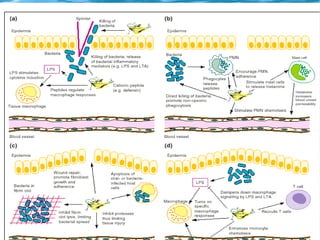
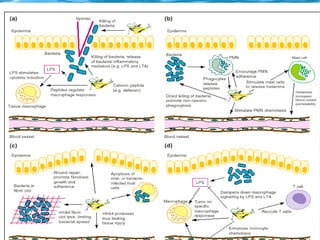
Mediate of cross-talk between 2 wings of
immune sytem. How?
●
Achieved by cytokine and chemokine
production(immunomodulation)
●
Also by facilitating immune and inflammatory
cell migration
●
●
What are the functions of
antimicrobial peptides??
●
α and β-defensins, and cathelicidin extend
neutrophil lifespan(by suppression of
neutrophil apoptosis)
●
Induce secretion of histamine and
prostaglandins from mast cells
●
Induce cytokine release from T cells
Where do we find antimicrobial
peptides?
●
In cells- neutrophils, Paneth cells, ????
●
In body fluids-complement proteins
●
In body secretions such as saliva and tears
●
In intestinal mucus layers-peptides bound to
mucins detected in rectal mucus
●
Β-defensin of Epithelial cells of trachea-LPS
dependent production via rel/NFKappaB
●
Where do we find antimicrobial
peptides?
●
α-Defensins in neutrophils and Paneth cells
●
β-defensins from epithelia of many organs
including skin
●
Cathelicidins in secretory granules of
neutrophils and in NK cells, T cells, B cells,
mast cells and epithelial cells
●
In insect venom, frog skin,?????
●
How about D analogs of these
peptides?
●
Can be effective as well
●
In nature, ___ sugars and ___ amino acids
are found?
●
Be familiar with D and L and R and S
designations in organic chemistry.
Antimicrobial peptides
●
Magainin 1-from frog
●
GIGKFLHSAGKFGKAFVGEIMKS
●
Broad activity vs bacteria, protozoa, yeast,
fungi, viruses(HSV-1 and HSV-2)
●
Cytotoxic against some cancer cells
Antimicrobial peptides
●
Aurein-net charge 1
●
GLFDIIKKIAESI
●
The antibiotic and anti-cancer active aurein
peptides from the australian bell frogs Litoria
aurea and Litoria raniformis; the solution
structure of aurein 1.2.
●
Rozek T, Wegener KL, Bowie JH, Olver IN,
Carver JA, Wallace JC, Tyler MJ.
●
Eur J Biochem. 2000 Sep;267(17):5330-41.
●
Antimicrobial peptides-porcine
●
Protegrin-porcine leukocytes-cathelicidin family
●
RGGRLCYCRRRFCVCVGR - NH2 (disulfide
bridge:6 - 15 and 8 - 13)
●
H - Arg - Gly - Gly - Arg - Leu - Cys - Tyr - Cys -
Arg - Arg - Arg - Phe - Cys - Val - Cys - Val - Gly -
Arg - NH2 (disulfide bridge:6 - 15 and 8 – 13)
●
Active vs Escherichia coli, Listeria
monocytogenes, candida albicans, and enveloped
viruses
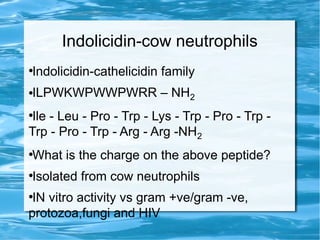
Indolicidin-cow neutrophils
●
Indolicidin-cathelicidin family
●ILPWKWPWWPWRR – NH2
●
Ile - Leu - Pro - Trp - Lys - Trp - Pro - Trp -
Trp - Pro - Trp - Arg - Arg -NH2
●
What is the charge on the above peptide?
●
Isolated from cow neutrophils
●
IN vitro activity vs gram +ve/gram -ve,
protozoa,fungi and HIV
Defensins, histatins and
cathelicidins are 3 important
peptides in humans●
small, cationic and amphipathic.
●
Exhibit broad-spectrum activity against
Gram-positive and Gram-negative bacteria,
yeasts, fungi and enveloped viruses
●
Defensins
●
alpha-defensins and beta-defensins
●
Cationic, non-glycosylated peptides with six
cysteine residue
●
Cysteines form three intramolecular disulfide
bridges
●
We triple-stranded beta-sheet
Histatins-saliva
●
small, cationic, histidine-rich peptides
●
random coil conformation in aqueous
solvents
●
alpha-helices in non-aqueous solvents
Cathelicidins
●
random coil conformation in a hydrophilic
environment
●
Alpha helical in hydrophobic medium
Antimicrobial peptides-from cells in
human gut
●
Lysozyme and Defensins (bactericidal proteins)
●
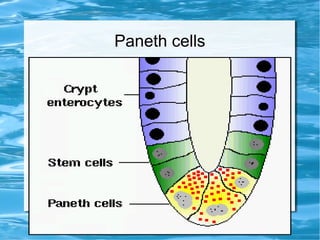
Paneth cells (PCs)-terminally differentiated,
specialized secretory cells located at the base
of the crypts of Lieberkühn in the small
intestine.
●
Paneth cells located adjacent to stem cells-role
in defendepithelial cell renewal??
●
MyD88-dependent toll-like receptor (TLR) and
other receptors sense bacteria
●
Paneth cell secrete antimicrobials
to regulate gut microbiome
●
PCs secrete granules containing
defensins/cryptdins(mice) and lysozyme-into
the lumen
●
Homeostatic relationship between host and
microbes(
●
Maintain gastrointestinal barrier; regulate gut
microbiome
●
Paneth cell dysfuction in intestinal
inflammation (Crohn's disease)
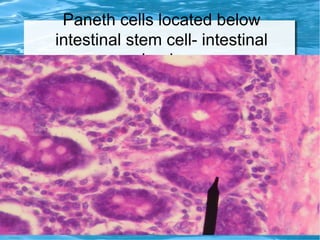
Paneth cells located below
intestinal stem cell- intestinal
glands●
Histology
Paneth cells
●
Paneth cells
PalG1from cow rumen vs
Vancomycin-resistant Enterococci
(VRE)●
Enterococcus faecalis- human enterococcal
infections
●
Being charecterized
●
palG1 has potential in the treatment of
enterococcal infections
Antimicrobial peptides from saliva
●
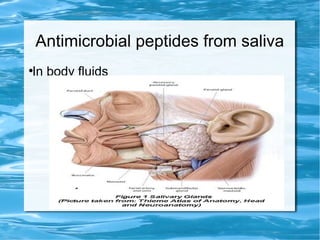
Major secretion-submandibular glands,
sublingual glands and parotid glands(these
are paired glands).
●
Also secreted by many minor salivary
glands(in lamina propria and oral mucosa)
●
Connective tissue(lamina propria)
+epithelia=mucosa
●
Minor salivary glands-lingual, buccal and
labial glands, palatine glands and
glossopalatine folds
Lysozyme and lactoferrin from both
major and minor salivary glands
●
Salivary lysozyme-hydrolyzes beta(1-4)
bond between N-acetylmuramic acid and N-
acetylglucosamine in the peptidoglycan layer
of the bacterial cell wall.
●
Perturbed cell wall integrity-bacteria more
suceptible to lysis due to the hypoosmotic
conditions in saliva
●
Lactoferrin-cationic peptide binds iron thus
hindering bacterial growth
Antimicrobial peptides from saliva
●
Perioxidase slows down acid production and
growth of many oral microbes and fungi.
●
Lysozyme promotes lysis of bacteria in
conjunction with other antibacterial systems.
●
Histatins from human saliva
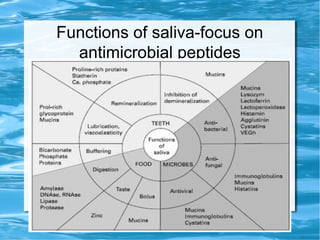
Functions of saliva-focus on
antimicrobial peptides
●
Peptides
Antimicrobial peptides from saliva
●
In body fluids
Antimicrobial peptides-complement
●
Complement system made of nearly 30
proteins circulating in blood plasma.
●
Most are inactive; cleaved by a protease and
converted into a protease(active).
●
Components of the system serve as the
substrate of a prior component and then as
an enzyme to activate a subsequent
component.
●
Antimicrobial peptides-complement
●
Sequential activation produces an expanding
cascade of activity (like the blood clotting
system
●
Complement proteins provide an effector
mechanim to enhance the specific antibody-
antigen interactions
●
antibodies "finger" the target, complement
destroys it
●
Produced by liver and by monocytes, these
proteins punch holes in bacteria
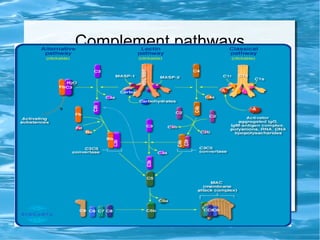
Complement pathways
●
Complement
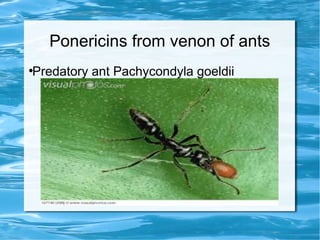
Ponericins from venon of ants
●
Predatory ant Pachycondyla goeldii
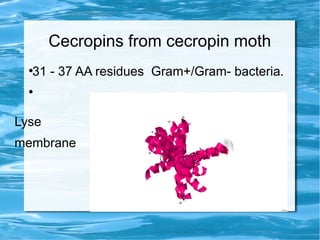
Cecropins from cecropin moth
●
31 - 37 AA residues Gram+/Gram- bacteria.
●
Lyse
membrane
Plant sources-Neem leaf extracts
●
Shown to be effective against Enterococcus
faecalis
●
E faecalis is a major microbe recovered from
root canal when endodontic treatment has
failed
Proline-rich Bactenicins against
gram-ves
●
Bac-7 can enter bacterial cells without
damaging membranes
●
Uses SbmA- a bacterial proton-drive
transporter to enter bacterial cells
●
10-residue proline-rich peptide with two
arginine residues enters best
●
Sadler et al. Biochemistry, 2002, 41 (48), pp
14150–14157
PAF-26 is a de novo designed
hexapeptide antifungal
●
PAF-26- a de novo-designed hexapeptide
●
2 motifs-N-terminal cationic region and a C-
terminal hydrophobic region.
●
PAF26 -dynamic antifungal mode-of-action
that involves electrostatic interaction with cell
membrane, internalisation, and cell killing
●
Mode of fungal killing still unclear
●
Current research on PAF-26
●
Attached a fluorescent tag
●
analysed by live cell imaging
●
in the fungal model Neurospora crassa
●
the human fungal pathogen Aspergillus
fumigatus
Newer antimicrobial peptides-shark
squalamine
Squalamine-from liver tissue of deep water
shark
amino sterol cationic peptide analog-anti-
obesity and anti angiogenesis
Newer peptide antimicrobials
●
An antimicrobial peptide library screen
against Candida albicans
●
600 9-mer peptides tested
●
A 9-mer peptide analaog RLWLAIGRG-NH2
of insect defensin Protoetiamycin being
tested for antibacterial activity
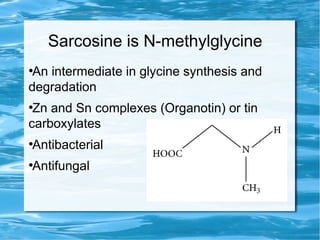
Sarcosine is N-methylglycine
●
An intermediate in glycine synthesis and
degradation
●
Zn and Sn complexes (Organotin) or tin
carboxylates
●
Antibacterial
●
Antifungal
●
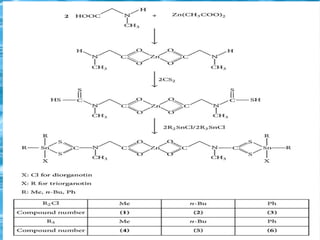
Scheme
Sarcosine complexes more active
against gram negatives
●
Bidentate carboxyl ion can coordinate Zn
●
Complexes with Sn and Zn are more lipid
soluble
●
Complexes can enter cell walls more easily
●
More studies are needed
●
Antimicrobial peptides from
Lactococcus bacteria
●
Nisin- 34 aa peptide
●
Other peptides from Lactococcus
●
Signal peptide of L lactis was fused to codon
sequence of antimicrobials
●
Codon sequence cloned under nisin-
inducible promoter and bacteria transformed
into recombinant strain
●
Vozing et al. ACS Synth. Biol., 2013, 2 (11),
pp 643–650
Antimicrobial from Neem plant
●
Tripeptide N-Ala-Phe-Cys-C has been
isolated
●
MW=321.5 Da
●
●
Recombinant L lactis produces
antimicrobials active vs gram -ves
●
A3APO and Alyteserin showed activity
against gram -ve E coli and Salmonella
●
A3APO and Alyteserin currently being
investigated against gram negatives
Release of antimicrobial peptides
●
Paneth cells release antimicrobial peptides
upon stimulation by the proinflammatory
cytokine, interferon gamma(IFN-γ)
●
Neutrophils-
●
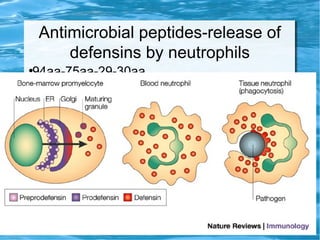
Antimicrobial peptides-release of
defensins by neutrophils
●
94aa-75aa-29-30aa
Structure of antimicrobial peptides
●
Most are cationic and amphipathic
●
Presence of multiple lysine and arginine
residues
●
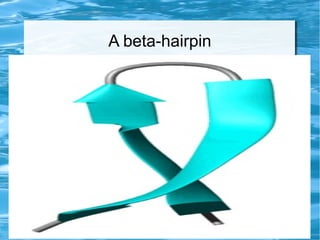
Simplest ones are alpha-helical or beta-
hairpin
●
Alpha helix and hairpins are structural motifs
Primary and secondary structures
of petides-review
●
Alpha helix, beta sheets and random coils
are examples of secondary structures of
proteins
●
Alpha helices held by H-bonds
within a strand
●
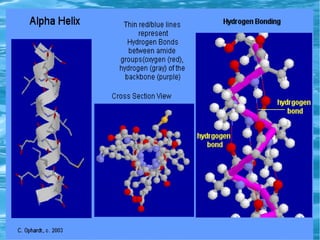
Intra-chain hydrogen bonds stabilize the helix
●
Some proteins-keratin and collagen-almost
entirely alpha helical in structure.
●
Most globular proteins contain both alpha helical
and beta pleated sheat regions in addition to
regions without alpha helical or beta pleated
sheats???
●
How does an alpha helix form?
●
An alpha helix is formed by making a rope
coil in a left handed direction
●
In proteins, the rope is represented by the N-
C-C-N-C-C-N .... backbone of the polypeptide
chain.
Alpha helix
●
Alpha
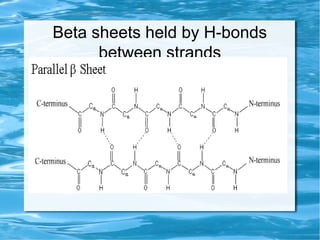
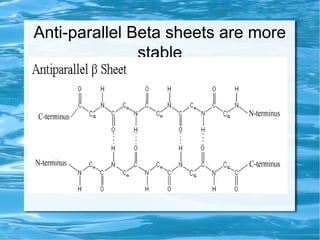
Beta sheets held by H-bonds
between strands
●
Parallel
Anti-parallel Beta sheets are more
stable
●
Anti
A beta-hairpin
●
Image
Intermolecular hydrogen bonding in
beta-sheats
●
Compared with alpha helices, beta sheats
held by intermolecular hydrogen bonds
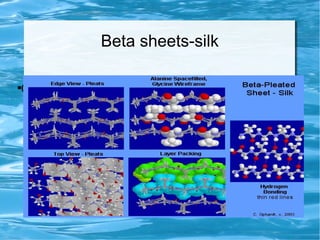
H-bonds in silk-a beta sheat
●
The hydrogen on the amide of one protein chain
is hydrogen bonded to the amide oxygen of the
neighboring protein chain.
●
The pleated sheet effect arises form the fact that
the amide structure is planar while the "bends"
occur at the carbon containing the side chain.
●
Can you follow the N-C-C-N-C-C backbone on
next slide??
Beta sheets-silk
●
Gly-Ala
Secondary structre of silk arises from a
basic primary structure
●
The basic primary structure is: -gly-ala-gly-
ala-gly-ala-.
●
glycine and alanine=75-80% of the amino
acids
●
another 10-15% is serine and the final 10 %
contain bulky side chains such as in tyr, arg,
val, asp, and glu.
Effect of amino acids on secondary
structures
●
Charged amino acid side chains destabilize
the alpha helical or beta-pleated sheat
structures.
●
amino acids containing hydrophobic side
chains are compatible with the formation of
alpha helices and beta pleated sheats.
Mechanism of action of antimicrobial
peptides●
Exact mechanism still unknown
●
cationic, hydrophobic peptides of the prototypic
sequence KKAAAXAAAAAXAAWAAXAAAKKKK-
amide
●
Peptide–lipid interactions lead to membrane
permeation
●
Mechanism of action
●
Carpet model-lysine interacts with anionic
phospholipid head groups
●
Hydophobic region then interacts with the
lipid bilayer disrupting bacterial membrane
●
Hydrophobicity of core residues determines
ability of peptide to insert into the membrane
●
Next slide
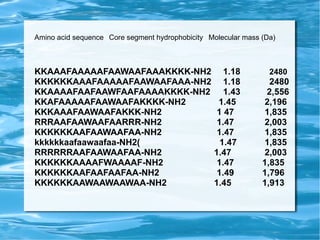
Amino acid sequence Core segment hydrophobicity Molecular mass (Da)
KKAAAFAAAAAFAAWAAFAAAKKKK-NH2 1.18 2480
KKKKKKAAAFAAAAAFAAWAAFAAA-NH2 1.18 2480
KKAAAAFAAFAAWFAAFAAAAKKKK-NH2 1.43 2,556
KKAFAAAAAFAAWAAFAKKKK-NH2 1.45 2,196
KKKAAAFAAWAAFAKKK-NH2 1 47 1,835
RRRAAFAAWAAFAARRR-NH2 1.47 2,003
KKKKKKAAFAAWAAFAA-NH2 1.47 1,835
kkkkkkaafaawaafaa-NH2( 1.47 1,835
RRRRRRAAFAAWAAFAA-NH2 1.47 2,003
KKKKKKAAAAFWAAAAF-NH2 1.47 1,835
KKKKKKAAFAAFAAFAA-NH2 1.49 1,796
KKKKKKAAWAAWAAWAA-NH2 1.45 1,913
Circular dichroism(CD) is a useful
tool in peptide drug discovery
●
Light absorption spectroscopy that helps
determine secondary strucure of polypeptides
●
measures difference in absorbance of right-
and left-circularly polarized light
●
http://www.cryst.bbk.ac.uk/PPS2/course/secti
on8/ss-960531_21.html
CD spectra of the F17-6K peptide in an aqueous buffer (Aq) containing 20 mM Tris-HCl and 20
mM NaCl, pH 7.4, and in the same buffer with the addition of 20 mM SDS. The spectrum of all-d
F17-6K in SDS is presented for comparison. [θ], ellipticity (measured in degrees × square
centimeter per decimole).
Stark M et al. Antimicrob. Agents Chemother. 2002;46:3585-
3590
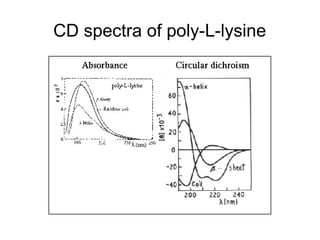
CD spectra of poly-L-lysine
Mechanism of action against
bacteria
●
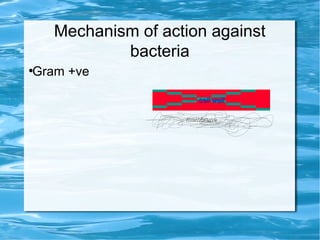
Gram +ve
cell wallcell wall
membranemembrane
Mechanism of action against
bacteria
●
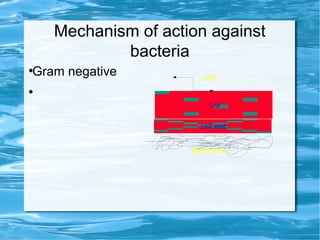
Gram negative
●
OMOM
cell wallcell wall
Membrane
LPS
Mechanisms
●
Mech.
Mechanisms
●
Mech.
Antimicrobial peptides differ from
peptide antibiotics of bacteria
●
These peptides differ from most (but not all)
peptide antibiotics of bacteria
●
Also differ from peptide antibiotics from fungi
●
Fungi synthesize peptide antibiotics by
specialized metabolic pathways
How do we measure the activity of
antimicrobial peptides???
●
Therapeutic potential of antimicrobial
peptides is compared using Minimum
inhibitory concentration assays
●
MIC is lowest concentration at which the
drug prevents growth of inoculum of 100000
cells/ml of exponentially growing bacteria
●
Drawbacks of MIC testing for
efficacy of antimicrobial peptides
●
Lacks info on actual killing of bacterial cells
●
Can't differentiate between bactericidal and
bacteriostatic activities
●
Some use cell viability as a more reliable
measure of bactericidal activity
Safety profile of antimicrobial
peptides
●
There are some toxicity concerns
●
How we deliver antimicrobial
peptides??
●
Nanodized drug delivery systems being
studied
●
Chitosan-based nanoparticles can be used
Novel strategies to deliver
antimicrobial peptides
●
Insert gene encoding peptide into
bacteriophage
●
Maybe effective vs MRSA
●
UCLA doctoral thesis with Timothy Lu,
Michael Coris at Boston University
Useful websites
●
http://users.rcn.com/jkimball.ma.ultranet/BiologyPa
●
http://www.biog1445.org/demo/01/fibrous_v_glob.h
●
(http://www.bbcm.univ.trieste.it/ tossi/pag1.ht∼
m).
References and Resources●
http://aps.unmc.edu/AP/database/antiB.ph
●
Nagakoa et al. Modulation of Neutrophil
Apoptosis by Antimicrobial Peptides(2012).
ISRN Microbiology.
http://dx.doi.org/10.5402/2012/345791
●
http://cariology.wikifoundry.com/page/Formation+of
●
Stark et al(2002). Cationic Hydrophobic
Peptides with Antimicrobial Activity.
Antimicrobial agents and
Chemotherapy.46(11). 3580-3585
●
References and Resources
●
Charles L. Bevins & Nita H. Salzman(2011)
Paneth cells, antimicrobial peptides and
maintenance of intestinal homeostasis.
Nature Reviews Microbiology 9, 356-368
●
François Niyonsaba et al. (2010)
Antimicrobial Peptides Human β-Defensins
and Cathelicidin LL-37 Induce the Secretion
of a Pruritogenic Cytokine IL-31 by Human
Mast Cells. J Immun 184(7) 3526-3534.
References and Resources
●
Rozek et al.(2000). The antibiotic and
anticancer active aurein peptides from the
australian bell frogs Litoria aurea and Litoria
raniformis the solution structure of aurein
1.2.Eur J Biochem.Sep;267(17):5330-41.
●
Mor et al(1991). Isolation, amino acid
sequence, and synthesis of dermaseptin, a
novel antimicrobial peptide of amphibian skin.
30(36):8824-8830.

Antimicrobial peptides

  • 1.
    Antimicrobial peptides-readings ● Text :Immunobiology 7th Edition by Janeway and Travers et al. 2008. ● Principals of Mucosal Immunology. Philip Smith, Thomas T MacDonald, Richard S. Blumberg. Eds. Garland Science 2012.
  • 2.
    What are antimicrobialpeptides? ● Antimicrobial peptides- defined as polypeptide antimicrobial substances ● More than 100 of these peptides identified in fungi, insects, amphibians and humans. ● Between 12-50 amino acids;half the residues hydrophobic ● Generally cationic and amphipathic molecules ● A role in innate defense mechanism of many species
  • 3.
    Classification of antimicrobial peptides ● Majorclasses include ● (a) beta-sheets with S-S bonds ● (b) linear alpha-helices ● (c) exended coils ● (d) loop structures ● Predominant class is the linear, amphipathic, α-helical peptide
  • 4.
    What are thefunctions of antimicrobial peptides?? ● Antimicrobial peptides participate in the innate immune system ● Can protect host from invasive microbial infections ● New evidence views antimicrobial peptides as multifunctional molecules that link innate immune response to adaptive immune system ●
  • 5.
    What are thefunctions of antimicrobial peptides?? ● Mediate of cross-talk between 2 wings of immune sytem. How? ● Achieved by cytokine and chemokine production(immunomodulation) ● Also by facilitating immune and inflammatory cell migration ● ●
  • 6.
    What are thefunctions of antimicrobial peptides?? ● α and β-defensins, and cathelicidin extend neutrophil lifespan(by suppression of neutrophil apoptosis) ● Induce secretion of histamine and prostaglandins from mast cells ● Induce cytokine release from T cells
  • 7.
    Where do wefind antimicrobial peptides? ● In cells- neutrophils, Paneth cells, ???? ● In body fluids-complement proteins ● In body secretions such as saliva and tears ● In intestinal mucus layers-peptides bound to mucins detected in rectal mucus ● Β-defensin of Epithelial cells of trachea-LPS dependent production via rel/NFKappaB ●
  • 8.
    Where do wefind antimicrobial peptides? ● α-Defensins in neutrophils and Paneth cells ● β-defensins from epithelia of many organs including skin ● Cathelicidins in secretory granules of neutrophils and in NK cells, T cells, B cells, mast cells and epithelial cells ● In insect venom, frog skin,????? ●
  • 9.
    How about Danalogs of these peptides? ● Can be effective as well ● In nature, ___ sugars and ___ amino acids are found? ● Be familiar with D and L and R and S designations in organic chemistry.
  • 10.
    Antimicrobial peptides ● Magainin 1-fromfrog ● GIGKFLHSAGKFGKAFVGEIMKS ● Broad activity vs bacteria, protozoa, yeast, fungi, viruses(HSV-1 and HSV-2) ● Cytotoxic against some cancer cells
  • 11.
    Antimicrobial peptides ● Aurein-net charge1 ● GLFDIIKKIAESI ● The antibiotic and anti-cancer active aurein peptides from the australian bell frogs Litoria aurea and Litoria raniformis; the solution structure of aurein 1.2. ● Rozek T, Wegener KL, Bowie JH, Olver IN, Carver JA, Wallace JC, Tyler MJ. ● Eur J Biochem. 2000 Sep;267(17):5330-41. ●
  • 12.
    Antimicrobial peptides-porcine ● Protegrin-porcine leukocytes-cathelicidinfamily ● RGGRLCYCRRRFCVCVGR - NH2 (disulfide bridge:6 - 15 and 8 - 13) ● H - Arg - Gly - Gly - Arg - Leu - Cys - Tyr - Cys - Arg - Arg - Arg - Phe - Cys - Val - Cys - Val - Gly - Arg - NH2 (disulfide bridge:6 - 15 and 8 – 13) ● Active vs Escherichia coli, Listeria monocytogenes, candida albicans, and enveloped viruses
  • 13.
    Indolicidin-cow neutrophils ● Indolicidin-cathelicidin family ●ILPWKWPWWPWRR– NH2 ● Ile - Leu - Pro - Trp - Lys - Trp - Pro - Trp - Trp - Pro - Trp - Arg - Arg -NH2 ● What is the charge on the above peptide? ● Isolated from cow neutrophils ● IN vitro activity vs gram +ve/gram -ve, protozoa,fungi and HIV
  • 14.
    Defensins, histatins and cathelicidinsare 3 important peptides in humans● small, cationic and amphipathic. ● Exhibit broad-spectrum activity against Gram-positive and Gram-negative bacteria, yeasts, fungi and enveloped viruses ●
  • 15.
    Defensins ● alpha-defensins and beta-defensins ● Cationic,non-glycosylated peptides with six cysteine residue ● Cysteines form three intramolecular disulfide bridges ● We triple-stranded beta-sheet
  • 16.
    Histatins-saliva ● small, cationic, histidine-richpeptides ● random coil conformation in aqueous solvents ● alpha-helices in non-aqueous solvents
  • 17.
    Cathelicidins ● random coil conformationin a hydrophilic environment ● Alpha helical in hydrophobic medium
  • 18.
    Antimicrobial peptides-from cellsin human gut ● Lysozyme and Defensins (bactericidal proteins) ● Paneth cells (PCs)-terminally differentiated, specialized secretory cells located at the base of the crypts of Lieberkühn in the small intestine. ● Paneth cells located adjacent to stem cells-role in defendepithelial cell renewal?? ● MyD88-dependent toll-like receptor (TLR) and other receptors sense bacteria ●
  • 19.
    Paneth cell secreteantimicrobials to regulate gut microbiome ● PCs secrete granules containing defensins/cryptdins(mice) and lysozyme-into the lumen ● Homeostatic relationship between host and microbes( ● Maintain gastrointestinal barrier; regulate gut microbiome ● Paneth cell dysfuction in intestinal inflammation (Crohn's disease)
  • 20.
    Paneth cells locatedbelow intestinal stem cell- intestinal glands● Histology
  • 21.
  • 22.
    PalG1from cow rumenvs Vancomycin-resistant Enterococci (VRE)● Enterococcus faecalis- human enterococcal infections ● Being charecterized ● palG1 has potential in the treatment of enterococcal infections
  • 23.
    Antimicrobial peptides fromsaliva ● Major secretion-submandibular glands, sublingual glands and parotid glands(these are paired glands). ● Also secreted by many minor salivary glands(in lamina propria and oral mucosa) ● Connective tissue(lamina propria) +epithelia=mucosa ● Minor salivary glands-lingual, buccal and labial glands, palatine glands and glossopalatine folds
  • 24.
    Lysozyme and lactoferrinfrom both major and minor salivary glands ● Salivary lysozyme-hydrolyzes beta(1-4) bond between N-acetylmuramic acid and N- acetylglucosamine in the peptidoglycan layer of the bacterial cell wall. ● Perturbed cell wall integrity-bacteria more suceptible to lysis due to the hypoosmotic conditions in saliva ● Lactoferrin-cationic peptide binds iron thus hindering bacterial growth
  • 25.
    Antimicrobial peptides fromsaliva ● Perioxidase slows down acid production and growth of many oral microbes and fungi. ● Lysozyme promotes lysis of bacteria in conjunction with other antibacterial systems. ● Histatins from human saliva
  • 26.
    Functions of saliva-focuson antimicrobial peptides ● Peptides
  • 27.
    Antimicrobial peptides fromsaliva ● In body fluids
  • 28.
    Antimicrobial peptides-complement ● Complement systemmade of nearly 30 proteins circulating in blood plasma. ● Most are inactive; cleaved by a protease and converted into a protease(active). ● Components of the system serve as the substrate of a prior component and then as an enzyme to activate a subsequent component. ●
  • 29.
    Antimicrobial peptides-complement ● Sequential activationproduces an expanding cascade of activity (like the blood clotting system ● Complement proteins provide an effector mechanim to enhance the specific antibody- antigen interactions ● antibodies "finger" the target, complement destroys it ● Produced by liver and by monocytes, these proteins punch holes in bacteria
  • 30.
  • 31.
    Ponericins from venonof ants ● Predatory ant Pachycondyla goeldii
  • 32.
    Cecropins from cecropinmoth ● 31 - 37 AA residues Gram+/Gram- bacteria. ● Lyse membrane
  • 33.
    Plant sources-Neem leafextracts ● Shown to be effective against Enterococcus faecalis ● E faecalis is a major microbe recovered from root canal when endodontic treatment has failed
  • 34.
    Proline-rich Bactenicins against gram-ves ● Bac-7can enter bacterial cells without damaging membranes ● Uses SbmA- a bacterial proton-drive transporter to enter bacterial cells ● 10-residue proline-rich peptide with two arginine residues enters best ● Sadler et al. Biochemistry, 2002, 41 (48), pp 14150–14157
  • 35.
    PAF-26 is ade novo designed hexapeptide antifungal ● PAF-26- a de novo-designed hexapeptide ● 2 motifs-N-terminal cationic region and a C- terminal hydrophobic region. ● PAF26 -dynamic antifungal mode-of-action that involves electrostatic interaction with cell membrane, internalisation, and cell killing ● Mode of fungal killing still unclear ●
  • 36.
    Current research onPAF-26 ● Attached a fluorescent tag ● analysed by live cell imaging ● in the fungal model Neurospora crassa ● the human fungal pathogen Aspergillus fumigatus
  • 37.
    Newer antimicrobial peptides-shark squalamine Squalamine-fromliver tissue of deep water shark amino sterol cationic peptide analog-anti- obesity and anti angiogenesis
  • 38.
    Newer peptide antimicrobials ● Anantimicrobial peptide library screen against Candida albicans ● 600 9-mer peptides tested ● A 9-mer peptide analaog RLWLAIGRG-NH2 of insect defensin Protoetiamycin being tested for antibacterial activity
  • 39.
    Sarcosine is N-methylglycine ● Anintermediate in glycine synthesis and degradation ● Zn and Sn complexes (Organotin) or tin carboxylates ● Antibacterial ● Antifungal
  • 40.
  • 41.
    Sarcosine complexes moreactive against gram negatives ● Bidentate carboxyl ion can coordinate Zn ● Complexes with Sn and Zn are more lipid soluble ● Complexes can enter cell walls more easily ● More studies are needed ●
  • 42.
    Antimicrobial peptides from Lactococcusbacteria ● Nisin- 34 aa peptide ● Other peptides from Lactococcus ● Signal peptide of L lactis was fused to codon sequence of antimicrobials ● Codon sequence cloned under nisin- inducible promoter and bacteria transformed into recombinant strain ● Vozing et al. ACS Synth. Biol., 2013, 2 (11), pp 643–650
  • 43.
    Antimicrobial from Neemplant ● Tripeptide N-Ala-Phe-Cys-C has been isolated ● MW=321.5 Da ● ●
  • 44.
    Recombinant L lactisproduces antimicrobials active vs gram -ves ● A3APO and Alyteserin showed activity against gram -ve E coli and Salmonella ● A3APO and Alyteserin currently being investigated against gram negatives
  • 45.
    Release of antimicrobialpeptides ● Paneth cells release antimicrobial peptides upon stimulation by the proinflammatory cytokine, interferon gamma(IFN-γ) ● Neutrophils- ●
  • 46.
    Antimicrobial peptides-release of defensinsby neutrophils ● 94aa-75aa-29-30aa
  • 47.
    Structure of antimicrobialpeptides ● Most are cationic and amphipathic ● Presence of multiple lysine and arginine residues ● Simplest ones are alpha-helical or beta- hairpin ● Alpha helix and hairpins are structural motifs
  • 48.
    Primary and secondarystructures of petides-review ● Alpha helix, beta sheets and random coils are examples of secondary structures of proteins ●
  • 49.
    Alpha helices heldby H-bonds within a strand ● Intra-chain hydrogen bonds stabilize the helix ● Some proteins-keratin and collagen-almost entirely alpha helical in structure. ● Most globular proteins contain both alpha helical and beta pleated sheat regions in addition to regions without alpha helical or beta pleated sheats??? ●
  • 50.
    How does analpha helix form? ● An alpha helix is formed by making a rope coil in a left handed direction ● In proteins, the rope is represented by the N- C-C-N-C-C-N .... backbone of the polypeptide chain.
  • 51.
  • 52.
    Beta sheets heldby H-bonds between strands ● Parallel
  • 53.
    Anti-parallel Beta sheetsare more stable ● Anti
  • 54.
  • 55.
    Intermolecular hydrogen bondingin beta-sheats ● Compared with alpha helices, beta sheats held by intermolecular hydrogen bonds
  • 56.
    H-bonds in silk-abeta sheat ● The hydrogen on the amide of one protein chain is hydrogen bonded to the amide oxygen of the neighboring protein chain. ● The pleated sheet effect arises form the fact that the amide structure is planar while the "bends" occur at the carbon containing the side chain. ● Can you follow the N-C-C-N-C-C backbone on next slide??
  • 57.
  • 58.
    Secondary structre ofsilk arises from a basic primary structure ● The basic primary structure is: -gly-ala-gly- ala-gly-ala-. ● glycine and alanine=75-80% of the amino acids ● another 10-15% is serine and the final 10 % contain bulky side chains such as in tyr, arg, val, asp, and glu.
  • 59.
    Effect of aminoacids on secondary structures ● Charged amino acid side chains destabilize the alpha helical or beta-pleated sheat structures. ● amino acids containing hydrophobic side chains are compatible with the formation of alpha helices and beta pleated sheats.
  • 60.
    Mechanism of actionof antimicrobial peptides● Exact mechanism still unknown ● cationic, hydrophobic peptides of the prototypic sequence KKAAAXAAAAAXAAWAAXAAAKKKK- amide ● Peptide–lipid interactions lead to membrane permeation ●
  • 61.
    Mechanism of action ● Carpetmodel-lysine interacts with anionic phospholipid head groups ● Hydophobic region then interacts with the lipid bilayer disrupting bacterial membrane ● Hydrophobicity of core residues determines ability of peptide to insert into the membrane ● Next slide
  • 62.
    Amino acid sequenceCore segment hydrophobicity Molecular mass (Da) KKAAAFAAAAAFAAWAAFAAAKKKK-NH2 1.18 2480 KKKKKKAAAFAAAAAFAAWAAFAAA-NH2 1.18 2480 KKAAAAFAAFAAWFAAFAAAAKKKK-NH2 1.43 2,556 KKAFAAAAAFAAWAAFAKKKK-NH2 1.45 2,196 KKKAAAFAAWAAFAKKK-NH2 1 47 1,835 RRRAAFAAWAAFAARRR-NH2 1.47 2,003 KKKKKKAAFAAWAAFAA-NH2 1.47 1,835 kkkkkkaafaawaafaa-NH2( 1.47 1,835 RRRRRRAAFAAWAAFAA-NH2 1.47 2,003 KKKKKKAAAAFWAAAAF-NH2 1.47 1,835 KKKKKKAAFAAFAAFAA-NH2 1.49 1,796 KKKKKKAAWAAWAAWAA-NH2 1.45 1,913
  • 63.
    Circular dichroism(CD) isa useful tool in peptide drug discovery ● Light absorption spectroscopy that helps determine secondary strucure of polypeptides ● measures difference in absorbance of right- and left-circularly polarized light ● http://www.cryst.bbk.ac.uk/PPS2/course/secti on8/ss-960531_21.html
  • 64.
    CD spectra ofthe F17-6K peptide in an aqueous buffer (Aq) containing 20 mM Tris-HCl and 20 mM NaCl, pH 7.4, and in the same buffer with the addition of 20 mM SDS. The spectrum of all-d F17-6K in SDS is presented for comparison. [θ], ellipticity (measured in degrees × square centimeter per decimole). Stark M et al. Antimicrob. Agents Chemother. 2002;46:3585- 3590
  • 65.
    CD spectra ofpoly-L-lysine
  • 66.
    Mechanism of actionagainst bacteria ● Gram +ve cell wallcell wall membranemembrane
  • 67.
    Mechanism of actionagainst bacteria ● Gram negative ● OMOM cell wallcell wall Membrane LPS
  • 68.
  • 69.
  • 70.
    Antimicrobial peptides differfrom peptide antibiotics of bacteria ● These peptides differ from most (but not all) peptide antibiotics of bacteria ● Also differ from peptide antibiotics from fungi ● Fungi synthesize peptide antibiotics by specialized metabolic pathways
  • 71.
    How do wemeasure the activity of antimicrobial peptides??? ● Therapeutic potential of antimicrobial peptides is compared using Minimum inhibitory concentration assays ● MIC is lowest concentration at which the drug prevents growth of inoculum of 100000 cells/ml of exponentially growing bacteria ●
  • 72.
    Drawbacks of MICtesting for efficacy of antimicrobial peptides ● Lacks info on actual killing of bacterial cells ● Can't differentiate between bactericidal and bacteriostatic activities ● Some use cell viability as a more reliable measure of bactericidal activity
  • 73.
    Safety profile ofantimicrobial peptides ● There are some toxicity concerns ●
  • 74.
    How we deliverantimicrobial peptides?? ● Nanodized drug delivery systems being studied ● Chitosan-based nanoparticles can be used
  • 75.
    Novel strategies todeliver antimicrobial peptides ● Insert gene encoding peptide into bacteriophage ● Maybe effective vs MRSA ● UCLA doctoral thesis with Timothy Lu, Michael Coris at Boston University
  • 76.
  • 77.
    References and Resources● http://aps.unmc.edu/AP/database/antiB.ph ● Nagakoaet al. Modulation of Neutrophil Apoptosis by Antimicrobial Peptides(2012). ISRN Microbiology. http://dx.doi.org/10.5402/2012/345791 ● http://cariology.wikifoundry.com/page/Formation+of ● Stark et al(2002). Cationic Hydrophobic Peptides with Antimicrobial Activity. Antimicrobial agents and Chemotherapy.46(11). 3580-3585 ●
  • 78.
    References and Resources ● CharlesL. Bevins & Nita H. Salzman(2011) Paneth cells, antimicrobial peptides and maintenance of intestinal homeostasis. Nature Reviews Microbiology 9, 356-368 ● François Niyonsaba et al. (2010) Antimicrobial Peptides Human β-Defensins and Cathelicidin LL-37 Induce the Secretion of a Pruritogenic Cytokine IL-31 by Human Mast Cells. J Immun 184(7) 3526-3534.
  • 79.
    References and Resources ● Rozeket al.(2000). The antibiotic and anticancer active aurein peptides from the australian bell frogs Litoria aurea and Litoria raniformis the solution structure of aurein 1.2.Eur J Biochem.Sep;267(17):5330-41. ● Mor et al(1991). Isolation, amino acid sequence, and synthesis of dermaseptin, a novel antimicrobial peptide of amphibian skin. 30(36):8824-8830.