 PRESENTED BY: PRADDUM KUMAR NAMDEV
BSc (Hons) ZOOLOGY 6th sem.
MAJOR HISTOCOMPATIBILITY
COMPLEX
1
THIS PRESENTATION INCLUDES:
 What are MHCs?
 What do MHC do
 Types of MHC
 MHC class І
 MHC class ІІ
 MHC class ІІІ
 MHC molecules and antigen presentation
 Features of MHC class I and II
 Peptides of MHC class I and II
 Important aspects of MHC
2
WHAT ARE MHCS?
 Discovered by Peter Gorer in 1930
 Major histocompatibility complex (MHC) is tightly linked
cluster genes present in every vertebrate species, the
product of which play in intercellular recognition and in
discrimination between self and nonself.
 MHC is located on chromosome 6 in humans and
chromosome 17 in mice (HLA – Human leukocyte
antigen) complex and H-2 (histocompatibility- 2)
respectively.
3
CONTD…
 MHC genes are organized 3 classes
A. Class І MHC genes
 Glycoproteins expressed on all nucleated cells
 Major function to present peptide Ags to Tc cells
B. Class ІІ MHC
 Glycoproteins expressed on Mф, B cells, DCs
 Major function to present processed Ags peptide to TH cells
C. Class ІІІ MHC
 Class III molecules are not membrane proteins, are not related
structurally to class I and class II molecules, and have no role in
Ag presentation, although most play some role in immune
response. e.g. C2, C4a, C4b, factor B21-hydroxylase enzymes,
TNFα, TNFβ, heat shock proteins (HSP).
2
WHAT DO MHCS DO?
 MHCs bind to peptide fragments (parts of chopped
up through phagocytosis by APCs) and
display/present them on the surface of the cell.
 The T cells monitor the MHCs for evidence of an
invasion of a cell or for foreign cell.
 B cells do not interact with MHCs directly but come
into action after stimulation by T cells.
5
TYPES OF MHCS…
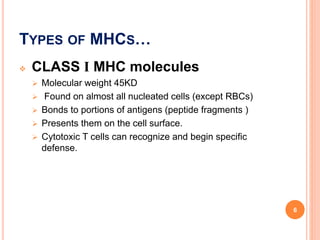
 CLASS І MHC molecules
 Molecular weight 45KD
 Found on almost all nucleated cells (except RBCs)
 Bonds to portions of antigens (peptide fragments )
 Presents them on the cell surface.
 Cytotoxic T cells can recognize and begin specific
defense.
6
CONTD…
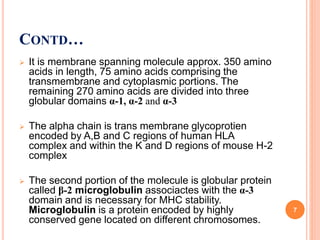
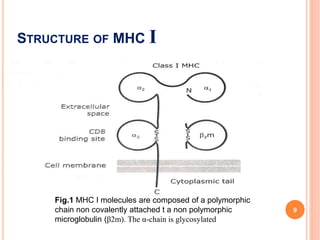
 It is membrane spanning molecule approx. 350 amino
acids in length, 75 amino acids comprising the
transmembrane and cytoplasmic portions. The
remaining 270 amino acids are divided into three
globular domains α-1, α-2 and α-3
 The alpha chain is trans membrane glycoprotien
encoded by A,B and C regions of human HLA
complex and within the K and D regions of mouse H-2
complex
 The second portion of the molecule is globular protein
called β-2 microglobulin associactes with the α-3
domain and is necessary for MHC stability.
Microglobulin is a protein encoded by highly
conserved gene located on different chromosomes.
7
CONTD…
 the β2 microglobulin is non covalently associated with the
α3 domain.
 The α1 and α2 domains interact to form 8 antiparallel β
strands spanned by 2 long α helical regions. The region is
capable of binding (via non-covalent interactions) as small
peptide of 10 amino acids. This small peptide is
“presented” to a T-cell and defines the antigen “epitope”
that the T-cell recognizes.
 The peptide-binding cleft is located on the top surface of
the MHC class І molecule and it is enough to bind a
peptide 8 to 10 amino acids. 8
STRUCTURE OF MHC І
9
Fig.1 MHC I molecules are composed of a polymorphic
chain non covalently attached t a non polymorphic
microglobulin (β2m). The α-chain is glycosylated
CONTD…
 Between the α-1 and β-2 domains lies a region very
similar to that seen in the class І molecule. This region,
bounded by a β- pleated sheet on the bottom and two
alpha- helices on the sides, is capable of binding (via
non-covalent interactions) a small peptide of about 10
amino acids, this small peptide is presented to a T-cell
and defines the antigen “epitope” that the T-cell
recognise.
10
CLASS ІІ MHC MOLECULE
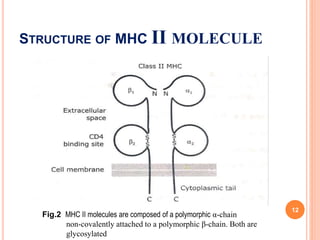
 Class ІІ molecules are composed of two polypeptide
chains.
 These polypeptides (alpha and beta) are about 230 and
240 amino acids long respectively, and are glycosylated,
giving molecular weights of about 33 kDa 28 kDa.
 The polypeptides fold into two separate domains; α1 and
α2 for the alpha polypeptide, and β-1 and β-2 for the beta
polypeptide.
11
STRUCTURE OF MHC ІІ MOLECULE
12
Fig.2 MHC II molecules are composed of a polymorphic α-chain
non-covalently attached to a polymorphic β-chain. Both are
glycosylated
13
MHC CLASS ІІІ MOLECULE
 These are heterogeneous molecules
 Include complement component C2, C4 and factor
B (components responsible for formation of C3
convertase)
 They also include heat shock proteins and tumour
necrosis factor.
14
MHC MOLECULES AND ANTIGEN
PRESENTATION
 Both type of membrane glycoproteins (class I and class II
MHC) function as highly specialised antigen-presenting
molecules.
 The class I and class II MHC molecule present antigen to T-
cells.
 Antigen recognition is mediated by αβ or γδ T-cell antigen
receptors (TCR).
 T-cell recognize only combined with MHC molecules.
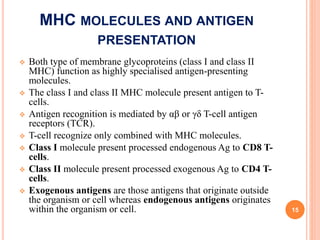
 Class I molecule present processed endogenous Ag to CD8 T-
cells.
 Class II molecule present processed exogenous Ag to CD4 T-
cells.
 Exogenous antigens are those antigens that originate outside
the organism or cell whereas endogenous antigens originates
within the organism or cell. 15
16
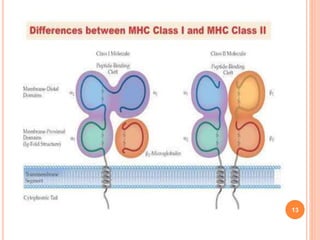
FEATURES OF CLASS І & CLASS ІІ MHC
17
PEPTIDES OF MHC I & MHC II
 Class I MHC molecule present a peptide of 8-10
amino acids and are endogenous.
 Peptide bind MHC due to presence of specific a/a
found at the ends of peptide.
e.g. Gycine @ position 2.
 Class II MHC molecules bind and present slightly
longer peptides of 13-18 amino acids, processed
through endocytic pathway.
 Non peptide antigens (such as glycolipid,
phospholipid) are presented by members of the
CD1 family related to non classical class MHC I.
18
IMPORTANT ASPECTS OF MHC
 MHC molecules (class I and class II) are membrane
bound; recognition by T- cells requires cell-cell contact.
 Because each MHC molecule can bind to many different
peptide, binding id termed degenerate.
 Although there is high degree of polymorphism for a
species, an individual has maximum 6 different class I
MHC products and only slightly more class II MHC
products (considering only the major loci).
 Each MHC molecule has only one binding site.
 The different peptides can bind to a given MHC molecule
to the same site, but only at a time.
 MHC polymorphism determined only in the germline.
There are no recombination mechanism for generating
diversity, 19
CONTD…
 Alleles for MHC genes are codominant.
 Each MHC gene product is expressed on the cell
surface of an individual nucleated cells.
 Cytokines (especially interferon-γ) increase level of
expression of MHC.
 Endogenous peptide associate with class I MHC are
recognised by TC cells.
 Exogenous peptide associate with class II MHC are
recognised by TH cells.
20

 LIFE SCIENCES
FUNDAMENTALS AND PRACTICES -1
(PATH FINDER PUBLICATION)
BY- PRANAV KUMAR
 www.slideshare.com
 www.immunologynotes.com
21
References
22

MAJOR HISTOCOMPATIBILITY COMPLEX

  • 1.
     PRESENTED BY:PRADDUM KUMAR NAMDEV BSc (Hons) ZOOLOGY 6th sem. MAJOR HISTOCOMPATIBILITY COMPLEX 1
  • 2.
    THIS PRESENTATION INCLUDES: What are MHCs?  What do MHC do  Types of MHC  MHC class І  MHC class ІІ  MHC class ІІІ  MHC molecules and antigen presentation  Features of MHC class I and II  Peptides of MHC class I and II  Important aspects of MHC 2
  • 3.
    WHAT ARE MHCS? Discovered by Peter Gorer in 1930  Major histocompatibility complex (MHC) is tightly linked cluster genes present in every vertebrate species, the product of which play in intercellular recognition and in discrimination between self and nonself.  MHC is located on chromosome 6 in humans and chromosome 17 in mice (HLA – Human leukocyte antigen) complex and H-2 (histocompatibility- 2) respectively. 3
  • 4.
    CONTD…  MHC genesare organized 3 classes A. Class І MHC genes  Glycoproteins expressed on all nucleated cells  Major function to present peptide Ags to Tc cells B. Class ІІ MHC  Glycoproteins expressed on Mф, B cells, DCs  Major function to present processed Ags peptide to TH cells C. Class ІІІ MHC  Class III molecules are not membrane proteins, are not related structurally to class I and class II molecules, and have no role in Ag presentation, although most play some role in immune response. e.g. C2, C4a, C4b, factor B21-hydroxylase enzymes, TNFα, TNFβ, heat shock proteins (HSP). 2
  • 5.
    WHAT DO MHCSDO?  MHCs bind to peptide fragments (parts of chopped up through phagocytosis by APCs) and display/present them on the surface of the cell.  The T cells monitor the MHCs for evidence of an invasion of a cell or for foreign cell.  B cells do not interact with MHCs directly but come into action after stimulation by T cells. 5
  • 6.
    TYPES OF MHCS… CLASS І MHC molecules  Molecular weight 45KD  Found on almost all nucleated cells (except RBCs)  Bonds to portions of antigens (peptide fragments )  Presents them on the cell surface.  Cytotoxic T cells can recognize and begin specific defense. 6
  • 7.
    CONTD…  It ismembrane spanning molecule approx. 350 amino acids in length, 75 amino acids comprising the transmembrane and cytoplasmic portions. The remaining 270 amino acids are divided into three globular domains α-1, α-2 and α-3  The alpha chain is trans membrane glycoprotien encoded by A,B and C regions of human HLA complex and within the K and D regions of mouse H-2 complex  The second portion of the molecule is globular protein called β-2 microglobulin associactes with the α-3 domain and is necessary for MHC stability. Microglobulin is a protein encoded by highly conserved gene located on different chromosomes. 7
  • 8.
    CONTD…  the β2microglobulin is non covalently associated with the α3 domain.  The α1 and α2 domains interact to form 8 antiparallel β strands spanned by 2 long α helical regions. The region is capable of binding (via non-covalent interactions) as small peptide of 10 amino acids. This small peptide is “presented” to a T-cell and defines the antigen “epitope” that the T-cell recognizes.  The peptide-binding cleft is located on the top surface of the MHC class І molecule and it is enough to bind a peptide 8 to 10 amino acids. 8
  • 9.
    STRUCTURE OF MHCІ 9 Fig.1 MHC I molecules are composed of a polymorphic chain non covalently attached t a non polymorphic microglobulin (β2m). The α-chain is glycosylated
  • 10.
    CONTD…  Between theα-1 and β-2 domains lies a region very similar to that seen in the class І molecule. This region, bounded by a β- pleated sheet on the bottom and two alpha- helices on the sides, is capable of binding (via non-covalent interactions) a small peptide of about 10 amino acids, this small peptide is presented to a T-cell and defines the antigen “epitope” that the T-cell recognise. 10
  • 11.
    CLASS ІІ MHCMOLECULE  Class ІІ molecules are composed of two polypeptide chains.  These polypeptides (alpha and beta) are about 230 and 240 amino acids long respectively, and are glycosylated, giving molecular weights of about 33 kDa 28 kDa.  The polypeptides fold into two separate domains; α1 and α2 for the alpha polypeptide, and β-1 and β-2 for the beta polypeptide. 11
  • 12.
    STRUCTURE OF MHCІІ MOLECULE 12 Fig.2 MHC II molecules are composed of a polymorphic α-chain non-covalently attached to a polymorphic β-chain. Both are glycosylated
  • 13.
  • 14.
    MHC CLASS ІІІMOLECULE  These are heterogeneous molecules  Include complement component C2, C4 and factor B (components responsible for formation of C3 convertase)  They also include heat shock proteins and tumour necrosis factor. 14
  • 15.
    MHC MOLECULES ANDANTIGEN PRESENTATION  Both type of membrane glycoproteins (class I and class II MHC) function as highly specialised antigen-presenting molecules.  The class I and class II MHC molecule present antigen to T- cells.  Antigen recognition is mediated by αβ or γδ T-cell antigen receptors (TCR).  T-cell recognize only combined with MHC molecules.  Class I molecule present processed endogenous Ag to CD8 T- cells.  Class II molecule present processed exogenous Ag to CD4 T- cells.  Exogenous antigens are those antigens that originate outside the organism or cell whereas endogenous antigens originates within the organism or cell. 15
  • 16.
  • 17.
    FEATURES OF CLASSІ & CLASS ІІ MHC 17
  • 18.
    PEPTIDES OF MHCI & MHC II  Class I MHC molecule present a peptide of 8-10 amino acids and are endogenous.  Peptide bind MHC due to presence of specific a/a found at the ends of peptide. e.g. Gycine @ position 2.  Class II MHC molecules bind and present slightly longer peptides of 13-18 amino acids, processed through endocytic pathway.  Non peptide antigens (such as glycolipid, phospholipid) are presented by members of the CD1 family related to non classical class MHC I. 18
  • 19.
    IMPORTANT ASPECTS OFMHC  MHC molecules (class I and class II) are membrane bound; recognition by T- cells requires cell-cell contact.  Because each MHC molecule can bind to many different peptide, binding id termed degenerate.  Although there is high degree of polymorphism for a species, an individual has maximum 6 different class I MHC products and only slightly more class II MHC products (considering only the major loci).  Each MHC molecule has only one binding site.  The different peptides can bind to a given MHC molecule to the same site, but only at a time.  MHC polymorphism determined only in the germline. There are no recombination mechanism for generating diversity, 19
  • 20.
    CONTD…  Alleles forMHC genes are codominant.  Each MHC gene product is expressed on the cell surface of an individual nucleated cells.  Cytokines (especially interferon-γ) increase level of expression of MHC.  Endogenous peptide associate with class I MHC are recognised by TC cells.  Exogenous peptide associate with class II MHC are recognised by TH cells. 20
  • 21.
      LIFE SCIENCES FUNDAMENTALSAND PRACTICES -1 (PATH FINDER PUBLICATION) BY- PRANAV KUMAR  www.slideshare.com  www.immunologynotes.com 21 References
  • 22.