PUNEET- 17/664
ZAKIR HUUSSAIN DELHI COLLEGE
Bsc .Hons.Zoology
Semester 5th
Antibody structure and classification
MUBEEN -17/613
WHAT IS ANTIBODY ?
Antibodies can be defined as a multifunctional
Protein or glcoprotein
Produced indirect response against antigens by vertebrates
• multifunction how ?
Antibody
2 parts
Binding to antigen bindiing to receptor of phagocytes
activation of complement pathway
avtivate nk cells
ANTIBODIES
STRUCTURE
M. HEIDELBERGER ESTABLISHED THAT PROTEINS ARE
PROTEINS , BECAUSE HE NITROGEN INEVERY ANTIBODY-
ANTIGEN PRECIPITATE , EVEN HE USE CARBOHYDRATE AS
ANTIGEN
BY 1930S , WE KNOW THAT ANTIBODIES ARE GLOBULIN PROTEINS
2.1940S
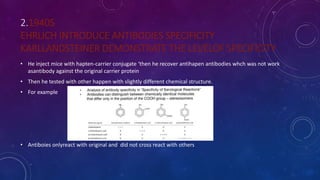
EHRLICH INTRODUCE ANTIBODIES SPECIFICITY
KARLLANDSTEINER DEMONSTRATE THE LEVELOF SPECIFICITY
• He inject mice with hapten-carrier conjugate ‘then he recover antihapen antibodies whch was not work
asantibody against the original carrier protein
• Then he tested with other happen with slightly different chemical structure.
• For example
• Antiboies onlyreact with original and did not cross react with others
SOME BASIC KNOWLEDGE
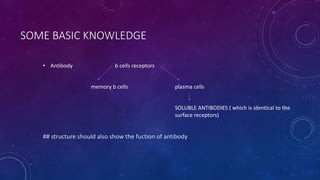
• Antibody b cells receptors
memory b cells plasma cells
SOLUBLE ANTIBODIES ( which is identical to the
surface receptors)
## structure should also show the fuction of antibody
NOW WHAT IS SERUM?
• Blood after centrifugation divide in 2 fraction (cellular and fluid components )
1.Cellular : RBC, LEUKOCYTES, PLATELETS
2. FLUID /PLASMA : soluble small molecules , macromolecules of blood ,including fibrins and other clottiing
protein , varoius kind of other proteins
AFTER CLOTTING THE REMIANING FLUID CALLED SERUM
plasma – clotting factors = serum
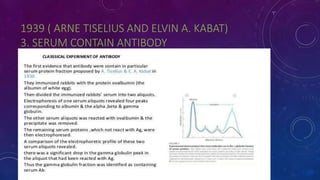
1939 ( ARNE TISELIUS AND ELVIN A. KABAT)
3. SERUM CONTAIN ANTIBODY
They immunised rabbit with protein ovaalbumin,prepared serum and then divide the serim into two
aliquotes.
electrophoretic separation of one serum aliquotes revealed that it has four type of protein
1. Albumin
2. Alpha globulin
3. Beta globulin
4. Gamma globulin
•Shape of antibody
molecule.......
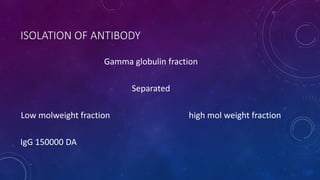
ISOLATION OF ANTIBODY
Gamma globulin fraction
Separated
Low molweight fraction high mol weight fraction
IgG 150000 DA
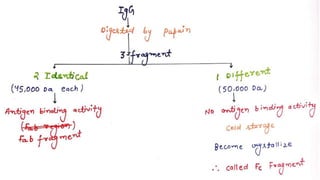
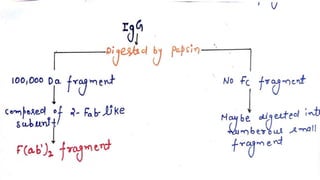
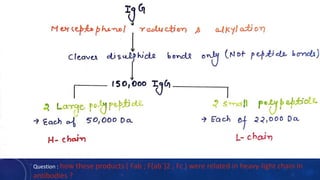
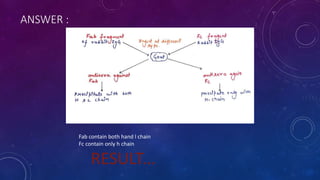
Question : how these products ( Fab ; F(ab`)2 ; Fc ) were related in heavy-light chain in
antibodies ?
ANSWER :
Fab contain both hand l chain
Fc contain only h chain
RESULT...
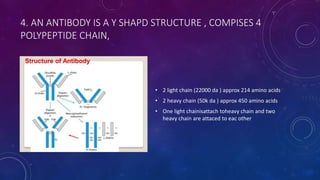
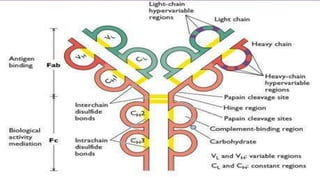
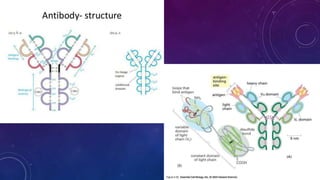
4. AN ANTIBODY IS A Y SHAPD STRUCTURE , COMPISES 4
POLYPEPTIDE CHAIN,
• 2 light chain (22000 da ) approx 214 amino acids
• 2 heavy chain (50k da ) approx 450 amino acids
• One light chainisattach toheavy chain and two
heavy chain are attaced to eac other
NEXT TARGET IS TO DETERMINE THE AMINO ACIDS
SEQUENCES OF CHAINS ?
• Amino acid sequence require pure sample of
immunoglobulin ?
• Multiple myeloma patient (cancer of plasma
cells) – patient produce large nuber of ig
molecules of particular cell type
Multiple myeloma is a spontaneously in human and
oter mammals eg mice , but chance chances canbe
increase by inducing mineral oil in peritoneal cavity
• George kohler and ceaser
milsteiin develop
monoclonal antibody
technique
5. VARIABLE AND CONSTANT REGION IN L-CHAIN
SEQUENCING OF BENCE JONESPROTEIN FROM DIFF ORGANISM
REVEAL
1st half of l chain
• 100-110 amino cidssequence is highy variablein
different class of antibodies and indifferent
organism
• Therefore called Vl region
2nd half of l chain
• Rest of the sequence not show much variation
• Its whole composed of repeatationof only 2/3
amino acids
• Therefore callled Cl region
The first 110 or so amino acids of amino terminal of light or heavy chains have a variable sequence
1. These segments of the highn variable sequence are called variable (V) region of light (V) or heavy (V) chain.
2. The regins boyond the variable region (from 110-214 amino acids in L ot 110-450 amino acids in H chain have the
same composition and a relatively constant sequence in different abodies .This seg ment is referred to as constant (C)
region of light (C) or heavy (C) chain.
3. A typical antbody molecule has two intra chain disulphide bonds in the light chain-one in the variable region and one
in the constant region There are on an average four covalent disulplhide bonds linking the heavy chains
4. Both the light and heavy chains have several repcating homologous units, each of about 110 amino acid residues in
length, which form an independent common immunoglobulin domain.
5. Within each domain, there is an intra-chain disulphide linkage which forms a loop of about 60 aminoacids.lightchain
has one variabledomainandone constant domian ie.two disulphide bond or loop in l chain.
• For simplification:sequencing of heavy chain reveals there are 5 types of heavy chain (based
onthedifference in constant region )
IgD/IgD/IgA -330 AMINO ACIDS ( H CAIN ) ; 4 DOMAIN
IgM/IgE – 440 AMINO acid long ; 5 doain
6. Heavy chain has one loop/disulphide linkage in variable region ; and 3/4 disulphide linkage /loop in
constant region
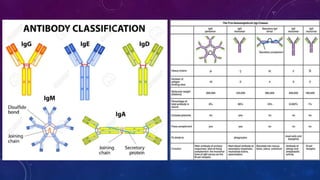
IMMUNOGLOBULIN A (SECOND MOST
ABUNDANT)
THE CHIEF CHARACTERISTICS OF IMMUNOGLOBULIN A ARE AS UNDER.
1. MONOMERIC (160,000 DA) AND SOMETIMES DIMERIC, TRIMERIC OR TETRAMERIC.
2. SEDIMENTATION COEFFICIENT-9 S (MONOMERIC).
3. HEAVY CHAIN-A TYPE.
4. TWO HUMAN IGA SUBCLASSES KNOWN-IGA1 AND IGA2.
5. IGA2 CONSTITUTES ABOUT 20 PER CENT OF IGA IN SERUM.
6. 10-15 PER CENT OF THE TOTAL IMMUNOGLOBULIN.
7. FUNCTIONS-THE PREDOMINANT IMMUNO- GLOBULIN IN EXTERNAL SECRETIONS SUCH AS;
SALIVA, TEARS, MUCOUS, BREAST MILK, SECRETIONS OF THE BRONCHIAL, GENITOURINARY AND DIGESTIVE
TRACTS,
WHERE IT DEFENDS THE EXPOSED EXTERNAL SURFACE OF THE BODY AGAINST PATHOGENIC ORGANISMS.
IMMUNOGLOBULIN M (OR B )
1. Molecular weight-900,000 Da.
2. Sedimentation coefficient-19 S
3. The five monomer subunits are arranged with their Fe region in the centre of the pentamer and ten antigen-binding
sites on the periphery of the molecule. Each pentamer contains additional F-linked polypeptide called the J chain, which is
di- sulphide linked to two of the ten μ chain.
4. Heavy chain μ type
5. No human IgM subclasses known
6. Valency for antigen binding is 10. However, because of steric hindrance only five or fewer molecules of large antigens can
be bound
7. 5-10 per cent of the total immunoglobulin.
8. Functions-the first immunoglobulin class that is produced in a primary immune response and also the first immunoglobulin
to be synthesized by a neewborn; very eective aglutinin; and effective first line of defence against bacterial or viral imvasic
More efficient in activating complement than IgG believed that IgM is the first to appear in ontogeny and is phylogenetically
the oldest antibody .
IMMUNOGLOBULIN G ( OR C)
MOST ABUNDANT IN BODY
• Molecular weight-150,000 Da.
• Sedimentation coefficient-7 S.
• Heavy chain-y type.
• Four human IgG subclasses are identified: IgG1, IgG2, IgG3 and IgG4. The subclasses are chains and numbered
according to their decreasing average serum concentration; that is IgG1 has the highest serum concentration
and IgG4 the lowest.
• 80 per cent of the total serum immunoglobulin.
• Functions-most abundant immunoglobulin of internal body fiuids where it combats microorganisms and their
toxins. IgG1, IgG3, IgG4 can cross the placenta and impart neonatal immunity.
• The complex of IgG and bacteria activates the complement path way. IgG3 is the most potent in activating
complement, followed by IgG1. IgG enhand phagocytosis by opsonization.
IMUNOGLOBULIN D
1. Molecular weight-180,000 Da.
2. Sedimentation coefficient-7 S.
3. No human IgD subclasses known
4. Valency for antigen binding-2.
5. Approximately 0.2 per cent of total immunoglobulin.
• Functions-function not established; a major inmunoglobulin expressed on mature B cells, apart from
IgM: probably involved in lymphocyte activation and suppression;
• IgD antibodies cannot activate complement,
• cross placenta or cause mast cell degranulation.
IMMUNOGLOBULIN E
1. Molecular weight-190,000 Da
2. Sedimentation coefficient-9 S.
3. Heavy chain is ε type .
4. Valency for antigen binding-2
5. Represents 0.002 per cent of total immunoglobulins
6. Functions-protection of the external mucosal surface,
a major immunoglobulin that is involved in type I hypersensitivity reaction ;
IgE binds to Fc receptors present on the surface of mast cells and basophils. The aggregation of Fc
receptor when IgE binds the provoking antigen, results in degranulation of mast cells.
Antibody structure , functions and classification

Antibody structure , functions and classification

  • 1.
    PUNEET- 17/664 ZAKIR HUUSSAINDELHI COLLEGE Bsc .Hons.Zoology Semester 5th Antibody structure and classification MUBEEN -17/613
  • 2.
    WHAT IS ANTIBODY? Antibodies can be defined as a multifunctional Protein or glcoprotein Produced indirect response against antigens by vertebrates • multifunction how ? Antibody 2 parts Binding to antigen bindiing to receptor of phagocytes activation of complement pathway avtivate nk cells
  • 3.
  • 4.
    M. HEIDELBERGER ESTABLISHEDTHAT PROTEINS ARE PROTEINS , BECAUSE HE NITROGEN INEVERY ANTIBODY- ANTIGEN PRECIPITATE , EVEN HE USE CARBOHYDRATE AS ANTIGEN BY 1930S , WE KNOW THAT ANTIBODIES ARE GLOBULIN PROTEINS
  • 5.
    2.1940S EHRLICH INTRODUCE ANTIBODIESSPECIFICITY KARLLANDSTEINER DEMONSTRATE THE LEVELOF SPECIFICITY • He inject mice with hapten-carrier conjugate ‘then he recover antihapen antibodies whch was not work asantibody against the original carrier protein • Then he tested with other happen with slightly different chemical structure. • For example • Antiboies onlyreact with original and did not cross react with others
  • 6.
    SOME BASIC KNOWLEDGE •Antibody b cells receptors memory b cells plasma cells SOLUBLE ANTIBODIES ( which is identical to the surface receptors) ## structure should also show the fuction of antibody
  • 7.
    NOW WHAT ISSERUM? • Blood after centrifugation divide in 2 fraction (cellular and fluid components ) 1.Cellular : RBC, LEUKOCYTES, PLATELETS 2. FLUID /PLASMA : soluble small molecules , macromolecules of blood ,including fibrins and other clottiing protein , varoius kind of other proteins AFTER CLOTTING THE REMIANING FLUID CALLED SERUM plasma – clotting factors = serum
  • 8.
    1939 ( ARNETISELIUS AND ELVIN A. KABAT) 3. SERUM CONTAIN ANTIBODY They immunised rabbit with protein ovaalbumin,prepared serum and then divide the serim into two aliquotes. electrophoretic separation of one serum aliquotes revealed that it has four type of protein 1. Albumin 2. Alpha globulin 3. Beta globulin 4. Gamma globulin
  • 9.
  • 10.
    ISOLATION OF ANTIBODY Gammaglobulin fraction Separated Low molweight fraction high mol weight fraction IgG 150000 DA
  • 13.
    Question : howthese products ( Fab ; F(ab`)2 ; Fc ) were related in heavy-light chain in antibodies ?
  • 14.
    ANSWER : Fab containboth hand l chain Fc contain only h chain RESULT...
  • 15.
    4. AN ANTIBODYIS A Y SHAPD STRUCTURE , COMPISES 4 POLYPEPTIDE CHAIN, • 2 light chain (22000 da ) approx 214 amino acids • 2 heavy chain (50k da ) approx 450 amino acids • One light chainisattach toheavy chain and two heavy chain are attaced to eac other
  • 16.
    NEXT TARGET ISTO DETERMINE THE AMINO ACIDS SEQUENCES OF CHAINS ? • Amino acid sequence require pure sample of immunoglobulin ? • Multiple myeloma patient (cancer of plasma cells) – patient produce large nuber of ig molecules of particular cell type Multiple myeloma is a spontaneously in human and oter mammals eg mice , but chance chances canbe increase by inducing mineral oil in peritoneal cavity • George kohler and ceaser milsteiin develop monoclonal antibody technique
  • 17.
    5. VARIABLE ANDCONSTANT REGION IN L-CHAIN SEQUENCING OF BENCE JONESPROTEIN FROM DIFF ORGANISM REVEAL 1st half of l chain • 100-110 amino cidssequence is highy variablein different class of antibodies and indifferent organism • Therefore called Vl region 2nd half of l chain • Rest of the sequence not show much variation • Its whole composed of repeatationof only 2/3 amino acids • Therefore callled Cl region
  • 19.
    The first 110or so amino acids of amino terminal of light or heavy chains have a variable sequence 1. These segments of the highn variable sequence are called variable (V) region of light (V) or heavy (V) chain. 2. The regins boyond the variable region (from 110-214 amino acids in L ot 110-450 amino acids in H chain have the same composition and a relatively constant sequence in different abodies .This seg ment is referred to as constant (C) region of light (C) or heavy (C) chain. 3. A typical antbody molecule has two intra chain disulphide bonds in the light chain-one in the variable region and one in the constant region There are on an average four covalent disulplhide bonds linking the heavy chains 4. Both the light and heavy chains have several repcating homologous units, each of about 110 amino acid residues in length, which form an independent common immunoglobulin domain. 5. Within each domain, there is an intra-chain disulphide linkage which forms a loop of about 60 aminoacids.lightchain has one variabledomainandone constant domian ie.two disulphide bond or loop in l chain.
  • 20.
    • For simplification:sequencingof heavy chain reveals there are 5 types of heavy chain (based onthedifference in constant region ) IgD/IgD/IgA -330 AMINO ACIDS ( H CAIN ) ; 4 DOMAIN IgM/IgE – 440 AMINO acid long ; 5 doain 6. Heavy chain has one loop/disulphide linkage in variable region ; and 3/4 disulphide linkage /loop in constant region
  • 22.
    IMMUNOGLOBULIN A (SECONDMOST ABUNDANT) THE CHIEF CHARACTERISTICS OF IMMUNOGLOBULIN A ARE AS UNDER. 1. MONOMERIC (160,000 DA) AND SOMETIMES DIMERIC, TRIMERIC OR TETRAMERIC. 2. SEDIMENTATION COEFFICIENT-9 S (MONOMERIC). 3. HEAVY CHAIN-A TYPE. 4. TWO HUMAN IGA SUBCLASSES KNOWN-IGA1 AND IGA2. 5. IGA2 CONSTITUTES ABOUT 20 PER CENT OF IGA IN SERUM. 6. 10-15 PER CENT OF THE TOTAL IMMUNOGLOBULIN. 7. FUNCTIONS-THE PREDOMINANT IMMUNO- GLOBULIN IN EXTERNAL SECRETIONS SUCH AS; SALIVA, TEARS, MUCOUS, BREAST MILK, SECRETIONS OF THE BRONCHIAL, GENITOURINARY AND DIGESTIVE TRACTS, WHERE IT DEFENDS THE EXPOSED EXTERNAL SURFACE OF THE BODY AGAINST PATHOGENIC ORGANISMS.
  • 23.
    IMMUNOGLOBULIN M (ORB ) 1. Molecular weight-900,000 Da. 2. Sedimentation coefficient-19 S 3. The five monomer subunits are arranged with their Fe region in the centre of the pentamer and ten antigen-binding sites on the periphery of the molecule. Each pentamer contains additional F-linked polypeptide called the J chain, which is di- sulphide linked to two of the ten μ chain. 4. Heavy chain μ type 5. No human IgM subclasses known 6. Valency for antigen binding is 10. However, because of steric hindrance only five or fewer molecules of large antigens can be bound 7. 5-10 per cent of the total immunoglobulin. 8. Functions-the first immunoglobulin class that is produced in a primary immune response and also the first immunoglobulin to be synthesized by a neewborn; very eective aglutinin; and effective first line of defence against bacterial or viral imvasic More efficient in activating complement than IgG believed that IgM is the first to appear in ontogeny and is phylogenetically the oldest antibody .
  • 24.
    IMMUNOGLOBULIN G (OR C) MOST ABUNDANT IN BODY • Molecular weight-150,000 Da. • Sedimentation coefficient-7 S. • Heavy chain-y type. • Four human IgG subclasses are identified: IgG1, IgG2, IgG3 and IgG4. The subclasses are chains and numbered according to their decreasing average serum concentration; that is IgG1 has the highest serum concentration and IgG4 the lowest. • 80 per cent of the total serum immunoglobulin. • Functions-most abundant immunoglobulin of internal body fiuids where it combats microorganisms and their toxins. IgG1, IgG3, IgG4 can cross the placenta and impart neonatal immunity. • The complex of IgG and bacteria activates the complement path way. IgG3 is the most potent in activating complement, followed by IgG1. IgG enhand phagocytosis by opsonization.
  • 25.
    IMUNOGLOBULIN D 1. Molecularweight-180,000 Da. 2. Sedimentation coefficient-7 S. 3. No human IgD subclasses known 4. Valency for antigen binding-2. 5. Approximately 0.2 per cent of total immunoglobulin. • Functions-function not established; a major inmunoglobulin expressed on mature B cells, apart from IgM: probably involved in lymphocyte activation and suppression; • IgD antibodies cannot activate complement, • cross placenta or cause mast cell degranulation.
  • 26.
    IMMUNOGLOBULIN E 1. Molecularweight-190,000 Da 2. Sedimentation coefficient-9 S. 3. Heavy chain is ε type . 4. Valency for antigen binding-2 5. Represents 0.002 per cent of total immunoglobulins 6. Functions-protection of the external mucosal surface, a major immunoglobulin that is involved in type I hypersensitivity reaction ; IgE binds to Fc receptors present on the surface of mast cells and basophils. The aggregation of Fc receptor when IgE binds the provoking antigen, results in degranulation of mast cells.