BLOOD GROUPING,
TYPES AND ABO
HISTOCOMPATIBILITY
Dr. AKSHAYA J
1st Year Post Graduate
Department of Periodontology
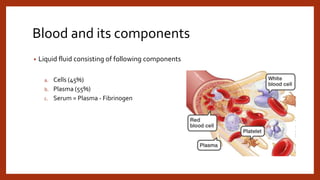
Blood and its components
• Liquid fluid consisting of following components
a. Cells (45%)
b. Plasma (55%)
c. Serum = Plasma - Fibrinogen
Antigen - Antibody
• Antigen:
The foreign substance that triggers the production of antibodies.
• Antibodies:
The substance produced in response to antigens.
Agglutination
• The reaction between the antigen and antibody.
• Clumping of red blood cells occur in some cases and in some cases do not.
Introduction to blood group system
• 35 blood group system are recognized.
• Most important ABO blood group system and Rh system.
• M-N system also has little importance.
• Classification is based on inherited antigenic substances.
M-n blood group system
• This system was discovered by Land Steiner and Levine (1927)
• Antigens M and N are encoded by polymorphic genes GYPA and GYPB
MN blood group system types
• The system has three blood types:
• MM blood group
• NN blood group
• MN blood group
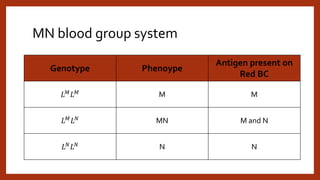
MN blood group system
Genotype Phenoype
Antigen present on
Red BC
𝐿𝑀𝐿𝑀 M M
𝐿𝑀𝐿𝑁 MN M and N
𝐿𝑁𝐿𝑁 N N
MN AntigensVs ANTIBODIES
• M and N antigens are weakly immunogenic for humans.
• Antibodies against M and N antigens are rare.
• Little clinical significance in blood transfusion.
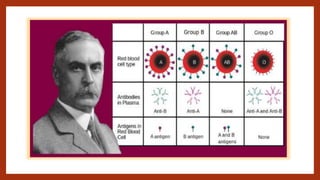
ABO Blood Group system
• The most impotent and well studied blood group system.
• Discovered by KARL LANDSTEINER.
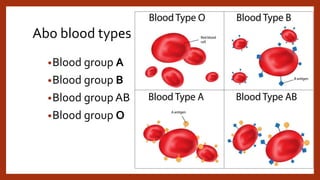
Abo blood types
•Blood group A
•Blood group B
•Blood group AB
•Blood group O
ABO blood type
• Determined by the ABO gene, located on chromosome no.9.
• The gene has three allelic forms 𝑰𝑨
𝑰𝑩
and I.
• These determine four types of blood groups.
Abo blood group types
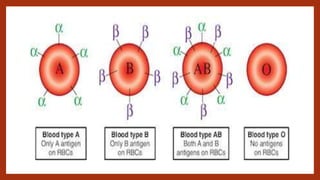
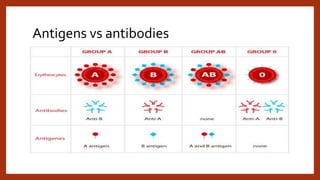
• If A antigen is present, blood group will be A
• If B antigen is present, blood group will be B
• If both A and B antigens are present, blood group will be AB
• If neither A nor B antigen is present, blood group will be O
Antibodies againstABO antigens
• The immune system form antibodies against whichever ABO blood group
antigens are present.
• For example a person with blood group A will have B antibodies and so as other.
Antigens vs antibodies
Biochemical basis of abo blood group
system
• A and B are carbohydrate group bound to lipid.
• The specificity of antigen based on terminal sugar of carbohydrate.
• The one or two terminal sugar added to H substance blood group.
Biochemical basis of ABO blood group
system
• 𝐼𝐴
allele and N-acetyl galactosamine.
• 𝐼𝐵
allele add terminal glactose.
• Heterozygote 𝐼𝐴
𝐼𝐵
add both sugar at various sites on RBC’s surface.
• The recessive allele I does not add either sugar.
Importance of ABO blood group system
Most important test because:
• Antibodies of ABO system present in every person.
• Incompatible blood transfer causes the intravascular hemolysis of RBC’s leading to
death.
Change in phenotypic expression of ABO
gene
BOMBAY PHENOYPE:
• The Hh blood group contains one antigen, the H antigen, which is found on virtually all
RBCs and is the building block for the production of the antigens within the ABO blood
group.
• H antigen deficiency is known as the "Bombay phenotype" (h/h, also known as Oh) and is
found in 1 of 10,000 individuals in India and 1 in a million people in Europe.There is no ill
effect with being H deficient, but if a blood transfusion is ever needed, people with this
blood type can receive blood only from other donors who are also H deficient.
• The individuals possess neither A nor B antigens on their surface.
• Phenotypic expression is like O blood group type.
Biochemical basis of Bombay phenotype
• Normal person have H antigen on surface of RCB’s acting as precursor.
• Affected individuals do not encode H antigen.
• Can receive blood only from H antigen deficient donors.
Universal donor vs Universal Acceptors
UNIVERSAL DONOR
• Can donate their blood to anyone
• Have O negative blood group
UNIVERSAL ACCEPTORS
• Can accept blood from anyone
• Have AB positive blood group
Rh typing
• HISTORY
• 1939 - Levine and Stetson defined D antigen
(Rh factor)
• 1949 - Landsteiner andWeiner discovered anti Rh
(named after Rhesus money)
Rh typing
• Rh blood group system is second in significance after ABO system.
• Genes that control the system are present on chromosome 1.
• Consist of over 50 related Ags.
• Important genes are D, C, E, c, e.
All Rh antigen are controlled by two genes
• RHD gene - determine expression of D.
• RHCE - encodes for C, c and E, e.
• Rhd is strong antigen (immunogenic) and other antigen are less antigenic than D and
are of less clinical significance.
• Therefore, in practice Rh negative and Rh positive depends on presence of D antigen
on the surface of red cells which is detected by strong anti-D serum.
• Occasionally, Anti – D, C, E, c, e may develop in case of pregnancy of transfusion.
Rh positive
• There is presence of D antigen.
• The individuals contribute 80% of population.
Rh Negative
• There is absence of D antigen.These individuals constitute 17% of population.
Cc and Ee antigen
• There are weak antigen and therefore risk of sensation is less than that of D antigen.
Rh antibody
• Unlike ABO system there is no naturally occurring antibodies against Rh antigens in Rh
negative individuals.
Immune Abs
• Rh Abs develop against Rh Ag after exposure to Rh Ags following transfusion or
pregnancy.
• But can be detected by enzyme treatment or coomb test (antiglobulin test).
Significance
• Rh incompatibility results in haemolytic transfusion reaction.
• Haemolytic disease of newborn.
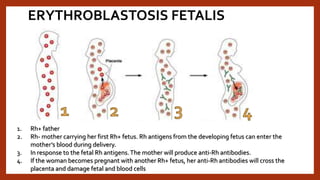
ERYTHROBLASTOSIS FETALIS
1. Rh+ father
2. Rh- mother carrying her first Rh+ fetus. Rh antigens from the developing fetus can enter the
mother’s blood during delivery.
3. In response to the fetal Rh antigens.The mother will produce anti-Rh antibodies.
4. If the woman becomes pregnant with another Rh+ fetus, her anti-Rh antibodies will cross the
placenta and damage fetal and blood cells
Anti –D
Anti-D (rh) immunoglobulin is a prescription medication used to prevent Rh
immunization, also known as Rh incompatibility. This occurs when a person
who has an Rh-negative blood type receives blood or blood products that are
Rh-positive or when a mother who is Rh-negative is pregnant with a fetus
who is Rh-positive.
Importance of blood grouping and Rh
typing
• In blood transfusion
• Haemolytic disease of newborn
• Paternity dispute
• Medicolegal issues
• Immunology, genetics, anthropology
• Susceptibility to various disease
(blood group O- peptic ulcer )
(blood group A - gastric ulcer )
Cross matching
• Also known as compatibility testing.
• It is the most important test before a blood transfusion is given.
• The primary purpose of cross matching is to detect ABO incompatibilities between
donor and recipient.
• This is carried out to prevent transfusion reactions by detecting Abs in recipient’s
serum.
Two main functions of cross matching
1. It is a confirm ABO compatibility between donor and recipient.
2. It may detect presence of irregular Ab in patient’s serum that will react with
donor RBCs.
Cross matching test can be
1. Major
2. Minor
Major cross match test
Mixing the patient’s plasma with donor RBCs.
Minor cross matching test
• Mixing the donor’s plasma with patient’s RBCs.
• It is completely eliminated in most blood banks recipient cells are combined with
donor plasma.
3 stages of compatibility test
Compatibility at RoomTemperature
Procedure
i. Take 1 drop of recipient's serum/plasma in a small test tube.
ii. Add 5% saline suspension of donor’s RBC.
iii. Mix the two.
iv. Incubate at room temperature.
v. Centrifuge.
vi. Check for agglutination or haemolysis.
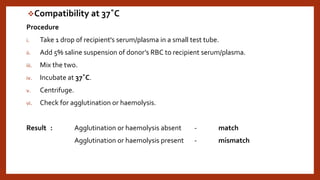
Compatibility at 37˚C
Procedure
i. Take 1 drop of recipient's serum/plasma in a small test tube.
ii. Add 5% saline suspension of donor’s RBC to recipient serum/plasma.
iii. Mix the two.
iv. Incubate at 37˚C.
v. Centrifuge.
vi. Check for agglutination or haemolysis.
Result : Agglutination or haemolysis absent - match
Agglutination or haemolysis present - mismatch
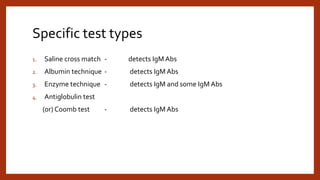
Specific test types
1. Saline cross match - detects IgM Abs
2. Albumin technique - detects IgM Abs
3. Enzyme technique - detects IgM and some IgM Abs
4. Antiglobulin test
(or) Coomb test - detects IgM Abs
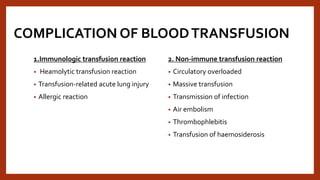
COMPLICATION OF BLOODTRANSFUSION
1.Immunologic transfusion reaction
• Heamolytic transfusion reaction
• Transfusion-related acute lung injury
• Allergic reaction
2. Non-immune transfusion reaction
• Circulatory overloaded
• Massive transfusion
• Transmission of infection
• Air embolism
• Thrombophlebitis
• Transfusion of haemosiderosis
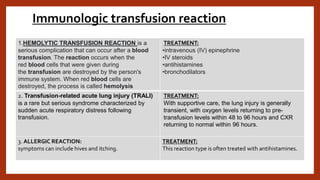
Immunologic transfusion reaction
1.HEMOLYTIC TRANSFUSION REACTION is a
serious complication that can occur after a blood
transfusion. The reaction occurs when the
red blood cells that were given during
the transfusion are destroyed by the person's
immune system. When red blood cells are
destroyed, the process is called hemolysis
TREATMENT:
•intravenous (IV) epinephrine
•IV steroids
•antihistamines
•bronchodilators
2. Transfusion-related acute lung injury (TRALI)
is a rare but serious syndrome characterized by
sudden acute respiratory distress following
transfusion.
TREATMENT:
With supportive care, the lung injury is generally
transient, with oxygen levels returning to pre-
transfusion levels within 48 to 96 hours and CXR
returning to normal within 96 hours.
3. ALLERGIC REACTION:
symptoms can include hives and itching.
TREATMENT:
This reaction type is often treated with antihistamines.
Non-immune transfusion reaction
TRANSFUSION ASSOCIATED CIRCULATORY
OVERLOAD : includes any four of the following
occurring within 6 h of a BT[3] - acute respiratory
distress, tachycardia, increased blood pressure (BP),
acute or worsening pulmonary edema and evidence of
a positive fluid balance.
TREATMENT:
Move the patient into a sitting position and
administer oxygen to facilitate breathing.The most
specific treatment is discontinuing the transfusion and
removing the excessive fluid.
MASSIVETRANSFUSION is traditionally defined as
transfusion of 10 units of packed red blood cells
(PRBCs) within a 24 hour period.
TREATMENT:
MassiveTransfusion Protocol” (MTP) refers to rapid
administration of large amounts of blood products (at
least 6 units of PRBC) in fixed ratios (usually 1:1:1) for
the management of hemorrhagic shock. Only a subset
of patients with “massive transfusion” will receive
a massive transfusion protocol.
TRANSFUSION-TRANSMITTED INFECTIONS (TTIS)
are infections resulting from the introduction of a
pathogen into a person through blood transfusion. A
wide variety of organisms, including bacteria, viruses,
prions, and parasites can be transmitted through
blood transfusions.
TREATMENT:
• donor selection
• the screening of donations
• specific processing
• quarantine of plasma
• bacterial culturing
• post-donation and post-transfusion notification
Non-immune transfusion reaction
AIR EMBOLISM: is a blood vessel blockage
caused by one or more bubbles of air or other gas
in the circulatory system. Air embolisms may also
occur in the xylem of vascular plants, especially
when suffering from water stress
TREATMENT:
• hospital care,
• oxygen,
• removing air from the heart and a high-
pressure chamber.
THROMBOPHLEBITIS is an inflammatory process
that causes a blood clot to form and block one or
more veins, usually in your legs.
TREATMENT:
• Blood-thinning medications.
• Clot-dissolving medications
• Compression stockings.
• Vena cava filter
• Varicose vein stripping
TRANSFUSION OF HEMOSIDEROSIS:
Transfusional hemosiderosis is the accumulation
of iron in the liver and heart but also endocrine
organs, in patients who receive or did receive
frequent blood transfusions
TREATMENT:
• Corticosteroids
• Immunosuppresants
Blood Grouping.pptx

Blood Grouping.pptx

  • 1.
    BLOOD GROUPING, TYPES ANDABO HISTOCOMPATIBILITY Dr. AKSHAYA J 1st Year Post Graduate Department of Periodontology
  • 2.
    Blood and itscomponents • Liquid fluid consisting of following components a. Cells (45%) b. Plasma (55%) c. Serum = Plasma - Fibrinogen
  • 3.
    Antigen - Antibody •Antigen: The foreign substance that triggers the production of antibodies. • Antibodies: The substance produced in response to antigens.
  • 4.
    Agglutination • The reactionbetween the antigen and antibody. • Clumping of red blood cells occur in some cases and in some cases do not.
  • 5.
    Introduction to bloodgroup system • 35 blood group system are recognized. • Most important ABO blood group system and Rh system. • M-N system also has little importance. • Classification is based on inherited antigenic substances.
  • 6.
    M-n blood groupsystem • This system was discovered by Land Steiner and Levine (1927) • Antigens M and N are encoded by polymorphic genes GYPA and GYPB
  • 7.
    MN blood groupsystem types • The system has three blood types: • MM blood group • NN blood group • MN blood group
  • 8.
    MN blood groupsystem Genotype Phenoype Antigen present on Red BC 𝐿𝑀𝐿𝑀 M M 𝐿𝑀𝐿𝑁 MN M and N 𝐿𝑁𝐿𝑁 N N
  • 9.
    MN AntigensVs ANTIBODIES •M and N antigens are weakly immunogenic for humans. • Antibodies against M and N antigens are rare. • Little clinical significance in blood transfusion.
  • 10.
    ABO Blood Groupsystem • The most impotent and well studied blood group system. • Discovered by KARL LANDSTEINER.
  • 12.
    Abo blood types •Bloodgroup A •Blood group B •Blood group AB •Blood group O
  • 13.
    ABO blood type •Determined by the ABO gene, located on chromosome no.9. • The gene has three allelic forms 𝑰𝑨 𝑰𝑩 and I. • These determine four types of blood groups.
  • 14.
    Abo blood grouptypes • If A antigen is present, blood group will be A • If B antigen is present, blood group will be B • If both A and B antigens are present, blood group will be AB • If neither A nor B antigen is present, blood group will be O
  • 16.
    Antibodies againstABO antigens •The immune system form antibodies against whichever ABO blood group antigens are present. • For example a person with blood group A will have B antibodies and so as other.
  • 17.
  • 18.
    Biochemical basis ofabo blood group system • A and B are carbohydrate group bound to lipid. • The specificity of antigen based on terminal sugar of carbohydrate. • The one or two terminal sugar added to H substance blood group.
  • 19.
    Biochemical basis ofABO blood group system • 𝐼𝐴 allele and N-acetyl galactosamine. • 𝐼𝐵 allele add terminal glactose. • Heterozygote 𝐼𝐴 𝐼𝐵 add both sugar at various sites on RBC’s surface. • The recessive allele I does not add either sugar.
  • 20.
    Importance of ABOblood group system Most important test because: • Antibodies of ABO system present in every person. • Incompatible blood transfer causes the intravascular hemolysis of RBC’s leading to death.
  • 21.
    Change in phenotypicexpression of ABO gene BOMBAY PHENOYPE: • The Hh blood group contains one antigen, the H antigen, which is found on virtually all RBCs and is the building block for the production of the antigens within the ABO blood group. • H antigen deficiency is known as the "Bombay phenotype" (h/h, also known as Oh) and is found in 1 of 10,000 individuals in India and 1 in a million people in Europe.There is no ill effect with being H deficient, but if a blood transfusion is ever needed, people with this blood type can receive blood only from other donors who are also H deficient. • The individuals possess neither A nor B antigens on their surface. • Phenotypic expression is like O blood group type.
  • 22.
    Biochemical basis ofBombay phenotype • Normal person have H antigen on surface of RCB’s acting as precursor. • Affected individuals do not encode H antigen. • Can receive blood only from H antigen deficient donors.
  • 23.
    Universal donor vsUniversal Acceptors UNIVERSAL DONOR • Can donate their blood to anyone • Have O negative blood group UNIVERSAL ACCEPTORS • Can accept blood from anyone • Have AB positive blood group
  • 24.
    Rh typing • HISTORY •1939 - Levine and Stetson defined D antigen (Rh factor) • 1949 - Landsteiner andWeiner discovered anti Rh (named after Rhesus money)
  • 25.
    Rh typing • Rhblood group system is second in significance after ABO system. • Genes that control the system are present on chromosome 1. • Consist of over 50 related Ags. • Important genes are D, C, E, c, e.
  • 26.
    All Rh antigenare controlled by two genes • RHD gene - determine expression of D. • RHCE - encodes for C, c and E, e.
  • 27.
    • Rhd isstrong antigen (immunogenic) and other antigen are less antigenic than D and are of less clinical significance. • Therefore, in practice Rh negative and Rh positive depends on presence of D antigen on the surface of red cells which is detected by strong anti-D serum. • Occasionally, Anti – D, C, E, c, e may develop in case of pregnancy of transfusion.
  • 28.
    Rh positive • Thereis presence of D antigen. • The individuals contribute 80% of population.
  • 29.
    Rh Negative • Thereis absence of D antigen.These individuals constitute 17% of population. Cc and Ee antigen • There are weak antigen and therefore risk of sensation is less than that of D antigen.
  • 30.
    Rh antibody • UnlikeABO system there is no naturally occurring antibodies against Rh antigens in Rh negative individuals. Immune Abs • Rh Abs develop against Rh Ag after exposure to Rh Ags following transfusion or pregnancy. • But can be detected by enzyme treatment or coomb test (antiglobulin test).
  • 31.
    Significance • Rh incompatibilityresults in haemolytic transfusion reaction. • Haemolytic disease of newborn.
  • 32.
    ERYTHROBLASTOSIS FETALIS 1. Rh+father 2. Rh- mother carrying her first Rh+ fetus. Rh antigens from the developing fetus can enter the mother’s blood during delivery. 3. In response to the fetal Rh antigens.The mother will produce anti-Rh antibodies. 4. If the woman becomes pregnant with another Rh+ fetus, her anti-Rh antibodies will cross the placenta and damage fetal and blood cells
  • 33.
    Anti –D Anti-D (rh)immunoglobulin is a prescription medication used to prevent Rh immunization, also known as Rh incompatibility. This occurs when a person who has an Rh-negative blood type receives blood or blood products that are Rh-positive or when a mother who is Rh-negative is pregnant with a fetus who is Rh-positive.
  • 34.
    Importance of bloodgrouping and Rh typing • In blood transfusion • Haemolytic disease of newborn • Paternity dispute • Medicolegal issues • Immunology, genetics, anthropology • Susceptibility to various disease (blood group O- peptic ulcer ) (blood group A - gastric ulcer )
  • 35.
    Cross matching • Alsoknown as compatibility testing. • It is the most important test before a blood transfusion is given. • The primary purpose of cross matching is to detect ABO incompatibilities between donor and recipient. • This is carried out to prevent transfusion reactions by detecting Abs in recipient’s serum.
  • 36.
    Two main functionsof cross matching 1. It is a confirm ABO compatibility between donor and recipient. 2. It may detect presence of irregular Ab in patient’s serum that will react with donor RBCs.
  • 37.
    Cross matching testcan be 1. Major 2. Minor Major cross match test Mixing the patient’s plasma with donor RBCs.
  • 38.
    Minor cross matchingtest • Mixing the donor’s plasma with patient’s RBCs. • It is completely eliminated in most blood banks recipient cells are combined with donor plasma.
  • 39.
    3 stages ofcompatibility test Compatibility at RoomTemperature Procedure i. Take 1 drop of recipient's serum/plasma in a small test tube. ii. Add 5% saline suspension of donor’s RBC. iii. Mix the two. iv. Incubate at room temperature. v. Centrifuge. vi. Check for agglutination or haemolysis.
  • 40.
    Compatibility at 37˚C Procedure i.Take 1 drop of recipient's serum/plasma in a small test tube. ii. Add 5% saline suspension of donor’s RBC to recipient serum/plasma. iii. Mix the two. iv. Incubate at 37˚C. v. Centrifuge. vi. Check for agglutination or haemolysis. Result : Agglutination or haemolysis absent - match Agglutination or haemolysis present - mismatch
  • 41.
    Specific test types 1.Saline cross match - detects IgM Abs 2. Albumin technique - detects IgM Abs 3. Enzyme technique - detects IgM and some IgM Abs 4. Antiglobulin test (or) Coomb test - detects IgM Abs
  • 42.
    COMPLICATION OF BLOODTRANSFUSION 1.Immunologictransfusion reaction • Heamolytic transfusion reaction • Transfusion-related acute lung injury • Allergic reaction 2. Non-immune transfusion reaction • Circulatory overloaded • Massive transfusion • Transmission of infection • Air embolism • Thrombophlebitis • Transfusion of haemosiderosis
  • 43.
    Immunologic transfusion reaction 1.HEMOLYTICTRANSFUSION REACTION is a serious complication that can occur after a blood transfusion. The reaction occurs when the red blood cells that were given during the transfusion are destroyed by the person's immune system. When red blood cells are destroyed, the process is called hemolysis TREATMENT: •intravenous (IV) epinephrine •IV steroids •antihistamines •bronchodilators 2. Transfusion-related acute lung injury (TRALI) is a rare but serious syndrome characterized by sudden acute respiratory distress following transfusion. TREATMENT: With supportive care, the lung injury is generally transient, with oxygen levels returning to pre- transfusion levels within 48 to 96 hours and CXR returning to normal within 96 hours. 3. ALLERGIC REACTION: symptoms can include hives and itching. TREATMENT: This reaction type is often treated with antihistamines.
  • 44.
    Non-immune transfusion reaction TRANSFUSIONASSOCIATED CIRCULATORY OVERLOAD : includes any four of the following occurring within 6 h of a BT[3] - acute respiratory distress, tachycardia, increased blood pressure (BP), acute or worsening pulmonary edema and evidence of a positive fluid balance. TREATMENT: Move the patient into a sitting position and administer oxygen to facilitate breathing.The most specific treatment is discontinuing the transfusion and removing the excessive fluid. MASSIVETRANSFUSION is traditionally defined as transfusion of 10 units of packed red blood cells (PRBCs) within a 24 hour period. TREATMENT: MassiveTransfusion Protocol” (MTP) refers to rapid administration of large amounts of blood products (at least 6 units of PRBC) in fixed ratios (usually 1:1:1) for the management of hemorrhagic shock. Only a subset of patients with “massive transfusion” will receive a massive transfusion protocol. TRANSFUSION-TRANSMITTED INFECTIONS (TTIS) are infections resulting from the introduction of a pathogen into a person through blood transfusion. A wide variety of organisms, including bacteria, viruses, prions, and parasites can be transmitted through blood transfusions. TREATMENT: • donor selection • the screening of donations • specific processing • quarantine of plasma • bacterial culturing • post-donation and post-transfusion notification
  • 45.
    Non-immune transfusion reaction AIREMBOLISM: is a blood vessel blockage caused by one or more bubbles of air or other gas in the circulatory system. Air embolisms may also occur in the xylem of vascular plants, especially when suffering from water stress TREATMENT: • hospital care, • oxygen, • removing air from the heart and a high- pressure chamber. THROMBOPHLEBITIS is an inflammatory process that causes a blood clot to form and block one or more veins, usually in your legs. TREATMENT: • Blood-thinning medications. • Clot-dissolving medications • Compression stockings. • Vena cava filter • Varicose vein stripping TRANSFUSION OF HEMOSIDEROSIS: Transfusional hemosiderosis is the accumulation of iron in the liver and heart but also endocrine organs, in patients who receive or did receive frequent blood transfusions TREATMENT: • Corticosteroids • Immunosuppresants