INNATE IMMUNE
SYSTEM
Presented By:
Ayesha Aftab
Zainab Nooruddin
Dept. of Bioinformatics
Mohammad Ali Jinnah University.
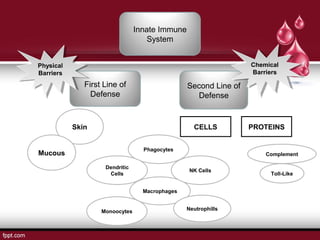
Innate Immune
System
Second Line of
Defense
First Line of
Defense
Physical
Barriers
Physical
Barriers
Chemical
Barriers
Chemical
Barriers
Skin
Mucous
CELLS PROTEINS
Macrophages
Neutrophills
Phagocytes
NK Cells
Dendritic
Cells
Monoocytes
Complement
Toll-Like
INNATE IMMUNITY
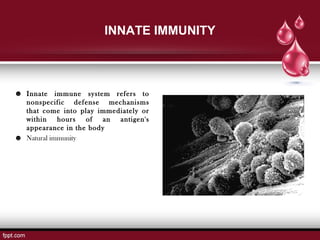
☻ Innate immune system refers to
nonspecific defense mechanisms
that come into play immediately or
within hours of an antigen's
appearance in the body
☻ Natural immunity
FIRST LINE of
DEFENSE
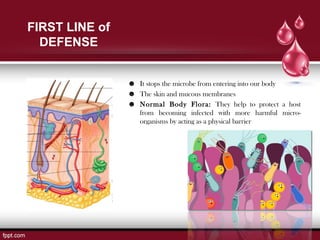
☻ It stops the microbe from entering into our body
☻ The skin and mucous membranes
☻ Normal Body Flora: They help to protect a host
from becoming infected with more harmful micro-
organisms by acting as a physical barrier
SECOND LINE
of DEFENSE
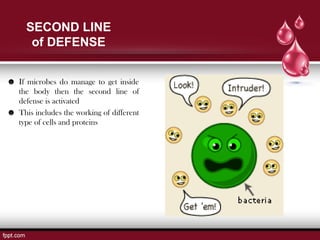
☻ If microbes do manage to get inside
the body then the second line of
defense is activated
☻ This includes the working of different
type of cells and proteins
PHAGOCYTES
☻ From the Greek phagas, to eat,
and kutos, a vessel (or cell)
☻ Recognition of a microbial invader
☻ Quickly followed by its engulfment
MONOCYTES
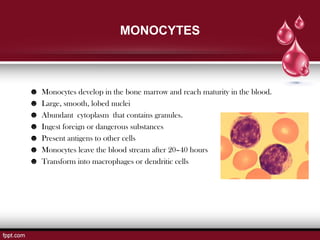
☻ Monocytes develop in the bone marrow and reach maturity in the blood. 
☻ Large, smooth, lobed nuclei
☻ Abundant cytoplasm that contains granules.
☻ Ingest foreign or dangerous substances  
☻ Present antigens to other cells
☻ Monocytes leave the blood stream after 20–40 hours
☻ Transform into macrophages or dendritic cells
MACROPHAGES
☻ Macrophages - large eaters are the
sentries of the immune system
☻ Produced by stem cells in the bone
marrow
☻ Distributed throughout the body just
below the surface of the skin and
mucous membranes
☻ In their normal, resting state,
macrophages are the janitors of the
body
☻ During this stage, macrophages
proliferate slowly
DENDRITIC CELLS
☻ Specialized antigen-presenting cells
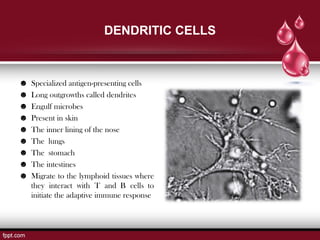
☻ Long outgrowths called dendrites
☻ Engulf microbes
☻ Present in skin
☻ The inner lining of the nose
☻ The lungs
☻ The stomach
☻ The intestines
☻ Migrate to the lymphoid tissues where
they interact with T and B cells to
initiate the adaptive immune response
NEUTROPHILLS
☻ Neutrophils make up the majority of
white blood cells in the body
☻ Their sole job is to respond to the site
of an infection in order to attack and
eat invaders
☻ Are present in the bloodstream
☻ Neutrophils respond to the location of
infection and inflammation after
detecting chemical signals in the blood
☻ Short lived
☻ Dead neutrophils make up a large
proportion of puss
NATURAL KILLER CELLS
☻ Natural killer cells are called “natural”
killers because they are ready to kill as
soon as they are formed
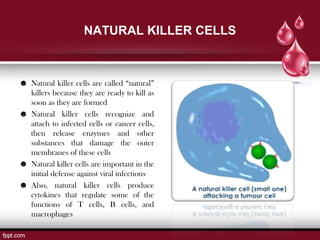
☻ Natural killer cells recognize and
attach to infected cells or cancer cells,
then release enzymes and other
substances that damage the outer
membranes of these cells
☻ Natural killer cells are important in the
initial defense against viral infections
☻ Also, natural killer cells produce
cytokines that regulate some of the
functions of T cells, B cells, and
macrophages
COMPLEMENTS
PROTEINS
☻ The complement system consists of more than 30 proteins that act in a
sequence: One protein activates another and so on. This sequence is
called the complement cascade.
☻ Complement proteins have many functions in acquired immunity as well as innate:
☻ Killing bacteria directly
☻ Helping destroy bacteria by attaching to them and thus making the bacteria easier for
neutrophils and macrophages to identify and ingest
☻ Attracting macrophages and neutrophils to a trouble spot
☻ Neutralizing viruses
☻ Helping immune cells remember specific invaders
☻ Promoting antibody formation
☻ Enhancing the effectiveness of antibodies
☻ Helping the body eliminate dead cells and immune complexes (which consist of an
antibody attached to an antigen)
TOLL-LIKE RECEPTORS
☻ Toll-like receptors (TLRs) are a class
of proteins
☻ They are usually expressed in cells
such as macrophages and dendritic
cells
☻ Once these microbes have breached
physical barriers they are recognized
by TLRs, which activate immune cell
responses
REFERENCES
☻ http://www.microbiologyonline.org.uk/about-microbiology/microbes-and-the-human-
☻ http://www.novimmune.com/science/innate.html
☻ http://www.merckmanuals.com/home/immune-disorders/biology-of-the-
immune-system/innate-immunity
☻ http://www.biology.arizona.edu/immunology/tutorials/immunology/page3.htm
l
☻ http://www.ncbi.nlm.nih.gov/books/NBK26846/
☻ http://www.immunologyexplained.co.uk/HowItWorks.aspx

Innate Immune System

  • 1.
    INNATE IMMUNE SYSTEM Presented By: AyeshaAftab Zainab Nooruddin Dept. of Bioinformatics Mohammad Ali Jinnah University.
  • 2.
    Innate Immune System Second Lineof Defense First Line of Defense Physical Barriers Physical Barriers Chemical Barriers Chemical Barriers Skin Mucous CELLS PROTEINS Macrophages Neutrophills Phagocytes NK Cells Dendritic Cells Monoocytes Complement Toll-Like
  • 3.
    INNATE IMMUNITY ☻ Innateimmune system refers to nonspecific defense mechanisms that come into play immediately or within hours of an antigen's appearance in the body ☻ Natural immunity
  • 4.
    FIRST LINE of DEFENSE ☻It stops the microbe from entering into our body ☻ The skin and mucous membranes ☻ Normal Body Flora: They help to protect a host from becoming infected with more harmful micro- organisms by acting as a physical barrier
  • 5.
    SECOND LINE of DEFENSE ☻If microbes do manage to get inside the body then the second line of defense is activated ☻ This includes the working of different type of cells and proteins
  • 6.
    PHAGOCYTES ☻ From theGreek phagas, to eat, and kutos, a vessel (or cell) ☻ Recognition of a microbial invader ☻ Quickly followed by its engulfment
  • 7.
    MONOCYTES ☻ Monocytes developin the bone marrow and reach maturity in the blood.  ☻ Large, smooth, lobed nuclei ☻ Abundant cytoplasm that contains granules. ☻ Ingest foreign or dangerous substances   ☻ Present antigens to other cells ☻ Monocytes leave the blood stream after 20–40 hours ☻ Transform into macrophages or dendritic cells
  • 8.
    MACROPHAGES ☻ Macrophages -large eaters are the sentries of the immune system ☻ Produced by stem cells in the bone marrow ☻ Distributed throughout the body just below the surface of the skin and mucous membranes ☻ In their normal, resting state, macrophages are the janitors of the body ☻ During this stage, macrophages proliferate slowly
  • 9.
    DENDRITIC CELLS ☻ Specializedantigen-presenting cells ☻ Long outgrowths called dendrites ☻ Engulf microbes ☻ Present in skin ☻ The inner lining of the nose ☻ The lungs ☻ The stomach ☻ The intestines ☻ Migrate to the lymphoid tissues where they interact with T and B cells to initiate the adaptive immune response
  • 10.
    NEUTROPHILLS ☻ Neutrophils makeup the majority of white blood cells in the body ☻ Their sole job is to respond to the site of an infection in order to attack and eat invaders ☻ Are present in the bloodstream ☻ Neutrophils respond to the location of infection and inflammation after detecting chemical signals in the blood ☻ Short lived ☻ Dead neutrophils make up a large proportion of puss
  • 11.
    NATURAL KILLER CELLS ☻Natural killer cells are called “natural” killers because they are ready to kill as soon as they are formed ☻ Natural killer cells recognize and attach to infected cells or cancer cells, then release enzymes and other substances that damage the outer membranes of these cells ☻ Natural killer cells are important in the initial defense against viral infections ☻ Also, natural killer cells produce cytokines that regulate some of the functions of T cells, B cells, and macrophages
  • 12.
    COMPLEMENTS PROTEINS ☻ The complementsystem consists of more than 30 proteins that act in a sequence: One protein activates another and so on. This sequence is called the complement cascade. ☻ Complement proteins have many functions in acquired immunity as well as innate: ☻ Killing bacteria directly ☻ Helping destroy bacteria by attaching to them and thus making the bacteria easier for neutrophils and macrophages to identify and ingest ☻ Attracting macrophages and neutrophils to a trouble spot ☻ Neutralizing viruses ☻ Helping immune cells remember specific invaders ☻ Promoting antibody formation ☻ Enhancing the effectiveness of antibodies ☻ Helping the body eliminate dead cells and immune complexes (which consist of an antibody attached to an antigen)
  • 13.
    TOLL-LIKE RECEPTORS ☻ Toll-likereceptors (TLRs) are a class of proteins ☻ They are usually expressed in cells such as macrophages and dendritic cells ☻ Once these microbes have breached physical barriers they are recognized by TLRs, which activate immune cell responses
  • 15.
    REFERENCES ☻ http://www.microbiologyonline.org.uk/about-microbiology/microbes-and-the-human- ☻ http://www.novimmune.com/science/innate.html ☻http://www.merckmanuals.com/home/immune-disorders/biology-of-the- immune-system/innate-immunity ☻ http://www.biology.arizona.edu/immunology/tutorials/immunology/page3.htm l ☻ http://www.ncbi.nlm.nih.gov/books/NBK26846/ ☻ http://www.immunologyexplained.co.uk/HowItWorks.aspx