#2 Student Misconceptions and Concerns
1. Depending on their backgrounds, students may not be aware of the lymphatic system. A quick review of its general structure and the movements and functions of lymph might be a helpful part of an introduction.
Active Lecture Tips
1. See the Activity The Immune System as the Body’s Militia on the Instructor Exchange. Visit the Instructor Exchange in the MasteringBiology instructor resource area for a description of this activity.
#4 Student Misconceptions and Concerns
1. Depending on their backgrounds, students may not be aware of the lymphatic system. A quick review of its general structure and the movements and functions of lymph might be a helpful part of an introduction.
Active Lecture Tips
1. See the Activity The Immune System as the Body’s Militia on the Instructor Exchange. Visit the Instructor Exchange in the MasteringBiology instructor resource area for a description of this activity.
#5 Student Misconceptions and Concerns
1. Depending on their backgrounds, students may not be aware of the lymphatic system. A quick review of its general structure and the movements and functions of lymph might be a helpful part of an introduction.
Active Lecture Tips
1. See the Activity The Immune System as the Body’s Militia on the Instructor Exchange. Visit the Instructor Exchange in the MasteringBiology instructor resource area for a description of this activity.
#6 Student Misconceptions and Concerns
1. Depending on their backgrounds, students may not be aware of the lymphatic system. A quick review of its general structure and the movements and functions of lymph might be a helpful part of an introduction.
Active Lecture Tips
1. See the Activity The Immune System as the Body’s Militia on the Instructor Exchange. Visit the Instructor Exchange in the MasteringBiology instructor resource area for a description of this activity.
#7 Student Misconceptions and Concerns
1. Depending on their backgrounds, students may not be aware of the lymphatic system. A quick review of its general structure and the movements and functions of lymph might be a helpful part of an introduction.
Active Lecture Tips
1. See the Activity The Immune System as the Body’s Militia on the Instructor Exchange. Visit the Instructor Exchange in the MasteringBiology instructor resource area for a description of this activity.
#8 Student Misconceptions and Concerns
1. The concepts of innate and adaptive defenses are sometimes difficult distinctions for students new to the subject. Some analogies, such as the following, might help. Clothing can be considered a general defense against physical harm, excessive sunlight, and some minor chemical damage. Firefighters and their equipment often function like an adaptive defense, responding after a problem has arisen in an attempt to limit damage.
Teaching Tips
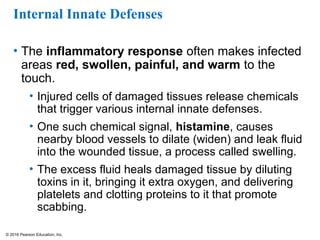
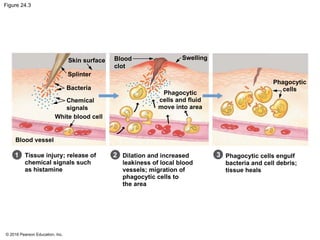
1. The inflammatory response is a good topic to hook students into this chapter on immunology. The inflammatory response is a reaction that is immediately apparent, with characteristics that can cause alarm. Students are typically more interested in subjects that have obvious relevance and that address threats to their health.
2. In an interesting article on the effectiveness of common hygiene methods, “Hygiene of the Skin: When Is Clean Too Clean?” Elaine Larson reviews the relationship between skin hygiene and infection. It can be found at the CDC website at http://wwwnc.cdc.gov/eid/article/7/2/70-0225_article
Active Lecture Tips
1. See the Activity The Immune System as the Body’s Militia on the Instructor Exchange. Visit the Instructor Exchange in the MasteringBiology instructor resource area for a description of this activity.
#9 Student Misconceptions and Concerns
1. The concepts of innate and adaptive defenses are sometimes difficult distinctions for students new to the subject. Some analogies, such as the following, might help. Clothing can be considered a general defense against physical harm, excessive sunlight, and some minor chemical damage. Firefighters and their equipment often function like an adaptive defense, responding after a problem has arisen in an attempt to limit damage.
Teaching Tips
1. The inflammatory response is a good topic to hook students into this chapter on immunology. The inflammatory response is a reaction that is immediately apparent, with characteristics that can cause alarm. Students are typically more interested in subjects that have obvious relevance and that address threats to their health.
2. In an interesting article on the effectiveness of common hygiene methods, “Hygiene of the Skin: When Is Clean Too Clean?” Elaine Larson reviews the relationship between skin hygiene and infection. It can be found at the CDC website at http://wwwnc.cdc.gov/eid/article/7/2/70-0225_article
Active Lecture Tips
1. See the Activity The Immune System as the Body’s Militia on the Instructor Exchange. Visit the Instructor Exchange in the MasteringBiology instructor resource area for a description of this activity.
#10 Student Misconceptions and Concerns
1. The concepts of innate and adaptive defenses are sometimes difficult distinctions for students new to the subject. Some analogies, such as the following, might help. Clothing can be considered a general defense against physical harm, excessive sunlight, and some minor chemical damage. Firefighters and their equipment often function like an adaptive defense, responding after a problem has arisen in an attempt to limit damage.
Teaching Tips
1. The inflammatory response is a good topic to hook students into this chapter on immunology. The inflammatory response is a reaction that is immediately apparent, with characteristics that can cause alarm. Students are typically more interested in subjects that have obvious relevance and that address threats to their health.
2. In an interesting article on the effectiveness of common hygiene methods, “Hygiene of the Skin: When Is Clean Too Clean?” Elaine Larson reviews the relationship between skin hygiene and infection. It can be found at the CDC website at http://wwwnc.cdc.gov/eid/article/7/2/70-0225_article
Active Lecture Tips
1. See the Activity The Immune System as the Body’s Militia on the Instructor Exchange. Visit the Instructor Exchange in the MasteringBiology instructor resource area for a description of this activity.
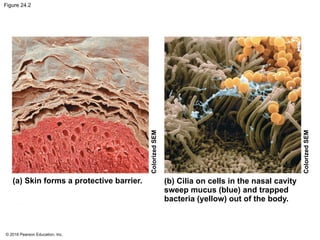
#11 Figure 24.2 External innate defenses block or filter out pathogens
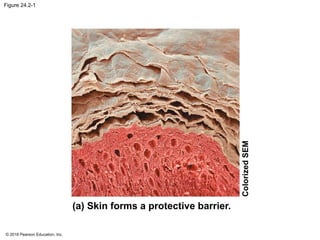
#12 Figure 24.2-1 External innate defenses block or filter out pathogens (part 1: skin)
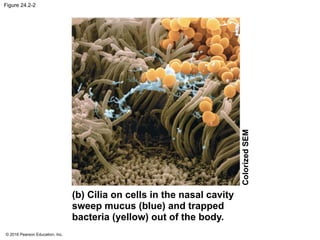
#13 Figure 24.2-2 External innate defenses block or filter out pathogens (part 2: cilia and mucus)
#14 Student Misconceptions and Concerns
1. The concepts of innate and adaptive defenses are sometimes difficult distinctions for students new to the subject. Some analogies, such as the following, might help. Clothing can be considered a general defense against physical harm, excessive sunlight, and some minor chemical damage. Firefighters and their equipment often function like an adaptive defense, responding after a problem has arisen in an attempt to limit damage.
Teaching Tips
1. The inflammatory response is a good topic to hook students into this chapter on immunology. The inflammatory response is a reaction that is immediately apparent, with characteristics that can cause alarm. Students are typically more interested in subjects that have obvious relevance and that address threats to their health.
2. In an interesting article on the effectiveness of common hygiene methods, “Hygiene of the Skin: When Is Clean Too Clean?” Elaine Larson reviews the relationship between skin hygiene and infection. It can be found at the CDC website at http://wwwnc.cdc.gov/eid/article/7/2/70-0225_article
Active Lecture Tips
1. See the Activity The Immune System as the Body’s Militia on the Instructor Exchange. Visit the Instructor Exchange in the MasteringBiology instructor resource area for a description of this activity.
#15 Student Misconceptions and Concerns
1. The concepts of innate and adaptive defenses are sometimes difficult distinctions for students new to the subject. Some analogies, such as the following, might help. Clothing can be considered a general defense against physical harm, excessive sunlight, and some minor chemical damage. Firefighters and their equipment often function like an adaptive defense, responding after a problem has arisen in an attempt to limit damage.
Teaching Tips
1. The inflammatory response is a good topic to hook students into this chapter on immunology. The inflammatory response is a reaction that is immediately apparent, with characteristics that can cause alarm. Students are typically more interested in subjects that have obvious relevance and that address threats to their health.
2. In an interesting article on the effectiveness of common hygiene methods, “Hygiene of the Skin: When Is Clean Too Clean?” Elaine Larson reviews the relationship between skin hygiene and infection. It can be found at the CDC website at http://wwwnc.cdc.gov/eid/article/7/2/70-0225_article
Active Lecture Tips
1. See the Activity The Immune System as the Body’s Militia on the Instructor Exchange. Visit the Instructor Exchange in the MasteringBiology instructor resource area for a description of this activity.
#17 Student Misconceptions and Concerns
1. The concepts of innate and adaptive defenses are sometimes difficult distinctions for students new to the subject. Some analogies, such as the following, might help. Clothing can be considered a general defense against physical harm, excessive sunlight, and some minor chemical damage. Firefighters and their equipment often function like an adaptive defense, responding after a problem has arisen in an attempt to limit damage.
Teaching Tips
1. The inflammatory response is a good topic to hook students into this chapter on immunology. The inflammatory response is a reaction that is immediately apparent, with characteristics that can cause alarm. Students are typically more interested in subjects that have obvious relevance and that address threats to their health.
2. In an interesting article on the effectiveness of common hygiene methods, “Hygiene of the Skin: When Is Clean Too Clean?” Elaine Larson reviews the relationship between skin hygiene and infection. It can be found at the CDC website at http://wwwnc.cdc.gov/eid/article/7/2/70-0225_article
Active Lecture Tips
1. See the Activity The Immune System as the Body’s Militia on the Instructor Exchange. Visit the Instructor Exchange in the MasteringBiology instructor resource area for a description of this activity.
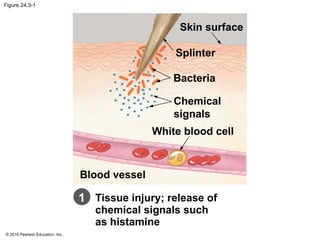
#19 Figure 24.3-1 The inflammatory response (part 1: release of chemical signals)
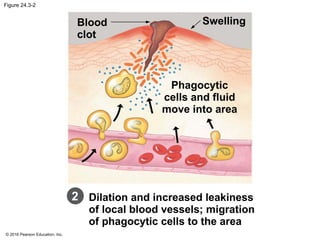
#20 Figure 24.3-2 The inflammatory response (part 2: migration of phagocytic cells)
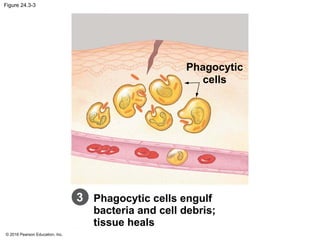
#21 Figure 24.3-3 The inflammatory response (part 3: engulfing of bacteria)
#22 Student Misconceptions and Concerns
1. The concepts of innate and adaptive defenses are sometimes difficult distinctions for students new to the subject. Some analogies, such as the following, might help. Clothing can be considered a general defense against physical harm, excessive sunlight, and some minor chemical damage. Firefighters and their equipment often function like an adaptive defense, responding after a problem has arisen in an attempt to limit damage.
Teaching Tips
1. The inflammatory response is a good topic to hook students into this chapter on immunology. The inflammatory response is a reaction that is immediately apparent, with characteristics that can cause alarm. Students are typically more interested in subjects that have obvious relevance and that address threats to their health.
2. In an interesting article on the effectiveness of common hygiene methods, “Hygiene of the Skin: When Is Clean Too Clean?” Elaine Larson reviews the relationship between skin hygiene and infection. It can be found at the CDC website at http://wwwnc.cdc.gov/eid/article/7/2/70-0225_article
Active Lecture Tips
1. See the Activity The Immune System as the Body’s Militia on the Instructor Exchange. Visit the Instructor Exchange in the MasteringBiology instructor resource area for a description of this activity.
#23 Student Misconceptions and Concerns
1. The concepts of innate and adaptive defenses are sometimes difficult distinctions for students new to the subject. Some analogies, such as the following, might help. Clothing can be considered a general defense against physical harm, excessive sunlight, and some minor chemical damage. Firefighters and their equipment often function like an adaptive defense, responding after a problem has arisen in an attempt to limit damage.
Teaching Tips
1. The inflammatory response is a good topic to hook students into this chapter on immunology. The inflammatory response is a reaction that is immediately apparent, with characteristics that can cause alarm. Students are typically more interested in subjects that have obvious relevance and that address threats to their health.
2. In an interesting article on the effectiveness of common hygiene methods, “Hygiene of the Skin: When Is Clean Too Clean?” Elaine Larson reviews the relationship between skin hygiene and infection. It can be found at the CDC website at http://wwwnc.cdc.gov/eid/article/7/2/70-0225_article
Active Lecture Tips
1. See the Activity The Immune System as the Body’s Militia on the Instructor Exchange. Visit the Instructor Exchange in the MasteringBiology instructor resource area for a description of this activity.
#24 Student Misconceptions and Concerns
1. For students with limited science backgrounds, this section of the chapter can be particularly difficult; for some, it is the most challenging part of the textbook. Students must have a solid knowledge of the properties of different cells and their interactions and understand that repeated exposure to antigens generates new interactions. The challenge is similar to explaining a new sport to someone unfamiliar to the game. (Imagine explaining the rules and strategies of football or poker to someone who had never heard of them.) Instructors might consider slowing their pace and using learning aids such as reference lists of cell types and their functions, or diagrams that remind students of these cellular interactions.
Teaching Tips
1. During a medical examination, a physician might feel for tenderness in the throat and axillary (armpit) regions. Students are unlikely to appreciate the significance of this part of the exam. Such relevancy can add meaning to your class discussions and generate additional interest in the subject.
Active Lecture Tips
1. See the Activity The Immune System as the Body’s Militia on the Instructor Exchange. Visit the Instructor Exchange in the MasteringBiology instructor resource area for a description of this activity.
#25 Student Misconceptions and Concerns
1. For students with limited science backgrounds, this section of the chapter can be particularly difficult; for some, it is the most challenging part of the textbook. Students must have a solid knowledge of the properties of different cells and their interactions and understand that repeated exposure to antigens generates new interactions. The challenge is similar to explaining a new sport to someone unfamiliar to the game. (Imagine explaining the rules and strategies of football or poker to someone who had never heard of them.) Instructors might consider slowing their pace and using learning aids such as reference lists of cell types and their functions, or diagrams that remind students of these cellular interactions.
Teaching Tips
1. During a medical examination, a physician might feel for tenderness in the throat and axillary (armpit) regions. Students are unlikely to appreciate the significance of this part of the exam. Such relevancy can add meaning to your class discussions and generate additional interest in the subject.
Active Lecture Tips
1. See the Activity The Immune System as the Body’s Militia on the Instructor Exchange. Visit the Instructor Exchange in the MasteringBiology instructor resource area for a description of this activity.
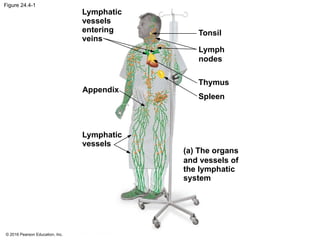
#26 Figure 24.4-1 The human lymphatic system (part 1: organs and vessels)
#27 Student Misconceptions and Concerns
1. For students with limited science backgrounds, this section of the chapter can be particularly difficult; for some, it is the most challenging part of the textbook. Students must have a solid knowledge of the properties of different cells and their interactions and understand that repeated exposure to antigens generates new interactions. The challenge is similar to explaining a new sport to someone unfamiliar to the game. (Imagine explaining the rules and strategies of football or poker to someone who had never heard of them.) Instructors might consider slowing their pace and using learning aids such as reference lists of cell types and their functions, or diagrams that remind students of these cellular interactions.
Teaching Tips
1. During a medical examination, a physician might feel for tenderness in the throat and axillary (armpit) regions. Students are unlikely to appreciate the significance of this part of the exam. Such relevancy can add meaning to your class discussions and generate additional interest in the subject.
Active Lecture Tips
1. See the Activity The Immune System as the Body’s Militia on the Instructor Exchange. Visit the Instructor Exchange in the MasteringBiology instructor resource area for a description of this activity.
#28 Student Misconceptions and Concerns
1. For students with limited science backgrounds, this section of the chapter can be particularly difficult; for some, it is the most challenging part of the textbook. Students must have a solid knowledge of the properties of different cells and their interactions and understand that repeated exposure to antigens generates new interactions. The challenge is similar to explaining a new sport to someone unfamiliar to the game. (Imagine explaining the rules and strategies of football or poker to someone who had never heard of them.) Instructors might consider slowing their pace and using learning aids such as reference lists of cell types and their functions, or diagrams that remind students of these cellular interactions.
Teaching Tips
1. During a medical examination, a physician might feel for tenderness in the throat and axillary (armpit) regions. Students are unlikely to appreciate the significance of this part of the exam. Such relevancy can add meaning to your class discussions and generate additional interest in the subject.
Active Lecture Tips
1. See the Activity The Immune System as the Body’s Militia on the Instructor Exchange. Visit the Instructor Exchange in the MasteringBiology instructor resource area for a description of this activity.
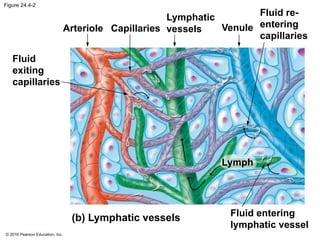
#29 Figure 24.4-2 The human lymphatic system (part 2: lymphatic vessels)
#30 Student Misconceptions and Concerns
1. For students with limited science backgrounds, this section of the chapter can be particularly difficult; for some, it is the most challenging part of the textbook. Students must have a solid knowledge of the properties of different cells and their interactions and understand that repeated exposure to antigens generates new interactions. The challenge is similar to explaining a new sport to someone unfamiliar to the game. (Imagine explaining the rules and strategies of football or poker to someone who had never heard of them.) Instructors might consider slowing their pace and using learning aids such as reference lists of cell types and their functions, or diagrams that remind students of these cellular interactions.
Teaching Tips
1. During a medical examination, a physician might feel for tenderness in the throat and axillary (armpit) regions. Students are unlikely to appreciate the significance of this part of the exam. Such relevancy can add meaning to your class discussions and generate additional interest in the subject.
Active Lecture Tips
1. See the Activity The Immune System as the Body’s Militia on the Instructor Exchange. Visit the Instructor Exchange in the MasteringBiology instructor resource area for a description of this activity.
#31 Student Misconceptions and Concerns
1. For students with limited science backgrounds, this section of the chapter can be particularly difficult; for some, it is the most challenging part of the textbook. Students must have a solid knowledge of the properties of different cells and their interactions, and understand that repeated exposure to antigens generates new interactions. The challenge is similar to explaining a new sport to someone unfamiliar to the game. (Imagine explaining the rules and strategies of football or poker to someone who had never heard of them.) Instructors might consider slowing their pace and using learning aids such as reference lists of cell types and their functions, or diagrams that remind students of these cellular interactions.
Teaching Tips
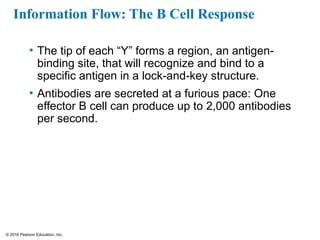
1. The authors suggest that the specific nature of the binding between an antigen and an antibody is like the relationship between a lock and a key. You might further this analogy by noting that the tremendous diversity of antibodies is like having a set of keys for virtually every possible type of lock.
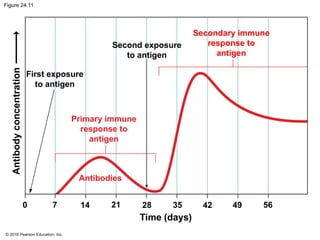
2. Our own learning experiences provide an analogy to the greater swiftness and intensity of a secondary immune response. When first presented with a problem, we may struggle to determine how best to respond. However, with that first experience behind us, we expect to respond more quickly and effectively when we meet that challenge again. Although in each circumstance we benefit from a certain type of memory (experiential in one case, chemical in the other), their mechanisms are quite different. Consider noting these similarities and differences in your class discussion of primary and secondary immune responses.
3. The recognition by a helper T cell of a self protein and a foreign antigen in combination is like the two-key system used by banks to access safe-deposit boxes.
4. The Centers for Disease Control and Prevention has extensive information about AIDS and other public health threats at www.cdc.gov/hiv.
Active Lecture Tips
1. Consider challenging your class to explain the adaptive advantages of the Y shape of an antibody. Why is an antibody not just a single heavy chain and light chain? (Many biologists think that the Y shape permits the binding together of two antigens or antigen-presenting surfaces, permitting a chain reaction or form of clumping.)
2. See the Activity The Immune System as the Body’s Militia on the Instructor Exchange. Visit the Instructor Exchange in the MasteringBiology instructor resource area for a description of this activity.
3. See the Activity Collecting Student Misconceptions About the Flu Vaccine on the Instructor Exchange. Visit the Instructor Exchange in the MasteringBiology instructor resource area for a description of this activity.
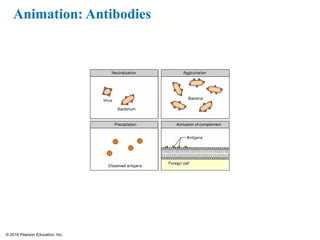
4. See the Activity The Function of Antibodies and Complement Compared to Chocolate Chips on the Instructor Exchange. Visit the Instructor Exchange in the MasteringBiology instructor resource area for a description of this activity.
#32 Student Misconceptions and Concerns
1. For students with limited science backgrounds, this section of the chapter can be particularly difficult; for some, it is the most challenging part of the textbook. Students must have a solid knowledge of the properties of different cells and their interactions, and understand that repeated exposure to antigens generates new interactions. The challenge is similar to explaining a new sport to someone unfamiliar to the game. (Imagine explaining the rules and strategies of football or poker to someone who had never heard of them.) Instructors might consider slowing their pace and using learning aids such as reference lists of cell types and their functions, or diagrams that remind students of these cellular interactions.
Teaching Tips
1. The authors suggest that the specific nature of the binding between an antigen and an antibody is like the relationship between a lock and a key. You might further this analogy by noting that the tremendous diversity of antibodies is like having a set of keys for virtually every possible type of lock.
2. Our own learning experiences provide an analogy to the greater swiftness and intensity of a secondary immune response. When first presented with a problem, we may struggle to determine how best to respond. However, with that first experience behind us, we expect to respond more quickly and effectively when we meet that challenge again. Although in each circumstance we benefit from a certain type of memory (experiential in one case, chemical in the other), their mechanisms are quite different. Consider noting these similarities and differences in your class discussion of primary and secondary immune responses.
3. The recognition by a helper T cell of a self protein and a foreign antigen in combination is like the two-key system used by banks to access safe-deposit boxes.
4. The Centers for Disease Control and Prevention has extensive information about AIDS and other public health threats at www.cdc.gov/hiv.
Active Lecture Tips
1. Consider challenging your class to explain the adaptive advantages of the Y shape of an antibody. Why is an antibody not just a single heavy chain and light chain? (Many biologists think that the Y shape permits the binding together of two antigens or antigen-presenting surfaces, permitting a chain reaction or form of clumping.)
2. See the Activity The Immune System as the Body’s Militia on the Instructor Exchange. Visit the Instructor Exchange in the MasteringBiology instructor resource area for a description of this activity.
3. See the Activity Collecting Student Misconceptions About the Flu Vaccine on the Instructor Exchange. Visit the Instructor Exchange in the MasteringBiology instructor resource area for a description of this activity.
4. See the Activity The Function of Antibodies and Complement Compared to Chocolate Chips on the Instructor Exchange. Visit the Instructor Exchange in the MasteringBiology instructor resource area for a description of this activity.
#33 Student Misconceptions and Concerns
1. For students with limited science backgrounds, this section of the chapter can be particularly difficult; for some, it is the most challenging part of the textbook. Students must have a solid knowledge of the properties of different cells and their interactions, and understand that repeated exposure to antigens generates new interactions. The challenge is similar to explaining a new sport to someone unfamiliar to the game. (Imagine explaining the rules and strategies of football or poker to someone who had never heard of them.) Instructors might consider slowing their pace and using learning aids such as reference lists of cell types and their functions, or diagrams that remind students of these cellular interactions.
Teaching Tips
1. The authors suggest that the specific nature of the binding between an antigen and an antibody is like the relationship between a lock and a key. You might further this analogy by noting that the tremendous diversity of antibodies is like having a set of keys for virtually every possible type of lock.
2. Our own learning experiences provide an analogy to the greater swiftness and intensity of a secondary immune response. When first presented with a problem, we may struggle to determine how best to respond. However, with that first experience behind us, we expect to respond more quickly and effectively when we meet that challenge again. Although in each circumstance we benefit from a certain type of memory (experiential in one case, chemical in the other), their mechanisms are quite different. Consider noting these similarities and differences in your class discussion of primary and secondary immune responses.
3. The recognition by a helper T cell of a self protein and a foreign antigen in combination is like the two-key system used by banks to access safe-deposit boxes.
4. The Centers for Disease Control and Prevention has extensive information about AIDS and other public health threats at www.cdc.gov/hiv.
Active Lecture Tips
1. Consider challenging your class to explain the adaptive advantages of the Y shape of an antibody. Why is an antibody not just a single heavy chain and light chain? (Many biologists think that the Y shape permits the binding together of two antigens or antigen-presenting surfaces, permitting a chain reaction or form of clumping.)
2. See the Activity The Immune System as the Body’s Militia on the Instructor Exchange. Visit the Instructor Exchange in the MasteringBiology instructor resource area for a description of this activity.
3. See the Activity Collecting Student Misconceptions About the Flu Vaccine on the Instructor Exchange. Visit the Instructor Exchange in the MasteringBiology instructor resource area for a description of this activity.
4. See the Activity The Function of Antibodies and Complement Compared to Chocolate Chips on the Instructor Exchange. Visit the Instructor Exchange in the MasteringBiology instructor resource area for a description of this activity.
#34 Student Misconceptions and Concerns
1. For students with limited science backgrounds, this section of the chapter can be particularly difficult; for some, it is the most challenging part of the textbook. Students must have a solid knowledge of the properties of different cells and their interactions, and understand that repeated exposure to antigens generates new interactions. The challenge is similar to explaining a new sport to someone unfamiliar to the game. (Imagine explaining the rules and strategies of football or poker to someone who had never heard of them.) Instructors might consider slowing their pace and using learning aids such as reference lists of cell types and their functions, or diagrams that remind students of these cellular interactions.
Teaching Tips
1. The authors suggest that the specific nature of the binding between an antigen and an antibody is like the relationship between a lock and a key. You might further this analogy by noting that the tremendous diversity of antibodies is like having a set of keys for virtually every possible type of lock.
2. Our own learning experiences provide an analogy to the greater swiftness and intensity of a secondary immune response. When first presented with a problem, we may struggle to determine how best to respond. However, with that first experience behind us, we expect to respond more quickly and effectively when we meet that challenge again. Although in each circumstance we benefit from a certain type of memory (experiential in one case, chemical in the other), their mechanisms are quite different. Consider noting these similarities and differences in your class discussion of primary and secondary immune responses.
3. The recognition by a helper T cell of a self protein and a foreign antigen in combination is like the two-key system used by banks to access safe-deposit boxes.
4. The Centers for Disease Control and Prevention has extensive information about AIDS and other public health threats at www.cdc.gov/hiv.
Active Lecture Tips
1. Consider challenging your class to explain the adaptive advantages of the Y shape of an antibody. Why is an antibody not just a single heavy chain and light chain? (Many biologists think that the Y shape permits the binding together of two antigens or antigen-presenting surfaces, permitting a chain reaction or form of clumping.)
2. See the Activity The Immune System as the Body’s Militia on the Instructor Exchange. Visit the Instructor Exchange in the MasteringBiology instructor resource area for a description of this activity.
3. See the Activity Collecting Student Misconceptions About the Flu Vaccine on the Instructor Exchange. Visit the Instructor Exchange in the MasteringBiology instructor resource area for a description of this activity.
4. See the Activity The Function of Antibodies and Complement Compared to Chocolate Chips on the Instructor Exchange. Visit the Instructor Exchange in the MasteringBiology instructor resource area for a description of this activity.
#35 Student Misconceptions and Concerns
1. For students with limited science backgrounds, this section of the chapter can be particularly difficult; for some, it is the most challenging part of the textbook. Students must have a solid knowledge of the properties of different cells and their interactions, and understand that repeated exposure to antigens generates new interactions. The challenge is similar to explaining a new sport to someone unfamiliar to the game. (Imagine explaining the rules and strategies of football or poker to someone who had never heard of them.) Instructors might consider slowing their pace and using learning aids such as reference lists of cell types and their functions, or diagrams that remind students of these cellular interactions.
Teaching Tips
1. The authors suggest that the specific nature of the binding between an antigen and an antibody is like the relationship between a lock and a key. You might further this analogy by noting that the tremendous diversity of antibodies is like having a set of keys for virtually every possible type of lock.
2. Our own learning experiences provide an analogy to the greater swiftness and intensity of a secondary immune response. When first presented with a problem, we may struggle to determine how best to respond. However, with that first experience behind us, we expect to respond more quickly and effectively when we meet that challenge again. Although in each circumstance we benefit from a certain type of memory (experiential in one case, chemical in the other), their mechanisms are quite different. Consider noting these similarities and differences in your class discussion of primary and secondary immune responses.
3. The recognition by a helper T cell of a self protein and a foreign antigen in combination is like the two-key system used by banks to access safe-deposit boxes.
4. The Centers for Disease Control and Prevention has extensive information about AIDS and other public health threats at www.cdc.gov/hiv.
Active Lecture Tips
1. Consider challenging your class to explain the adaptive advantages of the Y shape of an antibody. Why is an antibody not just a single heavy chain and light chain? (Many biologists think that the Y shape permits the binding together of two antigens or antigen-presenting surfaces, permitting a chain reaction or form of clumping.)
2. See the Activity The Immune System as the Body’s Militia on the Instructor Exchange. Visit the Instructor Exchange in the MasteringBiology instructor resource area for a description of this activity.
3. See the Activity Collecting Student Misconceptions About the Flu Vaccine on the Instructor Exchange. Visit the Instructor Exchange in the MasteringBiology instructor resource area for a description of this activity.
4. See the Activity The Function of Antibodies and Complement Compared to Chocolate Chips on the Instructor Exchange. Visit the Instructor Exchange in the MasteringBiology instructor resource area for a description of this activity.
#37 Student Misconceptions and Concerns
1. For students with limited science backgrounds, this section of the chapter can be particularly difficult; for some, it is the most challenging part of the textbook. Students must have a solid knowledge of the properties of different cells and their interactions, and understand that repeated exposure to antigens generates new interactions. The challenge is similar to explaining a new sport to someone unfamiliar to the game. (Imagine explaining the rules and strategies of football or poker to someone who had never heard of them.) Instructors might consider slowing their pace and using learning aids such as reference lists of cell types and their functions, or diagrams that remind students of these cellular interactions.
Teaching Tips
1. The authors suggest that the specific nature of the binding between an antigen and an antibody is like the relationship between a lock and a key. You might further this analogy by noting that the tremendous diversity of antibodies is like having a set of keys for virtually every possible type of lock.
2. Our own learning experiences provide an analogy to the greater swiftness and intensity of a secondary immune response. When first presented with a problem, we may struggle to determine how best to respond. However, with that first experience behind us, we expect to respond more quickly and effectively when we meet that challenge again. Although in each circumstance we benefit from a certain type of memory (experiential in one case, chemical in the other), their mechanisms are quite different. Consider noting these similarities and differences in your class discussion of primary and secondary immune responses.
3. The recognition by a helper T cell of a self protein and a foreign antigen in combination is like the two-key system used by banks to access safe-deposit boxes.
4. The Centers for Disease Control and Prevention has extensive information about AIDS and other public health threats at www.cdc.gov/hiv.
Active Lecture Tips
1. Consider challenging your class to explain the adaptive advantages of the Y shape of an antibody. Why is an antibody not just a single heavy chain and light chain? (Many biologists think that the Y shape permits the binding together of two antigens or antigen-presenting surfaces, permitting a chain reaction or form of clumping.)
2. See the Activity The Immune System as the Body’s Militia on the Instructor Exchange. Visit the Instructor Exchange in the MasteringBiology instructor resource area for a description of this activity.
3. See the Activity Collecting Student Misconceptions About the Flu Vaccine on the Instructor Exchange. Visit the Instructor Exchange in the MasteringBiology instructor resource area for a description of this activity.
4. See the Activity The Function of Antibodies and Complement Compared to Chocolate Chips on the Instructor Exchange. Visit the Instructor Exchange in the MasteringBiology instructor resource area for a description of this activity.
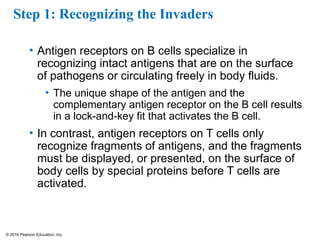
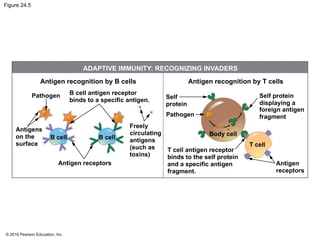
#38 Figure 24.5 Two ways antigens are recognized by the adaptive defenses
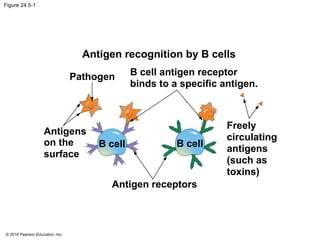
#39 Figure 24.5-1 Two ways antigens are recognized by the adaptive defenses (part 1: recognition by B cells)
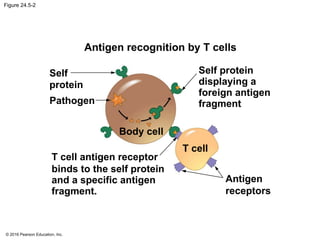
#40 Figure 24.5-2 Two ways antigens are recognized by the adaptive defenses (part 2: recognition by T cells)
#41 Student Misconceptions and Concerns
1. For students with limited science backgrounds, this section of the chapter can be particularly difficult; for some, it is the most challenging part of the textbook. Students must have a solid knowledge of the properties of different cells and their interactions, and understand that repeated exposure to antigens generates new interactions. The challenge is similar to explaining a new sport to someone unfamiliar to the game. (Imagine explaining the rules and strategies of football or poker to someone who had never heard of them.) Instructors might consider slowing their pace and using learning aids such as reference lists of cell types and their functions, or diagrams that remind students of these cellular interactions.
Teaching Tips
1. The authors suggest that the specific nature of the binding between an antigen and an antibody is like the relationship between a lock and a key. You might further this analogy by noting that the tremendous diversity of antibodies is like having a set of keys for virtually every possible type of lock.
2. Our own learning experiences provide an analogy to the greater swiftness and intensity of a secondary immune response. When first presented with a problem, we may struggle to determine how best to respond. However, with that first experience behind us, we expect to respond more quickly and effectively when we meet that challenge again. Although in each circumstance we benefit from a certain type of memory (experiential in one case, chemical in the other), their mechanisms are quite different. Consider noting these similarities and differences in your class discussion of primary and secondary immune responses.
3. The recognition by a helper T cell of a self protein and a foreign antigen in combination is like the two-key system used by banks to access safe-deposit boxes.
4. The Centers for Disease Control and Prevention has extensive information about AIDS and other public health threats at www.cdc.gov/hiv.
Active Lecture Tips
1. Consider challenging your class to explain the adaptive advantages of the Y shape of an antibody. Why is an antibody not just a single heavy chain and light chain? (Many biologists think that the Y shape permits the binding together of two antigens or antigen-presenting surfaces, permitting a chain reaction or form of clumping.)
2. See the Activity The Immune System as the Body’s Militia on the Instructor Exchange. Visit the Instructor Exchange in the MasteringBiology instructor resource area for a description of this activity.
3. See the Activity Collecting Student Misconceptions About the Flu Vaccine on the Instructor Exchange. Visit the Instructor Exchange in the MasteringBiology instructor resource area for a description of this activity.
4. See the Activity The Function of Antibodies and Complement Compared to Chocolate Chips on the Instructor Exchange. Visit the Instructor Exchange in the MasteringBiology instructor resource area for a description of this activity.
#42 Student Misconceptions and Concerns
1. For students with limited science backgrounds, this section of the chapter can be particularly difficult; for some, it is the most challenging part of the textbook. Students must have a solid knowledge of the properties of different cells and their interactions, and understand that repeated exposure to antigens generates new interactions. The challenge is similar to explaining a new sport to someone unfamiliar to the game. (Imagine explaining the rules and strategies of football or poker to someone who had never heard of them.) Instructors might consider slowing their pace and using learning aids such as reference lists of cell types and their functions, or diagrams that remind students of these cellular interactions.
Teaching Tips
1. The authors suggest that the specific nature of the binding between an antigen and an antibody is like the relationship between a lock and a key. You might further this analogy by noting that the tremendous diversity of antibodies is like having a set of keys for virtually every possible type of lock.
2. Our own learning experiences provide an analogy to the greater swiftness and intensity of a secondary immune response. When first presented with a problem, we may struggle to determine how best to respond. However, with that first experience behind us, we expect to respond more quickly and effectively when we meet that challenge again. Although in each circumstance we benefit from a certain type of memory (experiential in one case, chemical in the other), their mechanisms are quite different. Consider noting these similarities and differences in your class discussion of primary and secondary immune responses.
3. The recognition by a helper T cell of a self protein and a foreign antigen in combination is like the two-key system used by banks to access safe-deposit boxes.
4. The Centers for Disease Control and Prevention has extensive information about AIDS and other public health threats at www.cdc.gov/hiv.
Active Lecture Tips
1. Consider challenging your class to explain the adaptive advantages of the Y shape of an antibody. Why is an antibody not just a single heavy chain and light chain? (Many biologists think that the Y shape permits the binding together of two antigens or antigen-presenting surfaces, permitting a chain reaction or form of clumping.)
2. See the Activity The Immune System as the Body’s Militia on the Instructor Exchange. Visit the Instructor Exchange in the MasteringBiology instructor resource area for a description of this activity.
3. See the Activity Collecting Student Misconceptions About the Flu Vaccine on the Instructor Exchange. Visit the Instructor Exchange in the MasteringBiology instructor resource area for a description of this activity.
4. See the Activity The Function of Antibodies and Complement Compared to Chocolate Chips on the Instructor Exchange. Visit the Instructor Exchange in the MasteringBiology instructor resource area for a description of this activity.
#43 Student Misconceptions and Concerns
1. For students with limited science backgrounds, this section of the chapter can be particularly difficult; for some, it is the most challenging part of the textbook. Students must have a solid knowledge of the properties of different cells and their interactions, and understand that repeated exposure to antigens generates new interactions. The challenge is similar to explaining a new sport to someone unfamiliar to the game. (Imagine explaining the rules and strategies of football or poker to someone who had never heard of them.) Instructors might consider slowing their pace and using learning aids such as reference lists of cell types and their functions, or diagrams that remind students of these cellular interactions.
Teaching Tips
1. The authors suggest that the specific nature of the binding between an antigen and an antibody is like the relationship between a lock and a key. You might further this analogy by noting that the tremendous diversity of antibodies is like having a set of keys for virtually every possible type of lock.
2. Our own learning experiences provide an analogy to the greater swiftness and intensity of a secondary immune response. When first presented with a problem, we may struggle to determine how best to respond. However, with that first experience behind us, we expect to respond more quickly and effectively when we meet that challenge again. Although in each circumstance we benefit from a certain type of memory (experiential in one case, chemical in the other), their mechanisms are quite different. Consider noting these similarities and differences in your class discussion of primary and secondary immune responses.
3. The recognition by a helper T cell of a self protein and a foreign antigen in combination is like the two-key system used by banks to access safe-deposit boxes.
4. The Centers for Disease Control and Prevention has extensive information about AIDS and other public health threats at www.cdc.gov/hiv.
Active Lecture Tips
1. Consider challenging your class to explain the adaptive advantages of the Y shape of an antibody. Why is an antibody not just a single heavy chain and light chain? (Many biologists think that the Y shape permits the binding together of two antigens or antigen-presenting surfaces, permitting a chain reaction or form of clumping.)
2. See the Activity The Immune System as the Body’s Militia on the Instructor Exchange. Visit the Instructor Exchange in the MasteringBiology instructor resource area for a description of this activity.
3. See the Activity Collecting Student Misconceptions About the Flu Vaccine on the Instructor Exchange. Visit the Instructor Exchange in the MasteringBiology instructor resource area for a description of this activity.
4. See the Activity The Function of Antibodies and Complement Compared to Chocolate Chips on the Instructor Exchange. Visit the Instructor Exchange in the MasteringBiology instructor resource area for a description of this activity.
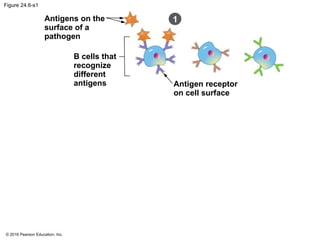
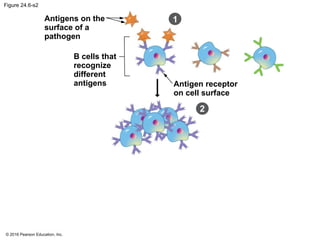
#44 Figure 24.6-s1 Clonal selection during the first exposure to an antigen (step 1)
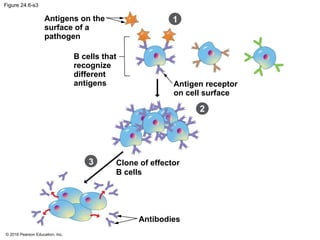
#45 Figure 24.6-s2 Clonal selection during the first exposure to an antigen (step 2)
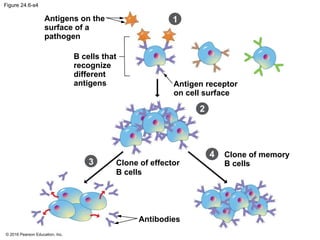
#46 Figure 24.6-s3 Clonal selection during the first exposure to an antigen (step 3)
#47 Figure 24.6-s4 Clonal selection during the first exposure to an antigen (step 4)
#48 Student Misconceptions and Concerns
1. For students with limited science backgrounds, this section of the chapter can be particularly difficult; for some, it is the most challenging part of the textbook. Students must have a solid knowledge of the properties of different cells and their interactions, and understand that repeated exposure to antigens generates new interactions. The challenge is similar to explaining a new sport to someone unfamiliar to the game. (Imagine explaining the rules and strategies of football or poker to someone who had never heard of them.) Instructors might consider slowing their pace and using learning aids such as reference lists of cell types and their functions, or diagrams that remind students of these cellular interactions.
Teaching Tips
1. The authors suggest that the specific nature of the binding between an antigen and an antibody is like the relationship between a lock and a key. You might further this analogy by noting that the tremendous diversity of antibodies is like having a set of keys for virtually every possible type of lock.
2. Our own learning experiences provide an analogy to the greater swiftness and intensity of a secondary immune response. When first presented with a problem, we may struggle to determine how best to respond. However, with that first experience behind us, we expect to respond more quickly and effectively when we meet that challenge again. Although in each circumstance we benefit from a certain type of memory (experiential in one case, chemical in the other), their mechanisms are quite different. Consider noting these similarities and differences in your class discussion of primary and secondary immune responses.
3. The recognition by a helper T cell of a self protein and a foreign antigen in combination is like the two-key system used by banks to access safe-deposit boxes.
4. The Centers for Disease Control and Prevention has extensive information about AIDS and other public health threats at www.cdc.gov/hiv.
Active Lecture Tips
1. Consider challenging your class to explain the adaptive advantages of the Y shape of an antibody. Why is an antibody not just a single heavy chain and light chain? (Many biologists think that the Y shape permits the binding together of two antigens or antigen-presenting surfaces, permitting a chain reaction or form of clumping.)
2. See the Activity The Immune System as the Body’s Militia on the Instructor Exchange. Visit the Instructor Exchange in the MasteringBiology instructor resource area for a description of this activity.
3. See the Activity Collecting Student Misconceptions About the Flu Vaccine on the Instructor Exchange. Visit the Instructor Exchange in the MasteringBiology instructor resource area for a description of this activity.
4. See the Activity The Function of Antibodies and Complement Compared to Chocolate Chips on the Instructor Exchange. Visit the Instructor Exchange in the MasteringBiology instructor resource area for a description of this activity.
#49 Student Misconceptions and Concerns
1. For students with limited science backgrounds, this section of the chapter can be particularly difficult; for some, it is the most challenging part of the textbook. Students must have a solid knowledge of the properties of different cells and their interactions, and understand that repeated exposure to antigens generates new interactions. The challenge is similar to explaining a new sport to someone unfamiliar to the game. (Imagine explaining the rules and strategies of football or poker to someone who had never heard of them.) Instructors might consider slowing their pace and using learning aids such as reference lists of cell types and their functions, or diagrams that remind students of these cellular interactions.
Teaching Tips
1. The authors suggest that the specific nature of the binding between an antigen and an antibody is like the relationship between a lock and a key. You might further this analogy by noting that the tremendous diversity of antibodies is like having a set of keys for virtually every possible type of lock.
2. Our own learning experiences provide an analogy to the greater swiftness and intensity of a secondary immune response. When first presented with a problem, we may struggle to determine how best to respond. However, with that first experience behind us, we expect to respond more quickly and effectively when we meet that challenge again. Although in each circumstance we benefit from a certain type of memory (experiential in one case, chemical in the other), their mechanisms are quite different. Consider noting these similarities and differences in your class discussion of primary and secondary immune responses.
3. The recognition by a helper T cell of a self protein and a foreign antigen in combination is like the two-key system used by banks to access safe-deposit boxes.
4. The Centers for Disease Control and Prevention has extensive information about AIDS and other public health threats at www.cdc.gov/hiv.
Active Lecture Tips
1. Consider challenging your class to explain the adaptive advantages of the Y shape of an antibody. Why is an antibody not just a single heavy chain and light chain? (Many biologists think that the Y shape permits the binding together of two antigens or antigen-presenting surfaces, permitting a chain reaction or form of clumping.)
2. See the Activity The Immune System as the Body’s Militia on the Instructor Exchange. Visit the Instructor Exchange in the MasteringBiology instructor resource area for a description of this activity.
3. See the Activity Collecting Student Misconceptions About the Flu Vaccine on the Instructor Exchange. Visit the Instructor Exchange in the MasteringBiology instructor resource area for a description of this activity.
4. See the Activity The Function of Antibodies and Complement Compared to Chocolate Chips on the Instructor Exchange. Visit the Instructor Exchange in the MasteringBiology instructor resource area for a description of this activity.
#50 Student Misconceptions and Concerns
1. For students with limited science backgrounds, this section of the chapter can be particularly difficult; for some, it is the most challenging part of the textbook. Students must have a solid knowledge of the properties of different cells and their interactions, and understand that repeated exposure to antigens generates new interactions. The challenge is similar to explaining a new sport to someone unfamiliar to the game. (Imagine explaining the rules and strategies of football or poker to someone who had never heard of them.) Instructors might consider slowing their pace and using learning aids such as reference lists of cell types and their functions, or diagrams that remind students of these cellular interactions.
Teaching Tips
1. The authors suggest that the specific nature of the binding between an antigen and an antibody is like the relationship between a lock and a key. You might further this analogy by noting that the tremendous diversity of antibodies is like having a set of keys for virtually every possible type of lock.
2. Our own learning experiences provide an analogy to the greater swiftness and intensity of a secondary immune response. When first presented with a problem, we may struggle to determine how best to respond. However, with that first experience behind us, we expect to respond more quickly and effectively when we meet that challenge again. Although in each circumstance we benefit from a certain type of memory (experiential in one case, chemical in the other), their mechanisms are quite different. Consider noting these similarities and differences in your class discussion of primary and secondary immune responses.
3. The recognition by a helper T cell of a self protein and a foreign antigen in combination is like the two-key system used by banks to access safe-deposit boxes.
4. The Centers for Disease Control and Prevention has extensive information about AIDS and other public health threats at www.cdc.gov/hiv.
Active Lecture Tips
1. Consider challenging your class to explain the adaptive advantages of the Y shape of an antibody. Why is an antibody not just a single heavy chain and light chain? (Many biologists think that the Y shape permits the binding together of two antigens or antigen-presenting surfaces, permitting a chain reaction or form of clumping.)
2. See the Activity The Immune System as the Body’s Militia on the Instructor Exchange. Visit the Instructor Exchange in the MasteringBiology instructor resource area for a description of this activity.
3. See the Activity Collecting Student Misconceptions About the Flu Vaccine on the Instructor Exchange. Visit the Instructor Exchange in the MasteringBiology instructor resource area for a description of this activity.
4. See the Activity The Function of Antibodies and Complement Compared to Chocolate Chips on the Instructor Exchange. Visit the Instructor Exchange in the MasteringBiology instructor resource area for a description of this activity.
#51 Student Misconceptions and Concerns
1. For students with limited science backgrounds, this section of the chapter can be particularly difficult; for some, it is the most challenging part of the textbook. Students must have a solid knowledge of the properties of different cells and their interactions, and understand that repeated exposure to antigens generates new interactions. The challenge is similar to explaining a new sport to someone unfamiliar to the game. (Imagine explaining the rules and strategies of football or poker to someone who had never heard of them.) Instructors might consider slowing their pace and using learning aids such as reference lists of cell types and their functions, or diagrams that remind students of these cellular interactions.
Teaching Tips
1. The authors suggest that the specific nature of the binding between an antigen and an antibody is like the relationship between a lock and a key. You might further this analogy by noting that the tremendous diversity of antibodies is like having a set of keys for virtually every possible type of lock.
2. Our own learning experiences provide an analogy to the greater swiftness and intensity of a secondary immune response. When first presented with a problem, we may struggle to determine how best to respond. However, with that first experience behind us, we expect to respond more quickly and effectively when we meet that challenge again. Although in each circumstance we benefit from a certain type of memory (experiential in one case, chemical in the other), their mechanisms are quite different. Consider noting these similarities and differences in your class discussion of primary and secondary immune responses.
3. The recognition by a helper T cell of a self protein and a foreign antigen in combination is like the two-key system used by banks to access safe-deposit boxes.
4. The Centers for Disease Control and Prevention has extensive information about AIDS and other public health threats at www.cdc.gov/hiv.
Active Lecture Tips
1. Consider challenging your class to explain the adaptive advantages of the Y shape of an antibody. Why is an antibody not just a single heavy chain and light chain? (Many biologists think that the Y shape permits the binding together of two antigens or antigen-presenting surfaces, permitting a chain reaction or form of clumping.)
2. See the Activity The Immune System as the Body’s Militia on the Instructor Exchange. Visit the Instructor Exchange in the MasteringBiology instructor resource area for a description of this activity.
3. See the Activity Collecting Student Misconceptions About the Flu Vaccine on the Instructor Exchange. Visit the Instructor Exchange in the MasteringBiology instructor resource area for a description of this activity.
4. See the Activity The Function of Antibodies and Complement Compared to Chocolate Chips on the Instructor Exchange. Visit the Instructor Exchange in the MasteringBiology instructor resource area for a description of this activity.
#52 Student Misconceptions and Concerns
1. For students with limited science backgrounds, this section of the chapter can be particularly difficult; for some, it is the most challenging part of the textbook. Students must have a solid knowledge of the properties of different cells and their interactions, and understand that repeated exposure to antigens generates new interactions. The challenge is similar to explaining a new sport to someone unfamiliar to the game. (Imagine explaining the rules and strategies of football or poker to someone who had never heard of them.) Instructors might consider slowing their pace and using learning aids such as reference lists of cell types and their functions, or diagrams that remind students of these cellular interactions.
Teaching Tips
1. The authors suggest that the specific nature of the binding between an antigen and an antibody is like the relationship between a lock and a key. You might further this analogy by noting that the tremendous diversity of antibodies is like having a set of keys for virtually every possible type of lock.
2. Our own learning experiences provide an analogy to the greater swiftness and intensity of a secondary immune response. When first presented with a problem, we may struggle to determine how best to respond. However, with that first experience behind us, we expect to respond more quickly and effectively when we meet that challenge again. Although in each circumstance we benefit from a certain type of memory (experiential in one case, chemical in the other), their mechanisms are quite different. Consider noting these similarities and differences in your class discussion of primary and secondary immune responses.
3. The recognition by a helper T cell of a self protein and a foreign antigen in combination is like the two-key system used by banks to access safe-deposit boxes.
4. The Centers for Disease Control and Prevention has extensive information about AIDS and other public health threats at www.cdc.gov/hiv.
Active Lecture Tips
1. Consider challenging your class to explain the adaptive advantages of the Y shape of an antibody. Why is an antibody not just a single heavy chain and light chain? (Many biologists think that the Y shape permits the binding together of two antigens or antigen-presenting surfaces, permitting a chain reaction or form of clumping.)
2. See the Activity The Immune System as the Body’s Militia on the Instructor Exchange. Visit the Instructor Exchange in the MasteringBiology instructor resource area for a description of this activity.
3. See the Activity Collecting Student Misconceptions About the Flu Vaccine on the Instructor Exchange. Visit the Instructor Exchange in the MasteringBiology instructor resource area for a description of this activity.
4. See the Activity The Function of Antibodies and Complement Compared to Chocolate Chips on the Instructor Exchange. Visit the Instructor Exchange in the MasteringBiology instructor resource area for a description of this activity.
#53 Student Misconceptions and Concerns
1. For students with limited science backgrounds, this section of the chapter can be particularly difficult; for some, it is the most challenging part of the textbook. Students must have a solid knowledge of the properties of different cells and their interactions, and understand that repeated exposure to antigens generates new interactions. The challenge is similar to explaining a new sport to someone unfamiliar to the game. (Imagine explaining the rules and strategies of football or poker to someone who had never heard of them.) Instructors might consider slowing their pace and using learning aids such as reference lists of cell types and their functions, or diagrams that remind students of these cellular interactions.
Teaching Tips
1. The authors suggest that the specific nature of the binding between an antigen and an antibody is like the relationship between a lock and a key. You might further this analogy by noting that the tremendous diversity of antibodies is like having a set of keys for virtually every possible type of lock.
2. Our own learning experiences provide an analogy to the greater swiftness and intensity of a secondary immune response. When first presented with a problem, we may struggle to determine how best to respond. However, with that first experience behind us, we expect to respond more quickly and effectively when we meet that challenge again. Although in each circumstance we benefit from a certain type of memory (experiential in one case, chemical in the other), their mechanisms are quite different. Consider noting these similarities and differences in your class discussion of primary and secondary immune responses.
3. The recognition by a helper T cell of a self protein and a foreign antigen in combination is like the two-key system used by banks to access safe-deposit boxes.
4. The Centers for Disease Control and Prevention has extensive information about AIDS and other public health threats at www.cdc.gov/hiv.
Active Lecture Tips
1. Consider challenging your class to explain the adaptive advantages of the Y shape of an antibody. Why is an antibody not just a single heavy chain and light chain? (Many biologists think that the Y shape permits the binding together of two antigens or antigen-presenting surfaces, permitting a chain reaction or form of clumping.)
2. See the Activity The Immune System as the Body’s Militia on the Instructor Exchange. Visit the Instructor Exchange in the MasteringBiology instructor resource area for a description of this activity.
3. See the Activity Collecting Student Misconceptions About the Flu Vaccine on the Instructor Exchange. Visit the Instructor Exchange in the MasteringBiology instructor resource area for a description of this activity.
4. See the Activity The Function of Antibodies and Complement Compared to Chocolate Chips on the Instructor Exchange. Visit the Instructor Exchange in the MasteringBiology instructor resource area for a description of this activity.
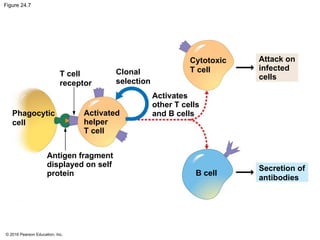
#54 Figure 24.7 The roles of an activated helper T cell
#55 Student Misconceptions and Concerns
1. For students with limited science backgrounds, this section of the chapter can be particularly difficult; for some, it is the most challenging part of the textbook. Students must have a solid knowledge of the properties of different cells and their interactions, and understand that repeated exposure to antigens generates new interactions. The challenge is similar to explaining a new sport to someone unfamiliar to the game. (Imagine explaining the rules and strategies of football or poker to someone who had never heard of them.) Instructors might consider slowing their pace and using learning aids such as reference lists of cell types and their functions, or diagrams that remind students of these cellular interactions.
Teaching Tips
1. The authors suggest that the specific nature of the binding between an antigen and an antibody is like the relationship between a lock and a key. You might further this analogy by noting that the tremendous diversity of antibodies is like having a set of keys for virtually every possible type of lock.
2. Our own learning experiences provide an analogy to the greater swiftness and intensity of a secondary immune response. When first presented with a problem, we may struggle to determine how best to respond. However, with that first experience behind us, we expect to respond more quickly and effectively when we meet that challenge again. Although in each circumstance we benefit from a certain type of memory (experiential in one case, chemical in the other), their mechanisms are quite different. Consider noting these similarities and differences in your class discussion of primary and secondary immune responses.
3. The recognition by a helper T cell of a self protein and a foreign antigen in combination is like the two-key system used by banks to access safe-deposit boxes.
4. The Centers for Disease Control and Prevention has extensive information about AIDS and other public health threats at www.cdc.gov/hiv.
Active Lecture Tips
1. Consider challenging your class to explain the adaptive advantages of the Y shape of an antibody. Why is an antibody not just a single heavy chain and light chain? (Many biologists think that the Y shape permits the binding together of two antigens or antigen-presenting surfaces, permitting a chain reaction or form of clumping.)
2. See the Activity The Immune System as the Body’s Militia on the Instructor Exchange. Visit the Instructor Exchange in the MasteringBiology instructor resource area for a description of this activity.
3. See the Activity Collecting Student Misconceptions About the Flu Vaccine on the Instructor Exchange. Visit the Instructor Exchange in the MasteringBiology instructor resource area for a description of this activity.
4. See the Activity The Function of Antibodies and Complement Compared to Chocolate Chips on the Instructor Exchange. Visit the Instructor Exchange in the MasteringBiology instructor resource area for a description of this activity.
#58 Student Misconceptions and Concerns
1. For students with limited science backgrounds, this section of the chapter can be particularly difficult; for some, it is the most challenging part of the textbook. Students must have a solid knowledge of the properties of different cells and their interactions, and understand that repeated exposure to antigens generates new interactions. The challenge is similar to explaining a new sport to someone unfamiliar to the game. (Imagine explaining the rules and strategies of football or poker to someone who had never heard of them.) Instructors might consider slowing their pace and using learning aids such as reference lists of cell types and their functions, or diagrams that remind students of these cellular interactions.
Teaching Tips
1. The authors suggest that the specific nature of the binding between an antigen and an antibody is like the relationship between a lock and a key. You might further this analogy by noting that the tremendous diversity of antibodies is like having a set of keys for virtually every possible type of lock.
2. Our own learning experiences provide an analogy to the greater swiftness and intensity of a secondary immune response. When first presented with a problem, we may struggle to determine how best to respond. However, with that first experience behind us, we expect to respond more quickly and effectively when we meet that challenge again. Although in each circumstance we benefit from a certain type of memory (experiential in one case, chemical in the other), their mechanisms are quite different. Consider noting these similarities and differences in your class discussion of primary and secondary immune responses.
3. The recognition by a helper T cell of a self protein and a foreign antigen in combination is like the two-key system used by banks to access safe-deposit boxes.
4. The Centers for Disease Control and Prevention has extensive information about AIDS and other public health threats at www.cdc.gov/hiv.
Active Lecture Tips
1. Consider challenging your class to explain the adaptive advantages of the Y shape of an antibody. Why is an antibody not just a single heavy chain and light chain? (Many biologists think that the Y shape permits the binding together of two antigens or antigen-presenting surfaces, permitting a chain reaction or form of clumping.)
2. See the Activity The Immune System as the Body’s Militia on the Instructor Exchange. Visit the Instructor Exchange in the MasteringBiology instructor resource area for a description of this activity.
3. See the Activity Collecting Student Misconceptions About the Flu Vaccine on the Instructor Exchange. Visit the Instructor Exchange in the MasteringBiology instructor resource area for a description of this activity.
4. See the Activity The Function of Antibodies and Complement Compared to Chocolate Chips on the Instructor Exchange. Visit the Instructor Exchange in the MasteringBiology instructor resource area for a description of this activity.
#59 Student Misconceptions and Concerns
1. For students with limited science backgrounds, this section of the chapter can be particularly difficult; for some, it is the most challenging part of the textbook. Students must have a solid knowledge of the properties of different cells and their interactions, and understand that repeated exposure to antigens generates new interactions. The challenge is similar to explaining a new sport to someone unfamiliar to the game. (Imagine explaining the rules and strategies of football or poker to someone who had never heard of them.) Instructors might consider slowing their pace and using learning aids such as reference lists of cell types and their functions, or diagrams that remind students of these cellular interactions.
Teaching Tips
1. The authors suggest that the specific nature of the binding between an antigen and an antibody is like the relationship between a lock and a key. You might further this analogy by noting that the tremendous diversity of antibodies is like having a set of keys for virtually every possible type of lock.
2. Our own learning experiences provide an analogy to the greater swiftness and intensity of a secondary immune response. When first presented with a problem, we may struggle to determine how best to respond. However, with that first experience behind us, we expect to respond more quickly and effectively when we meet that challenge again. Although in each circumstance we benefit from a certain type of memory (experiential in one case, chemical in the other), their mechanisms are quite different. Consider noting these similarities and differences in your class discussion of primary and secondary immune responses.
3. The recognition by a helper T cell of a self protein and a foreign antigen in combination is like the two-key system used by banks to access safe-deposit boxes.
4. The Centers for Disease Control and Prevention has extensive information about AIDS and other public health threats at www.cdc.gov/hiv.
Active Lecture Tips
1. Consider challenging your class to explain the adaptive advantages of the Y shape of an antibody. Why is an antibody not just a single heavy chain and light chain? (Many biologists think that the Y shape permits the binding together of two antigens or antigen-presenting surfaces, permitting a chain reaction or form of clumping.)
2. See the Activity The Immune System as the Body’s Militia on the Instructor Exchange. Visit the Instructor Exchange in the MasteringBiology instructor resource area for a description of this activity.
3. See the Activity Collecting Student Misconceptions About the Flu Vaccine on the Instructor Exchange. Visit the Instructor Exchange in the MasteringBiology instructor resource area for a description of this activity.
4. See the Activity The Function of Antibodies and Complement Compared to Chocolate Chips on the Instructor Exchange. Visit the Instructor Exchange in the MasteringBiology instructor resource area for a description of this activity.
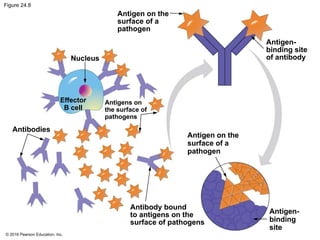
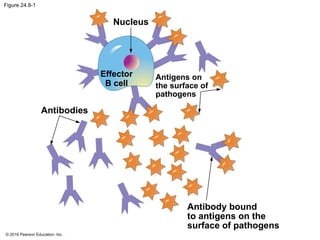
#62 Figure 24.8-1 The B cell response (part 1: antibodies bind antigens)
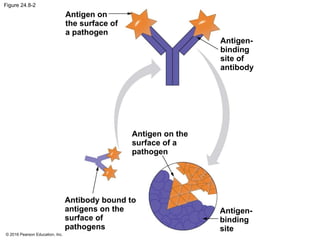
#63 Figure 24.8-2 The B cell response (part 2: antigen binding site)
#64 Student Misconceptions and Concerns
1. For students with limited science backgrounds, this section of the chapter can be particularly difficult; for some, it is the most challenging part of the textbook. Students must have a solid knowledge of the properties of different cells and their interactions, and understand that repeated exposure to antigens generates new interactions. The challenge is similar to explaining a new sport to someone unfamiliar to the game. (Imagine explaining the rules and strategies of football or poker to someone who had never heard of them.) Instructors might consider slowing their pace and using learning aids such as reference lists of cell types and their functions, or diagrams that remind students of these cellular interactions.
Teaching Tips
1. The authors suggest that the specific nature of the binding between an antigen and an antibody is like the relationship between a lock and a key. You might further this analogy by noting that the tremendous diversity of antibodies is like having a set of keys for virtually every possible type of lock.
2. Our own learning experiences provide an analogy to the greater swiftness and intensity of a secondary immune response. When first presented with a problem, we may struggle to determine how best to respond. However, with that first experience behind us, we expect to respond more quickly and effectively when we meet that challenge again. Although in each circumstance we benefit from a certain type of memory (experiential in one case, chemical in the other), their mechanisms are quite different. Consider noting these similarities and differences in your class discussion of primary and secondary immune responses.
3. The recognition by a helper T cell of a self protein and a foreign antigen in combination is like the two-key system used by banks to access safe-deposit boxes.
4. The Centers for Disease Control and Prevention has extensive information about AIDS and other public health threats at www.cdc.gov/hiv.
Active Lecture Tips
1. Consider challenging your class to explain the adaptive advantages of the Y shape of an antibody. Why is an antibody not just a single heavy chain and light chain? (Many biologists think that the Y shape permits the binding together of two antigens or antigen-presenting surfaces, permitting a chain reaction or form of clumping.)
2. See the Activity The Immune System as the Body’s Militia on the Instructor Exchange. Visit the Instructor Exchange in the MasteringBiology instructor resource area for a description of this activity.
3. See the Activity Collecting Student Misconceptions About the Flu Vaccine on the Instructor Exchange. Visit the Instructor Exchange in the MasteringBiology instructor resource area for a description of this activity.
4. See the Activity The Function of Antibodies and Complement Compared to Chocolate Chips on the Instructor Exchange. Visit the Instructor Exchange in the MasteringBiology instructor resource area for a description of this activity.
#65 Figure 24.9-1 The binding of antibodies to antigens blocks or helps to destroy an invader (part 1: antibodies block virus entry)
#66 Student Misconceptions and Concerns
1. For students with limited science backgrounds, this section of the chapter can be particularly difficult; for some, it is the most challenging part of the textbook. Students must have a solid knowledge of the properties of different cells and their interactions, and understand that repeated exposure to antigens generates new interactions. The challenge is similar to explaining a new sport to someone unfamiliar to the game. (Imagine explaining the rules and strategies of football or poker to someone who had never heard of them.) Instructors might consider slowing their pace and using learning aids such as reference lists of cell types and their functions, or diagrams that remind students of these cellular interactions.
Teaching Tips
1. The authors suggest that the specific nature of the binding between an antigen and an antibody is like the relationship between a lock and a key. You might further this analogy by noting that the tremendous diversity of antibodies is like having a set of keys for virtually every possible type of lock.
2. Our own learning experiences provide an analogy to the greater swiftness and intensity of a secondary immune response. When first presented with a problem, we may struggle to determine how best to respond. However, with that first experience behind us, we expect to respond more quickly and effectively when we meet that challenge again. Although in each circumstance we benefit from a certain type of memory (experiential in one case, chemical in the other), their mechanisms are quite different. Consider noting these similarities and differences in your class discussion of primary and secondary immune responses.
3. The recognition by a helper T cell of a self protein and a foreign antigen in combination is like the two-key system used by banks to access safe-deposit boxes.
4. The Centers for Disease Control and Prevention has extensive information about AIDS and other public health threats at www.cdc.gov/hiv.
Active Lecture Tips
1. Consider challenging your class to explain the adaptive advantages of the Y shape of an antibody. Why is an antibody not just a single heavy chain and light chain? (Many biologists think that the Y shape permits the binding together of two antigens or antigen-presenting surfaces, permitting a chain reaction or form of clumping.)
2. See the Activity The Immune System as the Body’s Militia on the Instructor Exchange. Visit the Instructor Exchange in the MasteringBiology instructor resource area for a description of this activity.
3. See the Activity Collecting Student Misconceptions About the Flu Vaccine on the Instructor Exchange. Visit the Instructor Exchange in the MasteringBiology instructor resource area for a description of this activity.
4. See the Activity The Function of Antibodies and Complement Compared to Chocolate Chips on the Instructor Exchange. Visit the Instructor Exchange in the MasteringBiology instructor resource area for a description of this activity.
#67 Figure 24.9-2 The binding of antibodies to antigens blocks or helps to destroy an invader (part 2: antibodies enhance phagocytosis)
#68 Student Misconceptions and Concerns
1. For students with limited science backgrounds, this section of the chapter can be particularly difficult; for some, it is the most challenging part of the textbook. Students must have a solid knowledge of the properties of different cells and their interactions, and understand that repeated exposure to antigens generates new interactions. The challenge is similar to explaining a new sport to someone unfamiliar to the game. (Imagine explaining the rules and strategies of football or poker to someone who had never heard of them.) Instructors might consider slowing their pace and using learning aids such as reference lists of cell types and their functions, or diagrams that remind students of these cellular interactions.
Teaching Tips
1. The authors suggest that the specific nature of the binding between an antigen and an antibody is like the relationship between a lock and a key. You might further this analogy by noting that the tremendous diversity of antibodies is like having a set of keys for virtually every possible type of lock.
2. Our own learning experiences provide an analogy to the greater swiftness and intensity of a secondary immune response. When first presented with a problem, we may struggle to determine how best to respond. However, with that first experience behind us, we expect to respond more quickly and effectively when we meet that challenge again. Although in each circumstance we benefit from a certain type of memory (experiential in one case, chemical in the other), their mechanisms are quite different. Consider noting these similarities and differences in your class discussion of primary and secondary immune responses.
3. The recognition by a helper T cell of a self protein and a foreign antigen in combination is like the two-key system used by banks to access safe-deposit boxes.
4. The Centers for Disease Control and Prevention has extensive information about AIDS and other public health threats at www.cdc.gov/hiv.
Active Lecture Tips
1. Consider challenging your class to explain the adaptive advantages of the Y shape of an antibody. Why is an antibody not just a single heavy chain and light chain? (Many biologists think that the Y shape permits the binding together of two antigens or antigen-presenting surfaces, permitting a chain reaction or form of clumping.)
2. See the Activity The Immune System as the Body’s Militia on the Instructor Exchange. Visit the Instructor Exchange in the MasteringBiology instructor resource area for a description of this activity.
3. See the Activity Collecting Student Misconceptions About the Flu Vaccine on the Instructor Exchange. Visit the Instructor Exchange in the MasteringBiology instructor resource area for a description of this activity.
4. See the Activity The Function of Antibodies and Complement Compared to Chocolate Chips on the Instructor Exchange. Visit the Instructor Exchange in the MasteringBiology instructor resource area for a description of this activity.
#70 Student Misconceptions and Concerns
1. For students with limited science backgrounds, this section of the chapter can be particularly difficult; for some, it is the most challenging part of the textbook. Students must have a solid knowledge of the properties of different cells and their interactions, and understand that repeated exposure to antigens generates new interactions. The challenge is similar to explaining a new sport to someone unfamiliar to the game. (Imagine explaining the rules and strategies of football or poker to someone who had never heard of them.) Instructors might consider slowing their pace and using learning aids such as reference lists of cell types and their functions, or diagrams that remind students of these cellular interactions.
Teaching Tips
1. The authors suggest that the specific nature of the binding between an antigen and an antibody is like the relationship between a lock and a key. You might further this analogy by noting that the tremendous diversity of antibodies is like having a set of keys for virtually every possible type of lock.
2. Our own learning experiences provide an analogy to the greater swiftness and intensity of a secondary immune response. When first presented with a problem, we may struggle to determine how best to respond. However, with that first experience behind us, we expect to respond more quickly and effectively when we meet that challenge again. Although in each circumstance we benefit from a certain type of memory (experiential in one case, chemical in the other), their mechanisms are quite different. Consider noting these similarities and differences in your class discussion of primary and secondary immune responses.
3. The recognition by a helper T cell of a self protein and a foreign antigen in combination is like the two-key system used by banks to access safe-deposit boxes.
4. The Centers for Disease Control and Prevention has extensive information about AIDS and other public health threats at www.cdc.gov/hiv.
Active Lecture Tips
1. Consider challenging your class to explain the adaptive advantages of the Y shape of an antibody. Why is an antibody not just a single heavy chain and light chain? (Many biologists think that the Y shape permits the binding together of two antigens or antigen-presenting surfaces, permitting a chain reaction or form of clumping.)
2. See the Activity The Immune System as the Body’s Militia on the Instructor Exchange. Visit the Instructor Exchange in the MasteringBiology instructor resource area for a description of this activity.
3. See the Activity Collecting Student Misconceptions About the Flu Vaccine on the Instructor Exchange. Visit the Instructor Exchange in the MasteringBiology instructor resource area for a description of this activity.
4. See the Activity The Function of Antibodies and Complement Compared to Chocolate Chips on the Instructor Exchange. Visit the Instructor Exchange in the MasteringBiology instructor resource area for a description of this activity.
#71 Student Misconceptions and Concerns
1. For students with limited science backgrounds, this section of the chapter can be particularly difficult; for some, it is the most challenging part of the textbook. Students must have a solid knowledge of the properties of different cells and their interactions, and understand that repeated exposure to antigens generates new interactions. The challenge is similar to explaining a new sport to someone unfamiliar to the game. (Imagine explaining the rules and strategies of football or poker to someone who had never heard of them.) Instructors might consider slowing their pace and using learning aids such as reference lists of cell types and their functions, or diagrams that remind students of these cellular interactions.
Teaching Tips
1. The authors suggest that the specific nature of the binding between an antigen and an antibody is like the relationship between a lock and a key. You might further this analogy by noting that the tremendous diversity of antibodies is like having a set of keys for virtually every possible type of lock.
2. Our own learning experiences provide an analogy to the greater swiftness and intensity of a secondary immune response. When first presented with a problem, we may struggle to determine how best to respond. However, with that first experience behind us, we expect to respond more quickly and effectively when we meet that challenge again. Although in each circumstance we benefit from a certain type of memory (experiential in one case, chemical in the other), their mechanisms are quite different. Consider noting these similarities and differences in your class discussion of primary and secondary immune responses.
3. The recognition by a helper T cell of a self protein and a foreign antigen in combination is like the two-key system used by banks to access safe-deposit boxes.
4. The Centers for Disease Control and Prevention has extensive information about AIDS and other public health threats at www.cdc.gov/hiv.
Active Lecture Tips
1. Consider challenging your class to explain the adaptive advantages of the Y shape of an antibody. Why is an antibody not just a single heavy chain and light chain? (Many biologists think that the Y shape permits the binding together of two antigens or antigen-presenting surfaces, permitting a chain reaction or form of clumping.)
2. See the Activity The Immune System as the Body’s Militia on the Instructor Exchange. Visit the Instructor Exchange in the MasteringBiology instructor resource area for a description of this activity.
3. See the Activity Collecting Student Misconceptions About the Flu Vaccine on the Instructor Exchange. Visit the Instructor Exchange in the MasteringBiology instructor resource area for a description of this activity.
4. See the Activity The Function of Antibodies and Complement Compared to Chocolate Chips on the Instructor Exchange. Visit the Instructor Exchange in the MasteringBiology instructor resource area for a description of this activity.
#73 Student Misconceptions and Concerns
1. For students with limited science backgrounds, this section of the chapter can be particularly difficult; for some, it is the most challenging part of the textbook. Students must have a solid knowledge of the properties of different cells and their interactions, and understand that repeated exposure to antigens generates new interactions. The challenge is similar to explaining a new sport to someone unfamiliar to the game. (Imagine explaining the rules and strategies of football or poker to someone who had never heard of them.) Instructors might consider slowing their pace and using learning aids such as reference lists of cell types and their functions, or diagrams that remind students of these cellular interactions.
Teaching Tips
1. The authors suggest that the specific nature of the binding between an antigen and an antibody is like the relationship between a lock and a key. You might further this analogy by noting that the tremendous diversity of antibodies is like having a set of keys for virtually every possible type of lock.
2. Our own learning experiences provide an analogy to the greater swiftness and intensity of a secondary immune response. When first presented with a problem, we may struggle to determine how best to respond. However, with that first experience behind us, we expect to respond more quickly and effectively when we meet that challenge again. Although in each circumstance we benefit from a certain type of memory (experiential in one case, chemical in the other), their mechanisms are quite different. Consider noting these similarities and differences in your class discussion of primary and secondary immune responses.
3. The recognition by a helper T cell of a self protein and a foreign antigen in combination is like the two-key system used by banks to access safe-deposit boxes.
4. The Centers for Disease Control and Prevention has extensive information about AIDS and other public health threats at www.cdc.gov/hiv.
Active Lecture Tips
1. Consider challenging your class to explain the adaptive advantages of the Y shape of an antibody. Why is an antibody not just a single heavy chain and light chain? (Many biologists think that the Y shape permits the binding together of two antigens or antigen-presenting surfaces, permitting a chain reaction or form of clumping.)
2. See the Activity The Immune System as the Body’s Militia on the Instructor Exchange. Visit the Instructor Exchange in the MasteringBiology instructor resource area for a description of this activity.
3. See the Activity Collecting Student Misconceptions About the Flu Vaccine on the Instructor Exchange. Visit the Instructor Exchange in the MasteringBiology instructor resource area for a description of this activity.
4. See the Activity The Function of Antibodies and Complement Compared to Chocolate Chips on the Instructor Exchange. Visit the Instructor Exchange in the MasteringBiology instructor resource area for a description of this activity.
#74 Figure 24.11 Antibody production during the two phases of the B cell response
#75 Student Misconceptions and Concerns
1. For students with limited science backgrounds, this section of the chapter can be particularly difficult; for some, it is the most challenging part of the textbook. Students must have a solid knowledge of the properties of different cells and their interactions, and understand that repeated exposure to antigens generates new interactions. The challenge is similar to explaining a new sport to someone unfamiliar to the game. (Imagine explaining the rules and strategies of football or poker to someone who had never heard of them.) Instructors might consider slowing their pace and using learning aids such as reference lists of cell types and their functions, or diagrams that remind students of these cellular interactions.
Teaching Tips
1. The authors suggest that the specific nature of the binding between an antigen and an antibody is like the relationship between a lock and a key. You might further this analogy by noting that the tremendous diversity of antibodies is like having a set of keys for virtually every possible type of lock.
2. Our own learning experiences provide an analogy to the greater swiftness and intensity of a secondary immune response. When first presented with a problem, we may struggle to determine how best to respond. However, with that first experience behind us, we expect to respond more quickly and effectively when we meet that challenge again. Although in each circumstance we benefit from a certain type of memory (experiential in one case, chemical in the other), their mechanisms are quite different. Consider noting these similarities and differences in your class discussion of primary and secondary immune responses.
3. The recognition by a helper T cell of a self protein and a foreign antigen in combination is like the two-key system used by banks to access safe-deposit boxes.
4. The Centers for Disease Control and Prevention has extensive information about AIDS and other public health threats at www.cdc.gov/hiv.
Active Lecture Tips
1. Consider challenging your class to explain the adaptive advantages of the Y shape of an antibody. Why is an antibody not just a single heavy chain and light chain? (Many biologists think that the Y shape permits the binding together of two antigens or antigen-presenting surfaces, permitting a chain reaction or form of clumping.)
2. See the Activity The Immune System as the Body’s Militia on the Instructor Exchange. Visit the Instructor Exchange in the MasteringBiology instructor resource area for a description of this activity.
3. See the Activity Collecting Student Misconceptions About the Flu Vaccine on the Instructor Exchange. Visit the Instructor Exchange in the MasteringBiology instructor resource area for a description of this activity.
4. See the Activity The Function of Antibodies and Complement Compared to Chocolate Chips on the Instructor Exchange. Visit the Instructor Exchange in the MasteringBiology instructor resource area for a description of this activity.
#76 Student Misconceptions and Concerns
1. For students with limited science backgrounds, this section of the chapter can be particularly difficult; for some, it is the most challenging part of the textbook. Students must have a solid knowledge of the properties of different cells and their interactions, and understand that repeated exposure to antigens generates new interactions. The challenge is similar to explaining a new sport to someone unfamiliar to the game. (Imagine explaining the rules and strategies of football or poker to someone who had never heard of them.) Instructors might consider slowing their pace and using learning aids such as reference lists of cell types and their functions, or diagrams that remind students of these cellular interactions.
Teaching Tips
1. The authors suggest that the specific nature of the binding between an antigen and an antibody is like the relationship between a lock and a key. You might further this analogy by noting that the tremendous diversity of antibodies is like having a set of keys for virtually every possible type of lock.
2. Our own learning experiences provide an analogy to the greater swiftness and intensity of a secondary immune response. When first presented with a problem, we may struggle to determine how best to respond. However, with that first experience behind us, we expect to respond more quickly and effectively when we meet that challenge again. Although in each circumstance we benefit from a certain type of memory (experiential in one case, chemical in the other), their mechanisms are quite different. Consider noting these similarities and differences in your class discussion of primary and secondary immune responses.
3. The recognition by a helper T cell of a self protein and a foreign antigen in combination is like the two-key system used by banks to access safe-deposit boxes.
4. The Centers for Disease Control and Prevention has extensive information about AIDS and other public health threats at www.cdc.gov/hiv.
Active Lecture Tips
1. Consider challenging your class to explain the adaptive advantages of the Y shape of an antibody. Why is an antibody not just a single heavy chain and light chain? (Many biologists think that the Y shape permits the binding together of two antigens or antigen-presenting surfaces, permitting a chain reaction or form of clumping.)
2. See the Activity The Immune System as the Body’s Militia on the Instructor Exchange. Visit the Instructor Exchange in the MasteringBiology instructor resource area for a description of this activity.
3. See the Activity Collecting Student Misconceptions About the Flu Vaccine on the Instructor Exchange. Visit the Instructor Exchange in the MasteringBiology instructor resource area for a description of this activity.
4. See the Activity The Function of Antibodies and Complement Compared to Chocolate Chips on the Instructor Exchange. Visit the Instructor Exchange in the MasteringBiology instructor resource area for a description of this activity.