Seminar On
“CMOS Image Sensor”
GOVERNMENT COLLEGE OF ENGINEERING JALGAON
(An Autonomous Institute of Government of Maharashtra)
Department Of Electronics and Tele - Communication Engineering
(2022-2023)
Presented By
Lokesh Dhanraj More(1912217)
Under the Guidance of
Dr. S P Mohani
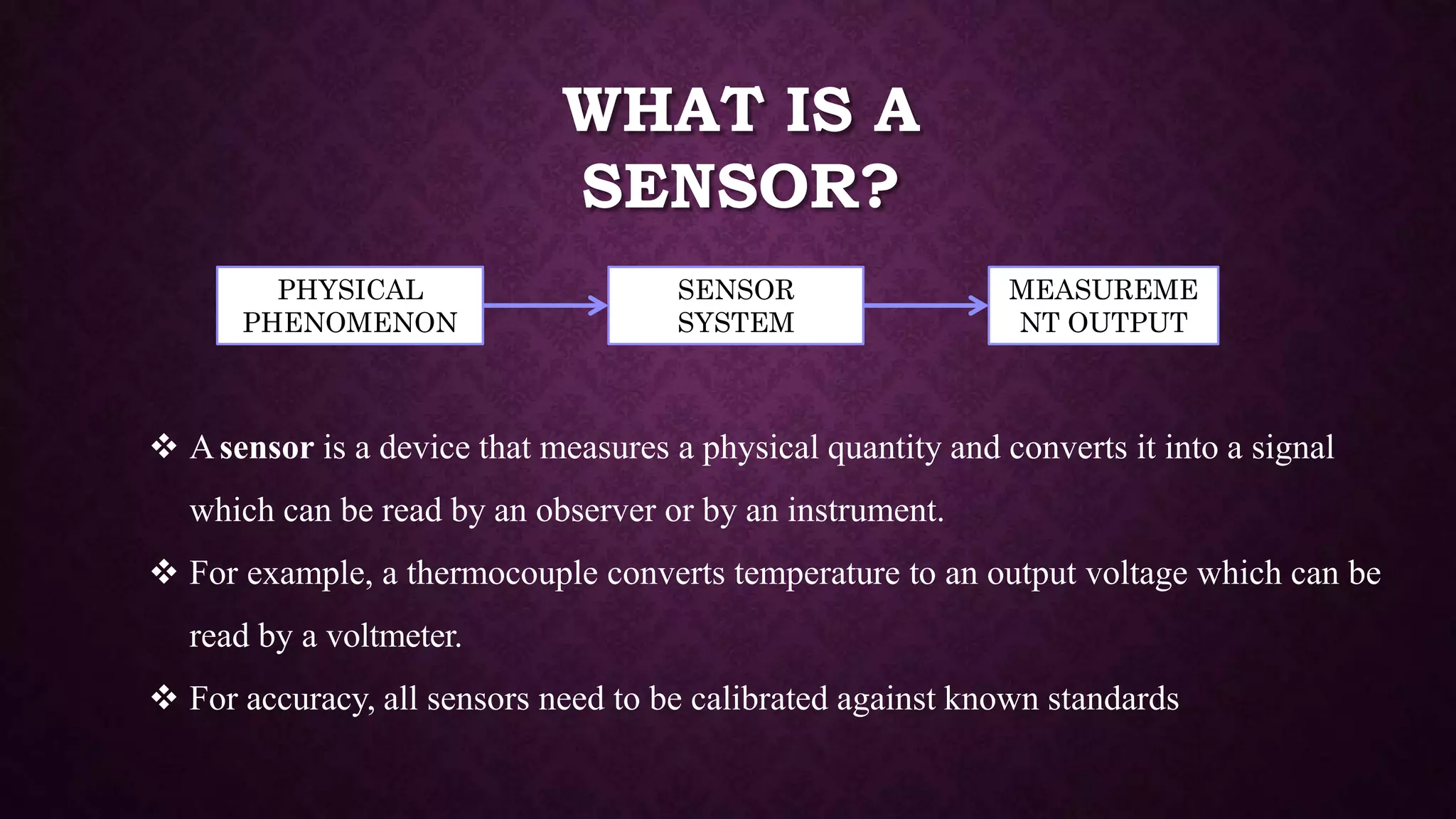
WHAT IS A
SENSOR?
PHYSICAL
PHENOMENON
SENSOR
SYSTEM
MEASUREME
NT OUTPUT
 Asensor is a device that measures a physical quantity and converts it into a signal
which can be read by an observer or by an instrument.
 For example, a thermocouple converts temperature to an output voltage which can be
read by a voltmeter.
 For accuracy, all sensors need to be calibrated against known standards
What is an Image Sensor?
 An image sensor is a device that converts an optical image into
an electrical signal.
 Unlike traditional camera, that use film to capture and store an
image, digital cameras use solid-state device called image
sensor.
 Image sensors contain millions of photosensitive diodes known
as photo sites.
 When you take a picture, the camera's shutter opens briefly and
each photo site on the image sensor records the brightness of the
light that falls on it by accumulating photons. The more light
that hits a photo site, the more photons it records.
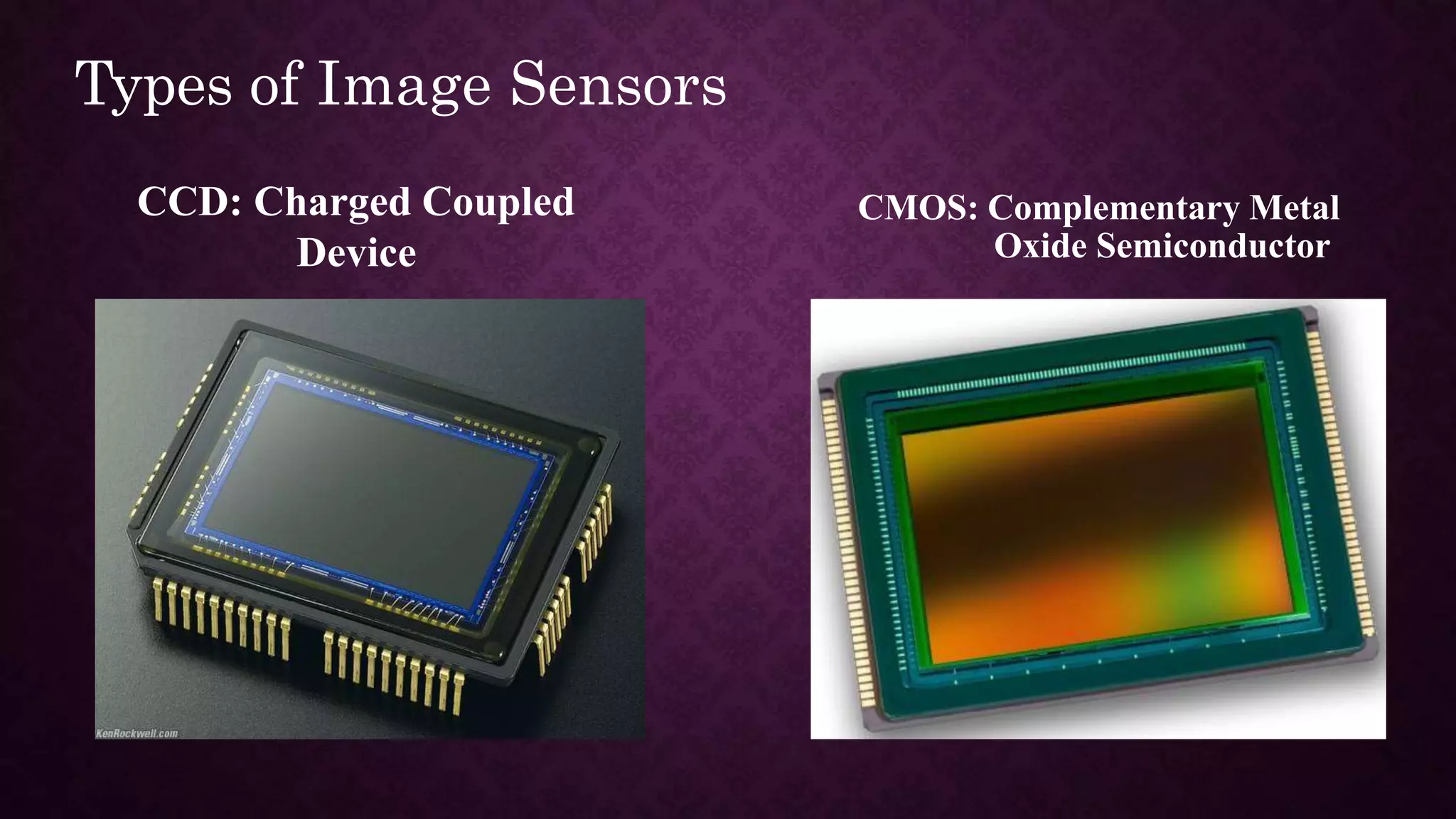
Types of Image Sensors
CCD: Charged Coupled
Device
CMOS: Complementary Metal
Oxide Semiconductor
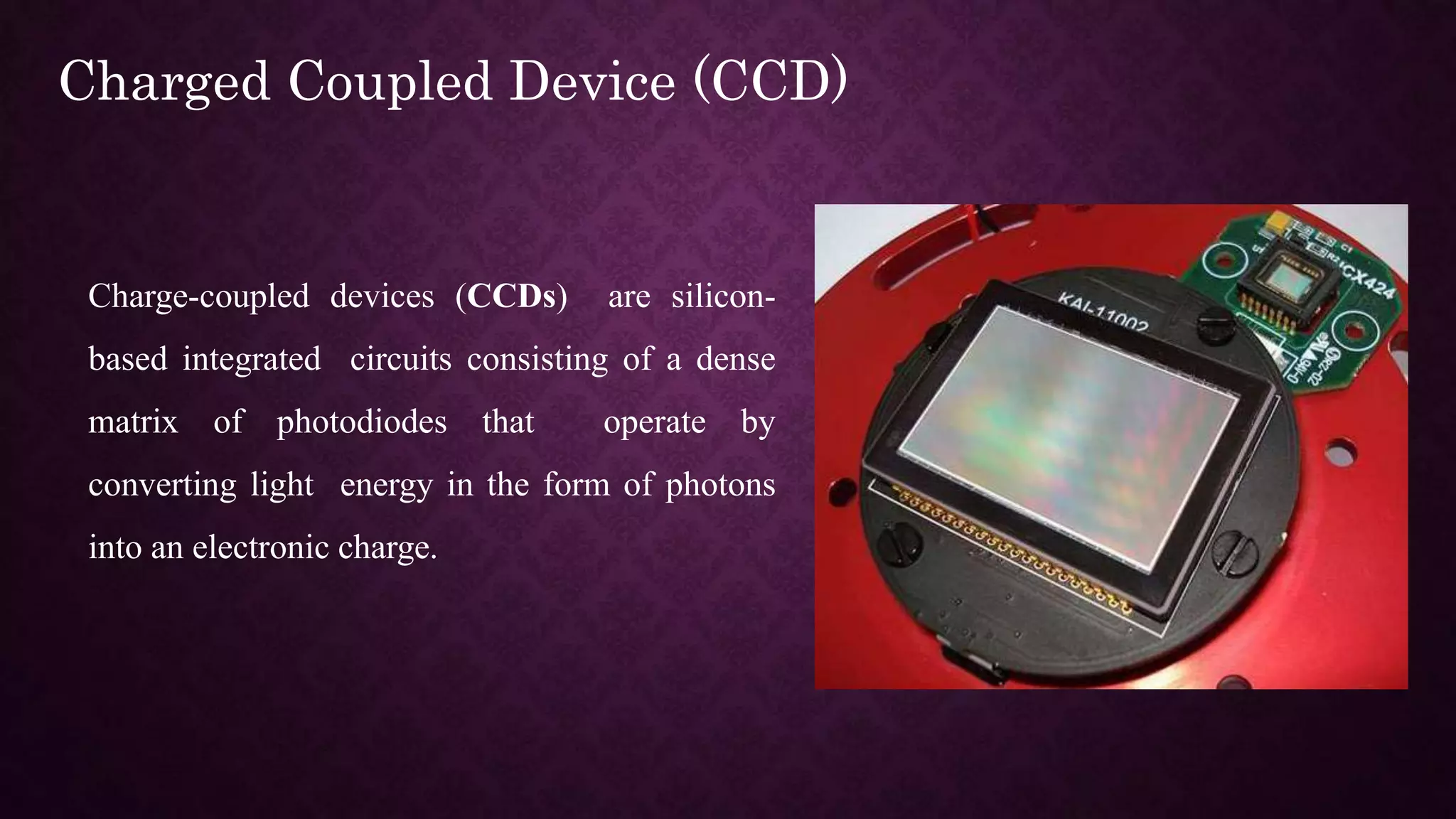
Charged Coupled Device (CCD)
Charge-coupled devices (CCDs) are silicon-
based integrated circuits consisting of a dense
matrix of photodiodes that operate by
converting light energy in the form of photons
into an electronic charge.
Basic Operation of a CCD
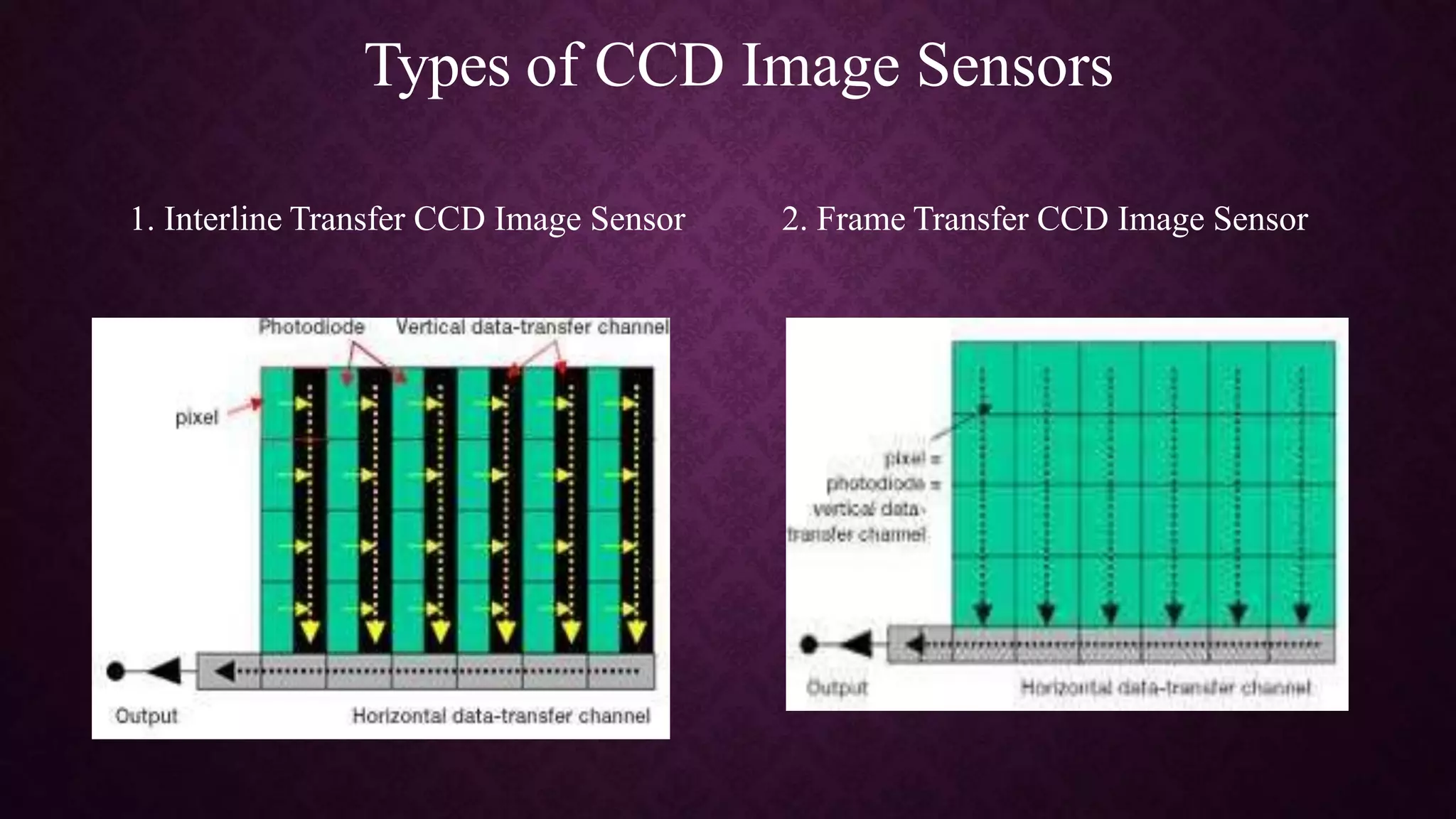
Types of CCD Image Sensors
1. Interline Transfer CCD Image Sensor 2. Frame Transfer CCD Image Sensor
COMPLEMENTARY METAL OXIDE SEMICONDUCTOR (CMOS)
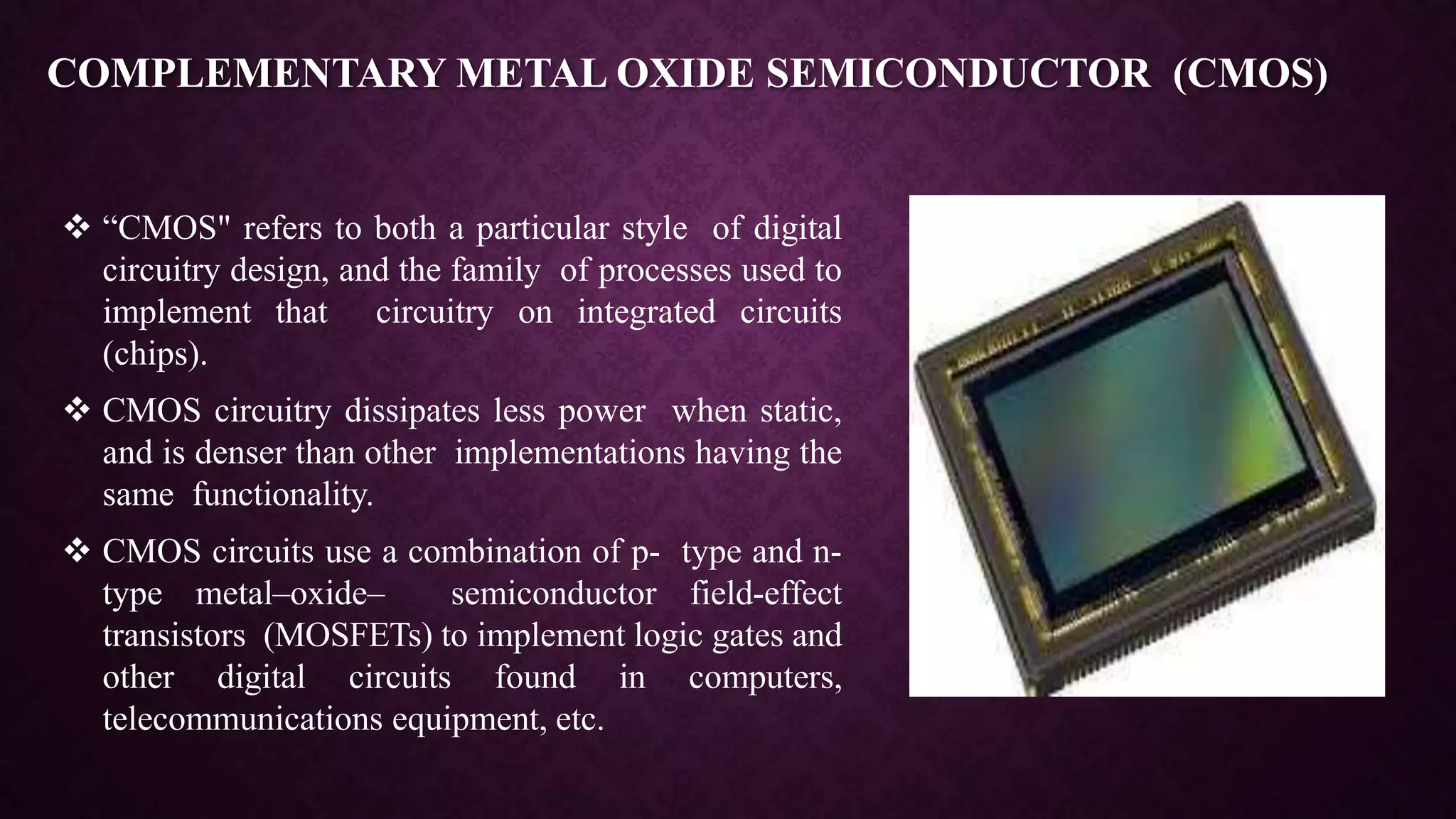
 “CMOS" refers to both a particular style of digital
circuitry design, and the family of processes used to
implement that circuitry on integrated circuits
(chips).
 CMOS circuitry dissipates less power when static,
and is denser than other implementations having the
same functionality.
 CMOS circuits use a combination of p- type and n-
type metal–oxide– semiconductor field-effect
transistors (MOSFETs) to implement logic gates and
other digital circuits found in computers,
telecommunications equipment, etc.
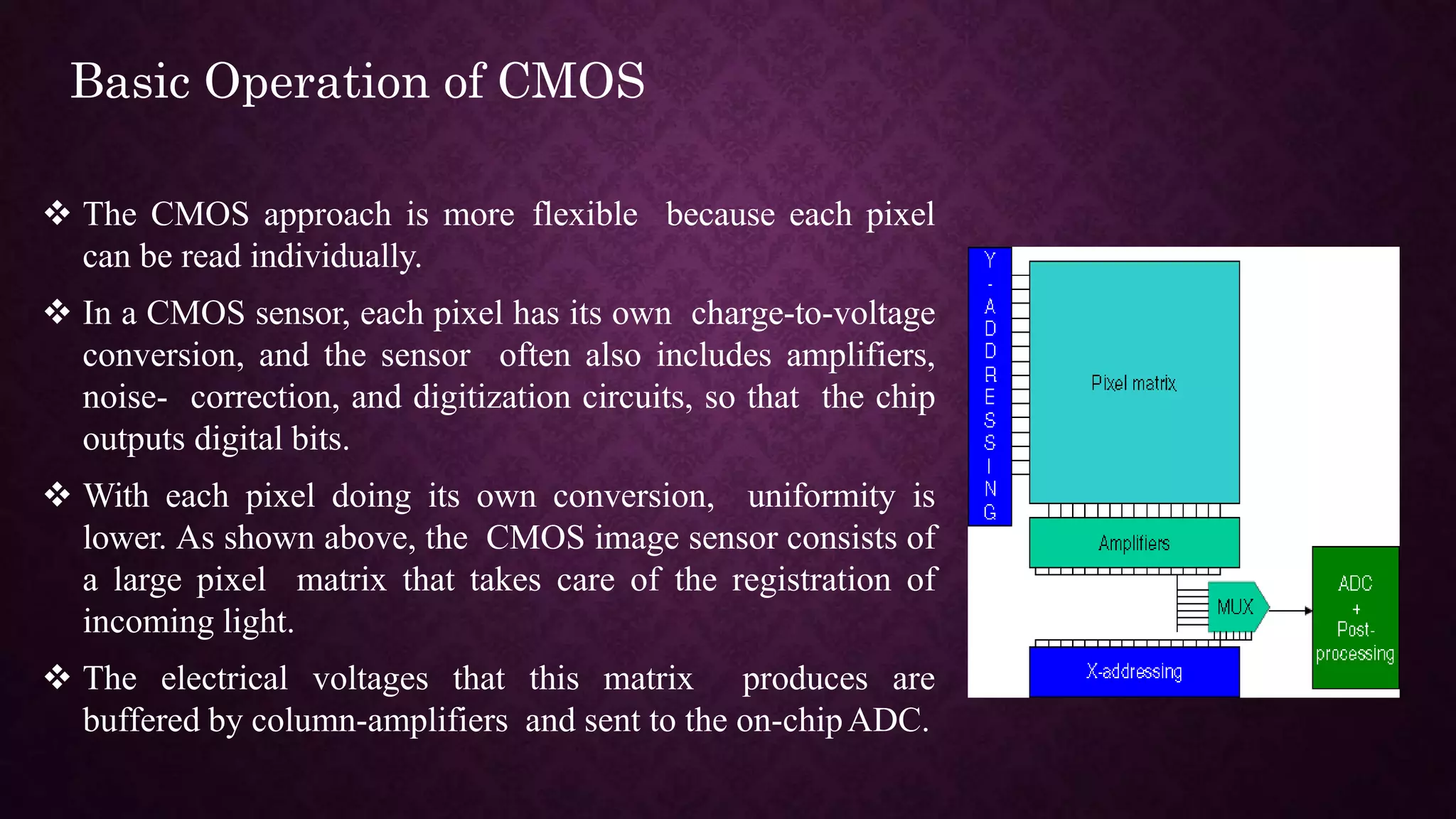
 The CMOS approach is more flexible because each pixel
can be read individually.
 In a CMOS sensor, each pixel has its own charge-to-voltage
conversion, and the sensor often also includes amplifiers,
noise- correction, and digitization circuits, so that the chip
outputs digital bits.
 With each pixel doing its own conversion, uniformity is
lower. As shown above, the CMOS image sensor consists of
a large pixel matrix that takes care of the registration of
incoming light.
 The electrical voltages that this matrix produces are
buffered by column-amplifiers and sent to the on-chipADC.
Basic Operation of CMOS
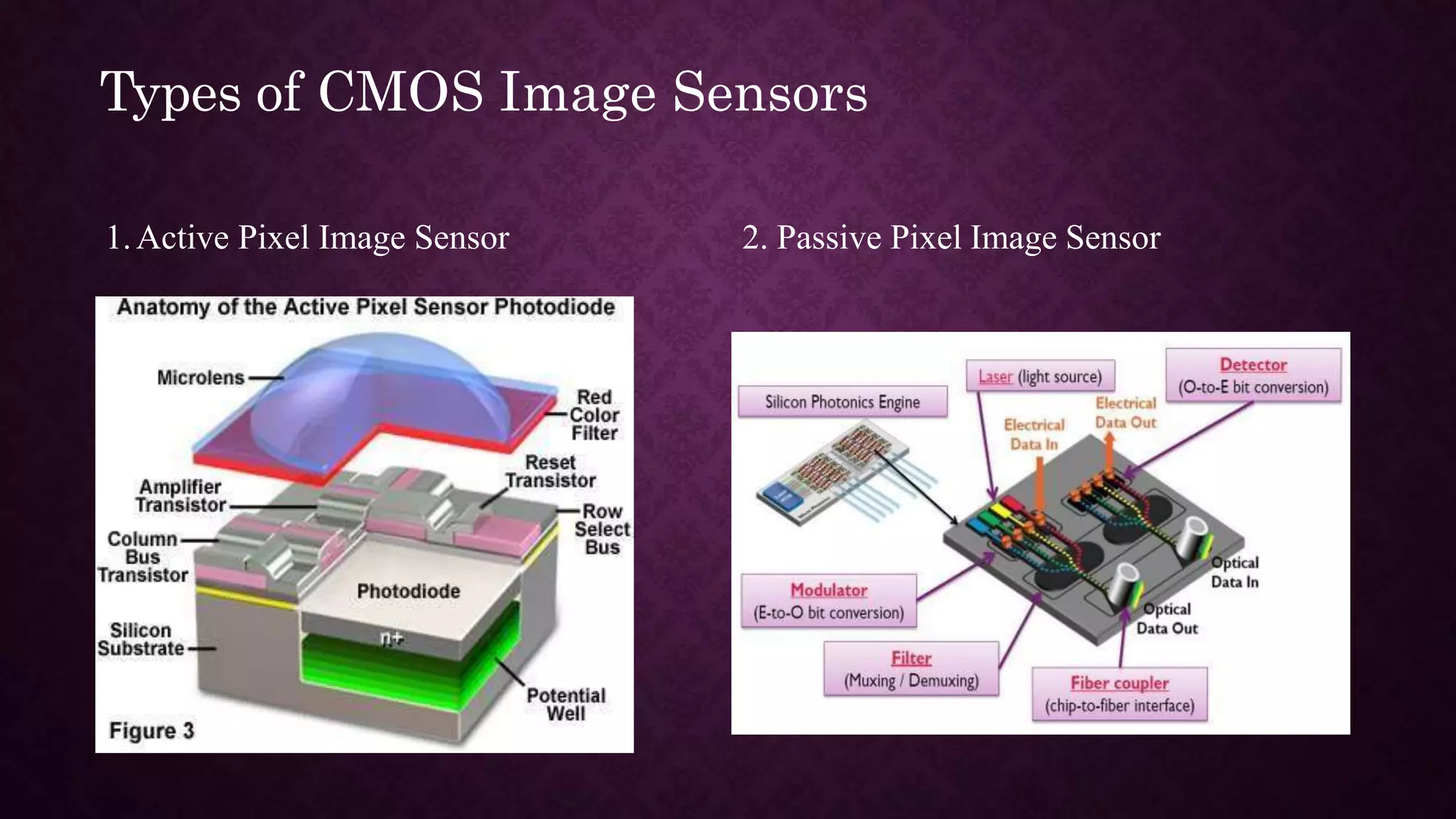
1.Active Pixel Image Sensor 2. Passive Pixel Image Sensor
Types of CMOS Image Sensors
Sensing Color
CCD vs CMOS
 Many separate chips required for CCD where cmos is built on single chip.
 Image stabilization and Image compression much more than ccd.
 Not only does this make the camera smaller, lighter, and cheaper; it also requires less
power so batteries last longer.
 CMOS image sensors can switch modes on the fly between still photography and video.
 CMOS sensors excel in the capture of outdoor pictures on sunny days, they suffer in low
light conditions.
APPLICATION OF IMAGE
SENSOR
CONCLUSION
CMOS imagers will replace CCD devices in some cases, because of its
low cost, low power consumption, integration capability, etc.
Nevertheless, CCD technology will continue as predominant in high
performance systems, such as medical imaging, astronomy, low-end
professional cameras, etc. because of its better image quality. To sum up,
State-of-the-art of CMOS image sensors has been provided.

CMOS IMAGE SENSOR.pptx

  • 1.
    Seminar On “CMOS ImageSensor” GOVERNMENT COLLEGE OF ENGINEERING JALGAON (An Autonomous Institute of Government of Maharashtra) Department Of Electronics and Tele - Communication Engineering (2022-2023) Presented By Lokesh Dhanraj More(1912217) Under the Guidance of Dr. S P Mohani
  • 2.
    WHAT IS A SENSOR? PHYSICAL PHENOMENON SENSOR SYSTEM MEASUREME NTOUTPUT  Asensor is a device that measures a physical quantity and converts it into a signal which can be read by an observer or by an instrument.  For example, a thermocouple converts temperature to an output voltage which can be read by a voltmeter.  For accuracy, all sensors need to be calibrated against known standards
  • 3.
    What is anImage Sensor?  An image sensor is a device that converts an optical image into an electrical signal.  Unlike traditional camera, that use film to capture and store an image, digital cameras use solid-state device called image sensor.  Image sensors contain millions of photosensitive diodes known as photo sites.  When you take a picture, the camera's shutter opens briefly and each photo site on the image sensor records the brightness of the light that falls on it by accumulating photons. The more light that hits a photo site, the more photons it records.
  • 4.
    Types of ImageSensors CCD: Charged Coupled Device CMOS: Complementary Metal Oxide Semiconductor
  • 5.
    Charged Coupled Device(CCD) Charge-coupled devices (CCDs) are silicon- based integrated circuits consisting of a dense matrix of photodiodes that operate by converting light energy in the form of photons into an electronic charge.
  • 6.
  • 7.
    Types of CCDImage Sensors 1. Interline Transfer CCD Image Sensor 2. Frame Transfer CCD Image Sensor
  • 8.
    COMPLEMENTARY METAL OXIDESEMICONDUCTOR (CMOS)  “CMOS" refers to both a particular style of digital circuitry design, and the family of processes used to implement that circuitry on integrated circuits (chips).  CMOS circuitry dissipates less power when static, and is denser than other implementations having the same functionality.  CMOS circuits use a combination of p- type and n- type metal–oxide– semiconductor field-effect transistors (MOSFETs) to implement logic gates and other digital circuits found in computers, telecommunications equipment, etc.
  • 9.
     The CMOSapproach is more flexible because each pixel can be read individually.  In a CMOS sensor, each pixel has its own charge-to-voltage conversion, and the sensor often also includes amplifiers, noise- correction, and digitization circuits, so that the chip outputs digital bits.  With each pixel doing its own conversion, uniformity is lower. As shown above, the CMOS image sensor consists of a large pixel matrix that takes care of the registration of incoming light.  The electrical voltages that this matrix produces are buffered by column-amplifiers and sent to the on-chipADC. Basic Operation of CMOS
  • 10.
    1.Active Pixel ImageSensor 2. Passive Pixel Image Sensor Types of CMOS Image Sensors
  • 11.
  • 12.
    CCD vs CMOS Many separate chips required for CCD where cmos is built on single chip.  Image stabilization and Image compression much more than ccd.  Not only does this make the camera smaller, lighter, and cheaper; it also requires less power so batteries last longer.  CMOS image sensors can switch modes on the fly between still photography and video.  CMOS sensors excel in the capture of outdoor pictures on sunny days, they suffer in low light conditions.
  • 13.
  • 14.
    CONCLUSION CMOS imagers willreplace CCD devices in some cases, because of its low cost, low power consumption, integration capability, etc. Nevertheless, CCD technology will continue as predominant in high performance systems, such as medical imaging, astronomy, low-end professional cameras, etc. because of its better image quality. To sum up, State-of-the-art of CMOS image sensors has been provided.