I. What is VLC
II. Visible light & Spectrum
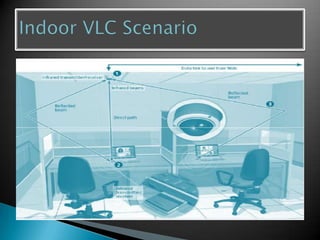
III. Indoor VLC scenario
IV. History
V. VLC process
VI. -Transmitter
VII. -Receiver
VIII. VLCC
IX. Comparison with RF
X. Applications
What is VLC..???
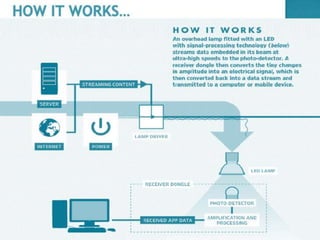
The visible light communication (VLC) refers to
the communication technology which utilizes the
visible light source as a signal transmitter, the air as
a transmission medium, and the appropriate
photodiode as a signal receiving component.
Visible light is thus by definition comprised
of visually-perceivable electromagnetic waves.
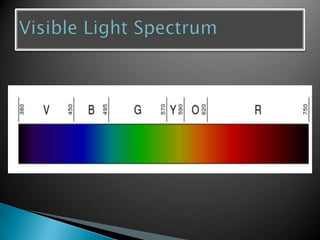
The visible spectrum covers wave lengths
from 380 nm to 750 nm.
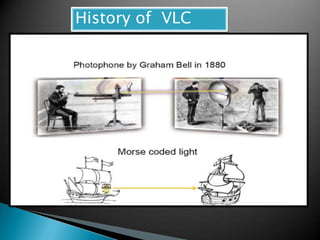
History of VLC
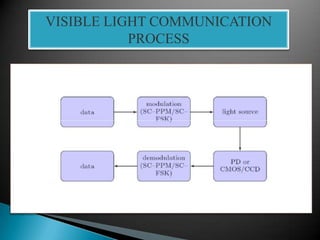
VISIBLE LIGHT COMMUNICATION
PROCESS
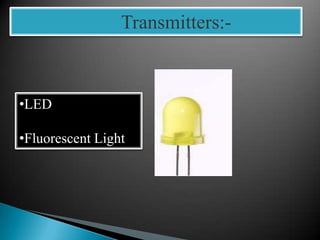
Transmitters:-
•LED
•Fluorescent Light
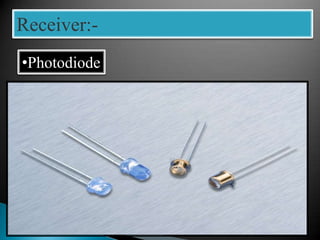
Receiver:-
•Photodiode
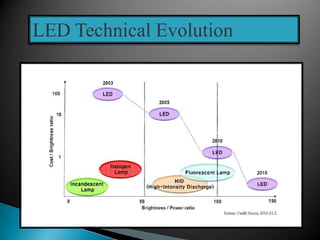
LED Technical Evolution
The Visible Light Communications
Consortium (VLCC) which is mainly
comprised of Japanese technology companies
was founded in November 2003. It increases
the data speed compared to any
communication
•Human Safety
•High Data Rate
•Bandwidth
•Security
•Visibility
•Unlicensed Spectrum
•Limited Transmission Power
•Regulated Spectrum:
•Banned in Sensitive Areas
• Position Detection
•Intelligent Transport System
• Image Sensor Communications
• Networking
• Audio Applications
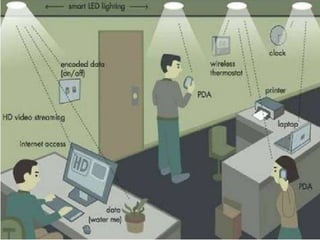
•LED can be used not only for lighting the
homes but also as means for wireless in-
house communication.
After few years the VLC is become more
popular
VISIBLE LIGHT COMMUNICATION

VISIBLE LIGHT COMMUNICATION