RAGHU ENGINEERING COLLEGE
(AUTONOMOUS)
DAKAMARRI
M UDAY KUMAR
17981A04B8
ECE-C
TECHNICAL SEMINAR ON
CHARGE COUPLED DEVICES
OBJECTIVE
• Study and observe working and application of
charged coupled devices
INTRODUCTION TO CCD’s
• CCDs are used to convert light into a digital
value
• The CCD captures light and converts it to
digital data that is recorded by the camera.
• It can be defined as a light-sensitive integrated
circuit imprinted on a silicon surface to form
light-sensitive elements called pixels, and each
pixel is converted into an electrical charge.
TYPES OF CCD’S
There are different CCDs such as
• Electron multiplying CCDs,
• Intensified CCD,
• Frame-transfer CCD
• Buried-channel CCD.
WORKING
• They transfer incoming photons into an electrical
charge in the CCD chip
• The photons are received in a photoactive region
of silicon
• A lens is used to focus the light onto the silicon
• A charge is accumulated in the capacitors
proportional to the light intensity
• Each photo site corresponds to an
individual pixel in the final image and photo sites
are often referred to simply as pixels.
• Each “photo sites” will refer to the CCD chip
and “pixels” will refer to an image.
• When a photon of light strikes the surface of
certain metal materials the energy imparted
by the photon can release an electron from
the metal.
• In a CCD, this electron is stored within the
walls of a photo site
HOW TO GET DATA FROM CCD’S
• Photo sites are read out, one row at a time,
into a serial register along the bottom of the
CCD array.
• The serial register then transfers the charge
from each photo site to an output node.
• From there the charge is sent to the camera’s
electronics unit where the electrons are
digitized.
8
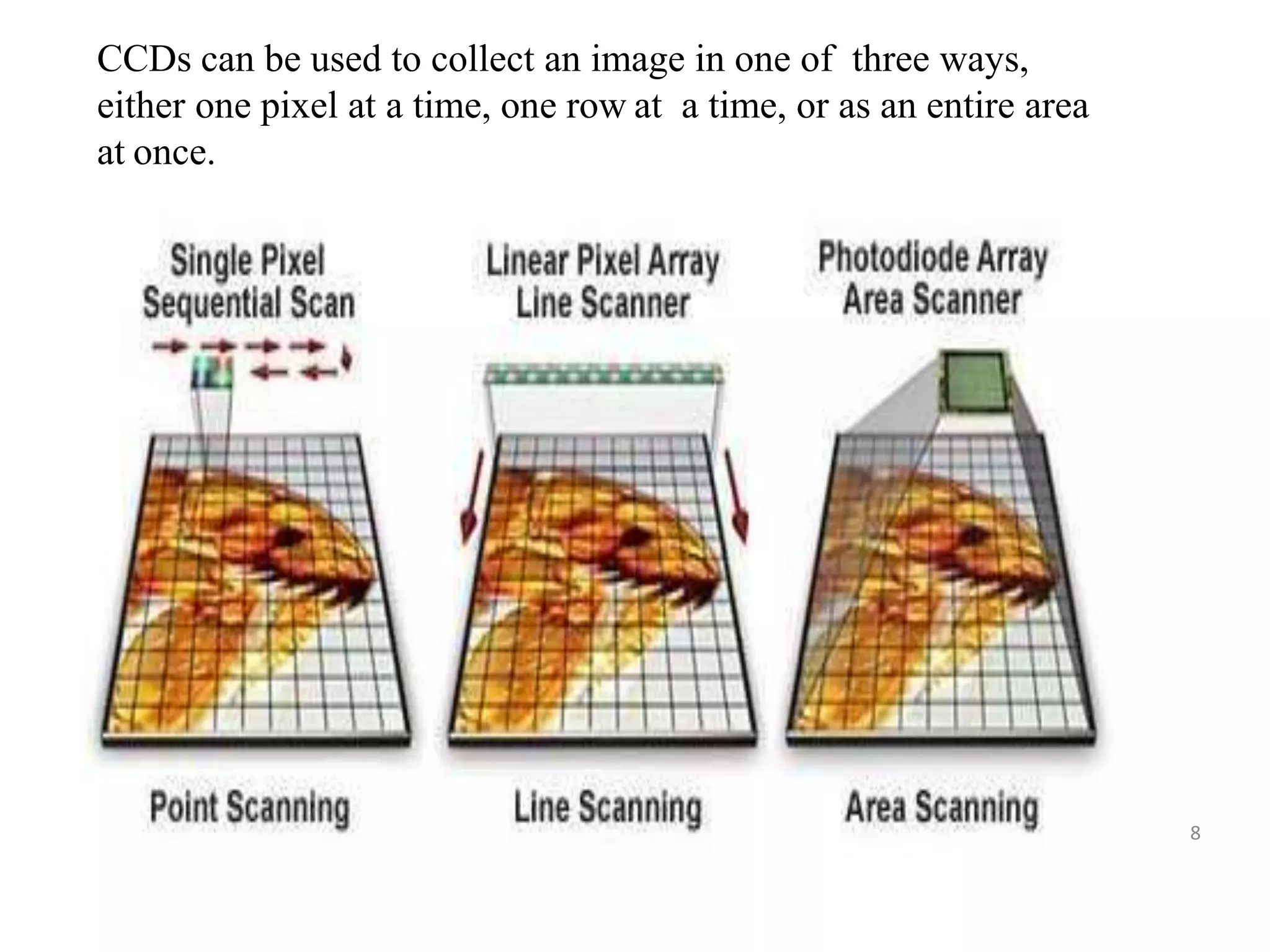
CCDs can be used to collect an image in one of three ways,
either one pixel at a time, one row at a time, or as an entire area
at once.
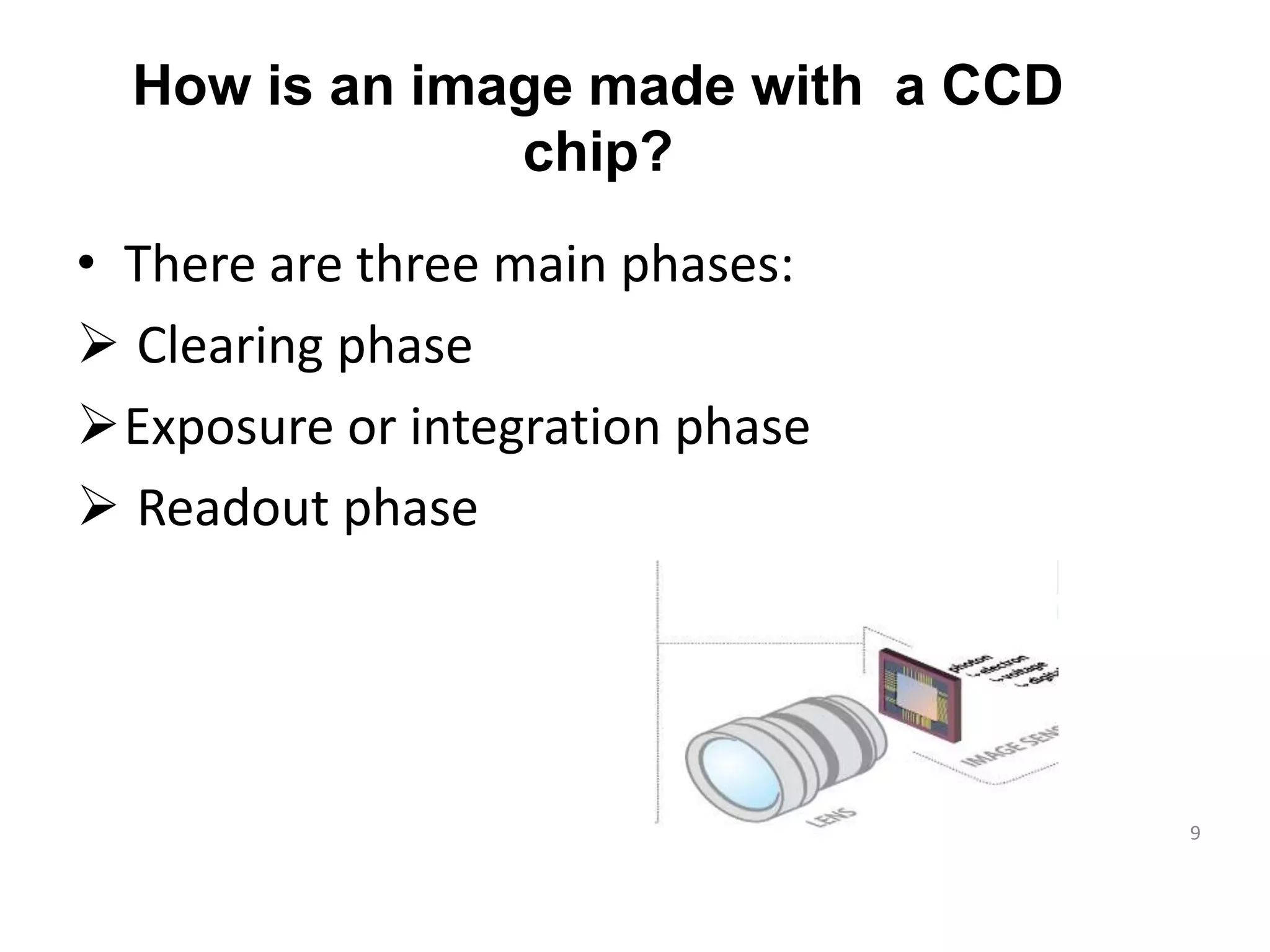
How is an image made with a CCD
chip?
• There are three main phases:
 Clearing phase
Exposure or integration phase
 Readout phase
9
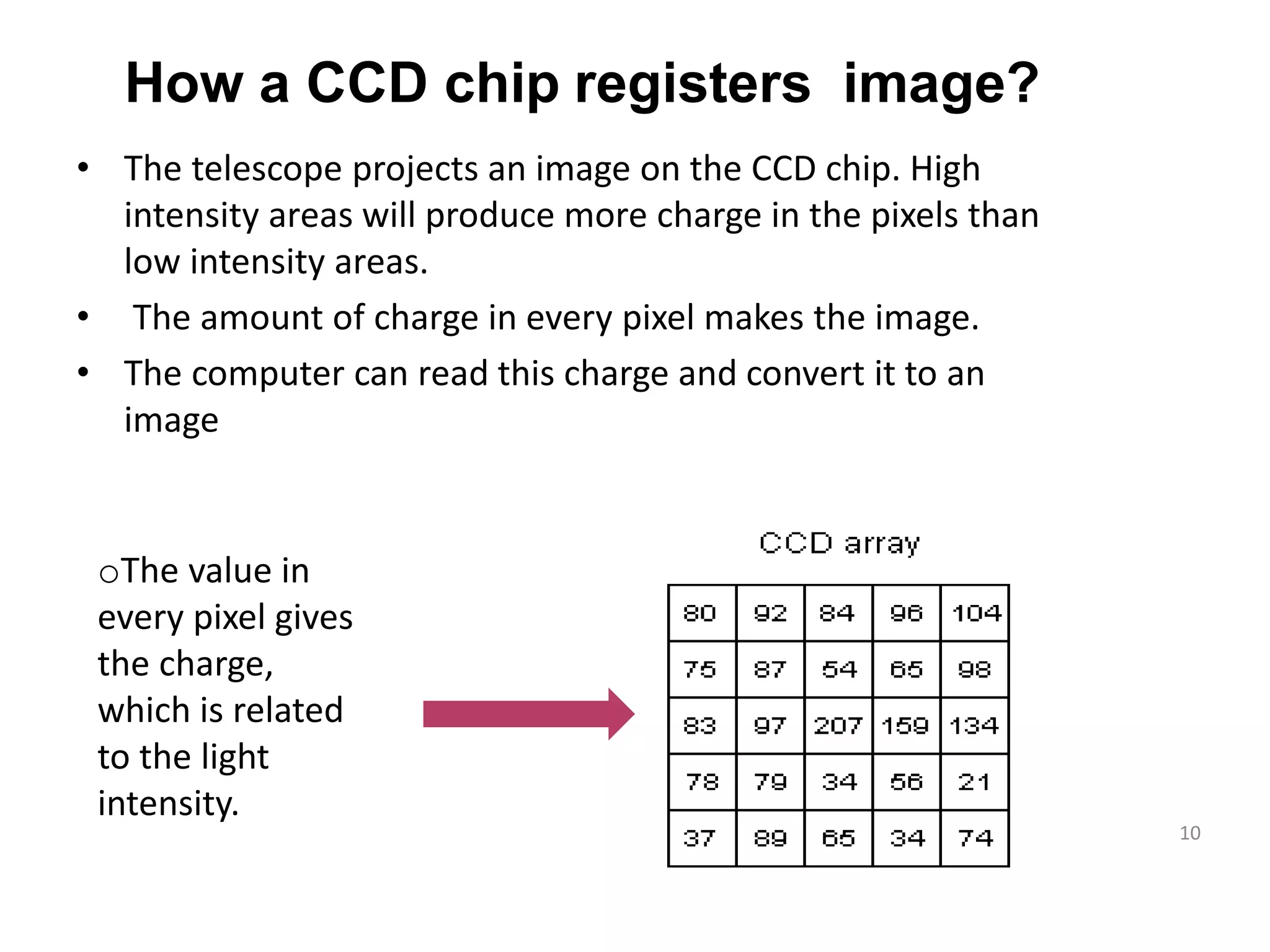
How a CCD chip registers image?
• The telescope projects an image on the CCD chip. High
intensity areas will produce more charge in the pixels than
low intensity areas.
• The amount of charge in every pixel makes the image.
• The computer can read this charge and convert it to an
image
10
oThe value in
every pixel gives
the charge,
which is related
to the light
intensity.
Clearing phase
• Mostly you don’t have a
shutter in your camera, this
means that there is always
light falling on the CCD chip.
• When you want to make an
image, all existing charge has
to be removed from the pixels.
• The lowest line will move the
charge to a clearing line,
where it will be removed.
• When all lines are shifted
away, there is no charge left
anymore
11
Exposure or integration phase
• The lens projects the image on the CCD chip, so charge
will accumulate in the pixels.
• The longer you wait, the more light will be registered
by the chip.
• This phase controls the exposure time, also called:
integration time,
• because the chip integrates the amount of light in a
certain period. With lunar and planetary photography
it usually takes a few tenths of a second, but it can take
minutes or even hours
Readout phase
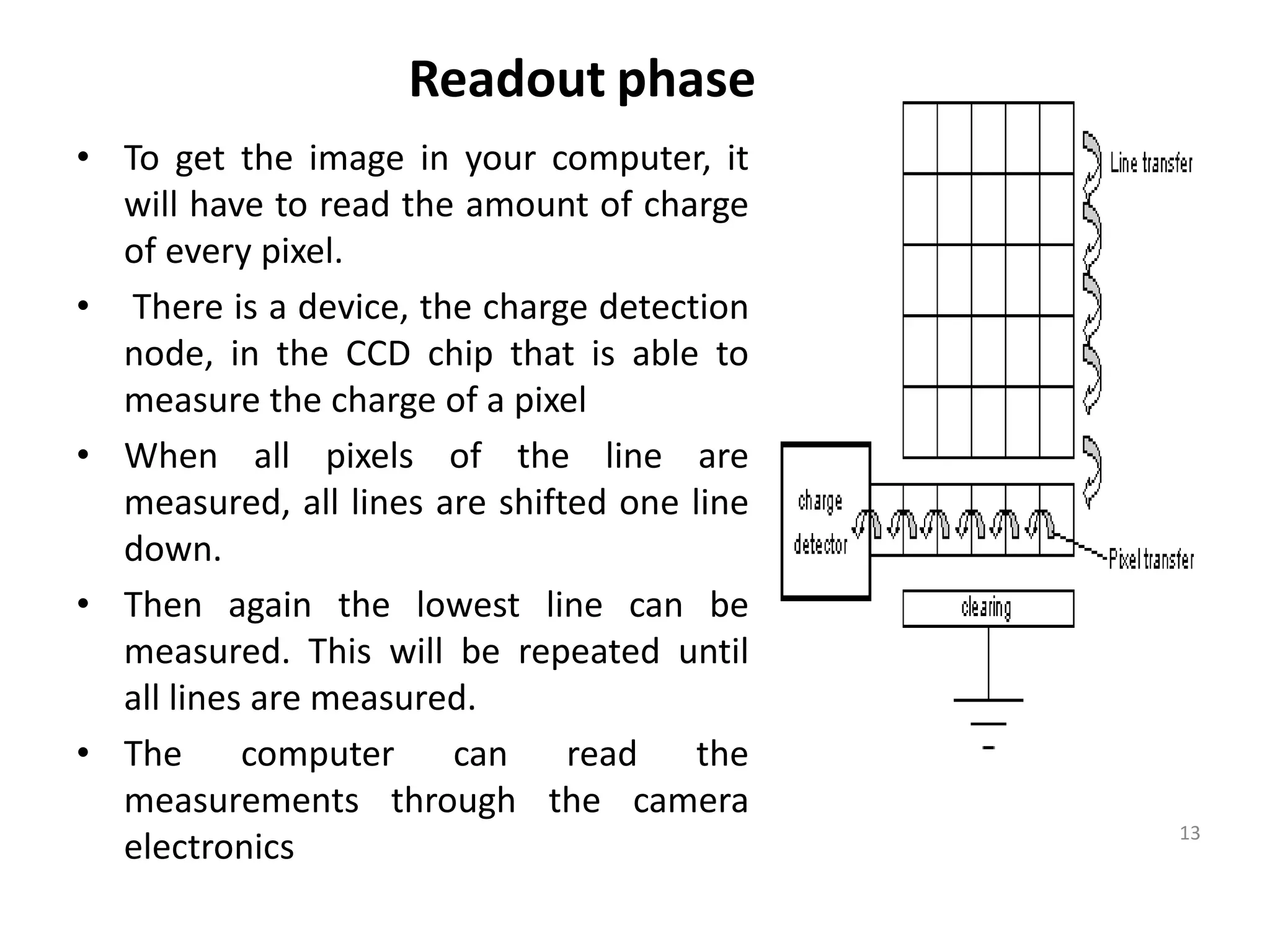
• To get the image in your computer, it
will have to read the amount of charge
of every pixel.
• There is a device, the charge detection
node, in the CCD chip that is able to
measure the charge of a pixel
• When all pixels of the line are
measured, all lines are shifted one line
down.
• Then again the lowest line can be
measured. This will be repeated until
all lines are measured.
• The computer can read the
measurements through the camera
electronics 13
Applications
• CCDs are used in digital cameras, optical
scanners and video cameras as light-sensing
devices.
• CCD cameras used in astrophotography.
• CCDs are typically sensitive to infrared light,
which allows infrared photography, night-vision
devices , video recording/photography.
• CCD are use to take exposures of galaxies and
nebulae
14
Advantages
o Relative simple
o More sensitive than photographic film
o Cheaper to replace if failure
o Modularity-easy upgrades
o Detector costs simple
o No chemical processing is needed
15
DISADVANTAGES
• CCD sensors consume much much more power.
• HD video-less pixel rates.
• CCDS are expensive as they require special
manufacturing.
• CCD sensors may be wired/wireless-mastering the
use requires some effort and learning period
REFERENCE
• https://www.elprocus.com/know-about-the-
working-principle-of-charge-coupled-device/
• https://en.wikipedia.org/wiki/Charge-
coupled_device

CHARGE COUPLED DEVICES

  • 1.
    RAGHU ENGINEERING COLLEGE (AUTONOMOUS) DAKAMARRI MUDAY KUMAR 17981A04B8 ECE-C TECHNICAL SEMINAR ON CHARGE COUPLED DEVICES
  • 2.
    OBJECTIVE • Study andobserve working and application of charged coupled devices
  • 3.
    INTRODUCTION TO CCD’s •CCDs are used to convert light into a digital value • The CCD captures light and converts it to digital data that is recorded by the camera. • It can be defined as a light-sensitive integrated circuit imprinted on a silicon surface to form light-sensitive elements called pixels, and each pixel is converted into an electrical charge.
  • 4.
    TYPES OF CCD’S Thereare different CCDs such as • Electron multiplying CCDs, • Intensified CCD, • Frame-transfer CCD • Buried-channel CCD.
  • 5.
    WORKING • They transferincoming photons into an electrical charge in the CCD chip • The photons are received in a photoactive region of silicon • A lens is used to focus the light onto the silicon • A charge is accumulated in the capacitors proportional to the light intensity • Each photo site corresponds to an individual pixel in the final image and photo sites are often referred to simply as pixels.
  • 6.
    • Each “photosites” will refer to the CCD chip and “pixels” will refer to an image. • When a photon of light strikes the surface of certain metal materials the energy imparted by the photon can release an electron from the metal. • In a CCD, this electron is stored within the walls of a photo site
  • 7.
    HOW TO GETDATA FROM CCD’S • Photo sites are read out, one row at a time, into a serial register along the bottom of the CCD array. • The serial register then transfers the charge from each photo site to an output node. • From there the charge is sent to the camera’s electronics unit where the electrons are digitized.
  • 8.
    8 CCDs can beused to collect an image in one of three ways, either one pixel at a time, one row at a time, or as an entire area at once.
  • 9.
    How is animage made with a CCD chip? • There are three main phases:  Clearing phase Exposure or integration phase  Readout phase 9
  • 10.
    How a CCDchip registers image? • The telescope projects an image on the CCD chip. High intensity areas will produce more charge in the pixels than low intensity areas. • The amount of charge in every pixel makes the image. • The computer can read this charge and convert it to an image 10 oThe value in every pixel gives the charge, which is related to the light intensity.
  • 11.
    Clearing phase • Mostlyyou don’t have a shutter in your camera, this means that there is always light falling on the CCD chip. • When you want to make an image, all existing charge has to be removed from the pixels. • The lowest line will move the charge to a clearing line, where it will be removed. • When all lines are shifted away, there is no charge left anymore 11
  • 12.
    Exposure or integrationphase • The lens projects the image on the CCD chip, so charge will accumulate in the pixels. • The longer you wait, the more light will be registered by the chip. • This phase controls the exposure time, also called: integration time, • because the chip integrates the amount of light in a certain period. With lunar and planetary photography it usually takes a few tenths of a second, but it can take minutes or even hours
  • 13.
    Readout phase • Toget the image in your computer, it will have to read the amount of charge of every pixel. • There is a device, the charge detection node, in the CCD chip that is able to measure the charge of a pixel • When all pixels of the line are measured, all lines are shifted one line down. • Then again the lowest line can be measured. This will be repeated until all lines are measured. • The computer can read the measurements through the camera electronics 13
  • 14.
    Applications • CCDs areused in digital cameras, optical scanners and video cameras as light-sensing devices. • CCD cameras used in astrophotography. • CCDs are typically sensitive to infrared light, which allows infrared photography, night-vision devices , video recording/photography. • CCD are use to take exposures of galaxies and nebulae 14
  • 15.
    Advantages o Relative simple oMore sensitive than photographic film o Cheaper to replace if failure o Modularity-easy upgrades o Detector costs simple o No chemical processing is needed 15
  • 16.
    DISADVANTAGES • CCD sensorsconsume much much more power. • HD video-less pixel rates. • CCDS are expensive as they require special manufacturing. • CCD sensors may be wired/wireless-mastering the use requires some effort and learning period
  • 17.