Spatial Transformations

IT472: Digital Image Processing, Lecture 5
Spatial Transformations

   Affine transformations of the support of the image f (x, y )
       Scaling: x = cx x and y = cy y             → f (x , y ) = f (x, y ).
       Rotation: x = x cos θ − y sin θ and
       y = x cos θ + y sin θ → f (x , y ) = f (x, y ).
       Translation: x = x + tx and
       y = y + ty → f (x , y ) = f (x, y ).
       Shear: x = x + sy y and y = y              → f (x , y ) = f (x, y ).
       All these collected together can be represented in a matrix
       form using Homogeneous coordinates, as follows:
                                                      
             x           cos θ/cx /1 sin θ/sy /0 0/tx       x
           y  =  − sin θ/sx /0 cos θ/cy /1 0/ty   y  (1)
             1                0           0         1       1


                        IT472: Lecture 5   2/18
Spatial Transformations

   Affine transformations of the support of the image f (x, y )
       Scaling: x = cx x and y = cy y             → f (x , y ) = f (x, y ).
       Rotation: x = x cos θ − y sin θ and
       y = x cos θ + y sin θ → f (x , y ) = f (x, y ).
       Translation: x = x + tx and
       y = y + ty → f (x , y ) = f (x, y ).
       Shear: x = x + sy y and y = y              → f (x , y ) = f (x, y ).
       All these collected together can be represented in a matrix
       form using Homogeneous coordinates, as follows:
                                                      
             x           cos θ/cx /1 sin θ/sy /0 0/tx       x
           y  =  − sin θ/sx /0 cos θ/cy /1 0/ty   y  (1)
             1                0           0         1       1


                        IT472: Lecture 5   2/18
Spatial Transformations

   Affine transformations of the support of the image f (x, y )
       Scaling: x = cx x and y = cy y             → f (x , y ) = f (x, y ).
       Rotation: x = x cos θ − y sin θ and
       y = x cos θ + y sin θ → f (x , y ) = f (x, y ).
       Translation: x = x + tx and
       y = y + ty → f (x , y ) = f (x, y ).
       Shear: x = x + sy y and y = y              → f (x , y ) = f (x, y ).
       All these collected together can be represented in a matrix
       form using Homogeneous coordinates, as follows:
                                                      
             x           cos θ/cx /1 sin θ/sy /0 0/tx       x
           y  =  − sin θ/sx /0 cos θ/cy /1 0/ty   y  (1)
             1                0           0         1       1


                        IT472: Lecture 5   2/18
Spatial Transformations

   Affine transformations of the support of the image f (x, y )
       Scaling: x = cx x and y = cy y             → f (x , y ) = f (x, y ).
       Rotation: x = x cos θ − y sin θ and
       y = x cos θ + y sin θ → f (x , y ) = f (x, y ).
       Translation: x = x + tx and
       y = y + ty → f (x , y ) = f (x, y ).
       Shear: x = x + sy y and y = y              → f (x , y ) = f (x, y ).
       All these collected together can be represented in a matrix
       form using Homogeneous coordinates, as follows:
                                                      
             x           cos θ/cx /1 sin θ/sy /0 0/tx       x
           y  =  − sin θ/sx /0 cos θ/cy /1 0/ty   y  (1)
             1                0           0         1       1


                        IT472: Lecture 5   2/18
Spatial Transformations

   Affine transformations of the support of the image f (x, y )
       Scaling: x = cx x and y = cy y             → f (x , y ) = f (x, y ).
       Rotation: x = x cos θ − y sin θ and
       y = x cos θ + y sin θ → f (x , y ) = f (x, y ).
       Translation: x = x + tx and
       y = y + ty → f (x , y ) = f (x, y ).
       Shear: x = x + sy y and y = y              → f (x , y ) = f (x, y ).
       All these collected together can be represented in a matrix
       form using Homogeneous coordinates, as follows:
                                                      
             x           cos θ/cx /1 sin θ/sy /0 0/tx       x
           y  =  − sin θ/sx /0 cos θ/cy /1 0/ty   y  (1)
             1                0           0         1       1


                        IT472: Lecture 5   2/18
Implementation issues


      For a given affine transformation matrix A, A · (x, y )t is not
      always an integer.
      Is it possible that due to rounding off
      A · (x1 , y1 )t = A · (x2 , y2 )t
      Solution:
          Instead of using a forward mapping, let’s work with the inverse
          mapping.
                              A−1 : (x , y )t → (x, y )t
          We can scan the output image coordinates and see where they
          come from, and accordingly assign them grey values.


                       IT472: Lecture 5   3/18
Implementation issues


      For a given affine transformation matrix A, A · (x, y )t is not
      always an integer.
      Is it possible that due to rounding off
      A · (x1 , y1 )t = A · (x2 , y2 )t
      Solution:
          Instead of using a forward mapping, let’s work with the inverse
          mapping.
                              A−1 : (x , y )t → (x, y )t
          We can scan the output image coordinates and see where they
          come from, and accordingly assign them grey values.


                       IT472: Lecture 5   3/18
Implementation issues


      For a given affine transformation matrix A, A · (x, y )t is not
      always an integer.
      Is it possible that due to rounding off
      A · (x1 , y1 )t = A · (x2 , y2 )t
      Solution:
          Instead of using a forward mapping, let’s work with the inverse
          mapping.
                              A−1 : (x , y )t → (x, y )t
          We can scan the output image coordinates and see where they
          come from, and accordingly assign them grey values.


                       IT472: Lecture 5   3/18
Implementation issues


      For a given affine transformation matrix A, A · (x, y )t is not
      always an integer.
      Is it possible that due to rounding off
      A · (x1 , y1 )t = A · (x2 , y2 )t
      Solution:
          Instead of using a forward mapping, let’s work with the inverse
          mapping.
                              A−1 : (x , y )t → (x, y )t
          We can scan the output image coordinates and see where they
          come from, and accordingly assign them grey values.


                       IT472: Lecture 5   3/18
Implementation issues

      For a given affine transformation matrix A, A · (x, y )t is not
      always an integer.
      Is it possible that due to rounding off
      A · (x1 , y1 )t = A · (x2 , y2 )t
      Solution:
          Instead of using a forward mapping, let’s work with the inverse
          mapping.
                              A−1 : (x , y )t → (x, y )t
          We can scan the output image coordinates and see where they
          come from, and accordingly assign them grey values.


                       IT472: Lecture 5   3/18
Implementation issues

      For a given affine transformation matrix A, A · (x, y )t is not
      always an integer.
      Is it possible that due to rounding off
      A · (x1 , y1 )t = A · (x2 , y2 )t
      Solution:
          Instead of using a forward mapping, let’s work with the inverse
          mapping.
                              A−1 : (x , y )t → (x, y )t
          We can scan the output image coordinates and see where they
          come from, and accordingly assign them grey values.


                       IT472: Lecture 5   3/18
Examples


  Figure: (top-left) Image of Lena (top-right) Image rotated by 23◦
  (bottom-left) Shear sx = 1.2, (bottom-right) Shear sx = −1.2


                         IT472: Lecture 5   4/18
End of Chapter 2
Chapter 3: Intensity transformations and Spatial filtering
(Image enhancement in the spatial domain)


                 IT472: Lecture 5   5/18
End of Chapter 2
Chapter 3: Intensity transformations and Spatial filtering
(Image enhancement in the spatial domain)


                 IT472: Lecture 5   5/18
Image enhancement


      Image enhancement is a pre-processing step that makes the
      input image better suited for further processing. For example,
      for segmentation, recognition, or simply better for somebody
      to view the image.
      Intensity transformations: Depends only on the intensity value
      at a point: g (x, y ) = T [f (x, y )], can be also written as
      s = T [r ], where r and s are the input and output grey values
      respectively.


                       IT472: Lecture 5   6/18
Image enhancement


      Image enhancement is a pre-processing step that makes the
      input image better suited for further processing. For example,
      for segmentation, recognition, or simply better for somebody
      to view the image.
      Intensity transformations: Depends only on the intensity value
      at a point: g (x, y ) = T [f (x, y )], can be also written as
      s = T [r ], where r and s are the input and output grey values
      respectively.


                       IT472: Lecture 5   6/18
Intensity transformations


       Image negative: s = L − 1 − r
       Powers, nth roots, Log transformations etc..


                        IT472: Lecture 5   7/18
Intensity transformations


       Image negative: s = L − 1 − r
       Powers, nth roots, Log transformations etc..


                        IT472: Lecture 5   7/18
Intensity transformations

       Image negative: s = L − 1 − r
       Powers, nth roots, Log transformations etc..


                        IT472: Lecture 5   7/18
Applications of Intensity transformations


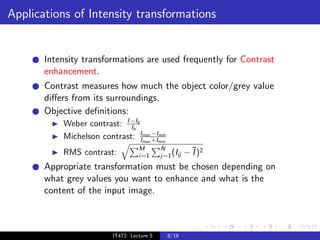
       Intensity transformations are used frequently for Contrast
       enhancement.
       Contrast measures how much the object color/grey value
       differs from its surroundings.
       Objective definitions:
           Weber contrast: I −Ib
                             Ib
           Michelson contrast: IImax −Imin
                                 max +I
                                        min


                                    M        N
           RMS contrast:            i=1      j=1 (Iij   − ¯)2
                                                          I
       Appropriate transformation must be chosen depending on
       what grey values you want to enhance and what is the
       content of the input image.


                          IT472: Lecture 5     8/18
Applications of Intensity transformations


       Intensity transformations are used frequently for Contrast
       enhancement.
       Contrast measures how much the object color/grey value
       differs from its surroundings.
       Objective definitions:
           Weber contrast: I −Ib
                             Ib
           Michelson contrast: IImax −Imin
                                 max +I
                                        min


                                    M        N
           RMS contrast:            i=1      j=1 (Iij   − ¯)2
                                                          I
       Appropriate transformation must be chosen depending on
       what grey values you want to enhance and what is the
       content of the input image.


                          IT472: Lecture 5     8/18
Applications of Intensity transformations


       Intensity transformations are used frequently for Contrast
       enhancement.
       Contrast measures how much the object color/grey value
       differs from its surroundings.
       Objective definitions:
           Weber contrast: I −Ib
                             Ib
           Michelson contrast: IImax −Imin
                                 max +I
                                        min


                                    M        N
           RMS contrast:            i=1      j=1 (Iij   − ¯)2
                                                          I
       Appropriate transformation must be chosen depending on
       what grey values you want to enhance and what is the
       content of the input image.


                          IT472: Lecture 5     8/18
Applications of Intensity transformations


       Intensity transformations are used frequently for Contrast
       enhancement.
       Contrast measures how much the object color/grey value
       differs from its surroundings.
       Objective definitions:
           Weber contrast: I −Ib
                             Ib
           Michelson contrast: IImax −Imin
                                 max +I
                                        min


                                    M        N
           RMS contrast:            i=1      j=1 (Iij   − ¯)2
                                                          I
       Appropriate transformation must be chosen depending on
       what grey values you want to enhance and what is the
       content of the input image.


                          IT472: Lecture 5     8/18
Applications of Intensity transformations


       Intensity transformations are used frequently for Contrast
       enhancement.
       Contrast measures how much the object color/grey value
       differs from its surroundings.
       Objective definitions:
           Weber contrast: I −Ib
                             Ib
           Michelson contrast: IImax −Imin
                                 max +I
                                        min


                                    M        N
           RMS contrast:            i=1      j=1 (Iij   − ¯)2
                                                          I
       Appropriate transformation must be chosen depending on
       what grey values you want to enhance and what is the
       content of the input image.


                          IT472: Lecture 5     8/18
Applications of Intensity transformations


       Intensity transformations are used frequently for Contrast
       enhancement.
       Contrast measures how much the object color/grey value
       differs from its surroundings.
       Objective definitions:
           Weber contrast: I −Ib
                             Ib
           Michelson contrast: IImax −Imin
                                 max +I
                                        min


                                    M        N
           RMS contrast:            i=1      j=1 (Iij   − ¯)2
                                                          I
       Appropriate transformation must be chosen depending on
       what grey values you want to enhance and what is the
       content of the input image.


                          IT472: Lecture 5     8/18
Applications of Intensity transformations


       Intensity transformations are used frequently for Contrast
       enhancement.
       Contrast measures how much the object color/grey value
       differs from its surroundings.
       Objective definitions:
           Weber contrast: I −Ib
                             Ib
           Michelson contrast: IImax −Imin
                                 max +I
                                        min


                                    M        N
           RMS contrast:            i=1      j=1 (Iij   − ¯)2
                                                          I
       Appropriate transformation must be chosen depending on
       what grey values you want to enhance and what is the
       content of the input image.


                          IT472: Lecture 5     8/18
Contrast enhancement


      We will frequently use the log-transformation to view the
      Fourier spectrum of an image.


                      IT472: Lecture 5   9/18
Contrast enhancement


      We will frequently use the log-transformation to view the
      Fourier spectrum of an image.


                      IT472: Lecture 5   9/18
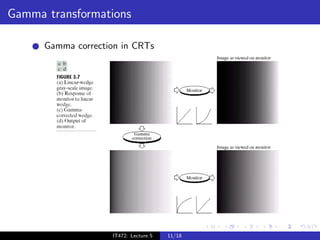
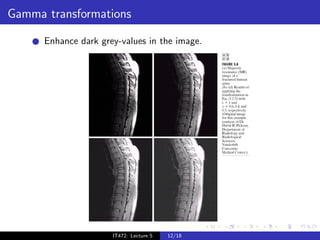
Gamma transformations

      s = cr γ


                 IT472: Lecture 5   10/18
Gamma transformations

      Gamma correction in CRTs


                    IT472: Lecture 5   11/18
Gamma transformations

      Enhance dark grey-values in the image.


                      IT472: Lecture 5   12/18
Gamma transformations

      Enhance brighter grey-values in the image.


                      IT472: Lecture 5   13/18
Contrast stretching


                      IT472: Lecture 5   14/18
Intensity slicing


                    IT472: Lecture 5   15/18
Bit-plane slicing


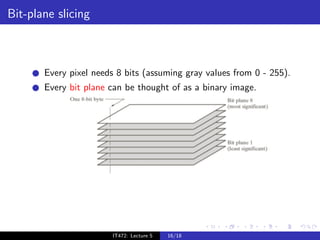
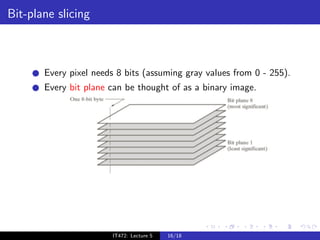
       Every pixel needs 8 bits (assuming gray values from 0 - 255).
       Every bit plane can be thought of as a binary image.


                       IT472: Lecture 5   16/18
Bit-plane slicing


       Every pixel needs 8 bits (assuming gray values from 0 - 255).
       Every bit plane can be thought of as a binary image.


                       IT472: Lecture 5   16/18
Bit-plane slicing


       Every pixel needs 8 bits (assuming gray values from 0 - 255).
       Every bit plane can be thought of as a binary image.


                       IT472: Lecture 5   16/18
Bit-plane slicing


                    IT472: Lecture 5   17/18
Bit-plane slicing

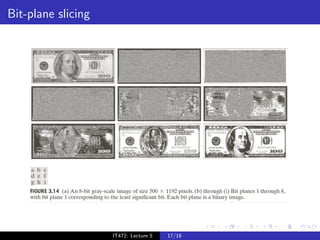
   Can be used for image compression.


   Figure: (top row) Reconstructions from bit planes (bottom) Original
   image


                          IT472: Lecture 5   18/18

Image Processing 3

  • 1.
    Spatial Transformations IT472: DigitalImage Processing, Lecture 5
  • 2.
    Spatial Transformations Affine transformations of the support of the image f (x, y ) Scaling: x = cx x and y = cy y → f (x , y ) = f (x, y ). Rotation: x = x cos θ − y sin θ and y = x cos θ + y sin θ → f (x , y ) = f (x, y ). Translation: x = x + tx and y = y + ty → f (x , y ) = f (x, y ). Shear: x = x + sy y and y = y → f (x , y ) = f (x, y ). All these collected together can be represented in a matrix form using Homogeneous coordinates, as follows:      x cos θ/cx /1 sin θ/sy /0 0/tx x  y  =  − sin θ/sx /0 cos θ/cy /1 0/ty   y  (1) 1 0 0 1 1 IT472: Lecture 5 2/18
  • 3.
    Spatial Transformations Affine transformations of the support of the image f (x, y ) Scaling: x = cx x and y = cy y → f (x , y ) = f (x, y ). Rotation: x = x cos θ − y sin θ and y = x cos θ + y sin θ → f (x , y ) = f (x, y ). Translation: x = x + tx and y = y + ty → f (x , y ) = f (x, y ). Shear: x = x + sy y and y = y → f (x , y ) = f (x, y ). All these collected together can be represented in a matrix form using Homogeneous coordinates, as follows:      x cos θ/cx /1 sin θ/sy /0 0/tx x  y  =  − sin θ/sx /0 cos θ/cy /1 0/ty   y  (1) 1 0 0 1 1 IT472: Lecture 5 2/18
  • 4.
    Spatial Transformations Affine transformations of the support of the image f (x, y ) Scaling: x = cx x and y = cy y → f (x , y ) = f (x, y ). Rotation: x = x cos θ − y sin θ and y = x cos θ + y sin θ → f (x , y ) = f (x, y ). Translation: x = x + tx and y = y + ty → f (x , y ) = f (x, y ). Shear: x = x + sy y and y = y → f (x , y ) = f (x, y ). All these collected together can be represented in a matrix form using Homogeneous coordinates, as follows:      x cos θ/cx /1 sin θ/sy /0 0/tx x  y  =  − sin θ/sx /0 cos θ/cy /1 0/ty   y  (1) 1 0 0 1 1 IT472: Lecture 5 2/18
  • 5.
    Spatial Transformations Affine transformations of the support of the image f (x, y ) Scaling: x = cx x and y = cy y → f (x , y ) = f (x, y ). Rotation: x = x cos θ − y sin θ and y = x cos θ + y sin θ → f (x , y ) = f (x, y ). Translation: x = x + tx and y = y + ty → f (x , y ) = f (x, y ). Shear: x = x + sy y and y = y → f (x , y ) = f (x, y ). All these collected together can be represented in a matrix form using Homogeneous coordinates, as follows:      x cos θ/cx /1 sin θ/sy /0 0/tx x  y  =  − sin θ/sx /0 cos θ/cy /1 0/ty   y  (1) 1 0 0 1 1 IT472: Lecture 5 2/18
  • 6.
    Spatial Transformations Affine transformations of the support of the image f (x, y ) Scaling: x = cx x and y = cy y → f (x , y ) = f (x, y ). Rotation: x = x cos θ − y sin θ and y = x cos θ + y sin θ → f (x , y ) = f (x, y ). Translation: x = x + tx and y = y + ty → f (x , y ) = f (x, y ). Shear: x = x + sy y and y = y → f (x , y ) = f (x, y ). All these collected together can be represented in a matrix form using Homogeneous coordinates, as follows:      x cos θ/cx /1 sin θ/sy /0 0/tx x  y  =  − sin θ/sx /0 cos θ/cy /1 0/ty   y  (1) 1 0 0 1 1 IT472: Lecture 5 2/18
  • 7.
    Implementation issues For a given affine transformation matrix A, A · (x, y )t is not always an integer. Is it possible that due to rounding off A · (x1 , y1 )t = A · (x2 , y2 )t Solution: Instead of using a forward mapping, let’s work with the inverse mapping. A−1 : (x , y )t → (x, y )t We can scan the output image coordinates and see where they come from, and accordingly assign them grey values. IT472: Lecture 5 3/18
  • 8.
    Implementation issues For a given affine transformation matrix A, A · (x, y )t is not always an integer. Is it possible that due to rounding off A · (x1 , y1 )t = A · (x2 , y2 )t Solution: Instead of using a forward mapping, let’s work with the inverse mapping. A−1 : (x , y )t → (x, y )t We can scan the output image coordinates and see where they come from, and accordingly assign them grey values. IT472: Lecture 5 3/18
  • 9.
    Implementation issues For a given affine transformation matrix A, A · (x, y )t is not always an integer. Is it possible that due to rounding off A · (x1 , y1 )t = A · (x2 , y2 )t Solution: Instead of using a forward mapping, let’s work with the inverse mapping. A−1 : (x , y )t → (x, y )t We can scan the output image coordinates and see where they come from, and accordingly assign them grey values. IT472: Lecture 5 3/18
  • 10.
    Implementation issues For a given affine transformation matrix A, A · (x, y )t is not always an integer. Is it possible that due to rounding off A · (x1 , y1 )t = A · (x2 , y2 )t Solution: Instead of using a forward mapping, let’s work with the inverse mapping. A−1 : (x , y )t → (x, y )t We can scan the output image coordinates and see where they come from, and accordingly assign them grey values. IT472: Lecture 5 3/18
  • 11.
    Implementation issues For a given affine transformation matrix A, A · (x, y )t is not always an integer. Is it possible that due to rounding off A · (x1 , y1 )t = A · (x2 , y2 )t Solution: Instead of using a forward mapping, let’s work with the inverse mapping. A−1 : (x , y )t → (x, y )t We can scan the output image coordinates and see where they come from, and accordingly assign them grey values. IT472: Lecture 5 3/18
  • 12.
    Implementation issues For a given affine transformation matrix A, A · (x, y )t is not always an integer. Is it possible that due to rounding off A · (x1 , y1 )t = A · (x2 , y2 )t Solution: Instead of using a forward mapping, let’s work with the inverse mapping. A−1 : (x , y )t → (x, y )t We can scan the output image coordinates and see where they come from, and accordingly assign them grey values. IT472: Lecture 5 3/18
  • 13.
    Examples Figure:(top-left) Image of Lena (top-right) Image rotated by 23◦ (bottom-left) Shear sx = 1.2, (bottom-right) Shear sx = −1.2 IT472: Lecture 5 4/18
  • 14.
    End of Chapter2 Chapter 3: Intensity transformations and Spatial filtering (Image enhancement in the spatial domain) IT472: Lecture 5 5/18
  • 15.
    End of Chapter2 Chapter 3: Intensity transformations and Spatial filtering (Image enhancement in the spatial domain) IT472: Lecture 5 5/18
  • 16.
    Image enhancement Image enhancement is a pre-processing step that makes the input image better suited for further processing. For example, for segmentation, recognition, or simply better for somebody to view the image. Intensity transformations: Depends only on the intensity value at a point: g (x, y ) = T [f (x, y )], can be also written as s = T [r ], where r and s are the input and output grey values respectively. IT472: Lecture 5 6/18
  • 17.
    Image enhancement Image enhancement is a pre-processing step that makes the input image better suited for further processing. For example, for segmentation, recognition, or simply better for somebody to view the image. Intensity transformations: Depends only on the intensity value at a point: g (x, y ) = T [f (x, y )], can be also written as s = T [r ], where r and s are the input and output grey values respectively. IT472: Lecture 5 6/18
  • 18.
    Intensity transformations Image negative: s = L − 1 − r Powers, nth roots, Log transformations etc.. IT472: Lecture 5 7/18
  • 19.
    Intensity transformations Image negative: s = L − 1 − r Powers, nth roots, Log transformations etc.. IT472: Lecture 5 7/18
  • 20.
    Intensity transformations Image negative: s = L − 1 − r Powers, nth roots, Log transformations etc.. IT472: Lecture 5 7/18
  • 21.
    Applications of Intensitytransformations Intensity transformations are used frequently for Contrast enhancement. Contrast measures how much the object color/grey value differs from its surroundings. Objective definitions: Weber contrast: I −Ib Ib Michelson contrast: IImax −Imin max +I min M N RMS contrast: i=1 j=1 (Iij − ¯)2 I Appropriate transformation must be chosen depending on what grey values you want to enhance and what is the content of the input image. IT472: Lecture 5 8/18
  • 22.
    Applications of Intensitytransformations Intensity transformations are used frequently for Contrast enhancement. Contrast measures how much the object color/grey value differs from its surroundings. Objective definitions: Weber contrast: I −Ib Ib Michelson contrast: IImax −Imin max +I min M N RMS contrast: i=1 j=1 (Iij − ¯)2 I Appropriate transformation must be chosen depending on what grey values you want to enhance and what is the content of the input image. IT472: Lecture 5 8/18
  • 23.
    Applications of Intensitytransformations Intensity transformations are used frequently for Contrast enhancement. Contrast measures how much the object color/grey value differs from its surroundings. Objective definitions: Weber contrast: I −Ib Ib Michelson contrast: IImax −Imin max +I min M N RMS contrast: i=1 j=1 (Iij − ¯)2 I Appropriate transformation must be chosen depending on what grey values you want to enhance and what is the content of the input image. IT472: Lecture 5 8/18
  • 24.
    Applications of Intensitytransformations Intensity transformations are used frequently for Contrast enhancement. Contrast measures how much the object color/grey value differs from its surroundings. Objective definitions: Weber contrast: I −Ib Ib Michelson contrast: IImax −Imin max +I min M N RMS contrast: i=1 j=1 (Iij − ¯)2 I Appropriate transformation must be chosen depending on what grey values you want to enhance and what is the content of the input image. IT472: Lecture 5 8/18
  • 25.
    Applications of Intensitytransformations Intensity transformations are used frequently for Contrast enhancement. Contrast measures how much the object color/grey value differs from its surroundings. Objective definitions: Weber contrast: I −Ib Ib Michelson contrast: IImax −Imin max +I min M N RMS contrast: i=1 j=1 (Iij − ¯)2 I Appropriate transformation must be chosen depending on what grey values you want to enhance and what is the content of the input image. IT472: Lecture 5 8/18
  • 26.
    Applications of Intensitytransformations Intensity transformations are used frequently for Contrast enhancement. Contrast measures how much the object color/grey value differs from its surroundings. Objective definitions: Weber contrast: I −Ib Ib Michelson contrast: IImax −Imin max +I min M N RMS contrast: i=1 j=1 (Iij − ¯)2 I Appropriate transformation must be chosen depending on what grey values you want to enhance and what is the content of the input image. IT472: Lecture 5 8/18
  • 27.
    Applications of Intensitytransformations Intensity transformations are used frequently for Contrast enhancement. Contrast measures how much the object color/grey value differs from its surroundings. Objective definitions: Weber contrast: I −Ib Ib Michelson contrast: IImax −Imin max +I min M N RMS contrast: i=1 j=1 (Iij − ¯)2 I Appropriate transformation must be chosen depending on what grey values you want to enhance and what is the content of the input image. IT472: Lecture 5 8/18
  • 28.
    Contrast enhancement We will frequently use the log-transformation to view the Fourier spectrum of an image. IT472: Lecture 5 9/18
  • 29.
    Contrast enhancement We will frequently use the log-transformation to view the Fourier spectrum of an image. IT472: Lecture 5 9/18
  • 30.
    Gamma transformations s = cr γ IT472: Lecture 5 10/18
  • 31.
    Gamma transformations Gamma correction in CRTs IT472: Lecture 5 11/18
  • 32.
    Gamma transformations Enhance dark grey-values in the image. IT472: Lecture 5 12/18
  • 33.
    Gamma transformations Enhance brighter grey-values in the image. IT472: Lecture 5 13/18
  • 34.
    Contrast stretching IT472: Lecture 5 14/18
  • 35.
    Intensity slicing IT472: Lecture 5 15/18
  • 36.
    Bit-plane slicing Every pixel needs 8 bits (assuming gray values from 0 - 255). Every bit plane can be thought of as a binary image. IT472: Lecture 5 16/18
  • 37.
    Bit-plane slicing Every pixel needs 8 bits (assuming gray values from 0 - 255). Every bit plane can be thought of as a binary image. IT472: Lecture 5 16/18
  • 38.
    Bit-plane slicing Every pixel needs 8 bits (assuming gray values from 0 - 255). Every bit plane can be thought of as a binary image. IT472: Lecture 5 16/18
  • 39.
    Bit-plane slicing IT472: Lecture 5 17/18
  • 40.
    Bit-plane slicing Can be used for image compression. Figure: (top row) Reconstructions from bit planes (bottom) Original image IT472: Lecture 5 18/18