Submitted By: Ravinder Kaur
 Introduction to Digital Image Processing
 Why we need Digital Image Processing?
 Applications of Digital Image Processing
 Image Enhancement
 Areas in which Image Enhancement Used
 Literature Review
 Problem Definition
 Objectives of Proposed Work
 Methology
 Conclusion
• Image processing is the form of signal processing in which image is given as input
and output is become either an image or set of characteristics related to image.
• Image processing involves the processing of image such as altering, enhancement,
compressing etc the existing image.
• Image processing is a method to convert an image into digital form and perform
some operations on it, in order to get an enhanced image or to extract some useful
information from it.
Image processing is of two types:
 Analog image processing: Analog image processing is done on analog signals.
 Digital image processing:
The digital image processing deals with developing a digital system that performs o
perations on an digital image.
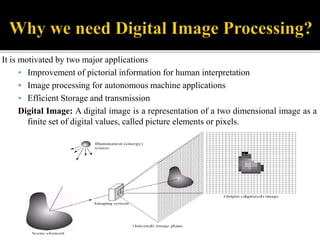
It is motivated by two major applications
 Improvement of pictorial information for human interpretation
 Image processing for autonomous machine applications
 Efficient Storage and transmission
Digital Image: A digital image is a representation of a two dimensional image as a
finite set of digital values, called picture elements or pixels.
Some of the major fields in which digital image
processing is widely used are mentioned below
 Image sharpening and restoration
 Medical field
 Remote sensing
 Transmission and encoding
 Machine/Robot vision
 Color processing
 Pattern recognition
 Video processing
 Microscopic Imaging
 Image Enhancement is the process of manipulating an image so that the result is
more suitable than the original for a specific application.
 Image enhancement refers to accentuation, or sharpening of image features such as
edges, boundaries, or contrast to make a graphic display more useful for display and
analysis.
 Image enhancement is used to improve the quality of an image for visual perception
of human beings.
 Types of Image Enhancement Techniques:
Image enhancement techniques can be divided into two broad categories:
 1. Spatial domain techniques, which operate directly on pixels.
 2. Frequency domain techniques, which operate on the Fourier transform of an
image.
Some of the areas in which Image Enhancement has wide application are noted
below.
 In atmospheric sciences, Image Enhancement is used to reduce the effects of haze,
fog, and turbulent weather for meteorological observations
 In forensics, Image Enhancement is used for identification, evidence gathering and
surveillance.
 Astrophotography faces challenges due to light and noise pollution that can be
minimized by Image Enhancement.
 In oceanography the study of images reveals interesting features of water flow,
sediment concentration, geomorphology and bathymetric patterns to name a few.
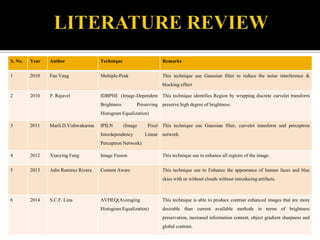
S. No. Year Author Technique Remarks
1 2010 Fan Yang Multiple-Peak This technique use Gaussian filter to reduce the noise interference &
blocking effect
2 2010 P. Rajavel IDBPHE (Image-Dependent
Brightness Preserving
Histogram Equalization)
This technique identifies Region by wrapping discrete curvelet transform
preserve high degree of brightness.
3 2011 Murli D.Vishwakarma IPILN (Image Pixel
Interdependency Linear
Perceptron Network)
This technique use Gaussian filter, curvelet transform and perceptron
network.
4 2012 Xiaoying Fang Image Fusion This technique use to enhance all regions of the image.
5 2013 Adin Ramirez Rivera Content Aware This technique use to Enhance the appearance of human faces and blue
skies with or without clouds without introducing artifacts.
6 2014 S.C.F. Lina AVHEQ(Averaging
Histogram Equalization)
This technique is able to produce contrast enhanced images that are more
desirable than current available methods in terms of brightness
preservation, increased information content, object gradient sharpness and
global contrast.
 Generally image enhancement techniques not able
to preserve Image brightness.
 Some techniques are unable to recover information
from the dark areas of images.
 In the some method the process of calculating the
pixel difference some values are rejected which
could be important data.
My aim to resolve these problems in Image
Enhancement techniques.
Image enhancement is very interesting field of
image processing.
1) The main objective of Image enhancement is to modify
attributes of an image and the choice of attributes and the way
they modify are specific to given task.
2) Images are stored in standard database and Enhanced image
from standard database.
3) Comparing of different technique of image enhancement and
then Choosing the best technique for specific task.
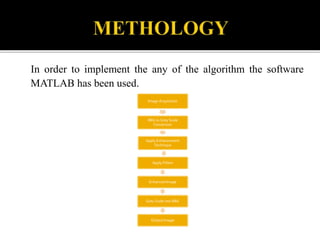
In order to implement the any of the algorithm the software
MATLAB has been used.
Image Acquisition
RBG to Grey Scale
Conversion
Apply Enhancement
Technique
Apply Filters
Enhanced Image
Grey Scale into RBG
Output Image
The Image enhancement plays important role in image
processing. I have been taken survey on various
techniques of image enhancement. Some of the image
enhancement techniques does not provide better results
in multiple light sources. Most of the techniques are
useful for altering the gray level values of individual
pixels and hence the overall contrast of the entire image.
But they usually enhance the whole image in a uniform
manner which in many cases produces undesirable
results. I will compare results of discussed techniques
and choose a better technique for specific task.

Image enhancement

  • 1.
  • 2.
     Introduction toDigital Image Processing  Why we need Digital Image Processing?  Applications of Digital Image Processing  Image Enhancement  Areas in which Image Enhancement Used  Literature Review  Problem Definition  Objectives of Proposed Work  Methology  Conclusion
  • 3.
    • Image processingis the form of signal processing in which image is given as input and output is become either an image or set of characteristics related to image. • Image processing involves the processing of image such as altering, enhancement, compressing etc the existing image. • Image processing is a method to convert an image into digital form and perform some operations on it, in order to get an enhanced image or to extract some useful information from it. Image processing is of two types:  Analog image processing: Analog image processing is done on analog signals.  Digital image processing: The digital image processing deals with developing a digital system that performs o perations on an digital image.
  • 4.
    It is motivatedby two major applications  Improvement of pictorial information for human interpretation  Image processing for autonomous machine applications  Efficient Storage and transmission Digital Image: A digital image is a representation of a two dimensional image as a finite set of digital values, called picture elements or pixels.
  • 5.
    Some of themajor fields in which digital image processing is widely used are mentioned below  Image sharpening and restoration  Medical field  Remote sensing  Transmission and encoding  Machine/Robot vision  Color processing  Pattern recognition  Video processing  Microscopic Imaging
  • 6.
     Image Enhancementis the process of manipulating an image so that the result is more suitable than the original for a specific application.  Image enhancement refers to accentuation, or sharpening of image features such as edges, boundaries, or contrast to make a graphic display more useful for display and analysis.  Image enhancement is used to improve the quality of an image for visual perception of human beings.  Types of Image Enhancement Techniques: Image enhancement techniques can be divided into two broad categories:  1. Spatial domain techniques, which operate directly on pixels.  2. Frequency domain techniques, which operate on the Fourier transform of an image.
  • 7.
    Some of theareas in which Image Enhancement has wide application are noted below.  In atmospheric sciences, Image Enhancement is used to reduce the effects of haze, fog, and turbulent weather for meteorological observations  In forensics, Image Enhancement is used for identification, evidence gathering and surveillance.  Astrophotography faces challenges due to light and noise pollution that can be minimized by Image Enhancement.  In oceanography the study of images reveals interesting features of water flow, sediment concentration, geomorphology and bathymetric patterns to name a few.
  • 8.
    S. No. YearAuthor Technique Remarks 1 2010 Fan Yang Multiple-Peak This technique use Gaussian filter to reduce the noise interference & blocking effect 2 2010 P. Rajavel IDBPHE (Image-Dependent Brightness Preserving Histogram Equalization) This technique identifies Region by wrapping discrete curvelet transform preserve high degree of brightness. 3 2011 Murli D.Vishwakarma IPILN (Image Pixel Interdependency Linear Perceptron Network) This technique use Gaussian filter, curvelet transform and perceptron network. 4 2012 Xiaoying Fang Image Fusion This technique use to enhance all regions of the image. 5 2013 Adin Ramirez Rivera Content Aware This technique use to Enhance the appearance of human faces and blue skies with or without clouds without introducing artifacts. 6 2014 S.C.F. Lina AVHEQ(Averaging Histogram Equalization) This technique is able to produce contrast enhanced images that are more desirable than current available methods in terms of brightness preservation, increased information content, object gradient sharpness and global contrast.
  • 9.
     Generally imageenhancement techniques not able to preserve Image brightness.  Some techniques are unable to recover information from the dark areas of images.  In the some method the process of calculating the pixel difference some values are rejected which could be important data. My aim to resolve these problems in Image Enhancement techniques.
  • 10.
    Image enhancement isvery interesting field of image processing. 1) The main objective of Image enhancement is to modify attributes of an image and the choice of attributes and the way they modify are specific to given task. 2) Images are stored in standard database and Enhanced image from standard database. 3) Comparing of different technique of image enhancement and then Choosing the best technique for specific task.
  • 11.
    In order toimplement the any of the algorithm the software MATLAB has been used. Image Acquisition RBG to Grey Scale Conversion Apply Enhancement Technique Apply Filters Enhanced Image Grey Scale into RBG Output Image
  • 12.
    The Image enhancementplays important role in image processing. I have been taken survey on various techniques of image enhancement. Some of the image enhancement techniques does not provide better results in multiple light sources. Most of the techniques are useful for altering the gray level values of individual pixels and hence the overall contrast of the entire image. But they usually enhance the whole image in a uniform manner which in many cases produces undesirable results. I will compare results of discussed techniques and choose a better technique for specific task.