INDIAN INSTITUTE OF TECHNOLOGY ROORKEE
EEN-628
Image enhancement and techniques used for
Image enhancement
Presented by:
Baldeep Singh Chhabra
19115039
2
Outline
• Introduction
• Techniques used in Image Enhancement
• Contrast Stretching
• Gray level slicing
• Histogram Equalization
• Advantages of Image Enhancement
• Disadvantages
• Applications of Image Enhancement
• Summary
3
Introduction
• The principal objective of image enhancement is to process a
given image so that the result is more suitable than the original
image for a specific application.
• It accentuates or sharpens image features such as edges,
boundaries, or contrast to make a graphic display more helpful
for display and analysis.
• The enhancement doesn't increase the inherent information
content of the data, but it increases the dynamic range of the
chosen features so that they can be detected easily.
4
Introduction (Contd.)
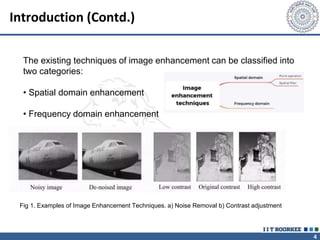
The existing techniques of image enhancement can be classified into
two categories:
• Spatial domain enhancement
• Frequency domain enhancement
Fig 1. Examples of Image Enhancement Techniques. a) Noise Removal b) Contrast adjustment
5
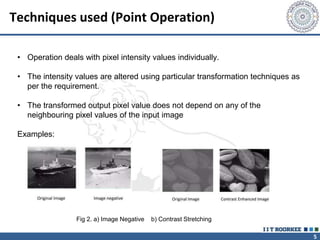
Techniques used (Point Operation)
• Operation deals with pixel intensity values individually.
• The intensity values are altered using particular transformation techniques as
per the requirement.
• The transformed output pixel value does not depend on any of the
neighbouring pixel values of the input image
Examples:
Fig 2. a) Image Negative b) Contrast Stretching
6
Contrast Stretching
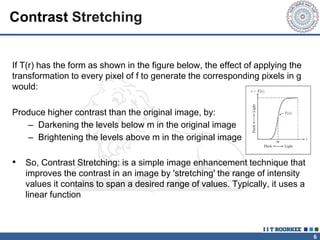
If T(r) has the form as shown in the figure below, the effect of applying the
transformation to every pixel of f to generate the corresponding pixels in g
would:
Produce higher contrast than the original image, by:
– Darkening the levels below m in the original image
– Brightening the levels above m in the original image
• So, Contrast Stretching: is a simple image enhancement technique that
improves the contrast in an image by 'stretching' the range of intensity
values it contains to span a desired range of values. Typically, it uses a
linear function
7
Contrast Stretching (contd.)
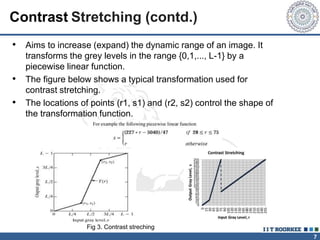
• Aims to increase (expand) the dynamic range of an image. It
transforms the grey levels in the range {0,1,..., L-1} by a
piecewise linear function.
• The figure below shows a typical transformation used for
contrast stretching.
• The locations of points (r1, s1) and (r2, s2) control the shape of
the transformation function.
Fig 3. Contrast streching
8
Contrast Stretching(contd.)
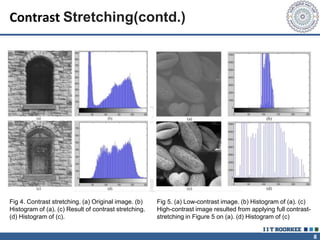
Fig 4. Contrast stretching. (a) Original image. (b)
Histogram of (a). (c) Result of contrast stretching.
(d) Histogram of (c).
Fig 5. (a) Low-contrast image. (b) Histogram of (a). (c)
High-contrast image resulted from applying full contrast-
stretching in Figure 5 on (a). (d) Histogram of (c)
9
Gray Level Slicing
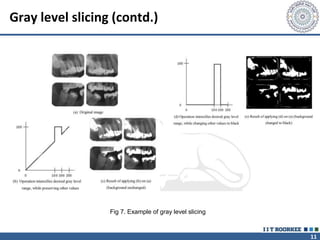
• Gray-level slicing aims to highlight a specific range [A...B] of gray levels.
It simply maps all gray levels in the chosen range to a high value.
• Other gray levels are either mapped to a low value (Figure 6(a)) or left
unchanged (Figure 6(b)).
• Gray-level slicing is used for enhancing features such as masses of
water in satellite imagery. Thus it is useful for feature extraction.
Figure 6. Gray-level slicing
10
Gray Level Slicing
• Gray-level slicing aims to highlight a specific range [A...B] of gray levels.
It simply maps all gray levels in the chosen range to a high value.
• Other gray levels are either mapped to a low value (Figure 6(a)) or left
unchanged (Figure 6(b)).
• Gray-level slicing is used for enhancing features such as masses of
water in satellite imagery. Thus it is useful for feature extraction.
Figure 6. Gray-level slicing
11
Gray level slicing (contd.)
Fig 7. Example of gray level slicing
12
Histogram Equalization
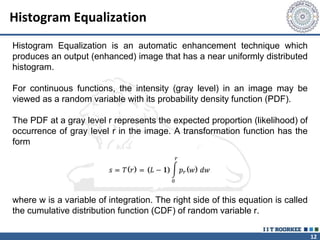
Histogram Equalization is an automatic enhancement technique which
produces an output (enhanced) image that has a near uniformly distributed
histogram.
For continuous functions, the intensity (gray level) in an image may be
viewed as a random variable with its probability density function (PDF).
The PDF at a gray level r represents the expected proportion (likelihood) of
occurrence of gray level r in the image. A transformation function has the
form
where w is a variable of integration. The right side of this equation is called
the cumulative distribution function (CDF) of random variable r.
13
Histogram Equalization (contd.)
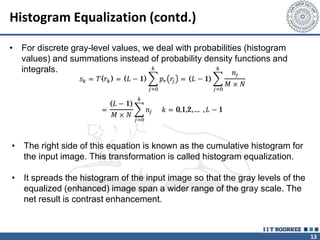
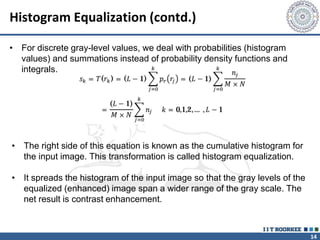
• For discrete gray-level values, we deal with probabilities (histogram
values) and summations instead of probability density functions and
integrals.
• The right side of this equation is known as the cumulative histogram for
the input image. This transformation is called histogram equalization.
• It spreads the histogram of the input image so that the gray levels of the
equalized (enhanced) image span a wider range of the gray scale. The
net result is contrast enhancement.
14
Histogram Equalization (contd.)
• For discrete gray-level values, we deal with probabilities (histogram
values) and summations instead of probability density functions and
integrals.
• The right side of this equation is known as the cumulative histogram for
the input image. This transformation is called histogram equalization.
• It spreads the histogram of the input image so that the gray levels of the
equalized (enhanced) image span a wider range of the gray scale. The
net result is contrast enhancement.
15
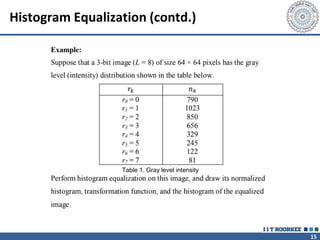
Histogram Equalization (contd.)
Table 1. Gray level intensity
16
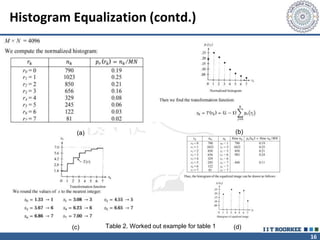
Histogram Equalization (contd.)
(a) (b)
(c) (d)
Table 2. Worked out example for table 1
17
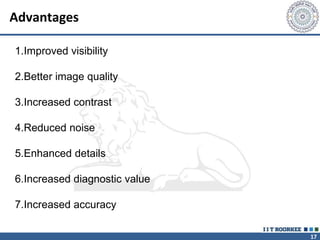
Advantages
1.Improved visibility
2.Better image quality
3.Increased contrast
4.Reduced noise
5.Enhanced details
6.Increased diagnostic value
7.Increased accuracy
18
Disadvantages
1.Over-enhancement
2.Artificial look
3.Loss of information
4.Technical expertise
5.Cost
6.Time-consuming
7.Interpreting results
8.Bias
19
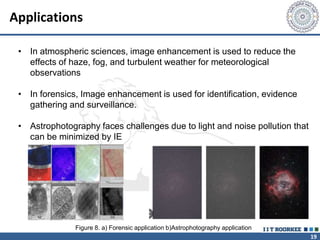
Applications
• In atmospheric sciences, image enhancement is used to reduce the
effects of haze, fog, and turbulent weather for meteorological
observations
• In forensics, Image enhancement is used for identification, evidence
gathering and surveillance.
• Astrophotography faces challenges due to light and noise pollution that
can be minimized by IE
Figure 8. a) Forensic application b)Astrophotography application
20
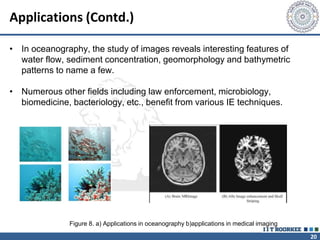
Applications (Contd.)
• In oceanography, the study of images reveals interesting features of
water flow, sediment concentration, geomorphology and bathymetric
patterns to name a few.
• Numerous other fields including law enforcement, microbiology,
biomedicine, bacteriology, etc., benefit from various IE techniques.
Figure 8. a) Applications in oceanography b)applications in medical imaging
21
Summary
•Image enhancement is the process of improving the quality, clarity, and visual
appeal of an image.
•Image enhancement techniques can help improve the visibility of details in an
image, increase contrast, reduce noise and artifacts, and reveal hidden details.
•There are various image enhancement techniques, including histogram equalization,
filtering, thresholding, and color correction.
•Image enhancement techniques can have several applications, including scientific
research, medical diagnosis, industrial inspection, and entertainment.
•Image enhancement techniques can be performed using software tools and
algorithms, as well as hardware devices such as cameras and scanners.
•While image enhancement can provide significant benefits, it is important to apply
these techniques carefully and avoid over-enhancement, which can result in loss of
information and unnatural image appearance.
INDIAN INSTITUTE OF TECHNOLOGY ROORKEE
Thank You

Imagee.pptx

  • 1.
    INDIAN INSTITUTE OFTECHNOLOGY ROORKEE EEN-628 Image enhancement and techniques used for Image enhancement Presented by: Baldeep Singh Chhabra 19115039
  • 2.
    2 Outline • Introduction • Techniquesused in Image Enhancement • Contrast Stretching • Gray level slicing • Histogram Equalization • Advantages of Image Enhancement • Disadvantages • Applications of Image Enhancement • Summary
  • 3.
    3 Introduction • The principalobjective of image enhancement is to process a given image so that the result is more suitable than the original image for a specific application. • It accentuates or sharpens image features such as edges, boundaries, or contrast to make a graphic display more helpful for display and analysis. • The enhancement doesn't increase the inherent information content of the data, but it increases the dynamic range of the chosen features so that they can be detected easily.
  • 4.
    4 Introduction (Contd.) The existingtechniques of image enhancement can be classified into two categories: • Spatial domain enhancement • Frequency domain enhancement Fig 1. Examples of Image Enhancement Techniques. a) Noise Removal b) Contrast adjustment
  • 5.
    5 Techniques used (PointOperation) • Operation deals with pixel intensity values individually. • The intensity values are altered using particular transformation techniques as per the requirement. • The transformed output pixel value does not depend on any of the neighbouring pixel values of the input image Examples: Fig 2. a) Image Negative b) Contrast Stretching
  • 6.
    6 Contrast Stretching If T(r)has the form as shown in the figure below, the effect of applying the transformation to every pixel of f to generate the corresponding pixels in g would: Produce higher contrast than the original image, by: – Darkening the levels below m in the original image – Brightening the levels above m in the original image • So, Contrast Stretching: is a simple image enhancement technique that improves the contrast in an image by 'stretching' the range of intensity values it contains to span a desired range of values. Typically, it uses a linear function
  • 7.
    7 Contrast Stretching (contd.) •Aims to increase (expand) the dynamic range of an image. It transforms the grey levels in the range {0,1,..., L-1} by a piecewise linear function. • The figure below shows a typical transformation used for contrast stretching. • The locations of points (r1, s1) and (r2, s2) control the shape of the transformation function. Fig 3. Contrast streching
  • 8.
    8 Contrast Stretching(contd.) Fig 4.Contrast stretching. (a) Original image. (b) Histogram of (a). (c) Result of contrast stretching. (d) Histogram of (c). Fig 5. (a) Low-contrast image. (b) Histogram of (a). (c) High-contrast image resulted from applying full contrast- stretching in Figure 5 on (a). (d) Histogram of (c)
  • 9.
    9 Gray Level Slicing •Gray-level slicing aims to highlight a specific range [A...B] of gray levels. It simply maps all gray levels in the chosen range to a high value. • Other gray levels are either mapped to a low value (Figure 6(a)) or left unchanged (Figure 6(b)). • Gray-level slicing is used for enhancing features such as masses of water in satellite imagery. Thus it is useful for feature extraction. Figure 6. Gray-level slicing
  • 10.
    10 Gray Level Slicing •Gray-level slicing aims to highlight a specific range [A...B] of gray levels. It simply maps all gray levels in the chosen range to a high value. • Other gray levels are either mapped to a low value (Figure 6(a)) or left unchanged (Figure 6(b)). • Gray-level slicing is used for enhancing features such as masses of water in satellite imagery. Thus it is useful for feature extraction. Figure 6. Gray-level slicing
  • 11.
    11 Gray level slicing(contd.) Fig 7. Example of gray level slicing
  • 12.
    12 Histogram Equalization Histogram Equalizationis an automatic enhancement technique which produces an output (enhanced) image that has a near uniformly distributed histogram. For continuous functions, the intensity (gray level) in an image may be viewed as a random variable with its probability density function (PDF). The PDF at a gray level r represents the expected proportion (likelihood) of occurrence of gray level r in the image. A transformation function has the form where w is a variable of integration. The right side of this equation is called the cumulative distribution function (CDF) of random variable r.
  • 13.
    13 Histogram Equalization (contd.) •For discrete gray-level values, we deal with probabilities (histogram values) and summations instead of probability density functions and integrals. • The right side of this equation is known as the cumulative histogram for the input image. This transformation is called histogram equalization. • It spreads the histogram of the input image so that the gray levels of the equalized (enhanced) image span a wider range of the gray scale. The net result is contrast enhancement.
  • 14.
    14 Histogram Equalization (contd.) •For discrete gray-level values, we deal with probabilities (histogram values) and summations instead of probability density functions and integrals. • The right side of this equation is known as the cumulative histogram for the input image. This transformation is called histogram equalization. • It spreads the histogram of the input image so that the gray levels of the equalized (enhanced) image span a wider range of the gray scale. The net result is contrast enhancement.
  • 15.
  • 16.
    16 Histogram Equalization (contd.) (a)(b) (c) (d) Table 2. Worked out example for table 1
  • 17.
    17 Advantages 1.Improved visibility 2.Better imagequality 3.Increased contrast 4.Reduced noise 5.Enhanced details 6.Increased diagnostic value 7.Increased accuracy
  • 18.
    18 Disadvantages 1.Over-enhancement 2.Artificial look 3.Loss ofinformation 4.Technical expertise 5.Cost 6.Time-consuming 7.Interpreting results 8.Bias
  • 19.
    19 Applications • In atmosphericsciences, image enhancement is used to reduce the effects of haze, fog, and turbulent weather for meteorological observations • In forensics, Image enhancement is used for identification, evidence gathering and surveillance. • Astrophotography faces challenges due to light and noise pollution that can be minimized by IE Figure 8. a) Forensic application b)Astrophotography application
  • 20.
    20 Applications (Contd.) • Inoceanography, the study of images reveals interesting features of water flow, sediment concentration, geomorphology and bathymetric patterns to name a few. • Numerous other fields including law enforcement, microbiology, biomedicine, bacteriology, etc., benefit from various IE techniques. Figure 8. a) Applications in oceanography b)applications in medical imaging
  • 21.
    21 Summary •Image enhancement isthe process of improving the quality, clarity, and visual appeal of an image. •Image enhancement techniques can help improve the visibility of details in an image, increase contrast, reduce noise and artifacts, and reveal hidden details. •There are various image enhancement techniques, including histogram equalization, filtering, thresholding, and color correction. •Image enhancement techniques can have several applications, including scientific research, medical diagnosis, industrial inspection, and entertainment. •Image enhancement techniques can be performed using software tools and algorithms, as well as hardware devices such as cameras and scanners. •While image enhancement can provide significant benefits, it is important to apply these techniques carefully and avoid over-enhancement, which can result in loss of information and unnatural image appearance.
  • 22.
    INDIAN INSTITUTE OFTECHNOLOGY ROORKEE Thank You