Image Compression
Preview
 Methods of compressing data prior to storage and / or
transmission are of significant practical and commercial
 Image compression addresses the problem of reducing
the amount of data required to a digital image .
 The underlying basis of the reduction process is the
removal of redundant data .
Fundamentals
 The data compression refers to the process of reducing
the amount of data required to represent a given quantity
of information .
 The difference of data and information .
 Data are the means by which information is conveyed .
 Data redundancy is a central issue in digital image
compression
Fundamentals
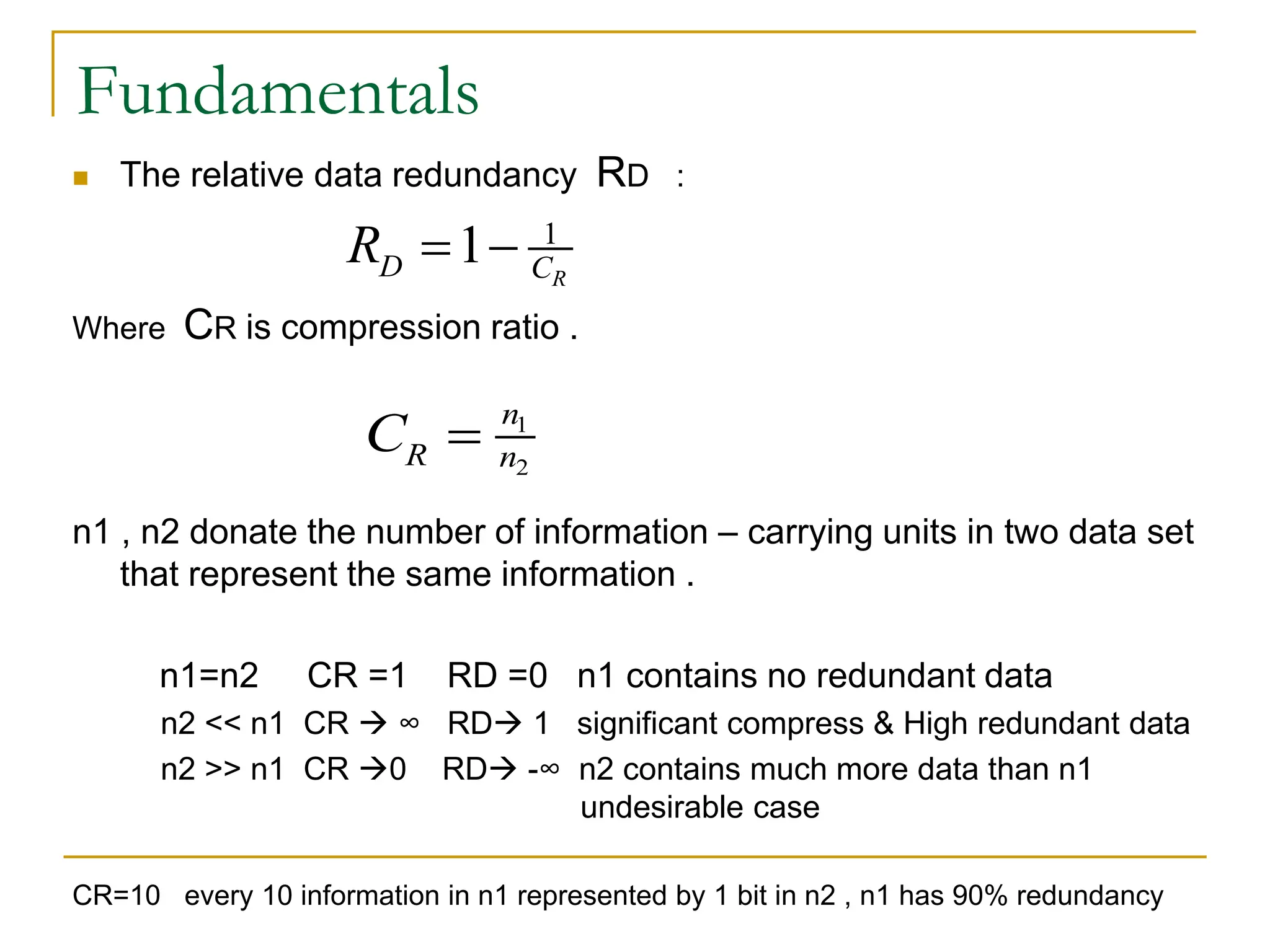
 The relative data redundancy RD :
Where CR is compression ratio .
n1 , n2 donate the number of information – carrying units in two data set
that represent the same information .
n1=n2 CR =1 RD =0 n1 contains no redundant data
n2 << n1 CR  ∞ RD 1 significant compress & High redundant data
n2 >> n1 CR 0 RD -∞ n2 contains much more data than n1
undesirable case
CR=10 every 10 information in n1 represented by 1 bit in n2 , n1 has 90% redundancy
1
1 R
D C
R  
1
2
n
R n
C 
3 basic Data redundancies
 Coding Redundancy .
 Spatial and Temporal Redundancy.
 i.e. Video sequence (Correlated pixels are not repeated.)
 Irrelevant Information.
 Information that ignored by human visual system
Coding Redundancy
 Lets assume , that a discrete random variable rK in the
interval [0 , 1] represents the gray levels of an image and
each rK occurs with probability
k=0,1,2,……L-1
Where L is the number gray levels ,
nK is the number of times that the Kth gray level appears in
image .
n is the total number of pixel in the image .
( ) K
n
r K n
P r 
( )
r K
P r
Coding Redundancy
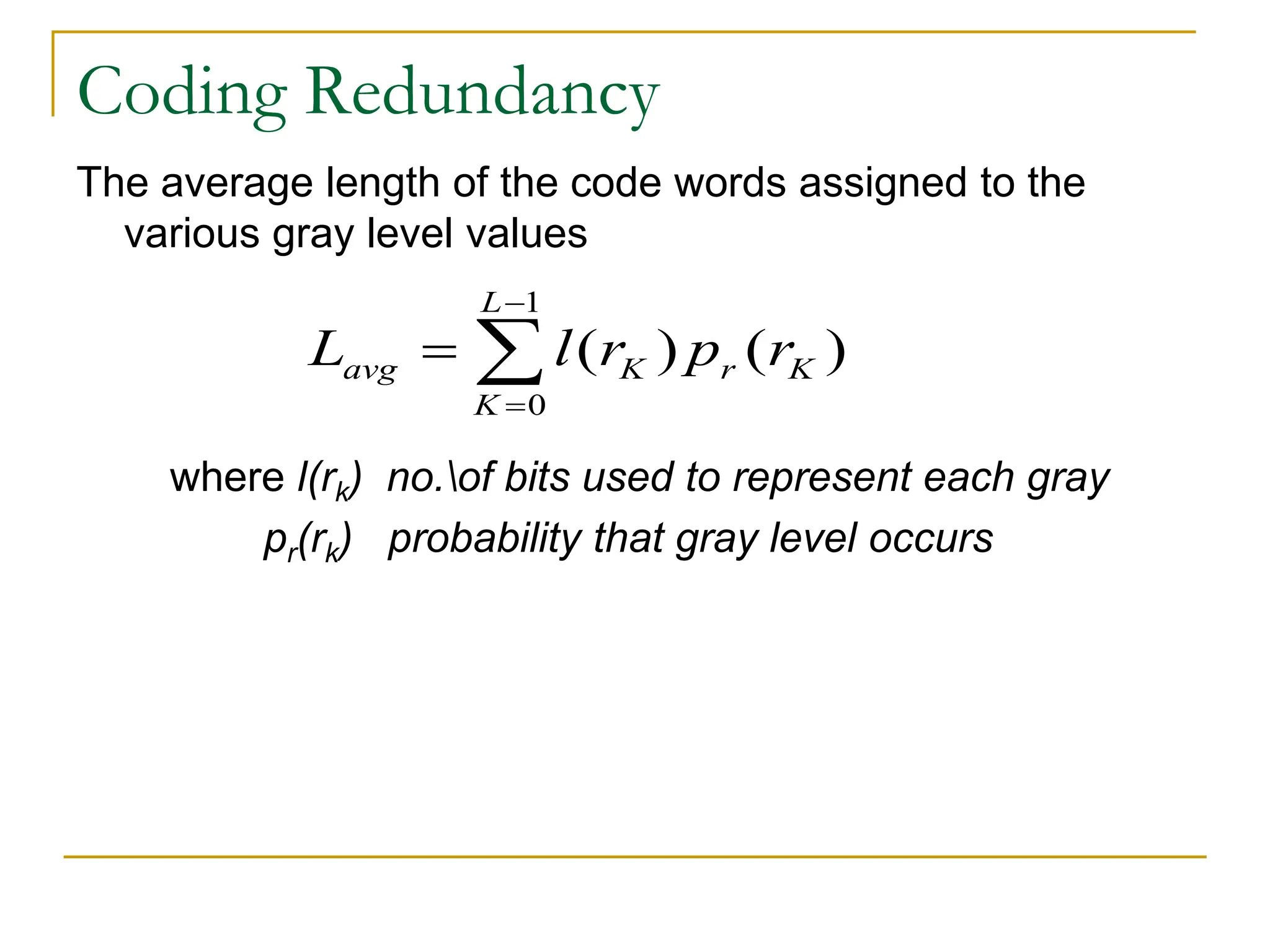
The average length of the code words assigned to the
various gray level values
where l(rk) no.of bits used to represent each gray
pr(rk) probability that gray level occurs
1
0
( ) ( )
L
avg K r K
K
L l r p r


 
)
(
)
( K
r
K
avg r
p
r
l
L 

.
7
.
2
)
02
.
0
(
6
)
03
.
0
(
6
)
06
.
0
(
5
)
08
.
0
(
4
)
16
.
0
(
3
)
21
.
0
(
2
)
25
.
0
(
2
)
19
.
0
(
2
bits









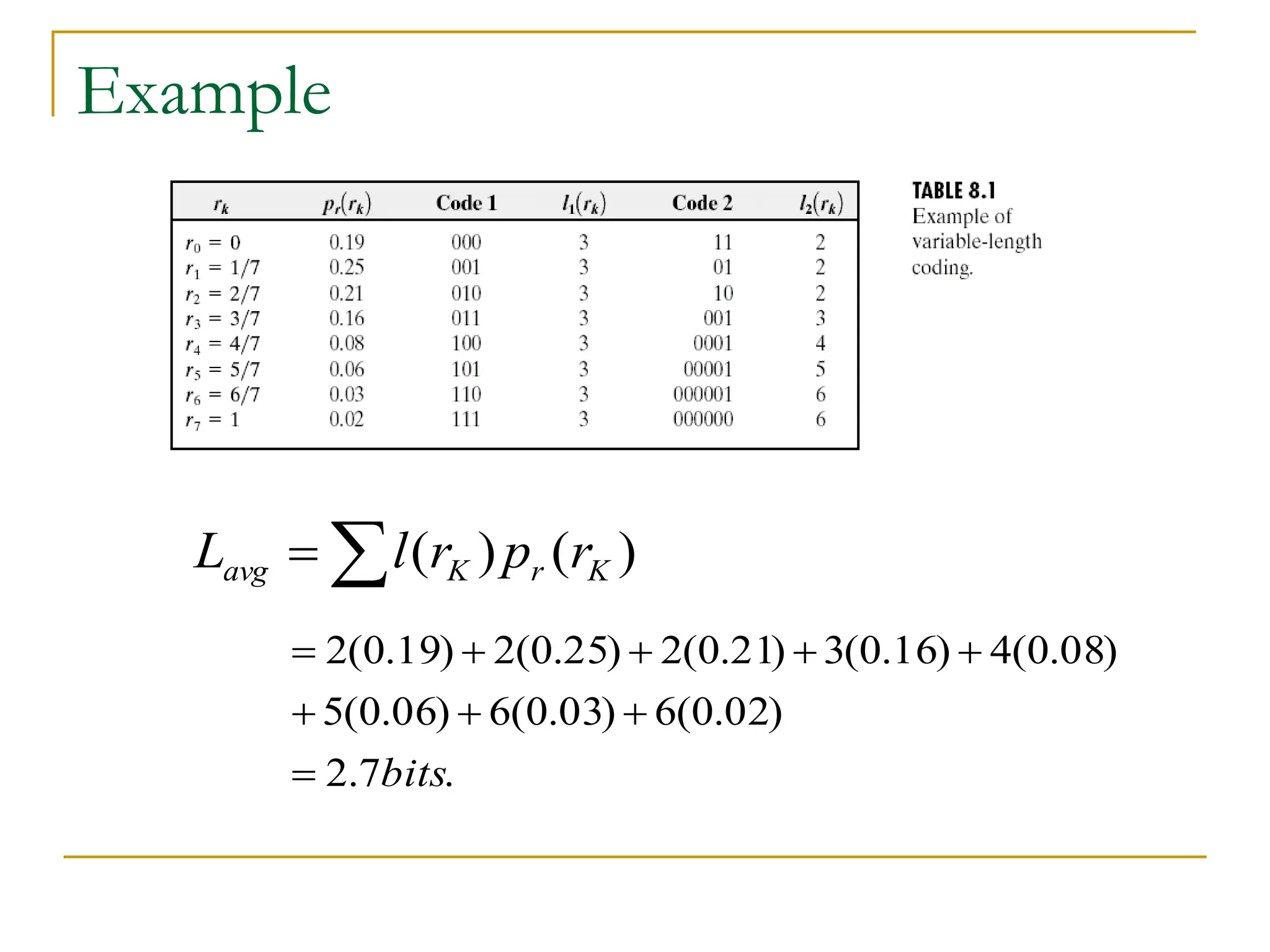
Example
Example
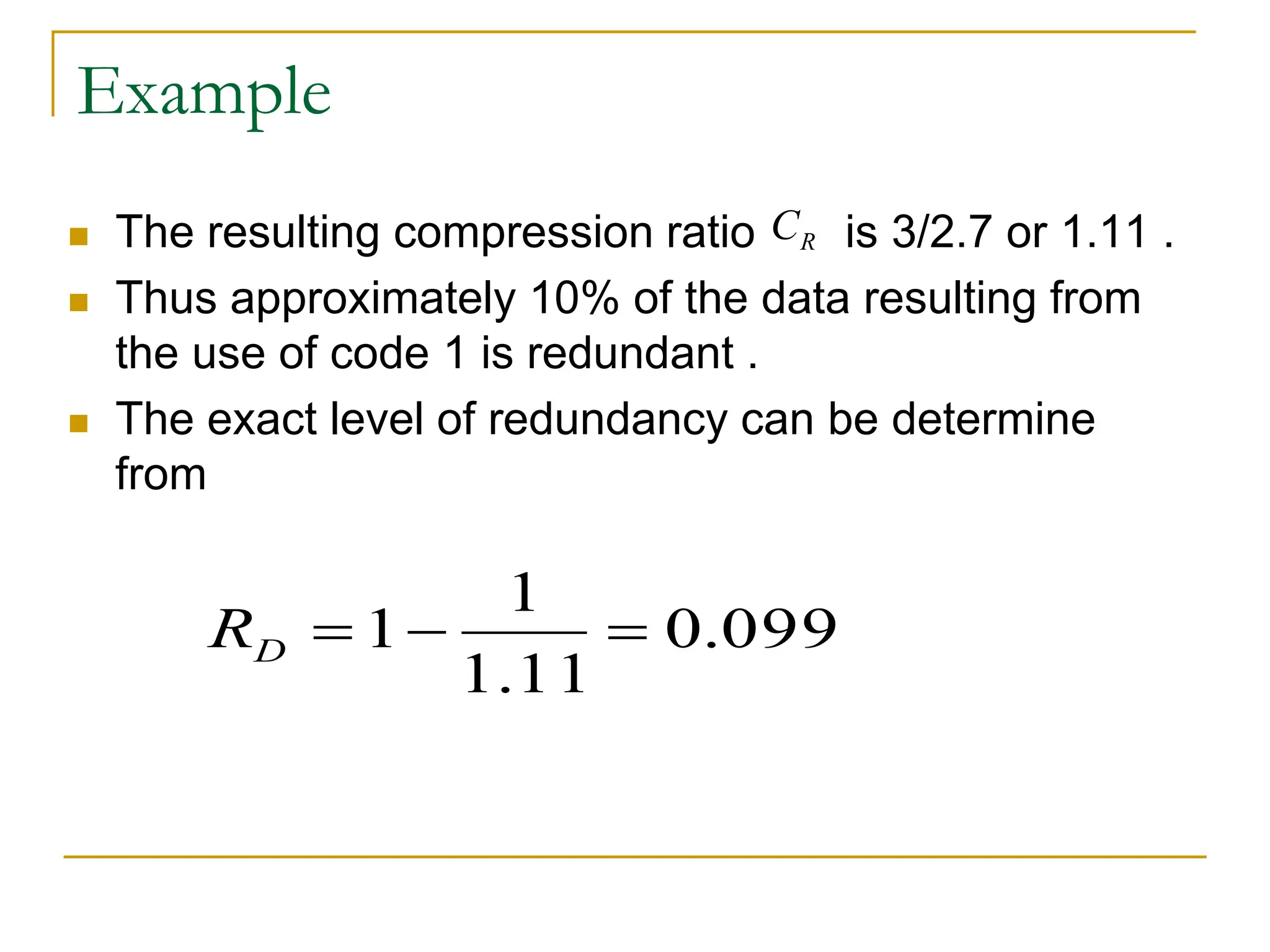
 The resulting compression ratio is 3/2.7 or 1.11 .
 Thus approximately 10% of the data resulting from
the use of code 1 is redundant .
 The exact level of redundancy can be determine
from
R
C
099
.
0
11
.
1
1
1 


D
R
Spatial and Temporal redundancy
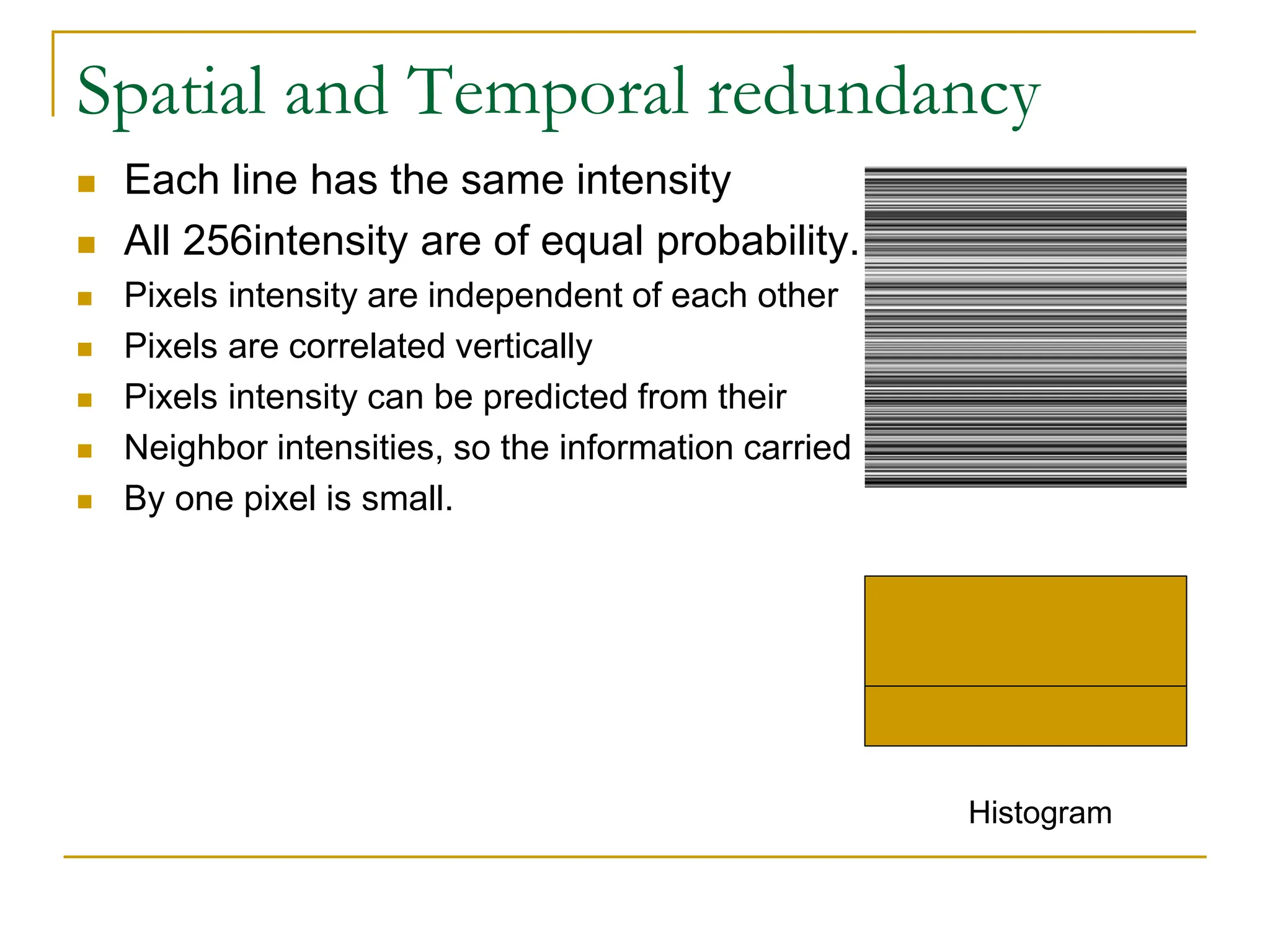
 Each line has the same intensity
 All 256intensity are of equal probability.
 Pixels intensity are independent of each other
 Pixels are correlated vertically
 Pixels intensity can be predicted from their
 Neighbor intensities, so the information carried
 By one pixel is small.
Histogram
Irrelevant Information
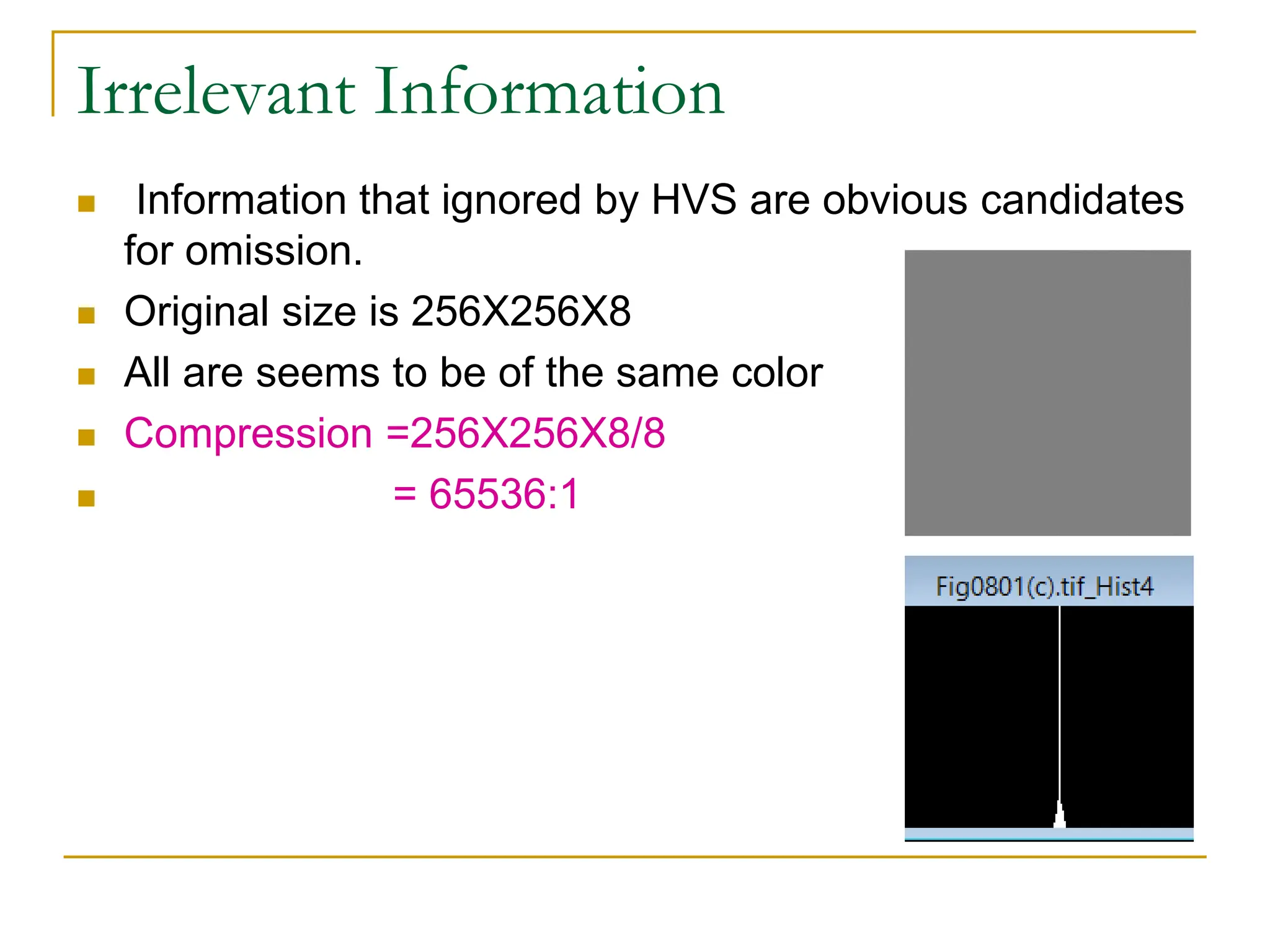
 Information that ignored by HVS are obvious candidates
for omission.
 Original size is 256X256X8
 All are seems to be of the same color
 Compression =256X256X8/8
 = 65536:1
Irrelevant Information
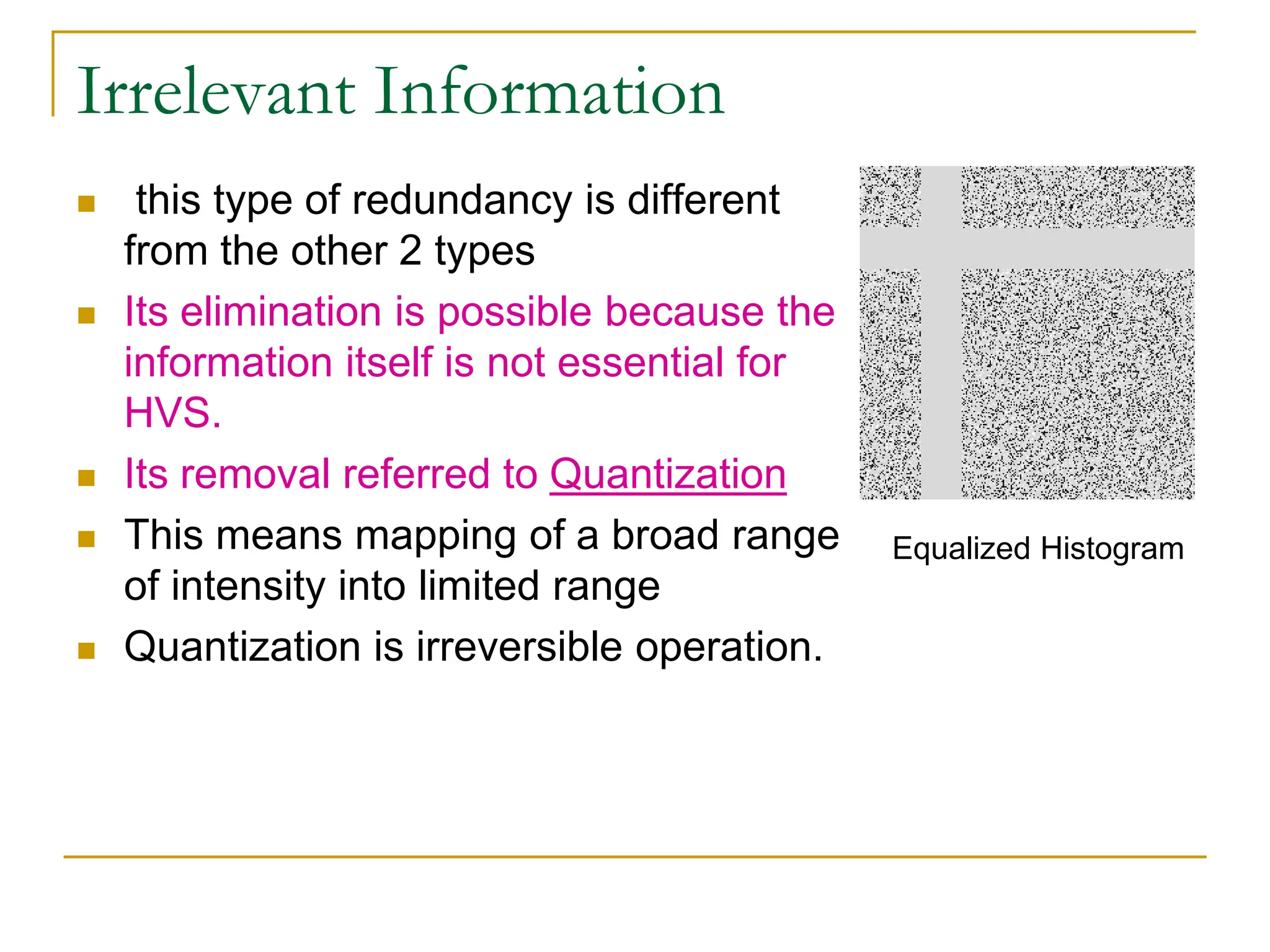
 this type of redundancy is different
from the other 2 types
 Its elimination is possible because the
information itself is not essential for
HVS.
 Its removal referred to Quantization
 This means mapping of a broad range
of intensity into limited range
 Quantization is irreversible operation.
Equalized Histogram
How do we measure information?
 What is the information content of a
message/image?
 What is the minimum amount of data that is
sufficient to describe completely an image
without loss of information?
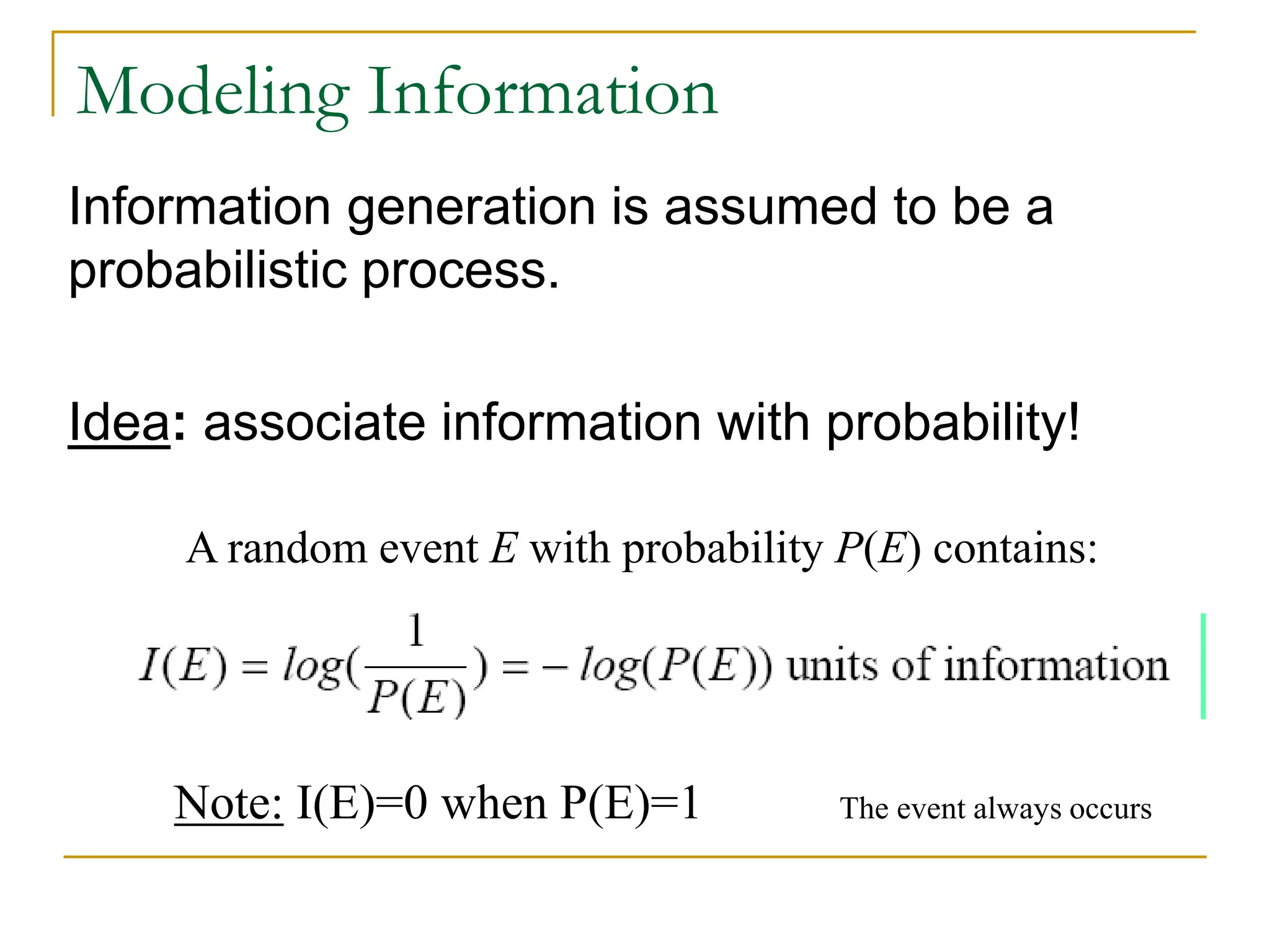
Modeling Information
Information generation is assumed to be a
probabilistic process.
Idea: associate information with probability!
Note: I(E)=0 when P(E)=1 The event always occurs
A random event E with probability P(E) contains:
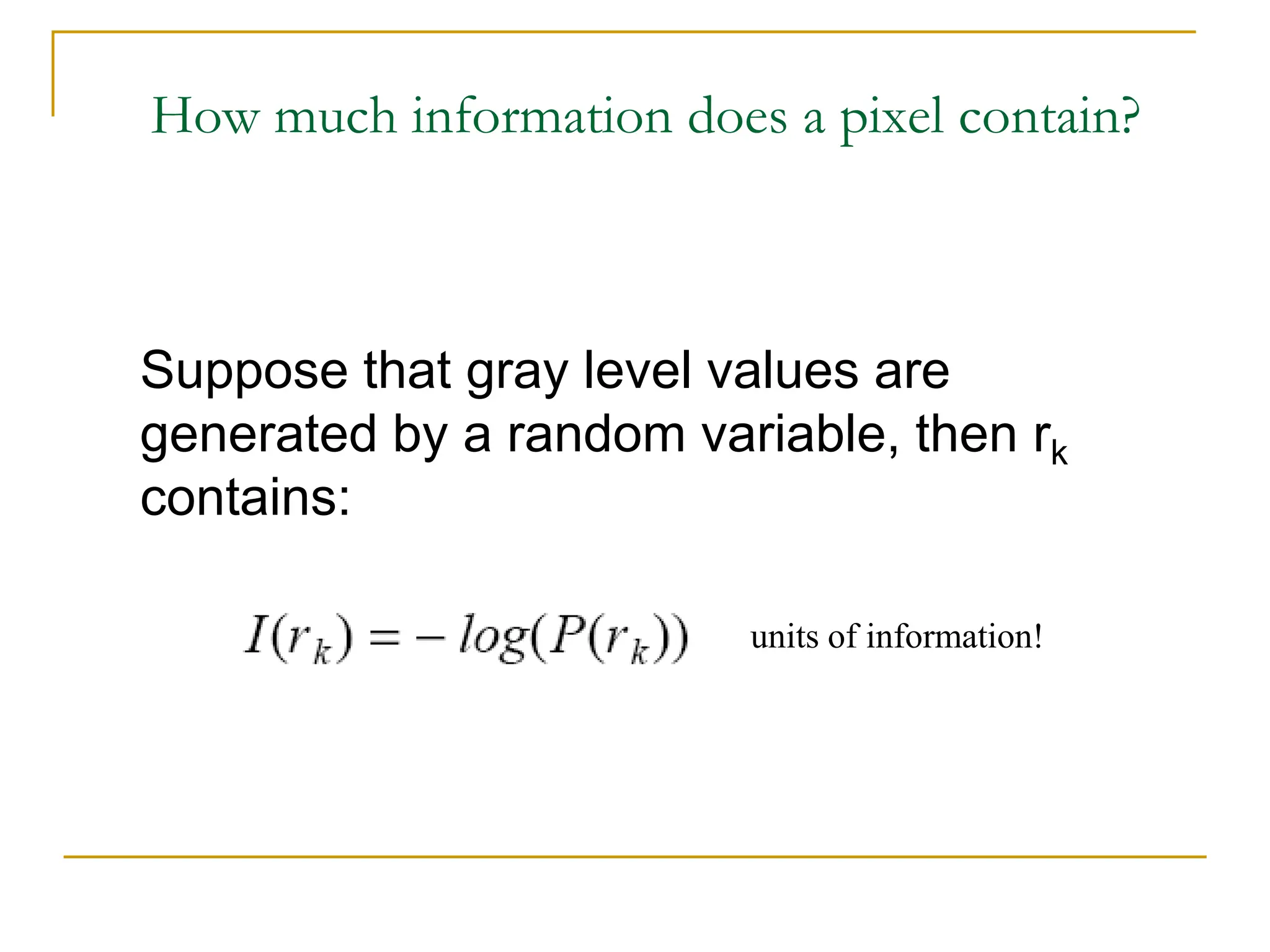
How much information does a pixel contain?
Suppose that gray level values are
generated by a random variable, then rk
contains:
units of information!

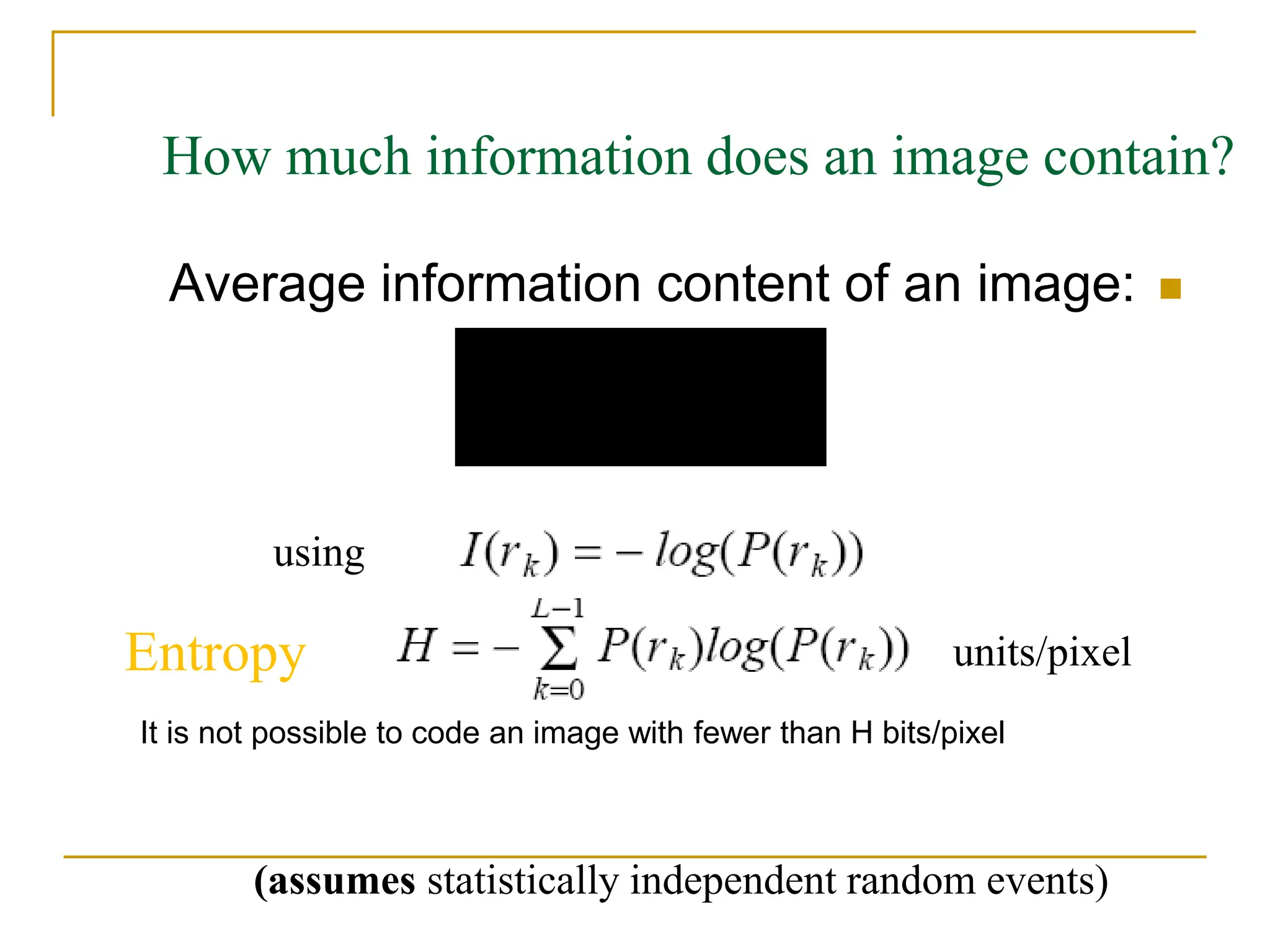
Average information content of an image:
units/pixel
1
0
( )Pr( )
L
k k
k
E I r r


 
using
How much information does an image contain?
(assumes statistically independent random events)
Entropy
It is not possible to code an image with fewer than H bits/pixel
Example:
 H = -[.25 log2 0.25 +.47 log2 0.47 +
 .25 log2 0.25 + .03 log2 0.03]
 = [-0.25(-2) +.47(-1.09) + .25(-2) +.03(-5.06)]
 = 1.6614 bits/pixel
 What about H for the second type of redundancy?
Fidelity Criteria
 Objective fidelity criterion
Loss of information – compress – decompress .
 Subjective fidelity criteria
Quality of image .
Fidelity criteria
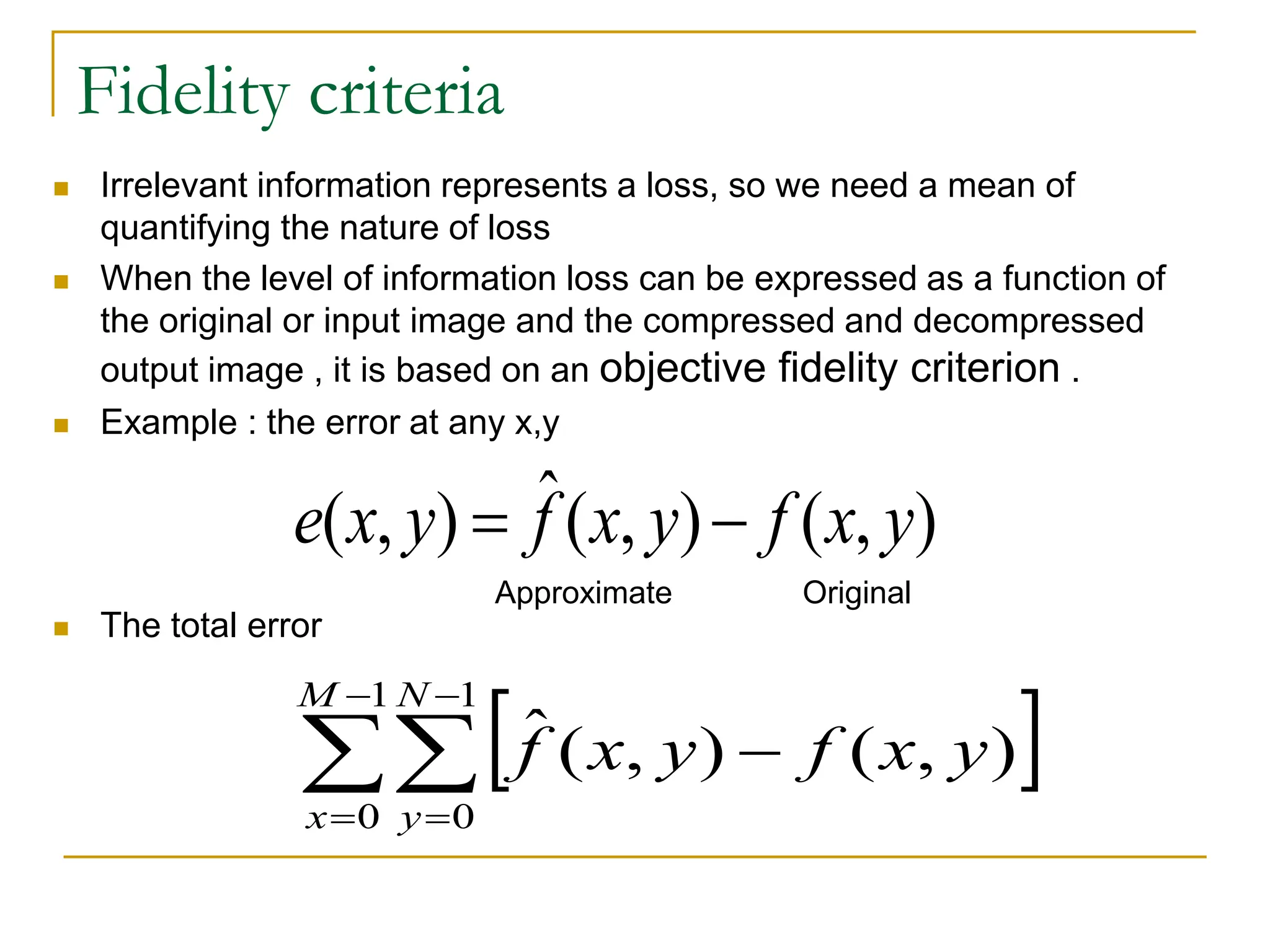
 Irrelevant information represents a loss, so we need a mean of
quantifying the nature of loss
 When the level of information loss can be expressed as a function of
the original or input image and the compressed and decompressed
output image , it is based on an objective fidelity criterion .
 Example : the error at any x,y
 The total error
 






1
0
1
0
)
,
(
)
,
(
ˆ
M
x
N
y
y
x
f
y
x
f
)
,
(
)
,
(
ˆ
)
,
( y
x
f
y
x
f
y
x
e 

Approximate Original
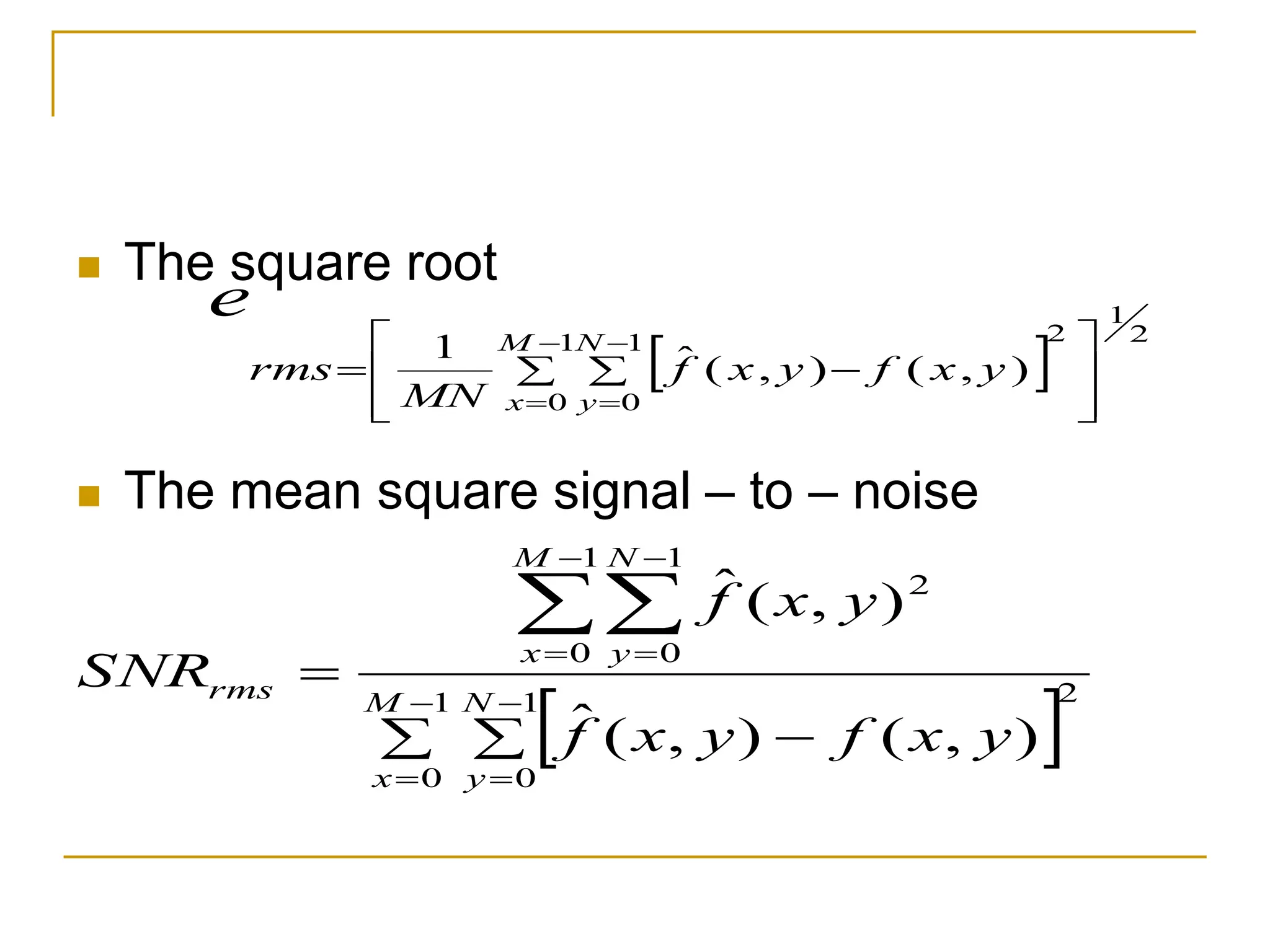
 The square root
 The mean square signal – to – noise
 
2
1
0
1
0
1
0
1
0
2
)
,
(
)
,
(
ˆ
)
,
(
ˆ
  










M
x
N
y
M
x
N
y
rms
y
x
f
y
x
f
y
x
f
SNR
 
2
1
2
1
0
1
0
)
,
(
)
,
(
ˆ
1








  





M
x
N
y
y
x
f
y
x
f
MN
rms
e
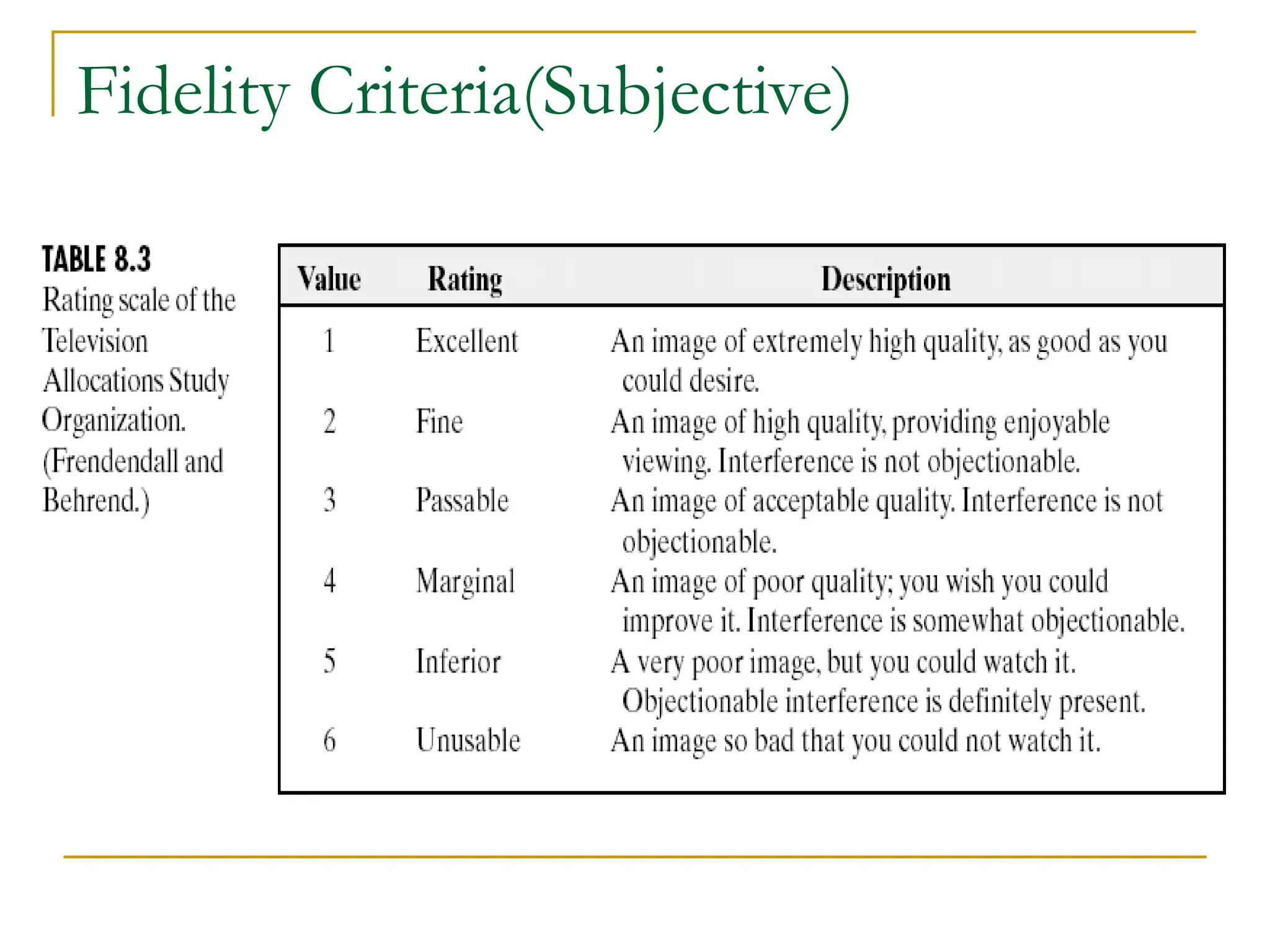
Fidelity Criteria(Subjective)
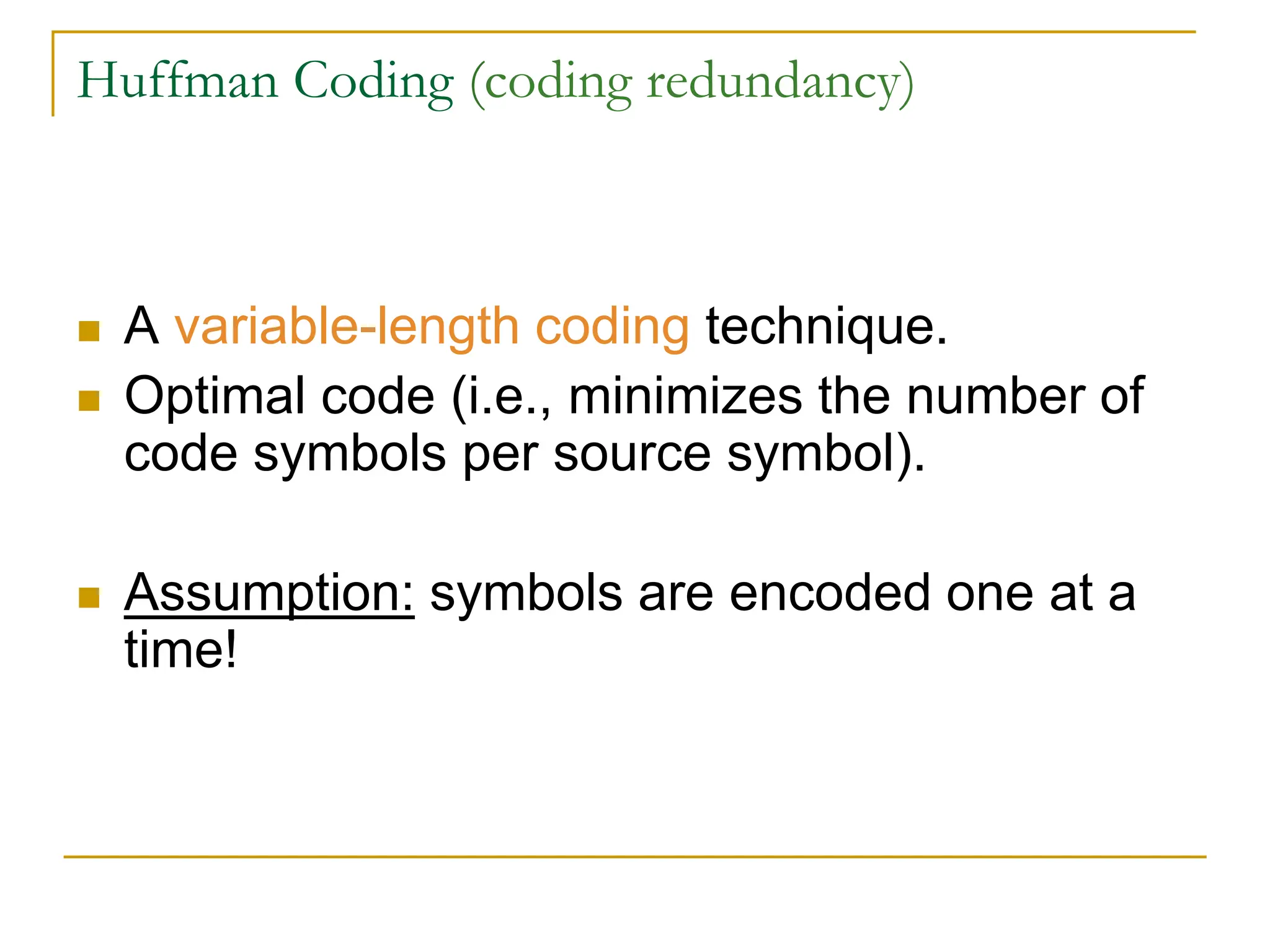
Huffman Coding (coding redundancy)
 A variable-length coding technique.
 Optimal code (i.e., minimizes the number of
code symbols per source symbol).
 Assumption: symbols are encoded one at a
time!
Huffman Coding (cont’d)
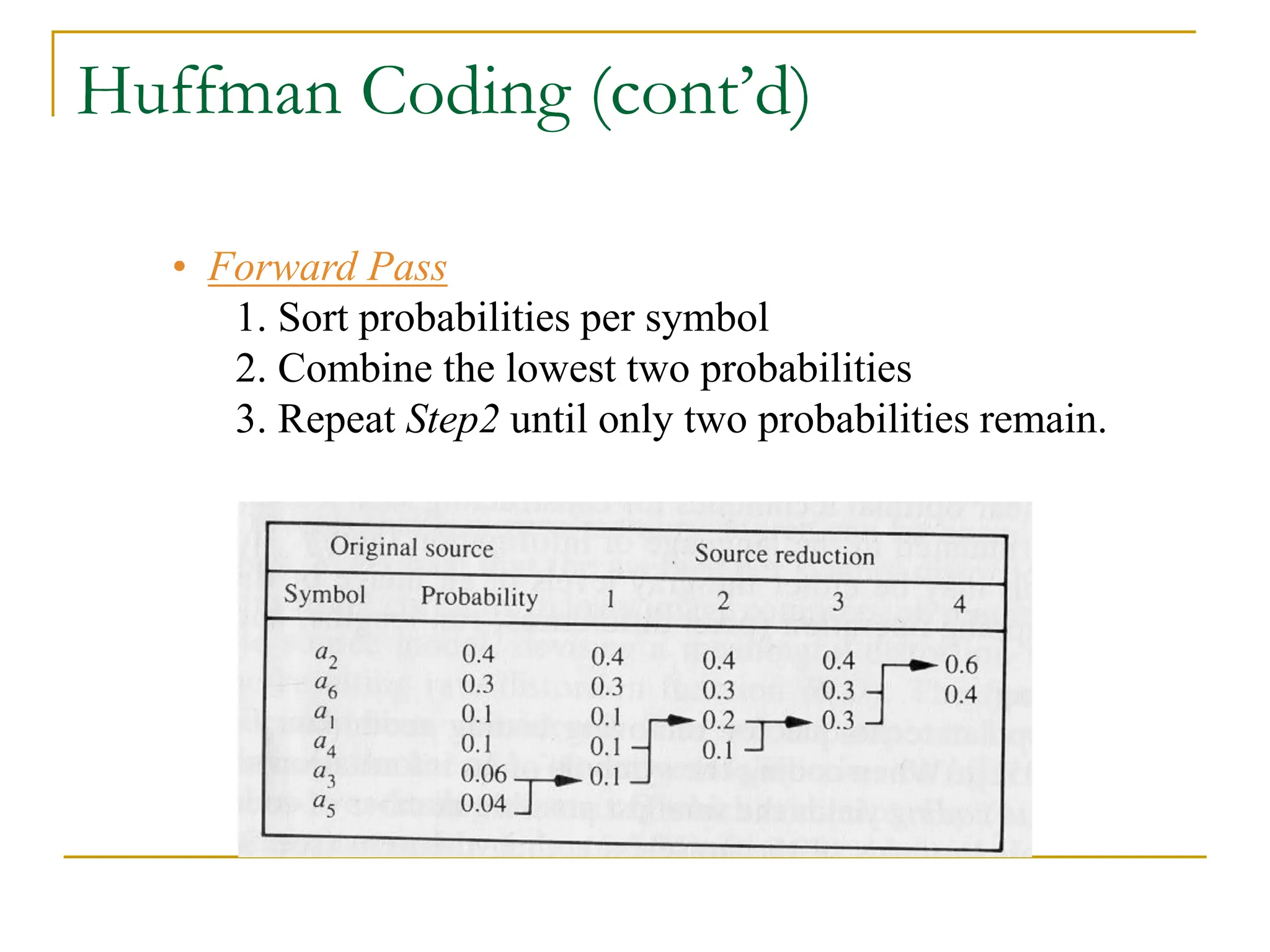
• Forward Pass
1. Sort probabilities per symbol
2. Combine the lowest two probabilities
3. Repeat Step2 until only two probabilities remain.
Huffman Coding (cont’d)
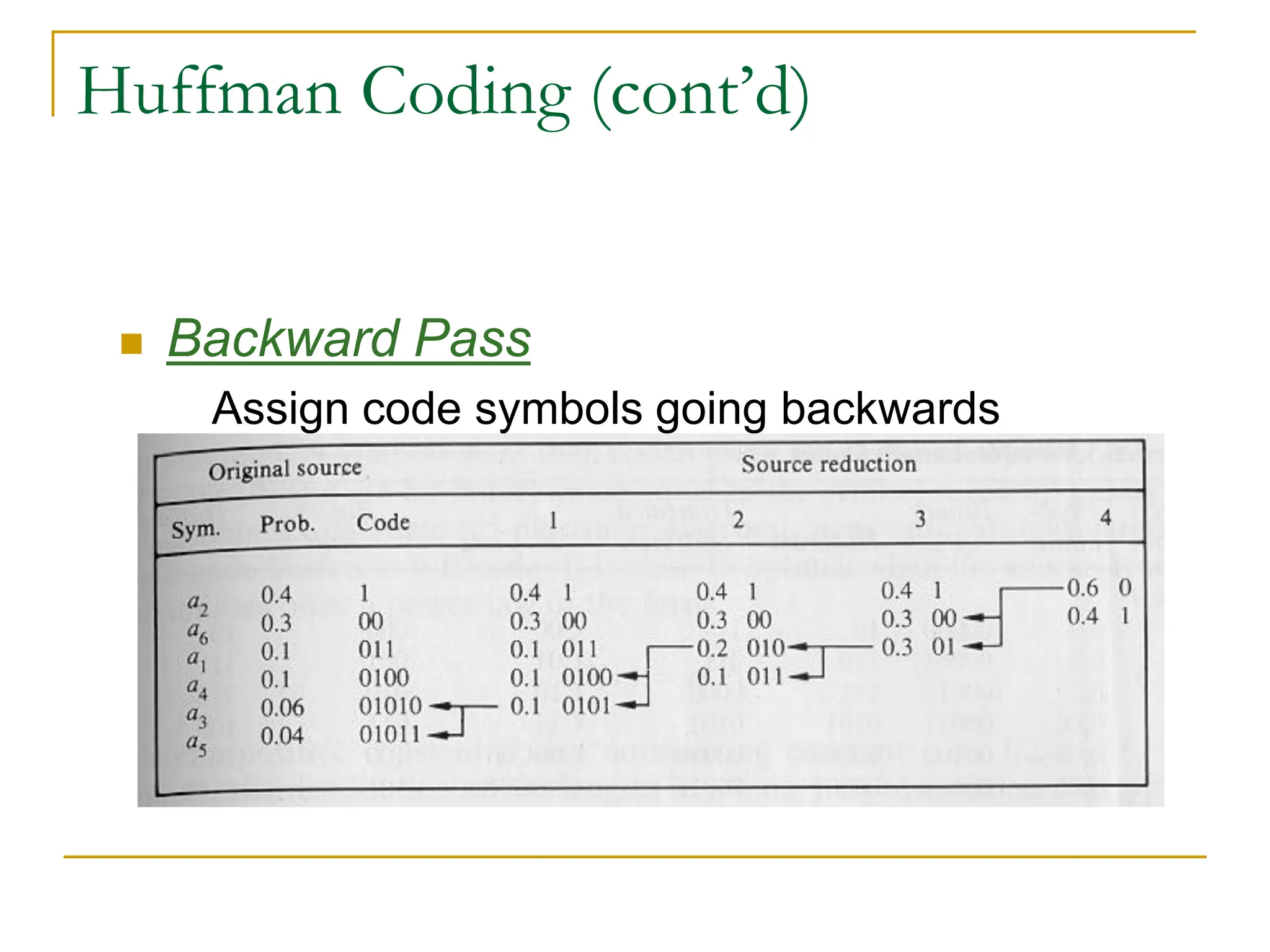
 Backward Pass
Assign code symbols going backwards
Huffman Coding (cont’d)
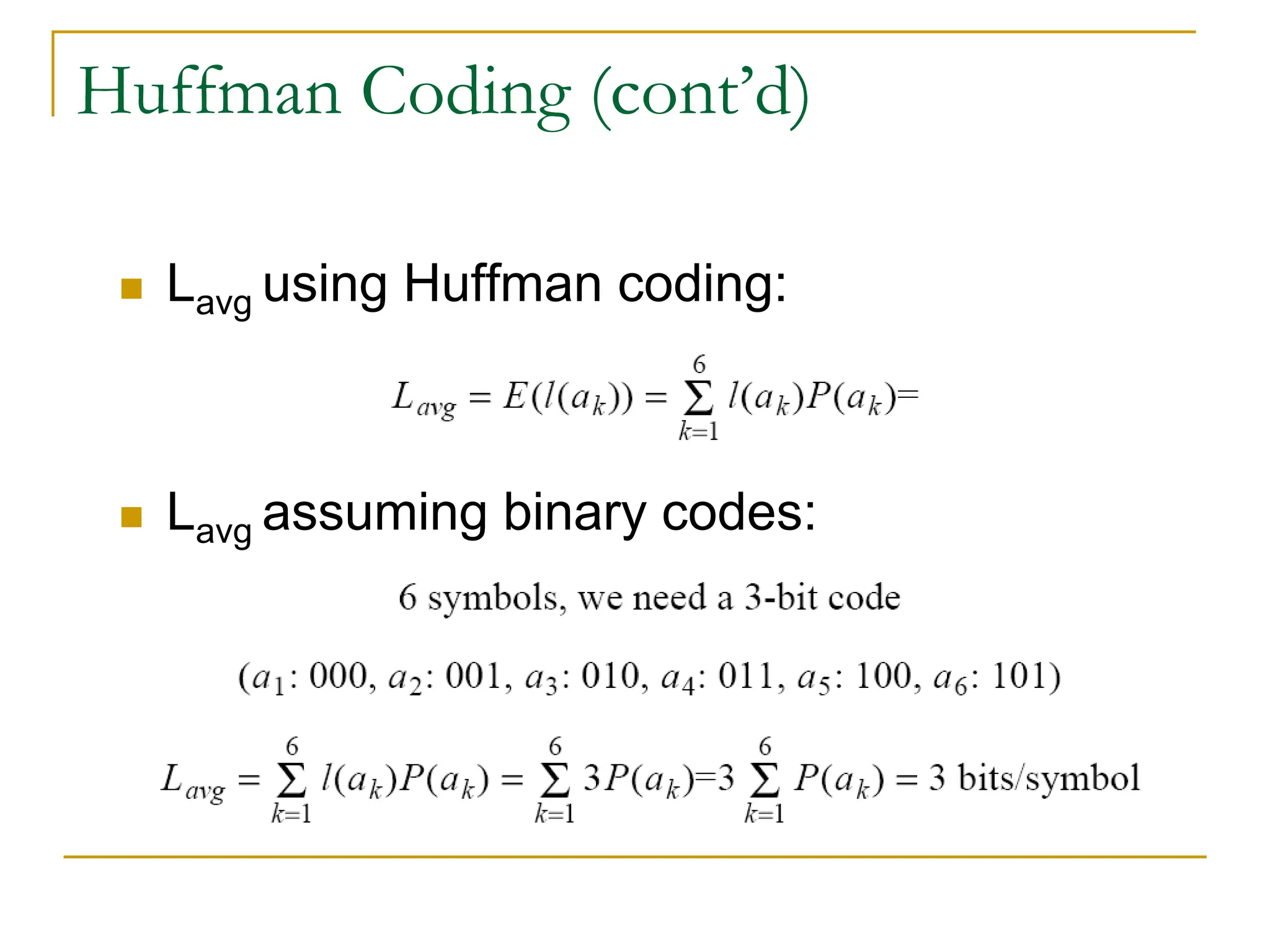
 Lavg using Huffman coding:
 Lavg assuming binary codes:
Huffman Coding/Decoding

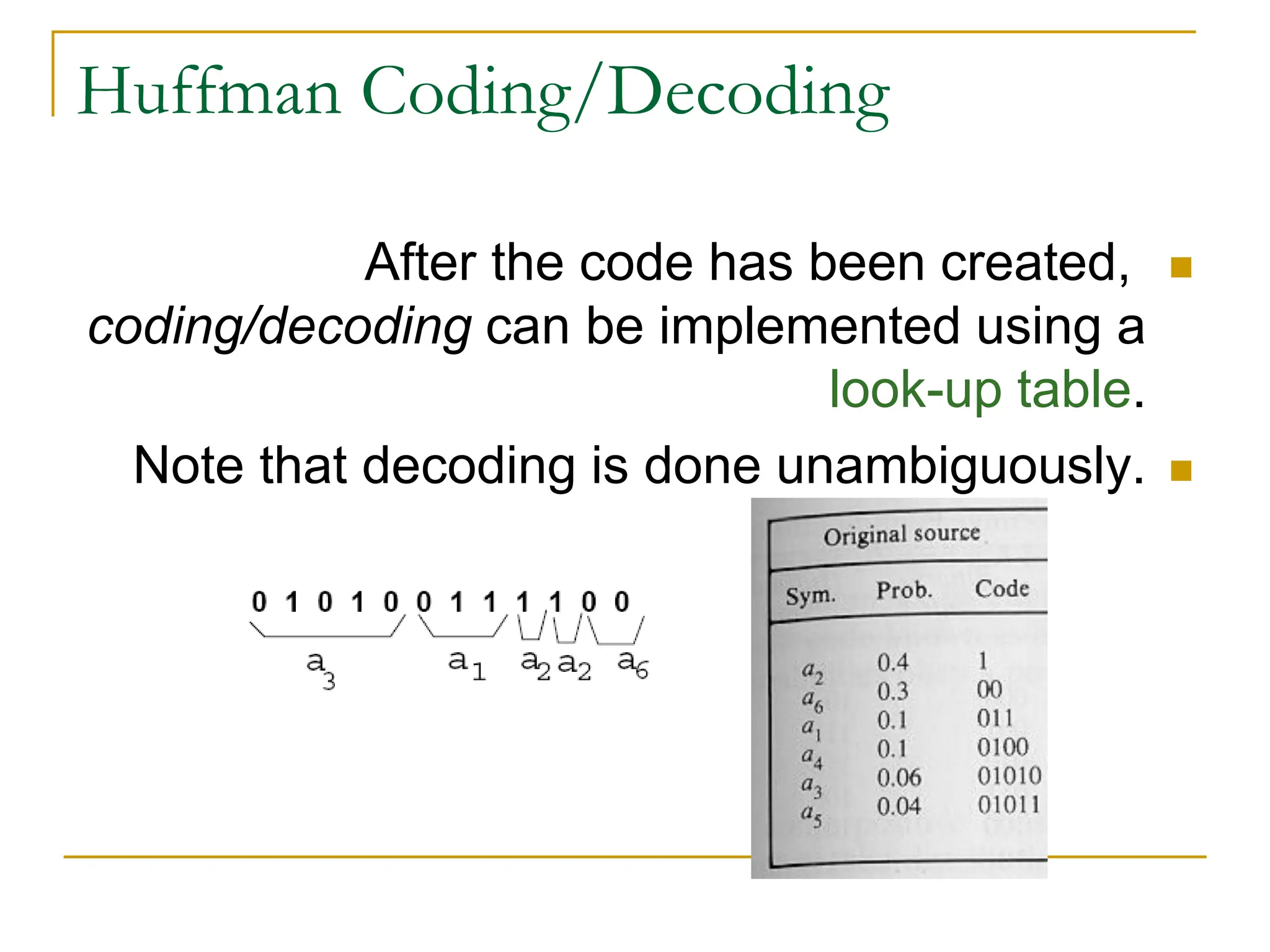
After the code has been created,
coding/decoding can be implemented using a
look-up table.

Note that decoding is done unambiguously.
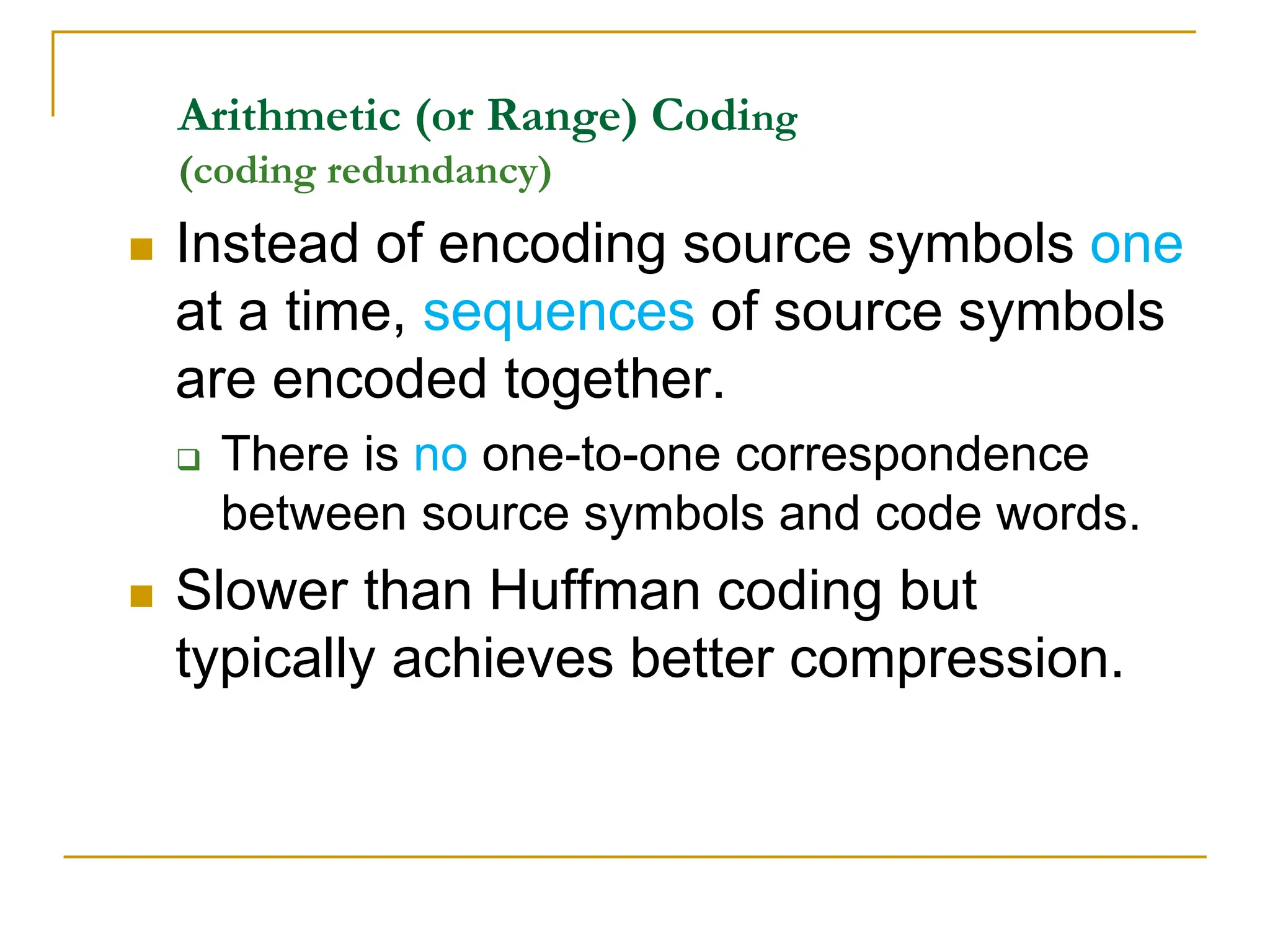
Arithmetic (or Range) Coding
(coding redundancy)
 Instead of encoding source symbols one
at a time, sequences of source symbols
are encoded together.
 There is no one-to-one correspondence
between source symbols and code words.
 Slower than Huffman coding but
typically achieves better compression.
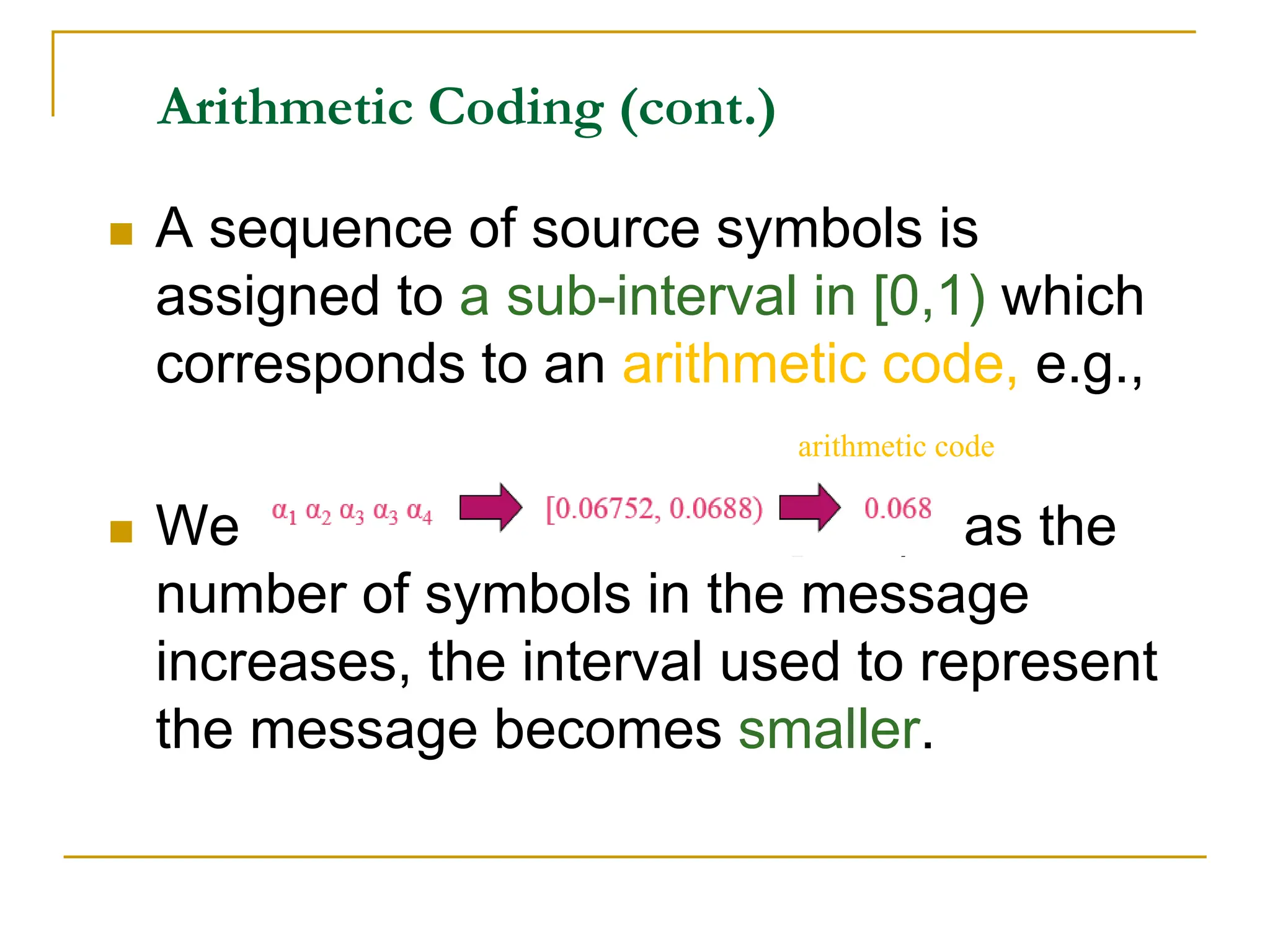
Arithmetic Coding (cont.)
 A sequence of source symbols is
assigned to a sub-interval in [0,1) which
corresponds to an arithmetic code, e.g.,
 We start with the interval [0, 1) ; as the
number of symbols in the message
increases, the interval used to represent
the message becomes smaller.
arithmetic code
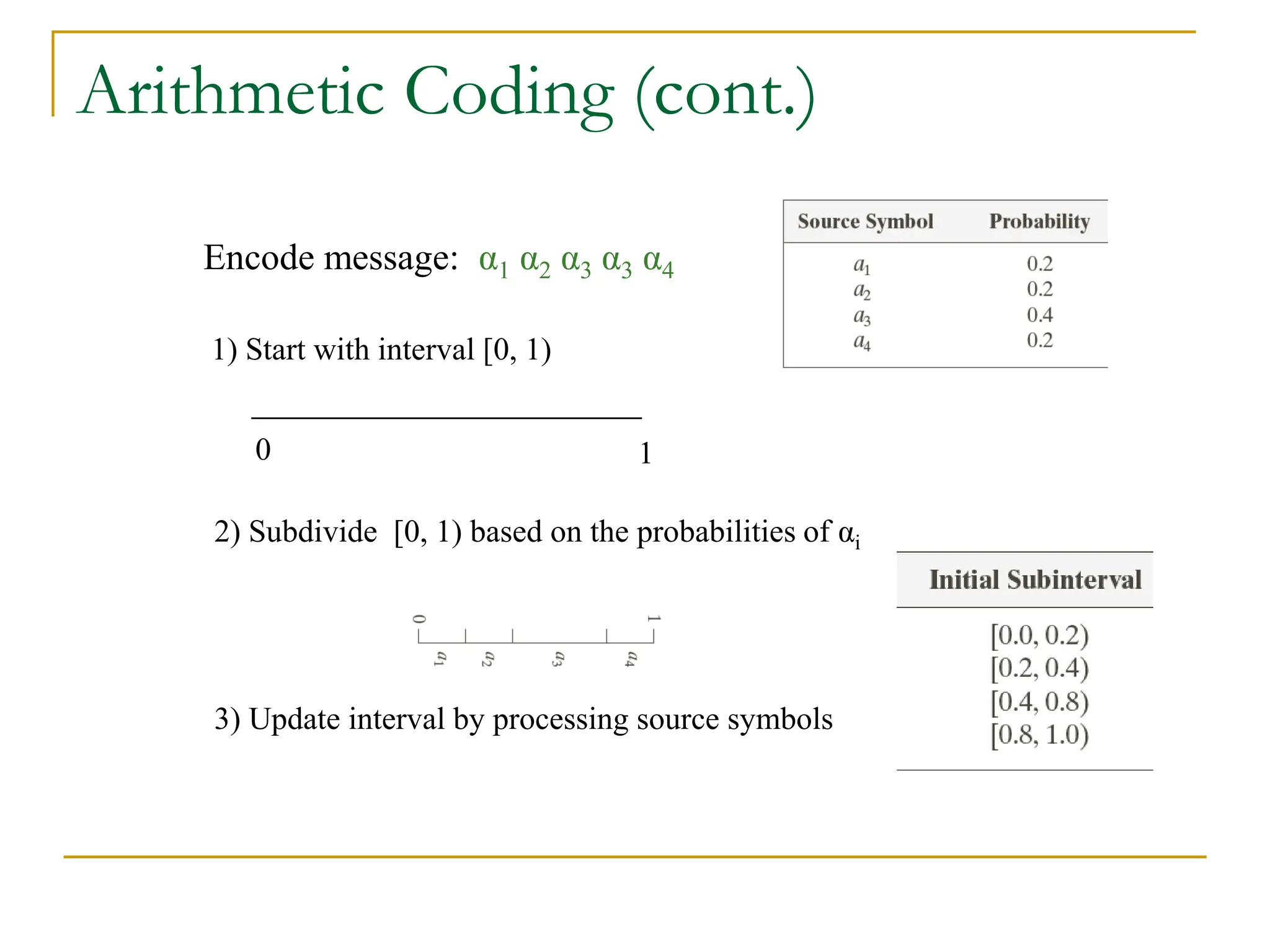
Arithmetic Coding (cont.)
Encode message: α1 α2 α3 α3 α4
0 1
1) Start with interval [0, 1)
2) Subdivide [0, 1) based on the probabilities of αi
3) Update interval by processing source symbols
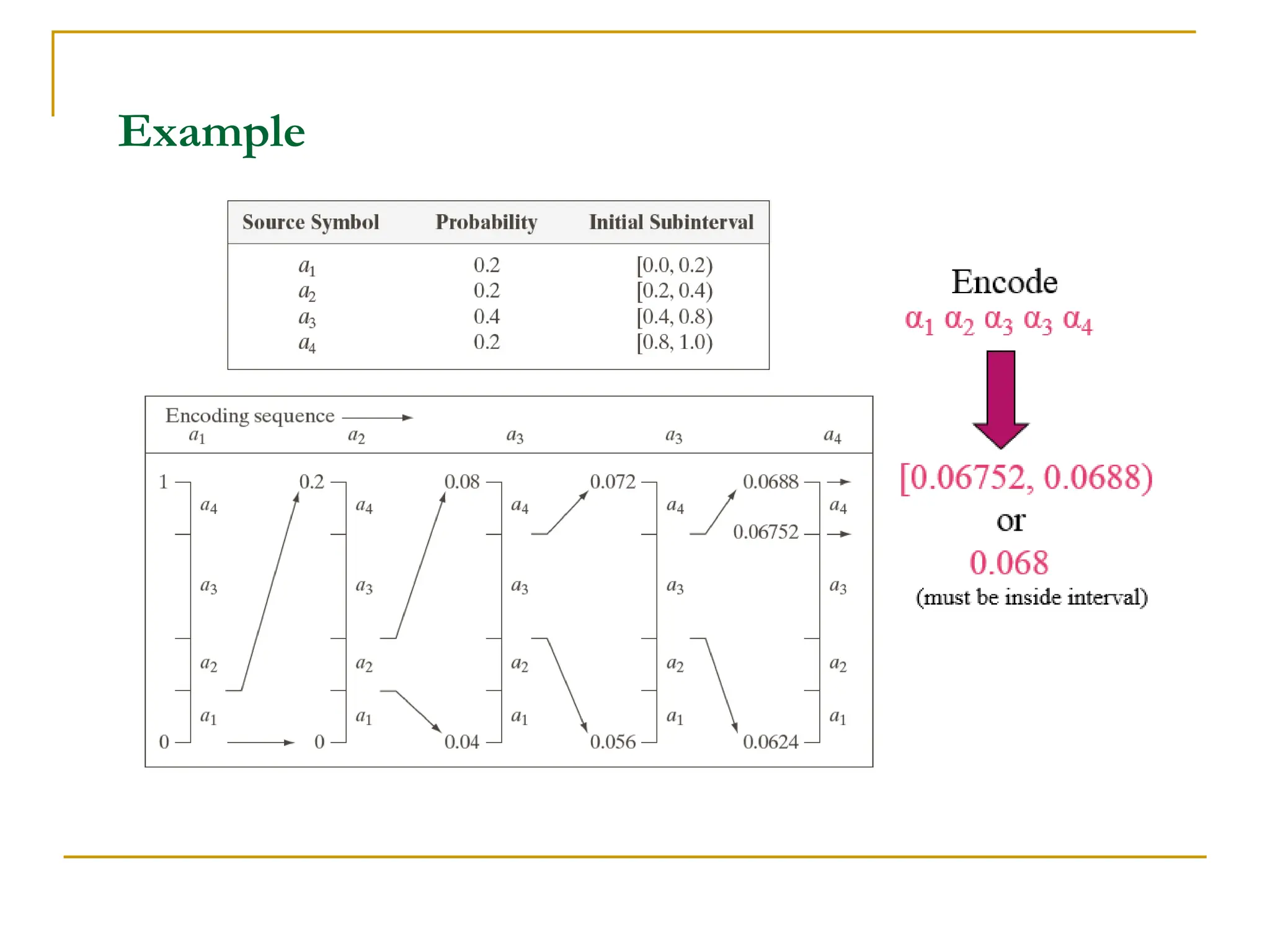
Example
Example (cont.)
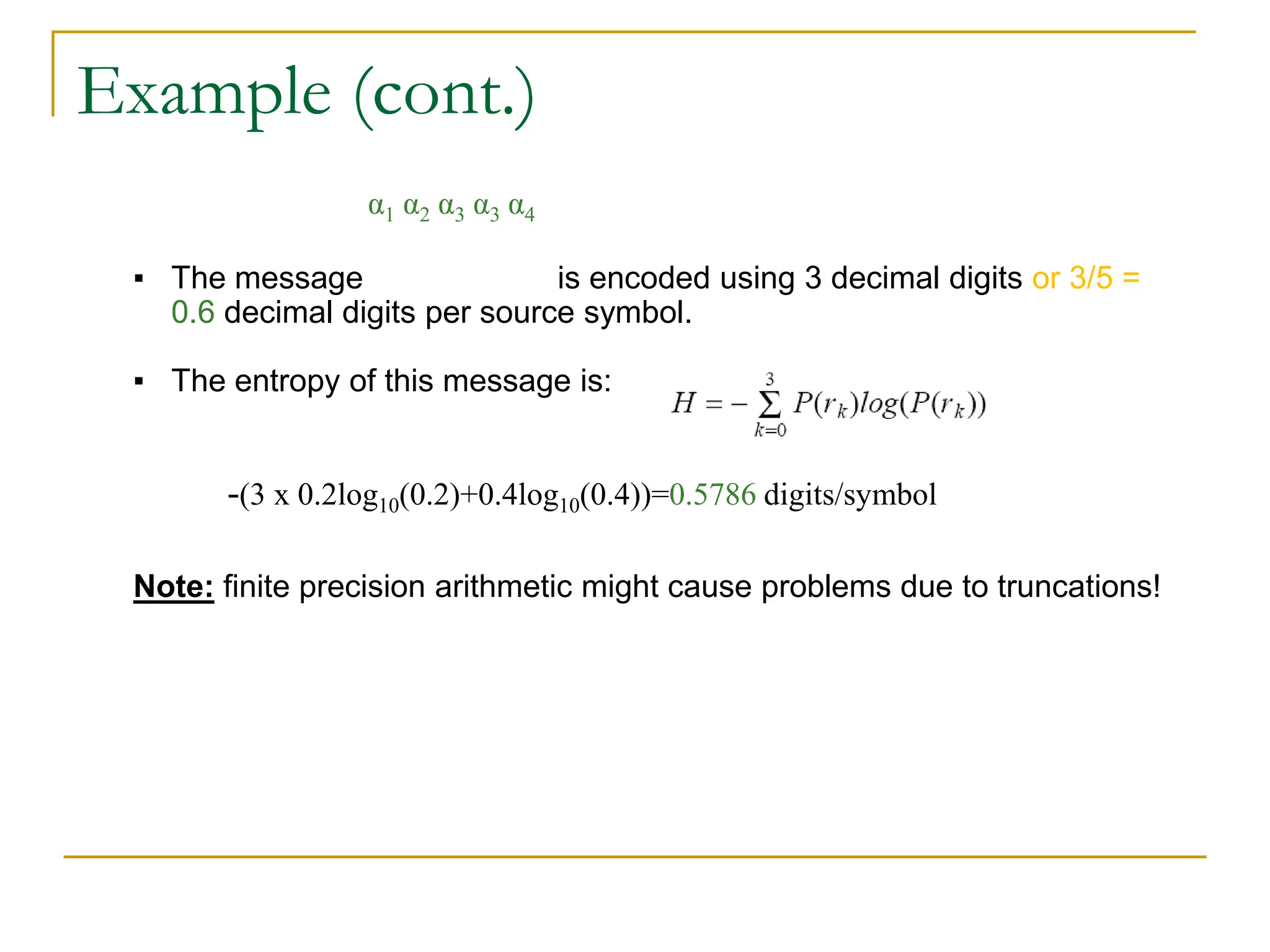
▪ The message is encoded using 3 decimal digits or 3/5 =
0.6 decimal digits per source symbol.
▪ The entropy of this message is:
Note: finite precision arithmetic might cause problems due to truncations!
α1 α2 α3 α3 α4
-(3 x 0.2log10(0.2)+0.4log10(0.4))=0.5786 digits/symbol
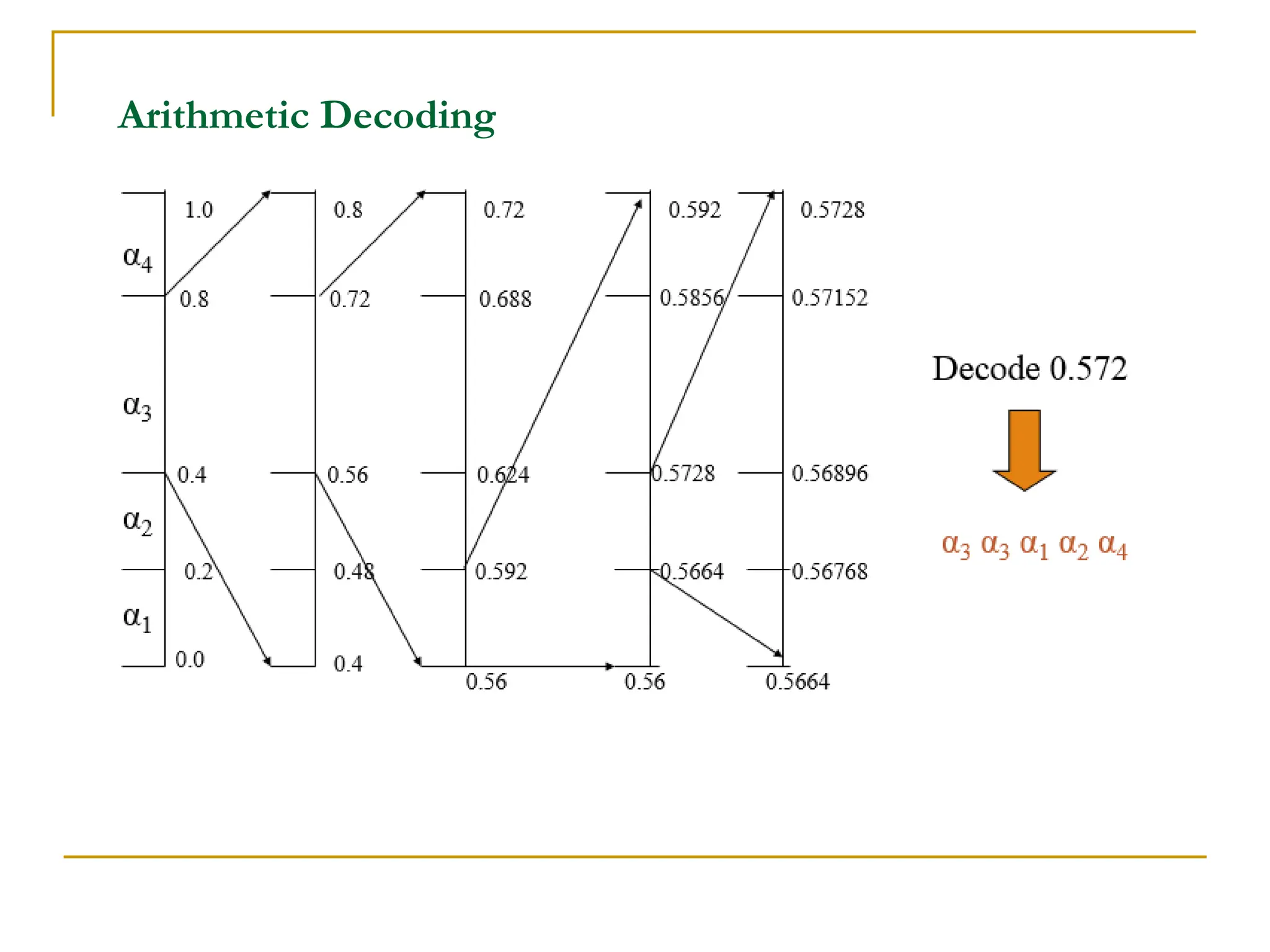
Arithmetic Decoding

Lec_8_Image Compression.pdf

  • 1.
  • 2.
    Preview  Methods ofcompressing data prior to storage and / or transmission are of significant practical and commercial  Image compression addresses the problem of reducing the amount of data required to a digital image .  The underlying basis of the reduction process is the removal of redundant data .
  • 3.
    Fundamentals  The datacompression refers to the process of reducing the amount of data required to represent a given quantity of information .  The difference of data and information .  Data are the means by which information is conveyed .  Data redundancy is a central issue in digital image compression
  • 4.
    Fundamentals  The relativedata redundancy RD : Where CR is compression ratio . n1 , n2 donate the number of information – carrying units in two data set that represent the same information . n1=n2 CR =1 RD =0 n1 contains no redundant data n2 << n1 CR  ∞ RD 1 significant compress & High redundant data n2 >> n1 CR 0 RD -∞ n2 contains much more data than n1 undesirable case CR=10 every 10 information in n1 represented by 1 bit in n2 , n1 has 90% redundancy 1 1 R D C R   1 2 n R n C 
  • 5.
    3 basic Dataredundancies  Coding Redundancy .  Spatial and Temporal Redundancy.  i.e. Video sequence (Correlated pixels are not repeated.)  Irrelevant Information.  Information that ignored by human visual system
  • 6.
    Coding Redundancy  Letsassume , that a discrete random variable rK in the interval [0 , 1] represents the gray levels of an image and each rK occurs with probability k=0,1,2,……L-1 Where L is the number gray levels , nK is the number of times that the Kth gray level appears in image . n is the total number of pixel in the image . ( ) K n r K n P r  ( ) r K P r
  • 7.
    Coding Redundancy The averagelength of the code words assigned to the various gray level values where l(rk) no.of bits used to represent each gray pr(rk) probability that gray level occurs 1 0 ( ) ( ) L avg K r K K L l r p r    
  • 8.
    ) ( ) ( K r K avg r p r l L  . 7 . 2 ) 02 . 0 ( 6 ) 03 . 0 ( 6 ) 06 . 0 ( 5 ) 08 . 0 ( 4 ) 16 . 0 ( 3 ) 21 . 0 ( 2 ) 25 . 0 ( 2 ) 19 . 0 ( 2 bits          Example
  • 9.
    Example  The resultingcompression ratio is 3/2.7 or 1.11 .  Thus approximately 10% of the data resulting from the use of code 1 is redundant .  The exact level of redundancy can be determine from R C 099 . 0 11 . 1 1 1    D R
  • 10.
    Spatial and Temporalredundancy  Each line has the same intensity  All 256intensity are of equal probability.  Pixels intensity are independent of each other  Pixels are correlated vertically  Pixels intensity can be predicted from their  Neighbor intensities, so the information carried  By one pixel is small. Histogram
  • 11.
    Irrelevant Information  Informationthat ignored by HVS are obvious candidates for omission.  Original size is 256X256X8  All are seems to be of the same color  Compression =256X256X8/8  = 65536:1
  • 12.
    Irrelevant Information  thistype of redundancy is different from the other 2 types  Its elimination is possible because the information itself is not essential for HVS.  Its removal referred to Quantization  This means mapping of a broad range of intensity into limited range  Quantization is irreversible operation. Equalized Histogram
  • 13.
    How do wemeasure information?  What is the information content of a message/image?  What is the minimum amount of data that is sufficient to describe completely an image without loss of information?
  • 14.
    Modeling Information Information generationis assumed to be a probabilistic process. Idea: associate information with probability! Note: I(E)=0 when P(E)=1 The event always occurs A random event E with probability P(E) contains:
  • 15.
    How much informationdoes a pixel contain? Suppose that gray level values are generated by a random variable, then rk contains: units of information!
  • 16.
     Average information contentof an image: units/pixel 1 0 ( )Pr( ) L k k k E I r r     using How much information does an image contain? (assumes statistically independent random events) Entropy It is not possible to code an image with fewer than H bits/pixel
  • 17.
    Example:  H =-[.25 log2 0.25 +.47 log2 0.47 +  .25 log2 0.25 + .03 log2 0.03]  = [-0.25(-2) +.47(-1.09) + .25(-2) +.03(-5.06)]  = 1.6614 bits/pixel  What about H for the second type of redundancy?
  • 18.
    Fidelity Criteria  Objectivefidelity criterion Loss of information – compress – decompress .  Subjective fidelity criteria Quality of image .
  • 19.
    Fidelity criteria  Irrelevantinformation represents a loss, so we need a mean of quantifying the nature of loss  When the level of information loss can be expressed as a function of the original or input image and the compressed and decompressed output image , it is based on an objective fidelity criterion .  Example : the error at any x,y  The total error         1 0 1 0 ) , ( ) , ( ˆ M x N y y x f y x f ) , ( ) , ( ˆ ) , ( y x f y x f y x e   Approximate Original
  • 20.
     The squareroot  The mean square signal – to – noise   2 1 0 1 0 1 0 1 0 2 ) , ( ) , ( ˆ ) , ( ˆ              M x N y M x N y rms y x f y x f y x f SNR   2 1 2 1 0 1 0 ) , ( ) , ( ˆ 1                 M x N y y x f y x f MN rms e
  • 21.
  • 22.
    Huffman Coding (codingredundancy)  A variable-length coding technique.  Optimal code (i.e., minimizes the number of code symbols per source symbol).  Assumption: symbols are encoded one at a time!
  • 23.
    Huffman Coding (cont’d) •Forward Pass 1. Sort probabilities per symbol 2. Combine the lowest two probabilities 3. Repeat Step2 until only two probabilities remain.
  • 24.
    Huffman Coding (cont’d) Backward Pass Assign code symbols going backwards
  • 25.
    Huffman Coding (cont’d) Lavg using Huffman coding:  Lavg assuming binary codes:
  • 26.
    Huffman Coding/Decoding  After thecode has been created, coding/decoding can be implemented using a look-up table.  Note that decoding is done unambiguously.
  • 27.
    Arithmetic (or Range)Coding (coding redundancy)  Instead of encoding source symbols one at a time, sequences of source symbols are encoded together.  There is no one-to-one correspondence between source symbols and code words.  Slower than Huffman coding but typically achieves better compression.
  • 28.
    Arithmetic Coding (cont.) A sequence of source symbols is assigned to a sub-interval in [0,1) which corresponds to an arithmetic code, e.g.,  We start with the interval [0, 1) ; as the number of symbols in the message increases, the interval used to represent the message becomes smaller. arithmetic code
  • 29.
    Arithmetic Coding (cont.) Encodemessage: α1 α2 α3 α3 α4 0 1 1) Start with interval [0, 1) 2) Subdivide [0, 1) based on the probabilities of αi 3) Update interval by processing source symbols
  • 30.
  • 31.
    Example (cont.) ▪ Themessage is encoded using 3 decimal digits or 3/5 = 0.6 decimal digits per source symbol. ▪ The entropy of this message is: Note: finite precision arithmetic might cause problems due to truncations! α1 α2 α3 α3 α4 -(3 x 0.2log10(0.2)+0.4log10(0.4))=0.5786 digits/symbol
  • 32.