NAME- SOUMA MAITI
ROLL N0- 27500120016
REG NO.- 202750100110016
DEPARTMENT- COMPUTER SCIENCE
YEAR- 3RD YEAR(6TH SEMESTER)
SUBJECT NAME- IMAGE PROCESSING
SUBJECT CODE- PEC-IT601D
INTRODUCTION
• What is an image?
• An image is defined as a two-dimensional
function F(x,y) where x and y are spatial
coordinates, and the amplitude of F at any
pair of coordinates (x,y) is called
the intensity of that image at that point.
When x,y and amplitude values of F are
finite, we call it a digital image.
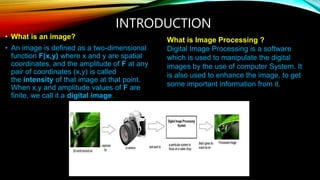
What is Image Processing ?
Digital Image Processing is a software
which is used to manipulate the digital
images by the use of computer System. It
is also used to enhance the image, to get
some important information from it.
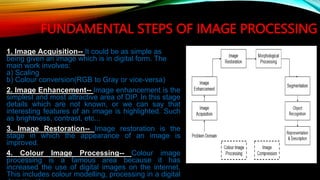
FUNDAMENTAL STEPS OF IMAGE PROCESSING
1. Image Acquisition-- It could be as simple as
being given an image which is in digital form. The
main work involves:
a) Scaling
b) Colour conversion(RGB to Gray or vice-versa)
2. Image Enhancement-- Image enhancement is the
simplest and most attractive area of DIP. In this stage
details which are not known, or we can say that
interesting features of an image is highlighted. Such
as brightness, contrast, etc...
3. Image Restoration-- Image restoration is the
stage in which the appearance of an image is
improved.
4. Colour Image Processing-- Colour image
processing is a famous area because it has
increased the use of digital images on the internet.
This includes colour modelling, processing in a digital
5. Wavelets and Multi-Resolution Processing-- In this stage, an image is
represented in various degrees of resolution. Image is divided into smaller
regions for data compression and for the pyramidal representation.
6. Image Compression--It involves in developing some functions to perform
this operation. It mainly deals with image size or resolution.
7. Morphological Processing--This stage deals with tools which are used
for extracting the components of the image, which is useful in the
representation and description of shape.
8. Segmentation-- In this stage, an image is a partitioned into its objects.
Segmentation is the most difficult tasks in DIP. It is a process which takes a
lot of time for the successful solution of imaging problems which requires
objects to identify individually.
9.Representation & Description-- It follows output of segmentation stage,
choosing a representation is only the part of solution for transforming raw
data into processed data.
10. Object recognition-- In this stage, the label is assigned to the object,
which is based on descriptors
11. Knowledge Base-- Knowledge is the last stage in DIP. In this stage,
important information of the image is located, which limits the searching
processes. The knowledge base is very complex when the image database
has a high-resolution
Fundamental Steps Of Image Processing

Fundamental Steps Of Image Processing

  • 1.
    NAME- SOUMA MAITI ROLLN0- 27500120016 REG NO.- 202750100110016 DEPARTMENT- COMPUTER SCIENCE YEAR- 3RD YEAR(6TH SEMESTER) SUBJECT NAME- IMAGE PROCESSING SUBJECT CODE- PEC-IT601D
  • 2.
    INTRODUCTION • What isan image? • An image is defined as a two-dimensional function F(x,y) where x and y are spatial coordinates, and the amplitude of F at any pair of coordinates (x,y) is called the intensity of that image at that point. When x,y and amplitude values of F are finite, we call it a digital image. What is Image Processing ? Digital Image Processing is a software which is used to manipulate the digital images by the use of computer System. It is also used to enhance the image, to get some important information from it.
  • 3.
    FUNDAMENTAL STEPS OFIMAGE PROCESSING 1. Image Acquisition-- It could be as simple as being given an image which is in digital form. The main work involves: a) Scaling b) Colour conversion(RGB to Gray or vice-versa) 2. Image Enhancement-- Image enhancement is the simplest and most attractive area of DIP. In this stage details which are not known, or we can say that interesting features of an image is highlighted. Such as brightness, contrast, etc... 3. Image Restoration-- Image restoration is the stage in which the appearance of an image is improved. 4. Colour Image Processing-- Colour image processing is a famous area because it has increased the use of digital images on the internet. This includes colour modelling, processing in a digital
  • 4.
    5. Wavelets andMulti-Resolution Processing-- In this stage, an image is represented in various degrees of resolution. Image is divided into smaller regions for data compression and for the pyramidal representation. 6. Image Compression--It involves in developing some functions to perform this operation. It mainly deals with image size or resolution. 7. Morphological Processing--This stage deals with tools which are used for extracting the components of the image, which is useful in the representation and description of shape. 8. Segmentation-- In this stage, an image is a partitioned into its objects. Segmentation is the most difficult tasks in DIP. It is a process which takes a lot of time for the successful solution of imaging problems which requires objects to identify individually. 9.Representation & Description-- It follows output of segmentation stage, choosing a representation is only the part of solution for transforming raw data into processed data. 10. Object recognition-- In this stage, the label is assigned to the object, which is based on descriptors 11. Knowledge Base-- Knowledge is the last stage in DIP. In this stage, important information of the image is located, which limits the searching processes. The knowledge base is very complex when the image database has a high-resolution