 Refers to reducing the amount of data required to
represent a digital image.

Principle of compression:
reduce the redundant information, e.g.,

 coding redundancy
•

Coding redundancy is present when less than optimal code

words are used.

 interpixel redundancy
•

Interpixel redundancy results from correlations between
the pixels of an image.

 psychovisual redundancy
Psychovisual redundancy is due to data that is
ignored by the human visual system
(i.e. visually non essential information).
Principal objective: To minimize
the number of bits required to
represent an image.

*Intended to yield a compact

representation of an image.
*Reducing the image storage.
*Transmission requirements.
Image data compression methods
fall into two common categories:

*Lossy compression
*Lossless compression
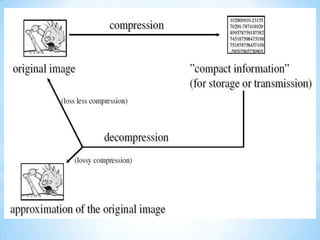
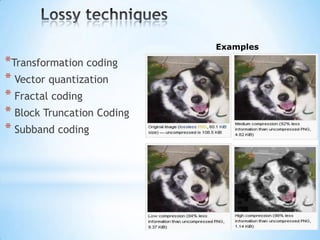
* A lossy compression method is one where

compressing data and then decompressing it
retrieves data that may well be different from
the original, but is close enough to be useful
in some way.

* Used to compress multimedia data (audio,

video, still images), especially in applications
such as streaming media and internet
telephony.

 Provide higher levels of data reduction
 Result in a less than perfect reproduction
original image

of the
* Also called Information preserving
compression.

* Compress and decompress images without
losing information.
*Run length encoding
* Huffman encoding
* LZW coding
* Area coding
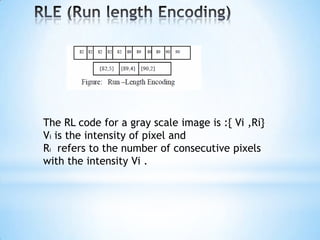
The RL code for a gray scale image is :{ Vi ,Ri}
Vi is the intensity of pixel and
Ri refers to the number of consecutive pixels
with the intensity Vi .
Examples

*Transformation coding
* Vector quantization
* Fractal coding
* Block Truncation Coding
* Subband coding
*In this coding scheme, transforms such as DFT

and
DCT are used to change the pixels in the original
image into frequency domain coefficients (called
transform coefficients).

*These coefficients have the energy compaction

property i.e. energy of the original data being
concentrated in only a few of the significant
transform coefficients. Only those few significant
coefficients are selected and the remaining are
discarded.
* Joint Photographic Experts Group created the
standard.

* Lossy Compression Technique based on use of
Discrete Cosine Transform (DCT)
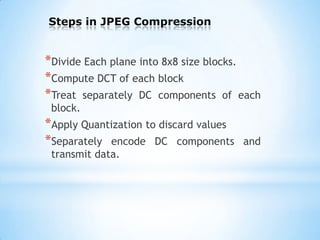
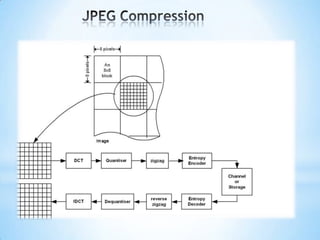
Steps in JPEG Compression

*Divide Each plane into 8x8 size blocks.
*Compute DCT of each block
*Treat separately DC components of each
block.

*Apply Quantization to discard values
*Separately encode DC components
transmit data.

and
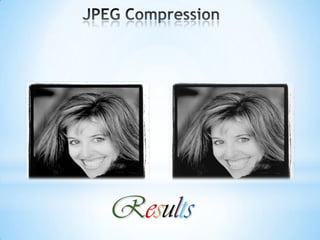
Results
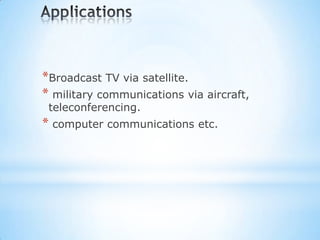
*Broadcast TV via satellite.
* military communications via aircraft,
teleconferencing.

* computer communications etc.
Image compression introductory presentation

Image compression introductory presentation

  • 1.
     Refers toreducing the amount of data required to represent a digital image. Principle of compression: reduce the redundant information, e.g.,  coding redundancy • Coding redundancy is present when less than optimal code words are used.  interpixel redundancy • Interpixel redundancy results from correlations between the pixels of an image.  psychovisual redundancy Psychovisual redundancy is due to data that is ignored by the human visual system (i.e. visually non essential information).
  • 2.
    Principal objective: Tominimize the number of bits required to represent an image. *Intended to yield a compact representation of an image. *Reducing the image storage. *Transmission requirements.
  • 3.
    Image data compressionmethods fall into two common categories: *Lossy compression *Lossless compression
  • 4.
    * A lossycompression method is one where compressing data and then decompressing it retrieves data that may well be different from the original, but is close enough to be useful in some way. * Used to compress multimedia data (audio, video, still images), especially in applications such as streaming media and internet telephony.  Provide higher levels of data reduction  Result in a less than perfect reproduction original image of the
  • 5.
    * Also calledInformation preserving compression. * Compress and decompress images without losing information.
  • 7.
    *Run length encoding *Huffman encoding * LZW coding * Area coding
  • 8.
    The RL codefor a gray scale image is :{ Vi ,Ri} Vi is the intensity of pixel and Ri refers to the number of consecutive pixels with the intensity Vi .
  • 9.
    Examples *Transformation coding * Vectorquantization * Fractal coding * Block Truncation Coding * Subband coding
  • 10.
    *In this codingscheme, transforms such as DFT and DCT are used to change the pixels in the original image into frequency domain coefficients (called transform coefficients). *These coefficients have the energy compaction property i.e. energy of the original data being concentrated in only a few of the significant transform coefficients. Only those few significant coefficients are selected and the remaining are discarded.
  • 11.
    * Joint PhotographicExperts Group created the standard. * Lossy Compression Technique based on use of Discrete Cosine Transform (DCT)
  • 12.
    Steps in JPEGCompression *Divide Each plane into 8x8 size blocks. *Compute DCT of each block *Treat separately DC components of each block. *Apply Quantization to discard values *Separately encode DC components transmit data. and
  • 14.
  • 15.
    *Broadcast TV viasatellite. * military communications via aircraft, teleconferencing. * computer communications etc.