International Journal of Engineering and Techniques
ISSN: 2395-1303
Comparative Analysis of
Disease P
Amit Tate1
, Bajrangsingh
1,2,3,4
Computer Engineering (Bachelor of Engineering), MESCOE PUNE
Department of Computer Engineering
I. INTRODUCTION
Disease or medical is based on doctor experience
and patients database which people’s survived from
disease. Medical Misdiagnoses is a serious risk to
our healthcare environment. If misdiagnosis is
continue, then people will fear going to the hospital
for treatment.
Disease prediction mean the some number of
symptoms are selected for processing and using this
symptoms as input we can predict the disease with
help of many kind of classification algorithms.
In this paper we used Weka Explorer version
3.6.13 for prediction of diabetes disease using input
training dataset. Analysed all experimental result
among time taken, recall.
Data classification is divided into two
including a learning step and a classifi
Learning step constructing the classification model
and classification step where the dataset is used to
predict the class labels for predefined dataset. In th
learning step, a classification algorithm
defining a programmed set of data classes. This is
the learning step (or training phase), Classifi
RESEARCH ARTICLE
Abstract:
Classification of data is a data mining
item set in as a set of dataset into a set of predefined labelled as classes or groups. Classification is tasks for
different application such as text classification, image classificatio
this paper, we presenting the major classification techniques used for prediction of classes using supervised
learning dataset. Several major types of classification method including Random Forest, Naive
Vector Machine (SVM) techniques. The goal of this review paper is to provide a review, accuracy and comparative
between different classification techniques in data mining.
Keywords — ML, Classification, Naive Bayes, (Support Vector Machine)
(RF).
International Journal of Engineering and Techniques - Volume 2 Issue 6, Nov –
http://www.ijetjournal.org
nalysis of Classification Algorithms
Prediction in Data Mining
, Bajrangsingh Rajpurohit2
, Jayanand Pawar3,
Ujwala Gavhane
Computer Engineering (Bachelor of Engineering), MESCOE PUNE-411001, INDIA
Gopal B. Deshmukh5
Department of Computer Engineering, MESCOE PUNE-411001, INDIA
Disease or medical is based on doctor experience
and patients database which people’s survived from
a serious risk to
misdiagnosis is
continue, then people will fear going to the hospital
Disease prediction mean the some number of
symptoms are selected for processing and using this
predict the disease with
help of many kind of classification algorithms.
Weka Explorer version
for prediction of diabetes disease using input
training dataset. Analysed all experimental result
cation is divided into two process,
g a learning step and a classification step.
constructing the classification model
and classification step where the dataset is used to
class labels for predefined dataset. In the
cation algorithm is construct
defining a programmed set of data classes. This is
Classification
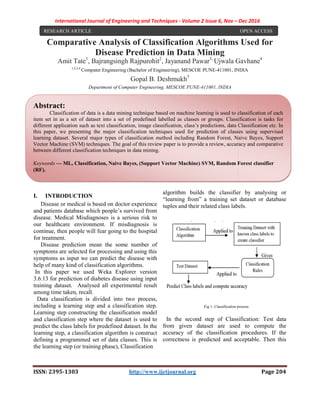
algorithm builds the classifier by analysing or
“learning from” a training set dataset or
tuples and their related class labels.
Fig 1. Classification process
In the second step of Classifi
from given dataset are used to com
accuracy of the classification procedures. If the
correctness is predicted and ac
Classification of data is a data mining technique based on machine learning is used to classification of each
item set in as a set of dataset into a set of predefined labelled as classes or groups. Classification is tasks for
different application such as text classification, image classification, class’s predictions, data Classification etc. In
this paper, we presenting the major classification techniques used for prediction of classes using supervised
learning dataset. Several major types of classification method including Random Forest, Naive
Vector Machine (SVM) techniques. The goal of this review paper is to provide a review, accuracy and comparative
between different classification techniques in data mining.
ML, Classification, Naive Bayes, (Support Vector Machine) SVM, Random Forest classifier
Dec 2016
Page 204
lgorithms Used for
Ujwala Gavhane4
411001, INDIA
er by analysing or
“learning from” a training set dataset or database
tuples and their related class labels.
Classification process
Classification: Test data
are used to compute the
cation procedures. If the
and acceptable. Then this
OPEN ACCESS
technique based on machine learning is used to classification of each
item set in as a set of dataset into a set of predefined labelled as classes or groups. Classification is tasks for
n, class’s predictions, data Classification etc. In
this paper, we presenting the major classification techniques used for prediction of classes using supervised
learning dataset. Several major types of classification method including Random Forest, Naive Bayes, Support
Vector Machine (SVM) techniques. The goal of this review paper is to provide a review, accuracy and comparative
, Random Forest classifier
International Journal of Engineering and Techniques - Volume 2 Issue 6, Nov – Dec 2016
ISSN: 2395-1303 http://www.ijetjournal.org Page 205
procedures can be applied to the classification of
new dataset in databases. [9]
In the classification process classification
algorithms is directly applied to training dataset
with known class labels. Those classification
algorithms gives the classification rules and rules
are applied to test dataset. Finally, Class labels and
compute accuracy will predicted.
II. RELATED WORK
Disease prediction using Random Forest is very
easy to implement. Powerful algorithms for
classification and regression.
Author described in this paper major kinds of
algorithms such as Support Vector Machine, K-
nearest neighbour and Neural network.[1]
Comparative study of algorithms used for
classification in web usage mining described in this
paper. Pattern discovery and analysis is identified in
Web usage mining using classification algorithms.
[2]
In this paper author proposed dynamic
characterization for disease diagnosis using
ensemble classifier. In this paper author proved
how Random Forest algorithms is powerful and
best for classification. [3]
This paper involve survey of text mining
using classification techniques and also proposed
experimental result with error rate of classification
for given dataset. [4]
Author introduced supervised machine
learning techniques and analysed experimental
result of accuracy. Tree based algorithm is best as
compare to other classification is proved by author.
[7]
Survey and future research work for random
forest classifier. Author mentioned improvement
required for Random Forest algorithm based on
their performance. [8]
This author introduced survey on kinds of
machine learning techniques in data mining. Paper
include decision tree based algorithm and
comparison among the classification techniques.
[10]
Author proposed random forest algorithm in
cloud environment for big data. Different
Algorithms is optimized using dimension reduction
and weighted vote approach. [11]
In this paper author described comparative
study of classification algorithm. Classification
algorithms used for rainfall forecasting and
predicted result in form of features. [13]
Disease diagnosis system is proposed using random
forest algorithm with help of dynamic
characterization. Medical images used for
classification as input training dataset, then
accuracy, precision and recall is computed and
result is predicted. [14]
This author introduced prediction for heart disease
using data mining classification algorithms. In this
paper author described Random Forest algorithm
used for heart disease prediction. [15]
III. MACHINE LEARNING
Machine learning indicates how computers
can learn or improve their performance using data.
Computer programs to automatically learn to
identify patterns and make intelligent based
decisions on data. Machine learning is a fast-
growing discipline. Here, we illustrate classic
problems in machine learning that are highly related
to data mining. [9]
Fig 2. Classification of Machine Learning concepts
There are three main types of machine learning
concept as following:
International Journal of Engineering and Techniques - Volume 2 Issue 6, Nov – Dec 2016
ISSN: 2395-1303 http://www.ijetjournal.org Page 206
A. Supervised learning: Supervised learning consist of
all data is labelled and algorithm learn to predict the
output from training dataset.
E.g.: Support Vector Machine (SVM), Random
Forest, Naive Bayes. [9]
B. Unsupervised learning: Unsupervised learning is
used for clustering based algorithm. In this learning
all the data is unlabelled and algorithm learn to
essential structure from the input dataset. We can
use clustering to discover classes within the dataset.
E.g. K-means, KNN. Neural Networks [9]
C. Semi-supervised: Semi-supervised learning is a
combination of supervised learning and
unsupervised learning. In Semi-supervised learning
some data is labelled and some data is not labelled.
In this approach, labelled training dataset are used
to learn class models and unlabelled training dataset
are used to define the boundaries between classes.
[9]
VI. CLASSIFICATION ALGORITHMS
A. Support Vector Machine (SVM):
SVM is one of the technique from
supervised learning based algorithm which is used
for classification and regression analysis. This
algorithm is used for classification using training
dataset. In Support vector Machine algorithm, it
will design each data item set as a point in n-
dimensional space. In this space n is used for
number of features in] training dataset and with the
value of each feature being the value of a specific
coordinate. [6]
Then, we achieve classification by finding
and constructing the hyper-plane on dataset
that divides the dataset into two classes. Support
Vectors are basically the co-ordinates of individual
reflection. Support Vector Machine is a border
which best segregates the two classes. [6]
This algorithm is classified into linear data
and non- linear data. Linear classification is
implemented using hyperplane. Non-linear
classification some kinds of transformation to given
training dataset and then after transformation
various methods are trying to use linear
classification for separation.
Fig 3. Support Vector Machine
There are 2 key implementations of SVM technique
that are mathematical programming and kernel
function. Hyper plane separates those data point of
different classes in a high dimensional space.
Support vector classifier (SVC) searching hyper
plane. But SVC is outlined so kernel functions are
introduced in order to non-line on decision surface.
[10].
B. Random Forest (RF):
Random Forest algorithm are an ensemble
supervised learning method which is used as
predictor of data for classification and regression.
In the classification process algorithm build a
number of decision trees at training time and
construct the class that is the mode of the classes
output by using each single trees. (Random Forests
is introduced by Leo Breiman and Adele Cutler for
an ensemble of decision trees). [5]
Random Forest algorithm is a grouping of tree
predictors where each tree based on the values of a
random vector experimented independently with the
equal distribution for all trees in the forest. The
basic principle is that a group of “weak learners”
can come together to form a “strong learner”.
Random Forests are a perfect tool for making
predictions considering they do not over fit.
Presenting the accurate kind of randomness makes
them accurate classifiers and regression. [5]
Single decision trees often have high variance or
high bias. Random Forests trying to moderate the
high variance problems and high bias by averaging
to find a natural balance between the two extremes.
International Journal of Engineering and Techniques
ISSN: 2395-1303
Considering that Random Forests have few
parameters to tune and can be used simply with
default parameter settings, they are a simple tool to
use without having a model or to produce a
reasonable model fast and efficiently. [5]
Random Forests are easy to learn and use
for both professionals and lay people
research and programming required and may be
used by folks without a strong statistical
background. Simply put, you can safely make more
accurate predictions without most basic mistakes
common to other methods.
Random Forests produces
classification for given trees. Each tree is grown as
follows:
1. If number of circumstances in the training
set is D, sample D cases at random state
replacement, from the original dataset. This sample
testing set will be the training set for inc
tree.
2. If there are input variables from training
dataset, a number is indicated such that at each
node of the tree, m variables are selected at random
available for the and the best splitting
is used to splitting the node. The value of
as constant during entire the forest growing.
3. Each tree is grown to the largest size
possible. There is no pruning
grownup tree.
The random forest algorithm is an ensemble
classifier algorithm based on the decision tree
model. It generates k different training data subsets
from an original dataset using a bootstrap sampling
approach, and then, k decision trees are built by
training these subsets. A random forest is
constructed from these decision trees. Each sample
of the testing dataset is predicted by all decision
trees, and the final classification result is returned
depending on the votes of these trees. [11] The
original training dataset is formalized as
S = {(ai, bj), i = 1, 2... D; j = 1, 2... },
Where a is a sample and b is a feature variable of
S. Namely, the original training dataset contains D
samples, and there are feature variables in each
sample.
International Journal of Engineering and Techniques - Volume 2 Issue 6, Nov –
http://www.ijetjournal.org
Considering that Random Forests have few
ne and can be used simply with
default parameter settings, they are a simple tool to
use without having a model or to produce a
reasonable model fast and efficiently. [5]
Random Forests are easy to learn and use
for both professionals and lay people - with little
research and programming required and may be
used by folks without a strong statistical
background. Simply put, you can safely make more
accurate predictions without most basic mistakes
Random Forests produces several
trees. Each tree is grown as
number of circumstances in the training data
state but with
. This sample
will be the training set for increasing the
from training
is indicated such that at each
, m variables are selected at random
ing on these
the node. The value of is used
the forest growing.
Each tree is grown to the largest size as
possible. There is no pruning an overall
The random forest algorithm is an ensemble
decision tree
model. It generates k different training data subsets
from an original dataset using a bootstrap sampling
approach, and then, k decision trees are built by
training these subsets. A random forest is finally
es. Each sample
by all decision
fication result is returned
depending on the votes of these trees. [11] The
original training dataset is formalized as
},
is a feature variable of
inal training dataset contains D
feature variables in each
Fig 4. Process of the construction of the RF algorithm
The main process of the construction of the
RF algorithm is presented in Fig.
The steps of the construction of the random forest
algorithm are as follows:
Step 1. Sampling k training subsets.
In the first step, k training data
experimented from the original training dataset S in
a bootstrap selection manner. Namely, N records
are selected from S by a random sampling and
replacement method in each sampling time. After
the current step, k training subsets are constructed
as a collection of training subsets S Train:
S Train = {S1, S2,...,Sk}.
At the same time, the records that are not to be
selected in each sampling period are composed as
an Out-Of-Bag (OOB) dataset.
In this way, k OOB sets are constructed as a
collection of SOOB:
SOOB = {OOB1, OOB2... OOBk},
Where k ≪ N, Si ∩ OOBi = ϕ and Si
To obtain the classification accuracy of each tree
model, these OOB sets are used as testing sets after
the training process. [11]
Step 2. Constructing each decision tree model.
In an RF model, each Meta decision tree is
created by a C4.5 or CART algorithm from each
training subset Si. In the growth process of each
Dec 2016
Page 207
Process of the construction of the RF algorithm
The main process of the construction of the
RF algorithm is presented in Fig. 4[11]
The steps of the construction of the random forest
Sampling k training subsets.
In the first step, k training datasets are
rom the original training dataset S in
a bootstrap selection manner. Namely, N records
are selected from S by a random sampling and
replacement method in each sampling time. After
the current step, k training subsets are constructed
ning subsets S Train:
At the same time, the records that are not to be
selected in each sampling period are composed as
In this way, k OOB sets are constructed as a
OOB2... OOBk},
and Si ∪ OOBi = S.
fication accuracy of each tree
model, these OOB sets are used as testing sets after
Constructing each decision tree model.
, each Meta decision tree is
created by a C4.5 or CART algorithm from each
training subset Si. In the growth process of each
International Journal of Engineering and Techniques - Volume 2 Issue 6, Nov – Dec 2016
ISSN: 2395-1303 http://www.ijetjournal.org Page 208
tree, m feature variables of dataset Si are randomly
selected from M variables. In each tree node’s
dividing process is done, then gain ratio of each
feature variable is computed, and the best one or
most priority node is chosen as the splitting node.
This splitting process is repeated until a leaf node is
generated. Finally, k decision trees are trained from
k training subsets in the same way. [11]
Step 3. Collecting k trees into an RF model.
The k trained trees are collected into an RF
model, which is defined in Eq. (1):
( , Θj) = ℎ ( , Θj), (j = 1,2, . . . , m),
where hi(x,Θj) is a meta decision tree classifier, X
are the input feature vectors of the training dataset,
and Θj is an independent and identically distributed
random vector that determines the growth process
of the tree. [11]
C. Naive Bayes
Naive Bayes algorithm is technique based
on Bayes Theorem used for classification with an
assumption of independence between class
predictors. Naive Bayes classification algorithm
assumes that the presence of an exact feature in a
class is dissimilar to the presence of any other
feature. [12]
Naive Bayes algorithm model is easy to
implement and useful for large datasets. Naive
Bayes is known to outclass even highly cultured
classification algorithm. [12]
Bayes theorem describes a way of
calculating posterior probability ( | ) from
P(C), P(X) and ( | ). See the following
equation.
( | )
( | ) ( )
( )
( | ) = ( | ) × ( | ) × … × ( | )
× ( )
Above,
 ( | ) is a posterior probability of class
( , target) given predictor (x, attributes).
 P(C) is called class prior probability.
 ( | ) is the likelihood which indicate
the predictor probability of given class.
 P(X) is called prior probability of the
predictor.
Following example are explaining
implementation of Naive Bayes algorithms
E.g. Weather dataset having attributes Weather-
Sunny, Overcast, and Rainy. Using training dataset
Naïve Bayes algorithms will predict the value as
you can play or not.
Table 1. Training dataset of Weather
Weather Play
Sunny Yes
Overcast Yes
Overcast Yes
Sunny No
Rainy No
Sunny No
Overcast Yes
Sunny Yes
Overcast Yes
Rainy No
Sunny Yes
Rainy Yes
Overcast Yes
Rainy Yes
Rainy No
Sunny Yes
Overcast Yes
Table 2. Frequency data of Weather
Frequency Table
Weather 
Play
Yes No
Rainy 3 2
Sunny 4 2
Overcast 6 0
Total 13 4
International Journal of Engineering and Techniques - Volume 2 Issue 6, Nov – Dec 2016
ISSN: 2395-1303 http://www.ijetjournal.org Page 209
Now, using Naive Bayesian equation we can
compute the posterior probability for each class.
The class which has highest posterior probability is
the result of prediction.
P (Yes | Sunny) = P (Sunny | Yes) * P (Yes) / P
(Sunny)
Here we have P (Sunny |Yes) = 4/13 = 0.30, P
(Sunny) = 6/17 = 0.35, P (Yes) = 13/17 = 0.76
Now, P (Yes | Sunny) = 0.30 * 0.76 / 0.35 = 0.65,
which has higher probability.
V. ADVANTAGES AND APPLICATION AREA OF
ALGORITHMS: [7]
Table 1. Advantages and application of
classification algorithms
Algorith
ms
Advantages Applicatio
n area
Naive
Bayes
Ability to interpret
problem in terms of
structural
relationship among
predictors, takes less
computational time
for training, no free
parameters to be set
Document
classificati
on,
medical
diagnostic
systems
Random
forest
Fast, scalable, robust
to noise, does not
over fit, offer
explanation and
visualization of its
output without any
parameters to worry
about
To find
cluster of
patients.
Classificati
on of
microarray
data,
object
detection
Support
Vector
Machine
(SVM)
High accuracy, avoid
over fitting, flexible
selection of kernels
for nonlinearity,
accuracy and
performance are
independent of
number of features,
good generalization
ability
Text
Classificati
on
6. ANALYSIS OF ALGORITHMS
We have classified Diabetes demo of dataset using
Weka Explorer version 3.6.13 and we have seen the
following results:
Fig 5. Detailed analysis of Support Vector Machine algorithm
Fig 6. Detailed analysis of Naïve Bayes algorithm
Fig 7. Detailed analysis of Random Forest
0
0.2
0.4
0.6
0.8
1
Detailed Analysis By SVM(Support Vector Machine)
Weighted Avg.
0
0.2
0.4
0.6
0.8
1
Detailed Analysis By Naive Bayes
Weighted Avg.
0
0.2
0.4
0.6
0.8
1
Detailed Analysis By Random
Forest
Weighted Avg.
International Journal of Engineering and Techniques - Volume 2 Issue 6, Nov – Dec 2016
ISSN: 2395-1303 http://www.ijetjournal.org Page 210
Fig 8. Time taken by algorithms in seconds
Fig 9. Comparison for Recall
Fig 10. Comparison for Precision
VI. CONCLUSION
This paper presents a comparative study on the
performance of various classifiers of data mining
over high dimensional data. We observe that
Random Forest algorithm performed well with
respect to all the factors. Different classification
algorithms gives different result on base of
accuracy, training time, precision, recall. In future
work, different data mining techniques can be used
with Random Forest classification algorithm to
improve performance and high accuracy.
REFERENCES
1. Patel Pinky S, Raksha R. Patel, Ankita J. Patel, Maitri
Joshi “Review on Classification Algorithms in Data
Mining” (ISSN 2250-2459, ISO 9001:2008 Certified
Journal, Volume 5, Issue 1, January 2015)
2. . Supreet Dhillon, Kamaljit Kaur “Comparative Study of
Classification Algorithms for Web Usage Mining”,
Volume 4, Issue 7, July 2014 ISSN: 2277 128X
International Journal of Advanced Research in Computer
Science and Software Engineering.
3. Sarika Pachange, Bela Joglekar “An Approach for
Dynamic Characterization of Ensemble classifier for
Disease Diagnosis”.
4. S.Brindha, Dr.K.Prabha, Dr.S.Sukumaran, “A SURVEY
ON CLASSIFICATION TECHNIQUES FOR TEXT
MINING”. 2016 3rd International Conference on
Advanced Computing and Communication Systems.
5. http://www.datasciencecentral.com/profiles/blogs/random-
forests-algorithm.
6. . https://www.analyticsvidhya.com/blog/2015
7. Amanpreet Singh, Narina Thakur, Aakanksha Sharma, “A
Review of Supervised Machine Learning Algorithms”
2016 International Conference on Computing for
Sustainable Global Development.
8. Vrushali Y Kulkarni, Dr Pradeep K Sinha. “Random
Forest Classifiers: A Survey and Future Research
Directions”. International Journal of Advanced
Computing, ISSN: 2051-0845, Vol.36, Issue.
9. Jiawei Han (Author), Micheline Kamber (Author), Jian
Pei Professor (Author). “Data Mining: Concepts and
Techniques”
0
0.005
0.01
0.015
0.02
0.025
Naïve Bayes Random Forest SVM
Time Taken
Time Taken
0.735
0.74
0.745
0.75
0.755
0.76
0.765
0.77
0.775
Naïve Bayes Random
Forest
SVM
Recall
Recall
0.75
0.755
0.76
0.765
0.77
0.775
0.78
Naïve Bayes Random
Forest
SVM
Precision
Precision
International Journal of Engineering and Techniques - Volume 2 Issue 6, Nov – Dec 2016
ISSN: 2395-1303 http://www.ijetjournal.org Page 211
10. “Machine Learning Techniques for Data Mining: A
Survey” by Seema Sharma, Jitendra Agrawal, Shikha
Agarwal, Sanjeev Sharma.
11. Jianguo Chen, Kenli Li, Senior Member, IEEE, Zhuo
Tang, Member, IEEE, Kashif Bilal, Shui Yu, Member,
IEEE, Chuliang Weng, Member, IEEE, and Keqin Li,
Fellow, IEEE “A Parallel Random Forest Algorithm for
Big Data in a Spark Cloud Computing Environment”.
12. https://www.analyticsvidhya.com/blog/2015/09/naive-
bayes-explained/.
13. Deepti Gupta, Udayan Ghose “A Comparative Study of
Classification Algorithms for Forecasting Rainfall”.
14. Mohammed E. El-Telbany, Mahmoud Warda“An
Empirical Comparison of Tree-Based Learning
Algorithms: An Egyptian Rice Diseases Classification
Case Study”
15. Ankur Makwana, Jaymin Patel “Decision Support System
for Heart Disease Prediction using Data Mining
Classification Techniques” International Journal of
Computer Applications (0975 8887) Volume 117 - No. 22,
May 2015.

IJET-V2I6P32

  • 1.
    International Journal ofEngineering and Techniques ISSN: 2395-1303 Comparative Analysis of Disease P Amit Tate1 , Bajrangsingh 1,2,3,4 Computer Engineering (Bachelor of Engineering), MESCOE PUNE Department of Computer Engineering I. INTRODUCTION Disease or medical is based on doctor experience and patients database which people’s survived from disease. Medical Misdiagnoses is a serious risk to our healthcare environment. If misdiagnosis is continue, then people will fear going to the hospital for treatment. Disease prediction mean the some number of symptoms are selected for processing and using this symptoms as input we can predict the disease with help of many kind of classification algorithms. In this paper we used Weka Explorer version 3.6.13 for prediction of diabetes disease using input training dataset. Analysed all experimental result among time taken, recall. Data classification is divided into two including a learning step and a classifi Learning step constructing the classification model and classification step where the dataset is used to predict the class labels for predefined dataset. In th learning step, a classification algorithm defining a programmed set of data classes. This is the learning step (or training phase), Classifi RESEARCH ARTICLE Abstract: Classification of data is a data mining item set in as a set of dataset into a set of predefined labelled as classes or groups. Classification is tasks for different application such as text classification, image classificatio this paper, we presenting the major classification techniques used for prediction of classes using supervised learning dataset. Several major types of classification method including Random Forest, Naive Vector Machine (SVM) techniques. The goal of this review paper is to provide a review, accuracy and comparative between different classification techniques in data mining. Keywords — ML, Classification, Naive Bayes, (Support Vector Machine) (RF). International Journal of Engineering and Techniques - Volume 2 Issue 6, Nov – http://www.ijetjournal.org nalysis of Classification Algorithms Prediction in Data Mining , Bajrangsingh Rajpurohit2 , Jayanand Pawar3, Ujwala Gavhane Computer Engineering (Bachelor of Engineering), MESCOE PUNE-411001, INDIA Gopal B. Deshmukh5 Department of Computer Engineering, MESCOE PUNE-411001, INDIA Disease or medical is based on doctor experience and patients database which people’s survived from a serious risk to misdiagnosis is continue, then people will fear going to the hospital Disease prediction mean the some number of symptoms are selected for processing and using this predict the disease with help of many kind of classification algorithms. Weka Explorer version for prediction of diabetes disease using input training dataset. Analysed all experimental result cation is divided into two process, g a learning step and a classification step. constructing the classification model and classification step where the dataset is used to class labels for predefined dataset. In the cation algorithm is construct defining a programmed set of data classes. This is Classification algorithm builds the classifier by analysing or “learning from” a training set dataset or tuples and their related class labels. Fig 1. Classification process In the second step of Classifi from given dataset are used to com accuracy of the classification procedures. If the correctness is predicted and ac Classification of data is a data mining technique based on machine learning is used to classification of each item set in as a set of dataset into a set of predefined labelled as classes or groups. Classification is tasks for different application such as text classification, image classification, class’s predictions, data Classification etc. In this paper, we presenting the major classification techniques used for prediction of classes using supervised learning dataset. Several major types of classification method including Random Forest, Naive Vector Machine (SVM) techniques. The goal of this review paper is to provide a review, accuracy and comparative between different classification techniques in data mining. ML, Classification, Naive Bayes, (Support Vector Machine) SVM, Random Forest classifier Dec 2016 Page 204 lgorithms Used for Ujwala Gavhane4 411001, INDIA er by analysing or “learning from” a training set dataset or database tuples and their related class labels. Classification process Classification: Test data are used to compute the cation procedures. If the and acceptable. Then this OPEN ACCESS technique based on machine learning is used to classification of each item set in as a set of dataset into a set of predefined labelled as classes or groups. Classification is tasks for n, class’s predictions, data Classification etc. In this paper, we presenting the major classification techniques used for prediction of classes using supervised learning dataset. Several major types of classification method including Random Forest, Naive Bayes, Support Vector Machine (SVM) techniques. The goal of this review paper is to provide a review, accuracy and comparative , Random Forest classifier
  • 2.
    International Journal ofEngineering and Techniques - Volume 2 Issue 6, Nov – Dec 2016 ISSN: 2395-1303 http://www.ijetjournal.org Page 205 procedures can be applied to the classification of new dataset in databases. [9] In the classification process classification algorithms is directly applied to training dataset with known class labels. Those classification algorithms gives the classification rules and rules are applied to test dataset. Finally, Class labels and compute accuracy will predicted. II. RELATED WORK Disease prediction using Random Forest is very easy to implement. Powerful algorithms for classification and regression. Author described in this paper major kinds of algorithms such as Support Vector Machine, K- nearest neighbour and Neural network.[1] Comparative study of algorithms used for classification in web usage mining described in this paper. Pattern discovery and analysis is identified in Web usage mining using classification algorithms. [2] In this paper author proposed dynamic characterization for disease diagnosis using ensemble classifier. In this paper author proved how Random Forest algorithms is powerful and best for classification. [3] This paper involve survey of text mining using classification techniques and also proposed experimental result with error rate of classification for given dataset. [4] Author introduced supervised machine learning techniques and analysed experimental result of accuracy. Tree based algorithm is best as compare to other classification is proved by author. [7] Survey and future research work for random forest classifier. Author mentioned improvement required for Random Forest algorithm based on their performance. [8] This author introduced survey on kinds of machine learning techniques in data mining. Paper include decision tree based algorithm and comparison among the classification techniques. [10] Author proposed random forest algorithm in cloud environment for big data. Different Algorithms is optimized using dimension reduction and weighted vote approach. [11] In this paper author described comparative study of classification algorithm. Classification algorithms used for rainfall forecasting and predicted result in form of features. [13] Disease diagnosis system is proposed using random forest algorithm with help of dynamic characterization. Medical images used for classification as input training dataset, then accuracy, precision and recall is computed and result is predicted. [14] This author introduced prediction for heart disease using data mining classification algorithms. In this paper author described Random Forest algorithm used for heart disease prediction. [15] III. MACHINE LEARNING Machine learning indicates how computers can learn or improve their performance using data. Computer programs to automatically learn to identify patterns and make intelligent based decisions on data. Machine learning is a fast- growing discipline. Here, we illustrate classic problems in machine learning that are highly related to data mining. [9] Fig 2. Classification of Machine Learning concepts There are three main types of machine learning concept as following:
  • 3.
    International Journal ofEngineering and Techniques - Volume 2 Issue 6, Nov – Dec 2016 ISSN: 2395-1303 http://www.ijetjournal.org Page 206 A. Supervised learning: Supervised learning consist of all data is labelled and algorithm learn to predict the output from training dataset. E.g.: Support Vector Machine (SVM), Random Forest, Naive Bayes. [9] B. Unsupervised learning: Unsupervised learning is used for clustering based algorithm. In this learning all the data is unlabelled and algorithm learn to essential structure from the input dataset. We can use clustering to discover classes within the dataset. E.g. K-means, KNN. Neural Networks [9] C. Semi-supervised: Semi-supervised learning is a combination of supervised learning and unsupervised learning. In Semi-supervised learning some data is labelled and some data is not labelled. In this approach, labelled training dataset are used to learn class models and unlabelled training dataset are used to define the boundaries between classes. [9] VI. CLASSIFICATION ALGORITHMS A. Support Vector Machine (SVM): SVM is one of the technique from supervised learning based algorithm which is used for classification and regression analysis. This algorithm is used for classification using training dataset. In Support vector Machine algorithm, it will design each data item set as a point in n- dimensional space. In this space n is used for number of features in] training dataset and with the value of each feature being the value of a specific coordinate. [6] Then, we achieve classification by finding and constructing the hyper-plane on dataset that divides the dataset into two classes. Support Vectors are basically the co-ordinates of individual reflection. Support Vector Machine is a border which best segregates the two classes. [6] This algorithm is classified into linear data and non- linear data. Linear classification is implemented using hyperplane. Non-linear classification some kinds of transformation to given training dataset and then after transformation various methods are trying to use linear classification for separation. Fig 3. Support Vector Machine There are 2 key implementations of SVM technique that are mathematical programming and kernel function. Hyper plane separates those data point of different classes in a high dimensional space. Support vector classifier (SVC) searching hyper plane. But SVC is outlined so kernel functions are introduced in order to non-line on decision surface. [10]. B. Random Forest (RF): Random Forest algorithm are an ensemble supervised learning method which is used as predictor of data for classification and regression. In the classification process algorithm build a number of decision trees at training time and construct the class that is the mode of the classes output by using each single trees. (Random Forests is introduced by Leo Breiman and Adele Cutler for an ensemble of decision trees). [5] Random Forest algorithm is a grouping of tree predictors where each tree based on the values of a random vector experimented independently with the equal distribution for all trees in the forest. The basic principle is that a group of “weak learners” can come together to form a “strong learner”. Random Forests are a perfect tool for making predictions considering they do not over fit. Presenting the accurate kind of randomness makes them accurate classifiers and regression. [5] Single decision trees often have high variance or high bias. Random Forests trying to moderate the high variance problems and high bias by averaging to find a natural balance between the two extremes.
  • 4.
    International Journal ofEngineering and Techniques ISSN: 2395-1303 Considering that Random Forests have few parameters to tune and can be used simply with default parameter settings, they are a simple tool to use without having a model or to produce a reasonable model fast and efficiently. [5] Random Forests are easy to learn and use for both professionals and lay people research and programming required and may be used by folks without a strong statistical background. Simply put, you can safely make more accurate predictions without most basic mistakes common to other methods. Random Forests produces classification for given trees. Each tree is grown as follows: 1. If number of circumstances in the training set is D, sample D cases at random state replacement, from the original dataset. This sample testing set will be the training set for inc tree. 2. If there are input variables from training dataset, a number is indicated such that at each node of the tree, m variables are selected at random available for the and the best splitting is used to splitting the node. The value of as constant during entire the forest growing. 3. Each tree is grown to the largest size possible. There is no pruning grownup tree. The random forest algorithm is an ensemble classifier algorithm based on the decision tree model. It generates k different training data subsets from an original dataset using a bootstrap sampling approach, and then, k decision trees are built by training these subsets. A random forest is constructed from these decision trees. Each sample of the testing dataset is predicted by all decision trees, and the final classification result is returned depending on the votes of these trees. [11] The original training dataset is formalized as S = {(ai, bj), i = 1, 2... D; j = 1, 2... }, Where a is a sample and b is a feature variable of S. Namely, the original training dataset contains D samples, and there are feature variables in each sample. International Journal of Engineering and Techniques - Volume 2 Issue 6, Nov – http://www.ijetjournal.org Considering that Random Forests have few ne and can be used simply with default parameter settings, they are a simple tool to use without having a model or to produce a reasonable model fast and efficiently. [5] Random Forests are easy to learn and use for both professionals and lay people - with little research and programming required and may be used by folks without a strong statistical background. Simply put, you can safely make more accurate predictions without most basic mistakes Random Forests produces several trees. Each tree is grown as number of circumstances in the training data state but with . This sample will be the training set for increasing the from training is indicated such that at each , m variables are selected at random ing on these the node. The value of is used the forest growing. Each tree is grown to the largest size as possible. There is no pruning an overall The random forest algorithm is an ensemble decision tree model. It generates k different training data subsets from an original dataset using a bootstrap sampling approach, and then, k decision trees are built by training these subsets. A random forest is finally es. Each sample by all decision fication result is returned depending on the votes of these trees. [11] The original training dataset is formalized as }, is a feature variable of inal training dataset contains D feature variables in each Fig 4. Process of the construction of the RF algorithm The main process of the construction of the RF algorithm is presented in Fig. The steps of the construction of the random forest algorithm are as follows: Step 1. Sampling k training subsets. In the first step, k training data experimented from the original training dataset S in a bootstrap selection manner. Namely, N records are selected from S by a random sampling and replacement method in each sampling time. After the current step, k training subsets are constructed as a collection of training subsets S Train: S Train = {S1, S2,...,Sk}. At the same time, the records that are not to be selected in each sampling period are composed as an Out-Of-Bag (OOB) dataset. In this way, k OOB sets are constructed as a collection of SOOB: SOOB = {OOB1, OOB2... OOBk}, Where k ≪ N, Si ∩ OOBi = ϕ and Si To obtain the classification accuracy of each tree model, these OOB sets are used as testing sets after the training process. [11] Step 2. Constructing each decision tree model. In an RF model, each Meta decision tree is created by a C4.5 or CART algorithm from each training subset Si. In the growth process of each Dec 2016 Page 207 Process of the construction of the RF algorithm The main process of the construction of the RF algorithm is presented in Fig. 4[11] The steps of the construction of the random forest Sampling k training subsets. In the first step, k training datasets are rom the original training dataset S in a bootstrap selection manner. Namely, N records are selected from S by a random sampling and replacement method in each sampling time. After the current step, k training subsets are constructed ning subsets S Train: At the same time, the records that are not to be selected in each sampling period are composed as In this way, k OOB sets are constructed as a OOB2... OOBk}, and Si ∪ OOBi = S. fication accuracy of each tree model, these OOB sets are used as testing sets after Constructing each decision tree model. , each Meta decision tree is created by a C4.5 or CART algorithm from each training subset Si. In the growth process of each
  • 5.
    International Journal ofEngineering and Techniques - Volume 2 Issue 6, Nov – Dec 2016 ISSN: 2395-1303 http://www.ijetjournal.org Page 208 tree, m feature variables of dataset Si are randomly selected from M variables. In each tree node’s dividing process is done, then gain ratio of each feature variable is computed, and the best one or most priority node is chosen as the splitting node. This splitting process is repeated until a leaf node is generated. Finally, k decision trees are trained from k training subsets in the same way. [11] Step 3. Collecting k trees into an RF model. The k trained trees are collected into an RF model, which is defined in Eq. (1): ( , Θj) = ℎ ( , Θj), (j = 1,2, . . . , m), where hi(x,Θj) is a meta decision tree classifier, X are the input feature vectors of the training dataset, and Θj is an independent and identically distributed random vector that determines the growth process of the tree. [11] C. Naive Bayes Naive Bayes algorithm is technique based on Bayes Theorem used for classification with an assumption of independence between class predictors. Naive Bayes classification algorithm assumes that the presence of an exact feature in a class is dissimilar to the presence of any other feature. [12] Naive Bayes algorithm model is easy to implement and useful for large datasets. Naive Bayes is known to outclass even highly cultured classification algorithm. [12] Bayes theorem describes a way of calculating posterior probability ( | ) from P(C), P(X) and ( | ). See the following equation. ( | ) ( | ) ( ) ( ) ( | ) = ( | ) × ( | ) × … × ( | ) × ( ) Above,  ( | ) is a posterior probability of class ( , target) given predictor (x, attributes).  P(C) is called class prior probability.  ( | ) is the likelihood which indicate the predictor probability of given class.  P(X) is called prior probability of the predictor. Following example are explaining implementation of Naive Bayes algorithms E.g. Weather dataset having attributes Weather- Sunny, Overcast, and Rainy. Using training dataset Naïve Bayes algorithms will predict the value as you can play or not. Table 1. Training dataset of Weather Weather Play Sunny Yes Overcast Yes Overcast Yes Sunny No Rainy No Sunny No Overcast Yes Sunny Yes Overcast Yes Rainy No Sunny Yes Rainy Yes Overcast Yes Rainy Yes Rainy No Sunny Yes Overcast Yes Table 2. Frequency data of Weather Frequency Table Weather Play Yes No Rainy 3 2 Sunny 4 2 Overcast 6 0 Total 13 4
  • 6.
    International Journal ofEngineering and Techniques - Volume 2 Issue 6, Nov – Dec 2016 ISSN: 2395-1303 http://www.ijetjournal.org Page 209 Now, using Naive Bayesian equation we can compute the posterior probability for each class. The class which has highest posterior probability is the result of prediction. P (Yes | Sunny) = P (Sunny | Yes) * P (Yes) / P (Sunny) Here we have P (Sunny |Yes) = 4/13 = 0.30, P (Sunny) = 6/17 = 0.35, P (Yes) = 13/17 = 0.76 Now, P (Yes | Sunny) = 0.30 * 0.76 / 0.35 = 0.65, which has higher probability. V. ADVANTAGES AND APPLICATION AREA OF ALGORITHMS: [7] Table 1. Advantages and application of classification algorithms Algorith ms Advantages Applicatio n area Naive Bayes Ability to interpret problem in terms of structural relationship among predictors, takes less computational time for training, no free parameters to be set Document classificati on, medical diagnostic systems Random forest Fast, scalable, robust to noise, does not over fit, offer explanation and visualization of its output without any parameters to worry about To find cluster of patients. Classificati on of microarray data, object detection Support Vector Machine (SVM) High accuracy, avoid over fitting, flexible selection of kernels for nonlinearity, accuracy and performance are independent of number of features, good generalization ability Text Classificati on 6. ANALYSIS OF ALGORITHMS We have classified Diabetes demo of dataset using Weka Explorer version 3.6.13 and we have seen the following results: Fig 5. Detailed analysis of Support Vector Machine algorithm Fig 6. Detailed analysis of Naïve Bayes algorithm Fig 7. Detailed analysis of Random Forest 0 0.2 0.4 0.6 0.8 1 Detailed Analysis By SVM(Support Vector Machine) Weighted Avg. 0 0.2 0.4 0.6 0.8 1 Detailed Analysis By Naive Bayes Weighted Avg. 0 0.2 0.4 0.6 0.8 1 Detailed Analysis By Random Forest Weighted Avg.
  • 7.
    International Journal ofEngineering and Techniques - Volume 2 Issue 6, Nov – Dec 2016 ISSN: 2395-1303 http://www.ijetjournal.org Page 210 Fig 8. Time taken by algorithms in seconds Fig 9. Comparison for Recall Fig 10. Comparison for Precision VI. CONCLUSION This paper presents a comparative study on the performance of various classifiers of data mining over high dimensional data. We observe that Random Forest algorithm performed well with respect to all the factors. Different classification algorithms gives different result on base of accuracy, training time, precision, recall. In future work, different data mining techniques can be used with Random Forest classification algorithm to improve performance and high accuracy. REFERENCES 1. Patel Pinky S, Raksha R. Patel, Ankita J. Patel, Maitri Joshi “Review on Classification Algorithms in Data Mining” (ISSN 2250-2459, ISO 9001:2008 Certified Journal, Volume 5, Issue 1, January 2015) 2. . Supreet Dhillon, Kamaljit Kaur “Comparative Study of Classification Algorithms for Web Usage Mining”, Volume 4, Issue 7, July 2014 ISSN: 2277 128X International Journal of Advanced Research in Computer Science and Software Engineering. 3. Sarika Pachange, Bela Joglekar “An Approach for Dynamic Characterization of Ensemble classifier for Disease Diagnosis”. 4. S.Brindha, Dr.K.Prabha, Dr.S.Sukumaran, “A SURVEY ON CLASSIFICATION TECHNIQUES FOR TEXT MINING”. 2016 3rd International Conference on Advanced Computing and Communication Systems. 5. http://www.datasciencecentral.com/profiles/blogs/random- forests-algorithm. 6. . https://www.analyticsvidhya.com/blog/2015 7. Amanpreet Singh, Narina Thakur, Aakanksha Sharma, “A Review of Supervised Machine Learning Algorithms” 2016 International Conference on Computing for Sustainable Global Development. 8. Vrushali Y Kulkarni, Dr Pradeep K Sinha. “Random Forest Classifiers: A Survey and Future Research Directions”. International Journal of Advanced Computing, ISSN: 2051-0845, Vol.36, Issue. 9. Jiawei Han (Author), Micheline Kamber (Author), Jian Pei Professor (Author). “Data Mining: Concepts and Techniques” 0 0.005 0.01 0.015 0.02 0.025 Naïve Bayes Random Forest SVM Time Taken Time Taken 0.735 0.74 0.745 0.75 0.755 0.76 0.765 0.77 0.775 Naïve Bayes Random Forest SVM Recall Recall 0.75 0.755 0.76 0.765 0.77 0.775 0.78 Naïve Bayes Random Forest SVM Precision Precision
  • 8.
    International Journal ofEngineering and Techniques - Volume 2 Issue 6, Nov – Dec 2016 ISSN: 2395-1303 http://www.ijetjournal.org Page 211 10. “Machine Learning Techniques for Data Mining: A Survey” by Seema Sharma, Jitendra Agrawal, Shikha Agarwal, Sanjeev Sharma. 11. Jianguo Chen, Kenli Li, Senior Member, IEEE, Zhuo Tang, Member, IEEE, Kashif Bilal, Shui Yu, Member, IEEE, Chuliang Weng, Member, IEEE, and Keqin Li, Fellow, IEEE “A Parallel Random Forest Algorithm for Big Data in a Spark Cloud Computing Environment”. 12. https://www.analyticsvidhya.com/blog/2015/09/naive- bayes-explained/. 13. Deepti Gupta, Udayan Ghose “A Comparative Study of Classification Algorithms for Forecasting Rainfall”. 14. Mohammed E. El-Telbany, Mahmoud Warda“An Empirical Comparison of Tree-Based Learning Algorithms: An Egyptian Rice Diseases Classification Case Study” 15. Ankur Makwana, Jaymin Patel “Decision Support System for Heart Disease Prediction using Data Mining Classification Techniques” International Journal of Computer Applications (0975 8887) Volume 117 - No. 22, May 2015.